My Wife Is Dying, and Our Children Keep Asking Questions That I’m Not Emotionally Prepared to Answer
I never imagined that the hardest part of my life would be trying to explain to my children that their mother might not be with us forever. I am a 38-year-old man, and my wife, Emily, is 36. We have been married for eleven years, and together we have built a life filled with ordinary moments that I never realized were so precious until everything changed. We have two children, a nine-year-old daughter named Lily and a six-year-old son named Noah. Before my wife became seriously ill, our biggest worries involved school assignments, weekend activities, household bills, and deciding what to cook for dinner. I used to complain about being exhausted after work or having too many responsibilities to handle. Now, I would give anything to return to those days, even for a single afternoon.
Everything changed when Emily started experiencing unusual symptoms that she initially dismissed as stress and exhaustion. She had always been the kind of person who put everyone else’s needs before her own, so she continued working, taking care of the children, and managing our home even when she clearly wasn’t feeling well. Eventually, the symptoms became impossible to ignore, and after several medical appointments and tests, we received the news that changed our lives forever. Emily had an aggressive form of cancer, and although her doctors discussed treatment options, they eventually explained that her condition was advanced and the chances of recovery were very limited. I remember sitting beside her in the hospital room, holding her hand while the doctor spoke. I could hear every word, but my mind refused to accept what I was hearing. The woman I loved, the mother of my children, and the person I had imagined growing old beside was facing something neither of us knew how to handle.
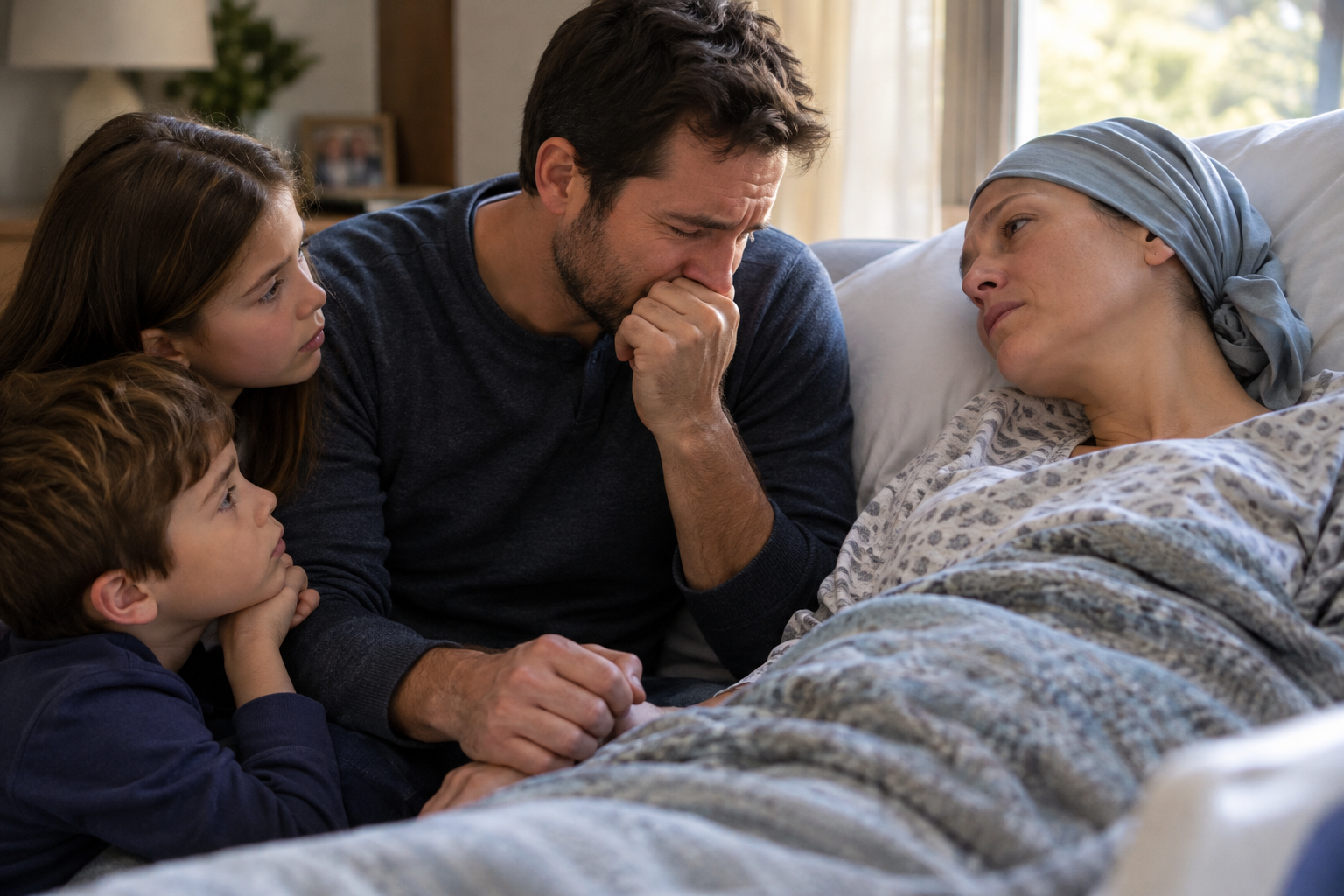
When we finally returned home, we agreed that we needed to tell the children the truth in a way they could understand. Emily wanted to be the one to explain what was happening, but she was so overwhelmed that she could barely get through the first few sentences without crying. I sat beside her on the couch while Lily and Noah listened quietly. We explained that Mommy was very sick, that the doctors were trying to help her, and that some illnesses were much harder to treat than others. We tried to reassure them that none of this was their fault and that they could ask us anything they wanted. Lily immediately began asking whether her mother would lose her hair and whether she would still be able to attend her school performance. Noah, who was sitting close to Emily, simply asked whether she would still read him bedtime stories. Emily hugged him and promised to do so for as long as she could. I smiled for the children’s sake, but inside, I felt as though my entire world was collapsing.
The questions became harder as the weeks passed. Lily started researching cancer on her school tablet, and I eventually discovered that she had been reading about people who died from the same disease. One evening, while I was helping her get ready for bed, she looked directly at me and asked, “Daddy, is Mommy going to die?” I froze. I had prepared myself for difficult conversations, but nothing could have prepared me for hearing those words from my little girl. My first instinct was to tell her that everything would be fine, that her mother would recover, and that we would all be together for many more years. I desperately wanted to give her that comfort, but I knew I couldn’t promise something I didn’t believe was possible. Instead, I sat beside her, held her hand, and explained that Mommy’s illness was very serious and that the doctors were worried they might not be able to make her better. Lily started crying and asked why this had to happen to our family. I had no answer. I pulled her into my arms and cried with her, something I had been trying very hard not to do in front of the children.
Noah’s questions were different, but they somehow hurt just as much. At six years old, he didn’t fully understand what cancer meant, and he seemed to believe that if he behaved well enough, his mother would eventually get better. He began cleaning his room without being asked, finishing his meals, and repeatedly telling Emily that he would never misbehave again. One afternoon, he approached me while I was washing dishes and asked whether Mommy would recover if he stopped arguing with his sister. I immediately turned off the water, knelt beside him, and told him that his mother’s illness had absolutely nothing to do with his behavior. I explained that he could be the most wonderful little boy in the world and still wouldn’t be able to control what was happening to her body. He listened quietly before asking whether he could give her some of his energy so she wouldn’t feel tired anymore. I had to turn away for a moment because I couldn’t bear the thought of him believing he was somehow responsible for saving his mother. I hugged him tightly and told him that loving her, spending time with her, and being himself were already wonderful gifts.
As Emily’s condition worsened, our entire household began to revolve around medical appointments, medication schedules, and the unpredictable nature of her good and bad days. Some mornings, she felt well enough to sit at the breakfast table with the children, laugh at their stories, and help Lily with her homework. On other days, she barely had enough strength to get out of bed. Those difficult days were especially painful because the children struggled to understand why Mommy could play with them one afternoon but couldn’t even sit up the next morning. I tried to maintain some sense of normality by preparing their lunches, taking them to school, and making sure their routines continued as much as possible. At night, after they went to sleep, I would sit beside Emily and tell her how the children were doing. Sometimes we talked about their future, the memories we wanted them to keep, and the things we still hoped to do together. Other times, neither of us said anything. I would simply hold her hand and listen to her breathing, terrified that one day I might wake up and discover that the person beside me was gone.
The most difficult moment came when Lily asked whether her mother would be present at her tenth birthday. Her birthday was only a few months away, and she had already started planning the cake, decorations, and games she wanted to play with her friends. She asked the question while Emily was resting in the bedroom, completely unaware that her innocent words had left me struggling to breathe. I told her that I hoped Mommy would be there, but that we couldn’t know for certain what would happen. Lily looked down at her hands and said that she didn’t want presents anymore; she just wanted her mother to stay alive. I sat beside her and tried to explain that it was okay to feel angry, frightened, confused, or sad. I told her she never had to pretend to be happy just to protect me or her mother. Then she asked another question that I still struggle to forget: “If Mommy dies, will you forget her too?” I promised her that I would never stop loving Emily and that we would continue talking about her, remembering her stories, and celebrating the wonderful person she was. I wanted my daughter to understand that even if we couldn’t control how much time we had left with someone, we could still hold on to the love and memories they gave us.
Since then, I have started realizing that I cannot protect my children from every painful truth, no matter how desperately I want to. My instinct as their father is to shield them from heartbreak, but pretending that everything will be fine would only leave them more confused and frightened. I have spoken with Emily about how we want to support them, and we are trying to create small memories they can carry with them. We take photographs together, record Emily reading their favorite bedtime stories, and encourage the children to ask questions whenever they need to. Some days, we laugh together as a family, and for a little while, our home feels almost normal. Other days, I find myself standing alone in the kitchen, wondering how I am supposed to raise two children while carrying the grief of losing my wife. I am frightened of the future, frightened of the conversations that are still waiting for me, and frightened of the day I will have to tell my children that their mother is no longer here. But when I see Emily smiling at them, even through her exhaustion, I remind myself that our children don’t need me to have every answer. They need me to be present, honest, and willing to cry with them when things become too painful.
I don’t know how much time Emily has left, and that uncertainty is something I am learning to live with one day at a time. I still catch myself imagining our future together, growing older, watching our children graduate, attending their weddings, and eventually becoming grandparents. Then reality returns, and I have to remind myself to focus on the moments we still have instead of the years we may never get. My children continue asking questions, and I know many of those questions will become even harder as they grow older and begin to understand the full meaning of what is happening. I cannot promise them that their mother will recover, and I cannot promise that losing her will ever stop hurting. What I can promise is that they will never have to face their grief alone. I will tell them how deeply their mother loved them, how hard she fought, and how much happiness she brought into our lives. Most importantly, I will make sure they know that the love we share as a family will not disappear just because our circumstances change. For now, I take Emily’s hand whenever I can, listen to our children laughing in the next room, and try to appreciate every ordinary moment we still have together. I only wish someone could tell me how to answer the next question my children ask when I am barely able to answer the questions in my own heart.
Read Story…
My Wife Is Dying, and I’m Trying to Make Every Remaining Moment Count Before I Have to Say Goodbye
I’m 41 years old, my wife is 38, and we’ve been married for 11 years. We have two beautiful boys, ages six and two, and until about 18 months ago, I never imagined that our lives could change so dramatically in such a short amount of time. Like most families, we had our share of problems, disagreements, financial worries, and stressful days.
Our marriage wasn’t perfect, and we certainly weren’t one of those couples who never argued or struggled to understand each other. However, we had built a life together, raised our children together, and shared enough memories that I honestly believed we would eventually grow old together. I thought we had decades ahead of us to work through our problems, watch our boys grow up, and figure out what the next chapter of our lives would look like.
I never considered that one of us might not be around to see those things happen.
About 18 months ago, while my wife was gradually weaning our youngest son from breastfeeding, she noticed a painful lump in her breast. At first, neither of us understood how serious it might be. We knew that unusual lumps should be checked by a doctor, but there was no immediate reason to believe that we were about to receive the kind of news that would completely destroy our sense of security.
We were already busy raising two young children, and life had a way of making everything feel urgent except the things we couldn’t see. Looking back, I wish we had been able to get her examined immediately, but it took nine weeks before she finally saw a doctor. That appointment led to another referral, which led to another doctor, and each step seemed to bring another delay, another appointment, and another period of waiting. During those weeks, we continued living our ordinary lives, completely unaware of what might be happening inside her body.
I remember thinking that once we finally got a proper diagnosis, we would know what we were dealing with and could move forward. I had no idea that getting an answer would be the beginning of the hardest period of our lives.
Eventually, the doctors confirmed that my wife had stage four metastatic breast cancer. By that point, the cancer had already spread to her kidneys, liver, and lymph nodes. I remember hearing the words during the appointment, but I honestly don’t remember everything the doctor said afterward. It felt as though someone had suddenly turned down the volume on the entire world. I could see the doctor’s mouth moving, and I knew my wife was sitting beside me, but my mind kept returning to the same thought: this cannot actually be happening to us. Cancer was something I associated with stories about other families, not the woman I shared a home with or the mother of my children. I had always assumed that if something terrible ever happened, there would be a treatment, a specialist, or some other option that could eventually put things right. Instead, we were being told that the disease was advanced and that the situation was much more serious than either of us had imagined.
I looked at my wife and tried to understand how the person sitting beside me could suddenly have a future that was so uncertain.
The months that followed became a blur of appointments, scans, blood tests, medications, and conversations about treatment options. We tried to focus on whatever the next step was rather than thinking too far ahead. Whenever a new treatment was suggested, I would research it, read about other patients’ experiences, and look for reasons to believe that it might work better than the previous one. I wanted to find something that would give us more time, something that would slow the disease down or perhaps produce a response that the doctors hadn’t expected.
I became familiar with medical terminology that I had never wanted to learn, and I started measuring time in treatment cycles and appointment dates rather than weeks and months. In the beginning, I thought that if I stayed informed and helped my wife make the right decisions, I could somehow keep the situation under control.
I now understand that there are limits to what information, planning, and determination can accomplish. I can attend every appointment, ask every question, and support her through every treatment, but I cannot force her cancer to respond the way we desperately need it to.
Her first treatment eventually stopped being effective, and the doctors moved her to a second-line treatment. We tried to remain hopeful because we knew that changing treatment was part of the process, and we wanted to believe that this next option might give her a meaningful amount of additional time. Unfortunately, she had an awful reaction to the second-line treatment. Watching her go through that experience was frightening in a way that I still struggle to describe.
The woman who had spent so much of her life caring for our children and keeping our family together was suddenly the person who needed constant support herself. There were moments when I wanted to take her place, even knowing that it was impossible.
I would have accepted almost any amount of discomfort if it meant she could be spared what she was experiencing. After that reaction, her doctors decided that it was time to move on to a third-line treatment. We are now facing another uncertain stage, trying to understand what this option might accomplish while preparing ourselves for the possibility that it may not work as well as we hope.
According to her doctor and everything I have been able to find through my own research, we may have approximately 12 months before palliative care becomes the primary focus, with perhaps a few additional months after that. I understand that these estimates are not guarantees and that every person’s experience is different, but knowing the possibilities has changed the way I look at absolutely everything. Twelve months sounds like a long time when you say it quickly, but when I think about the number of ordinary days that might actually represent, it feels unbearably short. I keep thinking about all the things we assumed we would have time to do later. There are family holidays we never planned because we thought there would always be another summer. There are conversations we postponed because we were tired or frustrated.
There are arguments that seemed important at the time but now feel completely insignificant compared with what we are facing. I find myself looking at the calendar and wondering how many more birthdays, school events, family dinners, and bedtime routines we might have together. I know that nobody can tell us exactly what will happen, but the uncertainty itself has become exhausting. Every time she has a difficult day, I wonder whether it means something has changed. Every time she has a better day, I feel relieved, then guilty for allowing myself to hope too much.
One of the hardest things about this situation is that our marriage wasn’t perfect before the diagnosis. We have had our problems over the years, and there were times when we struggled to communicate, disagreed about important things, or simply became caught up in the exhausting responsibilities of raising young children.
We have both said things we probably wish we could take back, and there have been moments when I wondered whether we were as happy together as we once had been. I am not going to pretend that the diagnosis magically erased all those difficulties or transformed us into a perfect couple. Real life doesn’t work that way. However, knowing that I might lose her has made me look at our relationship differently.
I keep thinking about the future conversations we may never have, the disagreements we may never get the chance to resolve, and the ordinary opportunities to reconnect that I once assumed would always be available.
I wish we had more time to work through everything, to understand each other better, and to enjoy the life we built without this enormous shadow hanging over us. At the same time, I feel guilty for even thinking about the imperfections in our marriage when she is fighting a disease that threatens her life. I know that relationships can be complicated, but I also know that I love her, and the thought of a world without her is something I cannot begin to accept.
Most of the time, I try to remain stoic around my wife and our boys. I don’t want every moment in our home to be dominated by fear, sadness, or conversations about what might happen. I want my wife to feel loved and supported rather than feeling that she has to comfort me while she is already dealing with so much herself. I want our children to have as much stability as possible, especially because they are too young to fully understand what is happening. Our six-year-old is beginning to notice that his mother gets tired more easily and that our family has been spending so much time dealing with doctors and hospitals. Our two-year-old is still at an age where his world revolves around familiar routines, toys, meals, and being close to the people he loves. Neither of them understands the full meaning of their mother’s diagnosis, and I am terrified of the day when I will have to explain it to them in a way they can understand.
How do you tell a six-year-old that his mother might not be there to watch him grow up? How do you explain to a toddler why the person who used to pick him up, play with him, and comfort him is no longer coming home? I cannot even finish those thoughts without feeling physically sick. Sometimes I imagine the conversation in my head, and I have to stop because the pain becomes too much.
When I am around them, I do my best to keep things normal. I help with meals, take care of household responsibilities, spend time playing with the boys, and try to make sure my wife knows that she doesn’t have to face this alone. I ask her how she is feeling, listen when she wants to talk, and try to be present even when my mind is racing. Sometimes we manage to laugh about something completely ordinary, and those moments feel almost surreal because they remind me that we are still a family living our lives, not just people waiting for something terrible to happen.
I want to protect those moments for her and for the children. But when I finally find myself alone, everything I have been holding back seems to come rushing out at once.
I cry uncontrollably, sometimes so hard that I struggle to catch my breath. I think about the boys growing up without their mother, about the empty space she would leave in our home, and about all the little things I would never be able to replace.
I imagine walking into the kitchen and not hearing her voice, sitting at the dinner table with two children who keep asking where she is, or watching our youngest reach for her out of habit. I think about having to make decisions on my own that we were supposed to make together. I think about the possibility of becoming the only parent in a household where both children will need comfort while I am trying to deal with my own grief. Sometimes I feel as though I am already mourning her even though she is still here, and then I feel guilty because I know she deserves to be loved and appreciated in the present rather than treated as though she has already gone.
The most frightening part is that I don’t know how I am supposed to prepare for something that feels impossible to survive. People sometimes tell me to stay strong, focus on the positive, or make the most of the time we have left. I understand that they mean well, and I know there is truth in the idea of appreciating the present, but those words don’t always help when I am lying awake at night wondering how I will tell my children that their mother has died. I don’t know how I will answer their questions when they ask why she cannot come back, whether she can still see them, or whether she would be proud of the things they do as they grow older. I don’t know how I will manage their birthdays, school events, illnesses, and milestones without the person who was supposed to share those responsibilities with me.
I don’t know how I will cope with the first holiday without her or how I will react when something funny happens and my instinct is to tell her about it before remembering that she isn’t there. I also don’t know how to balance preparing for the possibility of losing her with making sure that she feels fully alive and loved while she is still with us.
I don’t want to spend every remaining day grieving the future so intensely that I fail to appreciate the time we actually have.
I have started to realize that I need to find a way to talk honestly about what is happening instead of pretending I can carry everything by myself. I don’t want my wife to feel responsible for my emotions, but I also don’t want to become so consumed by trying to appear strong that I have nowhere to turn when the fear becomes overwhelming.
I know I need support, and I suspect that speaking with a counselor who understands serious illness and anticipatory grief could help me prepare for the emotional challenges ahead. I also want to find age-appropriate ways to talk with our boys about their mother’s illness, because I don’t want them to feel confused or believe they have done anything wrong.
Most importantly, I want to ask my wife what matters most to her during the time ahead, what she wants our children to remember, and what we can do together to make our remaining time meaningful without turning every day into a desperate attempt to create perfect memories.
I want us to be able to enjoy ordinary things, even if those things are just watching a movie, eating dinner together, or sitting quietly while the children play nearby.
But even with those thoughts, I am still frightened. I am frightened of the next scan, the next treatment, and the possibility of hearing that there are no more options that can meaningfully slow the disease. I am frightened of watching my wife become weaker, and I am frightened of the decisions we may eventually have to make about her comfort and care. Most of all,
I am frightened of the day when our boys will need their mother and I will have to find a way to comfort them while desperately wishing I could bring her back. I know that I cannot control every part of this situation, and I know that worrying constantly will not change the outcome. Still, understanding something logically does not make it easier to accept emotionally.
I can tell myself to take things one day at a time, but there are moments when even getting through the next hour feels difficult.
I don’t know exactly what I am asking for by sharing this, other than perhaps hearing from people who have experienced something similar and somehow found a way to keep going. If you have lost a spouse while raising young children, how did you prepare yourself and your children for what was coming? Is there anything you wish you had done differently during the time you had left together?
How did you manage the fear, the guilt, and the overwhelming responsibility of trying to remain strong for your children while privately falling apart?
I am not looking for anyone to promise me that everything will be fine, because I understand that nobody can make that promise. I just need to know that there is a way to move through something like this without losing myself completely. My wife is still here, and I want to make the most of every day we have together.
I want her to know how much she matters to me, and I want our boys to grow up knowing how deeply their mother loved them. But I am also a husband who is terrified of losing his wife, a father who doesn’t know how to explain the unimaginable to his children, and a man who sometimes feels as though he is breaking apart in silence.
Right now, I am trying to take things one day at a time, hoping that I can find the strength to be there for the people I love while learning how to live with a future I never wanted and never imagined I would have to face.
Every Morning, I Hope My Dying Wife Will Somehow Get Better, While Our Children Keep Asking Questions I Can Barely Answer
I never imagined that I would have to prepare myself to live in a world without my wife while simultaneously trying to convince our children that everything would somehow be okay. For most of my adult life, she had been the person I turned to whenever life became difficult. She was my best friend, my partner, and the one person who could make even the worst day feel manageable. Now, as her illness slowly takes away the woman I love, I find myself facing questions from our children that I barely have the strength to answer. Every morning, I wake up hoping things will somehow be different, but every evening reminds me that we are running out of time.
My wife, Sarah, and I have been married for fourteen years. We have two wonderful children, Emma, who is eleven, and Noah, who is seven. Our life was never perfect, but it was the kind of ordinary happiness I always thought we would have for decades. We argued about household chores, worried about school expenses, planned family vacations, and spent weekends watching movies together. Sarah was the heart of our home. She remembered everyone’s favorite meals, knew when the children were upset before they said anything, and somehow managed to make our small house feel like the safest place in the world. I never thought that the life we built together could change so completely in such a short time.
Everything began about eight months ago when Sarah started experiencing unusual fatigue and persistent pain. At first, we assumed it was stress or perhaps something related to her busy schedule. She had always been the kind of person who put everyone else first, often ignoring her own discomfort until it became impossible to hide. When she finally agreed to see a doctor, I went with her, expecting to hear that she needed rest, medication, or a few lifestyle changes. Instead, we found ourselves sitting in a hospital room listening to words that seemed impossible to understand. Sarah had advanced cancer, and the doctors explained that the disease had already spread. I remember holding her hand while the doctor talked, desperately hoping I had misunderstood something important.
The days following that appointment passed in a blur. We met specialists, discussed treatment options, completed paperwork, and tried to understand what the future might look like. I became obsessed with finding solutions. I searched for new treatments, read medical information late into the night, and made calls to hospitals that offered different approaches. Every small possibility felt like something I needed to chase. Sarah, however, seemed to understand the seriousness of her situation much sooner than I did. She listened carefully to the doctors, asked practical questions, and tried to make the most of every moment she had. I admired her courage, but privately, I was terrified. I could accept that she was seriously ill, but accepting that I might actually lose her felt like something my mind refused to do.
For a while, we kept the details from the children. We told them that Mom was sick and needed treatment, which was true, but we avoided explaining how serious the situation had become. I convinced myself that we were protecting them. Emma noticed the changes immediately. She saw the hospital appointments, the medication bottles on the kitchen counter, and the way her mother sometimes slept through the afternoon. Noah was younger and seemed more focused on whether Sarah could still read him bedtime stories or help him find his favorite toys. I wanted to preserve their childhood for as long as possible. I wanted them to have ordinary school days, silly arguments, birthday parties, and evenings when their biggest concern was what we were having for dinner.
Unfortunately, illness does not wait for a family to feel emotionally prepared. Sarah’s condition gradually worsened, and the treatments became more exhausting. There were mornings when she could barely get out of bed, and afternoons when she struggled to eat even a few bites of food. Her beautiful hair began to thin, and the woman who once filled every room with energy started conserving her strength just to get through the day. Still, she tried to smile whenever the children entered the room. She asked Emma about school, listened to Noah explain complicated stories about his video games, and insisted on sitting with us at dinner whenever she could. Watching her make those efforts broke my heart because I knew how much pain she was hiding.
The first question that truly stopped me came from Noah one evening. Sarah had been resting in our bedroom while I prepared dinner, and he stood beside me holding a drawing he had made at school. He asked, completely casually, whether Mom would be better by his next birthday. I froze with a spoon in my hand. His birthday was only three months away, and I had no idea whether Sarah would still be with us by then. I wanted to say yes immediately, because that was the answer he deserved to hear. I wanted to promise him that his mother would be there to light the candles, sing the birthday song, and hug him afterward. Instead, I stared at the stove and told him that the doctors were doing their best to help her. He accepted the answer and returned to his drawing, leaving me standing in the kitchen fighting back tears.
Emma’s questions were different. She was old enough to understand that something serious was happening, and she had started searching for information online. One afternoon, I discovered her sitting alone in her room with her laptop open and several medical websites on the screen. When I asked what she was doing, she quickly closed the pages and said she had been looking up Mom’s illness. I sat beside her and tried to explain that the information she found online might not describe her mother’s exact situation. She looked directly at me and asked whether Mom was going to die. The question was so simple, but it felt as though the floor had disappeared beneath my feet. I wanted to protect her from the answer, yet I knew she was asking because she was frightened and needed someone to tell her the truth.
I told Emma that her mother’s illness was very serious and that the doctors were worried. I explained that we hoped treatment would help, but we could not promise that Mom would recover. I did not say everything I knew because I could not bring myself to speak the words clearly. Emma began crying, and I pulled her into my arms. She asked why this was happening to our family and whether she had done something wrong. That question hurt in a way I cannot describe. I immediately told her that none of this was her fault, that illness was not a punishment, and that nothing she had said or done could have caused it. We sat together for a long time, and I realized that my daughter had been carrying fears she did not know how to share with me.
After that conversation, I began noticing how differently our children were reacting. Emma became unusually quiet and started checking on her mother several times each evening. Sometimes I found her sitting beside Sarah’s bed, pretending to do homework while actually watching to make sure her mother was breathing comfortably. Noah, on the other hand, seemed to alternate between acting completely normal and becoming upset over small things. He would get angry when I told him it was time for bed, cry when he could not find a toy, or insist that Sarah come downstairs even when she was too tired. At first, I struggled to understand his behavior. Eventually, I realized that both children were frightened, but neither had the emotional tools to explain what was happening inside them.
I was struggling too. Every time the children asked a question, I felt as though I was being asked to choose between telling them something painful and giving them a little more time to feel safe. I knew that lying would not protect them forever, but the truth seemed cruel when they were already losing so much. I could barely say the words myself. How was I supposed to look at my seven-year-old son and explain that his mother might not be there to watch him grow up? How could I tell my eleven-year-old daughter that the person she called whenever she had a bad day might soon become someone she could only remember? I wanted to be strong for them, but strength had started to feel like an impossible performance.
One night, after both children were asleep, Sarah asked me to sit beside her. She had noticed that I had been avoiding difficult conversations with them. She gently told me that the children needed honesty, even if the truth hurt. She did not want them to remember this period as a time when everyone whispered around them and refused to explain what was happening. She wanted them to understand that she was very sick, that the doctors were trying to help her, and that there was a possibility she might not get better. She also wanted them to know that they could talk about their fears without worrying about upsetting us. I listened quietly, feeling ashamed that she had found the courage to face this conversation while I was still trying to escape it.
I told Sarah that I was afraid of breaking their hearts. She reached for my hand and reminded me that their hearts were already hurting. Keeping the truth from them would not remove that pain; it might only leave them feeling confused and alone. She said she wanted to spend whatever time remained answering their questions, hearing their stories, and making memories with them. She did not want every remaining day to become a long series of sad conversations, but she also did not want us to waste precious time pretending nothing was wrong. Her words stayed with me long after she fell asleep. I realized that my silence was partly about protecting the children, but it was also about protecting myself from having to say aloud what I feared most.
The following weekend, we decided to talk to both children together. We chose a quiet afternoon when Sarah felt well enough to sit in the living room. Emma sat close to her mother, while Noah curled up beside me on the couch. Sarah explained in simple language that she had a serious illness called cancer. She told them that the doctors had tried different treatments, but the illness was not responding the way everyone had hoped. She explained that the doctors were concerned she might not recover. We did not overwhelm them with medical details, and we stopped whenever they needed a moment to process what they had heard. The room was painfully quiet when she finished speaking.
Noah was the first to respond. He looked at Sarah with wide eyes and asked whether that meant she would not be able to come to his school sports day. Sarah’s face crumpled for a moment before she managed to answer gently. She told him she hoped she would be able to attend, but she could not promise because she did not know how she would feel that day. He started crying and said that he wanted his mom to be there because she always cheered louder than everyone else. Sarah opened her arms, and he climbed into her lap as carefully as he could. I turned my face away, trying to keep my own tears under control, but I could hear him asking her to get better. She held him close and told him she loved him more than he could ever imagine.
Emma did not cry immediately. She sat very still, looking down at her hands. When Sarah asked what she was thinking, Emma finally said that she had been afraid this was the answer all along. She admitted that she had searched for information online because nobody seemed willing to tell her how bad things really were. She asked whether her mother was going to die and whether she should start preparing herself. Sarah looked at me, and I knew she wanted me to help answer this question. I took a deep breath and told Emma that we were afraid her mother might die, although we did not know exactly when. I explained that we would keep talking with her and that she would never have to face those fears alone.
That conversation did not magically make everything easier. In some ways, it made the situation feel more real than ever before. The children began asking questions we could not always answer. Noah wanted to know whether people who died could still hear us. Emma wanted to know what would happen if her mother died while she was at school. They asked whether Sarah would feel pain, whether she would be alone, and whether we would still celebrate birthdays without her. Sometimes they asked the same question several times, hoping the answer might change. I learned that children often return to frightening questions because they need reassurance, not because they have forgotten what they were told. Even so, every new question left me emotionally exhausted.
I also had questions of my own that I could barely admit. Would I be able to raise two children while grieving the woman who had shared every major decision with me? How would I manage the bills, the school meetings, the meals, and the countless ordinary responsibilities Sarah had quietly helped carry? What would happen when Noah lost his first tooth and instinctively wanted to show his mother? What would I say when Emma experienced her first heartbreak and wanted the kind of advice only Sarah could give her? I was terrified not only of losing my wife but of all the moments afterward when I would have to find a way to help our children live with that loss. Sometimes I felt guilty for thinking about the future when Sarah was still here, but the thoughts arrived whether I invited them or not.
Eventually, I contacted a counselor who worked with families facing serious illness. I had resisted the idea at first because I thought asking for help meant I was failing to handle my responsibilities. Instead, the counselor explained that there was no perfect way to guide children through this experience. We discussed answering questions honestly, using clear language, and allowing different emotions to exist without trying to fix them immediately. I learned that I did not have to pretend to be fearless. It was okay for my children to see me cry, provided they understood that my sadness was not their responsibility to manage. I could tell them I was scared too, while reassuring them that the adults around them would continue caring for them.
One of the most useful things I learned was to stop treating every conversation as though I needed to deliver a complete explanation. When Noah asked whether his mother would get better, I could say that I hoped she would feel more comfortable, but the doctors were worried she might not recover. When Emma asked what would happen if her mother died, I could acknowledge that we were afraid of that possibility and explain that we would make sure she and her brother were cared for. I began asking them what they were most worried about instead of assuming I already knew. Sometimes their concerns were much smaller than I expected. Noah worried that he would forget the sound of Sarah’s laugh. Emma worried that she would forget the way her mother hugged her after a difficult day. Those fears helped me understand what mattered most to them.
Sarah and I also began creating small memories together. We recorded her reading Noah’s favorite bedtime stories, including the funny voices she always used for the characters. We took photographs during ordinary afternoons, not just on days when everyone was dressed nicely and smiling for the camera. Sarah wrote short birthday letters for the children and left notes about the things she loved most about each of them. We talked about family traditions, favorite recipes, and the little habits that made our home feel like ours. These activities were painful because they forced us to acknowledge a future we desperately wanted to avoid. Yet they also gave us something meaningful to do with the time we had. We were not trying to replace the future Sarah might miss. We were preserving pieces of the life and love she had already given us.
There were difficult days when none of our plans worked. Sarah sometimes felt too exhausted to participate in family activities, and the children occasionally became frustrated when she could not do the things she used to do. Once, Noah became angry because she could not help him build a complicated model he had received as a gift. He shouted that she never did anything with him anymore, then immediately burst into tears when he realized what he had said. Sarah called him back and explained that she understood he was disappointed. She told him that she wished she had the energy to do everything he wanted, but her illness made ordinary activities difficult. She reminded him that she loved spending time with him, even when all she could manage was sitting beside him while he worked. That evening taught me that grief does not always look like sadness. Sometimes it looks like anger, impatience, or a child struggling to understand why the world has changed.
As the weeks passed, Sarah’s condition continued to decline. We had more appointments, more difficult conversations with doctors, and more moments when I had to step into another room because I could not bear to cry in front of her. She became weaker, and some days she slept for hours. The children adapted in small ways, learning to speak more quietly when she rested and finding activities they could enjoy beside her without exhausting her. Emma started reading aloud to her mother, while Noah brought her drawings and explained every detail. I watched them build a new kind of closeness around the limitations of her illness. It was beautiful, but it was also heartbreaking because I knew how desperately they wanted their old life back.
I still struggle with the questions my children ask. Some days, Emma wants to know whether her mother is suffering. Other days, Noah asks whether we will ever be happy again if Sarah dies. I try to answer with honesty, but there are moments when I have to admit that I do not know. I tell them that we are doing everything we can to keep Mom comfortable and that we will continue asking her medical team for guidance. I explain that sadness may remain with us for a long time, but it will not mean we have stopped living or loving. I remind them that they can ask anything, even if the question makes me cry. I am learning that giving them permission to speak openly is more important than having a perfect answer prepared.
The hardest part is watching Sarah remain so deeply herself while her body grows weaker. She still laughs at my terrible jokes when she has the energy. She still asks about the children’s schoolwork and remembers which books Emma wants to read next. She still reaches for my hand when she sees that I am struggling. Sometimes, after the children have gone to bed, we talk about ordinary things because neither of us wants every conversation to be about illness. We remember our first apartment, the disastrous meal I cooked on our second anniversary, and the day Noah was born. We talk about places we hoped to visit and plans we once made without imagining that time could become so limited. Those conversations remind me that Sarah is not simply a dying person. She is my wife, the woman I fell in love with, and the person who has shared the most important years of my life.
I have also started understanding that I cannot carry every part of this experience alone. I have allowed close friends and family members to help with school pickups, meals, and household responsibilities. I have accepted offers to sit with the children when I need time to speak with Sarah’s doctors. I am learning that accepting support does not mean I love my family any less or that I am abandoning my responsibilities. It means I am trying to preserve enough strength to be present for the people who need me. The counselor has also helped us explore additional support for the children, including age-appropriate grief resources and opportunities to speak with someone outside the family. I want them to know that they do not have to protect me from their feelings just because I am their father.
Sometimes I imagine what I would tell another parent facing the same situation. I would tell them that they do not have to become emotionally invincible overnight. They can be frightened, exhausted, confused, and heartbroken while still being a loving parent. I would tell them that children deserve the truth, shared in language they can understand, and that they may need to hear the same explanations many times. I would tell them not to promise outcomes nobody can guarantee, but to offer reassurance about what they can control: who will care for them, who they can talk to, and how their family will continue supporting them through each difficult day. Most importantly, I would remind them that there is no single conversation that prepares a child for losing a parent. It is a process of listening, answering, comforting, and returning to one another again and again.
I do not know how much time Sarah has left, and that uncertainty remains one of the most painful parts of our lives. I wish I could tell my children that their mother will recover, that we will return to our ordinary routines, and that this frightening chapter will eventually become nothing more than a distant memory. But I cannot make those promises. What I can promise is that I will keep showing up for them, even on the mornings when I struggle to get out of bed. I will listen when they are angry, sit with them when they are sad, and answer their questions as honestly as I can. I will remind them that their mother loves them beyond measure and that nothing about this illness has changed that love.
For now, we are trying to live one day at a time. Some days contain tears, difficult conversations, and the quiet fear that something precious is slipping away. Other days contain laughter, family stories, a favorite meal, or Noah insisting that Sarah listen to a joke he has told five times already. Those ordinary moments have become more valuable than I ever imagined. I still feel unprepared for the questions my children ask, and I suspect I always will. But I am beginning to understand that they do not need a father who knows how to make everything okay. They need a father who will sit beside them when things are not okay, who will tell them the truth with kindness, and who will help them understand that even when life changes in ways we never wanted, love remains part of who we are. I cannot protect my children from every heartbreak that lies ahead, but I can make sure they never have to face it believing they are alone.