We Sent a Fake Letter to the Classmate Who Thought He Could Get Away With Everything
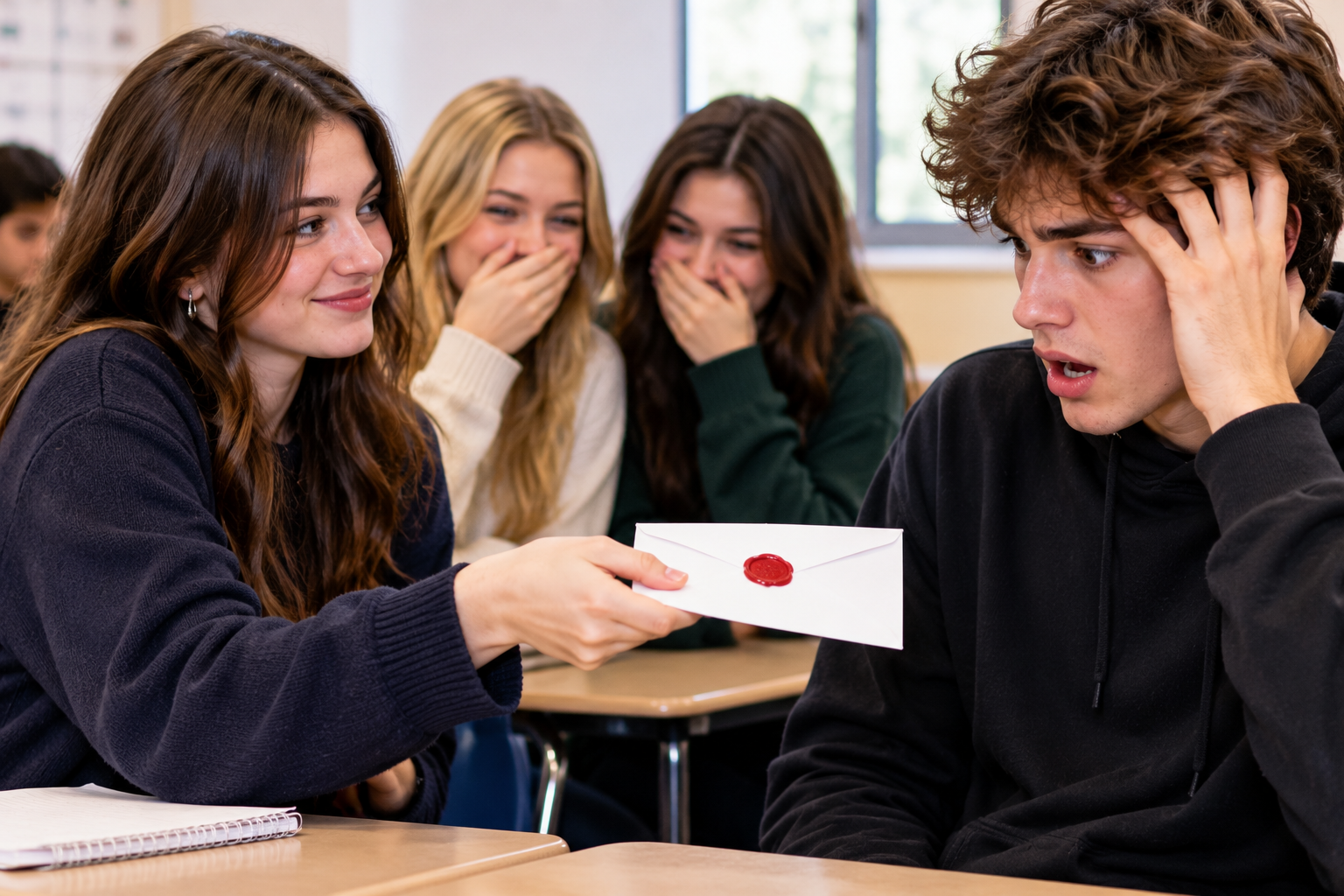
I never imagined that a simple school disagreement would turn into one of the funniest memories from my time as a student. It all started when I was working on a group assignment with several classmates. We had been given an important project that required everyone to contribute their own ideas, complete specific tasks, and work together to prepare the final presentation. At first, everything seemed fine, and we trusted each other to do our fair share. Unfortunately, one classmate decided that the rules did not apply to him, and his selfish behavior ended up creating a huge problem for the rest of us.
The classmate I am talking about was someone who always acted like he was smarter than everyone else. He was confident, talkative, and very good at making promises, but when it came to actually doing the work, he was rarely reliable. During the early stages of our project, he volunteered to handle an important section and assured us that he would finish it before the deadline. We believed him because we wanted the project to go smoothly. However, as the deadline approached, he kept making excuses and telling us that everything was under control, even though he had barely started his assigned work.
Things became even more frustrating when we discovered that he had been sharing our project ideas with another group while pretending to be fully committed to ours. Instead of helping us complete the assignment, he was using the information we had discussed together for his own benefit. When we confronted him, he acted as if we were overreacting and claimed that he had done nothing wrong. He even suggested that we should stop complaining and simply finish the project ourselves. His attitude made it clear that he had no intention of accepting responsibility for the trouble he had caused.
At that point, the rest of us had to work much harder than expected. We divided his unfinished tasks among ourselves, stayed after class, and spent extra time making sure everything was ready before the submission deadline. It was exhausting because we already had our own responsibilities, but we did not want one person’s behavior to ruin the entire group’s grade. Meanwhile, our classmate continued acting like everything was normal. He showed up whenever it was convenient, made a few comments about the presentation, and behaved as though he had contributed just as much as everyone else.
What annoyed us most was that he still expected to receive the same credit as the people who had actually completed the work. When the teacher asked about everyone’s contribution, he confidently described the project as a successful team effort without mentioning how much work the rest of us had done. We exchanged looks because we knew exactly what had happened. We were tempted to explain everything immediately, but we decided to focus on finishing the assignment first. After the project was submitted, we started discussing how we could teach him a harmless lesson about taking responsibility.
That was when someone came up with the idea of sending him a fake official-looking letter. We knew it had to be something believable enough to make him curious, but not something that could cause serious trouble or genuinely frighten him. We planned to make the letter sound formal and mysterious, as if it were connected to an imaginary school recognition process. The idea was simple: he would receive the letter, take it seriously for a moment, and then discover that his classmates had been behind the whole thing. We all thought it would be a funny way to respond to his ridiculous behavior.
After discussing the idea, we carefully prepared the letter and made sure it did not include any real threats, financial demands, or serious accusations. We wanted a harmless prank, not an incident that could get anyone into trouble. We chose our words carefully, gave it a formal appearance, and made the message sound unnecessarily serious. The funniest part was knowing that our classmate, who always acted as if he understood everything, might actually believe that something important was happening. We could barely keep ourselves from laughing while preparing it.
When he finally received the letter, his reaction was even better than we had expected. At first, he looked confused and read it several times, trying to understand why he had received such an unusual message. He started asking people whether they knew anything about it, but nobody admitted to being involved. His confidence suddenly disappeared, and he seemed genuinely curious about what the letter meant. We watched from a distance, trying our best to keep straight faces. The more seriously he treated the letter, the harder it became for us not to laugh.
Eventually, we revealed that the letter was a prank planned by the same classmates he had left to handle his unfinished work. Once he realized what had happened, he was embarrassed and annoyed, but he also understood why we had done it. We reminded him that the entire group had been forced to work harder because he had failed to keep his promises. Looking back, the prank was not some extraordinary act of revenge, but it became a memorable moment because it showed how quickly someone can lose the trust of the people around them.
Read Story…
Classmate got “pranked” by fake letter after screwing us over (old story)
This is a very old revenge from when I was a teenager in the 90’s.
There were only a few PC gamers around at the time and without Internet it was hard to get hold of new games. Me & a friend bought games from abroad via airmail because local stores didn’t sell many but these weren’t cheap. We’d trade them with each-other and would copy the copy protection (which was often included) so this made it semi-affordable for us.
A new kid joined our class however and his uncle had tons and tons of games we didn’t have. We offered to trade games with him & gave him our original copies for him to copy and in return we got … corrupted floppies (yes this was the 90’s), missing copy protection, etc. and after a few months of this we received not a SINGLE working game while he had received all of our games (The Settlers, Doom II, Monkey Island games, etc.) and some he returned in less than nice condition. We had enough and we wanted to get revenge but we didn’t know how.
Now, the 90’s were known for the many AIDS campaigns after Freddie Mercury died of AIDS in 1991. I was a huge fan of Queen and this new “friend” would often mock me for liking a “gay” singer. He came from a VERY conservative family & his mother was quite catholic & this is what gave us an idea when we had to attend an AIDS event organised by a certain foundation with our class.
At the end we were given flyers about AIDS, homosexuality, etc. and free condoms with the logo of the AIDS foundation were up for grabs. We each grabbed a few for reasons you’ll soon reach below.
Me and my friend were one of the very few with a computer & inkjet printer at home so we got this idea to screw him over: we created a fake letter addressed to our “friend” pretending we were the AIDS foundation copying the logo and everything to make it look as authentic as possible. It went something like this:
“Dear FIRST NAME,
Thank you for your letter. We understand it’s difficult being open about being homosexual and you have many questions after the event you attended with your class.
Please find enclosed a flyer which should answer many of your questions as well as some condoms. Please practice safe sex at all times.”
We enclosed all the flyers we had gotten at the event as well as the condoms and mailed it to “Mr LASTNAME” to guarantee his father would open the letter first.
We had no idea the shit storm this would create – we knew him being homophobic this would be great revenge but apparently his mother had been in tears, screaming, his father angry & he was grounded for weeks with his parents convinced he was gay.
In the end he figured we had something to do with it because we had been carefully fishing to see if our prank had succeeded but at first he thought the letter was authentic and we had contacted the foundation in his name.
When we finally confessed we had faked it all, we had a nice trip to the principal to explain why we had done this WITH his parents present.
It’s still the best revenge I ever took in my life even though it was 30 years ago.
A Classmate Who Wanted All the Credit Without Doing Any Work
I never imagined that something as simple as a school project would eventually turn into one of the funniest revenge stories from my teenage years. Back when I was a student, I had a small group of friends who usually worked together on assignments and other classroom activities. We trusted each other and believed that everyone should contribute equally whenever we were given a group task. Most of the time, things went smoothly because we all understood that one person’s laziness could create problems for everyone else. Unfortunately, one particular classmate had a completely different attitude. He always wanted the benefits of being part of a group but rarely wanted to accept the responsibilities that came with it.
This classmate was the kind of person who always acted confident, even when he had absolutely no reason to be. He enjoyed making promises and convincing people that he could handle difficult tasks. Whenever a teacher assigned group work, he would immediately volunteer for something important and make everyone believe that he was going to be extremely helpful. However, once the actual work began, he would suddenly become unavailable. He always had an excuse ready, and somehow, he managed to make other people feel responsible for completing the things he had promised to do.
At first, we did not take his behavior too seriously because we thought he might simply need some time to adjust. Everyone has busy days, and sometimes people genuinely struggle to manage their schoolwork. We were willing to help him whenever necessary because we did not want small disagreements to damage our friendship. However, after several similar incidents, we started realizing that his behavior was not accidental. He had developed a habit of allowing other people to do the difficult work while taking credit for the final result.
The biggest problem started when our teacher assigned us an important group project. We were divided into small teams and given several days to prepare everything. The assignment required research, written material, and a presentation in front of the entire class. Our group decided to divide the responsibilities equally so nobody would have to do everything alone. Each person received a specific section, and everyone agreed to complete their part before the final meeting. Our classmate volunteered for one of the most important sections and promised that he would finish it without any problems.
We trusted his promise and moved forward with the rest of the project. My friend and I spent several afternoons gathering information, organizing our notes, and preparing our presentation. Other members were also working on their assigned sections, so everything appeared to be progressing normally. Whenever we asked our classmate about his contribution, he confidently told us that he was almost finished. He never seemed worried about the deadline, and his relaxed attitude made us believe that he had everything under control.
However, as the deadline got closer, we started noticing that he was avoiding our questions. Whenever we asked him to share his completed work, he would say that he had not brought it with him. Sometimes he claimed that his computer was not working, while other times he said that he had forgotten to save the document. His excuses became increasingly ridiculous, but he continued insisting that there was nothing to worry about. We wanted to believe him, but deep down, we were beginning to suspect that he had not done much at all.
The situation became even worse when we discovered that he had been discussing our project with another group. We had shared our research ideas and some important information during our meetings, expecting everyone to keep the work within our team. Instead, he had apparently been giving details to other classmates while pretending that he was still fully committed to our group. We felt betrayed because we had trusted him with information that was supposed to remain part of our shared work. It was no longer just about being lazy; he was actively making our situation more difficult.
When we confronted him, his reaction was completely unexpected. Instead of apologizing or admitting that he had made a mistake, he acted as if we were creating unnecessary drama. He told us that everyone was making a big deal out of a simple school assignment. He even suggested that we should stop wasting time arguing and simply complete the remaining work ourselves. His attitude made us realize that he had no intention of accepting responsibility for anything. He genuinely believed that other people would always clean up his mess.
With the deadline approaching, we had very little time to argue with him. We decided to divide his unfinished section among ourselves and complete everything as quickly as possible. It meant spending extra hours working on something that was never supposed to be our responsibility. We stayed after school, compared our research, corrected mistakes, and made sure the presentation was organized. Everyone was frustrated, but nobody wanted our final grade to suffer because one person had decided not to do his part.
Meanwhile, our classmate continued behaving as if nothing had happened. He would sit with us during breaks, make jokes, and casually ask whether the project was ready. Sometimes he even gave suggestions about how we should present the information, despite having contributed almost nothing to it. His behavior was unbelievable because he seemed completely comfortable allowing everyone else to struggle. He apparently expected us to finish everything, include his name, and never mention what had happened.
The day of the presentation finally arrived, and we were relieved that the project was complete. We presented our work in front of the class and answered the teacher’s questions as confidently as possible. Everything went better than we had expected, especially considering how much additional work we had needed to complete. Our teacher seemed satisfied with the presentation, and we felt proud that our efforts had paid off. However, the most annoying part came afterward when our classmate started talking as though he had been equally responsible for the successful result.
He even told another student that our group had worked extremely well together. Hearing him say that was almost unbelievable. We had spent days completing his responsibilities, yet he was now acting like one of the main contributors. My friend and I exchanged looks because we both knew exactly what the other was thinking. We were tired of his behavior, and we started discussing whether there was a harmless way to make him understand how ridiculous he had been acting.
One afternoon, while sitting together after school, we began talking about the situation again. Everyone agreed that confronting him had not worked because he simply refused to take anything seriously. We did not want to start a major argument or create problems with the teacher, but we also did not want him to believe that his behavior was acceptable. Someone jokingly suggested that we should send him a fake letter and let him experience a little confusion for once. At first, we laughed at the idea, but the more we discussed it, the more entertaining it seemed.
The idea was to create a harmless letter that looked unusually formal. We wanted it to sound like an official message from some imaginary school committee, without using any real school authority’s identity or making serious accusations. It would be written in a serious tone and contain enough mysterious wording to make him curious. The whole point was to create a funny situation in which someone who always acted confident suddenly had no idea what was happening. We agreed that the prank should remain harmless and should not involve threats, money, or anything that could genuinely frighten him.
We spent some time discussing what the letter should say. Everyone contributed a few ideas, and we kept rejecting anything that sounded too obvious or unnecessarily complicated. We wanted the message to look formal enough to catch his attention but ridiculous enough that the joke would eventually become clear. The funniest part was imagining his reaction when he opened it. We knew he would probably spend several minutes trying to understand why he had received such an unusual message, especially because he always believed he was smarter than everyone else.
Once we had prepared the letter, we carefully checked the wording and made sure there was nothing that could cause genuine trouble. We were not trying to damage his reputation or create a serious misunderstanding. It was simply a private joke between classmates who were tired of being treated unfairly. We decided that the best approach would be to let him read the letter without immediately revealing who had written it. That way, we could see his first reaction before explaining the prank.
The next day at school, we waited for the right opportunity. We did not want to make a big scene in front of the entire class because that could turn a harmless joke into unnecessary embarrassment. We also knew that if too many people became involved, someone might misunderstand the situation. Our plan was to let him discover the letter naturally and then watch what happened. Everyone involved was trying to behave normally, which made the situation even funnier because we all knew something he did not.
When he finally received the letter, he looked at it with a confused expression. At first, he seemed unsure whether it was meant for him or whether someone had accidentally given him the wrong paper. He checked the front, opened it, and started reading carefully. His expression changed as he reached the middle of the message. He looked around the classroom as though he expected someone to explain what was going on. Meanwhile, we were sitting nearby, pretending to be completely interested in our own conversations.
He read the letter again, apparently trying to understand every sentence. Then he folded it and placed it on his desk, but a few moments later, he picked it up and started reading it once more. That was when we realized that the prank had worked much better than expected. He was clearly curious, and his usual confident attitude had disappeared for a little while. My friend and I could barely control our laughter because we knew exactly why he was taking the mysterious message so seriously.
After a few minutes, he began asking people whether they knew anything about the letter. He approached one classmate and asked if they had heard about anything unusual happening at school. The other student simply shrugged and said they had no idea. He then asked someone else, hoping to find an explanation. Nobody gave him a clear answer, partly because the rest of us were trying very hard not to laugh. It was becoming increasingly difficult to maintain our innocent expressions.
What made the situation especially entertaining was that he immediately started imagining different explanations. He wondered whether the letter had something to do with an upcoming school activity or whether he had somehow been selected for something. He even started discussing it with a friend during the break. We could hear him trying to figure out what the message meant, and every new theory made the whole situation more amusing. He had spent so much time avoiding responsibility that it was funny to see him suddenly become so interested in an unexpected piece of paper.
My friend and I decided that we had let the joke continue long enough. We did not want him to become genuinely worried or start believing that something serious was happening. During a break, we approached him and asked whether he had received an interesting letter that morning. He immediately looked at us and asked how we knew about it. That question was enough to make everyone nearby start laughing. He finally realized that something was not quite right.
We explained that the letter was a prank and that a few of us had prepared it because of his behavior during the group project. At first, he looked annoyed and asked why we had done something like that. We reminded him that he had promised to complete an important section, failed to do it, and left the rest of the group struggling near the deadline. We also explained that he had taken credit for work that other people had completed. We were not trying to start a fight; we simply wanted him to understand why we were frustrated.
His first reaction was to defend himself. He said that it was only a school project and that everyone was making too much of it. He also claimed that he had helped in other ways, even though none of us could remember any meaningful contribution. My friend calmly reminded him that we had asked him several times to complete his assigned section, and he had repeatedly assured us that everything was finished. He did not have much to say after that. For once, he could not simply change the subject and pretend that nothing had happened.
A few classmates who had heard the conversation started laughing about the letter. They were already aware that our group had faced problems during the project, so the explanation made sense to them. Nobody was trying to turn the situation into a public argument, but it was clear that our classmate was embarrassed. He probably expected us to keep covering for him as we had done before. Instead, he had finally realized that people were noticing his behavior and were no longer willing to pretend that everything was fine.
For the rest of that day, he was noticeably quieter than usual. He did not make as many jokes, and he avoided bringing up the project. I cannot say whether the prank genuinely taught him a lesson, but it certainly made him think about what had happened. Sometimes people become so comfortable taking advantage of others that they stop realizing how frustrating their behavior can be. He had assumed that we would always do the extra work and allow him to receive the same credit without questioning anything.
A few days later, we noticed that he had started behaving a little differently during classroom activities. Whenever teachers assigned group work, he seemed more careful about choosing his responsibilities. He also became less enthusiastic about making promises that he might not be able to keep. It was not a complete personality change, and he was still the same confident person in many ways, but there was at least some improvement. We hoped that he had finally understood that being part of a team meant contributing rather than simply enjoying the benefits.
Eventually, the whole incident became a funny memory that we occasionally discussed whenever someone mentioned school pranks. Looking back, the fake letter itself was not particularly complicated or impressive. It was just a harmless joke created by a group of frustrated teenagers. What made it memorable was the timing and the reaction of someone who had spent so much time acting as though nothing could ever go wrong for him. For a few minutes, he was the one trying to figure out what everyone else already knew.
I also learned something important from the experience. Working with other people requires trust, communication, and a willingness to accept responsibility. Nobody expects every group member to be perfect, and mistakes can happen to anyone. However, repeatedly making promises and leaving others to deal with the consequences is unfair. If someone makes a commitment, they should at least try to fulfill it or be honest when they cannot. That simple lesson would have saved all of us a lot of unnecessary frustration.
My friend and I never expected the situation to become such a memorable story. We had originally planned to finish our project, move on, and forget about the entire incident. Instead, one fake letter became the funniest part of the experience. Even now, I remember the confused expression on our classmate’s face when he first opened it. We were not proud of creating trouble, but we were certainly amused that someone who had made our lives difficult for days suddenly found himself completely confused by a harmless prank.
In the end, I would not describe what we did as some major act of revenge. We did not destroy anything, hurt anyone, or create a serious problem for him. We simply gave him a small taste of the confusion and frustration he had caused the rest of us. The real lesson was that people should not assume their classmates will always cover for them. Sometimes, the people you take advantage of eventually decide that they have had enough. And in our case, all it took was one fake letter to turn an ordinary school disagreement into a story we would remember for years.