Woman Trivializes Kid’s Disability As She Wants Special Cart So That Her Sleepy Child Can Rest
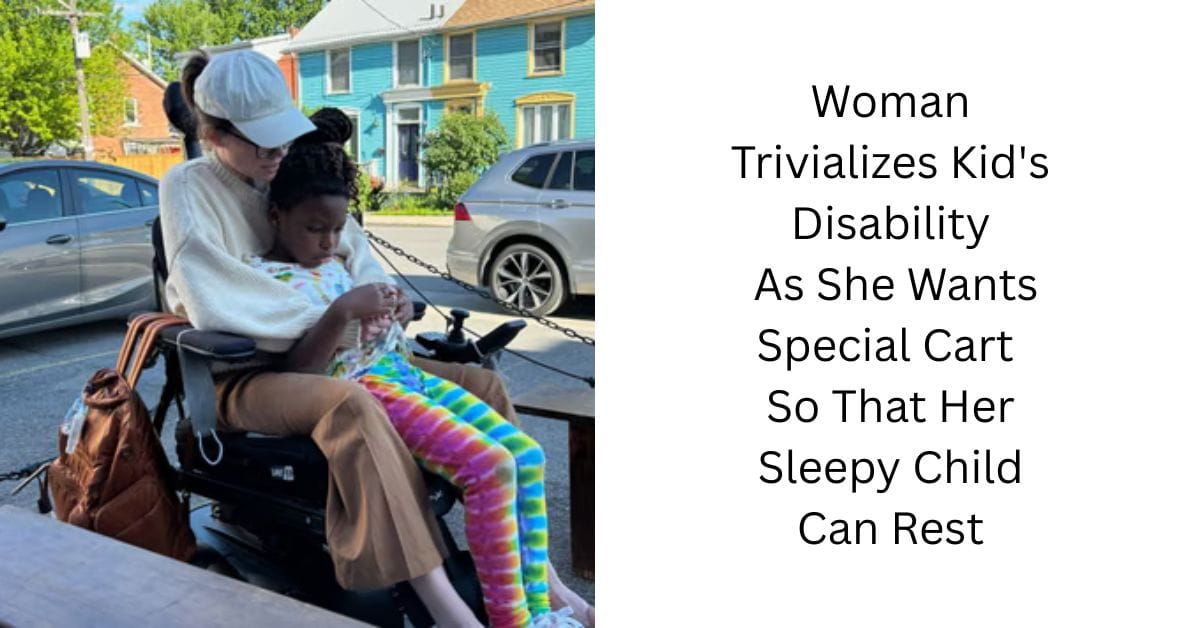
A routine shopping trip quickly turned into an uncomfortable confrontation when a woman with a child who appeared tired insisted on using a specially designed mobility cart intended for customers with disabilities. Although several standard shopping carts were available, she argued that her sleepy child deserved the more comfortable option because the child needed a place to lie down and rest. Nearby shoppers were surprised by her confidence, especially because another customer who genuinely relied on the accessible cart had been waiting patiently to use it. What seemed like a simple disagreement soon became a much larger discussion about entitlement, empathy, and respecting accommodations created for those with real medical needs.
The accessible shopping cart had been placed near the entrance specifically to assist individuals with disabilities or caregivers supporting someone with mobility challenges. Signs clearly explained its intended purpose, yet the woman dismissed those guidelines, claiming that “everyone has needs” and that her child’s comfort was just as important. Several witnesses exchanged confused looks, believing she misunderstood the difference between convenience and necessity. While caring for an exhausted child can certainly be difficult, many felt it did not justify taking away a resource designed for people who might otherwise struggle to complete even basic errands.
A Child’s Disability Changes the Discussion
As the conversation continued, another customer quietly approached, explaining that their child had a documented disability and depended on the specialized cart for every shopping trip. Rather than acknowledging the situation, the woman argued that disabilities should not automatically give someone priority over families dealing with tired children. Her comments immediately changed the atmosphere inside the store. Employees and shoppers alike recognized that the issue was no longer simply about a shopping cart—it had become about respecting accommodations that exist to ensure equal access for people facing physical limitations.

Advertisement
A store employee calmly stepped in to explain the policy. They politely informed the woman that the accessible cart was reserved for customers with disabilities and encouraged her to use one of the many standard carts available nearby. Although the explanation was respectful and professional, she appeared frustrated and insisted the rule was unfair. The employee remained patient, emphasizing that accessible equipment is provided because some shoppers cannot safely shop without it. Eventually, several bystanders voiced support for the employee, praising the store for protecting resources meant for those who genuinely depended on them.
The interaction sparked conversations among other customers throughout the store. Some parents admitted they had also dealt with cranky or exhausted children while shopping, but they agreed that temporary inconvenience was not comparable to living with a disability every day. Others pointed out that accessibility features often seem insignificant until someone personally experiences the challenges they are designed to address. The discussion became a reminder that empathy sometimes means accepting small inconveniences so others can receive the support they truly require.
After the incident was shared online, thousands of people discussed where the line should be drawn between personal convenience and accessibility. Most commenters agreed that accommodations for disabilities exist because they remove barriers, not because they provide extra comfort or special treatment. Many praised the employee for handling the situation with professionalism while reinforcing the importance of respecting inclusive policies. The story ultimately served as a reminder that understanding the purpose of accessibility resources—and allowing those who genuinely need them to use them—is a simple but meaningful way to show respect and compassion toward others.
Read Story…
I don’t care if your daughter is disabled, my child is too sleepy to walk.
First post now that I finally have the karma! Lurking long enough to know the lingo.
Backstory: My daughter is disabled. She has nonverbal autism and TBI (traumatic brain injury) which means she looks relatively normal, but she is profoundly disabled. I rarely take her out into public alone because she is so hard to manage, especially now that she is almost nine. Not only will she not stay with me, she will bolt like a greyhound, scream, rip things open, steal toys from babies and otherwise be an impossible nuisance. For this reason, I almost always order what I need for delivery, including groceries. However life is unpredictable sometimes and I every so often have to brave a trip to the grocery store.
A few years ago, the gods smiled down on me when the local grocery store I prefer started using the Caroline Cart. If you don’t know what that is, it’s a special cart with a large seat for disabled children who are too big for the toddler seat. They park it with the scooters and wheelchairs with a big blue HANDICAP marker on it so that parents don’t mistakenly use it for their older, able-bodied children but admittedly, this doesn’t seem to stop them. I see people using it all the time like one of the car carts (carts with a toy car attached for their kids to ‘drive’ while they shop).
This particular day a few weeks ago, the snow was so heavy and intense that not only was school canceled, but so was my grocery delivery. I would have to go to the store… with my daughter.
As usual, I walked in praying that the Caroline Cart would be available and thank goodness it was. Strapping my daughter into the seat (it has a five point harness) I started shopping. As usual, my first stop was the bakery to get a free cookie. They always hand them out to kids.
I noticed right away that there were a lot of other kids there that day, and assumed that many parents were like me, saddled with their kids during the snow day and unable to get grocery delivery. The bakery was hopping and there were a number of parents and kids waiting for a new batch of cookies to be ready.
One of the mothers seemed particularly harried and I cannot say I blamed her. Her daughter (around age 5) was having a meltdown. She was angry, crying, shouting, demanding a cookie.
EM: They aren’t ready yet honey, we just have to wait.
Noticing the glances of everyone around her she looked defensive but apologized saying, “I’m sorry, she’s very tired, it’s past her nap time.” No one said anything, we were all parents, we understood.
My daughter did not like the noise and as she often does when she is irritated, she was ‘stimming’, that is, flapping her hands or pushing a fist into her ear over and over. I got out her Minnie Mouse phone and handed it to her and she calmed down and started playing with it. Looking over, the EM saw us and looked inexplicably relieved.
EM: Oh thank goodness. That cart wasn’t there when we came in, do you mind if I use it? EK is exhausted.
Me: Uh… oh I’m sorry, but my daughter actually needs it. She’s disabled.
The EM blinked and looked at my daughter playing quietly with her toy. “She doesn’t look disabled. What’s wrong with her? Can she walk?”
I was flabbergasted at how insanely rude that was.
Me: Uh… yes, she can walk but she would run off in a hot second. I can’t hang onto her and shop at the same time.
EM: So you’re using the disabled cart because your daughter doesn’t listen to you? Look, she’s much older than my little girl and she seems fine, we really need the cart.
She started coming over and I protectively pulled the cart closer to me.
Me: Um no, she has autism-
EM: Jesus everyone has autism. That’s not a real disability.
I was pretty pissed at this point.
Me: The cart is for disabled children, like you JUST said, not sleepy children. Why don’t you use a car cart?
Her: There AREN’T any car carts! Besides I can’t see her in that. Just let me use the cart!!!
The shouting upset my daughter again and she started doing the thing where she punches her ear over and over. It was the first time she looked abnormal and the woman looked visibly distraught and sort of grossed out.
By now, other people were paying more attention and this wonderful older woman said,
W: Ma’am, autism can be a very severe disability. Look, you’re upsetting the little girl and the cart is for disabled children. You need to stop now.
I mouthed a silent thank you to the older woman wishing I could go hug her because that was some Wonder Woman level intervention to speak up that way but my daughter was upset so I decided to skip the cookie and just leave, so I turned the cart around and walked off. No one stopped me but the same older woman who had stood up for me saw us waiting in line and insisted I go in front of her so I could get home. I was so grateful!
My little girl was at that point, possessively clutching the string to a helium balloon I was intending to buy but I was debating how to get it away from her so it could be scanned without making her flip out because you can’t just take stuff from her.
The kind old lady saw my struggle and reached out to tear the scan code sticker off the string and put it with HER purchases.
W: I’ve got it.
She winked at me and my little girl and said, “I think you could use a little extra kindness today.”
Me: Oh no! It’s an eight dollar balloon really –
W: I insist.
I thanked her profusely and left with tears in my eyes, touched. I love it when people try to make my day a little easier.
Edit: For those commenting on the price of the balloon, yes $8.00 is very high for a balloon but they go as high as $12.00 at that store depending on the size and shape. It was a large balloon in the shape of a teddy bear. My daughter LOVES balloons and I usually get them from the dollar store but we weren’t at the dollar store so it was a splurge, mostly because of the EM upsetting her and skipping the cookie.
For those saying the EM wasn’t that bad, yes she was. She had no right to rudely demand to know what my daughter’s disability was, let alone cut me off before I could finish answering her, and she said autism isn’t a real disability. Furthermore, she wanted a cart she KNEW was for disabled children for her daughter because her daughter was ‘sleepy’. Not every EM story results in attacks and arrests, thank goodness. Thank you to those showing your support, I really appreciate it!
Online Reactions Spark a Wider Accessibility Debate
After the story spread online, many readers shared similar experiences from grocery stores, airports, and public spaces where accessibility equipment had been misused by people who simply wanted extra convenience. Individuals living with disabilities explained that they often hesitate to confront others because they fear arguments or judgment. They noted that while the public may only see a single interaction, many people with disabilities face these situations repeatedly, making routine errands far more stressful than they should be.
Accessible Shopping Carts Are Essential, Not Optional
Disability advocates pointed out that accessible shopping carts are not luxury items. They are carefully designed to provide support, safety, and independence for customers who might otherwise be unable to complete everyday tasks. Without them, some families would need assistance from multiple people or might even have to abandon their shopping trip entirely. This is why stores invest in such equipment despite the additional cost and maintenance required.
Advertisement
Several parents participating in the discussion acknowledged that shopping with young children can be exhausting. A sleepy toddler may cry, refuse to walk, or become overwhelmed by the environment. However, they emphasized that parenting challenges are temporary and should not come at the expense of someone else’s medically necessary accommodation. They argued that teaching children patience and consideration for others is far more valuable than avoiding a short period of discomfort.
Experts on accessibility explained that one of the biggest misconceptions is believing that every disability is immediately visible. Some individuals who require specialized equipment may not use wheelchairs or other obvious mobility aids, yet they still depend on accommodations because of chronic pain, neurological disorders, or developmental conditions. Assuming that someone does not “look disabled” can create unnecessary conflict and embarrassment for those already facing daily challenges.
The store later received praise from customers for standing behind its accessibility policy instead of giving in to pressure. Many commenters believed the employee handled the disagreement respectfully by listening to the woman’s concerns while still enforcing the rules fairly. They argued that consistent enforcement protects vulnerable customers and sends a clear message that accommodations exist for legitimate reasons.
Others reflected on how entitlement can develop when people begin to see public resources as available to anyone who wants them. They explained that convenience is different from necessity, and failing to recognize that distinction can undermine efforts to create inclusive spaces. Respecting accessibility measures requires understanding that equality does not always mean everyone receives the exact same thing—it means everyone has what they need to participate.
Disability organizations also used the discussion as an opportunity to educate the public about invisible disabilities and the importance of empathy. They encouraged people to avoid making assumptions about strangers and to trust that accommodations are generally being used appropriately. Public awareness, they argued, can reduce misunderstandings and create more welcoming communities for everyone.
Many readers appreciated that the customer waiting for the accessible cart remained calm despite the frustrating situation. Instead of responding with anger, they allowed the employee to explain the policy and trusted the store to resolve the matter. Commenters admired this patience, recognizing that maintaining composure in emotionally charged situations is often easier said than done.
Employees Face Difficult Accessibility Decisions
The incident also highlighted the difficult position employees are placed in when enforcing accessibility rules. Workers must balance customer service with fairness, often while facing criticism from unhappy shoppers. Many retail employees commented that these conversations can be emotionally draining, especially when policies designed to protect vulnerable customers are challenged.

Advertisement
Social media users debated whether stores should increase the number of accessible carts available. While many agreed that additional equipment could reduce conflicts, others pointed out that misuse would remain a problem unless people respected the purpose of those accommodations. Simply adding more resources would not solve the issue if individuals continued to ignore the guidelines.
Educators joined the conversation by emphasizing that moments like these can teach children valuable lessons about kindness and inclusion. Parents have an opportunity to explain why certain parking spaces, ramps, elevators, and specialized carts exist. Helping children understand these concepts early encourages empathy and respect for people with different abilities throughout their lives.
Some commenters admitted they had never considered how essential an accessible shopping cart could be until reading the story. They realized that something they viewed as an optional convenience might actually determine whether another family could shop safely and independently. The discussion encouraged many people to pay closer attention to accessibility features in public places.
Community members also noted that accessibility is about preserving dignity. When accommodations are unavailable because they are being used unnecessarily, individuals with disabilities may be forced to ask strangers for help or leave without completing important errands. Protecting these resources allows people to maintain greater independence and confidence in their daily lives.
As the online conversation continued, the overwhelming majority of responses supported the store’s decision. Readers agreed that policies are most meaningful when they are applied consistently, even if doing so leads to uncomfortable conversations. They believed that making exceptions based on convenience would weaken the purpose of accessibility accommodations and create unfair situations for those who genuinely rely on them.
A Valuable Lesson in Empathy and Respect
Ultimately, the incident became more than a disagreement over a shopping cart. It sparked an important conversation about empathy, respect, and the difference between temporary inconvenience and long-term necessity. While caring for a tired child is undoubtedly challenging, most people agreed that accessibility resources should remain available for those they were specifically designed to help. The story served as a reminder that small acts of consideration can make a significant difference in creating a more inclusive and compassionate community.

Advertisement