“My Fiancé Is Taking My Last Name After We Marry—Now His Parents Refuse to Attend Our Wedding”
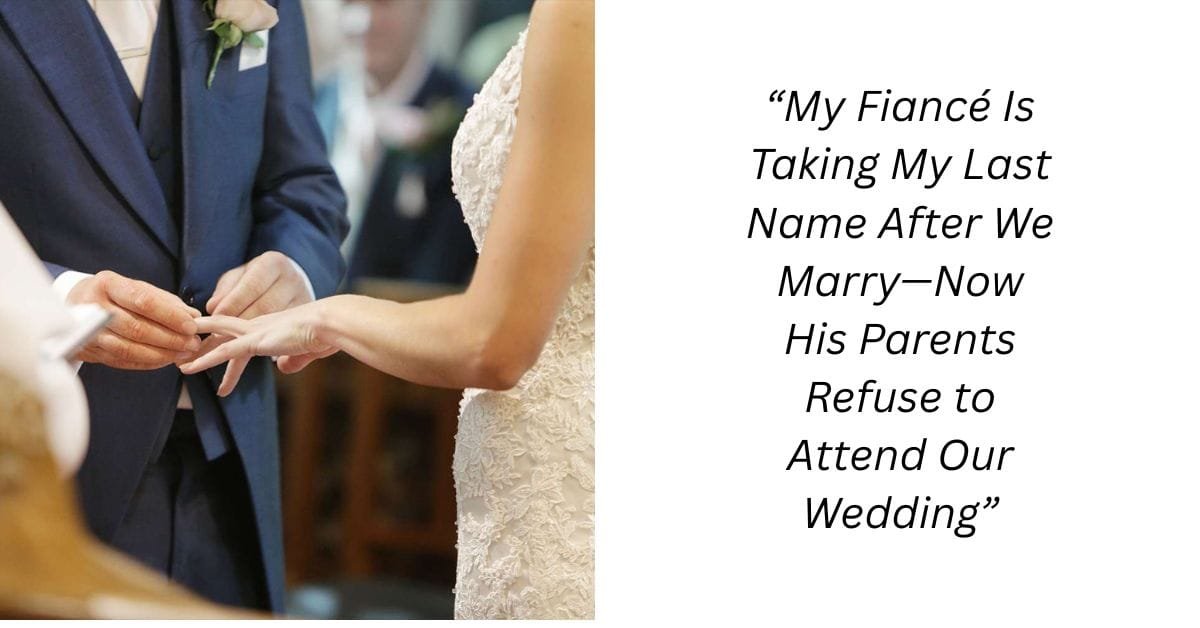
When my fiancé and I first started talking seriously about marriage, we agreed that we wanted to build our own life rather than simply follow traditions because everyone expected us to. We had already discussed the important things: where we would live, how we would handle finances, whether we wanted children, how we would divide household responsibilities, and even what kind of wedding we wanted. One conversation that came up unexpectedly was our last names. I had always planned to keep my surname after marriage because it is part of my identity, my professional life, and my connection to my family. My fiancé surprised me by saying that he actually liked the idea of taking my last name instead. At first, I thought he was joking, but he explained that he had never been particularly attached to his surname and that he felt there was nothing wrong with choosing the name that made the most sense for us as a couple. He said he wanted our marriage to be based on what we both genuinely wanted, not on what society automatically expected from a husband and wife. I told him that I would support whatever decision he made, but I also wanted to make sure he was choosing it because he truly wanted to, not because he thought it would make me happy. He insisted that it was his decision and that he felt completely comfortable with it. We talked about it several times before making anything official, and eventually decided that after the wedding, he would take my surname. At the time, neither of us imagined that this personal decision would become such a major source of conflict with his family.
The problem began when we told his parents. We had expected them to be surprised, but we were not prepared for how strongly they would react. His mother immediately asked whether I had pressured him into changing his name. His father became visibly angry and said that taking his wife’s surname was humiliating for a man. My fiancé calmly explained that this was his choice and that I had never demanded it from him. He told them that he had thought about it carefully and that he did not feel that changing his surname made him less of a man or less connected to his family. His parents did not seem interested in hearing that. They kept asking why I could not simply take his surname like “normal women” did. I tried not to become defensive because I knew this was emotionally charged for everyone, but the way they spoke about me made me uncomfortable. They acted as though I had somehow manipulated their son into rejecting his family. His mother even suggested that I must have planned this from the beginning and that I was trying to “erase” their family name. That was incredibly frustrating because the decision had actually come from my fiancé. I had not asked him to change his name. If anything, I had questioned the decision several times because I knew it might cause problems. He kept telling me that he was an adult and that he wanted to make this choice for himself. Unfortunately, his parents did not seem willing to accept that their son could make such a personal decision without being controlled by someone else.
As the wedding planning continued, the disagreement became much bigger than the surname itself. His parents began making comments about our wedding and questioning whether they should even attend. At first, I thought they were simply angry and would eventually calm down. We tried giving them space and avoided bringing up the name issue whenever we visited. My fiancé also had several private conversations with them, hoping they would eventually understand that he was not rejecting them. He explained that changing his surname did not mean he was ashamed of his family or that he no longer loved them. He simply wanted to make a decision about his own identity before starting a new chapter of his life. His father reportedly told him that if he went through with it, he would regret it for the rest of his life. His mother told him that she could not understand why he would choose “her family name” over the name they had given him. My fiancé responded that marriage was not supposed to be a competition between families. He was not choosing my family over his. He was simply choosing a name that felt right for him. But every attempt he made to explain himself seemed to make the situation worse. Eventually, his parents told him that they would not participate in certain wedding events unless he changed his mind. That was when the situation stopped feeling like a disagreement and started feeling like an attempt to pressure him into giving up a decision he had already made.
The most painful moment came when his parents told him they were considering not attending the wedding at all. At first, I thought they were bluffing. Surely they would not actually miss their own son’s wedding over a last name. But then his mother sent him a long message explaining that she could not “celebrate” a marriage that she believed was destroying the family tradition. She said she felt humiliated in front of relatives and friends and worried that people would judge them for allowing their son to take his wife’s surname. His father was even more direct and told him that he would not stand beside him at the ceremony unless he kept his family name. My fiancé was devastated. Despite everything, he loves his parents and had always imagined them being present on his wedding day. He had pictured his father giving a speech, his mother helping with wedding preparations, and both of them celebrating when he officially married me. Suddenly, all of those memories he had imagined were being replaced by arguments and threats. He told me that he felt torn between the family he grew up with and the future he was trying to build with me. I felt terrible because I never wanted him to lose his relationship with his parents over something that had never even been my demand. I even told him that if changing his surname was going to cause this much pain, he should reconsider it. I said I would support him either way and that I did not want him making such an important decision because he felt trapped between us. But he refused. He told me that changing his name was not something he was doing for me. It was something he had chosen for himself, and he did not want to give up his decision simply because his parents were unhappy.
At this point, I began questioning whether I was somehow responsible for the situation despite knowing logically that I had not forced him to do anything. I wondered whether I should have encouraged him to keep his surname simply to avoid conflict. I wondered whether our wedding would always carry this bitterness because his parents might see me as the woman who “took” their son’s name. My fiancé kept telling me that I was not responsible, but guilt is difficult to turn off when you know someone else’s family is hurting because of a decision connected to your relationship. We also started having difficult conversations about the future. What would happen if we had children? Would his parents refuse to accept grandchildren with my surname? Would they constantly remind our children that their father had abandoned the family name? Would every holiday become an argument? We realized that the surname issue was really exposing something much larger: his parents believed they should have a significant say in decisions their adult son made. If we gave in now, we worried that the same pattern could appear again with other major choices. My fiancé said he did not want our marriage to begin with the understanding that his parents could threaten to withdraw their love or presence whenever they disagreed with us. He wanted a relationship with them, but he also wanted boundaries. That was something I respected, even though I hated seeing him hurt.
Eventually, we decided to stop trying to convince his parents. My fiancé told them that he loved them, wanted them at the wedding, and hoped they could eventually accept his decision. But he also made it clear that he was not changing his mind simply to earn their approval. He told them that the wedding was going forward and that they were welcome to attend without conditions. If they chose not to come, he would be deeply disappointed, but he would not allow their absence to determine whether he married the person he loved or how he chose to live his life. His parents responded by saying they needed time to think. For a few days, we heard nothing. Those days were incredibly stressful because we had already sent invitations and made plans around the assumption that they would be there. Every time my fiancé’s phone rang, I could see the anxiety on his face. Eventually, his mother called and said she still did not approve of the name change, but she was considering attending because she did not want to miss her son’s wedding. She did not promise that she would be happy about it, and she made it clear that she still believed he was making a mistake. But she also admitted that she loved him more than she hated the decision. His father remained more resistant, although there were signs that he might eventually come around. It was not the perfect reconciliation we had hoped for, but at least the door was no longer completely closed.
The wedding has not happened yet, and honestly, I still do not know exactly what will happen when the day arrives. There is a part of me that wishes this entire situation had never become an issue. I would have been perfectly happy keeping my surname and letting my fiancé keep his. But I also know that his decision is his own, and I do not believe he should have to surrender control over his identity simply because his parents are uncomfortable with it. A surname does not determine whether someone loves their family, respects their parents, or values their history. My fiancé has not rejected the people who raised him. He has simply decided that his future does not have to look exactly like their past. I hope his parents eventually understand that. More than anything, I hope they can attend the wedding and celebrate their son’s happiness even if they would have made a different choice themselves. As for us, this experience has taught us something important before we have even exchanged vows: marriage means making decisions together and standing behind each other, but it also means understanding where family influence should end. I never wanted my fiancé to choose between me and his parents, and I still do not. I want him to have both. But if his parents ultimately refuse to attend because their adult son chose to take my surname, I think that will be their decision, not ours. We can invite them, love them, explain ourselves, and leave the door open. What we cannot do is build our marriage around the fear that someone else will withdraw their support whenever they disagree with our choices.
Read Story…
“My Fiancé Will Take My Name When We Marry, And Now His Parents Won’t Come to Our Wedding”
My fiancé and I are getting married and he (plus our future children) will be taking my name. His parents are so upset over this that they are not coming to our wedding. We had a pretty good relationship with them before this and I am honestly shocked at the reaction. What do I do? — What’s In A Name?
*You* do nothing, except continue with your wedding plans and supporting your fiancé. It’s his job to manage a relationship with his parents and it’s up to him to do – or not to do – anything regarding his parent’s behavior. If I were he, I’d probably send a note to my parents expressing disappointment in their decision to miss my wedding, but to let them know that I’m very happy in my decision to marry, to take my spouse’s name, and to give our future kids’ her name, and that when they’re ready to accept that, we welcome their presence in our lives. From there, it’s really up to them how to proceed – the ball will be in their court, so to speak. This doesn’t negate the pain their behavior might cause your partner (and you), and you can – and should – certainly support your fiancé through navigating whatever emotions he might be feeling and how he might express himself. You can also ask him what he might need from you and how best you can support him.
I’m 24 and had one of the most important experiences of my life this year that has forever impacted me. I’ve dealt with so much social anxiety throughout my life and have finally been able to overcome some of it, thanks to my good friend, “John.” I can finally talk to strangers or people in public without as much anxiety/fear. John and I went to the bar on Christmas and he asked out this guy, “Roger.” Then on New Year’s they were “officially boyfriends” and we all three celebrated New Years together at the bar.
Things occurred that night that convinced me that they were officially over because of the level of anger I saw in both of them. I shouldn’t have assumed that and I sincerely regret it. Later that night I messaged Roger and told him I was sorry about everything and hoped he was doing alright. I also told him I thought he was really attractive. I told him “I’m sorry” (fearing it wasn’t appreciated) and he said “it’s okay” like it was no problem. Little did I know that he and my friend, John, had made up and were both in bed together. I don’t understand why neither of them texted me and explained they were together again after I said those things.
The next day the three of us went out to the bar again and were having an amazing, fun time. We went to another bar together in my car. I nearly remember everything from that night up until John telling me that he was going to drive which I agreed was safer and I don’t recall anything after that. I woke up a few hours later at my house and, apparently, I had blacked out (my first experience to do so). I really don’t recall drinking more than the usual amount, which is strange.
John texted me hours later saying “we need to talk.” I assumed it only had something to do with my telling Roger that I think he is attractive. At the bar they had acted like nothing had happened and I assumed John didn’t know about my messaging Roger. Well, not only was he upset I called his boyfriend attractive – which I completely understand – he is also accusing me of touching his boyfriend sexually at the bar. I would never do that, especially to my best friend who means so much to me. I would never do that, let alone to someone I barely know, and in public, as well.
John said not to message Roger about the situation. Well, I didn’t listen because I was furious I was being accused of something I wouldn’t do. Roger said I touched him and literally had my hands “deep down” there. Then he blocked me. I asked John why he didn’t confront me about the messages calling Roger attractive, and he told me Roger didn’t want any drama, which I find suspicious…
I don’t know what to do. John is the only friend I have, and I care about him a lot. — Don’t Remember Being Handsy
For someone who is in the wrong here, you don’t seem to be as humble and apologetic about your mistakes as you should be. Reaching out to Roger to tell him how attractive you think he is when just hours earlier you believed he was your best friend’s boyfriend is pretty low, and I’m not picking up on the appropriate level of remorse from you (and I suspect John isn’t either). You’re also very defensive about your behavior the last time the three of you went out, claiming you’d never act the way you’re being accused of while also admitting you blacked out and don’t remember the second half of your night. Even your admission about the amount you drank is defensive (“I really don’t recall drinking more than the usual amount, which is strange.” It’s actually not strange to not recall things when you’ve had enough to drink to black out.)
Your whole tone is laced with suspicion – you even say that Roger’s desire to avoid drama, which is the reason John gave for not confronting you about your messages to Roger, was “suspicious.” Is it, really? Are you suggesting Roger had ulterior motives here? Are you implying that he’s to blame for your blacking out? That he lied about your putting your hands down his pants? Look, maybe he *is* lying, but nothing you’ve shared here suggests that it’s all that far-fetched that you crossed a boundary. You already crossed one when you told him how attractive you find him, and you admit to drinking enough that you thought it was safer for someone else to drive. You also say that you struggle with social anxiety. It’s not such a big stretch from all of that to imagine that you drank too much and behaved very inappropriately.
I would issue a heartfelt apology to John for your behavior – both what you can remember and what you can’t. I’d tell him how important he is to you and how much you regret betraying his trust and doing anything to jeopardize a friendship that means so much to you. Roger has blocked you, so you can’t reach out to him and you need to respect the boundary he’s put in place. With luck, John will forgive you and this can be a learning lesson for you. We all make mistakes. Even the most socially adept among us make missteps navigating relationships. But when we do, it’s so important to acknowledge our mistake and to make appropriate amends. You’ve misstepped here. You need to take responsibility, make a heartfelt apology, and give John some space to accept your apology and/or let you know what he needs from you to move forward.
I also think it’s a good idea to focus on building your social network so that John isn’t your sole friend. If anxiety is still keeping you from exploring potential friendships, seek out help for your anxiety (counseling, a support group, and perhaps even medication if a doctor thinks its warranted). Joining clubs, organizations (a LGBTQ one could be a great option!) or classes that interest you and bring you in the company of like-minded people would be good ways to meet others. Pursuing friendships from a place of respecting others and their boundaries is essential.
His Unexpected Decision to Take My Last Name
When my fiancé first told me he wanted to take my last name after we got married, I honestly thought he was joking. We had been together for almost four years, engaged for eight months, and had already discussed nearly every major decision about our future. We knew where we wanted to live, whether we wanted children, how we would handle money, and even what kind of home we hoped to have someday. His decision to take my surname was unexpected, but it wasn’t something I had asked him to do. I was actually the one who hesitated when he first brought it up because I knew his family was traditional. I asked him several times if he was completely sure, and every time he told me the same thing: he wanted to make the choice for himself.
My last name is important to me because it is the name I grew up with and the name my parents gave me. I have an unusually close relationship with my family, especially my father, who always told me that my name represented more than just a word written on paperwork. It represented our family history, our accomplishments, our mistakes, and everything we had built together. I never expected my future husband to take my name, though. Growing up, I had always assumed that if I married someone, I would probably be the one deciding whether to change mine. So when my fiancé said he actually liked the idea of becoming part of my family in that way, I found it surprisingly touching.
His reasoning was much simpler than I expected. He said he had never felt particularly attached to his surname. His relationship with his family had always been complicated, especially with his father, who had very strong opinions about what a man was supposed to be. My fiancé told me that he didn’t want his identity to be determined by tradition. He wanted our marriage to feel like the beginning of something we were creating together, rather than simply continuing the expectations of the families we came from. He also joked that since we were both starting a new family, there was no logical reason why one person’s surname automatically had to win.
I asked him whether he had considered how his parents would react. He admitted that he had, but he believed they would eventually accept it. He said they might be surprised or disappointed, but they loved him and would ultimately want him to be happy. I wasn’t so confident. His father had made comments before about men needing to “lead” their families, and his mother often talked about how important family traditions were. Still, I didn’t want to make assumptions about them. I told my fiancé that I would support whatever decision he made, but I didn’t want him choosing my name just to prove something to his parents. Everything changed when he finally told them. We were having dinner at his parents’ house when he casually mentioned that after the wedding, he planned to take my surname. I watched his mother’s expression change immediately. His father stopped eating and stared at him as though he had announced something completely outrageous. For several seconds, nobody said anything. Then his father asked, “You’re serious?” My fiancé calmly said yes. His father laughed, but it wasn’t a happy laugh. It was the kind of laugh people use when they think someone has said something ridiculous.
His mother immediately asked whether I had convinced him to do it. I told her I hadn’t. She looked at me as though she didn’t believe me. She asked why I would want him to give up his family name, and I explained that I hadn’t asked him to give up anything. This was his decision. She then asked him why he would voluntarily “erase” his connection to his family. My fiancé reminded her that changing a surname legally didn’t erase his childhood, his memories, or his relationship with them. But his father became increasingly angry and said that taking his wife’s name was humiliating and that no respectable man would make that choice.
I could tell my fiancé was hurt, even though he tried not to show it. He had always had a complicated relationship with his father, and I knew that getting his approval still mattered to him more than he liked admitting. His father continued talking about how embarrassed he would be if his friends found out. He said people would assume my fiancé was weak or that I controlled him. My fiancé finally interrupted him and said that nobody was controlling him. He was an adult making a decision about his own identity. That was the first time I had ever seen him directly challenge his father like that.
After that dinner, things became incredibly tense. His mother started calling him frequently, asking him to reconsider. Sometimes she would be emotional and tell him she couldn’t understand why he wanted to hurt his parents this way. Other times she would become angry and accuse him of disrespecting generations of family history. My fiancé tried explaining that he wasn’t rejecting them. He simply didn’t want to automatically follow a tradition just because it had existed for a long time. Unfortunately, they weren’t interested in hearing that distinction. Eventually, his parents started blaming me directly. His mother told him that she believed I had been slowly influencing him throughout our relationship. She suggested that I had probably made him feel guilty about keeping his own surname. That accusation upset me more than I expected. I had never once told him that he should take my name. In fact, I had repeatedly told him the opposite: that I didn’t want him making such a significant decision because he was afraid of losing me or because he wanted to prove his loyalty to me.
My fiancé defended me immediately. He told his mother that she needed to stop blaming me because the idea had been his. He explained that I had actually been nervous about telling them and had encouraged him to think carefully before making the decision. His mother didn’t apologize. Instead, she said that a woman would obviously say that because she had already gotten what she wanted. That comment made me realize this wasn’t really about the surname anymore. They had decided that I was the villain in a story where their son was supposedly being taken away from them.
A few weeks later, his father told him that if he went through with the name change, neither of his parents would attend the wedding. At first, my fiancé thought he was bluffing. But then his mother confirmed it. She said she couldn’t sit in a church or wedding venue and watch her son “give away” the family name. She said she would rather stay home than participate in something she considered disrespectful. When my fiancé told me, I felt sick. We had been planning our wedding for months, and suddenly two empty seats felt like the most noticeable thing in the room.
I asked him whether he wanted to postpone the name change until after the wedding. I thought maybe if we removed the pressure from the ceremony, his parents might calm down. He immediately said no. He didn’t want to negotiate his decision simply because they were threatening to withdraw their support. He told me that if he changed his mind now, he would always wonder whether he had done it because he truly wanted to or because his parents had pressured him. I understood his point, but I also knew that choosing this path meant accepting that his relationship with his parents might never be the same.
The hardest part was that I didn’t want to be responsible for creating a permanent conflict between him and his family. Even though I knew this wasn’t my decision, I couldn’t stop feeling guilty. I wondered whether I should tell him to keep his surname just to make everything easier. I even told him that I would understand if he changed his mind. He became frustrated and said that I was making this about myself when the actual issue was his parents refusing to respect his autonomy. He reminded me that if he were taking my name without their approval, the same principle would apply.
We had several difficult conversations about what our marriage would look like if his parents remained angry. We talked about holidays, birthdays, family gatherings, and eventually children. My fiancé said he didn’t want our future children growing up believing that their grandparents could punish their parents whenever they disagreed with a decision. He wanted our home to be a place where everyone could have opinions without using emotional threats to control one another. That conversation made me realize that the surname itself was only the beginning. If his parents couldn’t respect this relatively personal choice, there could be bigger problems later.
My family had a completely different reaction. When I told my parents, they were surprised, but they never pressured either of us. My father actually told my fiancé that he didn’t need to take our name to prove that he loved me or respected my family. He said that if my fiancé wanted to keep his own surname, nobody would think less of him. When my fiancé explained why he wanted to take mine, my father simply smiled and said that he hoped he was making the decision for the right reasons. That response made the contrast with my fiancé’s parents even more obvious.
There were moments when I wished we could simply cancel the entire conversation and go back to planning flowers, food, and seating arrangements. Instead, our wedding planning became dominated by questions about who would attend. His parents stopped responding to invitations and refused to help with anything. Some of his relatives started asking questions about why his parents weren’t involved. We didn’t want to turn the wedding into a family drama, so we tried to keep the details private. Unfortunately, family members have a way of finding out everything eventually.
One of his aunts called me privately and told me that I should consider changing my mind because “men can be stubborn when they’re in love.” I was stunned. She said that after the honeymoon phase, my fiancé might regret giving up his family name. I politely explained that he wasn’t giving up anything for me. He was choosing a name he felt comfortable carrying. She told me I was being naive and that I would understand once I had been married longer. I ended the conversation feeling angry because everyone seemed determined to treat him like someone incapable of making his own decisions.
My fiancé eventually told his extended family that he didn’t want anyone discussing the surname at the wedding. He said the wedding was supposed to celebrate our marriage, not become a debate about tradition. Some relatives respected that. Others didn’t. One cousin even joked that he would need to “check his masculinity at the door.” My fiancé didn’t laugh. He simply told him that jokes were easy when someone else was making the sacrifice. That was another moment when I realized how much stronger he had become during this process.
Despite everything, there were nights when he admitted he was still hurt by his parents’ decision. He didn’t suddenly stop loving them because they disagreed with him. He still remembered childhood vacations, family traditions, and all the times they had supported him. He told me that part of him still hoped they would show up at the wedding at the last minute. I told him that I hoped so too. I never wanted him to lose his parents. But I also told him that I couldn’t ask him to abandon a decision that mattered to him just to keep them comfortable.
About a month before the wedding, his mother finally called me directly. I expected another argument, but instead she sounded exhausted. She told me she didn’t understand our decision, but she admitted that she knew her son was serious. She asked me whether I had ever pressured him. I told her honestly that I hadn’t. I also told her that I would never want him to resent me for something he had done against his own wishes. There was a long silence. Then she said she believed me, although she still didn’t agree with the decision.
She didn’t promise that she and his father would attend. She simply said they needed time. I wasn’t sure whether that was progress or another way of avoiding the issue. My fiancé was relieved just to hear her acknowledge that he was making his own choice. For the first time in months, there was a small possibility that his parents might eventually understand that this wasn’t an attack against them. It was simply a decision about the family he was building with me.
Two weeks before the wedding, his father sent him a message saying that he still couldn’t accept the surname change. However, he also said he didn’t want to miss his son’s wedding. He didn’t apologize for the things he had said, and he didn’t say that he supported the decision. But he asked whether there was still a place for him and his wife. My fiancé showed me the message, and we both sat quietly for a while. I told him that of course there was a place for them. I didn’t want our wedding to become a punishment ceremony.
They eventually confirmed that they would attend. There were still conditions, though. His father made it clear that he wasn’t celebrating the surname decision, only the marriage itself. Honestly, I was okay with that. I didn’t need him to suddenly become enthusiastic about something he didn’t understand. I only needed him to respect his son’s right to make the decision. My fiancé also agreed that we couldn’t expect everyone to approve of every choice we made. Marriage, we were learning, wasn’t just about choosing each other. It was also about deciding which outside opinions were allowed to shape our lives.
On our wedding day, I kept looking toward the entrance. When his parents finally walked in, I felt an enormous sense of relief. His mother hugged him tightly, and his father shook his hand before eventually pulling him into a brief hug. Nobody mentioned the surname. During the ceremony, when we exchanged vows, I realized that the argument over a name had never really been about a name. It had been about control, tradition, identity, and the fear parents sometimes feel when their children become adults and start making decisions they cannot control.
We are married now, and yes, my fiancé is taking my last name. I still don’t know whether his parents will ever completely accept it, and honestly, I have stopped expecting them to. What matters to me is that my husband made the decision himself and stood behind it even when it became difficult. I also learned something I never expected from all of this: sometimes the hardest part of getting married isn’t choosing the person you want to spend your life with. It’s learning how to build a life together when the people who raised you have their own expectations for what that life should look like. Our wedding didn’t magically solve the family conflict, but it did make one thing clear—we are going into our marriage as partners, and neither of us wants fear of disappointing someone else to become the foundation of our future.