My Family Got Angry Because I Ordered an Expensive Meal at Dinner
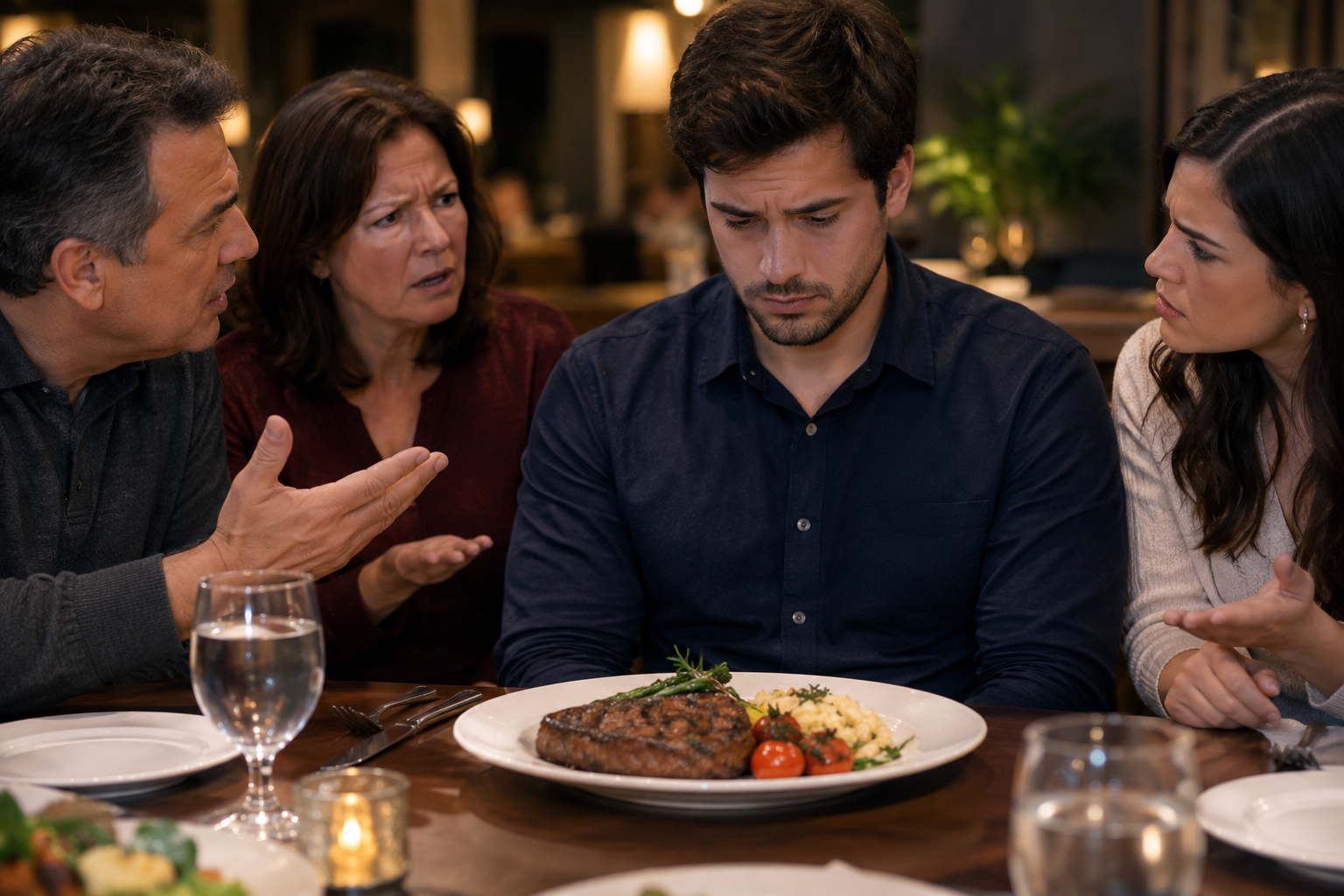
I never expected a simple family dinner to turn into an argument that would make me question my relationship with the people I grew up with. I am 28 years old, financially independent, and have been working hard for the past several years to build a comfortable life for myself. I pay my own bills, manage my expenses, and rarely ask my family for financial help. Last weekend, my parents invited me and my siblings to dinner at a nice restaurant to celebrate my father’s recent promotion. Everyone seemed excited, and I thought it would be a wonderful opportunity for us to spend time together. I had been looking forward to the evening because our family gatherings had become less frequent as everyone grew older and busier. I had no idea that the food I chose to order would become the center of a family argument.
When we arrived at the restaurant, I noticed that the menu had a wide range of options, from affordable pasta dishes to expensive steaks and seafood platters. My parents had chosen the restaurant, and nobody had mentioned a spending limit or suggested that we should order only from a particular section of the menu. I assumed that everyone would pay for their own meal unless my parents decided otherwise. I looked through the options and found a steak dinner that I had wanted to try for months. It cost considerably more than the other dishes, but I could easily afford it. I checked the description, asked the waiter a question about the preparation, and finally placed my order. I did not think it was a big deal. However, as soon as the waiter walked away, my older sister looked at me with an expression that immediately made me uncomfortable.
She asked whether I had actually ordered the steak, and I told her that I had. She then glanced at the price on the menu and said that it was ridiculous to spend that much money on a single meal. I laughed awkwardly because I thought she was joking, but she continued explaining that I should have chosen something cheaper like everyone else. My younger brother joined the conversation and said that ordering expensive food at a family dinner was unnecessary, especially when there were plenty of good options available for less money. I reminded them that I was paying for my own meal and that I had not asked anyone else to cover the cost. Instead of accepting my explanation, my sister said that my decision made the rest of the family look bad, as if they could not afford the same food. I was confused because nobody had compared their orders with mine until she brought it up.
My mother eventually joined the discussion and quietly asked me to change my order before the food was prepared. She said that she did not want the evening to become uncomfortable and suggested that I choose something more reasonably priced. I asked her why my meal was causing such a problem when I was not expecting anyone else to pay for it. She replied that family dinners were about being considerate and that I should have thought about how my choice might make everyone feel. I understood her point about being considerate, but I could not understand why that meant I had to order something I did not particularly want. I had not criticized anyone else’s choices, commented on their financial situation, or suggested that my meal was better than theirs. I simply wanted to enjoy the dinner without having to justify every decision I made.
Things became even more uncomfortable when my father asked what all the discussion was about. My sister explained that I had ordered one of the most expensive meals on the menu while everyone else had chosen ordinary dishes. She made it sound as though I had deliberately tried to show off my income. My father looked disappointed and told me that there was no reason to make such a statement at a family gathering. I was shocked by his reaction because I had never intended to make any statement at all. I explained that I had ordered the steak because I liked it and could afford it, not because I wanted anyone to notice what I was eating. My father responded that money was not the only consideration and that sometimes people needed to put their preferences aside to keep the peace. Hearing that from him made me feel as though my family cared more about controlling my choices than understanding my intentions.
By that point, I was beginning to regret attending the dinner. I considered asking the waiter to change my order, but the more everyone pressured me, the more uncomfortable I felt about giving in simply to satisfy them. I told my family that I respected their opinions, but I did not believe ordering a meal within my budget was disrespectful. I also pointed out that I had no problem with what anyone else had ordered and had not asked anyone to spend more money because of me. My sister rolled her eyes and accused me of always wanting to do whatever I pleased. That comment hurt because I have spent much of my adult life trying to be responsible and independent. I help my parents when they need assistance, remember important family occasions, and make an effort to show up whenever someone needs me. Yet, in that moment, I felt as though one ordinary decision had erased all of that.
When the food finally arrived, nobody seemed interested in having a pleasant conversation. My siblings continued exchanging looks, and my mother barely spoke to me. I tried to move the discussion toward my father’s promotion, hoping we could put the disagreement behind us, but my sister made another comment about how expensive my plate looked compared with everyone else’s. I finally told her that I would appreciate it if she stopped discussing my food. I was not going to criticize her for choosing a cheaper meal, and I expected the same courtesy in return. She responded that I was being defensive because I knew I had acted selfishly. At that point, I stopped arguing and ate my dinner quietly. The meal itself was delicious, but I could barely enjoy it because I felt as though I were being judged by the people who were supposed to know me best.
After dinner, the situation took another turn when my father asked everyone to wait before leaving. He explained that he had originally intended to pay for the entire meal as a celebration, but he was now reconsidering because he did not want anyone taking advantage of his generosity. I immediately told him that I had never assumed he would pay for my steak and that I was perfectly happy to cover my own bill. My sister said that was not the point and accused me of making the evening about myself. I paid for my meal, including the tax and tip, and left the restaurant feeling embarrassed and frustrated. Later that night, my mother sent me a message saying that I should apologize for creating tension during an important family celebration. My brother also texted me that I could have avoided the entire argument by ordering something cheaper. I asked whether any of them had considered that they were the ones who turned my food order into a family issue, but nobody gave me a direct answer.
Now I am wondering whether I genuinely did something wrong or whether my family simply disliked the fact that I made a choice they would not have made themselves. I understand that expensive meals can sometimes create awkward situations, especially when people are splitting a bill or sharing a limited budget. However, that was not what happened. Nobody told me there was a spending limit, nobody asked me to share the cost of their meals, and I never expected my parents to pay for my order. I would have gladly changed my choice if there had been a practical reason, but being pressured to do so because my family thought it looked bad felt unfair. I also wonder whether I could have handled the conversation more calmly instead of repeatedly defending myself. I love my family and do not want a restaurant argument to damage our relationships, but I do not want to apologize for simply choosing a meal I could afford. So, Reddit, AITA for ordering an expensive meal at dinner when my family wanted me to choose something cheaper?
Read Story…
AITA for ordering what I want at a restaurant?
My wife and I do not eat out very often. We both have busy schedules, and most of the time, we prefer to cook at home rather than spend money at restaurants. When we do decide to go out, it is usually for a special occasion, a birthday, an anniversary, or some kind of personal achievement. Because of that, I have always viewed eating at a restaurant as something we should both enjoy without unnecessary stress. I like taking my wife somewhere nice, looking through the menu, ordering something I genuinely want, and having a relaxing evening together. Unfortunately, there is one recurring issue that has gradually turned these occasions into something I sometimes dread.
My wife believes that when we eat at a restaurant, we should coordinate our main courses so that we can share them. I understand the idea behind sharing food, and I do not mind letting her taste my meal or trying a few bites of hers. The problem is that she does not see it as an occasional thing. To her, sharing has become an expectation, and if I order something she does not want to share, the entire process of choosing dinner can turn into an argument.
At first, I did not think much of it. When we were dating, I actually found it cute that she wanted to try different dishes and experience more of the menu. Sometimes she would order pasta while I ordered steak, and we would exchange a few bites. Other times, she would ask whether I wanted to try her seafood or whether she could taste my chicken. That felt completely normal to me. I have always believed that couples should be comfortable sharing things, including food, without turning every little preference into a major discussion. However, over time, I began noticing that she was not simply asking to taste what I ordered. Instead, she wanted me to choose my meal based on what she wanted to try.
If she saw two or three dishes that appealed to her, she would expect me to order one of them so she could have access to it without ordering it herself. Once the food arrived, she would then expect us to switch plates halfway through the meal, allowing her to enjoy both dishes while I was left eating something I had not particularly wanted in the first place.
The biggest issue is that our food preferences are quite different. I generally prefer meat dishes, especially steak, prime rib, ribs, burgers, and other hearty meals. My wife, on the other hand, tends to prefer vegetables, fish, seafood, and lighter dishes. There is nothing wrong with either preference, and I have never expected her to eat the same things I do. If she wants grilled salmon with vegetables, I am perfectly happy for her to order it. If I want a medium-rare steak with potatoes, I would like to be able to order that without having to defend my choice. The problem begins when she looks at the menu, notices something she wants to taste, and decides that I should order it instead.
For example, if I say that I am thinking about ordering a steak, she might immediately tell me that I should get the eggplant dish because she wants to try the steak herself but would also like to have something vegetarian. When I explain that I am not interested in the eggplant, she acts as though I am being difficult for no reason.
Over the years, I have tried several ways to handle this situation peacefully. Sometimes I agree to share because I do not want a pleasant evening to turn into an argument. Other times, I suggest that we order an appetizer for the table so we can both try something different without sacrificing our main courses. I have even suggested that she order two smaller dishes if the restaurant allows it, or that we choose a restaurant where the menu offers tasting plates and sharing options. Unfortunately, none of those suggestions seems to solve the underlying problem. She does not simply want to taste different foods. She wants me to participate in her preferred way of ordering, even when that means giving up the meal I actually wanted. When I point this out, she says that couples should share and that I am treating dinner like an individual activity rather than something we enjoy together. I have tried explaining that sharing a meal should be a choice, not an obligation, but she seems to interpret that as a refusal to be generous.
This has become especially frustrating because eating out is not something we do every week. If we went to restaurants frequently, perhaps I would be less bothered by occasionally choosing something different. But when we spend money on a special dinner, I want to enjoy the dish I have been looking forward to. I do not want to spend half the evening negotiating over which plate I should order. I also do not think that wanting my own meal makes me selfish. I am not stopping her from ordering whatever she likes, and I am not asking her to pay for something she does not want.
I simply want us both to make our own choices. If she wants to try my steak, she can ask politely, and I will usually let her have a bite. If I want to taste her salmon, I can ask her the same thing. That is how I think sharing should work. It should be a pleasant exchange between two people, not a requirement that one person choose a meal primarily to satisfy the other person’s curiosity.
Tonight, we went out to celebrate a promotion I had recently received at work. It was an important milestone for me because I had spent months working hard, taking on additional responsibilities, and trying to prove that I was ready for the next step in my career. The promotion came with better pay and more opportunities, and I wanted to celebrate the achievement with my wife. We chose a nice restaurant that we had both wanted to visit for a while. I was in a good mood, and I genuinely hoped we would have a relaxed evening together.
We sat down, looked through the menu, and started discussing the different options. I immediately noticed the prime rib, which sounded perfect after the kind of week I had experienced. It was exactly the sort of meal I wanted, and I told my wife that I thought I would order it. I was not asking for her opinion or suggesting that she should get the same thing. I was simply telling her what I had decided to eat.
As expected, she immediately said that the prime rib did not sound good and suggested that I order the eggplant dish instead. She explained that she wanted something lighter but would like to try the prime rib if I ordered it. I told her that I was not interested in the eggplant and that I wanted the prime rib.
She responded that there was no reason for us to order two dishes that we would not both enjoy when we could coordinate our choices and share. I reminded her that we had discussed this many times before and that I had already made my decision.
She continued trying to persuade me, suggesting that we could order something else and exchange plates later. I started feeling that familiar frustration because, once again, what should have been a simple decision was becoming a negotiation. I had been looking forward to this dinner, yet I was already being made to feel guilty for wanting the meal I had chosen.
Eventually, I reached my limit. I looked at her and told her that I did not care whether the prime rib sounded good to her because I wanted it, and she should order whatever she wanted for herself. I also told her that I was not going to keep changing my order every time she saw something on the menu that she wanted to taste.
I tried to keep my voice calm, but I was clearly frustrated. She looked offended and said that I did not need to speak to her that way. I replied that I was not trying to insult her, but I was tired of having the same argument every time we went out to eat.
I explained that she was free to order fish, vegetables, eggplant, or anything else she liked, and I would never tell her that she could not have it. In return, I expected the same freedom to order what I wanted. She said that I was missing the point because sharing food was part of enjoying a meal together. I told her that sharing should be something we both agree to, not something she gets to decide for both of us.
After that exchange, the atmosphere changed. We continued looking at the menu, but neither of us was in the same cheerful mood we had been in when we arrived. I ordered the prime rib, and she ordered a dish that suited her own preferences. When the food arrived, I tried to move on and enjoy the evening rather than continue arguing.
I complimented her choice and asked how she liked it. She answered briefly and then returned to the subject, saying that she did not understand why I was making such a big deal about something so small. I told her that the food itself was not the real issue.
The issue was that she repeatedly treated my personal choice as something she had the right to change. I would have happily shared a bite of the prime rib if she had asked, but I did not want to give up the meal I had ordered simply because she wanted to sample more than one dish. I wanted her to understand that I was not refusing to share out of spite. I was asking her to respect my preferences in the same way I respected hers.
She argued that I could have been more flexible, especially because the dinner was supposed to celebrate something positive. I told her that I agreed the evening should have been positive, which was exactly why I wanted to stop turning every restaurant visit into a debate about food. I also pointed out that she could order another dish if she wanted to try something else, provided she was willing to pay for it and the restaurant allowed it. She said that ordering extra food would be wasteful and that the whole point was to experience different dishes without spending more money. I understood that reasoning, but it still did not explain why I was expected to change my order. We were not struggling to afford dinner, and I was not ordering anything unreasonable. The prime rib was within our budget, and I was paying for my own meal as part of our usual arrangement.
There was no practical reason I could see for her to insist that I order something I did not want.
What bothers me most is that this pattern seems to extend beyond the actual food. When she wants something, she sometimes treats my agreement as the natural outcome and my disagreement as a personal rejection. I do not believe she is deliberately trying to control every aspect of my life, and I am not suggesting that our marriage is bad because of a disagreement over dinner. In many other areas, we work well together, support each other, and make decisions as a team.
That is why this recurring issue confuses me so much. I want to be considerate of her feelings, but I also want to feel that my own preferences matter.
If I always give in simply because I do not want to upset her, I end up feeling resentful. If I stand my ground, she says I am being stubborn or refusing to compromise. I am struggling to understand how to find a reasonable middle ground when the compromise always seems to involve me choosing something other than what I actually want.
On the drive home, we did not talk much about the dinner. She seemed upset, and I was still frustrated by how quickly the evening had turned into an argument. I kept thinking about whether I had been too blunt when I told her that I did not care whether she wanted the prime rib. Perhaps I could have chosen gentler words, and I can acknowledge that my tone may have sounded harsher than I intended. At the same time, I do not think the underlying message was unreasonable.
I should be allowed to order my preferred meal without being pressured to choose something else. I do not expect my wife to give up her favorite foods for me, and I do not think she should expect that from me. I want us to enjoy our differences rather than treat them as problems that must be solved every time we sit down at a restaurant.
Now I am wondering whether I am being unreasonable by refusing to participate in her expectation that we coordinate and exchange our main courses.
I know some couples love ordering several dishes and sharing everything, and I have no problem with that when both people genuinely enjoy it. I also recognize that relationships require compromise, and I do not want to become someone who refuses every small request simply because it inconveniences me.
But I feel that there is a difference between occasionally sharing food and being expected to order a meal primarily for someone else’s benefit. I am happy to offer her a taste of my food, and I am happy to try hers when she offers.
What I am not happy about is being told what I should order after I have already expressed what I want. So, Reddit, AITA for finally telling my wife that I will order what I want at a restaurant and that she needs to order what she wants, even if it means we do not share our main courses?
A Family Celebration Takes an Unexpected Turn
I never expected a simple family dinner to turn into an argument that would make me question my relationship with the people I grew up with. I am 28 years old, financially independent, and have been working hard for several years to build a comfortable life for myself. I pay my own bills, manage my expenses, and rarely ask my family for financial help. Last weekend, my parents invited me and my siblings to dinner at a nice restaurant to celebrate my father’s recent promotion. Everyone seemed excited about the evening, and I thought it would be a wonderful opportunity for us to spend time together. We had not all gathered in one place for quite some time, and I was looking forward to a relaxing evening filled with good food and conversation. I had no idea that the meal I chose to order would become the reason everyone turned against me.
My father had recently received a promotion at work after spending years in the same position. He had worked hard for it, and my mother was especially proud of him. When she called me to tell me about the dinner plans, she sounded excited and insisted that everyone should attend. She said that my father wanted to celebrate with the whole family, so I agreed without hesitation. I even rearranged a few things in my schedule to make sure I could arrive on time. I wanted the evening to be special for him, and I genuinely believed that we would all enjoy ourselves. Nobody mentioned a budget, a spending limit, or any particular expectations about what we should order. As far as I knew, we were simply going out to celebrate an important family achievement.
I have always been reasonably careful with money. Although I earn a decent salary, I do not spend recklessly or buy expensive things just to impress people. I save a portion of my income every month, maintain an emergency fund, and make sure my regular expenses are covered before spending money on entertainment. I occasionally treat myself to something nice, but I do not consider that irresponsible when I can comfortably afford it. My family knows that I have a stable job, but I rarely discuss my exact income with them because I prefer to keep financial matters private. Over the years, I have also helped my parents with unexpected expenses when necessary. I have never expected praise for doing so, because I believe helping family is a personal choice rather than something that should be used to gain recognition.
My older sister, who is 32, has always been more cautious about spending money on restaurants and entertainment. She believes that paying a high price for food is unnecessary when similar meals can be prepared at home for much less. My younger brother, who is 25, shares some of her views, although he occasionally spends money on things he enjoys. I have never criticized either of them for their financial habits. If my sister wants to order a basic pasta dish, I see nothing wrong with that. If my brother wants to save money by choosing a cheaper meal, that is entirely his decision. I have always believed that people should be allowed to make their own financial choices as long as they are not forcing others to pay for them. Unfortunately, my family did not seem willing to extend that same understanding to me.
When I arrived at the restaurant, my parents were already seated at a large table near the windows. My sister and brother arrived shortly afterward, and everyone greeted one another warmly. The restaurant was nicer than the places we usually visited together, with soft lighting, comfortable seating, and an extensive menu. My father seemed pleased with the choice, and my mother kept mentioning how happy she was that everyone had made time to attend. We talked about work, family updates, and my father’s promotion while waiting for the server to bring us menus. At that point, everything seemed perfectly normal. Nobody appeared upset, and I had no reason to believe that the evening would end badly.
When the menus arrived, I began looking through the options. There were several reasonably priced meals, including pasta, chicken dishes, salads, and sandwiches. There were also more expensive options, including seafood platters and premium steaks. I noticed a prime steak dinner that looked particularly appealing, but I eventually chose a specialty steak served with roasted vegetables and potatoes. It was one of the more expensive dishes on the menu, but the price was well within my budget. I had been working hard recently and thought it would be nice to enjoy something I genuinely wanted rather than automatically choosing the cheapest option. I was not trying to impress anyone, and I certainly did not expect anyone else to pay for my decision.
As we started discussing our orders, my sister mentioned that she was thinking about getting pasta. My brother decided on a chicken dish, while my mother chose a lighter meal. My father had not made up his mind yet, so he continued reading through the menu. When the server reached me, I ordered the steak dinner without hesitation. The server repeated the order and moved on to the next person. I thought nothing more of it until my sister suddenly looked at me and asked whether I had seen the price. I told her that I had and that I was comfortable paying for it. She gave me a strange look and said that the meal was unnecessarily expensive. I assumed she was teasing me, so I laughed and told her that I was treating myself that evening.
Instead of laughing with me, my sister continued criticizing the choice. She pointed out that I could get a perfectly good meal for half the price and asked why I would spend so much on a single plate of food. I explained that I rarely ordered something this expensive and that I had chosen it because I wanted to try it. She responded that the issue was not whether I could afford it but whether it was appropriate to spend that much during a family dinner. I was confused because I did not understand what made my order inappropriate. I had not ordered food for anyone else, asked to split the cost, or suggested that anyone should choose a more expensive meal. I had simply placed my own order, just as everyone else had done.
My younger brother joined the conversation and said that ordering the most expensive meal at the table could make other people uncomfortable. I asked him why my decision should affect what anyone else ordered. He explained that it might look as though I was trying to show off my financial situation. That genuinely surprised me because I had not mentioned money, my salary, or anything related to my career. I told him that I had no intention of showing off and that I would be equally happy if everyone ordered inexpensive meals. My sister replied that I should have considered the atmosphere and chosen something closer to what the rest of the family was ordering. It was the first time I realized that they were not simply discussing the price. They were expecting me to adjust my decision to match their preferences.
My mother eventually noticed the conversation and asked what was happening. My sister explained that I had ordered an expensive steak while everyone else had chosen ordinary dishes. She made it sound as though I had deliberately selected the meal to make a statement. My mother looked at me and asked whether I could change my order before the food was prepared. She said that she did not want an argument during my father’s celebration and that it would be better if I chose something more reasonable. I reminded her that I was paying for my own meal and had not asked anyone to cover the cost. She replied that family dinners were not only about money but also about being considerate of the people around us. I understood the general idea, but I did not believe that choosing a meal I could afford was inconsiderate.
I asked my mother whether she would have objected if I had ordered the same meal while dining with friends or coworkers. She paused for a moment and said that this was different because we were family. According to her, family members should avoid making choices that might create tension or make others feel uncomfortable. I told her that I had not criticized anyone else’s order or suggested that my food was better than theirs. If someone felt uncomfortable simply because I ordered a more expensive dish, I did not think the responsibility for that feeling automatically belonged to me. My mother became frustrated and said that I was turning a small issue into a much bigger disagreement. I wanted to tell her that I had not started the disagreement, but I decided to wait until my father understood what was happening.
Unfortunately, my father became involved a few minutes later. He asked why everyone seemed upset, and my sister immediately explained that I had chosen an expensive meal despite knowing that we were celebrating together. My father looked disappointed and told me that there was no reason to make the evening about myself. I was genuinely shocked by that statement. I had not talked about my salary, mentioned my job, or asked anyone to pay attention to my order. I had spent most of the evening listening to my family discuss their lives and asking my father about his promotion. I explained that I had chosen the steak because I liked it and could afford it, not because I wanted to draw attention to myself. My father responded that sometimes a person needed to put personal preferences aside for the sake of family harmony.
That comment hurt more than I expected. I have always tried to be supportive of my family, even when our opinions differ. When my parents need help with something, I usually try to make time for them. When my siblings experience problems, I listen and offer advice if they ask for it. I do not expect everyone to agree with every decision I make, but I do expect them to recognize that I am an adult capable of managing my own life. Hearing my father describe my food order as selfish made me feel as though I had somehow failed an important family responsibility. I asked him whether he genuinely believed I was doing something wrong by spending my own money on a meal I wanted. He sighed and said that I was missing the bigger picture, but he did not explain what that picture was.
For a moment, I considered changing my order just to end the argument. I could have asked the server to bring me something cheaper, and perhaps everyone would have stopped discussing it. However, the more I thought about it, the more uncomfortable I felt with the idea. I had not made an unreasonable purchase or placed anyone in a difficult financial position. I had chosen a meal within my budget at a restaurant my parents had selected. Changing my order because my family was pressuring me would not solve the underlying problem. It would only reinforce the idea that I needed their approval before making ordinary decisions about my own spending. I told them that I respected their opinions, but I was not going to change my meal simply because they did not like the price.
My sister accused me of being stubborn and said that I always wanted to do whatever I pleased. That comment felt unfair because I could think of several occasions when I had compromised to keep the peace. I had attended family events that conflicted with my schedule, adjusted holiday plans, and helped relatives when they needed support. I had never kept a record of those things or used them as reasons to demand special treatment. However, I could not help wondering whether my family had become so accustomed to me accommodating them that they now viewed any disagreement as a personal insult. I told my sister that I was not asking her to order an expensive meal or change her spending habits. I was simply asking her to let me make my own decision without turning it into a family discussion.
The server returned to check whether we needed anything else, and the conversation temporarily stopped. I felt embarrassed because the people at the surrounding tables seemed to be enjoying their meals while our family was arguing over a menu. I smiled politely at the server and confirmed that my order was correct. My father looked away, and my mother began asking my brother about his work. I hoped that the interruption would allow everyone to move on, but the tension remained. My sister occasionally glanced at my order confirmation and shook her head. I tried to focus on the conversation, asking my father about the responsibilities that came with his new position. He answered briefly, but I could tell that he was still upset with me. It was difficult to enjoy a celebration when I felt as though I was being judged for doing something entirely ordinary.
When the food finally arrived, everyone began eating. My steak looked exactly as I had hoped, and I was genuinely pleased with my choice. I complimented the meal and asked my father how he liked his food. For a few minutes, the conversation seemed to return to normal. Then my sister made another comment about how expensive my plate looked compared with everyone else’s. She said that she could never justify spending that much on one meal, especially when the money could be saved for something more useful. I told her that she did not need to justify her own choices to me, just as I should not have to justify mine to her. She replied that I was being defensive because I knew the order had been inappropriate. I stopped responding because I did not want to spend the entire dinner arguing about the same subject.
I finished my meal quietly and tried to appreciate the fact that we were all together. I still wanted my father to enjoy his celebration, and I did not want my disagreement with my sister to overshadow his achievement. I asked him a few more questions about his promotion and congratulated him again. He thanked me, but the warmth that had been present earlier in the evening seemed to have disappeared. My mother barely spoke to me, and my brother focused on his phone whenever the conversation slowed down. I began to feel as though my family was deliberately excluding me because I had refused to change my order. That feeling was difficult to ignore, especially because the original disagreement had seemed so minor. I had come to celebrate an important moment with my family, but I was leaving with the impression that my presence was welcome only when I agreed with everyone else.
When the bill arrived, my father initially reached for it. He had mentioned earlier that he wanted to celebrate his promotion by taking everyone out, so I assumed he planned to pay. However, after looking at the total, he put his wallet away and said that perhaps everyone should pay for their own meals. He explained that he did not want anyone to feel uncomfortable about the cost of the evening. I told him that I was perfectly happy to pay for my own order and had never assumed that he would cover my steak. My sister immediately said that the issue was not simply about who paid but about the attitude behind my choice. I asked her what attitude she meant, but she did not give me a clear answer. I paid for my meal, including the tax and tip, and made sure that nobody else had to contribute anything toward it.
As we prepared to leave, my father reminded everyone that the evening was supposed to celebrate a positive achievement. He said that he did not understand why a simple dinner had become so complicated. I agreed that it should not have become complicated, but I also felt that I had been blamed for the entire situation. I told him that I was sorry the evening had become uncomfortable, but I was not sorry for ordering something I wanted and could afford. My sister shook her head and said that I was incapable of admitting when I was wrong. My mother asked me not to continue the argument, so I decided to leave rather than respond. I said goodbye to my parents, congratulated my father once more, and drove home feeling disappointed and emotionally exhausted.
Later that night, my mother sent me a message saying that I should apologize to everyone for creating tension during an important family celebration. She said that my father had been looking forward to the dinner and that my behavior had taken some of the happiness out of the occasion. I read the message several times because I genuinely wanted to understand her perspective. I could acknowledge that I had been frustrated and that my tone might have sounded sharper than usual. However, I did not believe that ordering a meal within my budget was the same as deliberately ruining an event. I replied that I was sorry the evening had become unpleasant, but I had not intended to upset anyone. I also explained that I did not think it was fair to expect me to change my order simply because my family disapproved of the price.
My brother texted me the following morning and suggested that I could have avoided the whole situation by ordering something cheaper. He said that it would not have cost me anything to choose a different meal, and everyone could have enjoyed the evening without an argument. I understood why he saw it that way, but I asked him whether he believed that the person who disagreed should always be expected to give in. If I had changed my order, the immediate argument might have ended, but the expectation behind it would have remained. The next time we went out, someone could criticize another choice, and I would once again be expected to change my behavior to keep everyone happy. I told him that I was not trying to be difficult, but I wanted my family to understand that consideration should work both ways. He read my message but did not respond.
Over the next few days, I began thinking more carefully about how our family handles disagreements. My siblings and I have different personalities, incomes, interests, and spending habits. I do not expect us to make identical choices, and I do not believe that spending more money automatically makes someone better or more successful. I also recognize that expensive meals can be uncomfortable when one person is expected to pay for everyone or when a group has agreed to split a bill equally. If that had been the situation, I would have considered the financial impact on the others before ordering. But nobody had discussed a spending limit, and I was prepared to pay for my own food. I had not asked anyone to change their plans or spend money they did not have. That is why I still struggle to understand why my order was treated as a personal offense.
I also started wondering whether my financial independence had changed the way my family viewed me. Perhaps they thought that because I earned more than some of them, I should be especially careful not to make anyone feel uncomfortable. Perhaps my sister believed that choosing an expensive meal was an unnecessary display of privilege, even though I had no intention of showing off. I cannot know exactly what they were thinking because nobody has explained it clearly. I am willing to listen if they want to discuss their concerns calmly. I would never deliberately embarrass my family or make someone feel inferior because they could not afford the same things I could. At the same time, I do not want to feel guilty every time I spend money on something that fits within my budget. Financial independence should allow people to make responsible choices, not force them to seek approval for every purchase.
A few days later, my father called me to ask whether I was still upset about the dinner. I told him that I was disappointed, but I did not want a disagreement over food to damage our relationship. He said that he had only wanted everyone to enjoy the celebration and that he felt caught in the middle when the argument began. I explained that I understood his intention, but I had felt unfairly blamed when he suggested that I was trying to make the evening about myself. I reminded him that I had been excited about his promotion and had attended because I wanted to celebrate with him. He became quiet for a moment and admitted that perhaps the situation had been handled poorly. He did not fully apologize, but he said that we should try to avoid similar arguments in the future. I appreciated that he was willing to discuss it rather than simply telling me to forget about it.
My mother eventually softened as well, although she still believed that I could have chosen a cheaper dish. She told me that she did not want our family to become divided over something so small. I agreed that family relationships mattered far more than the price of a dinner, but I also explained that small disagreements can reveal larger expectations. I want to feel comfortable being myself around my family without worrying that every personal choice will be interpreted as criticism or disrespect. If my sister chooses an inexpensive meal, I will not question her decision. If my brother spends money on something I would never buy, I will not accuse him of showing off. I want us to give one another the same freedom. We may disagree about what is worth spending money on, but that does not mean one person’s preferences should control everyone else’s.
My sister has not apologized, and we have not discussed the dinner in detail since then. I am not planning to confront her or turn the incident into a larger conflict. I would rather move forward and allow our next family gathering to be a fresh start. However, I also know that if the same situation happens again, I will not automatically change my order just to avoid criticism. I can be polite, considerate, and respectful without surrendering every personal preference. If my family wants to establish a budget for a shared celebration, I am happy to discuss it beforehand. If someone needs help paying for dinner, I am willing to consider what I can reasonably contribute. But if everyone is making their own choices and I am paying for my own meal, I do not think I should have to defend the price of what I order.
Now I am turning to Reddit because I genuinely want an outside perspective. I know that family dynamics can be complicated, and I am aware that I may be missing something important about how my decision affected the evening. Perhaps I could have handled the conversation more gently instead of repeatedly defending myself. Perhaps my family interpreted my choice differently than I intended. I am willing to consider those possibilities, and I do not want to dismiss their feelings simply because I disagree with their conclusions. However, I also believe that adults should be allowed to make reasonable financial decisions without being pressured to follow everyone else’s preferences. I did not order the expensive steak to compete with my siblings, embarrass my parents, or make anyone feel inferior. I ordered it because I wanted it, could afford it, and believed I was entitled to choose my own meal.
So, Reddit, AITA for ordering an expensive meal at dinner when my family wanted me to choose something cheaper? Was I being inconsiderate by ordering one of the most expensive dishes on the menu during a family celebration, even though I was prepared to pay for it myself? Or did my family turn an ordinary personal decision into an unnecessary argument because they expected me to follow their spending habits? I love my family, and I want us to enjoy spending time together, but I also want to believe that respecting one another means allowing each person to make their own choices. I am happy to compromise when there is a genuine reason, but I do not think avoiding every disagreement should require me to give up what I want. I would appreciate hearing whether you think I crossed a line or whether my family was being unreasonable in expecting me to change my order.