AITA for Asking a Child to Stop Singing During a Live Theatre Performance?
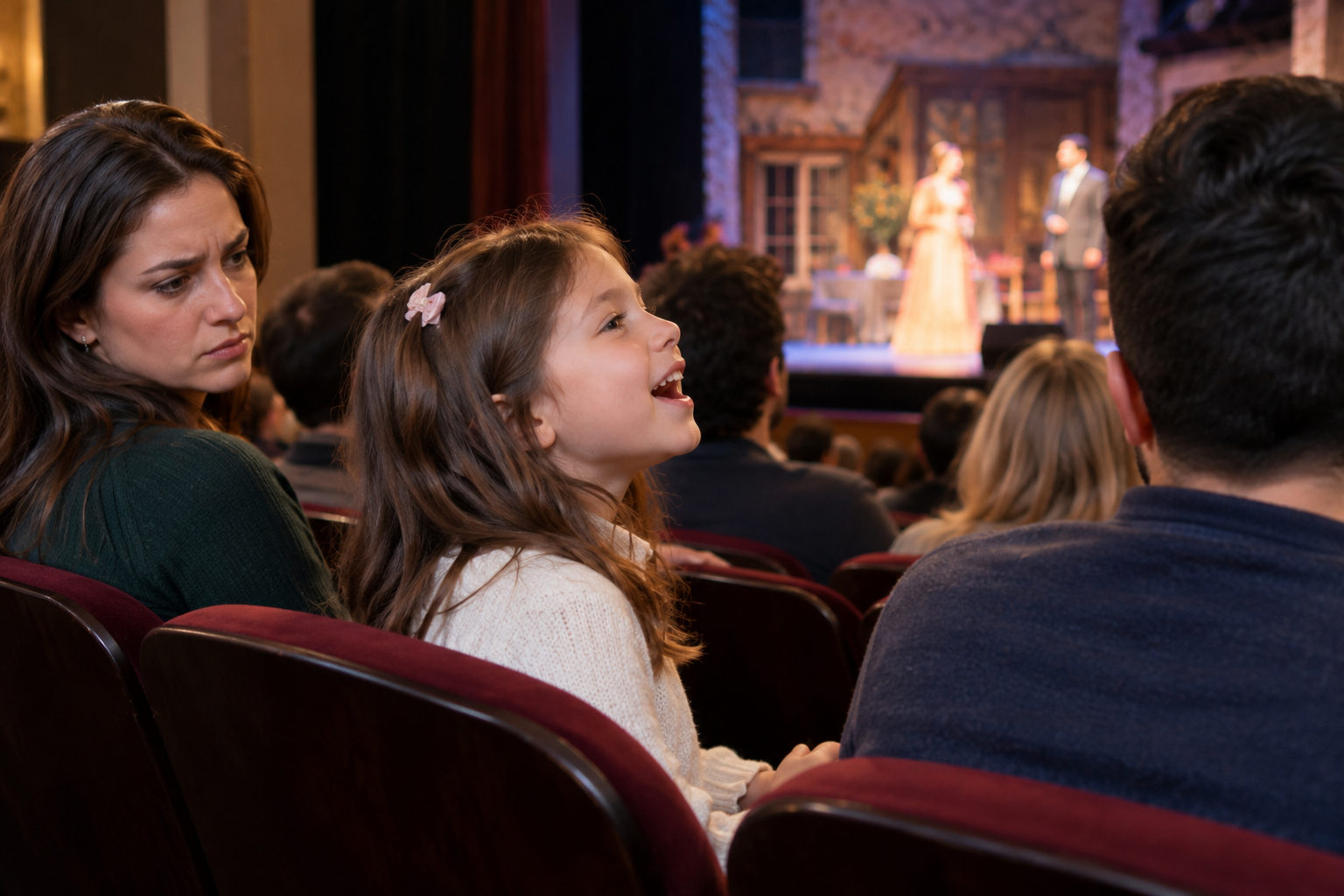
I never expected a simple evening at the theatre to turn into an uncomfortable confrontation with complete strangers, but that is exactly what happened. I had been looking forward to this particular performance for weeks because live theatre is something I genuinely enjoy. I love the atmosphere, the music, the actors, and the feeling of watching a story unfold on stage without distractions. Tickets were not cheap, so I had planned the evening carefully and wanted to enjoy every moment. Unfortunately, a family sitting near me had a young child who began singing along with the performers, and what initially seemed like a harmless moment eventually became a frustrating experience that left me questioning whether I had handled the situation correctly.
The performance was a popular musical, and the theatre was almost completely full. People had dressed nicely, arrived early, and settled into their seats while waiting for the show to begin. I was sitting several rows from the stage, close enough to appreciate the actors’ expressions and hear the music clearly. A family sitting nearby consisted of two adults and a child who looked to be around seven or eight years old. When the first musical number began, the child immediately started singing along. At first, I did not think much of it because children sometimes get excited when they recognize a song. I assumed the excitement would pass once the performance continued.
However, the singing did not stop after the first song. The child continued singing loudly during almost every musical number, sometimes trying to match the performers and sometimes singing the lyrics a little ahead of them. Whenever the audience became quiet during a softer moment, the child’s voice was especially noticeable. I could see several people around us glancing toward the family, and a couple of audience members shifted in their seats as if they were struggling to concentrate. I tried to ignore the noise because I did not want to become the kind of person who complains about every little thing. Still, as the performance continued, I found it increasingly difficult to hear the actual actors.
What bothered me most was that the child’s parents did not seem particularly concerned about the situation. They occasionally smiled at the child, and at one point, I even noticed one of them quietly encouraging the singing. I understand that parents enjoy seeing their children happy, and I am not against children expressing excitement. However, I felt there was a difference between allowing a child to enjoy a musical and letting them sing loudly over professional performers while hundreds of people were trying to watch. This was not a family sing-along event or a concert where audience participation was encouraged. It was a live theatre performance, and most people had paid for the opportunity to hear the actors and musicians.
I spent a considerable amount of time debating whether I should say anything. I did not want to embarrass a child or start an argument with strangers in the middle of a performance. I also knew that some parents become defensive when someone comments on their children’s behavior, even if the request is reasonable. For a while, I simply leaned back and tried to focus on the stage, hoping that the child would eventually become tired or lose interest. Unfortunately, every new song seemed to excite the child even more. By the time the next major musical number began, I had missed several important lines of dialogue and was becoming genuinely frustrated.
Eventually, during a brief pause between songs, I turned toward the family and politely asked whether they could encourage their child to sing a little more quietly. I tried to keep my voice calm and respectful because I did not want to create a scene. I explained that I was having trouble hearing the performers and hoped we could all enjoy the rest of the show. I did not insult the child, raise my voice, or demand that the family leave. I thought I had made a reasonable request in a courteous way. However, the parent closest to me immediately looked offended and asked why I had a problem with a child enjoying the performance.
I explained that I had no problem with the child enjoying the show, but the singing was loud enough to interfere with the performance for people sitting nearby. I pointed out that the actors were working hard on stage and that the audience had come to listen to them rather than to another audience member singing over their voices. The parent responded that the child was only young and should not be expected to sit perfectly still and silent for an entire show. I agreed that children should not be expected to behave like adults in every situation, but I still felt that parents should make an effort to help their children understand the expectations of a theatre. The conversation became increasingly awkward as the parent accused me of being unnecessarily rude and suggested that I should have more patience.
After our exchange, the parent appeared irritated and whispered something to the other adult. For a few minutes, the child became quieter, and I thought the issue had finally been resolved. However, the singing started again during the next musical number, although it was somewhat less frequent. I decided not to confront the family a second time because I did not want the entire evening to become an argument. I focused on the stage as best I could, but I still felt uncomfortable knowing that the parent believed I had been unreasonable. On our way out, I overheard someone nearby commenting that parents should teach children basic theatre etiquette, while another person said that children should be allowed to enjoy live performances without being criticized for every little thing. Hearing those opposing opinions made me wonder whether I had crossed a line by speaking up.
Now that I have had time to think about the situation, I am still unsure whether I was right to ask the child to stop singing. On one hand, I believe that attending a live theatre performance comes with an expectation of respecting the performers and other audience members. Everyone had paid for tickets, and I do not think it is unreasonable to expect parents to address behavior that repeatedly disrupts the show. On the other hand, I recognize that the child was young, excited, and probably did not understand how distracting the singing was to everyone around them. Perhaps I should have spoken to a theatre usher instead of addressing the parent directly. I never intended to ruin anyone’s evening or make a child feel bad, but I also do not think I should have to miss important parts of a performance because someone nearby refuses to keep their voice down. So, AITA for politely asking a child to stop singing during a live theatre performance, or should I have simply ignored it and allowed the parents to handle the situation in their own way?
Read Story…
AITA asking a kid to not sing at live theatre?
I Went to See Hamilton on Stage, but a Child Singing Every Word Turned the Entire Show Into a Nightmare
I had been looking forward to seeing Hamilton live for a long time. When I found out that the touring production was coming to Orlando, I knew I wanted to go. I had listened to the soundtrack countless times, watched performances online, and heard people talk about how incredible the show was in person. Finally getting the chance to sit in a theater and experience it live felt special to me. I bought my ticket, planned my evening, and arrived at the theater excited to enjoy every moment of the performance.
I am the kind of person who genuinely appreciates live theater. I love the atmosphere before the curtain rises, the quiet anticipation as the lights dim, and the feeling of watching talented performers bring a story to life right in front of you. There is something different about a live production that you simply cannot recreate at home. Every line, every song, and every movement feels more powerful when you are sitting in the audience, surrounded by people who have come together to experience the same thing.
Because of that, I believe there are certain basic rules of theater etiquette that everyone should understand. You do not have to be an expert in Broadway shows or know every traditional theater custom, but you should understand that the people around you have paid to watch the performance too. You can laugh when something is funny, react emotionally when a scene is moving, and applaud when appropriate. However, singing along to every song or talking loudly throughout the show is something entirely different.
I arrived at the theater with plenty of time to spare. I found my seat, settled in, and looked around at the audience. People were chatting quietly, checking their programs, and getting comfortable before the show began. There were couples, groups of friends, older theatergoers, and families with children. Nothing about the audience seemed unusual, and I had no reason to believe the evening would turn into an uncomfortable experience.
A family of three was seated beside me. There was a mother, another adult accompanying her, and a child who looked to be around ten years old. I noticed them when they arrived, but I did not think much about it. Hamilton is popular with people of different ages, and I understand that children can become enthusiastic about musicals. In fact, I think it is wonderful when young people develop an interest in theater, music, history, or the performing arts.
The child seemed especially excited about the show. Before the performance even started, I could tell that Hamilton was something they knew very well. They were talking enthusiastically, and the mother appeared pleased that the child was having such a good time. At that point, I assumed they would settle down once the performance began, just as most audience members do when the lights go out.
Then the show started.
The moment the first line was delivered, the child began singing or speaking along with the performers. At first, I thought it might be a brief burst of excitement. Perhaps the child had been waiting for that particular song and could not resist joining in for a few seconds. I tried to ignore it and focus on the stage, hoping the excitement would pass once the opening moments were over.
Unfortunately, it did not pass.
The child continued singing or reciting the words throughout the performance. Whenever a familiar line came up, the child said it aloud. Whenever a song began, the child sang along. It was not limited to one favorite number or a couple of especially exciting moments. From what I could hear, the child knew practically everything and seemed determined to perform every lyric right alongside the cast.
I tried to concentrate on the actors, but it became increasingly difficult. Hamilton has fast-paced lyrics, overlapping dialogue, and songs that depend heavily on timing and wordplay. Missing even a few lines can make a difference when you are trying to follow the story. Having another person recite those same lines beside you, sometimes loudly enough to compete with the performers, made it harder to hear what was actually happening onstage.
At first, I shifted my attention back and forth between the stage and the sound coming from the seat next to me. I adjusted my posture, tried to focus more carefully, and hoped that the child might eventually become tired or realize that the audience was supposed to listen. I did not want to create a scene. I had paid for my ticket because I wanted to enjoy the show, not because I wanted to spend the evening arguing with a stranger.
The mother occasionally joined in too. She did not sing every single line, but there were moments when I could hear her participating alongside the child. That made the situation even more frustrating because it suggested that the behavior was not something she was trying to manage. Instead, she seemed to regard it as part of the fun of attending the show.
I understand being excited. I really do. When someone loves a musical, hearing the songs performed live can be an emotional experience. The music might remind them of favorite memories, or they might have spent months waiting for the opportunity to see the production. A child who knows every lyric has probably listened to the soundtrack repeatedly and may feel an enormous amount of joy when those songs finally come alive onstage.
But there is a difference between feeling excited and expecting everyone around you to participate in that excitement.
The performers were the people who had come to deliver the show. The audience had come to watch them. The child was not part of the cast, and the theater was not a private living room where everyone could sing at whatever volume they wanted. There were dozens or hundreds of other people in the audience, and each of them deserved the opportunity to hear the performance clearly.
I kept trying to be patient. I told myself that perhaps the child would quiet down after the opening numbers. Then I thought maybe the mother would gently remind them to lower their voice. I did not expect the child to sit completely motionless or show the same level of restraint as an adult. Children sometimes whisper, shift in their seats, or react spontaneously to something exciting. That is normal.
However, this was not an occasional reaction. It was a continuous pattern that continued song after song.
By the time roughly thirty minutes had passed, I realized that I was no longer enjoying the performance the way I had expected. Instead of becoming absorbed in the story, I was constantly aware of the person beside me singing and speaking over the actors. I had spent a significant amount of money on a ticket and had been genuinely excited about this particular evening. Now I was struggling to hear a show I had wanted to experience for a long time.
I decided that I needed to say something.
I did not turn around angrily or raise my voice. I did not insult the child or accuse the mother of being a terrible parent. I understood that confronting someone in a theater could easily become awkward, and I wanted to handle the situation as politely as possible. My goal was simply to ask them to stop singing and talking so that the people around them could hear the performance.
I leaned toward the mother and quietly asked if they could please refrain from singing and talking during the show.
I thought the request was reasonable. I had not demanded that the child stop enjoying the music, and I had not asked the family to leave. I simply wanted them to listen instead of performing the songs aloud. I expected that the mother might feel a little embarrassed, apologize, or explain that the child was having trouble controlling their excitement. Even if she disagreed with me, I hoped we could find a way to keep the rest of the evening peaceful.
Instead, her reaction surprised me.
She looked at me as though I had just said something unbelievably cruel. Rather than acknowledging that their singing might be disturbing the people nearby, she defended the child’s behavior. She said she was not going to tell a child who loved the show and was extremely excited to see it that they could not sing.
I was stunned by that response.
Of course the child loved the show. That was obvious. Their enthusiasm was the reason they were singing along in the first place. But loving a performance does not automatically mean someone is entitled to interrupt the experience for everyone sitting nearby. If anything, I would have thought that someone who loved Hamilton so much would understand how important it was to hear the actual performers deliver the songs.
I also found myself wondering why the mother interpreted my request as an attempt to take away the child’s happiness. I had not told her that the child should not enjoy the musical. I had not complained about the child’s age or suggested that families should stay home. I had simply asked them not to sing and talk over a live performance.
There is a substantial difference between asking a child to behave appropriately in a shared public space and telling that child they are not allowed to enjoy something. Children can be excited and still learn that other people have needs too. In fact, situations like this can be opportunities for parents to teach consideration, patience, and respect for people outside their immediate family.
I did not continue arguing with her. I could tell that we were unlikely to agree, and I did not want a disagreement in the middle of the theater to become another distraction for everyone around us. There was also no guarantee that the family would stop singing even if I tried to explain myself further. I had made my request, she had rejected it, and the situation had reached a point where continuing the conversation would probably accomplish very little.
At that moment, I had to decide what to do next.
I could remain in my seat and try to tolerate the noise for the rest of the show. I could confront the mother again, risking a more heated exchange. Or I could speak to the theater staff and ask whether there was another way to resolve the problem.
I chose the third option.
I gathered my things, left the seating area, and found a member of the theater staff. I explained what had been happening and told them that I had politely asked the family to stop singing and talking, but the mother had refused. I did not demand that the family be removed or insist that anyone be punished. I simply explained that the noise was making it difficult for me to enjoy the performance and asked for assistance.
The staff responded by moving me to another seat.
I was relieved that they were willing to help. At least I had a chance to continue watching the show without sitting directly beside someone singing nearly every line. It was not the solution I had imagined when I purchased my ticket, because I had originally chosen my seat and expected to enjoy the performance from there. Still, moving was better than spending the rest of the evening frustrated and distracted.
As I settled into my new seat, I kept thinking about what had happened. I had gone to the theater expecting an ordinary evening of entertainment. Instead, I found myself questioning whether basic standards of public behavior had somehow become controversial.
I understand that people have different ideas about etiquette. Some audiences are more relaxed than others, and certain performances encourage participation. At a concert, singing along is often part of the experience. At a sing-along event, the audience is specifically invited to join in. Even some family-oriented productions encourage children to clap, respond, or participate in particular moments.
But this was not advertised as a sing-along version of Hamilton. It was a touring stage production, and people had purchased tickets to see the cast perform the show. The distinction matters because the expectations for those two experiences are different.
If I had knowingly purchased a ticket for an interactive performance where audience members were encouraged to sing, I would have had no reasonable basis for complaining about people participating. I would have understood what I was signing up for. But that was not the situation here. I expected a normal theatrical performance, where the audience listens while the actors and musicians do their jobs.
I also kept returning to the mother’s argument that she would not tell a child who loved the show not to sing. On one level, I can understand the emotion behind that statement. Parents want their children to feel happy, confident, and free to enjoy their interests. They do not want to embarrass them or make them feel that their enthusiasm is unwelcome.
However, parenting also involves teaching children that their actions affect other people. A child can love something deeply without being allowed to do absolutely anything they want in every setting. We teach children to use indoor voices in libraries, avoid running through crowded restaurants, and refrain from interrupting people when they are speaking. Those expectations do not mean that we dislike children or want to suppress their personalities.
They simply help children learn how to share public spaces with others.
I would have had a completely different reaction if the mother had acknowledged the issue and gently encouraged the child to sing quietly in their head. The child might have been disappointed for a moment, but that would not have destroyed their enjoyment of the show. They would still have been watching the performers, hearing the songs, and experiencing something they clearly loved.
Instead, the mother appeared to believe that her child’s excitement outweighed everyone else’s right to hear the performance. That attitude bothered me more than the singing itself. The child was ten years old, and children often rely on adults to help them understand what is appropriate in unfamiliar situations. If the adult sitting beside them believes that any request for consideration is unreasonable, how is the child supposed to learn those boundaries?
At the same time, I wondered whether I could have handled the situation differently. Perhaps I should have spoken to an usher immediately instead of addressing the mother directly. Perhaps my request came across more critically than I intended, even though I tried to be polite. I cannot know exactly how she interpreted my words, and I do not want to pretend that I handled every part of the situation perfectly.
I also recognize that live theater can be stressful for some children. A child might struggle to remain quiet because they are overwhelmed, anxious, or simply not accustomed to sitting through a long performance. Parents cannot always control every reaction, and I do not expect them to guarantee that their children will never make a sound in public.
But the mother’s response suggested that this was not an accidental outburst or a moment of difficulty. She explicitly defended the decision to sing because the child was excited. That made it harder for me to view the situation as something beyond her control.
The important question, in my opinion, is not whether children should be allowed to attend theater. Absolutely, they should, provided the production is appropriate for them and they are prepared for the experience. Introducing children to live performances can be wonderful. It can encourage an appreciation for music, storytelling, history, and the arts.
The question is whether attending a performance means that the audience must accept another person singing over the cast for the entire evening.
Everyone in that theater had made an effort to attend. Some people may have traveled a considerable distance. Others might have saved money for months to afford their tickets. Some could have been seeing Hamilton for the first time, while others might have loved the musical for years. We all had our own reasons for being there, but we were sharing the same space and the same performance.
The performers also deserved consideration. They were delivering a live production in front of a paying audience. Their work involved rehearsals, choreography, vocals, timing, and countless details that most audience members never see. Having a nearby audience member loudly recite their lines does not improve that work. It can distract other patrons and make it more difficult for people to appreciate the performance.
I am not claiming that a theater must be completely silent at every second. Audiences laugh, gasp, applaud, and sometimes react spontaneously. Those responses are part of live performance, and they can make a production feel vibrant and memorable. But there is a difference between reacting naturally to what is happening onstage and repeatedly speaking or singing the dialogue before the actors have finished delivering it.
One is an audience response. The other can interfere with the performance.
By the end of the evening, I was glad that I had asked the staff for help instead of allowing the situation to ruin the entire show for me. I did not want to spend the rest of the night exchanging dirty looks with the mother or wondering whether the child would sing louder after being confronted. Moving seats gave me the opportunity to return my attention to the production itself.
Still, the experience left me thinking about how people respond when someone politely asks them to consider others. The mother could have disagreed with me without treating me as though I had committed some terrible offense. She could have explained that her child was excited while still acknowledging that the singing was distracting. Instead, the conversation seemed to become a question of whether I was willing to tolerate the child’s behavior simply because the child enjoyed it.
And I do not believe enjoyment is a sufficient excuse for every kind of behavior.
If a child loves a movie, that does not mean they should be allowed to shout the dialogue in a crowded cinema. If a child loves a book, that does not mean they should be encouraged to read it aloud while everyone else is trying to study in a library. If a child loves music, that does not mean they should sing over a professional performance without regard for the people sitting around them.
The same principle applies to adults. An adult who knows every word of a musical should not assume that everyone else wants to hear them sing. Being enthusiastic about something does not exempt anyone from ordinary courtesy.
I have also thought about whether my decision to involve the theater staff was unfair to the family. I did not ask for them to be removed, and I did not insist that the mother change her parenting style. I asked for help because the situation was affecting my ability to watch the performance. The staff chose to resolve the issue by moving me, and I accepted that solution.
Some people might argue that I should simply have ignored the noise. Others might say that a ten-year-old deserves a little extra understanding, especially when seeing a beloved musical live. I can appreciate both perspectives to a certain extent. Patience is important, and not every minor disturbance deserves a confrontation.
However, thirty minutes of continuous singing and talking is not the same as a child whispering occasionally or becoming excited during a favorite song. By the time I spoke up, I had already spent a significant portion of the performance trying to ignore something that was repeatedly distracting me.
I did not go to Hamilton expecting a perfectly controlled audience or an experience without a single interruption. I went expecting to hear the performers I had paid to see. Asking for that seems reasonable to me.
I also do not think a parent should have to choose between supporting a child’s interests and teaching appropriate behavior. Those two things can exist together. A parent can celebrate a child’s love of theater while explaining that the best way to appreciate a live performance is to listen to the people onstage. A child can be excited without needing to make that excitement audible to everyone nearby.
Perhaps the mother believed that correcting her child would embarrass them or make the evening less magical. But I suspect the child could have enjoyed the show just as much while listening quietly. They already knew the lyrics. They did not need to sing every word aloud to prove that they loved the musical.
What I find most frustrating is that the situation could have been resolved so easily. A quiet reminder from the mother might have been enough. Even a simple acknowledgment of my request could have kept the interaction civil. Instead, a small issue of theater etiquette became an unnecessary conflict, and I ended up having to move seats during a performance I had been looking forward to seeing.
I am sharing this experience because I genuinely want to know how other people would have handled it. I know that audiences can be divided on questions involving children, public behavior, and how much consideration people should extend to strangers. Some people believe that children should be allowed to express themselves freely, while others believe that certain environments require everyone to follow particular expectations.
I do not think these positions have to be completely incompatible. Children should have opportunities to enjoy the arts, and adults should be patient when children occasionally behave like children. At the same time, parents should help their children understand that a theater audience is made up of many people, all of whom have come to experience the same performance.
I would never tell a child that they should not love Hamilton. I would never criticize a child simply for knowing every lyric or becoming visibly excited when a favorite song begins. I would not expect a ten-year-old to behave exactly like a seasoned theatergoer in every respect.
But I do believe that singing along loudly to an entire stage production is inappropriate when the audience has not been invited to participate.
I also believe that asking someone politely to stop a disruptive behavior does not automatically make you unreasonable or unkind. People should be able to communicate their needs without being treated as though they are attacking someone’s character. The mother’s disappointment did not mean my request was inherently wrong, just as my frustration did not mean that I wanted to spoil the child’s evening.
In the end, I attended the performance, encountered a problem, made a polite request, and sought assistance when the request was rejected. I did not shout at the family, insult the child, or demand that they leave. I accepted the theater staff’s solution and continued watching the show.
Now I am left wondering whether I was too sensitive about the noise or whether the mother was being unreasonable by insisting that her child’s excitement mattered more than the comfort of the surrounding audience.
So, Reddit, am I the asshole for asking a mother and her ten-year-old child to stop singing and talking during a live touring production of Hamilton, or was I justified in expecting them to follow basic theater etiquette?
A Night at the Theatre Turned Into an Unexpected Confrontation Over a Singing Child
I never expected a simple evening at the theatre to turn into an uncomfortable confrontation with complete strangers, but that is exactly what happened. I had been looking forward to this particular performance for weeks because live theatre is something I genuinely enjoy. I love the atmosphere, the music, the actors, and the feeling of watching a story unfold on stage. Tickets were not cheap, so I had planned the evening carefully and wanted to enjoy every moment. Unfortunately, a family sitting near me had a young child who began singing along with the performers, and what initially seemed harmless eventually became a frustrating experience that left me questioning whether I had handled the situation correctly.
The performance was a popular musical, and the theatre was almost completely full. People had dressed nicely, arrived early, and settled into their seats while waiting for the show to begin. I was sitting several rows from the stage, close enough to appreciate the actors’ expressions and hear the music clearly. A family sitting nearby consisted of two adults and a child who looked to be around seven or eight years old. When the first musical number began, the child immediately started singing along. At first, I did not think much of it because children sometimes get excited when they recognize a song.
I assumed the excitement would pass once the performance continued. After all, the child was probably thrilled to hear familiar music performed live, and I did not want to be overly sensitive about a little enthusiasm. I tried to focus on the stage and enjoy the opening number. However, when the next song began, the child started singing again, this time noticeably louder. I glanced toward the family, expecting one of the parents to gently remind the child to lower their voice, but neither seemed particularly concerned.
As the performance continued, it became clear that the singing was not going to stop on its own. The child sang along with almost every musical number, sometimes trying to match the performers and sometimes singing the lyrics ahead of them. Whenever the audience became quiet during a softer moment, the child’s voice was especially noticeable. I could still hear the music, but I was struggling to understand some of the actors’ lines. It was frustrating because I had paid to hear the professional performers, not someone sitting in the audience singing over them.
I tried several times to ignore the situation. I shifted in my seat, adjusted my attention toward the stage, and reminded myself that children do not always understand the expectations of a theatre. I also remembered being young and getting excited about things I loved. I did not want to become an adult who expected children to sit perfectly still and silent in every public place. Still, there is a difference between being excited and repeatedly making enough noise to interfere with other people’s experience.
What made the situation more frustrating was the parents’ apparent lack of concern. They occasionally smiled at the child, and at one point, one of them seemed amused by the singing. I understand that parents enjoy seeing their children happy, and I would not expect them to stop a child from quietly humming a familiar tune. However, this was a live theatre performance, not a family sing-along event. The performers were on stage doing their jobs, and the audience had gathered to watch and listen to them.
I noticed a few other people looking toward the family. One person sitting in front of me turned around briefly, while someone farther along the row exchanged an uncomfortable glance with their companion. Nobody else said anything, though, and I began wondering whether I was the only person who found the singing distracting. Perhaps everyone else had decided to tolerate it rather than risk an argument. I did not want to assume that their expressions meant they agreed with me, but I could tell that the noise was not going unnoticed.
During a particularly quiet scene, the child started singing again while one of the actors was delivering an important line. I missed part of the dialogue because the child’s voice was directly behind me. At that point, I felt that my patience was running out. I had paid for my ticket, arranged my evening around the performance, and genuinely wanted to enjoy the show. I did not believe that asking someone to lower their voice was unreasonable, but I was still hesitant because I knew the parent might take the request personally.
I spent a few more minutes debating whether to speak up. Part of me thought I should simply wait until the interval and mention the problem to a theatre usher. That would have avoided a direct confrontation and allowed someone responsible for managing the audience to handle the situation. Another part of me felt that a quiet, polite request would be quicker and less dramatic. I did not want the family to feel targeted, and I certainly did not want to interrupt the performance myself. Eventually, I decided to address the issue during a brief pause between songs.
I turned toward the family and politely asked whether they could encourage their child to sing a little more quietly. I kept my voice calm and tried not to sound angry. I explained that I was having trouble hearing the performers and hoped we could all enjoy the rest of the show. I did not insult the child, raise my voice, or demand that the family leave. I honestly thought it was a reasonable request that any parent could understand. Instead, the parent closest to me immediately looked offended and asked why I had a problem with a child enjoying the performance.
I was caught off guard by the reaction because I had not expected the request to become an argument. I explained that I had no problem with the child enjoying the show. I simply wanted to hear the actors without another voice competing with them. I also mentioned that the performance was taking place in a theatre, where audience members generally try to avoid talking or making unnecessary noise. I thought explaining my reasoning would help the parent understand that I was not criticizing the child personally.
Unfortunately, the parent did not seem interested in hearing my explanation. They responded that the child was only seven years old and should not be expected to sit perfectly still and silent for an entire performance. I agreed that children should not be expected to behave exactly like adults in every situation. However, I felt that asking a child not to sing loudly over professional performers was not the same as demanding complete silence or perfect behavior. I was asking for consideration, not punishment.
The parent then suggested that I should have more patience and remember that live theatre was supposed to be enjoyable for everyone, including children. I found that argument confusing because I agreed with the basic idea. Children should be able to enjoy theatre, and families should not automatically feel unwelcome at cultural events. But I also believed that enjoyment should not come at the expense of everyone sitting nearby. I wondered whether the parent would have reacted differently if another adult had been talking loudly throughout the performance.
I tried to keep my response respectful because I did not want to turn the situation into a public argument. I explained that I was not asking the child to stop enjoying the music altogether, only to avoid singing loudly enough to drown out the actors. I said that everyone had paid for tickets and deserved a reasonable opportunity to hear the performance. The parent shook their head and said that people had become too sensitive about children behaving like children. That comment made me feel as though my concern was being dismissed without any real consideration.
The other adult in the family finally joined the conversation. They said the child loved musicals and had been excited about attending this performance for a long time. I could understand that. It is wonderful when children discover something they enjoy, and I did not want to discourage that enthusiasm. However, the fact that a child loves something does not necessarily mean every expression of that excitement is appropriate in every setting. I tried to communicate that distinction, but the conversation had already become tense.
For a moment, I considered apologizing simply to end the disagreement. I did not enjoy arguing with strangers, especially when the lights were dim and the audience was waiting for the performance to continue. At the same time, I did not think I had said anything particularly offensive. I had made a polite request about a behavior that was disrupting my ability to hear the show. I felt uncomfortable that such a small request had turned into a discussion about whether I disliked children.
Eventually, the parent turned back toward the stage, clearly irritated. The child became quieter for a short time, and I hoped that the issue had been resolved. I focused on the performers and tried to put the awkward exchange behind me. For the next few minutes, I was able to enjoy the show without being distracted. I felt relieved because I had not wanted the evening to become a confrontation in the first place. Unfortunately, the quiet did not last very long.
When the next major musical number began, the child started singing again. This time, the singing was somewhat softer, but it was still audible over the performers during several moments. I considered saying something a second time, but I decided against it. I had already made my request, and I did not want to spend the rest of the performance arguing with the family. I also worried that another confrontation might disturb the other audience members even more than the singing itself.
I tried to concentrate on the stage, but I found myself feeling increasingly annoyed. Part of my frustration came from the fact that I had paid for an experience I was not fully able to enjoy. Another part came from the way the parent had responded to a request that I believed was reasonable. If they had simply acknowledged the concern and encouraged their child to lower their voice, the entire situation might have ended within seconds. Instead, I felt as though I had been made out to be a bad person for asking for basic consideration.
During the interval, I noticed people discussing the performance in the lobby. I did not approach the family again, but I overheard someone mention that a child nearby had been singing throughout the show. Another person said that parents should teach their children how to behave during live performances. Someone else argued that children should not be expected to remain silent for hours and that adults sometimes forget how difficult that can be. Hearing both perspectives reminded me that the situation was not as simple as I had initially thought.
I began questioning whether I should have handled things differently from the beginning. Perhaps I should have quietly spoken to an usher rather than addressing the parent directly. An usher might have been able to explain the theatre’s expectations without making the family feel personally criticized. On the other hand, I had not been aggressive or disrespectful, and my request had been brief. I still felt that asking politely was a reasonable first step, even if the parent disagreed with me.
I also thought about whether the child might have had a reason for behaving this way that I did not understand. I had no idea whether the child had sensory needs, developmental differences, or simply an unusually strong reaction to the music. I did not want to make assumptions about their behavior or suggest that the child was deliberately trying to annoy anyone. However, I also felt that parents were responsible for deciding whether their child could comfortably participate in a particular event and for helping them understand expectations when necessary.
By the end of the performance, I was disappointed that an evening I had anticipated for weeks had become such an uncomfortable experience. The actors had done a wonderful job, and there were several moments I genuinely enjoyed. Still, I knew I had missed parts of the show because of the repeated singing. I left the theatre wondering whether I had been unreasonable or whether the parent had simply refused to consider how their child’s behavior affected other people. I did not want to hold a grudge, but I could not stop thinking about the interaction.
Since then, I have discussed the situation with a couple of friends. One friend said I was completely justified because a live theatre performance is different from watching a movie at home or singing along at a concert. They pointed out that performers deserve to be heard and that audience members should respect the people around them. Another friend said that I should have been more understanding because the child was young and excited. According to them, directly approaching the parent might have embarrassed the child and made the situation more uncomfortable than necessary.
Now I am genuinely unsure where the line should be drawn. I do not believe children should be banned from live theatre or expected to behave perfectly throughout every performance. I also understand that parents cannot control every sound a child makes, and occasional excitement is part of life. However, I think there is a reasonable expectation that people will avoid repeatedly singing loudly over performers during a show. I asked the child to stop singing because I wanted to hear the performance, not because I wanted to shame anyone. So, AITA for politely asking a child to stop singing during a live theatre performance, or should I have ignored the situation and allowed the parents to handle their child’s behavior in their own way?