My Girlfriend Is Obsessed With Gerard Way as a Priest, and It’s Ruining Our Relationship
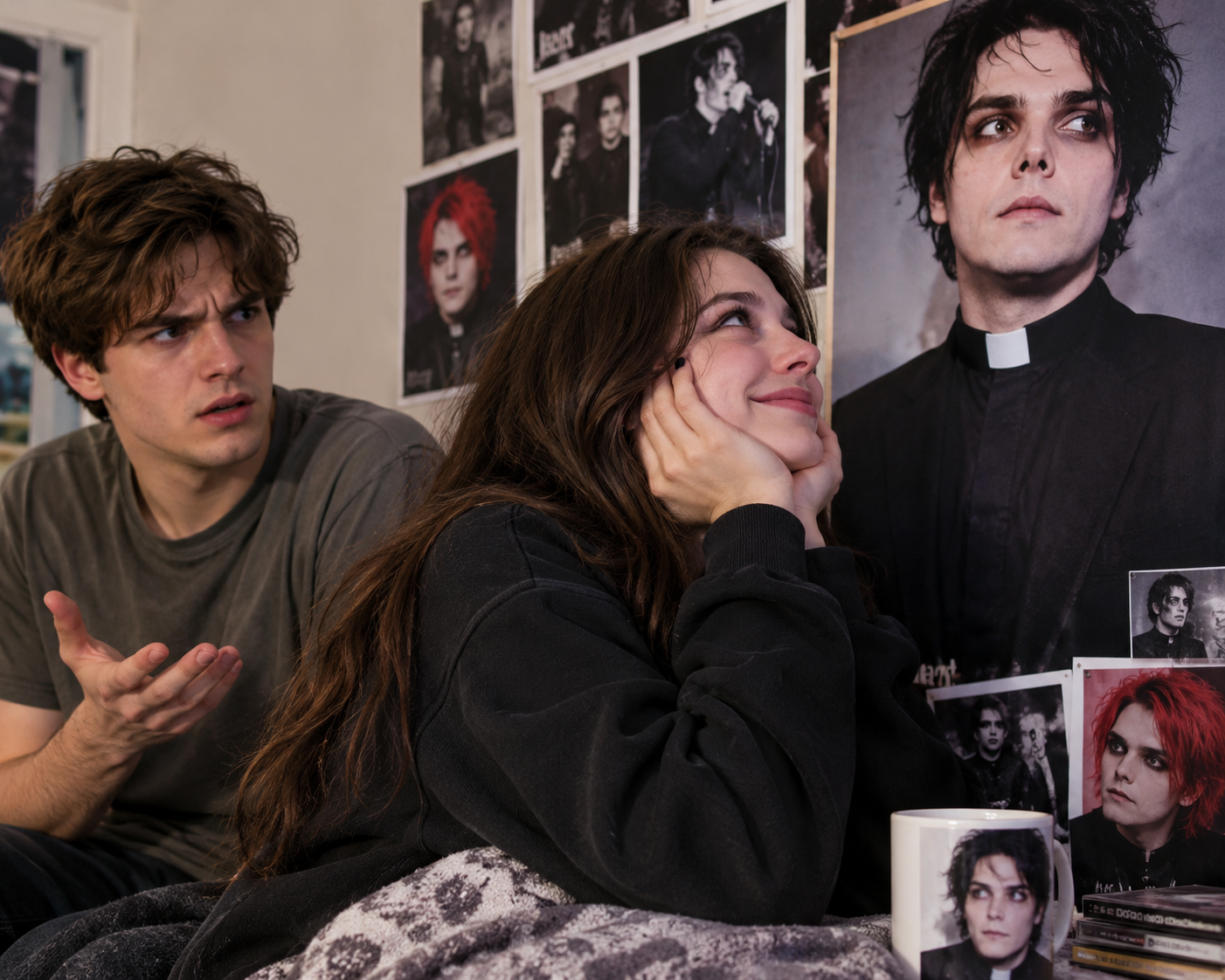
I never imagined that something as random as a celebrity fantasy could start causing serious problems in my relationship, but here I am, genuinely wondering whether my girlfriend and I are still on the same page. We have been together for a while, and until recently, I would have described our relationship as pretty normal. We have our differences, obviously, but we generally get along, enjoy spending time together, and understand each other. Then she developed an intense obsession with the idea of Gerard Way dressed as a priest, and somehow, it has become one of the biggest topics in her life. At first, I thought it was just a harmless internet joke or one of those random celebrity crushes people develop after seeing a particular picture or edit online. I laughed along with her because I honestly didn’t think much of it. Everyone has their own weird interests, and I have never expected my girlfriend to share every single one of mine. However, what started as an occasional joke gradually became something she brought up almost every single day. She would send me pictures, videos, fan edits, and memes featuring Gerard Way in priest-inspired outfits. Sometimes, she would interrupt an entirely unrelated conversation just to show me another edit she had found. I tried to be supportive and play along because I didn’t want to seem controlling or make her feel embarrassed about something she enjoyed. But eventually, I started noticing that this wasn’t just a passing interest anymore. It seemed like she had developed an entire fantasy around this particular version of him, and I was becoming increasingly uncomfortable with how much attention it was receiving in our relationship.
The first time I genuinely felt bothered by it was during what was supposed to be a nice evening together. We had planned to spend some quality time watching a movie, ordering food, and relaxing after a stressful week. I was looking forward to it because we had both been busy lately, and I wanted an opportunity to reconnect without distractions. Unfortunately, she spent a significant part of the evening scrolling through social media and showing me new Gerard Way edits. Every few minutes, she would laugh, make an excited comment, or start explaining why the priest aesthetic was apparently so attractive to her. I tried to redirect our attention toward the movie, but she kept checking her phone. Eventually, I asked her whether we could put our phones away and enjoy the evening together. She looked at me as though I had just said something completely unreasonable and told me that I was taking things too seriously. According to her, it was just a celebrity crush, and there was absolutely nothing wrong with enjoying something that made her happy. I understood her point, but that wasn’t really what bothered me. I wasn’t upset because she found a celebrity attractive, and I wasn’t asking her to stop enjoying the internet. I was upset because I had made an effort to spend time with her, yet I felt like I was competing for her attention against pictures of a man who didn’t even know she existed. When I explained that I felt ignored, she laughed and told me that I was being jealous over a fictional scenario. That response hurt more than I expected because I had hoped she would at least try to understand why I was frustrated.
Things became even stranger when her obsession started influencing our everyday conversations. I could bring up almost any subject, and somehow, she would find a way to connect it to Gerard Way as a priest. If we discussed music, she would mention him. If we watched a movie featuring a religious character, she would immediately start talking about how much better the character would be if Gerard played him. If I asked her what she wanted to do over the weekend, she might send me another fan edit before answering the question. She even started describing this imagined version of him in such detail that I sometimes wondered whether we were talking about an actual person or a character she had created in her mind. I tried asking her what exactly made this particular fantasy so appealing, partly because I genuinely wanted to understand her interest and partly because I hoped that talking about it would help me see the situation differently. She explained that she loved the aesthetic, the dramatic appearance, and the contrast between his usual image and the priest outfit. Fair enough. I could understand finding a particular look attractive without needing to share the same enthusiasm. The problem was that she seemed to expect me to participate in the obsession at the same level she did. If I didn’t react enthusiastically enough to a picture, she would tease me for being boring. If I changed the subject, she would accuse me of refusing to let her enjoy anything. I began feeling as though I had to pretend to be interested just to avoid another argument. I didn’t want to embarrass her or make fun of something she clearly enjoyed, but I also didn’t think it was unreasonable to want conversations that weren’t constantly dominated by the same celebrity fantasy.
What really made me question the situation was how defensive she became whenever I tried to explain that her behavior was affecting me. I never demanded that she delete her social media accounts, unfollow anyone, or stop looking at fan content. I simply asked whether we could establish some balance between her personal interests and the time we spent together as a couple. I wanted to feel like my presence mattered when we were together, rather than feeling as though I was just sitting beside her while she mentally occupied herself with an imaginary version of a celebrity. Instead of discussing that concern, she repeatedly framed the issue as me being insecure. She told me that Gerard Way was a celebrity, that the priest version was essentially a fantasy, and that I had absolutely nothing to worry about. I agreed that she wasn’t going to run away with a celebrity, but I tried explaining that the issue wasn’t whether she could realistically be with him. It was about attention, consideration, and the way she dismissed my feelings whenever I raised a concern. There is a difference between having an unusual interest and allowing that interest to interfere with your relationship. I started wondering whether I was being overly sensitive or whether I had simply reached my limit after months of hearing about the same thing. I even questioned whether bringing it up at all made me seem controlling, because I know that people deserve to have their own interests and fantasies regardless of whether their partners understand them. At the same time, I couldn’t ignore the fact that I had repeatedly expressed how I felt, and instead of trying to find a compromise, she kept turning the conversation into a debate about why my feelings were supposedly unreasonable.
Now I’m stuck trying to figure out what I should do next. I love my girlfriend, and I don’t want to throw away an otherwise meaningful relationship over something that might sound ridiculous when explained to other people. If I told someone that our relationship was struggling because of her obsession with Gerard Way dressed as a priest, I can already imagine how strange the story would sound. Some people would probably laugh and tell me to get over it, while others might understand that the celebrity itself isn’t the real problem. I don’t want to police her interests, and I certainly don’t expect her to stop finding other people attractive just because she is in a relationship with me. What I want is a partner who can recognize when something is affecting our connection and who is willing to listen without immediately dismissing my concerns. I’ve considered ignoring the whole situation and hoping the obsession eventually fades, but I’m worried that doing so will only make me more resentful. I’ve also considered having one final, serious conversation with her about what I need from this relationship and what I can no longer pretend doesn’t bother me. The difficult part is that I don’t know whether she will actually listen or simply accuse me of being jealous again. I know that nobody is obligated to share my perspective, but I do believe that partners should be able to discuss uncomfortable feelings without turning everything into a competition over who is right. So now I’m wondering whether this is just a harmless obsession that I need to learn to live with, or whether the real problem is that my girlfriend doesn’t seem willing to take my feelings seriously. Am I overreacting to an unusual celebrity crush, or is it reasonable to be concerned when something that started as a joke begins affecting the quality of our relationship?
Read Story…
My girlfriend is obsessed with ‘Gerard Way as a priest” and it’s destroying our relationship
I am not The OOP, OOP is u/WonderfulFuel9362
My girlfriend is obsessed with ‘Gerard Way as a priest” and it’s destroying our relationship
Originally posted to r/whatdoido & OOP’s own page
Thanks to a longtime lurker for suggesting this BoRU
TRIGGER WARNING: Obsessive behavior
Original Post Oct 25, 2026
Okay, this might seem unbelievably stupid in so many ways but I swear to go this is true and I think I’m going crazy. I’m french, sorry if my english is not perfect, I know this is clumsily written but this situation is so bizarre, I didn’t know how else to word this.
I’ve already posted about this issue on another subreddit but the thread was deleted and I was banned because people thought I was trolling. I can assure you it’s not the case and I am as baffled as this situation as you guys are
I am 24m and she’s 26f
For context, I met my girlfriend a year ago, we initially bonded over our mutual love for music and especially pop punk from the early 2000s. She’s always been a big fan of my chemical romance, enough to participate actively in their fandom, reading fanfiction or making fanart. At first I didn’t mind it at all, in fact I really like this band and I really enjoyed her being passionate about something she loved but things have taken a really weird turn.
A few months ago, she started talking about fanfiction she was reading about Gerard Way (the lead singer of my chemical romance) being a homosexual priest. I thought it was really bizarre but I didn’t want to shame her for liking something a bit weird. But as the weeks went by she started talking about him more and more to the point where she would bring him up almost every day.
The breaking point was when we were leaving a screening for the backrooms movie and instead of talking about the movie she just watched, she instantly started talking about gerard way as a priest again, telling me how much she “wished he was real” and stuff like that. I then got a bit upset and asked her jokingly if she would leave me if she met him and she said bluntly “without hesitation’ (why the fuck would she say that ?????)
Ever since that day, I’ve been going crazy, she spends her days scrolling through images of Gerard Way dressed as a priest (you’d be shocked how many there are), she brings him up in every discussion. She started giving him nicknames : “gerard priest” “gégé” “daddy gerard (I swear this is true and I truly think those nicknames might have been the reason my post was deleted. I know this sounds like a joke : it is not.) I’ve tried talking to her about it and every time I do she gets extremely defensive. She’s asked my countless time to roleplay as if I was him which I relunctantly did and she always ends up disappointed because “I’m not selling it” or not “good enough”
There’s also one thing that I failed to mention in the previous post that was deleted. Ever since we started living together, she’s been decorating the apartment with handmade posters and random things she prints that she glues on the walls. At first I thought it was cute and fun. But ever since her fixation on Priest Gerard started, she’s been putting them everywhere in the apartment at a very fast rate to the point I barely recognize our living space. She keeps telling me she does that because she thinks it’s funny and looks cool but to me it looks insanely weird.
All of this is making me extremely worried and also a bit insecure. We both work from homes and have almost no deadlines, she started neglecting her work and our relationship. A lot of people on the r/relationship subreddit told me she was matbe going through a manic episode or a psychotic episode. She’s definitely acting very weird and has changed a lot in a small amount of time but she isn’t acting erratic or overly energetic and she doesn’t seem to have any delusions that I know of. She just seems off, distant and irritable.
The only freaky behaviour that I noticed from her was when I took one of the gerard pictures off our kitchen wall (the water had torn it to shreds so I threw it in the trash.) I found her 2 hours later in our kitchen. She had been looking for it for 30 minutes. When I told her what I did she almost burst into tears and didn’t speak to me for the rest of the day. That was the only time where I would definitely say she seemed mentally unwell, this was very out of character and shockingly over the top.
I don’t want to break up with her, she’s a wonderful person and before her fixation started, everything was going very well. She’s an extravagant person that I care for deeply, I just wish she could tone this down.
I asked the r/relationships subreddit for help and also I talked about it with my friends and everybody seems convinced I need to very carefully bring this up to my girlfriend without hurting her feelings. I haven’t tried yet because I am unsure of what to say and tbh I’m also a bit scared of what could happen. Please, I beg you to take this seriously, I swear this is not a troll
What should I do?
Tldr : my girlfriend is in love with the concept of “gerard way as a priest” and is growing increasingly distant and weird because of it
RELEVANT COMMENTS
Panorpheus
It would be more than valid to leave psychosis girl over this. Knew a german girl who had a comparable obsession over a specific Schlagermusik singer. – By now, 15 years later, she’s in full blown denial of reality over it, when I met again her a few years back, in the same conversion thinking she is actually together with him or that she has a boyfirend looking the same as him.
OOP
I actually thought she was going through a manic episode at first but she’s not acting overly energetic or anything like that. She was already extravagant and maybe a bit neurodivergent but I don’t think she’s actually in full-blown psychosis. Should I try to convince her to see a therapist ? Or talk about it to her parents?
~
kn1vesout
Not the unholyverse mention on relationships. I think you can tell her that her preoccupation (maybe don’t use the worse obsession) is making you feel neglected in your relationship and that it has seemed to become the priority in her life, which is worrying you. I think that she won’t stay obsessed with this forever, but it’s still worth it to bring up that it is impacting her real life.
I don’t think she’s in psychosis as other people are saying, or even that she fully believes this character is a true representation of the real life gerard way. Fanfiction is pure fiction, hopefully she realizes that even if she is obsessed. Good luck lol.
OOP
Thank you, the comments telling me she was in psychosis were actually starting to make me pretty worried. She definitely doesn’t talk about it being real at all, she just “wishes he was real”. I’m sorry if the word “obsession” came off as rude, her preoccupation is just way more intense than the usual. I’ll try to tell her that this is starting to worry me a lot and that I feel neglected
~
Ill-Caterpillar-4339
That doesn’t sound healthy, but I’m not sure you’d get her to accept any help for it, unless her friends and family agreed it was a problem.
That’s assuming you’re even familiar with her support structure, if you don’t know her friends or family well enough to approach them about this, then I don’t think there’s much you can do but leave.
You definitely don’t sound like you like the way things are, and the way it’s going she may end up leaving you anyway and then you’d have spent more time miserable for nothing.
OOP
I met her family at least two or three times before and I’m familiar with a lot of her friends and though they have noticed her obsession has gotten pretty intense, they don’t seem to think it’s that big of a deal. I haven’t brought it up that much to her support structure though, I don’t want to alienate her from them and be the guy who talks shit about his girlfriend to her own friends. Do you think I should talk to them about it in greater detail ? I honestly don’t know if I’m overreacting or if my wording makes it look way more insane than it actually is
EDIT : I am a bit overwhelmed by the amount of responses on the post. I will answer later, I just need time to process all of this. Thank you for your support.
Update Oct 26, 2026 (Next Day)
The r/whatdoido mods have deleted my post. I don’t know why they did but maybe it’s for the best, I don’t want this to spread any further, all of this was pretty embarassing. I’ll just leave you with a final update that I posted mere minutes before everything was deleted, thank you for your support (except those who just made fun of me, I guess I can’t blame you guys either) :
I feel obligated to update you guys about this situation since it has gotten such a massive amount of attention over the past 24 hours. A lot of people have given me very useful advice while others have been mocking me and my relationship which I expected (though not to that extent). All this attention has been very stressful and overwhelming especially considering how badly things have turned out since.
Basically, shorty after my last update, my girlfriend texted me that we needed to talk. I went into the living room and she was furious and heartbroken. My last post was shared on the my chemical romance subreddit and the fandom reposted it all over tumblr and twitter. It was stupid of me not to consider that she would see it, especially after it started spreading wildly. We argued for a while, she screamed at me that I violated her privacy by sharing those pictures on the internet. She was upset that I didn’t respect her passions and that I never once tried to understand why she would like such things. She claimed that most of the things I complained about were jokes or done for fun which I disagree completely with : I know how she acts when she jokes around and it never felt like it.
I tried telling her that her behaviour, according to a lot of people on reddit, might indicate that she might be going through a psychiatric episode of some kind and that she may need help. Maybe it wasn’t the best idea, but things were getting pretty bad and I didn’t know how to be tactful. Of course, she didn’t react well at all and she told me that “the internet doesn’t live with her” which is fair. She then started comparing me to priest gerard and she got extremely mean about it (she brought up things about my looks, my attitude and even very intimate things that I won’t detail here).
I was very hurt by this whole argument. I, of course, phrased my grievances very badly, but her tone and her mean comments made me very angry. In the heat of the moment I gave her an ultimatum and asked her to choose between me and priest Gerard (I can’t believe I’m writing this). She responded by saying that it “won’t be me anyways”.
I was heartbroken so I packed a few things and I left. I slept at my mother’s house that night, it was of course pretty hard to explain to her what happened, it truly feels like I’m waking up from a fever dream. I don’t know what to do next but there won’t be anymore updates to this story. I have no idea how things turned out this way, I barely recognize the person I fell in love with a year ago.
Needless to say, I won’t be listening to mcr anytime soon. What a fucking shitshow
How My Girlfriend’s Unusual Celebrity Obsession Started Affecting Our Relationship
I never imagined that I would find myself questioning my relationship because of a celebrity obsession, but here I am, genuinely wondering whether I am being unreasonable or whether my girlfriend has taken things too far. My girlfriend and I have been together for a while, and for most of our relationship, things have been pretty good. We have always had different interests, different senses of humor, and different ways of spending our free time, but those differences never really bothered me. In fact, I always thought they made our relationship more interesting. I never expected her to share every hobby I had, and I certainly never expected her to stop finding celebrities attractive just because she was in a relationship with me. However, over time, she developed an intense fascination with the idea of Gerard Way dressed as a priest, and what initially seemed like a harmless internet joke gradually became something that started affecting our everyday interactions. At first, I laughed along with her because the whole thing seemed so random that it was difficult to take seriously. I assumed she would enjoy the joke for a few days, share some memes with her friends, and eventually move on to something else. Unfortunately, that never happened. Instead, the obsession seemed to grow stronger, and before I realized what was happening, it had become one of the most frequent subjects of conversation in our relationship.
For anyone who doesn’t know, Gerard Way is the lead vocalist of My Chemical Romance, and my girlfriend has become particularly fascinated with the aesthetic of imagining him dressed as a priest. I am not going to pretend that I understand the appeal, but I also recognize that people can find unusual things attractive. Everyone has their own preferences, and I have no intention of judging somebody simply because their celebrity crush happens to be unconventional. The problem is not that my girlfriend finds Gerard attractive or enjoys looking at fan-made edits. The problem is the sheer amount of attention she gives this particular fantasy and the way it has started interfering with our time together. What began as an occasional joke has turned into something she brings up constantly. She sends me pictures, videos, memes, fan edits, and fictional scenarios involving this version of him. Sometimes, she sends several messages in a row explaining why a particular edit is perfect, expecting me to react with the same enthusiasm she feels. I initially responded positively because I wanted to show that I supported her interests, even when I did not personally understand them. However, after weeks of hearing about the same subject almost every day, I began feeling exhausted. I tried to keep my reactions lighthearted because I did not want to hurt her feelings, but I started wondering whether there was any limit to how much of our relationship this obsession would occupy.
One of the first moments when I realized that this was becoming a genuine issue happened during a quiet evening we had planned to spend together. We had both been busy with our responsibilities, and I was looking forward to relaxing with her without having to worry about anything else. We ordered food, settled onto the couch, and chose a movie that we had both wanted to watch. For the first few minutes, everything seemed normal. Then her phone buzzed, and she immediately picked it up to check a notification. I did not think much of it because everyone checks their phone occasionally. However, she suddenly started laughing at something on her screen and turned the phone toward me to show me another Gerard Way priest edit. I looked at it, smiled politely, and returned my attention to the movie. A few minutes later, she showed me another one. Then another. Eventually, she started scrolling through an entire collection of edits while the movie continued playing in the background. I tried making a few comments about the film, hoping she would put her phone down and join me in watching it, but she barely responded. After a while, I gently asked whether we could take a break from our phones and enjoy the evening together. She looked at me with genuine confusion and asked why I was suddenly being so serious about something that was supposed to be fun.
I explained that I was not angry about the pictures themselves, but I had been looking forward to spending time with her. I told her that it was difficult to enjoy a movie together when she was constantly distracted by her phone and seemed much more interested in fan edits than in the evening we had planned. I expected her to understand what I meant, or at least acknowledge that I had a point. Instead, she laughed and said I was acting jealous over a celebrity who did not even know she existed. That response caught me off guard because jealousy was not really what I was trying to communicate. I had no genuine fear that Gerard Way would somehow appear in our lives and steal my girlfriend away. I understood that the whole thing was a fantasy, and I was not asking her to abandon it. I simply wanted to feel that the time we spent together mattered to her. I tried explaining this distinction, but she seemed convinced that my frustration could only come from insecurity. Eventually, I stopped arguing because the conversation was going nowhere. We finished the evening, but the atmosphere felt different. I had wanted a relaxing night with my girlfriend, yet I ended up feeling as though I had to compete with her phone for even a small amount of attention.
After that evening, I started noticing the obsession in situations where I had previously never expected it to appear. We could be discussing something completely unrelated, such as our plans for the weekend or what we wanted to eat, and she would somehow find a way to bring up Gerard Way. Sometimes, the connection was so random that I genuinely struggled to understand how the conversation had reached that point. If we discussed music, she would mention him. If we watched a movie featuring a religious character, she would immediately start imagining Gerard in the role. If I showed her a picture of an outfit I liked, she might compare it to the aesthetic she associated with her favorite fantasy. At first, I found some of these moments amusing because they were so unexpected. Eventually, however, the repetition became exhausting. I began feeling as though I could predict exactly where every conversation would go. It was not that I wanted to ban the subject from our relationship or demand that she never mention him again. I simply missed having conversations that could develop naturally without eventually circling back to the same obsession. I wanted to talk about our lives, our interests, our goals, and the ordinary things couples discuss when they enjoy each other’s company.
The strangest part was that my girlfriend seemed to expect me to participate in the obsession as enthusiastically as she did. If she sent me an edit and I responded with a simple laughing emoji, she sometimes complained that I was not appreciating it properly. If she showed me a picture and I said that I did not really understand the appeal, she would insist that I needed to look at it more carefully. On a few occasions, she even sent me multiple edits in a row and asked which one I liked best, as though choosing between them was an important relationship activity. I tried to be accommodating because I knew that sharing something you enjoy can be a way of connecting with someone you love. When your partner is excited about something, it can feel disappointing if they do not share your enthusiasm. I understand that feeling, and I never wanted to make her believe that her interests were stupid. However, there is a difference between occasionally participating in your partner’s hobby and feeling obligated to demonstrate enthusiasm every time they bring it up. I started worrying that any honest response would be interpreted as rejection or criticism. Rather than enjoying our conversations, I found myself carefully choosing my words to avoid another disagreement over whether I was being supportive enough of her latest discovery.
Eventually, I decided to ask her directly what made this particular fantasy so appealing to her. I was genuinely curious, and I hoped that understanding her perspective might help me become less frustrated. I asked whether it was the dramatic clothing, the overall aesthetic, the contrast between his usual image and the priest outfit, or simply the absurdity of the concept that made it so entertaining. She became excited immediately and started explaining everything she liked about it. She talked about the styling, the atmosphere, the way the imagined character looked, and how different it was from the usual celebrity images people shared online. She explained that the fantasy was not something she considered serious and that she simply enjoyed the creativity surrounding it. Listening to her, I could understand why she found it amusing. People develop all kinds of fictional crushes, and the internet is full of communities built around unusual celebrity fantasies. I was glad that she felt comfortable explaining something she enjoyed without feeling judged. For a little while, the conversation actually helped because I realized that the interest itself was not necessarily the problem. The problem was what happened when I tried to establish boundaries around how much space it occupied in our relationship.
I told her that I was happy for her to enjoy fan edits, discuss her celebrity crush, and share funny pictures with her friends. I was not asking her to change her personality or stop doing something that made her happy. However, I also explained that I wanted us to have time together when we could focus on each other. I suggested that when we planned a date night, watched a movie, or had an important conversation, we could both make an effort to put our phones away. I thought this was a pretty reasonable request because it was not directed exclusively at her. I was willing to follow the same rule myself. If I wanted us to spend quality time together, I needed to be present too. Unfortunately, she interpreted the suggestion as an attempt to control what she could look at on her phone. She asked why I cared so much about something that was not hurting anyone. I repeated that I did not care about the pictures themselves and that my concern was the lack of attention during the time we spent together. She responded that she should not have to change her behavior simply because I did not understand her interests. I tried explaining that compromise did not mean giving up something she loved, but she seemed to hear only a demand that she stop enjoying herself.
After that conversation, I started questioning whether I had approached the situation incorrectly. Perhaps I had waited too long to explain my frustration, allowing it to build until even a small mention of Gerard Way irritated me. Perhaps my reactions had become more negative than I realized, making my girlfriend feel as though I was judging her for something harmless. I considered whether I should simply ignore the subject whenever she brought it up and focus on the positive aspects of our relationship. After all, we still had good moments together, and I did not want one unusual obsession to overshadow everything else. I reminded myself that relationships require patience and that loving someone means accepting that they will have interests we do not understand. At the same time, I could not shake the feeling that I was being asked to accept more than the interest itself. I was being asked to tolerate repeated interruptions, distracted evenings, and dismissive responses whenever I tried to discuss how I felt. Those things seemed more important than the celebrity fantasy that had originally triggered the problem. I wanted to be fair to her, but I also wanted to be fair to myself.
The situation became particularly frustrating when I noticed how often she checked her phone during conversations that mattered to me. There were times when I wanted to tell her about something that had happened during my day, discuss a problem I was dealing with, or share something that genuinely excited me. I would begin explaining the situation, and she would listen for a while before glancing at her screen. Sometimes she would interrupt herself to check a notification, and other times she would suddenly remember an edit she wanted to show me. I tried not to react immediately because I knew that people can become distracted without intending to be rude. However, after it happened repeatedly, I started feeling that my conversations were being treated as less interesting than whatever appeared on her phone. One evening, I was explaining something that had been bothering me, and she suddenly interrupted to show me a new fan edit she had found. I stopped talking and waited for her to finish. When she asked me to continue, I had already lost the motivation to explain everything. She noticed that I had gone quiet and asked why I was acting strangely. I told her that I did not feel like talking anymore because I had not felt listened to in the first place. She apologized briefly, but the conversation quickly shifted back to her frustration that I seemed increasingly annoyed whenever she mentioned Gerard.
What made the situation harder was that my girlfriend did not appear to recognize the difference between criticism of her behavior and criticism of her interests. Whenever I explained that I felt ignored, she responded as though I had told her that her celebrity crush was embarrassing or unacceptable. She would defend her right to enjoy fan content, explain that plenty of people had unusual celebrity crushes, and remind me that she was not actually involved with anyone else. I agreed with all of those points. She had every right to enjoy her interests, and I had never accused her of cheating. However, those arguments did not address the problem I was trying to discuss. I was not asking whether her fantasy was morally acceptable. I was asking whether she could recognize that our relationship needed attention too. It was frustrating to repeat the same explanation in different ways and still feel misunderstood. Eventually, I began wondering whether she genuinely could not see my perspective or whether she simply did not want to acknowledge it because doing so would require her to change something about her routine. I did not want to assume the worst about her intentions, but I was struggling to understand why such a simple request had turned into such a persistent disagreement.
I also started thinking about how differently we seemed to define quality time. For me, spending time together meant being engaged in what we were doing, even if the activity itself was simple. We did not need expensive dates, elaborate plans, or constant entertainment. Sometimes I was perfectly happy sitting together, talking about our day, watching a show, or sharing a meal. I just wanted to feel that we were both present. My girlfriend, on the other hand, seemed comfortable doing several things at once. She could sit beside me while scrolling through social media, laughing at memes, and messaging her friends without feeling that anything was wrong. From her perspective, we were still spending time together because we were physically in the same place. I began to realize that some of our frustration might come from this difference in expectations. Neither approach necessarily makes someone a bad partner, but problems arise when two people have different expectations and neither is willing to discuss a compromise. I was willing to accept that she enjoyed multitasking, but I wanted certain moments to be reserved for us. I hoped we could find a balance that respected both of our preferences instead of turning every request for attention into an argument about jealousy.
One day, I decided to approach the subject differently by asking her how she would feel if our positions were reversed. I did not want to invent an elaborate scenario or deliberately make her jealous. I simply wanted her to imagine what it would be like if I constantly interrupted our conversations to look at pictures of a celebrity I found attractive. I asked whether she would be comfortable if I spent our planned date nights scrolling through edits of that person, repeatedly brought them into unrelated conversations, and expected her to react enthusiastically whenever I shared something new. She initially said that she probably would not care because she trusted me. I accepted that answer and explained that trust was not the issue for me either. I was not worried that she would leave me for Gerard Way. I wanted to know whether she would still feel comfortable if the behavior began affecting the attention and connection we shared. She paused for a moment, then said that she might become annoyed if I talked about the same person constantly. I thought we were finally getting somewhere. However, when I pointed out that this was essentially what I had been trying to explain, she became defensive again and said the situations were different because her interest was funny and mine would probably be annoying. I did not know how to respond to that without starting another argument.
Over the following weeks, I tried to make a conscious effort not to react negatively every time she mentioned Gerard. I reminded myself that I did not want to become the kind of partner who made someone feel embarrassed about harmless interests. When she sent me a funny edit, I sometimes laughed and responded normally. When she talked about the aesthetic, I listened without immediately trying to change the subject. I even made a few jokes of my own because I wanted to show her that I could participate without feeling threatened. For a while, things seemed better. She appeared happier because I was no longer questioning every reference, and I felt less frustrated because I was making an effort to separate the obsession itself from the way it affected our relationship. Unfortunately, the improvement did not last. As I became more accepting, she seemed to assume that I had completely stopped caring about the issue. The frequency of the interruptions increased again, and our evenings gradually returned to the same pattern. Whenever I tried to redirect our attention, she reminded me that I had previously said I was fine with her interest. I found that particularly frustrating because being fine with an interest was not the same as agreeing to give it unlimited space in every situation.
At that point, I started wondering whether the issue had become more about our communication than about the original obsession. I could accept that she enjoyed something I did not understand, and she could reasonably expect me not to mock her for it. However, I also expected to be able to express discomfort without being accused of insecurity. I wanted us to be able to say, “This bothers me,” or “I need something different,” and then work together to find a solution. Instead, every conversation seemed to turn into a debate over whether my feelings were justified. I began choosing silence because I was tired of explaining myself. That created another problem because my girlfriend noticed that I was less talkative and assumed I was deliberately punishing her. I tried explaining that I was not giving her the silent treatment; I simply did not know how to raise the issue without causing another argument. She told me that if I had a problem, I should talk about it rather than becoming distant. I agreed with her in principle, but I pointed out that I had tried talking about it several times already. We were caught in a frustrating cycle where she wanted me to communicate openly, but the conversations themselves rarely led to any understanding or change.
The more I thought about our situation, the more I realized that I was not actually asking her to become a different person. I was not asking her to stop enjoying music, abandon social media, delete fan accounts, or pretend that she did not find Gerard attractive. I wanted the same consideration I believed I was giving her. If she wanted to share something exciting, I was willing to listen. If she wanted time to enjoy her hobbies independently, I was happy for her to have that space. All I wanted was for our relationship to receive attention when we were deliberately spending time together. I thought this was a reasonable expectation for two people who cared about each other. However, I began to wonder whether we had different ideas about what a relationship should look like. Perhaps she saw my request as an unnecessary restriction because she believed that being together did not require focused attention. Perhaps I was more sensitive to distractions than she was. Those differences could have been manageable if we had both been willing to understand each other. What worried me was not the existence of those differences but the repeated refusal to take them seriously. I did not need her to agree with every feeling I had, but I did need her to care enough to discuss them honestly.
There was also a part of me that felt embarrassed to admit how much the situation bothered me. If I explained the problem to a friend, I imagined having to begin the conversation by saying that my girlfriend was obsessed with Gerard Way dressed as a priest. The sentence sounded ridiculous even in my own head. I could picture someone laughing and telling me that I needed to find something more important to worry about. I worried that people would assume I was jealous of a celebrity or insecure about my appearance, even though those were not the concerns driving my frustration. Because the situation sounded unusual, I sometimes questioned whether I had the right to be upset at all. I compared it to more obvious relationship problems and wondered whether I was making a mountain out of a molehill. After all, my girlfriend was not having an affair, hiding a secret relationship, or making plans to meet someone else. She was enjoying fan content about a celebrity. On paper, that sounded harmless. But relationships are not judged only by whether someone has technically crossed a major boundary. Small patterns can also create distance when they repeatedly leave one person feeling ignored or dismissed. I eventually realized that the unusual subject did not make my feelings automatically unreasonable.
One evening, I decided that I needed to have a more serious conversation with her. I waited until we were both relaxed and neither of us was distracted by our phones. I told her that I wanted to discuss our relationship rather than argue about Gerard Way. I explained that I was not asking her to stop enjoying her fantasy, and I was not interested in telling her what she could or could not look at online. I told her that I missed feeling connected to her during ordinary moments. I missed having conversations where we both listened, watching movies without constant interruptions, and feeling confident that she was interested in what I had to say. I also explained that being repeatedly called jealous or insecure whenever I raised the issue had made it harder for me to speak honestly. I wanted her to understand that I was not trying to win an argument. I was trying to explain something that had been affecting my feelings toward our relationship. For once, I tried not to soften every sentence or make a joke to reduce the tension. I wanted her to hear the seriousness of what I was saying. She listened quietly for a while, and I hoped that this conversation might finally be different from the previous ones.
Her response was mixed. She admitted that she had probably been talking about Gerard more often than she realized and that she could understand why constant interruptions might become annoying. Hearing her acknowledge that made me feel relieved because it was the first time I felt that she was considering my perspective instead of immediately defending herself. She also explained that the obsession had become a source of entertainment for her, especially when she was stressed or bored. Looking through edits and sharing them with friends gave her something fun to focus on, and she had never intended to make me feel unimportant. I appreciated that explanation because it helped me understand her behavior without assuming that she was deliberately trying to hurt me. However, when I asked whether we could agree to put our phones away during planned date nights and important conversations, she hesitated. She said she did not want our relationship to become full of rules about what she could do. I told her that I did not see it as a rule about her interests. I saw it as a mutual agreement to give each other attention. We eventually agreed to try being more present during certain activities, although I could tell that she was still uncomfortable with the idea. I decided to give the compromise a genuine chance rather than expect everything to change overnight.
For a short period, the compromise seemed to work. During our next movie night, she kept her phone beside her rather than constantly checking it. We watched the film, talked about the ending, and even laughed about a few scenes together. It felt surprisingly refreshing to enjoy a simple evening without the usual interruptions. I realized how much I had missed that kind of connection. Later, she showed me a few Gerard edits, and I reacted positively because I genuinely felt less irritated when the subject did not dominate the entire evening. For the first time in a while, I thought we might have found a balance that worked for both of us. She could continue enjoying her interests, and I could feel confident that our time together would not always be interrupted by them. I did not expect her to change completely, and I did not think she needed to. I simply wanted the effort to be mutual. Unfortunately, as the days passed, I began noticing that the improvement depended heavily on whether I reminded her of our agreement. If I did not say anything, she gradually returned to checking her phone more frequently. That made me wonder whether she genuinely understood why the compromise mattered or whether she was only following it to avoid another argument.
The next disagreement happened when we were talking about plans for the weekend. I had suggested that we spend one afternoon together doing something outside the house because we had both been spending a lot of time indoors. She initially agreed, and I started looking forward to it. Later, when I asked what time she wanted to leave, she sent me a series of messages about a new collection of Gerard Way priest edits that had appeared online. I responded to the messages and then asked whether we were still planning our afternoon together. She said yes, but she wanted to spend some time looking through the edits first. I told her that was fine, as long as we still followed through on our plans. Somehow, the conversation turned into another argument about how I seemed annoyed whenever she enjoyed herself. I reminded her that I was not asking her to choose between me and a celebrity fantasy. I was asking whether we could stick to plans we had made together. She accused me of making her feel guilty for having fun, and I felt the familiar frustration returning. I had hoped our earlier conversation would help us avoid this exact situation. Instead, it seemed that we were back where we started, arguing about the meaning of a request that I believed should have been straightforward.
That disagreement left me thinking about the difference between intention and impact. I genuinely believed my girlfriend when she said she did not intend to make me feel ignored. I did not think she woke up every morning planning to frustrate me or deliberately ruin our time together. She was enjoying something that made her happy, and she probably did not realize how often it was affecting our interactions. However, good intentions did not automatically erase the impact of repeated behavior. If someone tells you that something you are doing is hurting them, you may not immediately agree with their interpretation, but you can still make an effort to understand why they feel that way. I was willing to recognize that my girlfriend’s interest was harmless in itself, even though I found its intensity overwhelming. I wanted her to extend the same understanding toward me. I did not need her to admit that her obsession was wrong or embarrassing. I needed her to acknowledge that the way we handled it together was creating tension. Without that acknowledgment, every discussion became an argument about whether I had the right to feel frustrated, and we never reached the point where we could actually solve the problem.
As the weeks passed, I began noticing changes in myself that I did not particularly like. I became less enthusiastic when my girlfriend wanted to share something with me because I was already anticipating another long discussion about the same subject. Sometimes, when she reached for her phone during a conversation, I immediately felt irritated before I even knew what she was checking. I knew that reaction was not entirely fair because people are allowed to use their phones and become distracted occasionally. I did not want to become suspicious or resentful over something that had once seemed funny. I also did not want to associate her happiness with frustration simply because we had failed to find a workable balance. That realization worried me because resentment can quietly damage a relationship even when the original problem appears small. I started asking myself whether I was allowing my frustration to become bigger than the situation deserved. At the same time, I recognized that repeatedly suppressing my feelings would not solve anything either. I needed to find a way to address the pattern without treating every mention of Gerard as a personal offense. I also needed to decide how much effort I could reasonably expect from my girlfriend before accepting that we might have different expectations about attention and communication.
I eventually told her that I did not want our relationship to become a constant argument about her celebrity crush. I explained that I was tired of repeating the same points and that I wanted us to focus on the bigger issue instead. I told her that she was free to enjoy her fantasy, share edits, talk about Gerard with her friends, and spend time in online communities dedicated to the subject. I had no desire to control any of that. However, I also told her that I needed our shared time to feel meaningful. I wanted us to follow through on plans, listen when the other person was talking, and take each other’s concerns seriously. I asked her to consider whether she could make those changes without feeling that she was sacrificing an important part of herself. I also promised to be more patient, avoid mocking her interests, and communicate my concerns before they turned into frustration. I hoped that approaching the situation as a shared problem rather than something she needed to defend would make a difference. She said she understood what I was asking, but she also admitted that she felt uncomfortable knowing that something she enjoyed had become a source of conflict between us. I told her that I did not want her to feel ashamed. I simply wanted both of us to feel respected.
Now I am trying to figure out what all of this means for our future. I still love my girlfriend, and I do not want to throw away a relationship that has brought me happiness simply because we have struggled with an unusual situation. We have shared good memories, supported each other through difficult moments, and enjoyed plenty of things together. I know that one frustrating aspect of a relationship does not automatically erase everything positive about it. At the same time, I cannot ignore the fact that our disagreements have revealed something important about how we handle each other’s feelings. I want a relationship where both people can maintain their individuality without making the other person feel unimportant. I want my girlfriend to have her interests, friendships, hobbies, and private fantasies, and I want the same freedom for myself. But I also want us to recognize that being in a relationship involves making room for another person’s needs. That does not mean agreeing with everything your partner says or abandoning every activity they dislike. It means being willing to listen, discuss boundaries, and make reasonable adjustments when a repeated behavior starts affecting the relationship. I do not think that expectation is unreasonable, although I am beginning to understand that we may need to work harder than I originally expected to put it into practice.
The most difficult part is that I still cannot tell whether I am making too much of an unusual celebrity obsession or whether I am finally recognizing a deeper compatibility issue. If the situation were limited to a few jokes, occasional memes, and some harmless fan edits, I would not care at all. I might even find the whole thing amusing. What bothers me is the pattern of distraction, the repeated arguments, and the feeling that my concerns are treated as attacks instead of opportunities to understand each other. I do not want to become the person who tells his girlfriend what she is allowed to enjoy, and I do not want her to feel that she must hide her interests to keep me happy. But I also do not want to spend the rest of our relationship pretending that I am fine with something that repeatedly leaves me feeling ignored. I believe there should be room for both of us to enjoy our own lives while still making each other a priority. I am willing to work on my reactions, communicate more clearly, and accept that her interests will sometimes be different from mine. What I need to know is whether she is equally willing to consider my perspective and make an effort to find a balance that works for both of us.
So, here is where I am right now. My girlfriend is still obsessed with the idea of Gerard Way as a priest, and I have no intention of asking her to abandon that fantasy entirely. I understand that it is a celebrity crush and an internet aesthetic, not an actual relationship that threatens our future together. I am not asking her to stop finding someone attractive, delete her fan accounts, or pretend that she does not enjoy the content. I am asking for more attention during the time we spend together and a little more consideration when I explain that something is bothering me. I want us to be able to enjoy a date without constant distractions, have conversations without repeatedly changing the subject, and discuss disagreements without turning them into accusations of jealousy or insecurity. I also recognize that I need to be patient and avoid treating every reference to her favorite fantasy as evidence that our relationship is failing. There has to be room for humor, individuality, and harmless obsessions in a healthy relationship. However, there also has to be room for honest communication and mutual respect. Am I overreacting to something that should be harmless, or is it reasonable to expect my girlfriend to make more of an effort when her obsession starts interfering with our relationship? I genuinely want an outside perspective because I cannot tell whether I need to relax and accept this as part of who she is or whether the bigger issue is that we have not figured out how to respect each other’s needs.