Woman Demands Parents Get Ear Piercings as a Condition for Future Visits After Dispute Over Baby’s Piercing
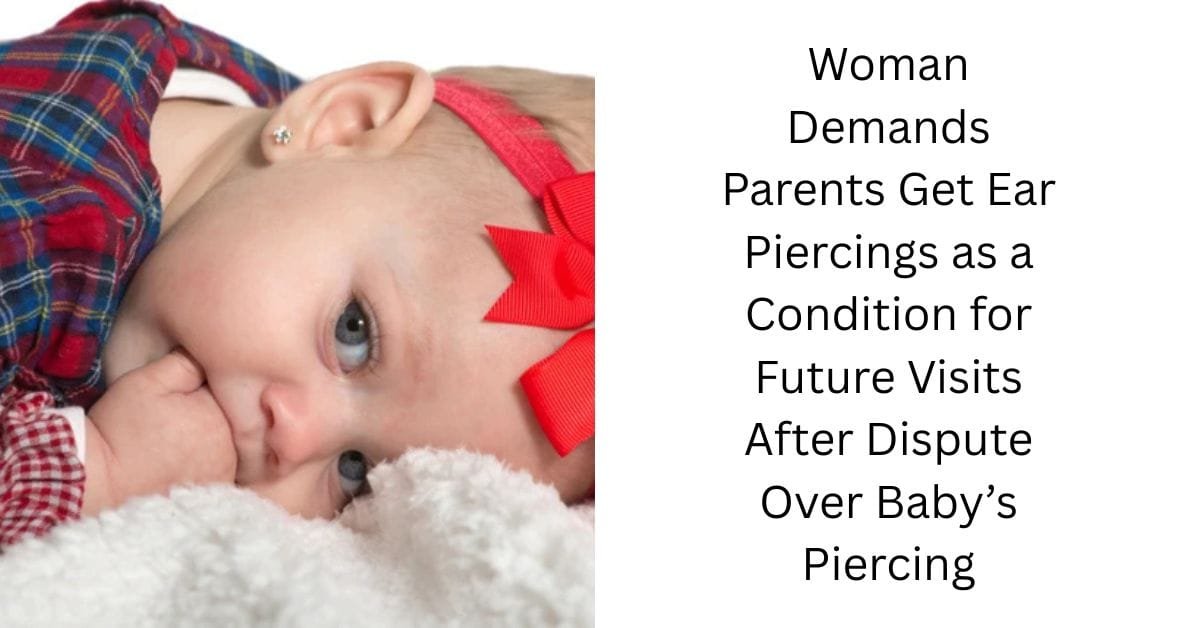
Thirty-year-old Olivia had always believed that respect for a child’s bodily autonomy began long before the child was old enough to speak. During her pregnancy, she and her husband, Mark, spent countless evenings discussing the kind of parents they wanted to become. They agreed that permanent decisions involving their daughter’s body would be left until she was mature enough to express her own wishes. That included haircuts, cosmetic procedures, and especially ear piercings. While friends and relatives often commented that pierced ears looked adorable on baby girls, Olivia politely explained that beauty was never more important than consent. Most family members accepted her decision without argument, but Mark’s parents strongly disagreed. They insisted that every girl in their family had received earrings before her first birthday and considered it a cherished tradition passed down through generations. Although the conversations remained polite, Olivia sensed that her in-laws believed they knew better than the baby’s own parents.
Everything changed one Saturday afternoon when Mark’s parents volunteered to babysit while the young couple attended a wedding. Olivia packed Lily’s diaper bag, reviewed her feeding schedule, and reminded the grandparents that she would only be gone for a few hours. She had no reason to doubt them because they had always appeared loving and responsible. When Olivia returned that evening, however, she immediately noticed two sparkling gold studs in Lily’s tiny ears. Her heart sank as she realized exactly what had happened. Instead of apologizing, the grandparents proudly revealed that they had taken the baby to a piercing shop, convinced they had done the right thing. They smiled while explaining that babies healed faster and would never remember the pain. Olivia could barely process what she was hearing. She wasn’t upset because of the earrings themselves—she was devastated because someone had ignored a clear parental decision and permanently altered her daughter’s body without permission.

Advertisement
The following day, the family gathered to discuss what had happened, but the meeting quickly turned into a heated argument. Mark demanded to know why his parents believed they had the authority to overrule him and Olivia. His mother insisted they were simply preserving a family tradition, while his father argued that parents today worried too much about things that had never been considered controversial in previous generations. Olivia remained calm until everyone had finished speaking. Then she asked a question that instantly changed the mood in the room. She said that if ear piercing was truly such a harmless and insignificant procedure, then both grandparents should agree to have their own ears pierced before they could visit Lily again. Silence filled the room. They immediately refused, saying they had no interest in putting unnecessary holes in their own ears. Olivia quietly pointed out that if adults deserved the right to refuse body modifications, then her daughter deserved exactly the same respect, even if she was too young to speak for herself.
The unexpected condition divided the entire family. Some relatives accused Olivia of being dramatic and claimed she was using an impossible demand simply to punish the grandparents. Others, however, defended her completely. They argued that the request was never really about earrings at all—it was about accountability and forcing the grandparents to understand the seriousness of making permanent decisions for someone else’s child. Mark supported his wife throughout the conflict and made it clear that his parents would not be left alone with Lily again until they genuinely acknowledged what they had done wrong. Weeks passed without any visits as the grandparents continued insisting they had acted out of love. Olivia replied that love without respect for boundaries could still cause lasting harm. She explained that rebuilding trust required more than saying they had good intentions; it required accepting responsibility for violating the parents’ authority.

Advertisement
As the disagreement spread among extended family members and eventually reached social media, thousands of people debated whether Olivia’s condition was justified or excessive. Some believed grandparents should never lose access to their grandchild over something they viewed as a cultural tradition, while others argued that ignoring parental consent crossed a line that could not simply be overlooked. Many commenters noted that the ear-piercing requirement was symbolic rather than literal, representing the grandparents’ willingness to experience the same permanent change they had chosen for someone else. In the end, Olivia maintained that the issue had never been about jewelry or appearances. It was about protecting her daughter’s right to make choices about her own body and ensuring that every future caregiver understood one simple rule: no tradition, opinion, or personal preference would ever outweigh the decisions made by Lily’s parents regarding their child’s well-being.

Advertisement
Read Story…
Pierce my baby’s ears without my permission – Fine, NC until you pierce your noses
AITA for telling my mom and dad that they have to get their noses pierced if they want to see my daughter again?
My husband and I travel down to Mexico to visit with my family. I am an American citizen my mom and dad are not.
My mom and dad got my daughter earrings for her birthday. My daughter’s ears are not pierced. She is only one year old.
I told them that I would save them for her until she was old enough to get her ears pierced.
We left my daughter with my parents while we went to meet up with some friends. When we went to pick up my daughter my mom showed us that we didn’t need to wait because they had taken her to get her ears pierced.
I got my daughter and I dragged my husband out of there before he lost his shit. We went back to our hotel.
I am furious. My husband said that my parents are not allowed to spend time alone with my daughter ever again. I went farther. I said that I would not be bringing her, or any other kids we might have, down here to see my parents. We checked out three days early and went home.
On the way home my parents were calling me to see when we were coming over. I ignored all the calls and texts until we were back home in Phoenix.
We took a couple of days to think things over and cool down.
I finally called them. I asked them not to speak until I was done talking. I told them that my husband and I are upset with them for getting our baby’s ears pierced without our permission. I told them that we went back home and probably wouldn’t be visiting for a while.
They said that my sister and I both had pierced ears when we were babies and that it did not harm us.
I said that we were not going to change our minds. They started getting everyone including my grandmother to call me and say I was being ridiculous.
I talked with my husband and we came up with a compromise. We agreed that we would resume visits, but not alone time, with them if they both got their noses pierced.
They said that we are being stupid and that they are not going to do that. I said no problem and hung up.
We have started blocking anyone who tries to call us and give us shit for denying my parents their RIGHT to see my daughter.
Comments
pizzadotgov
NTA! They violated your trust in a huuuuuge way, and they have absolutely no right to see your daughter, nor do they have a right to see you. They’re confusing rights with wants.
They were willing to do (semi)permanent damage to your baby directly against your wishes just because they want to decorate the baby. It displays a lack of respect for you and for your child. Their aesthetic wants are more important than the grandchild’s feelings. And if you think about it for more than five seconds, “I did this unnecessary thing to a baby before they were old enough to say No” is a terrible way to treat a person.*
It was very polite for you to save the earring gift for later.
until she was old enough to get her ears pierced
They’re grown adults, surely they didn’t think this meant “later today.”
If you want the piercing to close up properly, don’t use hydrogen peroxide or antibacterial soaps. Use a saline solution on the piercing daily. If the piercing seems like it might already be infected, do not remove the earring. We don’t want to close an infection inside the body. I recommend you talk to a local body piercer about this, or call a local shop that has all their licenses.
I say semi-permanent because I don’t personally know whether this will leave a scar if/when the piercing closes. It could be permanent, it could go away. I am not telling this mother to take the earring out because I am not a piercing professional and I will not be giving advice about removing fresh piercings without even seeing it.
Always_B_Batman
How about contacting their pediatrician?
WarmWeird_ish
As much as this may help, it could be counter productive: pediatricians aren’t piercers and may give unneeded antibiotics or incorrect advice (like to remove the earring without being sure it isn’t infected) versus a licensed and trained piercer who specializes in this category.
Legitimate-State8652
Our pediatrician does piercings, specifically for babies…….So depends entirely on the practice.
abortionlasagna
I’m a piercer and I say never go to your pediatrician for a piercing. They use studex guns which are extremely painful and unsafe. My professional opinion on piercing baby ears is that babies don’t need their ears pierced.
Ready_Tank_7463
NTA.
I read your “ultimatum” as more tongue-in-cheek. Not that you’re actually expecting them to get their noses pierced but that you’re simply enforcing a NC boundary (knowing that they’re obviously not getting themselves pierced). I think that’s fine and fair.
What they did was wrong on so many levels. And since they refuse to apologize or take accountability for their huge lapse of judgment, I think going NC is appropriate.
Glasgowghirl67
Same, if you are the grandparent or aunt or uncle then you don’t do stuff like this behind the parents back then expect to be trusted again. I get in some cultures it is normal for them to pierce the child’s ears when young but if the parent says no respect that.
MelodiesOfLife6
They said that my sister and I both had pierced ears when we were babies and that it did not harm us.
I mean I would have just come back with “And you as the PARENTS decided to do that, you didn’t let someone else do it behind your back did you?
That’s the end of the argument, they went behind your back to do something that you did not approve of to be done to YOUR child.
NTA.
OOP comments on why NC is being enforced
Currently it might be that she does not know them because she is missing her left earlobe.
**Judgement – NTA**
Update – 4 months later
Firstly my baby is okay. She got over the infection and the damage to her poor little ear was only cosmetic. My parents have agreed that they will pay for any reconstructive surgery that might be needed.
They also both got their noses pierced. I had one of my friends down there verify it.
My dad got his pierced like a bull so he can flip it up inside his nose. My mom got her nostril done.
Neither of them thought I was serious until we ignored them for a couple of months. No pictures no nothing.
My husband is still furious but has agreed to accept their apologies.
We also made sure that they understood that we would not be leaving our baby alone with them under any circumstances.
They are going to have to go a long time to rebuild our trust.
Before you ask. No I will not force them to keep their piercings. The deal was that they did it.
Comments
churchofdan
I also wouldn’t leave them alone with your husband. If people I trusted with my child potentially permanently scarred them on purpose, I’d probably have to be held back to not catch a charge.
OOP: Yeah he’s not happy still.
myboytys
I am with your husband you are being far more forgiving than I would be. If my inlaws did this there would be Police and child welfare involved and a very very lengthy time out. Your parents getting piercings is no real punishment.
Dashqu
“A piercing is not a big deal”
“Alright, you get your noses pierced then”
FRIGGING BEAUTIFUL!!!!
Trust needs to be rebuild, but you handled it like a pro!!! Standing ovation from this internet stranger
PokeT3ch
In a way that still kinda concerns me. Sorta means they still think its no big deal which is the opposite of what you want them to learn. Hopefully ghosting them for months was enough of a reality check.
Why Olivia Refused to Pierce Her Baby’s Ears
Thirty-year-old Olivia had always believed that becoming a parent meant accepting an enormous responsibility: making decisions that protected her child until her child was old enough to make those decisions herself. During her pregnancy, she and her husband, Mark, spent countless evenings discussing everything from sleeping schedules to education, but one topic surprisingly became a recurring conversation—body modifications. Olivia had grown up in a family where ear piercing was considered a personal choice rather than a tradition, and she wanted her future daughter to have the same freedom. Mark agreed completely. They promised each other that if they had a girl, they would wait until she was old enough to understand what ear piercing meant and ask for it herself. Their decision wasn’t based on fear or religion; it was based on respect for bodily autonomy. When their daughter Lily was born, they proudly shared that decision with friends and family. Most people smiled, nodded, and moved on. Unfortunately, Mark’s parents viewed the announcement very differently. They insisted that every baby girl in their family had received earrings before turning one year old and believed Olivia was unnecessarily rejecting a cherished family tradition.
Advertisement
Mark’s mother, Susan, never openly argued with Olivia, but she rarely missed an opportunity to mention how beautiful little girls looked with tiny gold earrings. Whenever relatives gathered for birthdays or holiday dinners, she would point at other babies wearing sparkling studs and comment that they looked “complete.” Olivia politely smiled each time, refusing to start an argument over something she believed should have been a simple parenting decision. Even when Susan brought out a tiny velvet jewelry box containing family heirloom earrings that had supposedly been passed down through four generations, Olivia thanked her for the thoughtful gift but explained that Lily would receive them when she was old enough to choose whether she wanted pierced ears. Susan’s smile faded slightly before she quietly returned the box to her purse. Although she said she understood, Olivia couldn’t shake the feeling that her mother-in-law had only accepted the answer on the surface. Mark noticed the same tension and reassured his wife that his parents would eventually respect their decision. Neither of them imagined that the disagreement would soon turn into a serious breach of trust that would affect the entire family.
Advertisement
When Lily was six months old, Mark’s cousin invited the family to an elegant wedding several hours away. The ceremony was adults-only, making childcare necessary for the first time since Lily’s birth. Susan immediately volunteered to babysit, insisting she had raised two children and knew exactly how to care for an infant. Olivia hesitated because she remembered all the previous conversations about ear piercing, but Mark gently reminded her that his parents loved Lily deeply and had never ignored their parenting rules before. After discussing it together, they decided to trust them. Olivia carefully packed diapers, bottles, extra clothes, favorite toys, emergency phone numbers, and a detailed schedule explaining Lily’s feeding and sleeping routine. Before leaving, she hugged her daughter, kissed her forehead, and casually reminded Susan once again that Lily was not to have her ears pierced or undergo any unnecessary procedures. Susan laughed softly and assured her there was nothing to worry about. Hearing those reassuring words, Olivia finally relaxed enough to enjoy the wedding, completely unaware that the promise had already been broken.

Advertisement
Several hours later, Olivia and Mark returned home tired but happy after the celebration. The moment Susan opened the front door with Lily in her arms, Olivia immediately sensed something was different. As she reached to take her daughter, the light reflected off two tiny gold studs resting in Lily’s ears. For several seconds, Olivia simply stared in disbelief, convinced she was imagining things. Then reality hit her all at once. Her hands began trembling as she realized someone had pierced her baby’s ears without permission. Before she could even ask what had happened, Susan proudly smiled and announced that Lily had been “given a proper family welcome.” She explained that she had taken the baby to a professional piercing studio because babies healed faster and wouldn’t remember the brief discomfort. Mark froze in complete shock while Olivia struggled to hold back tears. The grandparents expected gratitude, believing they had done something wonderful. Instead, silence filled the room as Olivia looked at her daughter and realized one of the first major parenting decisions she and Mark had ever made together had been completely ignored.
The confrontation that followed lasted nearly an hour. Olivia demanded to know how anyone could believe they had the authority to make a permanent decision about someone else’s child. Susan defended herself by insisting she had raised children successfully long before Olivia became a mother and argued that ear piercing wasn’t a serious issue. Mark’s father, David, joined the conversation, saying that in their generation parents appreciated help from grandparents instead of criticizing them. According to him, Lily would eventually thank them because she wouldn’t have to remember the pain of getting pierced as an older child. Olivia listened carefully before responding in a calm but emotional voice. She explained that the issue wasn’t really the earrings. It was the complete disregard for parental boundaries and consent. If the grandparents felt comfortable ignoring this decision, what other rules might they choose to ignore in the future? Safe sleeping? Food allergies? Medical decisions? The earrings represented far more than jewelry—they represented broken trust.
Mark surprised his parents by siding firmly with Olivia. Although he loved and respected them, he admitted they had crossed a line that should never have been crossed. He reminded them that they had been clearly told not to pierce Lily’s ears on multiple occasions. Susan insisted she thought Olivia would eventually forgive her once she saw how adorable Lily looked. That explanation only made matters worse because it confirmed the decision had been deliberate rather than accidental. Olivia carefully removed the tiny earrings later that evening after speaking with their pediatrician, who recommended keeping the piercings clean while they healed even if the earrings were removed. Looking at the tiny holes in her daughter’s ears broke Olivia’s heart. She knew they might eventually close, but the emotional damage remained. For the first time since becoming parents, she and Mark questioned whether they could safely leave Lily alone with his parents ever again. The trust they had freely given just days earlier had disappeared almost overnight.
The following afternoon, Mark invited his parents back to the house for one final conversation before deciding what would happen next. Everyone sat around the dining room table in complete silence until Olivia finally spoke. She explained that rebuilding trust would require more than a simple apology because what had happened couldn’t be undone. Susan reluctantly apologized but quickly followed it by saying she still believed she had done the right thing. That statement convinced Olivia that her mother-in-law still failed to understand why the situation was so serious. After taking a deep breath, Olivia calmly presented a condition that stunned everyone in the room. She said that before Susan and David could have unsupervised visits with Lily again, both of them would need to get their own ears pierced. The room became completely silent as the grandparents stared at her in disbelief. They initially laughed, assuming she was joking. Olivia wasn’t smiling.
Susan immediately refused the condition, insisting she had no desire to pierce her ears at her age. David laughed awkwardly and said he had never wanted earrings and certainly wasn’t going to start now. Olivia nodded quietly before asking a simple question that neither grandparent could answer. If they believed adults deserved the right to refuse unnecessary body modifications simply because they didn’t want them, why didn’t Lily deserve that same respect? The silence that followed was louder than any argument. Olivia explained that the request wasn’t actually about forcing anyone to wear earrings forever. It was about understanding what it felt like to have someone else decide to permanently alter your body without your consent. If they considered the idea unreasonable for themselves, perhaps they would finally understand why she was devastated by what they had done to her daughter. Mark remained silent, allowing his parents time to reflect on the comparison.
Instead of reflecting, Susan became defensive once again. She accused Olivia of trying to humiliate her and claimed the condition was nothing more than revenge disguised as a lesson. David argued that grandparents shouldn’t have to “earn permission” to see their own granddaughter after making what he described as a harmless mistake. Olivia calmly disagreed. She explained that accidents happen when people forget diaper bags or arrive late. Deliberately ignoring repeated instructions from parents wasn’t a mistake—it was a conscious decision. Trust, once broken, couldn’t simply be restored through family ties alone. By the end of the meeting, no agreement had been reached. Susan and David left the house upset, convinced they were being unfairly punished, while Olivia and Mark remained inside wondering whether they had done the right thing. Neither of them realized that within days the dispute would spread throughout the extended family, dividing relatives into opposing sides and eventually attracting thousands of opinions online.
Within forty-eight hours, the disagreement had spread far beyond the four people directly involved. Susan called Mark’s older sister, Emily, describing the situation from her perspective. According to her version of events, she had lovingly continued a harmless family tradition, only to be “punished” with an outrageous demand that she and her husband pierce their own ears before being allowed to see their granddaughter again. Emily immediately sympathized with her parents and called Mark, insisting Olivia had overreacted. However, Mark calmly explained the details Emily hadn’t heard. He reminded her that their parents had been told multiple times not to pierce Lily’s ears and that they had deliberately waited until they were alone with the baby to do it. Emily became noticeably quieter as she realized this hadn’t been a misunderstanding—it had been a conscious decision. Even so, she believed banning the grandparents from visiting was too harsh. Mark responded that they weren’t being punished for piercing Lily’s ears alone; they were facing consequences for proving they couldn’t be trusted to respect parental decisions.
The conflict soon reached both sides of the extended family. Some relatives argued that Olivia should simply accept what had happened because the piercings couldn’t be undone. Others strongly supported her, saying that ignoring parents’ wishes about their own child was one of the biggest violations of trust imaginable. One cousin pointed out that the issue wasn’t jewelry but consent. If grandparents could secretly authorize a cosmetic procedure, where should the line be drawn? Could they decide to cut a child’s hair? Could they ignore dietary restrictions? Could they refuse prescribed medication because they disagreed with the parents? The conversation gradually shifted away from earrings and toward a much larger discussion about family boundaries. Olivia listened to every opinion but remained firm. She wasn’t interested in winning an argument. She wanted everyone to understand that respecting parents wasn’t optional simply because someone had more life experience or believed tradition justified ignoring clear instructions.
Meanwhile, Lily’s ear piercings became a painful daily reminder of what had happened. Olivia carefully cleaned the tiny holes as instructed by the pediatrician, wondering whether they would eventually close completely. Every time she looked at her daughter’s ears, she remembered walking through the front door and realizing someone else had made a permanent decision for her child. Friends who visited the house often complimented Lily’s earrings without realizing the emotional story behind them. Olivia smiled politely but rarely explained the truth because discussing it brought back the same frustration and sadness. She wasn’t angry because Lily looked different. She was angry because someone had decided their opinion mattered more than hers as a parent. That realization hurt far more than the tiny earrings ever could. Mark noticed how emotional the situation remained for his wife and reassured her repeatedly that she hadn’t done anything wrong by standing her ground.
A week later, Susan called unexpectedly and asked whether she could stop by to see Lily for just a few minutes. Olivia politely declined, explaining that nothing had changed since their last conversation. Susan sighed heavily before insisting that grandparents shouldn’t have to apologize forever over something done with love. Olivia answered quietly that love and respect were supposed to exist together. She explained that intentions mattered, but actions mattered too. If someone drove recklessly while trying to help another person, the accident would still have consequences regardless of good intentions. Susan became emotional, saying she missed her granddaughter terribly. Olivia admitted that she genuinely wanted Lily to have a close relationship with her grandparents someday, but only if that relationship was built on mutual respect. Until Susan acknowledged why the decision had been wrong instead of defending it repeatedly, Olivia didn’t believe unsupervised visits could safely resume.
As the weeks passed, Mark began reflecting on his own childhood. He remembered countless moments when his parents had made decisions without asking for his opinion because they believed adults always knew best. At the time, he had accepted those decisions without question. Now, as a father himself, he realized how important it was to balance guidance with respect. He didn’t resent his parents for the way they had raised him, but he also recognized that parenting standards evolved over time. Modern parents often emphasized communication, consent, and bodily autonomy in ways previous generations rarely discussed. That difference didn’t automatically make one generation good and another bad, but it did require respect. Mark explained this perspective to his parents during another phone conversation. Unfortunately, Susan insisted that society had become overly sensitive and argued that people were creating problems where none existed. Mark ended the conversation disappointed, realizing they still viewed themselves as victims rather than participants in the conflict.
Several months later, another family gathering approached for Thanksgiving. Relatives hoped the disagreement would finally be resolved before everyone came together. Emily privately encouraged Susan to offer a sincere apology without defending her actions. At first Susan resisted, believing doing so would mean admitting she was a terrible grandmother. Emily gently explained that apologizing didn’t erase decades of love or sacrifice. It simply acknowledged that even good people could make serious mistakes. Susan quietly considered those words for several days. She loved Lily deeply and genuinely wanted to rebuild her relationship with Mark and Olivia. For the first time since the argument began, she started wondering whether she had spent too much time defending her intentions instead of listening to the hurt she had caused. That realization didn’t immediately solve the problem, but it planted the first seed of genuine self-reflection.
A few days before Thanksgiving, Susan asked to meet Olivia alone at a nearby coffee shop. Unlike previous conversations, she didn’t begin by explaining herself. Instead, she apologized without excuses. She admitted she had convinced herself that being older automatically meant knowing better, and in doing so, she had completely ignored the authority that belonged to Lily’s parents. She acknowledged that taking the baby for ear piercing without permission had been disrespectful regardless of whether she believed the procedure was harmless. Olivia listened carefully, noticing that for the first time Susan wasn’t trying to justify her decision. When Susan finished speaking, she quietly admitted she still didn’t want to pierce her own ears. Olivia smiled gently and revealed something Susan hadn’t expected to hear. The ear-piercing condition had never been a literal requirement. It had always been a way to illustrate how it felt when someone else made permanent decisions about another person’s body without consent.
The conversation ended with both women feeling more hopeful than they had in months. Olivia explained that trust wouldn’t return overnight, but genuine accountability was the first and most important step. She and Mark agreed that future visits would begin with supervised time together until everyone felt comfortable again. Susan accepted the decision without arguing, recognizing that rebuilding trust required patience rather than demands. When Thanksgiving finally arrived, the family gathered together with cautious optimism. Susan hugged Lily gently, respecting every instruction Olivia gave without question. It wasn’t a perfect ending, and some emotional wounds would take time to heal, but everyone left understanding a valuable lesson. Family traditions can be meaningful, but they should never override the rights and responsibilities of parents. Respect isn’t proven by insisting you’re right; it’s proven by listening when someone tells you that you’ve crossed a boundary. For Olivia and Mark, that lesson became the true foundation of their family’s future.
Although Thanksgiving ended peacefully, Olivia remained cautious. She had accepted Susan’s apology because it felt sincere, but trust wasn’t something that could be restored with a single conversation. Over the following weeks, every visit took place in Olivia and Mark’s home, where they could observe how Susan and David interacted with Lily. To their credit, the grandparents respected every rule without complaint. They asked before giving Lily snacks, followed her nap schedule exactly, and even checked with Olivia before buying new toys. These might have seemed like small gestures to an outsider, but to Olivia they represented something much bigger. For the first time since the piercing incident, the grandparents were demonstrating that they understood whose decisions mattered most. Mark quietly noticed the change as well. Instead of offering unsolicited advice, his parents now asked questions and genuinely listened to the answers. It wasn’t the relationship they had before, but it was slowly becoming a healthier one built on mutual respect rather than assumptions.
One afternoon, while Lily played happily on the living room floor, Susan watched her granddaughter laughing with colorful building blocks and quietly admitted something she had never confessed before. She told Olivia that when she became a young mother decades earlier, older relatives had often ignored her own parenting choices. At the time, she had promised herself she would never make another mother feel powerless. Somehow, over the years, she had become exactly the kind of grandparent she once struggled with. Olivia was surprised by the honesty. She realized Susan hadn’t acted out of cruelty or malice but from years of believing family traditions carried more authority than parental boundaries. Understanding that history didn’t erase the pain caused by the piercing incident, but it helped explain how someone who genuinely loved Lily could still make such a serious mistake. That conversation marked another important step toward rebuilding their relationship.
As Lily approached her first birthday, several relatives jokingly commented that she already looked adorable with her tiny earrings, assuming the family had always planned it that way. Susan immediately corrected them. Instead of proudly taking credit, she explained that the earrings had become a painful reminder of why respecting parents’ wishes mattered. She openly admitted that she had crossed a line and encouraged everyone present never to make decisions about another person’s child without permission. Olivia watched the conversation quietly from across the room. Hearing Susan accept responsibility in front of others without minimizing what had happened meant more than any private apology ever could. It showed that she had truly learned from the experience instead of simply saying whatever was necessary to restore family visits.
Several months later, Mark stumbled across an online discussion about grandparents overstepping parental boundaries. Curious, he anonymously shared a simplified version of what had happened with Lily. Thousands of people responded. Some insisted Olivia had every right to be furious because bodily autonomy should begin in infancy. Others believed the grandparents had made a mistake but didn’t deserve to lose access to their granddaughter over a pair of earrings. Many readers focused on Olivia’s unusual condition requiring the grandparents to pierce their own ears. Some thought it was brilliant because it forced them to imagine experiencing an unwanted body modification themselves. Others viewed it as unnecessary, arguing that forgiveness should have been enough. Reading hundreds of different opinions reminded Mark that every family approached these situations differently, but he remained convinced they had done what was best for their daughter.
The online discussion also sparked a broader conversation about consent and parenting. Parents shared stories about relatives secretly cutting children’s hair, introducing foods against medical advice, ignoring allergies, or posting children’s photos online after being asked not to. Olivia was surprised by how many families struggled with similar boundary issues. She realized the piercing incident wasn’t unique. In many cases, grandparents genuinely believed experience gave them permission to override younger parents’ decisions. Reading those stories reinforced her belief that clear boundaries weren’t signs of disrespect—they were necessary for healthy family relationships. She hoped that by openly discussing the situation with trusted friends, other parents might feel more confident standing up for their own decisions without feeling guilty or unreasonable.
One evening, when Lily was nearly three years old, she noticed the tiny holes in her ears while looking in the mirror. Curious, she asked her mother why they were there even though she wasn’t wearing earrings. Olivia smiled gently and explained in simple language that they had been made when Lily was a baby, before she was old enough to decide for herself. She then added something even more important. She told Lily that from now on, every decision about her body would include her voice whenever she was old enough to understand. Whether it was getting earrings again, cutting her hair short, or choosing clothes she liked, her opinions mattered. Lily nodded without fully understanding the deeper meaning behind those words, but Olivia felt comforted knowing she was raising her daughter with the values she had always believed in.
Years later, when Lily turned eight, she surprised everyone by asking if she could finally wear earrings. Olivia and Mark smiled because the request had come exactly the way they had always hoped—it was Lily’s own decision. They took her to a professional piercing studio, where the procedure was explained to her beforehand. She chose a pair of tiny silver stars after carefully looking through dozens of options. Susan accompanied them but remained respectfully in the background, allowing Olivia and Mark to guide the experience. When Lily proudly looked at herself in the mirror afterward, everyone celebrated not because her ears were pierced, but because the choice had belonged entirely to her. For Olivia, that moment finally replaced the painful memory of the first piercing with a happy one built on consent, trust, and respect.
Looking back, Olivia often reflected that the conflict had never truly been about earrings. It had been about something much deeper: who has the right to make permanent decisions for a child. The unusual condition that Susan and David pierce their own ears before future visits was never meant as revenge or humiliation. It was intended to make them pause and consider how it feels when someone else decides what should happen to your own body without asking. In the end, the grandparents never needed to get their ears pierced because they eventually understood the lesson behind the request. Trust was rebuilt slowly through accountability, patience, and changed behavior rather than stubborn arguments. The experience permanently reshaped their family dynamic, teaching everyone involved that love alone isn’t enough to justify ignoring boundaries. Real love includes respect, and real respect begins by recognizing that parents—not grandparents, traditions, or outside opinions—have the final responsibility for making decisions in their child’s best interests until that child is old enough to choose for themselves.