Woman Ends Two-Year Relationship Because Boyfriend Insists on the Code of the Safe in Which She Stores 6-Figure Gem Collection
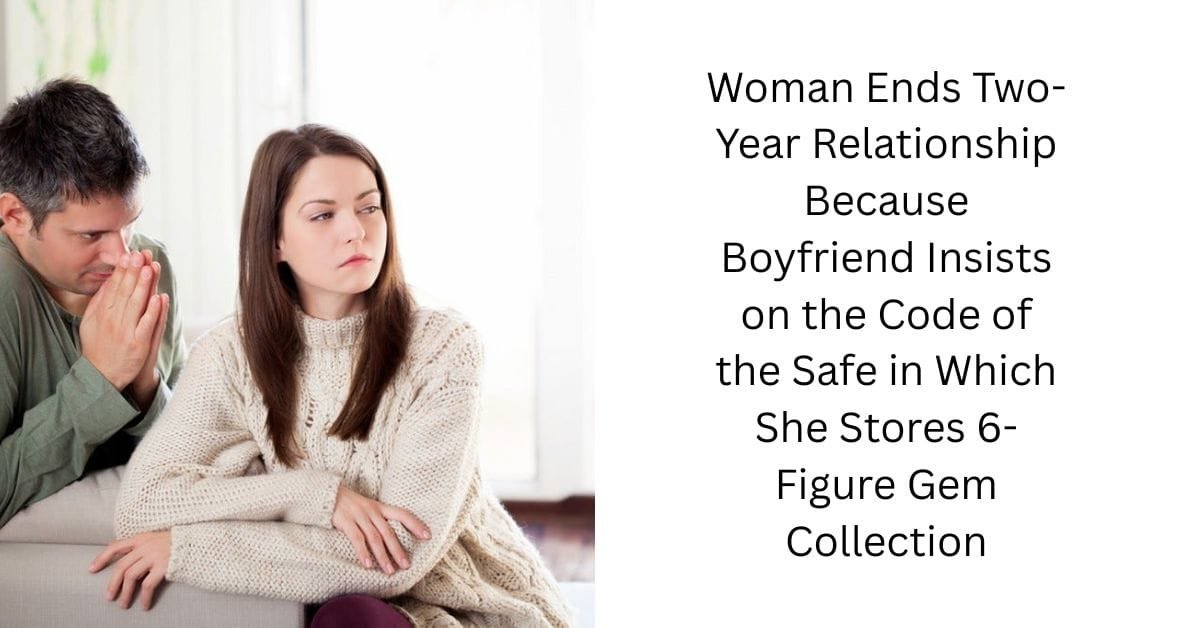
Thirty-one-year-old Victoria had spent nearly a decade building a collection that few people outside the gemstone community could truly appreciate. What had started as a fascination with rare minerals during college gradually turned into a serious passion for collecting investment-grade gemstones. She spent years attending gem exhibitions, studying market trends, and carefully purchasing sapphires, emeralds, rubies, and other valuable stones from reputable dealers. Some pieces had increased dramatically in value over time, while others carried sentimental significance because they had been inherited from her late grandmother, who had introduced her to the world of gemstones. Altogether, the collection was worth well into six figures, making it one of Victoria’s most treasured possessions. To protect the gems, she installed a professional-grade safe inside a hidden room in her home, keeping the access code known only to herself. She believed that financial independence included protecting her assets, and she never felt guilty about maintaining strict security measures, regardless of who questioned them.
For nearly two years, Victoria had been dating Daniel, a thirty-four-year-old software engineer whom she met through mutual friends. Their relationship appeared healthy by almost every measure. They enjoyed traveling together, supported each other’s careers, and rarely argued about money or lifestyle choices. Daniel often praised Victoria for being financially responsible, and he admired the dedication she had shown in building such an impressive collection. Because of this, Victoria never imagined that something as simple as the code to her safe would become the issue that threatened everything they had built together. She trusted Daniel enough to welcome him into her home whenever he visited, but she viewed access to the safe differently. In her mind, trust did not require sharing every password, financial account, or security code. She believed healthy relationships could include reasonable boundaries, especially when valuable personal assets were involved. Daniel initially seemed to understand that perspective, making casual jokes about her “secret treasure vault” without ever pressing the issue.

Advertisement
Everything changed one evening when the couple began discussing their future together over dinner. As the conversation turned toward moving in together, Daniel suddenly asked whether she planned to give him the safe’s combination once they shared a home. Victoria laughed at first, assuming he was joking, but his expression remained completely serious. When she politely explained that she intended to keep the code private, Daniel looked visibly disappointed and asked why she would hide something from someone she claimed to love. Victoria calmly responded that the safe contained investments worth hundreds of thousands of dollars and that limiting access was simply responsible ownership rather than a reflection of distrust. Daniel disagreed, insisting that committed partners should never keep secrets involving finances or property. According to him, refusing to share the code suggested she believed he might eventually steal from her or betray her in some way. Victoria tried explaining that banks, investment firms, and security experts all recommend limiting access to valuable assets regardless of relationship status, but Daniel dismissed those arguments, saying that real commitment required complete transparency. What had begun as an ordinary conversation quickly evolved into one of the most uncomfortable disagreements they had ever experienced.
Over the following weeks, the disagreement refused to disappear. Daniel repeatedly returned to the subject, raising it during quiet evenings, weekend trips, and even family gatherings. Each conversation became more emotional than the last. He argued that if they eventually married, there should be no barriers between them, while Victoria maintained that marriage did not erase an individual’s right to personal financial security. Daniel began comparing the safe code to passwords for streaming services or household alarm systems, claiming that couples routinely shared those details without hesitation. Victoria pointed out that entertainment accounts and home security systems were entirely different from granting unrestricted access to an asset worth hundreds of thousands of dollars. She also reminded him that she had never requested access to his retirement accounts, investment portfolios, or personal banking credentials because she respected his privacy. Instead of accepting her explanation, Daniel accused her of placing gemstones above their relationship and suggested that her refusal proved she would never fully trust him. The repeated pressure left Victoria emotionally exhausted, making her question whether the disagreement was truly about the safe or about Daniel’s need to control decisions that should remain hers alone.

Advertisement
Eventually, Victoria reached a conclusion she never expected to face. She realized that the real issue was no longer the safe’s combination but the fact that Daniel refused to respect a clearly stated personal boundary. Every compromise she offered—including documenting the collection in legal records, adding inheritance instructions, or discussing future financial planning—was rejected because Daniel wanted immediate access to the safe itself. The more he insisted, the more uncomfortable Victoria became, wondering whether similar conflicts would arise over other aspects of her independence in the future. After several difficult conversations that ended with the same unresolved argument, she decided to end the relationship despite still caring deeply for him. While the breakup was painful, Victoria believed that mutual respect was essential for any lasting partnership, and without it, even years of love could not overcome fundamental differences in values. Friends and family were divided over her decision, with some believing she had overreacted and others arguing that protecting valuable assets and maintaining healthy boundaries were signs of wisdom rather than suspicion. As the story later spread online, thousands of readers debated whether Victoria had made the right choice or whether Daniel’s request had crossed a line that should never have been crossed.
Read Story…
AITA for refusing to give my partner the code to my safe?
Update at the bottom
Throwaway and usual mobile formatting apologies.
I 32(f) and a Gemologist, I spend my days in the lab testing and identifying stones. From the nature of my work I also have a large and valuable collection of jewellery but also gem specimens that I keep in a safe I specifically bought and had installed to keep them safe. I also have a second smaller safe for keeping important documents like passports.
I own my home and my boyfriend (33m) of 2 years recently moved in as he was renting before. I gave him the code to the smaller safe so he could put valuables in it, but he also wants the code for my gem safe. Not to put anything in it, but he says because we are living together now I should trust him and give him the code. I’ve said no because he has no reason to open the safe as the only thing it’s used for is storing my collection, he’s said he has no interest in my gem collection, doesn’t want to look at them, but still wants the code to access them.
This is causing tension because he says I should give it to him as a show of trust, and I said no, because he literally has no reason to go in there so he doesn’t need the code. This is a 6 figure collection so I’m not being difficult over a few little gems here. I am the only one who knows the code.
So Reddit am I being TA here?
*also we are in the UK so we spell jewellery differently to the US
Edit: holy hell this blew up way more than I ever expected! Im sticking to my guns and I’m not giving him the code. All you lovely internet strangers are right, it’s a huge marinara flag and I’ll be telling him to pack his stuff. I’ll update you later. Thank you all for your comments!!
Edit 2: this keeps coming up, the safe weighs nearly half a ton, it’s bolted to the floor and wall and is from a company who make safes, vaults and strong rooms for jewellers. You could bring the house down around it and it would still be intact.
Final edit: I think I have phrased it badly but all of the gems and jewellery in the safe are mine and mine alone. I do not keep any clients jewellery at home. For my other business doing valuations I rent a separate space and keep client items there.
I will give an update once things have panned out
Another edit: I’ve checked for cameras (thank you for the suggestions people) and there aren’t any aside from the ones I already have fitted which he doesn’t have access to. I’ve moved all of my personal docs out of the little safe and into my gem safe. I’ve told my colleague what I’m doing and she is going to come around for when I do it.
Update:
Firstly thank you so much for the insane amount of comments and support, it meant so much to me. For all of your messages and questions I’m really sorry if I didn’t get to you there were just so many!
I probably didn’t emphasise in my last post that we had a couple of conversations about this and me explaining why he had no reason to go in there etc.
Short version is I told him he isn’t getting the code and I will die on this hill. He has no reason to have it and his continued lack of respect by the pushing of my boundaries wasn’t ok, I felt like he was trying to manipulate me by making it about trust.
After a lot of back and forth he finally admitted that he wanted access to the safe because he didn’t feel like I was sharing the whole house with him, because I insisted on a tenancy agreement rather than just letting him move in, and he didn’t like that part of where he lived was off limits to him. He was also insecure and resented that I have more money than him and own a home whilst he doesn’t, he had made a few comments about this before but I didn’t realise it was such a big issue for him. He also said that by keeping him out of the safe made him feel like I thought he was lesser than me and that it made him feel like I was treating him like a child.
I told him if that’s how he feels then this is not the right relationship for either of us and that it was best we break up. He was shocked that I was ending things over this, cried and asked me to reconsider, when I said no he then got angry, called me a stuck up b*tch said he was better off without me anyway and went to his friends. I told him via text he had 30 days before he had to leave (as per the tenancy agreement) so he didn’t need to stay at a friends, he said he would be gone by the end of the week. 2 days later he came back and packed up all of his stuff and left, he’s staying with his friend now.
I have changed all the locks, I have an alarm and cctv system that’s professionally monitored and I have changed the verbal password I have to give when you call up as a precaution. I’ve checked all of my collection and it hasn’t been touched. I also took your guys advice and am giving my solicitor the code and safe deposit details to be passed to my executor in the event of my death.
I feel horrible because despite all of this I love him, but lot’s of the comments said how I should have a partner who not only respects my boundaries but takes an interest in my passions and that really got to me because it’s true, so may of you reached out with questions and it made me so happy, but also sad as he never asked me stuff like that, I think this is what pushed me over the edge to end it more than anything.
I’m pretty cut up right now and missing him, but I know I’ll be ok, I have great friends and family around me, also diamonds are a girls best friend and I have a few knocking around to help cheer me up!
The Childhood Hobby That Became a Six-Figure Fortune
Thirty-one-year-old Victoria had never imagined that a childhood hobby would eventually become one of the most valuable investments of her life. When she was thirteen, her grandfather gave her a small polished amethyst that he had purchased during a vacation. To most people, it was nothing more than a pretty purple stone, but to Victoria, it became the beginning of an obsession. She spent years reading books about gemstones, learning how they were mined, graded, cut, and valued. After graduating from college and establishing herself in a successful financial consulting career, she finally had enough disposable income to begin purchasing investment-quality gems. Unlike jewelry, which often lost value because of design trends, loose certified gemstones frequently appreciated over time when selected carefully. Every purchase was researched for months before she spent a single dollar. By the time she turned thirty-one, her collection included rare sapphires, untreated Burmese rubies, Colombian emeralds, Paraíba tourmalines, and several unique spinels. Insurance documents placed the total value comfortably into six figures, though Victoria rarely mentioned the amount because she disliked discussing money. To protect the collection, she invested in a professional-grade fireproof safe that was securely anchored inside a concealed room in her house. Only she knew the access code, and she considered that decision simple common sense rather than secrecy.
Advertisement
Victoria met Daniel two years earlier during a mutual friend’s birthday celebration. Daniel was intelligent, confident, and easy to talk to. He worked as a senior software engineer for a growing technology company and enjoyed discussing everything from economics to travel destinations. Their personalities complemented each other remarkably well. Daniel appreciated Victoria’s organized lifestyle, while Victoria admired his creativity and calm approach to stressful situations. Friends often commented that they seemed unusually compatible because disagreements rarely escalated into arguments. They traveled together, celebrated holidays with each other’s families, and gradually discussed a future that included buying a larger home and possibly getting married within the next few years. Throughout the relationship, Daniel never displayed obvious signs of jealousy or financial irresponsibility. He earned a comfortable salary, paid his own bills, and encouraged Victoria’s interest in collecting gemstones even though he admitted he understood very little about the hobby. Whenever she attended gem exhibitions or auctions, he patiently accompanied her and listened as she explained the history behind different stones. Victoria believed she had finally found someone who respected both her passions and her independence.

Advertisement
Although Victoria never tried to hide the existence of her gemstone collection, she was intentionally private about its details. Close friends knew she owned valuable stones, but very few people knew exactly where they were stored or how much they were worth. Her insurance company had recommended limiting that information to as few individuals as possible, and security professionals gave identical advice. Victoria followed those recommendations carefully. She never posted photographs of the gems on social media, never discussed their exact value at parties, and never revealed the location of the safe inside her home. Daniel knew that a secure safe existed because she had mentioned it early in their relationship, but she never showed him where it was located or explained how to access it. Daniel initially laughed about her “secret treasure vault,” joking that she sounded like a movie character protecting pirate gold. Victoria laughed with him and explained that expensive collectibles required serious security. At that time, Daniel seemed to agree completely, even complimenting her for thinking ahead instead of assuming nothing bad could ever happen.
As their relationship approached the two-year mark, conversations naturally shifted toward the future. Daniel suggested that instead of renewing the lease on his apartment, they should consider moving into Victoria’s house since it was larger and located closer to both of their workplaces. Victoria welcomed the idea because she genuinely believed they were building a life together. They spent weekends discussing furniture arrangements, dividing household responsibilities, and estimating monthly expenses. Everything seemed exciting and surprisingly easy. Their families were equally enthusiastic, frequently asking when they planned to become engaged. Victoria could easily picture Daniel becoming her husband one day. She appreciated that he respected her career ambitions and never pressured her to abandon the financial independence she had worked so hard to achieve. Looking back later, Victoria would remember those conversations as the last period when everything felt completely normal before one unexpected question changed the direction of their entire relationship.

Advertisement
One quiet evening after dinner, while reviewing a checklist of practical matters involved in moving together, Daniel casually asked a question that immediately caught Victoria off guard. “Once I move in,” he said, “I assume you’ll give me the code to your safe?” Victoria looked up from her notebook and smiled, convinced he was making another joke about her gemstone collection. When she laughed, however, Daniel didn’t laugh back. His expression remained completely serious. She hesitated for a moment before answering gently that she didn’t plan to share the combination with anyone. Daniel frowned, clearly surprised by her response. “Not even with me?” he asked. Victoria calmly explained that the safe contained investment assets worth hundreds of thousands of dollars and that she had always intended to keep access limited regardless of who she dated or eventually married. She expected the explanation to end the conversation. Instead, Daniel leaned back in his chair, folded his arms, and quietly replied, “I don’t think I understand how you can expect us to build a life together if you don’t trust me with something that important.”
Victoria remained calm, convinced the misunderstanding could be resolved with a simple conversation. She explained that her decision had nothing to do with Daniel personally. If she had been dating anyone else—or even if she had already been married—her answer would have been exactly the same. The safe contained not only gemstones but also insurance documents, certificates of authenticity, and legal paperwork connected to the collection. Every expert she had consulted over the years had emphasized the importance of limiting access to valuable assets. Victoria compared it to a business owner protecting company records or someone keeping the passwords to investment accounts private. Daniel listened without interrupting, but the expression on his face suggested he found her reasoning completely unconvincing. When she finished, he quietly replied that relationships should not operate like business partnerships. In his opinion, two people planning to spend their lives together should have complete openness with one another, especially regarding finances and property. Victoria appreciated his perspective, but she still believed that healthy relationships could include reasonable personal boundaries.
The discussion ended politely that evening, yet the issue resurfaced only a few days later while they were shopping for furniture. Daniel casually pointed toward a display of home security systems and joked that perhaps he should purchase his own safe since he apparently could not be trusted with hers. Victoria laughed awkwardly, hoping he was teasing, but Daniel continued making subtle remarks throughout the afternoon. During dinner, he again asked why she refused to share something so simple. Victoria patiently repeated that the safe represented years of hard work, careful investing, and family memories that could never be replaced if something happened. She reminded him that she had never asked for access to his banking passwords, retirement accounts, or confidential work files because she respected his privacy. Daniel immediately replied that he would willingly share everything with her if she asked. To him, withholding access suggested that she expected betrayal someday. Victoria insisted that preparing for unlikely situations was simply responsible planning rather than a prediction that someone would act dishonestly. Unfortunately, neither of them seemed capable of convincing the other.
Over the following weeks, Daniel’s curiosity gradually turned into frustration. He began asking practical questions that felt strangely specific. He wanted to know exactly how much the collection was worth, whether the safe could survive a fire, who would inherit the gemstones if Victoria died unexpectedly, and whether anyone besides her insurance company knew where the collection was stored. While each individual question seemed reasonable on its own, the constant focus on the safe started making Victoria uncomfortable. She noticed that conversations that once revolved around vacations, movies, or weekend plans increasingly drifted back to the gemstones. Sometimes Daniel would bring it up while they were driving. Other times he mentioned it over breakfast before work. Victoria answered politely at first, believing transparency about the collection itself was acceptable. However, she continued refusing to discuss the safe’s location or combination. The more she maintained that boundary, the more determined Daniel appeared to become, leaving Victoria with the unsettling feeling that the disagreement was no longer about curiosity but about winning.
The situation became even more uncomfortable during a family barbecue hosted by Daniel’s parents. While everyone was gathered around the backyard table discussing investments and retirement planning, Daniel unexpectedly mentioned Victoria’s gemstone collection. He proudly told his parents that she owned an impressive investment portfolio made entirely of rare gemstones worth hundreds of thousands of dollars. Victoria immediately felt embarrassed because she intentionally avoided discussing the collection publicly. Daniel’s father expressed admiration, while his mother jokingly asked whether they needed to hire security guards whenever Victoria visited. Then Daniel laughed and remarked, “Apparently I’m not even trusted enough to know the code to the safe.” Although he said it with a smile, the comment instantly changed the atmosphere. His parents exchanged awkward glances before his mother gently replied that everyone had different approaches to protecting valuable belongings. Victoria forced a polite smile, but inside she felt disappointed that Daniel had chosen to involve his family in what she believed should have remained a private disagreement between the two of them.
After returning home that evening, Victoria calmly explained why Daniel’s comment had bothered her. Rather than apologizing immediately, he defended himself by insisting he had only been making conversation. He argued that if there were nothing unusual about keeping the code private, she shouldn’t have been embarrassed when he mentioned it. Victoria responded that the problem wasn’t the safe—it was that he had publicly framed her perfectly reasonable boundary as evidence that she didn’t trust him. The conversation quickly grew more emotional than either of them intended. Daniel admitted that he felt hurt every time he thought about building a future with someone who still believed certain parts of her life had to remain off-limits. Victoria countered that love did not require unlimited access to every possession or every piece of private information. She believed trust was demonstrated through respect, honesty, and consistent behavior, not through sharing security codes. As the discussion ended without resolution, Victoria noticed something she had never experienced before in their relationship: instead of feeling closer after talking through a disagreement, they both walked away feeling more distant than ever, uncertain whether the conflict was really about a safe or about fundamentally different ideas of trust, independence, and personal boundaries.
During the next month, Victoria noticed that Daniel’s attitude toward the gemstone collection had changed in subtle but unmistakable ways. Whenever they visited her house, his eyes seemed to wander through the rooms as though he were trying to figure out where the hidden safe might be located. At first she dismissed the feeling as her imagination, but after several occasions she realized it was becoming impossible to ignore. One afternoon, while she was preparing coffee in the kitchen, she returned to find Daniel standing in the hallway that led toward the spare rooms. He smiled casually and claimed he had simply been looking for the bathroom, even though he had visited her home dozens of times and knew exactly where it was. The incident lasted only a few seconds, yet it left Victoria feeling strangely uneasy. She hated doubting someone she loved, but she also couldn’t ignore the growing pattern. More than anything else, she wished Daniel would simply accept her decision and allow the subject to disappear. Instead, his curiosity seemed to become stronger every week.
Determined to settle the matter once and for all, Victoria invited Daniel to sit down for an honest conversation without distractions. She explained that she valued their relationship deeply and wanted to understand why the safe mattered so much to him. Daniel admitted that it was no longer just about the code itself. To him, the safe had become a symbol of whether Victoria truly viewed him as a permanent partner or merely as a boyfriend who could eventually be replaced. He confessed that every time she refused his request, he interpreted it as evidence that she expected the relationship to fail someday. Victoria listened carefully before responding. She explained that preparing for every possibility—including theft, accidents, divorce, or legal disputes—was simply part of being financially responsible. She reminded him that insurance companies, lawyers, and financial advisors consistently recommend limiting access to valuable assets, regardless of how strong a relationship appears. She stressed that boundaries were not the opposite of trust; in many cases, they helped preserve trust by preventing unnecessary conflicts. Daniel nodded politely, but she could tell from his expression that her explanation had not changed his opinion.
A week later, the disagreement took an unexpected turn. Daniel arrived at Victoria’s house carrying brochures from a financial planning firm. He enthusiastically suggested that they combine many of their assets before marriage, including opening joint investment accounts and organizing their finances together. Victoria appreciated the idea of discussing long-term financial planning, but she made it clear that her gemstone collection would remain separate property because she had built it years before meeting him. Daniel immediately returned to the familiar issue of the safe. He argued that if they were serious about spending their lives together, separating one major asset from the rest of their finances sent the wrong message. Victoria calmly replied that many happily married couples maintained individual savings, inheritances, or investments while still sharing household expenses. She emphasized that legal ownership and emotional commitment were not the same thing. Unfortunately, Daniel interpreted her position as another refusal to fully trust him. What had begun as a practical discussion about future planning quickly became another exhausting debate that ended with neither of them feeling heard.
As the weeks passed, Victoria found herself confiding in her older sister, Melissa, who had been married for nearly fifteen years. After listening carefully, Melissa asked a simple question that Victoria hadn’t seriously considered before. “If this weren’t about a safe,” she asked, “would you still be comfortable with the way he’s reacting to one of your boundaries?” The question lingered in Victoria’s mind long after their conversation ended. She realized that the specific object being discussed almost didn’t matter anymore. Whether it had been a safe, a private journal, a separate bank account, or even a locked office drawer, Daniel’s response seemed remarkably similar. Instead of accepting that she was entitled to maintain certain personal boundaries, he treated every refusal as a challenge that needed to be overcome. Melissa pointed out that healthy partners usually respected a clearly communicated boundary even when they didn’t fully understand it. Victoria didn’t want to believe Daniel was trying to control her, but she also couldn’t ignore how relentlessly he continued pressing the issue despite countless respectful explanations.
Everything came to a head one Friday evening when Daniel visited after work. They had planned to order dinner and watch a movie, hoping for a quiet night together. Instead, Daniel unexpectedly placed a small notebook on the coffee table and told Victoria he had made a list of things couples should never keep secret from one another. Near the top of the list was the combination to her safe. He calmly explained that unless she was willing to share it, he would have to question whether they were truly ready to build a future together. Victoria stared at the notebook in disbelief. She had assumed the argument would eventually fade with time, yet Daniel had apparently spent considerable effort organizing his thoughts into what felt more like an ultimatum than a conversation. She quietly closed the notebook, looked him in the eyes, and asked whether he genuinely believed their entire two-year relationship should be judged by a single security code. Daniel answered without hesitation. “Yes,” he said. “Because if you can’t trust me with that, I don’t think you trust me at all.” At that moment, Victoria felt something shift inside her. For the first time since they met, she wondered whether the relationship they had worked so hard to build was approaching a point from which it might never recover.
Victoria barely slept that night. Daniel’s ultimatum echoed in her mind long after he had left her house. She replayed every conversation they had shared over the previous two years, searching for signs she might have overlooked. Had he always expected complete access to every aspect of her life, or had this issue simply exposed a difference in values that neither of them had recognized before? The more she reflected, the clearer one fact became: the disagreement had never been about a four-digit code. It was about whether one person had the right to establish a reasonable boundary without being pressured to abandon it. Victoria realized she had spent weeks defending a decision that should never have required defending in the first place. She loved Daniel deeply, but she also understood that compromising on this issue would not end the conflict. If she surrendered simply to keep the peace, she feared it would teach him that persistence and emotional pressure were effective ways to change her mind whenever they disagreed. That realization frightened her more than the possibility of losing the relationship.
The following afternoon, Victoria met her longtime friend Natalie for lunch. Unlike many people, Natalie had worked in estate planning and regularly helped clients protect valuable collections and family assets. After hearing the entire story, Natalie didn’t immediately comment on Daniel’s behavior. Instead, she explained that wealthy clients often limited access to safes, investment accounts, and legal documents even after decades of marriage. Some spouses never knew the combinations because access was provided only if an emergency occurred through attorneys or estate executors. Natalie emphasized that this arrangement wasn’t unusual or disrespectful—it was simply one of many ways people managed financial risk. She then asked Victoria whether Daniel had shown equal interest in creating legal protections, wills, or insurance plans, or whether he remained focused exclusively on learning the safe’s combination. Victoria paused before admitting that Daniel rarely discussed those practical solutions. His attention always returned to one thing: direct access to the safe. That observation made the situation feel even more unsettling.
Two days later, Victoria invited Daniel over for what she knew would likely be their most difficult conversation. She calmly explained that she had spent considerable time reflecting on everything they had discussed. She acknowledged his feelings and admitted she understood why he associated the safe with trust. However, she also explained that she could not remain in a relationship where a clearly stated personal boundary was treated as something to be negotiated away. Daniel immediately interrupted, insisting that she was choosing gemstones over the future they had planned together. Victoria shook her head and replied that she was choosing self-respect and mutual respect. She reminded him that throughout their relationship she had never questioned his independence or demanded access to his private financial information. All she had asked in return was for him to respect one boundary that affected only her personal property. Daniel argued that marriage required complete openness, while Victoria answered that healthy marriages also required accepting that partners remained individuals with their own rights and responsibilities.
The conversation lasted nearly three hours, moving in circles without either person changing their position. Eventually Daniel grew visibly frustrated and asked one final question. “If I proposed tomorrow,” he said, “would you still refuse to tell me the combination?” Victoria answered honestly. “Yes,” she replied quietly. “Because being engaged or married wouldn’t change the reason I keep it private.” Daniel leaned back in silence for several moments before standing to gather his jacket. He looked disappointed more than angry, but there was also a sense of resignation in his expression. He admitted he could never understand why someone would keep something so important separate from the person they intended to spend their life with. Victoria responded that she couldn’t understand why someone who loved her would repeatedly refuse to accept a boundary that had been explained respectfully from the very beginning. Both of them realized there was no compromise that would satisfy them equally. Their disagreement reflected fundamentally different beliefs about trust, independence, and partnership.
With tears in her eyes, Victoria quietly told Daniel that she believed it was best to end the relationship before resentment replaced the affection they still felt for one another. The words were incredibly difficult to say, yet once they were spoken, she felt an unexpected sense of clarity. Daniel looked stunned, clearly believing she would eventually change her mind. He asked whether she was truly ending two years together over a safe. Victoria gently corrected him. “No,” she said. “I’m ending it because you wouldn’t accept my answer.” Neither of them shouted or insulted the other. They hugged goodbye, exchanged a few emotional words, and Daniel walked out the front door for the last time. After it closed behind him, Victoria sat alone in complete silence. She cried for hours, mourning not only the relationship she had lost but also the future she had once imagined. Although heartbroken, she also felt certain she had made the only decision that allowed her to remain true to her principles. She knew many people would disagree with her choice, but deep down she believed that respect for personal boundaries was just as important as love itself.
A few days after the breakup, Victoria still found herself wondering whether she had overreacted. The silence in her home felt unfamiliar after spending nearly every weekend with Daniel, and despite feeling confident about her reasoning, she couldn’t completely ignore the doubts created by friends and relatives who believed the relationship deserved another chance. Some people told her she had been too rigid, arguing that couples planning marriage should eventually share everything. Others insisted Daniel’s repeated demands were a warning sign that should never be ignored. Unable to decide whether she had made the right choice, Victoria created a throwaway account on Reddit and carefully wrote out the entire story, beginning with an apology for posting from her phone and explaining that she wanted honest opinions from strangers who had no personal connection to either of them. She described the years she had spent building the gemstone collection, the importance of protecting it, Daniel’s repeated requests for the safe combination, and the ultimatum that ultimately ended their relationship. Before pressing the submit button, she reread the post several times, wondering if she had unintentionally portrayed either herself or Daniel unfairly. Finally, she took a deep breath and clicked “Post.”
By the following morning, Victoria’s post had attracted thousands of comments. The overwhelming majority of readers believed she had made the correct decision, though many emphasized that the issue had very little to do with the gemstones themselves. Instead, commenters repeatedly pointed out that Daniel had refused to accept a clearly stated boundary despite receiving respectful explanations over the course of several weeks. Many people shared personal stories about maintaining separate bank accounts, individual inheritances, or private safes throughout long and successful marriages. Several attorneys, financial advisors, and insurance professionals even commented that limiting access to high-value assets was considered standard practice rather than an indication of distrust. Others observed that if Daniel had truly been concerned about emergency access, he could have suggested practical alternatives such as sealed legal instructions, estate planning documents, or an attorney holding the combination instead of insisting on immediate personal access. Reading those responses reassured Victoria that her decision had not been as unreasonable as some people in her personal life had suggested.
Not every comment supported Victoria, however. A smaller group of readers argued that relationships could not survive without complete transparency and believed Daniel had every right to question why someone planning marriage would withhold access to such an important asset. A few commenters suggested that both Victoria and Daniel had allowed pride to prevent meaningful compromise. Others wondered whether counseling before ending the relationship might have helped them better understand each other’s perspectives. Victoria appreciated those opinions even when she disagreed with them because they encouraged her to think carefully about the difference between privacy and secrecy. After reading hundreds of responses over several days, she concluded that while reasonable people could disagree about whether spouses should eventually share certain financial information, no healthy relationship should depend on one partner repeatedly pressuring the other to abandon a personal boundary. That distinction became clearer with every discussion she read.
About two weeks after publishing the original post, Victoria added an update for everyone who had requested one. She explained that Daniel had contacted her several times hoping they could reconcile, but every conversation eventually returned to the same disagreement. Although he admitted he regretted the breakup, he still insisted that sharing the safe combination was necessary before he could feel fully committed to the relationship. Victoria wrote that his continued focus on the code, even after losing the relationship, confirmed what she had gradually realized during their final weeks together. If he had returned simply to apologize for ignoring her wishes, she might have considered rebuilding their relationship. Instead, he remained convinced that her boundary itself was the problem. Victoria thanked the Reddit community for encouraging her to trust her instincts rather than allowing guilt or loneliness to influence such an important decision. She admitted the breakup remained painful, but she no longer questioned whether it had been necessary.
Several months later, Victoria’s life looked very different than she had imagined at the beginning of the year. The gemstone collection remained safely secured inside the same professional-grade safe, its combination still known only to her. More importantly, she had gained a deeper understanding of what she wanted from future relationships. She no longer believed that love required sacrificing every personal boundary in order to prove commitment. Instead, she came to view mutual respect as the foundation upon which lasting trust was built. Looking back, she realized the safe had never truly been the center of the conflict. It had merely revealed a fundamental incompatibility between two people who held very different beliefs about independence, privacy, and partnership. Although ending a two-year relationship had been heartbreaking, Victoria felt grateful that the disagreement surfaced before marriage rather than after it. In the end, she concluded that valuable collections could always be insured or replaced over time, but peace of mind, personal autonomy, and self-respect were assets far too important to compromise. Her story continued to spark debate across the internet, with readers divided over the role of trust in serious relationships, but one lesson appeared again and again throughout the discussion: healthy love is measured not by unlimited access to another person’s life, but by the willingness to respect the boundaries they choose to keep.