Entitled Dad Thinks A $35 Rental Fee Means The Public Park Is Exclusively His, Illegally Sets Up Bounce Houses, And Tries To Ban Other Kids From Using The Playground
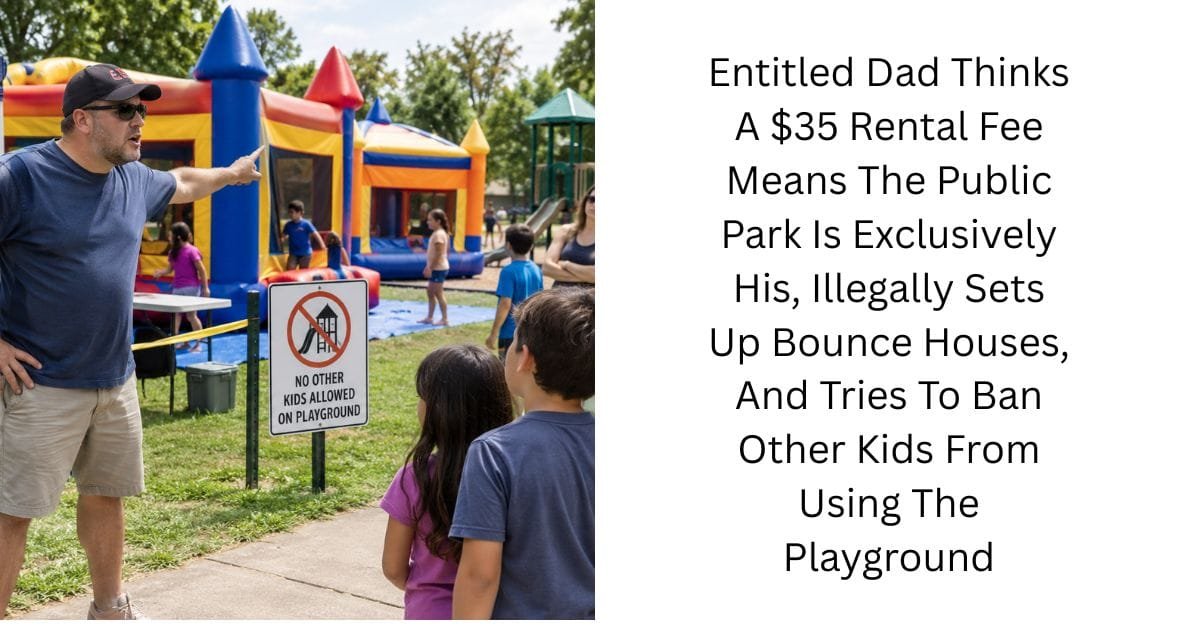
A local father thought paying a small rental fee for a public park gave him far more authority than it actually did. He had reserved a section of the park for his child’s birthday party and paid approximately $35 for the reservation. The rental allowed his family to use a designated area for the celebration, but it did not give them ownership of the entire park or exclusive control over the playground. The park remained open to the public, and other families were still allowed to use the playground, walking paths, and other shared facilities. However, the father apparently interpreted the reservation very differently. As soon as his party arrived, he began acting as though he had rented the entire property. He brought several large bounce houses and other party equipment, placing them around the area and making it increasingly difficult for other children to use parts of the park comfortably.
Things became even more unreasonable when other parents arrived with their children and tried to use the playground. Instead of simply sharing the public space, the father approached them and told them that the playground was essentially reserved for his party. The parents were confused because they had seen no signs indicating that the playground had been closed. They also knew that the park was a public facility and that the reservation only covered a specific area. When one parent politely explained that they were only trying to let their child play for a few minutes, the father reportedly became irritated and insisted that they should leave because he had “paid for the park.” He apparently believed that the $35 rental fee entitled him to decide who could enter the surrounding area. Several parents tried to explain that paying a reservation fee did not turn a public playground into a private playground, but he refused to accept the distinction.
The situation escalated when the father began telling children that they couldn’t use certain equipment because it was being used for his son’s birthday party. He even attempted to establish his own rules about where other children were allowed to stand and play. Parents nearby started questioning what was happening, especially because the bounce houses had apparently been brought in without the necessary approval from the park authorities. The father seemed convinced that because he had paid the rental fee, he could bring whatever equipment he wanted and control the space however he pleased. One parent eventually contacted park staff to clarify the rules. When an employee arrived, the father immediately insisted that he had rented the area and therefore had the right to keep other children away. The park employee explained that the reservation only covered the designated rental space and did not grant exclusive access to the public playground.
The father was reportedly furious when the employee told him that other park visitors were allowed to use the playground. He argued that the reservation fee should give him some form of priority because he had paid money while everyone else was using the park for free. The employee explained that the fee was simply for reserving a particular picnic or event area and that public facilities remained available to everyone unless they had specifically been closed or reserved under park regulations. The employee also questioned whether the bounce houses had been approved, because large inflatable structures often require advance permission, insurance, or specific placement rules depending on the park. The father eventually had to move some of the equipment and stop telling other families that they had to leave. What he had imagined would be an exclusive birthday celebration had turned into an embarrassing confrontation with park staff, all because he had mistaken a small reservation fee for ownership of a public space.
The incident left the other parents shaking their heads because the entire conflict could have been avoided with a basic understanding of how public parks work. Paying a fee to reserve a picnic area does not normally mean that someone owns the surrounding playground, walking paths, or other facilities available to the public. The father had every right to celebrate his child’s birthday in the space he legitimately reserved, but other families had every right to enjoy the public areas as well. His attempt to ban other children from the playground only made the situation worse and drew attention to the fact that he had exceeded the limits of his reservation. In the end, the $35 fee bought him a designated place for his party—not the authority to become the park’s unofficial security guard. The biggest lesson was simple: renting a public space means following the rules of that space, not rewriting them.
Read Story…
EP Thinks They Rented the Whole Park
I’m at a city park with my kids. We’ve been to this park a bunch. There is this one spot where there is a rocky hill, all tree covered. Nice and shady on a hot day. There is a playground and a pavilion at the top of the hill.
We get up there and I immediately notice loud noises and I’m having to step over cables and extension cords. Someone rented the pavilion and set up not one, but three, bounce houses around it.
Fuckin great.
So I have to give the disappointing news to my kids that even though they are surrounded by bounce houses, they cannot play in them since this is a private party, but they are free to go hit the playground. Everyone is cool. I sit on a bench as my kids go to town on the fake pirate ship when I hear “Hey!”
That’s when ED, doing his best to imitate The Situation from Jersey Shore walks up to me and informs me that the playground is closed for a “private party.”
I look at him and inform him that the public park does not close for “private parties” and it sounds like he rented the pavilion nearby which is fine, but doesn’t give him exclusive use of the neighboring playground. He storms off and returns with a rental agreement and shoves it in my face telling me to get my fucking kids and leave.
Right, so rental agreement is very clearly for the pavilion. All for the grand sum of $35 for four hours. How could any sensible adult think that $35 granted you exclusive use of a public playground? Moreover, why is it so important for you to HAVE exclusive use of a public playground?
I, again, point out to him, that he rented the pavilion, not the park and my kids won’t go on his bounce houses and we won’t go into his pavilion, but the playground is fair game for everyone. He begins hurling threats and I’m weighing just taking my kids and leaving to avoid this asshole. Then I decide I need to take a stand on principle. So I tell him to fuck off and proceed to use my phone to find the phone number for the park office. Our county staffs our parks. During the summer months they employ park rangers who have peace officer authority.
I call the park ranger and tell him that there is trouble up at this shady playground and they need to come right away.
Sure enough, as I’m getting off of the phone, Dolph returns with two of his meathead friends to tell me that they are ejecting me from the park.
No, you’re not. And if you touch me, I’m calling the cops and pressing charges. No anger, no rage. With this promise of action, however, one of them kind of widens his eyes and steps back saying to his friend “Just leave them alone, man.” This guy, for some reason, does NOT want the police coming and it is very obvious.
The ringleader won’t back down, however, and tries his best to get in my face, scream and yell. He grabs my arm, I remove his hand. All of this just as I see the ranger pull up, yell for everyone to step back from one another and come over.
This smug fucker shoves the rental contract into the chest of the ranger, telling him that I’m “trespassing” and he rented this space for the day for his kid’s party.
Now, normally I don’t like posturing by law enforcement but, here it was pretty amusing.
Ranger: “Touch me again and I’m arresting you.” -reads contract- “This is for renting the pavilion, you have use of the pavilion but the playground is open for public use.” -hands it back- “Also, your permit doesn’t allow you to set up bounce houses. Where did you plug these in?”
Ranger follows the extension cords and sees that they ran them to the nearby public bathrooms. There was an outdoor outlet. It was locked. This dude cut the lock off so he could plug in his shit.
Ranger comes back with the broken lock.
“Did you cut this lock?”
“Uhhh…it was like that when I found it.”
“Really? Because it was intact this morning. So some random person cut this lock and you just happened upon it within the last two hours?”
“Uhhh….I guess…”
Long story short, he let them stay and let them keep teh bounce castles because he didn’t want to ruin a kid’s party. He wrote the guy a citation for the broken lock and the unauthorized power use and banned him from the park for the remainder of the season (after the party).
Amazingly, this entire event was lost on my children who barely noticed anything was going on (likely because of the compressor noise).
The $35 Rental Fee That Started a Park Dispute
A father planning his child’s birthday party at a local public park apparently believed that paying a $35 rental fee gave him control over much more than the small area he had actually reserved. The park was a popular community space where families regularly brought their children to play, exercise, have picnics, and spend time outdoors. The father had legitimately reserved a designated area for his son’s birthday celebration, which meant he could use that particular space for his party during the scheduled time. However, the reservation did not include the entire park, and the public playground remained open to everyone. Unfortunately, the father seemed to interpret the reservation completely differently. From the moment his family arrived, he began behaving as though the entire park had been rented for his private event. What started as an ordinary birthday party quickly became a bizarre dispute with other parents who simply wanted their children to enjoy the playground.
The father had apparently spent a considerable amount of time planning the party. There were decorations, tables, chairs, food, drinks, games, and several large inflatable bounce houses. He wanted the celebration to feel special and had arranged for the equipment to be delivered to the park before the guests arrived. The problem was that some of the inflatable structures were positioned outside the area he had actually reserved. They were placed close to the playground and along portions of the surrounding space, creating the impression that his party had taken over a much larger section of the park. Other families began arriving with their children as they normally would on a weekend, only to discover that the birthday party appeared to be occupying areas that were supposed to remain open to the public.
At first, the other parents tried to ignore the situation. They assumed that the father had received permission to set up the equipment and that the party would stay within its designated area. Some parents simply guided their children toward another part of the playground. But eventually, the children naturally moved toward the equipment and the regular playground. That was when the father began approaching families and telling them they couldn’t use certain areas because they were part of his son’s birthday party. One parent reportedly asked him whether the playground had been reserved. The father answered that he had paid the park’s rental fee and therefore believed he had the right to use it. The parent was confused and explained that the playground was a public facility, not part of the rented picnic area.
Instead of reconsidering his position, the father became defensive. He reportedly told the parent that he had spent money on the reservation while everyone else was enjoying the park for free. In his mind, that apparently meant he deserved priority over other visitors. He argued that his son was having a birthday party and that other children should simply find somewhere else to play for a few hours. The parent pointed out that there were no signs saying the playground was closed and that the reservation information clearly applied only to the designated rental area. The father reportedly responded that people should respect private events and stop interfering with his child’s special day. What he didn’t seem to understand was that his event was taking place in a public park, not a privately rented amusement facility.
The situation became more awkward when several children tried to access the playground. The father began telling them that they couldn’t use certain equipment because his party had “reserved” the area. Some parents initially thought he was joking. After all, it seemed ridiculous that someone would believe a $35 picnic-area rental could give them control over a public playground. But it quickly became obvious that he was serious. He was reportedly standing near the playground and directing families away from areas where he had placed his party equipment. Some children became confused because they had used the playground many times before and had no idea why a stranger was suddenly telling them they weren’t allowed to play.
One parent finally decided to check the park’s reservation information rather than continue arguing with the father. The parent discovered that the rental covered only a specific picnic or gathering area. There was nothing indicating that the playground had been reserved for a private party. The parent explained this to the father, but he refused to accept the explanation. He insisted that the rental fee meant his family had paid for the use of the park and that everyone else should respect their reservation. When someone pointed out that a public park couldn’t simply be closed to other visitors because someone paid a small rental fee, the father reportedly became even more irritated. He said that people were being deliberately difficult and ruining his son’s birthday.
What made the situation more serious was the presence of the large bounce houses. The father apparently had not received the necessary permission to place them where he had put them. Depending on the park’s rules, inflatable structures may require advance approval, specific insurance documentation, safety requirements, or restrictions on where they can be installed. The father seemed to believe that paying the reservation fee automatically gave him permission to bring any equipment he wanted. He had apparently never checked whether the park allowed private bounce houses or whether the equipment needed to remain within the rented area. By putting the inflatables close to public playground equipment and walkways, he had created another issue beyond simply annoying other families.
One parent eventually contacted the park office or a member of the park staff. They explained that a birthday party was taking place and that the organizer was preventing other children from using the public playground. A park employee came to investigate the situation. The father immediately approached the employee and explained that he had paid $35 to reserve the park. He seemed confident that the employee would support him. He told the employee that he had a private event and that other families were interfering with it. He reportedly expected the staff member to tell the other parents to leave. Instead, the employee asked to see the reservation details and began examining exactly what had been rented.
The employee then explained the distinction that the father had apparently misunderstood. His reservation covered a specific designated area, not the entire public park. The playground remained open to other visitors, and the father had no authority to prevent other children from using it. The employee also explained that placing private equipment outside the permitted rental area could violate park rules. The father reportedly became visibly frustrated and insisted that he had paid for the reservation specifically so his family could have privacy. The employee clarified that privacy could only be guaranteed if the father rented a facility that was actually designated for private use. A small reservation fee for a public picnic area did not transform the entire park into private property.
The father reportedly argued that the park should have made the rules clearer. The employee responded that the reservation information clearly described the area being rented. The father had apparently agreed to those terms when he made the reservation. He couldn’t simply reinterpret the agreement after arriving. The employee also told him that the playground was intended for public use and that families could not be removed simply because another visitor was holding a birthday party nearby. At that point, several parents who had been watching the situation began to feel relieved. They had initially worried that they might somehow be violating a park rule by letting their children play, but the employee confirmed that they were allowed to remain.
The father still wasn’t satisfied. He reportedly asked whether the other children could at least stay away from the bounce houses. The employee explained that the bounce houses themselves were part of his private event, so he could control access to those structures, but he couldn’t use them as a reason to block public areas. The distinction was fairly simple: his rented area and privately arranged activities belonged to his party, while the public playground belonged to everyone. The father could tell people not to use his equipment, but he couldn’t tell them not to use public facilities. Once the rules were explained clearly, there was little room for argument.
The father then tried another approach. He reportedly complained that the other parents were allowing their children to come too close to his party and were making it difficult for his guests to enjoy themselves. He said that his family had paid money and deserved to have an uninterrupted celebration. The park employee sympathized with the desire to have a successful birthday party but reminded him that public spaces require people to share them. If he wanted an entirely private event, he would need to rent a private venue or a facility specifically intended for exclusive use. The fact that he had paid a modest reservation fee didn’t change the nature of the park.
Some of the other parents were particularly frustrated because the father had been acting as though they were trespassing. One parent explained that their child had been playing at the park regularly long before the birthday party arrived. Another parent said that they had initially moved away from the party area out of courtesy but became uncomfortable when the father started claiming parts of the playground. The situation wasn’t simply about sharing space anymore. It was about the father attempting to impose rules on people who had never agreed to them. His behavior made the other families feel as though they needed permission to use a public facility that existed specifically for community use.
The children themselves seemed confused by the entire conflict. Some of them had apparently been told by the father that the playground was unavailable because of the birthday party. When the park employee clarified that the playground remained open, the children returned to playing. The contrast was almost comical. Within minutes, the playground was functioning normally again while the birthday party continued nearby. Nothing about the children’s presence actually prevented the birthday celebration from happening. The father had simply convinced himself that he was entitled to complete control over the surrounding environment.
The bounce houses created another problem because the park employee reportedly asked the father whether he had obtained the required approval for them. The father apparently said that he assumed his reservation covered everything. The employee explained that it didn’t. If the park required permits or advance approval for inflatables, the father couldn’t ignore those rules simply because the equipment had already arrived. He was instructed to move or remove any equipment that had been placed outside the approved area. This was likely the moment when the father realized that his interpretation of the reservation was much broader than the park’s actual rules.
Rather than accepting responsibility, he reportedly complained that nobody had warned him. The employee reminded him that it was the responsibility of people organizing private events to understand the conditions attached to their reservation. The father argued that the $35 fee was too expensive if it didn’t give him exclusive use of the park. The employee explained that the fee wasn’t a purchase price for the entire facility. It was simply a rental charge for a specific area. The father had essentially paid for the right to use that area during the reserved period, not ownership of the surrounding property.
At some point, another parent quietly commented that the father seemed to think he had bought the park. That comment reportedly caused a few people nearby to laugh, although the father did not find it funny. He insisted that everyone was disrespecting him because he was trying to give his child a special birthday. The irony was that most people had no problem with the birthday party itself. They had a problem with being told that their children couldn’t use a public playground. If the father had kept his decorations and bounce houses within the designated area and allowed everyone else to use the public facilities, there probably would have been no conflict at all.
The park employee eventually gave the father clear instructions about what he could and couldn’t do. He was allowed to continue his birthday party within the area he had reserved. He could control access to the private equipment he had brought for his guests, provided the equipment itself complied with park rules. However, he could not prevent other visitors from using public playground equipment or other areas that remained open to the community. He also had to comply with the park’s rules concerning the placement and approval of inflatables. The employee reportedly made it clear that failure to follow those instructions could result in the party being shut down or the reservation being canceled.
The father finally backed down, although he reportedly remained angry about the situation. He moved some of the equipment and stopped approaching families who were using the playground. The other parents were relieved that the confrontation had ended without becoming even more serious. Once everyone understood the boundaries, the park returned to something resembling normal. The birthday guests enjoyed their party, while other families continued using the playground. The two groups were able to coexist perfectly well once the father stopped trying to control the entire space.
Interestingly, the birthday party itself apparently wasn’t the problem. The children attending the party had fun, the food was served, and the decorations remained in place. The only major conflict had been created by the father’s assumption that he was entitled to control everyone else’s activities. He could have celebrated his child’s birthday without any issue if he had simply respected the limits of his reservation. Instead, he turned a routine party into a confrontation that involved park staff and several unrelated families. His insistence on treating the public playground as private property made what should have been a pleasant event unnecessarily stressful.
Some parents later discussed the incident and agreed that the father’s behavior was especially unreasonable because the reservation fee was so small. They weren’t mocking the amount of money itself, but rather the idea that a modest payment could somehow override the rights of every other visitor. The park had thousands of dollars worth of public infrastructure, including playground equipment, walking areas, fields, and open spaces. A $35 reservation didn’t give one person ownership of all those facilities. It simply allowed him to reserve a particular location for his event.
The incident also raised questions about the bounce houses. Several parents wondered whether the father had knowingly ignored the park’s rules or had genuinely assumed that his reservation covered them. Either way, the situation demonstrated why event organizers should check the regulations before bringing large equipment onto public property. A bounce house may seem harmless, but inflatable structures can create safety, space, electrical, anchoring, and liability concerns. The fact that the father had brought them without apparently confirming the requirements made his attempt to control the surrounding playground even more problematic.
For the other families, the biggest frustration was that the father had tried to make them feel guilty for using a public facility. They hadn’t crashed his party, entered his rented area, or used his private equipment. They had simply brought their children to the playground. In a public park, that is exactly what the playground is there for. The father could reasonably expect his guests to have access to the space he reserved, but he couldn’t reasonably expect strangers to surrender their access to facilities they had never been asked to share exclusively.
The situation became a good example of how entitlement can turn a simple misunderstanding into a major conflict. The father may have believed that because he had paid money, he deserved a private experience. But paying for access to a public facility doesn’t necessarily mean paying for exclusivity. There is an important difference between reserving a designated area and renting an entire venue. The moment he started trying to ban other children from the playground, he crossed that line. The park employee had to step in not because the birthday party itself was inappropriate, but because the organizer was attempting to enforce rules he had no authority to create.
In the end, the father learned that the $35 reservation came with boundaries. He could enjoy his designated party area, decorate it, invite his guests, and use any approved equipment within the rules. What he couldn’t do was declare the entire park private or remove other families from public facilities. His attempt to turn a small rental into exclusive ownership had failed, and the park staff made sure everyone understood the difference. The other children went back to playing, the birthday party continued, and the conflict eventually ended.
The story was a reminder that public spaces only work when people understand that they are shared. Renting a portion of a park can give someone certain rights over that particular area, but it doesn’t automatically give them control over everyone else. If someone wants complete privacy, there are private venues specifically designed for that purpose. A public playground is different. It belongs to the community and remains available to the public unless there is an actual authorized closure or exclusive reservation. The father had every right to celebrate his child’s birthday, but he didn’t have the right to turn everyone else’s afternoon into a private inconvenience.
Ultimately, what made the story memorable wasn’t the $35 fee or even the bounce houses. It was the sheer confidence with which the father believed that a small rental payment had transformed him from a park visitor into the person in charge. He tried to decide where other children could play, confronted parents who questioned him, and assumed the park staff would support his interpretation. Instead, the staff reminded him of a very basic rule: paying to reserve part of a public park does not mean you own the rest of it. His $35 bought him a designated place for his son’s birthday—not the authority to ban other kids from the playground.


