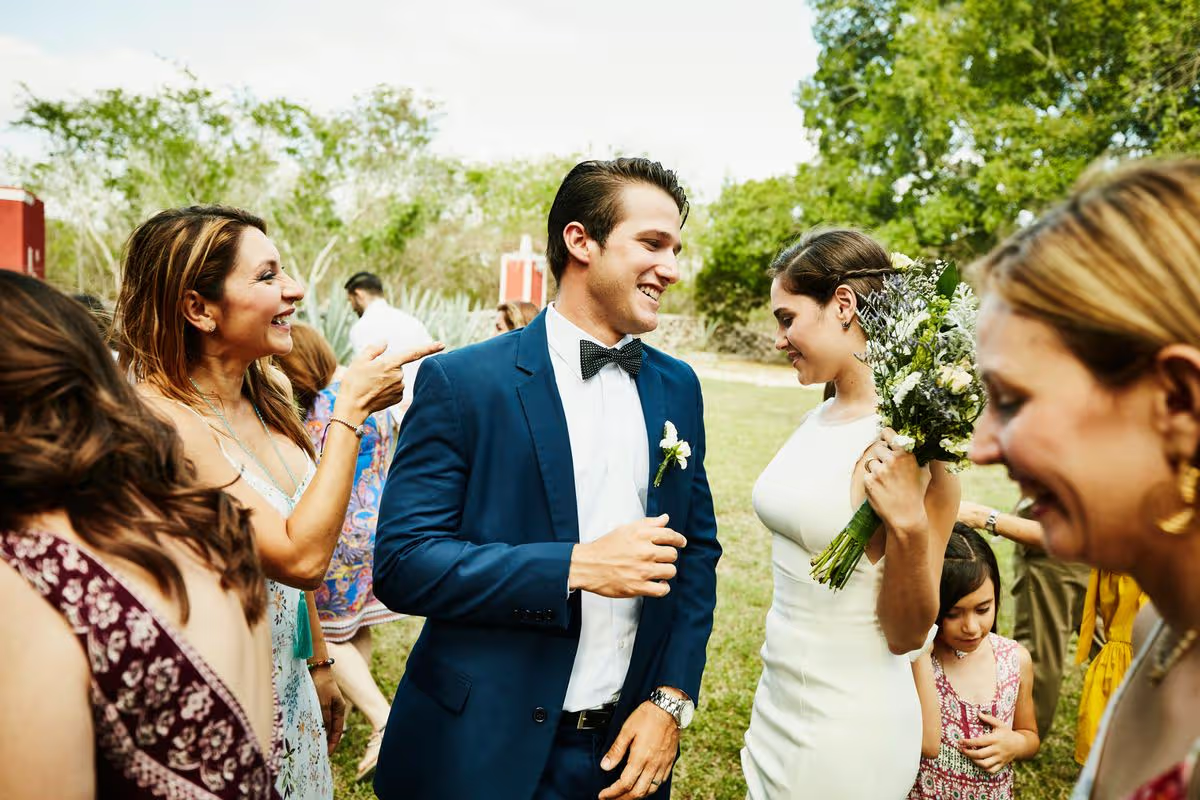
Bride Upset After Manipulative Mom Backtracks On Deal Not To Bring Estranged Dad To Wedding

The bride had spent months planning her wedding and trying to make sure the day would be peaceful and meaningful. One of the most difficult issues involved her relationship with her parents, particularly her estranged father. Their relationship had broken down over the years, and she had made it clear to her mother that she did not want him present at the wedding. For the bride, this was not about creating unnecessary drama or punishing anyone. She simply wanted to feel safe and comfortable on a day that was supposed to celebrate the beginning of her marriage. After several difficult conversations, her mother agreed that she would respect the bride’s wishes and would not bring the father to the wedding.
At first, the agreement gave the bride some relief. She believed that although her mother might not completely understand her decision, she would at least honor the boundary that had been discussed. The bride continued with her wedding preparations, trusting that the issue had been settled. However, as the wedding drew closer, her mother began making comments that made her suspicious. She started suggesting that the situation with the father was unfair and that perhaps everyone should simply put their differences aside for one day. Whenever the bride reminded her of their agreement, her mother acted as though the original conversation had been misunderstood or was never meant to be permanent.
Eventually, the mother revealed that she had changed her mind. She wanted to bring the estranged father to the wedding despite previously promising not to do so. The bride was understandably upset because she felt her mother was deliberately going back on a clear agreement. What made the situation even more frustrating was the way her mother handled the disagreement. Instead of openly acknowledging that she had broken her promise, she tried to make the bride feel guilty for objecting. She suggested that refusing to allow the father to attend would cause unnecessary family conflict and portrayed herself as the person caught in the middle.
The bride tried to explain that she was not asking her mother to choose sides or publicly reject anyone. She was simply asking her to respect one specific boundary concerning her own wedding. After everything she had already experienced in her relationship with her father, having him suddenly appear at the ceremony would completely change the atmosphere for her. She also felt manipulated because the agreement had originally been presented as a way to avoid exactly this kind of confrontation. Now that the wedding was approaching, she felt as though her mother was using emotional pressure to force her into accepting a situation she had clearly said she did not want.
What had started as a simple agreement between a bride and her mother ultimately became another painful family conflict just before the wedding. Instead of being able to focus entirely on celebrating with her future spouse, the bride found herself worrying about whether her mother would respect her wishes at all. She knew that some relatives might consider her decision harsh, while others might believe that her wedding day should be one of the few occasions where she could establish her own boundaries without being pressured. For the bride, the biggest issue was no longer simply whether her estranged father would attend—it was whether her mother could be trusted to keep her word when the situation became difficult.
Read Story…
“AITA for sticking to the original deal my mom and I made about my dad attending my wedding?”
The original poster (OP) explained:
“I (35, female) recently married my husband (37, male). My mom (60, female) wanted to completely fund our wedding because she was excited I was finally getting married and loved my fiancé. I’ve known my mom to be manipulative my entire life.”
“We accepted her offer under one explicit condition: she would not bring my dad (71, male), her husband, to the wedding. I don’t have a relationship with my dad, but that’s a long story.”
“My mom agreed to everything we wanted, but her arrangement was that we would sign all the vendor contracts and pay them, then she would reimburse us. Once our names were on the contracts and most vendors were booked, she started trying to force me to invite my dad.”
“She tried everything, including getting family members to tell me I was being unreasonable and calling me on my 34th birthday to say she would no longer come to the wedding or fund it unless I invited him. Eventually, my fiancé had to intervene and remind her that we had a deal.”
“She respects him, so she backed off and agreed again. The problem was that her payments were inconsistent. She’d give us $1K here and there, while wedding payments were coming due.”
“I asked if everything would be paid before the wedding, and she said she’d pay when she could. We didn’t have a real budget from her, but I knew she had the money.”
“A few months before the wedding, I finally told her she could bring my dad IF she paid everything by the wedding day, but he could not attend any activities before the wedding at 5:30. She agreed.”
“It became very ‘Gilmore Girls’: we had to call her every day to check in, but she was being nice and would give us chunks of $5–$10K when payments were due.”
“I knew she’d try something at the last minute, so I warned our photographer. On the wedding day, we were getting ready in the bridal suite with my five bridesmaids, hair and makeup, three photographers and two videographers.”
“My mom suddenly said she wouldn’t go to family photos afterward unless she could bring my dad.”
“I reminded her of our deal. She said she had ‘misunderstood.’ I called my mother-in-law in to try to talk her into coming. My mom stonewalled and my sister maid-of-honor (MOH), who we aren’t close with either, backed her up, and they left together.”
“They said they would show up when my dad did. I later learned my dad had positioned himself directly in front of the door as a guest greeter so he could appear front and center, which is part of why I didn’t want him there in the first place.”
“Everyone in the bridal suite was shocked, but I kept my cool. I ended up with no photos with my mom or sister, barely interacted with them during the wedding, and we haven’t spoken since.”
“AITA for sticking to the deal my mom and I made?”
OP later added to answer recurring questions:
“I explicitly wanted my sister and mom in the photos. They were the ones who said they wouldn’t do it after all if my dad didn’t join (which went against the agreement between my mom and I had in advance).”
“More context is that she did attend the rehearsal dinner without him the night before (no cameras there) and there was no fuss. It was when the cameras came out the day after that she started shenanigans because she knew I wanted photos with her and my sister. She used it as leverage.”
“Most photographers and videographers have second shooters, and in our case, our photog chose to add a third because she got injured and had limited mobility, which she did not want to affect her work product to clients.”
“Really wanted to have an opportunity to get closer with my sis through the experience of her being a MOH. She seemed to want that too until she didn’t…”
“Unless you’ve had a narcissistic parent, it can be hard to understand how difficult that cycle is to climb out of. I’m never going to accept a penny from her again, but her calling me every day to be excited about wedding things together blindsided me. I did want that closeness.”
“Mom got almost everything she wanted out of the deal. She offered to pay. She does well for herself financially and loves the optics of going all out for parties. She invited a bunch of family/friends she wanted to spend time with.”
“Had no issues with that part. Just one person I said no to and she said okay fine. She also went to the rehearsal dinner the night before without him and made no fuss.”
“Assumptions that both of my parents were paying, but one could attend are incorrect. Mom is manipulative about money, remember? Only she was paying from her own pocket.”
Redditors weighed in using the AITA voting acronyms:
- NTA – Not The A**hole
- YTA – You’re The A**hole
- NAH – No A**holes Here
- ESH – Everyone Sucks Here
- INFO – more information needed
Redditors decided the OP was ultimately not the a**hole (NTA), but many took OP to task for ever accepting their mother’s offer and adding their sister to the wedding party.
“NTA but you’ve been a bit dumb. You know your mom is manipulative and you keep falling for it. Time for therapy.” ~ LunaHoopla
“Exactly! If your mom is the way she is, why even give her that power? I would have eloped before I let my mother manipulate my wedding experience.
“OP said she’s not close with her sister, but yet she was the maid-of-honor. This wedding was doomed for the start.”
“You wanted great pics when your relationship is sh*t! Forget the pics, it sounds like she shouldn’t have been there in the first place.”
“NTA for this but you’re responsible for letting money make bad choices for you. Sounds like greed got the best of you. A small wedding you and your fiancé could afford would have been the better thing to do.” ~ One-Writer-4376
“So now instead of being able to remember her wedding day with joy, she gets to remember all of this family drama instead.” ~ Effective-Dog-6201
“The fact mom, who said she’d pay for everything, made OP sign the contracts should’ve been clue number 2. At this point, mom and sister going no contact with her is for the best since she can’t enforce any type of boundary.”
“Also, if she isn’t close to her sister, why did she make her the maid-of-honor? OP went out of her way to be miserable on her big day.” ~ lankyturtle229
“She just wanted the cash because she wanted a grand wedding at no cost to herself. She herself said she knew what she signed up for.”
“She could have chosen to just elope and avoided all that drama, but, you know…bling bling wedding is more important… You get what you pay for. The memories of her wedding will forever be tainted.” ~ raffles79
“Agreed. Money from manipulative family members comes at too expensive a price.” ~ SophisticatedScreams
“I had an epiphany one day that once you know who someone is by the behavior they have repeatedly shown you, that you are no longer a victim but a volunteer. Therefore I could not blame anyone but myself when my mom did exactly what she always did.”
“For another few years, I even tried to have a relationship knowing I was ‘volunteering’ for her manipulation and abuse before I finally went no contact. Tough lesson to get in my head, because I kept thinking ‘it shouldn’t be this way’.”
“But it was and I had the power to decide to not participate. It’s sad but true. I am not always happy with the situation, but I am at peace. ~ karzad
“NTA, but you’ve really got to learn to hedge your bets. She had too much wiggle room. Honestly, with her being so manipulative not sure why you even keep contact.” ~ tango421
“Your subject heading is incorrect: you didn’t stick to the original deal, which explicitly excluded your father from the wedding. You waffled and paid the consequences.”
“‘Her arrangement was that we would sign all the vendor contracts and pay them, then she would reimburse us’: not wise of you, if you really wanted to keep your father out.”
“I hope all this drama was a worthwhile price to pay for a wedding you couldn’t afford.” ~ ReadMeDrMemory
“You’re a 35-year-old woman who let her manipulative mommy pay for her wedding. You aren’t a victim, you chose to play the game.” ~ danmtypos
It’s lesson learned, again, for OP.
When someone repeatedly shows you who they are, why don’t you believe them?
Bride’s Wedding Plans Complicated By Conflict Over Her Estranged Father
The bride had spent months preparing for her wedding, imagining it as a day filled with happiness, family, and the people she genuinely wanted around her. Like many brides, she knew there would be stressful decisions along the way, but she expected the people closest to her to respect her wishes. Unfortunately, one of the biggest problems involved her own mother and the question of whether her estranged father would attend the wedding.

Advertisement
The bride had a difficult relationship with her father and had been separated from him for some time. Their history had created a great deal of emotional pain, and she did not feel comfortable having him present during such an important occasion. She understood that other family members might have different opinions, but she believed she had the right to decide who would be invited to her own wedding.
Her mother, however, did not see the situation in exactly the same way. She continued to have feelings about the family being separated and apparently wanted to find a way to bring everyone together again. The bride had already explained that the wedding was not the appropriate place to repair a broken relationship, especially one that had taken years to become complicated.
Because the bride wanted to avoid a major argument, she sat down with her mother and discussed the situation directly. She explained that she was not asking her mother to stop having a relationship with her father. She was simply asking her to respect one boundary for the wedding and not bring him along without permission.
After their conversation, the mother agreed not to bring the estranged father. This agreement gave the bride some peace of mind. Although she knew her mother might not completely agree with her decision, she believed that they had reached an understanding that would allow everyone to move forward.
The bride then returned her attention to wedding preparations. There were invitations to organize, plans to finalize, relatives to communicate with, and countless small details that needed attention. She thought the issue involving her father had finally been settled and did not expect it to become a problem again.
As the wedding approached, however, the mother began bringing up the father more frequently. She made comments about how difficult it would be for him to miss such an important family event. She also suggested that weddings were supposed to bring families together and that perhaps the bride would eventually regret excluding him.
The bride tried to remain patient. She reminded her mother that they had already discussed the matter and that the agreement was specifically made because she did not want the issue to become a source of conflict during the wedding. She hoped that repeating the boundary would be enough.
Instead, her mother’s attitude gradually changed. She began acting as though the original agreement was not as serious as the bride believed it was. Whenever the bride mentioned the promise, her mother offered different explanations and reasons for why circumstances had changed.
Eventually, the mother admitted that she was considering bringing the father to the wedding anyway. The bride was shocked and deeply upset. From her perspective, the entire purpose of their earlier conversation had been to make sure this exact situation would not happen.
The bride reminded her mother that she had made a clear promise. She had trusted that promise when continuing with the wedding plans. If her mother had disagreed from the beginning, the bride could have made other arrangements, but changing the agreement at the last minute left her feeling cornered.
Her mother argued that she was only trying to do what was best for everyone. She believed that having the father attend could prevent further family tension and possibly create an opportunity for reconciliation. The bride, however, did not see the wedding as an appropriate setting for such an emotionally complicated reunion.
She explained that reconciliation was something that could only happen if she personally wanted it and was ready for it. It could not be forced simply because there was a wedding on the calendar. She also did not want her special day to become a situation where she had to worry about arguments, uncomfortable interactions, or unexpected drama.
The mother responded by making the bride feel responsible for the family’s problems. She suggested that refusing to allow the father to attend would make the bride look unforgiving. The bride felt this was unfair because she was not responsible for repairing a relationship that had already become estranged.
What upset her most was the feeling that her mother was using guilt to pressure her into changing her mind. Instead of respecting the boundary they had agreed upon, her mother seemed determined to make the bride question whether she had the right to establish that boundary in the first place.
The bride tried several times to explain that she was not demanding that her mother stop seeing or speaking to her father. She was simply asking for one specific promise to be honored. In her mind, there was a major difference between controlling her mother’s personal choices and protecting her own wedding from a situation she knew would cause her distress.
The closer the wedding date came, the more stressful the situation became. What should have been an exciting period in the bride’s life was increasingly dominated by arguments and uncertainty. She began wondering whether she could trust her mother to follow through with the agreement.
Other family members also became aware of the disagreement. Some believed that the father should be allowed to attend because he was still the bride’s parent, while others understood why the bride wanted distance from him. The bride realized that no matter what she decided, there would probably be people who criticized her choice.
She did not want the issue to turn into a larger family battle. Her main concern was simply having control over her own wedding day. She had already made her feelings clear, and she felt that continuing to pressure her would only make the situation more painful.
The bride also questioned why her mother had agreed to the original arrangement if she never truly intended to follow it. If the mother believed the father deserved an invitation, she could have said so during their first conversation. Instead, she gave the bride reassurance and then reconsidered the agreement when the wedding was getting closer.
That made the bride feel betrayed in a way that went beyond the disagreement about her father. To her, the issue had become one of trust. She needed to know that when her mother gave her a promise about something this important, she would actually honor it.
The mother continued to insist that she was acting out of love and concern for the family. She did not necessarily view herself as manipulating her daughter. From her perspective, she may have believed that bringing the family together was worth taking the risk of upsetting the bride. However, the bride experienced the pressure very differently.
She felt that her mother’s actions ignored the emotional reasons behind her decision. The bride had not excluded her father casually or simply because of a minor disagreement. Their estrangement had developed over serious personal issues, and she did not want to explain or revisit those issues on the day she was getting married.
Eventually, the bride realized that she might have to make firm arrangements to ensure that her wishes were respected. She considered limiting her mother’s role in certain parts of the wedding and making it clear that no uninvited guest would be welcomed simply because someone else decided to bring them.
Although the situation was incredibly painful, the bride knew that allowing herself to be pressured could create even more regret. She wanted to remember her wedding as a celebration with her partner rather than as the day her family forced her into an unwanted confrontation.
In the end, the conflict left the bride questioning her relationship with her mother as well as her father. She had expected her mother to support her, even if she did not agree with every decision. Instead, the broken promise and continued pressure made her feel that her own wishes were being treated as less important than her mother’s desire to reunite the family.
For the bride, the central issue was never simply whether her estranged father should be physically present at the wedding. It was about boundaries, trust, and having the freedom to decide what would make her own wedding day comfortable. After months of planning, she now had to deal with a family conflict she had specifically tried to prevent, all because her mother chose to backtrack on a promise that had once given her reassurance.