My Mother Said My Brother Died as a Baby—Then I Found a Birthday Card From 1965
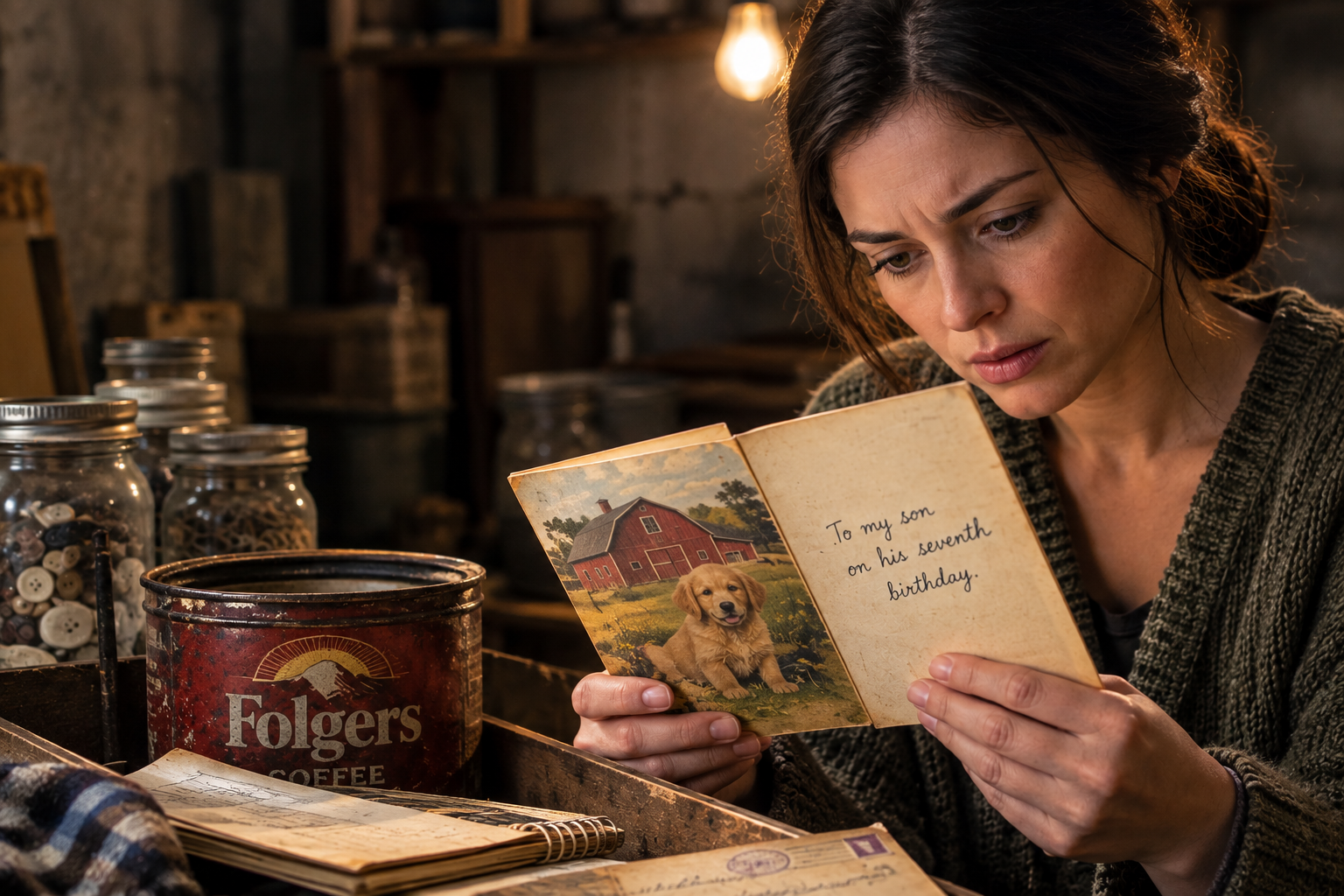
For most of my life, I believed the story my mother had always told me about my brother. She said he had died as a baby during the brutal winter of 1958, before I was old enough to remember him. We never visited a grave, but I had grown up accepting that there were some things children simply weren’t meant to question. My mother was a private woman who rarely talked about painful memories, so I never pushed her for details. After she passed away at the age of ninety-one, however, I was left with the difficult task of clearing out her old house. While sorting through the cellar, I spent days going through boxes filled with newspapers, seed catalogs, Mason jars, old household items, and records she had carefully saved for decades.
On the fourth afternoon, I discovered an old Folgers coffee can hidden behind a row of empty jars near the chimney. Inside were my mother’s old egg-money records, ration books, and other papers from decades earlier. But at the very bottom was something that immediately caught my attention: a yellowed envelope addressed to a township two hours north of our county. The envelope had been returned to the sender, and the postal stamp showed October 14, 1965. When I opened it, I found a birthday card with a faded photograph of a red barn and a golden retriever puppy on the front. Inside, written in my mother’s unmistakable handwriting, were six words: “To my son on his seventh birthday.” I stared at the card in disbelief. If my brother had died in the winter of 1958, as my mother had always claimed, how could she have been sending him a birthday card for his seventh birthday in 1965?
The discovery completely changed the way I looked at my childhood and my mother’s carefully guarded past. I couldn’t stop thinking about the numbers and what they meant. The card suggested that my brother had not died as a baby at all. Instead, he had been alive somewhere, growing up while my mother continued to carry the secret. After several days of thinking about it, I copied the return address from the envelope and drove north. The journey took about two hours, and with every mile I became more convinced that I needed to know the truth. Eventually, I arrived at an old farmhouse where a man named Samuel answered the door. The moment he saw me, he recognized who I was. He told me I had my mother’s mouth and immediately understood why I had come. When I showed him the old birthday card, he seemed deeply affected and asked if she had kept it all those years.
Samuel eventually explained what had really happened in 1958. My mother had been only twenty-four when my brother Thomas was born. During that terrible winter, the family was struggling financially, and a severe blizzard made everything even worse. Thomas became sick with croup, and my mother didn’t have enough money to get him the medical care he needed. Samuel explained that my grandfather was a harsh man who feared scandal and would not have tolerated the situation. My mother believed that if Thomas remained in the house, he might not survive. So, during the snowstorm, she carried the baby to Samuel’s home and asked him to take the child away to safety. She made him promise that Thomas would be raised elsewhere and that everyone would believe the baby had died. According to Samuel, it wasn’t because my mother didn’t love her son. She believed she was making an impossible sacrifice to give him a chance to survive. For years, she carried the pain of that decision while allowing the rest of the family to believe Thomas was gone.
Samuel then took me to meet the man who had been hidden from my family for decades. Thomas was living nearby and working in a small woodworking shop. When I saw him, I immediately noticed familiar features that connected him to my family, including the shape of his shoulders, his hands, and the unmistakable expression around his eyes. He already knew about his biological mother and understood why she had stayed away. He told me that when he was young, he had learned about Martha and had heard about the birthday card she once tried to send him. Thomas still had the old card and a tarnished 1954 Roosevelt dime that had been kept safe for years. Standing together in the woodshop, the missing years finally began to make sense. The brother I had believed was dead had actually spent his life only a short distance away. The old birthday card had uncovered a secret my mother had protected for decades, and although I could never recover the years we had lost, I finally understood that her silence had been tied to a painful decision she believed was necessary to keep her son alive.
Read Story…
A Birthday Card From 1965 Revealed That My “Dead” Brother Was Still Alive
Mama always said my brother died as a baby. Winter of 1958, before I was old enough to remember. We didn’t visit a grave, but you didn’t question Mama.
She passed away in January at ninety-one years old, leaving behind a house that smelled eternally of lemon oil, damp pine needles, and cold cast iron. For forty years, that house had been her fortress, kept at a steady, oppressive sixty-eight degrees because she said heat made the floorboards warp. When the funeral was over and the church ladies had finally stopped bringing foil-covered casseroles of tuna noodle bake and scalloped potatoes, I was left alone with the task of emptying out the cellar.
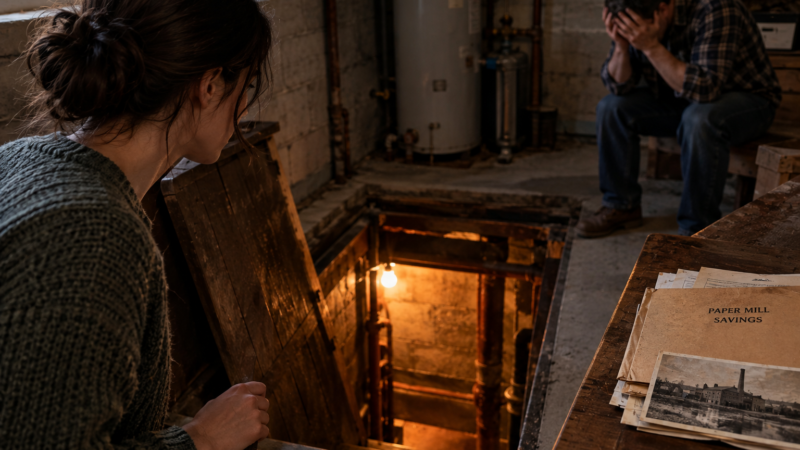
It was a limestone-walled room underneath the kitchen, reached by a steep set of wooden stairs that always groaned on the third step down.
I spent three days down there with a flashlight and a box of contractor trash bags, sorting through stacks of seed catalogs from 1974, yellowed newspapers reporting on local dairy prices, and dozens of Mason jars filled with buttons, rubber bands, and rusted curtain hooks. Mama kept everything. That was just her way. You didn’t throw out a piece of twine if it had three good inches left on it.
On the fourth afternoon, tucked behind a row of empty canning jars in the far back corner behind the chimney stack, I found an old Folgers coffee can with the plastic lid cracked down the middle. I had to pry it open with the flat edge of a butter knife because the tin had rusted slightly in the damp air.
Inside were her egg money records from the sixties, small spiral notebooks with her cramped, precise handwriting tracking every dozen sold to the creamery in town, along with ration books from the war that we didn’t even need anymore.
At the very bottom, underneath a bundle of dried sage and a receipt for a Sears woodstove, lay a single square envelope.
I pulled it out into the dim light of the single bare bulb dangling from the ceiling beam. The paper was heavy, cream-colored, and yellowed at the edges like old teeth. Across the front, written in Mama’s familiar, sloping hand, was an address I had never seen before in a township two hours north of our county line. Above it, stamped in purple ink by the postal service, were the words RETURN TO SENDER. Across the center stamp was a date: October 14, 1965.
I turned it over and slipped my finger under the flap, but it was already unsealed.
Inside was a birthday card with a faded photograph of a red barn and a golden retriever puppy on the cover. I opened it. Written inside in that same sharp, unyielding handwriting were six words: To my son on his seventh birthday.
I sat down hard on an overturned wooden crate that had once held apples. The concrete floor was freezing through the soles of my boots, but I didn’t feel it. I sat in the cellar and did that arithmetic about nine times.
If he had died in the winter of 1958, as Mama had repeated with absolute, unshakeable certainty every time the subject of a lost sibling drifted into our kitchen conversation, how could he be turning seven years old in October of 1965?
The numbers refused to line up. They banged against each other in my head like loose stones in a tin cup. 1958 minus 1965 did not equal a dead baby in a snowbank.
It equaled a child growing up somewhere else while Mama sat at her kitchen table every autumn and bought a five-cent stamp she never got to use again.
Three days later, I was still sitting on that arithmetic. The house upstairs felt different now, less like a home and more like a museum of a very carefully constructed lie. Every time I looked at the dark pine sideboard in the dining room, I thought about what else might have been hidden behind those polished doors. I didn’t call the neighbors, and I didn’t call my cousins down in Bangor. I just put the coffee can back on the shelf, locked the cellar door behind me, and walked out to my truck.
The drive north took two hours through rolling hills of scrub pine and gray granite that looked like the spine of a sleeping animal under the dull November sky. Route 9 was narrow and pitted with frost heaves that made my truck bed rattle every time I hit a patch of neglected asphalt. I kept the heater fan on high because the blower motor made a rhythmic thrumming sound that kept the silence from getting too loud in the cab.
As I drove, I thought about Mama’s hands. They were always dry, smelling faintly of lye soap and bleached flour, skin like old parchment pulled tight over knuckles that stayed swollen from arthritis every time a nor’easter rolled in off the bay. She was a woman who didn’t waste words, and she certainly didn’t waste tears. When my father died of a sudden lung hemorrhage in the barn back in seventy-two, she didn’t cry at the service. She stood by the open hole in the frozen ground with her wool coat buttoned up to her chin, looking down at the box as if she were inspecting a fence line for broken wire.
You don’t understand a person like that until you find out they spent thirty years carrying a secret heavier than a stone silo.
I pulled off the paved highway onto a gravel turnoff just past a rusted metal sign that read Miller’s Creek Road. The mailboxes out here were mounted on old cedar fence posts, weathered silver by the salt air and wind. I checked the slip of paper where I had copied down the return address from the envelope: Route 4, Box 82.
The farmhouse sat back from the gravel road about a hundred yards, half-hidden behind a ragged windbreak of balsam firs that dropped brown needles onto the packed dirt driveway. It was a white-painted clapboard house with green trim peeling around the window sills, the kind of place where people had lived and worked the same forty acres for generations without ever getting ahead or falling quite behind.
I cut the engine. The ticking sound of the cooling exhaust pipe was the only noise in the yard except for the wind moving through the fir branches overhead.
Before I even had my hand on the truck door handle, the front screen door of the farmhouse banged open. A man stepped out onto the porch. He was tall, wearing an old canvas chore coat with the cuffs frayed and a gray wool cap pulled down low over his forehead. He didn’t look like a stranger. He walked down those wooden porch steps with a slight hitch in his left knee, a distinct, heavy-footed way of favoring his right side that I had watched my father do every evening of my childhood when he came in from hauling feed sacks.
I sat there with my hand frozen on the latch, my heart doing a strange, slow thud against my ribs.
He walked straight toward the driver’s side of my truck, his hands shoved deep into his coat pockets, his chin tucked down against the cold. When he reached the window, he didn’t ask me what I wanted or tell me I was trespassing. He just looked at me through the dirty glass with eyes the exact color of a winter sky over the marsh.
“You’re Martha’s girl,” he said. It wasn’t a question.
I pushed the door open and stepped down into the gravel, the cold air hitting my face like a handful of dry needles. I didn’t say anything for a second, and honestly that felt worse than whatever explanation he was about to give me.
“How did you know?” I finally managed, my voice sounding thin and small against the wide expanse of the farmyard.
“You’ve got her mouth,” the man said. He pulled one hand out of his pocket and rubbed the stubble along his jawline. “And you’re driving her brother-in-law’s old pickup, or one just like it. I’m Samuel. I reckon you figured that out by now.”
I reached into the pocket of my coat and pulled out the yellowed envelope, holding it out between us like an offering or a shield. The paper looked even frailer out here in the open daylight than it had down in the dark of the cellar.
Samuel looked down at the handwriting. He didn’t touch it, but his shoulders seemed to drop an inch under the heavy canvas of his coat, as if he had been waiting forty years for someone to walk up this driveway and hold that exact piece of paper out to him.
“She kept it,” Samuel murmured, his voice rough as gravel scraped by a shovel. “She kept every one of those cards she couldn’t mail, didn’t she?”
“Just the one,” I said. “At the bottom of the coffee can.”
Samuel let out a long breath that turned into a plume of white vapor in the chill air. He looked back toward the house, then down the gravel lane toward a smaller, unpainted shed about a quarter-mile away where a thin curl of blue smoke was rising from a brick stovepipe.
“Come on inside,” he said, turning back toward the porch. “It’s too cold to stand out here chewing over things that happened before either of us had gray in our hair.”
The kitchen inside smelled of wood smoke, black coffee, and old linoleum cleaner. It was clean in the way only a bachelor’s house can be, everything put away in its proper place with no unnecessary clutter on the counters. Samuel pointed me toward a wooden chair with a braided rag cushion while he filled an enamel kettle at the hand pump by the sink and set it on the cast-iron stove.
“You want to know about fifty-eight,” he stated, leaning his hip against the edge of the kitchen table.
“Mama said he died,” I told him, keeping my eyes fixed on the oilcloth tabletop where a ring from an old mug had left a dark brown circle. “She said the winter took him when the roads were closed for four days straight. She said there wasn’t anything anyone could do.”
Samuel nodded slowly, staring down at his large, square hands. “She didn’t lie about the winter. That blizzard was the worst one we’ve seen since the logging days. Snow drifted up to the eaves on the south side of the barn, and the temperature dropped to twenty below before the wind even died down. But the boy didn’t die.”
The silence in the kitchen stretched out until the only sound was the metal kettle starting to sing on the hot iron burner.
“Then why?” I asked, and my voice cracked slightly on the word. “Why would she tell us he was gone? Why wouldn’t she keep him?”
Samuel pulled out a chair opposite me and sat down, his knees wide, his hands clasped between his boots. He looked tired, the kind of deep, bone-weary tiredness that comes from carrying a secret that doesn’t belong to you alone.
“Your mother was twenty-four years old when Thomas was born,” Samuel began, his voice dropping into a steady, rhythmic cadence like a man reading from an old ledger. “Times were lean enough in fifty-eight that we were burning old fence rails just to keep the stove going through the night. But that wasn’t the worst of it. The talk in town was ugly, and your grandfather was a hard man who didn’t take kindly to scandal. When the baby took sick with the croup during that four-day blow, he didn’t have the strength to fight it off. Your mother didn’t have milk, and we didn’t have money for the doctor down in Bangor. Not a dime.”
He paused, looking out the small window above the sink toward the line of fir trees.
“My wife and I didn’t have children,” Samuel continued softly. “We lived up here on the homestead, out of the way of the town gossips. Your mother came walking down this road through three feet of drifting snow with that bundle inside her shawl. She didn’t cry. Martha never did know how to cry when things got hard. She just laid the baby on this very table, wrapped in a wool blanket with blue stitching, and she looked me square in the eye.”
Samuel looked back at me, his eyes bright with a sudden, sharp moisture that he didn’t try to wipe away.
“She said, ‘Samuel, if you take him north to your sister in Aroostook, he might live. If he stays here under this roof, my father will put him out in the cold before the week is up, and I won’t have the strength to stop him.’ She made me swear on a Bible that I’d take him away before dawn, and she made me swear that she would never see him again, so the town would believe he was taken by the croup.”
He leaned forward, resting his forearms on the table.
“That wasn’t giving a child away out of spite or coldness. That was a woman cutting off her own arm to keep the rest of her body from freezing to death. She told your neighbors he died so nobody would come looking for him, and she told herself the same thing every morning so she could get up and tend to the rest of you.”
I sat there with my hands folded in my lap, feeling the whole structure of my childhood shifting and settling into a new shape, like an old house shifting on its foundation during a hard frost. All those years of watching Mama sit by the window with her sewing basket while the snow piled up against the glass weren’t years of quiet contentment. They were years of holding her breath.
“Does he know?” I asked.
Samuel nodded. “We told him when he was twelve. We didn’t think it was right to lie to a boy about where he came from. He knew his mother was Martha down in the valley, and he knew why she stayed away. He stayed right here in the county. Built a life for himself about a quarter-mile down the lane.”
He stood up from the table as the kettle began to whistle a sharp, steam-driven note. He pulled it off the burner with a thick rag, poured boiling water over two chipped ceramic mugs filled with instant coffee, and set one down in front of me before grabbing his coat from the peg by the door.
“Put your coat back on,” Samuel said quietly. “There’s someone you ought to meet before the sun goes down behind the ridge.”
We didn’t take the truck. We walked down the gravel lane together, our boots crunching on the frozen ruts where the mud had hardened into jagged ridges. The wind had died down, leaving the air still and bitter, smelling of wood smoke and decaying leaves.
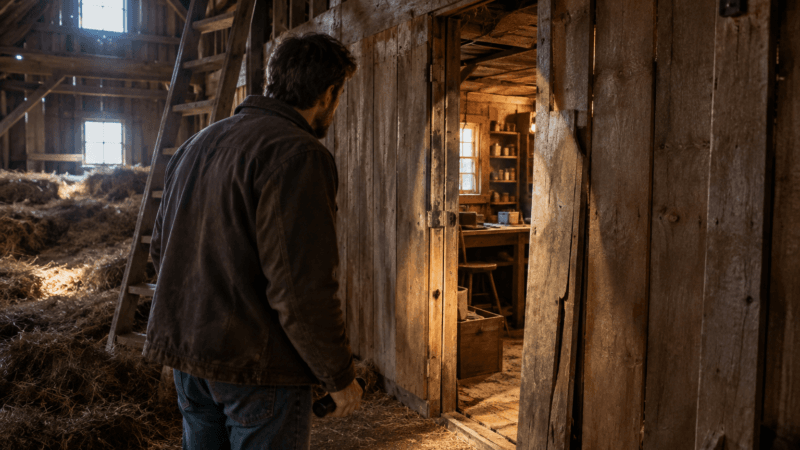
About a quarter-mile from the main farmhouse stood a small timber-framed building with a sign hanging over the double doors that read MILLER WOODWORKING. Inside, the air was warm and thick with the scent of fresh-cut cedar, pine shavings, and linseed oil. A cast-iron barrel stove glowed red in the corner, throwing long, dancing shadows across racks of clamps, chisels, and finished tabletops stacked against the rough-sawn walls.
A man was standing at a heavy oak workbench near the back window, running a hand plane across the edge of a wide pine board. With every pass of the blade, a long, translucent curl of wood peeled away and fell onto the sawdust-covered floor.
He stopped when he heard our boots on the threshold. He laid the plane down on the bench, wiped his hands on a rag tucked into his belt, and turned around.
He was shorter than Samuel, but he had the same square shoulders and the same wide, flat-knuckled hands that my father had carried to his grave. When he stepped closer to the light of the overhead lamp, I saw the exact shape of Mama’s brow, that stubborn, slightly heavy line above the eyes that made everyone in our family look like we were perpetually displeased with the weather.
Samuel didn’t say a word. He just stepped back toward the door and left us standing there in the smell of cedar and hot iron.
“You’re the girl from the cellar,” the man said. His voice was lower than Samuel’s, slightly rough around the edges, but steady.
“I found the card,” I said. My throat felt tight, and my hands were shaking inside my coat pockets. “From sixty-five. The one she sent for your seventh birthday.”
Thomas, I knew it was him before he even spoke his name, walked slowly over to the workbench. He reached down beside a stack of sandpaper sheets and picked up a small, flat wooden box with a sliding lid, rubbed smooth with oil until it shone like honey in the lamplight. He didn’t open it right away. He just held it in his palms, looking down at the grain.
“I remember when I was nine,” Thomas said, looking up at me with those gray marsh-sky eyes. “My adoptive mother told me a woman down the valley had tried to send me a letter with a silver dime inside for my birthday, but the mail carrier brought it back because we’d moved across the county road the month before. She kept that dime in her sewing box until the day she died.”
He walked the few steps toward me and held out the small wooden box. I took it from him. The wood was warm from his hands.
Inside, resting on a scrap of faded blue wool with frayed edges, was a single, tarnished 1954 Roosevelt dime and the yellowed, unsealed birthday card I had found in the Folgers tin three days ago.
We stood there in the quiet of the woodshop for a long time, neither of us saying anything more, because there wasn’t anything left to explain. The arithmetic had finally worked out. The missing years weren’t a void anymore; they were just a long, quiet bridge built out of silence and survival.
I stayed until the sun dipped entirely behind the black ridge of the western hills, turning the sky the color of bruised plums. Thomas walked me back up the lane to where my truck was parked, his boots making that same heavy, familiar thud on the gravel that I had heard every evening of my life growing up in Mama’s kitchen.
When I climbed back into the cab, I left the yellowed birthday card sitting upright on the workbench beside the old wooden box and the scrap of blue-edged blanket, right where it belonged. Samuel was standing by the porch steps, watching me with his hands in his pockets, giving a slow, single nod as I turned the ignition over.
The drive south down Route 9 was dark, the headlights cutting narrow tunnels through the thick Maine woods where the shadows reached out across the asphalt like old fingers. But for the first time since I had carried those trash bags down the cellar stairs, the cab didn’t feel cold.
I knew that when I got back to the house, I would have to finish clearing out the rest of Mama’s things. There were still boxes of jars to pack, old linens to fold, and floors to sweep where the dust had settled for forty years. But the cellar wouldn’t feel like a vault anymore. It would just be a room under a house, where an old woman had kept her secrets safe until someone was finally strong enough to carry them out into the light.
A Childhood Belief About a Brother Who Was Said to Be Dead
For as long as I could remember, my mother had always told me the same story about my brother. She said he had died as a baby during the terrible winter of 1958, long before I was old enough to remember him. There was never a grave that we visited, and there were very few details about what had happened, but I accepted her explanation because my mother was not someone who welcomed difficult questions. She rarely talked about painful memories, and whenever the subject of my lost brother came up, she simply repeated that the winter had taken him. I grew up believing that this was one of those tragedies my family had experienced before my time, something sad but permanent that could never be changed.
My mother lived to be ninety-one years old before she passed away in January. After her funeral, when the relatives and church ladies had finally stopped coming by with casseroles and condolences, I found myself responsible for cleaning out the old house. It had been my mother’s home for forty years, and almost everything inside seemed to carry some piece of her personality. The house smelled of lemon oil, damp pine needles, and cold cast iron, and she had kept the temperature unusually low because she always claimed that too much heat would damage the floorboards. Her habit of saving things had also filled the house with decades of memories. Nothing seemed too old or insignificant to keep, which meant that cleaning the place became a much larger job than I had expected.
The cellar was where I spent most of my time. It was a limestone-walled room beneath the kitchen, reached by a narrow wooden staircase that groaned beneath my weight. For several days, I sorted through old newspapers, seed catalogs, Mason jars, buttons, rubber bands, curtain hooks, and countless other objects my mother had apparently decided might someday be useful. On the fourth afternoon, I noticed an old Folgers coffee can hidden behind several empty canning jars near the chimney. The plastic lid was cracked, and the metal container had developed a little rust from the dampness. I opened it with a butter knife and found several old notebooks containing my mother’s egg-money records, along with ration books and other papers from decades earlier.
At the very bottom of the coffee can was a single envelope. It was square, yellowed around the edges, and made from heavy cream-colored paper. The handwriting on the front immediately caught my attention because I recognized it as my mother’s. The envelope was addressed to a location in a township nearly two hours north of our county, but what made it even stranger was the purple postal stamp across the front that said RETURN TO SENDER. The date was October 14, 1965. I opened the already-unsealed envelope and pulled out a birthday card. The front showed a faded red barn and a golden retriever puppy. When I opened it, I saw my mother’s handwriting again. The message contained only six words, but those words made my entire understanding of my family suddenly feel uncertain: “To my son on his seventh birthday.”
I sat down on an old wooden crate and stared at the card. I did the arithmetic over and over because I couldn’t make the dates fit together. My mother had always said that my brother died during the winter of 1958. Yet the card was dated 1965 and was clearly meant for a seven-year-old boy. If my brother had truly died as a baby, there was no way he could have been turning seven in 1965. The numbers kept running through my head, and the more I thought about them, the more impossible the story became. Suddenly, the absence of a grave and the lack of details about his death seemed different. What I had always accepted as grief now looked like a carefully protected secret.
For several days, I couldn’t stop thinking about what I had discovered. The house no longer felt like the home of the mother I had known. Instead, it began to feel like a museum filled with clues to a story I had never been allowed to hear. I kept wondering what else my mother might have hidden over the years. Eventually, I copied the return address from the envelope and decided to drive north. I didn’t know exactly what I expected to find when I got there. Maybe the address would lead to an abandoned property. Maybe the people who had lived there would know nothing about my mother. But I couldn’t simply put the card back in the coffee can and pretend I had never seen it.
The drive took about two hours through rolling hills, scrub pine, and gray granite beneath a dull November sky. As I drove along Route 9, I kept thinking about my mother and the way she had handled difficult moments throughout her life. She had never been a woman who cried easily or talked openly about emotional pain. Even when my father died suddenly in 1972, she had remained composed at the funeral. Remembering that made me wonder whether the secret I had discovered was something she had been carrying for decades. By the time I reached the gravel road listed on the envelope, I was no longer simply curious. I felt as though I was approaching a missing part of my own childhood.
The farmhouse stood about a hundred yards from the road, partially hidden behind a row of balsam fir trees. It was an old white clapboard house with green trim and a weathered appearance. Before I could even get out of my truck, the front screen door opened and a tall man stepped onto the porch. He wore a canvas chore coat and a gray wool cap. As he walked toward me, I noticed something strangely familiar about him. His left knee had a slight hitch, and the way he favored one side reminded me of the way my father had walked after long days of working around the farm. When the man reached my truck window, he looked directly at me and said, “You’re Martha’s girl.” He didn’t ask who I was. Somehow, he already knew.
The man’s name was Samuel. When I showed him the yellowed envelope, he immediately understood why I had come. He looked at the handwriting without even touching the paper and seemed overwhelmed by the sight of it. He asked whether my mother had kept the birthday cards she couldn’t mail. I told him that I had found only one. Samuel sighed and invited me inside because the weather was too cold to continue talking outside. His kitchen smelled of wood smoke and black coffee, and everything inside was carefully organized. After we sat down, I finally asked him about 1958. I told him exactly what my mother had said—that my brother had died during the terrible winter when the roads were closed for days.
Samuel didn’t deny that the winter had been horrible. He explained that the blizzard had been severe, with enormous snowdrifts and temperatures dropping far below zero. But then he told me the one thing I had never expected to hear: the boy had not died. He explained that my mother had been only twenty-four years old when Thomas was born. The family had been struggling financially, and when the baby became sick with croup during the storm, there was little money available for medical care. My grandfather was also a harsh man who cared deeply about what the neighbors thought. Samuel said my mother feared that if Thomas remained at home, the situation could become even more dangerous for him.
According to Samuel, my mother had walked through the snow to his home carrying the baby beneath her shawl. Samuel and his wife had no children of their own, and my mother believed they could give Thomas a chance to survive. She asked Samuel to take the baby north and keep him away from the family. She also made him promise that the truth would never become known. To protect the secret, everyone would be told that the baby had died during the winter. Samuel explained that my mother wasn’t abandoning Thomas because she didn’t love him. In his view, she believed she was making a painful sacrifice to save his life. She had to convince everyone around her—and eventually herself—that her son was gone so that nobody would come looking for him.
I asked Samuel what had happened to Thomas after that. He explained that the boy had grown up nearby and had eventually been told the truth about his birth. By the time he was twelve, Thomas knew that Martha was his biological mother and understood why she had stayed away. Samuel said Thomas had built a life for himself in the same county, only a short distance from the farmhouse. Then Samuel told me there was someone I needed to meet before the sun went down. We walked together down a gravel lane to a small woodworking shop. The building smelled of fresh cedar, pine shavings, and linseed oil. Inside, a man was working at a heavy oak bench. When he turned around, I immediately recognized pieces of my own family in his face.
His name was Thomas. He was shorter than Samuel but had the same broad shoulders and strong hands that I remembered from my family. Most strikingly, he had my mother’s brow and the same gray eyes that I had seen throughout my childhood. He told me he already knew who I was. When I explained that I had found the birthday card from 1965, he told me he remembered hearing about a woman from the valley who had once tried to send him something for his birthday. He had been told that a letter had been returned after they moved. Thomas then showed me a small wooden box that he had kept for years. Inside was a tarnished 1954 Roosevelt dime and the same yellowed birthday card I had discovered in my mother’s coffee can.
Standing there in the quiet woodshop, I finally understood why my mother had kept that card for so many years. The card wasn’t proof that she had forgotten her son. It was evidence that she had never truly stopped thinking about him. She had written the message, mailed it, and somehow kept the returned card after it came back to her. Thomas had grown up with another family, while my mother had continued living with the secret. The years between us could never be recovered, but the mystery that had surrounded my brother’s supposed death had finally been replaced by the truth. He had survived the winter that I had spent my life believing had killed him.
I stayed with Thomas until the sun disappeared behind the hills. Eventually, I walked back toward my truck with the realization that I had arrived at the farmhouse looking for an explanation and was leaving with an entirely different understanding of my mother. She had kept a painful secret for most of her life, and although I could never know every thought that had passed through her mind, I now understood that her story had been more complicated than the simple lie I had first imagined. Before leaving, I placed the birthday card beside the wooden box and the piece of blue-edged blanket that Thomas had kept. For the first time, the card was no longer a forgotten object hidden in a cellar. It belonged with the son my mother had never stopped remembering.
The drive home was dark, and the headlights cut through the thick Maine woods as I followed Route 9 south. I thought about all the years I had believed my brother was gone and about how a single birthday card had completely changed that story. When I returned to my mother’s house, there were still boxes to sort, old linens to fold, jars to pack, and floors to sweep. But the cellar no longer felt like a place where a terrible secret had been buried. It felt like the place where the truth had finally been waiting for me. My mother had taken her secret with her for decades, but she had accidentally left behind one small piece of evidence—a birthday card from 1965—that allowed me to find the brother I had spent my entire life believing was dead.


One thought on “My Mother Said My Brother Died as a Baby—Then I Found a Birthday Card From 1965”
Comments are closed.