Behind the Hayloft Wall: A Dead Dairy Farmer’s Hidden Secret Changed Everything I Believed About Family
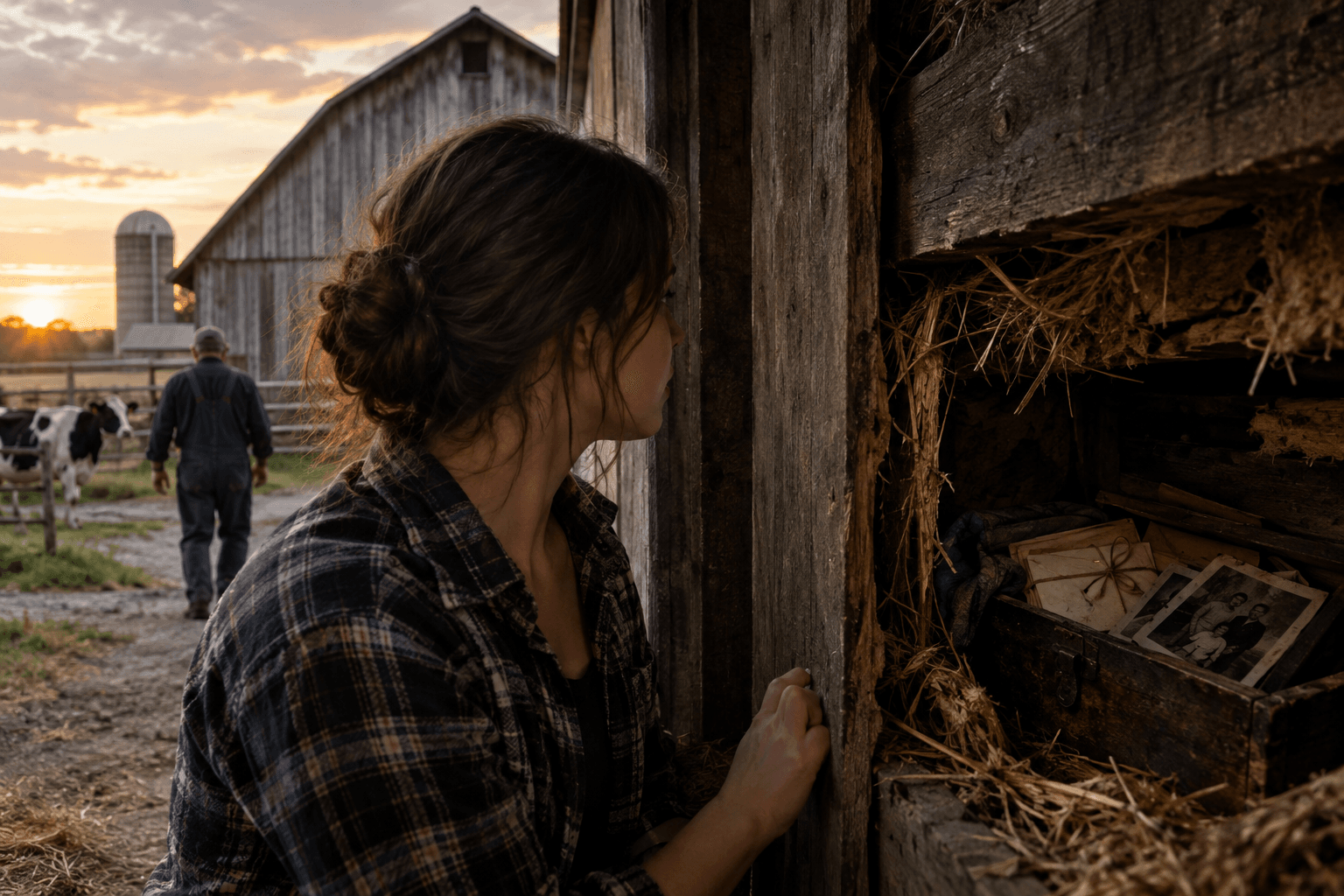
When my father died, I thought the hardest part would be saying goodbye to the man who had spent his entire life working on our family dairy farm. He had been a quiet, stubborn man who rarely talked about his feelings, but everyone in the community respected him. After the funeral, my siblings and I began sorting through the old farmhouse, barns, tools, paperwork, and everything else he had left behind. We expected the process to be emotional, but we never imagined that it would completely change what we believed about our own family. The farm had been in our family for generations, and every corner seemed to hold a memory. I had spent countless summers in the hayloft as a child, climbing over dusty beams and hiding behind stacks of hay. I never had any reason to believe that one of those walls was hiding something important.
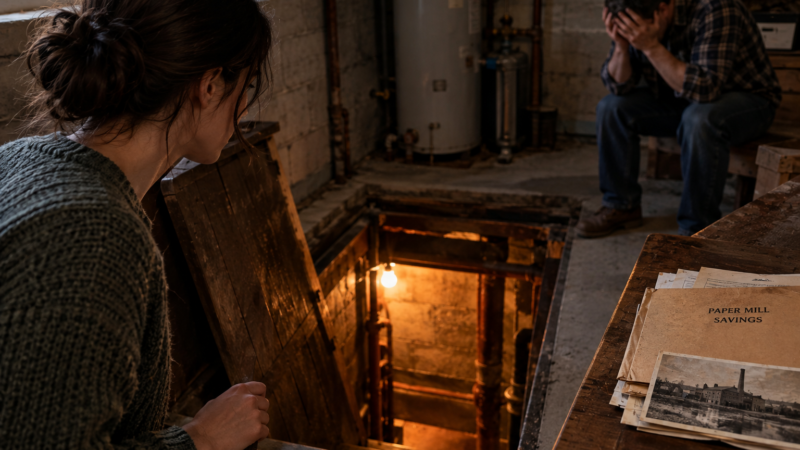
A few weeks after the funeral, I went into the hayloft to clear out some old equipment before we decided what to do with the property. While moving several wooden boards that had been leaning against the back wall, I noticed something strange. One section of the wall sounded hollow when I tapped it. At first, I assumed it was simply an old construction mistake, but curiosity got the better of me. I removed a few loose boards and discovered a narrow space hidden behind them. Inside was a small wooden box covered in dust. There were no valuables inside, at least not in the way I expected. Instead, there were old letters, photographs, receipts, and several documents carefully tied together with faded string. Some of the papers were decades old, and many carried my father’s handwriting. I immediately realized that this wasn’t something he had forgotten about. Someone had deliberately hidden the box, and my father had clearly intended for it to remain undiscovered.
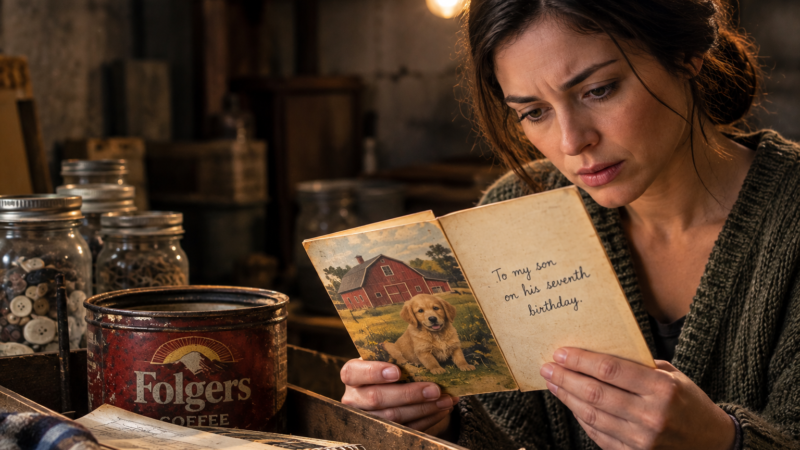
The first few documents were difficult to understand, but the photographs made things much clearer. There were pictures of my father standing beside a woman I had never seen before, holding a baby who looked surprisingly familiar. At first, I thought perhaps she was an old friend or distant relative, but then I found a letter that made my hands start shaking. The letter referred to a child born years before I was born and described arrangements that my father had apparently made with another family. According to the documents, he had been supporting someone financially for decades, sending money every month and occasionally visiting in secret. I couldn’t understand why he had never told us. The strangest part was that the name of the child appeared repeatedly in the documents, and it was a name I recognized from our own extended family. Suddenly, memories from my childhood that had always seemed insignificant began to feel completely different.
I confronted my siblings about what I had found, and at first they refused to believe me. My older brother insisted that the documents had to be some kind of misunderstanding, while my sister became angry and accused me of digging into things that should have remained buried with our father. But when we examined everything together, there was no denying that something had been kept from us. Eventually, an older relative finally admitted that the family had known part of the story for years. My father had apparently fathered a child before marrying our mother, and circumstances had led to that child being raised by another family. He had never publicly acknowledged the relationship because he feared destroying the life that had been built around him. Yet he had quietly remained involved, helping with expenses and keeping track of the child’s life from a distance. What shocked us most wasn’t simply the existence of another sibling. It was discovering how much of our father’s life had existed completely outside the family we thought we knew.
After learning the truth, I spent weeks looking at my father differently. It would have been easy to be angry with him, and part of me certainly was, but the documents also showed a side of him none of us had ever known. He had made mistakes, kept enormous secrets, and allowed his family to live without knowing the full truth. At the same time, he had apparently spent decades trying to take responsibility in the only way he believed he could. Eventually, we contacted the person named in the documents, and that conversation changed everything again. They already knew some version of the story but had never known how deeply my father had remained connected to our family. Meeting them was strange, painful, and unexpectedly emotional. We weren’t suddenly able to erase decades of secrets, but we were able to begin building a relationship based on the truth. In the end, the hidden box behind the hayloft wall didn’t just reveal a secret about my father’s past—it forced all of us to reconsider what family really means and how much of the people we love can remain unknown even after a lifetime together.
Read Story…
I Found a Hidden Door in an Abandoned Dairy Barn—What Was Behind It Changed Everything
The cedar stop-knob was about the size of a chess piece, turned down smooth on a lathe and rubbed with linseed oil until it felt like warm soap in the palm of my hand. I found it wedged behind the floorboards of the bench when I went back into the loft on Tuesday morning, after I had caught my breath and stopped shaking in the sun.
We bought the old Holtz place last April because the soil down by the creek bottom still held promise and the bank in Green Bay was practically giving the mortgage away to anyone with a clean truck and a workable credit score.
The dairy barn had been padlocked since the winter of 1988, right around the time the local cooperative went under and half the townships in eastern Wisconsin had foreclosure notices nailed to their milk houses. The previous family, the Holtz heirs, had signed every closing paper through a title company in Appleton and refused to set foot on the property once during the whole transaction.
I figured they just wanted to forget the bad years. Farming up here in the eighties was a slow bleeding out, and most kids who made it off the land didn’t care to look back at the rust and the empty stalls.
I was clearing out thirty years of damp pigeon droppings and rotted timothy hay from the second-story loft when I noticed the framing along the north gable didn’t line up with the exterior siding. The measurement was off by roughly two feet. It was the kind of dead space old farmers usually left for chimney flues or grain chutes, except this barn never had a grain dryer or a coal stove up top.
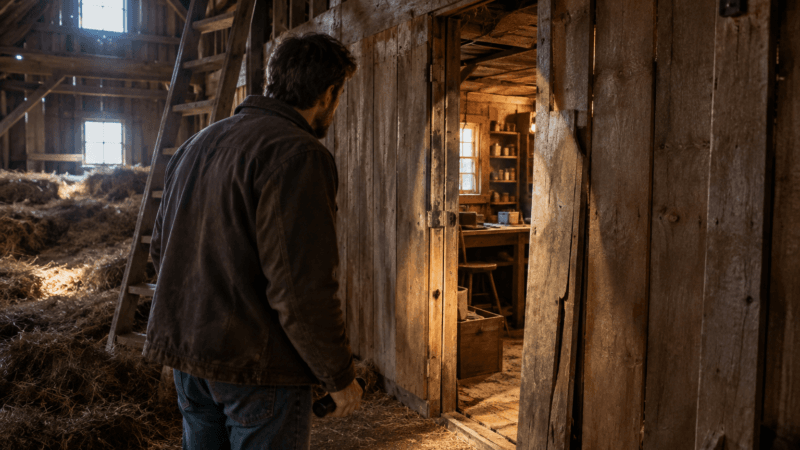
There was a narrow gap behind a stack of mildewed feed sacks that smelled faintly of rat nesting and old burlap. I shoved the sacks aside with my boot, and that was when I saw the flush-mounted door.
It was made of wide pine boards, painted the exact same weathered red as the rest of the loft interior so the grain lines matched right across the seams. The hinges weren’t rusted solid like every other piece of iron on the place. They were clean, dull gray, and slick with fresh machine oil that smelled like standard 30-weight motor oil from a red tin can. Someone had been opening that door recently. Someone had been coming out here while the bank padlocks were still rusting on the main sliding doors downstairs.
I pulled the iron latch, and the door swung inward without a single squeak, the wood sliding into the dark like a drawer.
I clicked on my three-cell flashlight and stepped across the threshold, shining the beam straight ahead into the hollow of the wall.
The moment I saw what that family had walled off in the back of their barn, I backed out into the daylight, because the beam didn’t hit old lumber or junk piles; it caught the gleaming, mathematical rows of sixty-one polished zinc and cedar organ pipes rising vertically toward the rafters in a silent, towering wall of sound.
I stood out in the high-noon sun by the open hayloft door for a long time, listening to the crows cawing over the corn stubble and trying to make sense of what I had just walked into. A dairy barn is supposed to smell like sour silage, dried manure, and wet hemlock. This room behind the wall smelled like beeswax, rosin, and old spruce. It was dead quiet, but the kind of quiet that feels heavy, like an empty church an hour before Sunday morning service.
I didn’t call the sheriff, and I didn’t call the bank. I walked back down the ladder, got into my truck, and drove ten miles into town to the county seat, where the old-timers still gather at the feed store around nine in the morning to drink black coffee out of paper cups.
Tom Miller was behind the counter, wiping down a display of ear-corn tags with a greasy rag. Tom remembers everything that happened between 1980 and 1989, back when the interest rates hit twenty percent and the tractors started getting repossessed before the farmers even finished their morning milking.
“Matthew Holtz?” Tom said when I set the small cedar stop-knob on the formica counter between us. He stopped wiping the rag and stared at the wood for a long second, his thumb rubbing the edge of his coffee cup. “Where’d you get that, son? That’s cherry. Matthew didn’t use pine for the stops if he could help it. Said pine was too soft for fingers that sweat.”
“Found it in the loft of the north barn,” I said. “Behind a false wall.”
Tom let out a long breath through his teeth, shaking his head. “Old man Matthew was a stubborn bastard. Lost his voice to throat cancer down at the clinic in Madison back in eighty-four. After that, he didn’t talk to a soul for four years. Just milked his thirty Holsteins at four in the morning and four in the afternoon, and the rest of the time you could hear hammering coming from up in the gable end. Nobody went up there. Not even Martha.”
“His daughter. She lives out on the edge of town now, near the Lutheran cemetery. Lives by herself in that little yellow bungalow with the overgrown lilac bushes. She was twenty-two when the bank took the farm. She’s the one who kept the keys until the estate forced the sale last winter.”
I stayed at the feed store for twenty minutes listening to Tom talk about how Matthew Holtz used to spend every dime he had left after the feed bill on organ leather and pipe metal, trading milk cans for cedar planks with the local sawmill. When the bank auctioneers finally came in eighty-eight to tag the tractors and the bulk tank, they didn’t know the back wall was hollow. They thought the loft was just full of chaff.
I drove out to the yellow bungalow by the cemetery around two o’clock. The gravel in the driveway was raked clean, but the yard looked like nobody had cared much about lawn ornaments or flower beds since the Reagan administration.
I knocked on the screen door. A small woman with silver hair pulled back into a tight bun opened it about three inches, keeping the safety chain latched. Her eyes were sharp and pale blue, looking right past my shoulder to my pickup parked in the street.
“If you’re from the county assessors, I already paid the weed abatement notice,” she said. Her voice had that dry, steady rattle of someone who spent their whole life talking across a kitchen table.
“I’m not from the county, Miss Holtz,” I said, and I reached into my coat pocket and pulled out the little cedar stop-knob, holding it flat on my palm so she could see the lathe marks on the bottom. “I bought the old farm last spring. I was cleaning out the hayloft.”
She stared at my hand for a long time. The skin around her eyes tightened, and for a second I thought she was going to slam the wood frame in my face and lock the door. Her knuckles turned white where she held the edge of the screen.
“You found the door,” she whispered.
“I found it,” I said. “And I didn’t call a salvage yard, and I didn’t tear it down for scrap.”
She let out a shaky breath that sounded like dry leaves sliding across concrete. The chain rattled as she unhooked it, and she pulled the door open wide enough for me to step into a front room that smelled strongly of peppermint tea and old newspapers.
“Every spring and every autumn for thirty-five years,” Martha said, not looking at me anymore, but looking out the window toward the graveyard across the road, “I drove my Buick out there through the back gate. I walked across the field so the neighbors wouldn’t see the car. I climbed up that damn ladder with a can of three-in-one oil and a rag. I oiled those hinges so they wouldn’t bind up. My daddy built that thing with his bare hands while his throat was rotting out from the inside. He said the bank could take his cows and they could take his land, but they weren’t going to take his music.”
“It’s still up there,” I told her quietly. “Every pipe. Every key. The bench is still sitting right where he left it.”
Martha turned her head back toward me, and her eyes were wet, though she didn’t wipe them. “Why didn’t you tear it out? It’s taking up six hundred square feet of good storage space.”
“Because it isn’t storage space,” I said. “It’s a cathedral.”
The next afternoon, Martha Holtz came back to the farm for the first time since the winter her father died. I drove into town and picked her up in my truck, helping her step up into the cab because her knees weren’t what they used to be. She wore a heavy wool cardigan that looked like it had been through forty winters and still smelled of mothballs.
We didn’t talk much on the drive out. When we pulled up beside the old dairy barn, she sat there looking at the weathered red boards for a long minute, her hands folded tight in her lap over a black leather purse.
“We can take our time,” I told her.
We walked across the packed dirt of the yard and went in through the side door past the empty stanchions where the smell of old lime and cedar still lingered in the floor joists. The wooden ladder up to the hayloft creaked under our boots, and I went first, keeping my hand out behind her heel just in case she lost her footing on the rungs.
When we reached the loft floor, the afternoon light was coming through the gable window in thick, slanting bars, catching the dust motes dancing in the quiet air. I walked over to the false wall, pushed the flush door open, and clicked on the small electric lantern I brought from the house.
The warm yellow light spilled into the hidden chamber, washing over the long rows of polished metal pipes, the cedar wind-chest Matthew Holtz had whittled out during his long, silent evenings, and the walnut console with its double rows of ivory-colored keys.
Martha stood in the doorway for a long time, her hand resting on the doorjamb. Her lips were parted slightly, and she didn’t say a word. She just stood there while the silence of the barn settled around us, heavy and solemn.
Then she stepped inside, her boots making a soft scuffing sound on the pine floorboards. She walked over to the wooden bench, her fingers trailing lightly along the edge of the music desk where her father’s handwritten logs were still stacked under a glass jar.
“He used old milk-line stainless for the lower bass couplers,” she murmured, almost to herself. “He stayed up here until midnight every night after the diagnosis, carving those stops out of firewood.”
She sat down slowly on the wooden bench, adjusting her wool cardigan around her shoulders. She looked down at the pale keys for a long moment, taking a deep breath like a diver about to go under. Then she lifted her right hand and pressed down a single low C.
The sound didn’t come out harsh or rusty. It rose up through the floorboards like a slow, deep sigh from the earth itself, rich and full and carrying all the weight of the valley through the old hemlock rafters until the glass in the hayloft window vibrated in its frame.
Martha sat at the wooden bench beneath the dust motes of the hayloft window, her hands pressing down on the keys, as the deep brass notes vibrated through the old dairy floorboards and drift out over the newly planted alfalfa.
We Bought an Abandoned Wisconsin Farm—But the Previous Family Left a Secret Behind
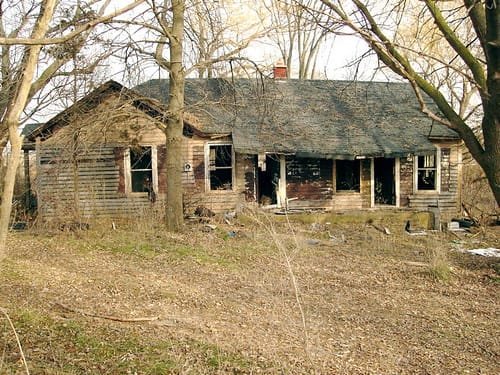
When we bought the old Holtz farm, I thought we were purchasing nothing more than a piece of neglected Wisconsin farmland with a history of bad years behind it. The soil near the creek was still good, the fields had plenty of potential, and the mortgage was manageable enough that we decided the property was worth the work. The dairy barn, however, had been abandoned for decades. It had been padlocked since the winter of 1988, after the local cooperative collapsed and the Holtz family lost the farm during one of the worst periods for small dairy operations in the area. The previous owners had completed the sale through a title company in Appleton and never once came back to walk through the property. At the time, I assumed they simply wanted to forget the farm and everything that had happened there. I had no idea that they had left something behind that would eventually force one of the last surviving members of the Holtz family to return.
Advertisement
The discovery happened while I was cleaning the second-story hayloft. Years of moisture, pigeon droppings, and rotting hay had turned the place into a miserable job, but I wanted to clear it before deciding what could be salvaged. While working along the north gable, I noticed that something about the wall didn’t look right. The interior framing seemed to sit nearly two feet away from the exterior siding, creating a large section of unexplained empty space. I moved several old feed sacks and discovered a narrow opening hidden behind them. What caught my attention was a wooden door almost perfectly disguised as part of the wall. The boards had been painted the same faded red as the rest of the loft, and whoever built it had carefully aligned the grain so the door almost disappeared when viewed from a distance. Even stranger, the hinges weren’t frozen with rust like everything else in the barn. They were clean and coated with fresh machine oil. Someone had been maintaining that door long after the farm had supposedly been abandoned.
I pulled the latch and opened it slowly. My flashlight disappeared into a dark chamber behind the wall, and for several seconds I couldn’t understand what I was seeing. Then the beam moved upward, revealing rows upon rows of polished zinc and cedar organ pipes standing vertically beneath the rafters. There were dozens of them, arranged with incredible precision. Some were short enough to fit in my arms, while others stretched nearly to the roof. Beyond the pipes was a wooden bench, a keyboard, bellows, tools, and shelves filled with pieces of unfinished instruments. The room smelled nothing like the rest of the barn. Instead of manure, old hay, and damp wood, there was the unmistakable scent of beeswax, rosin, cedar, and aged spruce. It looked less like a storage room and more like a private workshop hidden inside a church. I stood there in silence until I finally backed out because I suddenly felt as though I had entered somewhere I wasn’t supposed to be.
I took a small cedar stop-knob with me when I left the loft. It had been wedged behind some loose floorboards near the bench, and the wood was so smooth from years of handling that it felt almost warm in my palm. I drove into town and showed it to Tom Miller at the feed store. Tom was one of those people who seemed to remember every family, argument, foreclosure, and farm sale that had happened in the county. The moment he saw the little wooden piece, his expression changed. He immediately recognized the name Matthew Holtz. Tom explained that Matthew had been known as a stubborn and private man, but he had also possessed an extraordinary interest in organs and woodworking. After Matthew developed throat cancer in the mid-1980s and lost his ability to speak, he apparently spent even more time working alone in the upper part of the barn. According to Tom, people could hear hammering coming from the gable for hours, but almost nobody knew what he was building.
The story became even stranger when Tom told me about Matthew’s daughter, Martha. She had been in her early twenties when the bank finally took the farm, and she had apparently been the person responsible for maintaining some of her father’s belongings after his death. Tom gave me directions to her small yellow bungalow near the Lutheran cemetery. I drove there that afternoon, carrying the cedar stop-knob in my pocket. Martha answered the door only a few inches at first, clearly suspicious of a stranger appearing at her home. When I explained that I had purchased the old Holtz farm, her expression changed immediately. Then I placed the cedar knob in my palm and showed it to her. She stared at it for several seconds before quietly saying, “You found the door.” Those four words told me that the hidden room wasn’t some forgotten accident. Martha had known about it all along.
Once she let me inside, Martha explained that she had been secretly visiting the barn for decades. After the bank took the farm, she still had access to the property for a time, but eventually the new owners and later the bank-controlled estate made regular visits difficult. Even so, she had continued returning whenever she could. She told me that every spring and autumn she would drive her Buick through the back gate, park where the neighbors couldn’t easily see her, and walk across the field. She carried a small can of oil and a rag with her because her father had taught her that the hinges needed regular attention. Matthew had built the hidden room while his health was failing, working almost entirely by hand. He had told Martha that the bank could take his cows, his land, and eventually the house, but he didn’t want them to take the music he had spent years creating.
The more Martha talked, the more I realized that the organ had never simply been a hobby. It had been the center of Matthew’s life during the final years of his illness. Before he became sick, he had apparently played instruments whenever he had free time, but his farm demanded nearly every waking hour. Once his voice was gone, the organ became a different kind of language for him. Martha remembered sitting downstairs while he worked above her, listening to the faint sounds of tools, wood being shaped, and occasionally a single pipe being tested. He could no longer explain what he was building in conversation, so he communicated through the instrument. She said he would sometimes write short notes to her describing a problem with a pipe or a piece of wood, but most of his thoughts remained locked inside his head. The hidden room became the one place where he could still express himself.
The next day, I brought Martha back to the farm. She had not stepped onto the property since the winter of the auction, and the walk across the yard visibly affected her. She stopped several times to look at familiar places: the old milk house, the collapsed fence, the foundation where the family garden had once been. She remembered where her father kept certain tools and where the Holsteins had stood during winter storms. When we reached the barn, she placed her hand against the weathered red boards and remained silent for a long time. I helped her climb the ladder into the hayloft, and when she saw the hidden door, she became emotional. She reached for the latch with trembling fingers, almost as if she expected the room to have disappeared after all those years.
Inside, Martha immediately knew what had changed and what hadn’t. The organ was still there exactly as her father had left it. Dust covered the bench, but the pipes remained intact. Some wooden pieces had warped slightly from decades of temperature changes, but the craftsmanship was astonishing. Martha walked slowly from one end of the room to the other, touching familiar surfaces without speaking. Then she noticed something I hadn’t seen before: several handwritten notes tucked beneath the organ bench. They were Matthew’s notes, written during the final months of his life. Most were technical, describing measurements and adjustments, but one page contained a sentence addressed directly to Martha. It said that if the farm was ever sold, she should make sure the organ survived even if nothing else did. Matthew had apparently known that the property might be lost, but he had hoped his daughter would somehow protect the one thing he had built purely for himself.
We began looking through the rest of the hidden room and discovered that Matthew had left behind far more than an unfinished organ. There were sketches showing the instrument’s design, handwritten calculations, lists of materials, and receipts from local sawmills and metal suppliers. There were also photographs of Matthew working on different sections of the organ. In several pictures, Martha appeared as a little girl, sitting on a wooden stool while her father worked. She told me that she barely remembered those moments because she had been so young. Looking at the photographs, however, she suddenly remembered the smell of cedar and the sound of her father’s hammer. She explained that after Matthew became ill, the farm had been consumed by financial problems, medical bills, and arguments with the bank. The hidden workshop had been the one place where he wasn’t thinking about debt or losing the farm. It was where he still felt like himself.
One discovery in particular changed the way Martha viewed her father’s final years. Inside a small wooden drawer, we found a bundle of letters Matthew had written but apparently never mailed. They were addressed to several people in the community, including former neighbors and members of the local church. In the letters, he explained that he wanted the organ to eventually be played publicly, but he was afraid the family would lose everything before he could finish it. He wrote about the humiliation of losing the farm and about how difficult it had become to ask for help. One letter described how he believed people saw him only as a failed farmer after the foreclosure. Martha had always thought her father had simply become bitter and withdrawn because of his illness. The letters revealed something more complicated: he had been ashamed, frightened, and determined to leave behind something that couldn’t be measured by the value of his land or livestock.
After spending several days helping Martha organize the room, I asked her what she wanted to do with the organ. She initially said she didn’t know. The farm was legally mine, and she didn’t want to demand anything from me. But I could see that leaving the organ locked behind a wall for another generation would be difficult for her. We eventually agreed that I would preserve the workshop rather than demolish it. I repaired the hidden door, stabilized the floor, and hired someone familiar with old organs to inspect the instrument. Martha began visiting more regularly. She brought old photographs and documents from her house, and together we started reconstructing Matthew’s story. What began as a strange discovery slowly became a project that connected two families who otherwise would never have met.
The organ was not immediately playable, but the specialist who examined it believed much of the original work could be restored. Several pipes were damaged, and some components needed careful cleaning, but the basic structure had survived decades of neglect. Martha insisted that we not modernize it too much. She wanted the instrument to remain as close as possible to what her father had built with his own hands. We respected that wish. Over the following months, pieces were cleaned, wood was repaired, and the pipes were carefully catalogued. Every improvement seemed to bring another part of Matthew’s hidden world back to life. Eventually, one afternoon, a single note sounded from the organ. It wasn’t loud or perfect, but it filled the small room with a deep, haunting tone that seemed to travel through the entire barn.
Martha cried when she heard it. She later told me that the sound reminded her of being a child and hearing her father work upstairs while she played outside. For decades, she had carried the belief that the farm represented failure and loss. Her father had lost his land, his health, his voice, and eventually his life. But the hidden room showed her that those things weren’t the whole story. Matthew had also created something beautiful during the years when everything else was falling apart. He had built a place where his daughter could still remember him not as a sick and defeated farmer, but as a craftsman who refused to stop creating. The organ became proof that his final years had contained more than hardship.
I had originally thought the Holtz family had simply abandoned the farm because they couldn’t bear to remember it. I eventually understood that the truth was more complicated. They hadn’t forgotten the place at all. Martha had been quietly protecting her father’s secret for more than three decades, returning whenever she could to make sure the hidden room survived. She had carried the weight of that secret because she believed nobody else would understand why an old organ mattered more to her than the land surrounding it. By allowing me into that room, she had trusted a stranger with one of the most important pieces of her family’s history.
Today, the old dairy barn still stands, and the hidden room remains behind the same red-painted door. The farm is no longer the abandoned property I first saw when we bought it. The fields are productive again, the loft has been cleaned, and the organ is slowly being restored. Martha still visits whenever she feels strong enough, and sometimes we sit quietly in the workshop while the evening light comes through the cracks in the old boards. I used to think family was defined by blood, property, and the stories people openly shared with one another. The secret behind the hayloft wall taught me something different. Sometimes family is also made up of the things people protect when they have nothing else left to protect. Matthew Holtz lost almost everything the world could measure, but he left behind sixty-one polished pipes, a hidden room, and a piece of music that survived long after everyone thought his story was over.