My husband worked as a doctor in the same hospital where I spent an entire month fighting to survive—and he never came to see me. Not once.

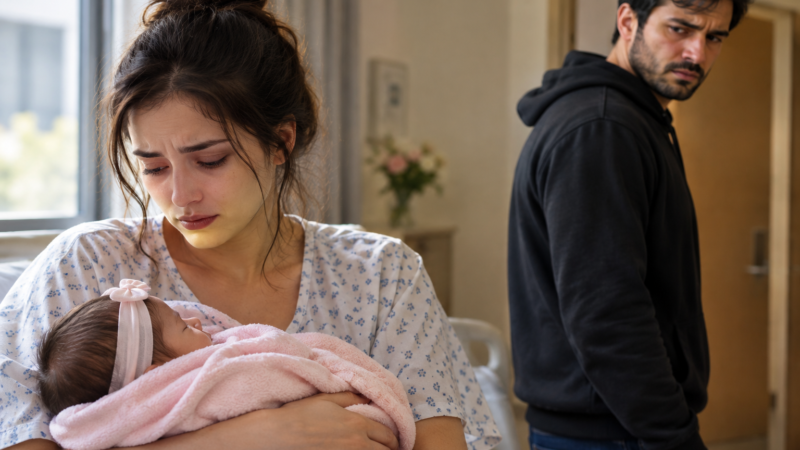
When I was admitted to the hospital, I never imagined that the hardest part of my illness would not be the pain, the tests, or the uncertainty about whether I would survive. My husband, Daniel, was a doctor at the very same hospital. I kept believing that sooner or later, he would walk through the door, sit beside my bed, and tell me that everything was going to be okay. But day after day passed, and he never came. Not once.
My condition had become serious enough that I needed to stay in the hospital for an entire month. I went through exhausting treatments, endless blood tests, sleepless nights, and moments when I genuinely feared that I might not make it home. Nurses became familiar faces, and some of them tried to comfort me whenever I became frightened. What hurt most, however, was knowing that my own husband was working somewhere in the same building while I was fighting for my life.
At first, I made excuses for him. I told myself that he was probably overwhelmed with work or that hospital rules prevented him from visiting me. Whenever another doctor came into my room, I secretly hoped it would be him. I kept checking the hallway whenever I heard footsteps. But he never appeared. Even when I sent him messages asking if he could come for just a few minutes, there was no response that made me feel reassured. His silence slowly became more painful than my physical suffering.
During the final week of my hospitalization, I began to realize that I could no longer keep pretending everything was normal. One evening, a nurse accidentally mentioned that my husband had been working several shifts in another department. That meant he had been only a short distance away from me many times while I was lying in that hospital bed. The realization left me devastated. I had spent weeks believing he simply couldn’t come, when the truth seemed to be that he had chosen not to.
When I was finally discharged, I returned home with a suitcase full of clothes and a heart full of unanswered questions. I expected Daniel to finally explain himself, but instead, he acted as though nothing unusual had happened. I looked at him and asked the question that had haunted me throughout my entire hospital stay: “How could you work in the same hospital where I was fighting to survive and never come to see me—not even once?” His answer changed everything I thought I knew about our marriage.
Read Story…
My Husband Never Visited Me During 30 Days in the Hospital—Until I Found the Shocking Document
When I was finally discharged, he looked at me and coldly said, “I was too busy.” I didn’t argue. I simply took off my wedding ring, placed it on top of my medical report, called a lawyer, and filed for divorce. He still had no idea what I had found in that hospital document.
“I spent thirty days in the hospital hovering between life and death, and my husband—a surgeon in the very same building—didn’t come up to see me even once.”
On the day I was discharged, I carefully folded my hospital gown and laid it on the edge of the bed. I had lost thirteen pounds following a ruptured appendix that had spiraled into severe peritonitis. From the seventeen-floor window of Metropolitan General Hospital in Chicago, I watched the gray autumn rain slick the pavement while a nurse reviewed my discharge instructions.
“Are you sure no one is coming to drive you home, Clara?” she asked softly, glancing at my chart. “Dr. Marcus Hayes works here, doesn’t he?”
I forced a polite smile and nodded. “He’s in a procedure.”
Marcus was one of the most celebrated cardiovascular surgeons at the hospital. He worked five floors below my room. For the first twenty days of my stay, he had been participating in a high-profile, international organ transplant initiative that required strict quarantine protocols. I had spent those three weeks defending him to everyone—my mother, my friends, the nursing staff. “He can’t leave the unit,” I had repeated like a script. “He’s saving lives.”
Then came the final ten days.
During those last ten days, the isolation protocol ended. I saw photos of Marcus posted on the hospital’s internal network, smiling at a gala dinner with visiting foreign specialists. Then I saw him in a local news interview. Then on a stage receiving a clinical excellence award.
Yet, across those ten full days, my hospital room phone never rang. Not once.
My work as a senior healthcare quality auditor had taught me one fundamental rule: before you react, verify the data.
I opened my tablet, logged into the hospital’s administrative portal, and pulled up the official protocol guidelines for the transplant project. In less than five minutes, I found Section 4, Paragraph B:
Personnel in isolation may request a temporary dispensation of up to two hours for immediate family medical emergencies, life-threatening illnesses, or surgical procedures, subject to standard re-sanitizations.
I then queried the system logs for all dispensation requests filed under Dr. Marcus Hayes.
Zero.
Not a single request had ever been submitted.
He had possessed the explicit right to see me. He had possessed the means. He simply chose not to. And when the quarantine lifted completely, he had ten full days to walk to an elevator, press the button for the seventeenth floor, and walk down the hall.
He chose not to do that, either.
I saved a PDF copy of the protocol, his shift logs, and the public event registries to a cloud drive. Then I called an Uber.
I didn’t go back to our brownstone in Lincoln Park. I drove straight to the law offices of my university friend, Sarah, a family law attorney.
When Sarah saw how frail and gaunt I looked, she stood up so fast her chair scraped against the hardwood. “Clara! My God, what happened to you?”
“I need you to draft divorce papers,” I said evenly.
She thought I was speaking out of the raw bitterness of illness. So I placed my tablet on her desk and showed her the timeline, the logs, and the protocol documents.
I didn’t want revenge. I didn’t want to strip him of his assets. We had no children. I proposed an even 50/50 split on the equity of the home we had purchased during our marriage, with each of us retaining our respective bank accounts, vehicles, and personal property.
That afternoon, I went back to the brownstone, packed my clothes, my degrees, and my books into two suitcases, and left my wedding ring sitting squarely on top of my hospital discharge summary on the dining table.
I moved into a furnished, short-term apartment in Gold Coast, changed my phone number, and routed all communication through Sarah.
Two weeks later, while Marcus was enjoying a catered reception in the hospital’s twelfth-floor conference center celebrating the conclusion of his project, a court process server walked into the room holding a manila envelope.
“Dr. Marcus Hayes? Personal service.”
Marcus opened the envelope in front of his colleagues and residents. Within three seconds, the triumphant smile drained from his face.
It was a petition for dissolution of marriage.
And Marcus had no idea that losing his wife was only the beginning of what was about to unfold.
Marcus folded the legal notice so fast the paper tore at the seam.
“Administrative error,” he muttered to his colleagues, shoving the document into his coat pocket.
But when he arrived at the Lincoln Park house that evening and found empty closets, bare dresser drawers, and his wife’s wedding band resting atop an emergency room discharge form, the illusion shattered.
He couldn’t call me because I had blocked his number. He called my mother. He called our mutual friends.
To everyone who answered, he delivered the exact same narrative: that I was emotionally unstable following my illness, that I was failing to grasp the crushing demands of a surgeon’s career, and that I was throwing away seven years of marriage over “a missed hospital visit.”
Our friend David called me, trying to mediate. “Clara, surgeons operate under insane pressure. Sometimes spouses have to show grace.”
“I understand grace during an emergency midnight bypass,” I told him calmly. “What I don’t accept are ten days of galas, television interviews, and award ceremonies without thirty seconds to check if your wife survived peritonitis.”
David went quiet and never brought it up again.
A few days later, I accepted an assignment to lead an independent external quality audit at Metropolitan General—the very hospital where Marcus worked. To eliminate any conflict of interest, I explicitly recused myself from auditing the cardiology department, assigning a colleague to that division while I took charge of administrative compliance, patient safety protocols, and institutional governance.
When Marcus found out I was in the building auditing management, he was furious.
Through Sarah, he demanded a meeting. We agreed to meet at a quiet coffee shop near the medical campus.
He arrived looking immaculate—tailored suit, expensive watch, crisp white shirt. He sat down across from me with the supreme confidence of a man who believed he was still in total control of the room.
“I assume you’ve finished making your point,” Marcus said, leaning back. “Instruct your lawyer to withdraw the petition, and let’s go home.”
I slid the separation agreement across the table. “Read page three.”
His face hardened as he saw the 50/50 equity split on the house. “Fifty percent? I paid for that property with eighty-hour workweeks and weekend surgeries! You review spreadsheets for a living!”
I pulled out my tablet. “Fine. Let’s talk about spreadsheets.”
I opened the file displaying the transplant quarantine protocol, highlighting Section 4, Paragraph B—the clause permitting two-hour emergency leaves for family illnesses.
Then I brought up the hospital server logs showing zero requests filed under his name, followed by the timestamped photos of his public appearances during the final ten days of my stay.
“No one held you hostage downstairs, Marcus,” I said, keeping my voice steady and cold. “You chose not to come up to the seventeenth floor because you were up for the Associate Chief of Surgery position, and you didn’t want a personal distraction blurring your image as the dedicated, unencumbered surgeon.”
For the first time since I had met him, Marcus lowered his eyes.
“It was one mistake, Clara,” he stammered.
A cold ache settled behind my ribs. “One mistake?”
I reminded him of a night six years earlier—a night I had spent six years trying to forget.
During our first year of marriage, I suffered a miscarriage at ten weeks. I was bleeding, terrified, and could barely stand. Marcus had promised to take me to the emergency room, but then his department head called, asking him to attend an unscheduled clinical panel with visiting board members.
It wasn’t an emergency surgery. There was no dying patient on the table.
Yet, he put me in a cab alone.
I spent that night sitting on a cold hospital gurney, signing consent forms with shaking hands, watching other women hold their husbands’ hands. Marcus didn’t show up until 8:00 AM the following morning.
I had forgiven him then.
“Six years ago, you abandoned your wife for a administrative meeting,” I told him. “This month, you left her in isolation with peritonitis for a promotion. These aren’t accidents, Marcus. This is who you are.”
His face turned gray. Yet his pride refused to yield; he pushed the pen away and refused to sign.
Sarah closed her briefcase, and I delivered my final boundary.
“You have three business days to execute the agreement, Marcus. If you don’t, we proceed with a contested divorce, and I will submit a formal administrative inquiry requesting the medical board review how isolation protocols were applied during your project.”
The anger drained from Marcus’s face, replaced by genuine fear.
Because he realized that the next person reading those logs wouldn’t be his forgiving wife. It would be the hospital’s board of trustees.
Marcus’s immediate instinct was to find an ally to pressure me into backing down.
He didn’t call to ask about my health or my recovery. Instead, he went to see Dr. Arthur Vance, his former mentor and the retired Chief of Staff at Metropolitan General—a man respected by the entire medical community who firmly believed that medical families should endure any hardship to stay intact.
That evening, Dr. Vance called my cell phone.
“Clara, Marcus came to see me,” the old doctor said gently. “He’s deeply distressed. He explained the intensity of the transplant initiative, the quarantine, the sheer exhaustion. Is it possible you’re making a permanent decision during an emotionally vulnerable recovery?”
I listened respectfully without interrupting.
When he finished, I asked one question: “Dr. Vance, did Marcus show you Section 4, Paragraph B of the project’s administrative protocol?”
A pause. “No. What is that?”
“It’s the clause that explicitly permits project personnel up to two hours of leave for an immediate family medical emergency.”
Silence.
“Did he also mention that for the last ten days of my thirty-day stay, his quarantine had already ended, and he was attending celebratory dinners and TV interviews while I was five floors above him?”
Another long silence.
I emailed him the PDF file. A few minutes passed while Dr. Vance reviewed the records on his computer.
When he spoke again, his tone had completely changed. “He didn’t tell me the truth, Clara.”
“No, Dr. Vance. He didn’t.”
“I won’t interfere any further,” the doctor said softly. “Your decision is entirely justified.”
Marcus had lost his primary advocate.
When the three days expired without his signature, I utilized the one professional tool I knew better than anyone: institutional auditing.
As a contributor to a national healthcare management journal, I authored a case study on institutional ethics. The article examined an anonymous scenario: a lead surgeon participating in a high-priority clinical project who, despite having clear protocol mechanisms to attend to a family medical emergency, chose not to utilize them out of concern for his professional advancement.
I didn’t name Marcus. I didn’t name Metropolitan General. I didn’t mention our marriage.
The paper analyzed a systemic issue: how high-performing medical institutions often claim to value human life while fostering an internal culture that excuses profound dehumanization under the guise of ‘dedication.’
The journal published the article online. Within forty-eight hours, it was circulating across medical administrative networks, hospital boards, and compliance groups.
The problem for Marcus was that the operational details aligned perfectly with the widely publicized transplant project that had just been featured in the press.
Whispers began echoing through the corridors of Metropolitan General.
The following morning, the Chief Executive Officer called Marcus into his office. A copy of the printed article was resting on the desk.
When Marcus tried to brush it off as a “personal marital dispute,” the CEO’s response was swift and merciless.
“I don’t care about your divorce, Dr. Hayes,” the CEO said coldly. “I care that our institution is being used as a shield to justify personal neglect. If the medical community believes we force our staff to abandon dying family members to maintain project metrics, that ceases to be a private matter.”
Marcus’s candidacy for Associate Chief of Surgery was immediately suspended pending an internal review of departmental culture and protocol compliance.
Three nights later, someone knocked on the door of my apartment.
I checked the security camera. It was Marcus.
Gone was the pristine, invincible surgeon. His tie was loosened, his hair unkempt, his eyes rimmed with dark circles.
I opened the door, standing firmly in the doorway. “Why are you here, Marcus?”
“Please, Clara,” he rasped out. “Can I come in?”
I stepped aside, allowing him into the living room.
“I made a mistake,” Marcus stammered, stepping toward me. “The board suspended my nomination. Everyone at the hospital is talking. I know I failed you. I know I was an idiot. Just give me one more chance. I’ll change.”
I looked at him in silence.
I had waited years to hear those words. I would have welcomed them six years ago after the miscarriage. I would have welcomed them during my first week in the hospital. I might have even accepted them on day twenty when his quarantine lifted.
But those words were only being spoken now because his promotion had evaporated.
“Answer me honestly,” I said softly. “If your nomination were still on track, if no one had read that article, and if your colleagues were still treating you like a hero, would you be standing in my living room right now?”
Marcus opened his mouth to speak.
No sound came out.
“That’s what I thought,” I said.
He sat down on the edge of the sofa and buried his face in his hands. “I don’t want to lose you.”
“You lost me the moment you decided five floors was too far to travel for your wife.”
I retrieved the finalized divorce agreement from my desk and set it beside him with a pen.
“I’m not looking to destroy your career, Marcus. But I am moving on. Sign the agreement, let’s end this with dignity, and we can both live with the consequences of our choices.”
Marcus picked up the pen with trembling fingers. He looked up at me one last time.
“Take the whole brownstone,” he whispered. “I don’t want the equity. Consider it… an apology.”
I shook my head. “No. I will take exactly the fifty percent that is legally mine. I don’t need your guilt to fund my life.”
He signed the documents—page after page.
When he stood up to leave, he lingered at the door. “Did you ever really love me, Clara?”
The question hurt, but I looked him straight in the eyes. “That’s the only reason I stayed for seven years.”
I closed the door behind him. And for the first time since my surgery, I slept through the entire night.
Two weeks later, we met in family court with our respective attorneys. The property settlement was executed without incident, and neither party requested a reconciliation delay.
As we walked down the courthouse steps into the cool Chicago air, Marcus paused. “I hope you find peace, Clara.”
“I hope you find perspective, Marcus.”
We walked in opposite directions. No drama. No scenes.
Some marriages end in explosive screaming matches. Ours ended with two people walking away because one of them realized, far too late, that love cannot survive where respect is absent.
Shortly after the divorce was finalized, I was approached by a major private hospital network based in Seattle. They were looking for a Regional Director of Healthcare Quality and Patient Safety—a role that involved restructuring institutional ethics and patient care protocols across six facilities.
My profile had been submitted months earlier by a former colleague who knew I was looking for a fresh start.
I accepted the position, sold my share of the Lincoln Park brownstone, and bought a sunlit condo overlooking Puget Sound. It didn’t have marble countertops or a formal dining room designed to entertain hospital board members. It had large windows, space for my books, and a quiet kitchen where I could eat breakfast without listening to anyone tell me their career mattered more than my dignity.
My health returned. I began running along the waterfront in the mornings. I gained my weight back. I built a life that was entirely my own.
A year later, Dr. Vance sent me an email letting me know that Marcus was still practicing as a lead cardiovascular surgeon. His clinical skills remained undisputed, but the board had permanently passed him over for the executive leadership track, concluding that he lacked the human empathy required to lead people.
I didn’t celebrate the news. Nor did I feel pity. Consequences aren’t always punishments inflicted by others; often, they are simply the natural result of treating people as optional until they decide to leave.
One afternoon, my mother visited me in Seattle. As we sat on the balcony watching the ferry boats cross the water, she looked at me softly.
“Do you ever regret not giving him one last chance, Clara?”
I smiled, taking a sip of my tea. “Mom, I gave him chances for seven years. I just didn’t call them that back then.”
She reached over and squeezed my hand. “Then I’m glad you finally chose to save yourself.”
Her words stayed with me.
For a long time, I had confused being a supportive wife with being a woman who endured endless neglect. I had believed that loving someone meant perpetual understanding, perpetual waiting, and perpetual forgiveness.
I was wrong. Love requires boundaries.
A surgeon can save hundreds of lives in an operating room and still fail miserably at holding the hand of the person sitting right beside him.
A woman can admire her husband’s talent and still decide that she refuses to live on the crumbs of his spare time.
During those thirty days, Marcus was five floors away from me. For years, I thought that gap could be bridged with patience.
It wasn’t five floors. It was a fundamental difference in how we viewed humanity. He believed everything could be sacrificed for professional ambition and repaired later with a quick apology.
I finally learned that some things, when abandoned too many times, simply stop waiting.
My Husband Was Only Five Floors Away—But Never Came to See Me
When I was admitted to Metropolitan General Hospital in Chicago, I never imagined that I would spend the next thirty days fighting for my life while my own husband worked only five floors below me. My name is Clara, and I had been married to Marcus Hayes for eight years. He was a respected cardiovascular surgeon, known for his long hours, calm personality, and dedication to his patients. I had always been proud of him. But during the darkest month of my life, I discovered that being married to a doctor did not mean I would receive even a few minutes of his time.
It started with what I thought was a severe stomachache. I had been feeling uncomfortable for several hours, but I assumed it was something I had eaten. By midnight, the pain had become unbearable. My mother insisted on taking me to the emergency room. Within hours, the doctors discovered that my appendix had ruptured, causing a dangerous infection that had spread throughout my abdomen. I was rushed into emergency surgery, and when I woke up, I was surrounded by machines, IV lines, and nurses.
The first person I thought about was Marcus. I knew he worked at the same hospital, and for a brief moment, I felt strangely comforted by that fact. Even though I was frightened, I told myself that at least my husband was nearby. I imagined him walking into my room after his shift, sitting beside me, and holding my hand. I even smiled when I told the nurse that my husband was a surgeon in the building.
But Marcus never came.
At first, I wasn’t worried. I knew he had an important medical assignment. He was involved in an international organ transplant initiative that required certain specialists to follow strict isolation and quarantine procedures. For the first twenty days of my hospitalization, I defended him whenever anyone questioned his absence. When my mother asked why he hadn’t visited, I told her that he couldn’t leave his unit. When my friends expressed concern, I gave them the same explanation. “He’s saving lives,” I said. “His work is important.”
I believed those words because I needed to believe them.
During those first twenty days, my condition remained unstable. I developed complications from the infection, lost weight, and struggled with weakness. Some nights, I couldn’t sleep because every movement caused pain. Nurses checked my vital signs throughout the night, while doctors adjusted my medications and monitored the infection. Whenever I heard footsteps outside my room, a small part of me hoped Marcus would finally appear.
He never did.
Still, I refused to become angry with him. I kept telling myself that he was under enormous professional pressure. I knew what his career demanded from him. I had spent years listening to stories about emergency surgeries, difficult cases, and patients who needed him at all hours. If anyone understood how demanding his job could be, it was me.
Then something changed.
Around the twentieth day, I learned that the isolation restrictions connected to Marcus’s assignment had ended. That information came casually from another doctor during a routine conversation. I remember lying in my hospital bed afterward, staring at the ceiling and thinking about all the excuses I had made for my husband.
If the quarantine was over, why hadn’t he come?
I tried calling him.
His phone went straight to voicemail.
I sent a message telling him that I was feeling stronger and would really like to see him. I didn’t demand that he stay for hours. I didn’t ask him to cancel surgery or leave work. I simply wanted ten minutes with my husband.
He didn’t come.
A few days later, I saw something that hurt more than his silence. Someone had posted photographs on the hospital’s internal network from a formal dinner honoring visiting medical specialists. Marcus was there. He was standing beside several doctors, smiling for the camera, holding a glass in one hand.
I stared at the photograph for several minutes.
There was nothing wrong with attending a professional dinner. I understood that. What I couldn’t understand was how he had time to attend an event but couldn’t find ten minutes to walk five floors to see his wife.
Then I saw him on local television.
The hospital was celebrating a major medical achievement, and Marcus had been interviewed about his work. He looked confident and relaxed. He spoke about dedication, compassion, and the importance of being there for patients during their most difficult moments.
I watched the interview from my hospital bed without saying a word.
The irony was almost unbearable.
I was one of his patients in the same building, fighting to recover from a life-threatening infection, yet my husband hadn’t once asked a nurse how I was doing.
By the twenty-fifth day, I stopped making excuses for him.
My mother noticed the change in me. She sat beside my bed one afternoon and asked, “Clara, what is really going on between you and Marcus?” I wanted to tell her everything, but I was afraid of hearing the truth out loud. Instead, I simply said, “I don’t know anymore.”
She reached for my hand and told me that whatever happened, I didn’t have to face it alone.
Those words stayed with me.
As my health improved, I began thinking less like a frightened patient and more like the healthcare quality auditor I had been for years. My profession had taught me something important: never make conclusions based only on assumptions. Verify the information. Check the records. Look at the evidence.
So I requested a copy of my hospital records.
At first, I was only interested in understanding my treatment. I wanted to know exactly what had happened during those thirty days. But while reviewing the documentation, I noticed something strange. There were several administrative entries connected to my case that I didn’t recognize.
One document immediately caught my attention.
It was a physician-access log.
The record showed which authorized medical personnel had accessed certain portions of my hospital file. I expected to see the names of the doctors treating me, nurses, and specialists involved in my care.
Then I saw Marcus’s name.
My husband had accessed my medical records multiple times.
I stared at the screen, confused.
If he had been too busy to visit me, why had he been checking my medical file?
I continued reading.
The dates were especially disturbing. Marcus had accessed my records on several of the exact days when I had been told he was unavailable because of work obligations. He had viewed updates about my condition, test results, and recovery.
He knew how sick I was.
He knew when I nearly deteriorated.
He knew when I was improving.
And yet he never came upstairs.
I felt something inside me go completely cold.
For the first time, I realized that his absence might not have been caused by professional obligations at all. He had known exactly what was happening to me. He had simply chosen to remain away.
When I was finally discharged on the thirtieth day, the nurse asked whether someone was coming to take me home. I told her no. I could manage it myself.
Outside, the autumn rain covered the streets of Chicago. I stood beneath the hospital entrance with my small suitcase, feeling physically weak but strangely clear-minded.
Marcus eventually appeared at home that evening.
He looked at me as if my month in the hospital had been an inconvenience that was finally over. There was no hug. No apology. No explanation.
I asked him one simple question.
“Why didn’t you come to see me?”
He barely reacted.
“I was too busy,” he said.
Those four words destroyed whatever remained of my trust.
I didn’t scream. I didn’t cry. I simply walked into our bedroom, removed my wedding ring, and placed it on top of my hospital discharge papers.
Then I called a lawyer.
Marcus watched me in silence, apparently convinced that I was reacting emotionally to a difficult month. He didn’t understand that my decision wasn’t based on one missed visit. It was based on thirty days of evidence.
Before leaving the room, I looked at him and said, “You knew everything that was happening to me.”
His expression changed.
For the first time, he looked nervous.
I told him that I had seen the access records and knew he had been checking my medical file throughout my hospitalization.
He had no answer.
But there was still one question I couldn’t answer.
Why would a husband secretly monitor his wife’s medical records while deliberately refusing to see her?
The answer came two days later, when my lawyer reviewed the documents with me.
There had been a note attached to one of the administrative records that I had initially overlooked. It concerned a confidential insurance and employment matter connected to Marcus’s department.
I read it twice before understanding what it meant.
Marcus hadn’t simply been avoiding me.
He had been monitoring my medical information because he was worried that something I had discovered before my hospitalization could expose him professionally.
Suddenly, his strange behavior began to make sense.
The month I had spent fighting for my life had also given him time to determine exactly what I knew.
But there was one thing he hadn’t counted on.
I had kept copies of the documents that had originally raised my concerns.
And now I had a lawyer.
I never expected my marriage to end because of a hospital record. I had imagined that if Marcus and I ever separated, it would be because of ordinary marital problems—growing apart, disagreements, or some painful mistake.
Instead, I discovered that the most important evidence about my marriage was sitting quietly inside my medical file.
Thirty days in a hospital had changed my life completely.
I entered that hospital believing my husband was simply too busy to visit me.
I left knowing that his absence had been a choice—and that the documents he thought would protect him might ultimately become the evidence that exposed the truth.
For years, I had believed that love meant trusting someone even when you didn’t understand their actions.
But I learned something different during those thirty days.
Trust should never require you to ignore the evidence.
And sometimes, the document you almost overlook is the one that changes everything.