My Husband Turns Cruel Whenever He Feels Criticized—Am I Wrong to Consider Divorce?
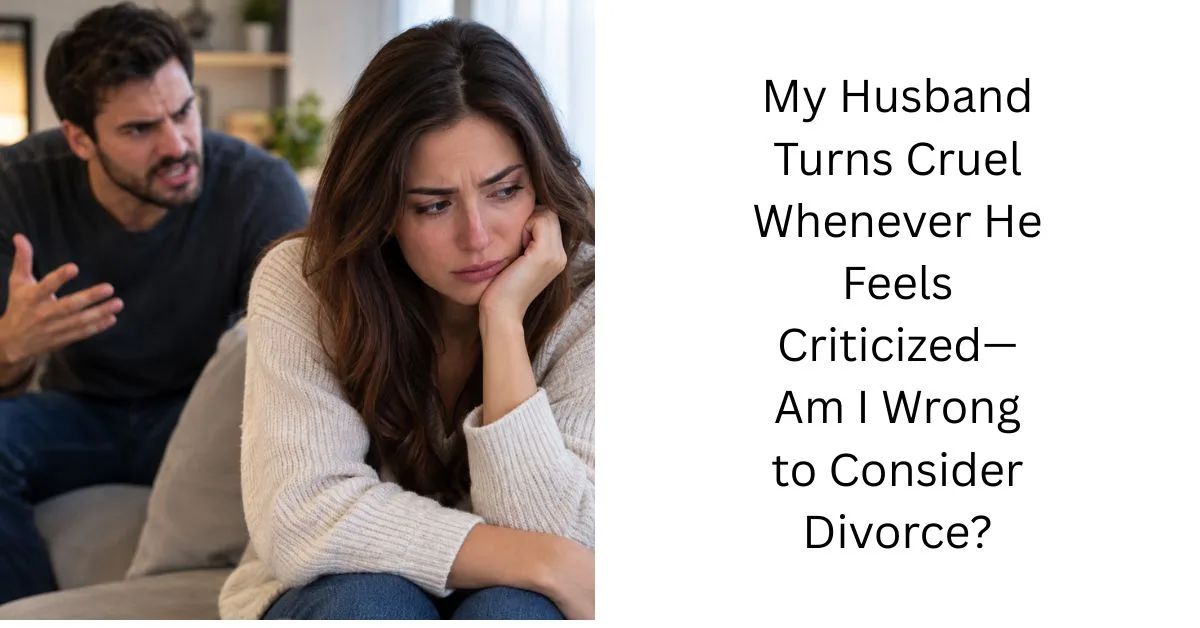
I am 30 years old, my husband is 39, and we have been married long enough that I know his moods, habits, and reactions better than almost anyone. We have children together, and from the outside, our family probably looks normal. We have good days, we laugh, we make plans, and we have built a life together. But there is one problem that has become harder and harder for me to ignore. Whenever my husband thinks I am criticizing him, even if I am simply correcting a small misunderstanding or explaining something calmly, his entire personality seems to change. He becomes defensive, angry, and sometimes cruel. What starts as a tiny disagreement can quickly turn into yelling, swearing, accusations, and him making me feel like I am somehow responsible for everything that went wrong. This has happened so many times that I have started carefully choosing my words around him because I never know what might trigger another explosion.
The latest incident happened the night before our youngest son’s first birthday. I had spent most of the day getting everything ready for his birthday and the party we were planning for the weekend. I wanted everything to be special because his first birthday felt important to me. We had bought presents for him, and I had placed them in a black plastic tub in the garage where the older children wouldn’t accidentally find them. That evening, I went into the garage looking for the tub because I wanted to start wrapping the gifts. But it wasn’t where I remembered leaving it. I immediately started getting stressed because I knew exactly what the tub looked like, and I couldn’t understand how an entire container filled with birthday presents could simply disappear. I asked my husband about it, and he confidently told me that all the presents were on the bench with the other things. I explained that those were Christmas gifts and that I was specifically looking for the black tub containing our son’s birthday presents. Instead of helping me look, he became irritated and insisted that the tub wasn’t there because he had organized the garage and knew exactly where everything was.
I kept searching anyway, and eventually I found the tub. It was in the garage the entire time. My husband had moved it and placed it with the containers holding larger sizes of the children’s clothes. I was relieved that I had found it, but I also pointed out that this was why I couldn’t find it. I wasn’t trying to start an argument. I simply told him that he had put the birthday gift tub in a different place, which was why I had been searching everywhere. Somehow, that simple statement caused everything to explode. He immediately started yelling and swearing at me. He became incredibly angry and started slamming things around. What shocked me most wasn’t even the anger itself because I have unfortunately seen it before. It was how quickly he turned the entire situation around and made it my fault. He insisted that I had told him to put the tub there. I knew I hadn’t. He also claimed that the tub had been labeled as children’s clothing, even though it wasn’t. He argued with me as though admitting that he had misplaced something was completely impossible.
There is normally a specific place where that tub goes, on top of a tall dresser in the garage. I had temporarily taken it down because I was putting the birthday presents inside. My husband apparently decided to put it somewhere else after organizing the garage. To me, this was such a small issue that I couldn’t understand why it had become such a huge fight. Nobody had been hurt. Nothing had been ruined. We had found the presents, and our son’s birthday was still going to happen the next day. But my husband seemed completely unable to accept even the slightest suggestion that he might have made a mistake. He told me that the place where I normally kept the tub wasn’t actually where it belonged. He even said that if I put it back there, he would throw everything in the bin. Hearing that was incredibly upsetting because it felt like the argument wasn’t really about the tub anymore. It was about his need to prove that he was right and that I was wrong, regardless of what had actually happened.
By midnight, I was sitting there wrapping our son’s birthday presents by myself while my husband sat on his phone and ignored me. I had spent the entire day trying to prepare everything for our child, and instead of ending the night feeling excited about his birthday, I was exhausted and emotionally drained. I kept thinking about how ridiculous the whole situation was. I wasn’t asking for anything unreasonable. I didn’t insult him or call him names. I wasn’t trying to embarrass him or make him feel incompetent. I simply told him that I had found the tub and that it had been placed somewhere different from where I expected it to be. Yet somehow, I ended up being yelled at, sworn at, and blamed. Then I was left to finish preparing everything alone while he acted as though I was the one who had caused the entire problem.
The worst part is that this isn’t an isolated incident. It happens every few weeks in some form. Sometimes I don’t even have to directly criticize him. If he interprets something I say as criticism, he becomes defensive and angry. I have learned that there are certain subjects I have to approach very carefully because I know how quickly he can shut down or become aggressive with his words. I find myself thinking before I speak, wondering whether something harmless might somehow turn into another argument. I don’t want to live like that. I don’t want my children growing up watching their mother constantly measure every word because she is afraid of how their father might react. I also don’t want them learning that yelling, swearing, blaming, and refusing to take responsibility are normal ways to handle conflict in a marriage.
I have tried to understand why he behaves this way. Maybe he has always struggled with criticism. Maybe he sees admitting a mistake as some kind of weakness. Maybe something from his past made him extremely defensive. But at this point, I am tired of trying to explain his behavior for him. Adults are responsible for how they treat the people around them, especially their spouses and children. I have suggested therapy before because I don’t think we can solve this problem by pretending it doesn’t exist. Unfortunately, he refuses any kind of therapy. He doesn’t believe there is anything wrong with the way he reacts, and that makes me feel even more hopeless. How can we fix something if the person causing the problem refuses to acknowledge that there is a problem? I can change how I communicate, stay calm, choose softer words, and avoid unnecessary arguments, but I cannot control how another adult chooses to respond.
Now I am seriously questioning whether I should stay in this marriage or consider divorce. The hardest part is that we have children, and I don’t want to make a decision that could affect their lives forever. Part of me thinks I should stay because I don’t want them growing up between two households. Another part of me wonders whether staying in an environment where their mother is regularly yelled at and blamed could be worse. I keep thinking about what I would tell my own daughter if she were in my position. Would I tell her to keep accepting this because she has children? Would I tell her that it is normal for a husband to become cruel whenever he feels criticized? I honestly don’t know. I love my family, and I don’t want to throw away years of our life together over arguments. But this isn’t one argument. It’s a pattern that keeps repeating, and every time it happens, I feel a little more disconnected from him.
I wish I could say that the birthday incident was the moment everything became clear, but instead, it has left me even more confused. I still love my husband, and there are good moments between the bad ones. That’s what makes this decision so difficult. If he were terrible all the time, maybe leaving would feel easier. But he isn’t. There are days when he is loving, funny, supportive, and a good father. Then something small happens, he feels criticized, and suddenly I am dealing with a completely different person. I don’t know how many more times I can go through this cycle. I don’t know whether I should stay and hope that someday he realizes how much his behavior hurts me, or whether I should accept that refusing therapy and refusing responsibility are answers in themselves. All I know is that I don’t want to spend the rest of my life afraid to tell my husband that he made a simple mistake. So now I am left with the question I never thought I would have to ask: Am I wrong for seriously considering divorce, even though we have children and even though I still love him?
Read Story…
My Husband Can Never Admit He’s Wrong, and I’m Exhausted
My husband 39M (I’m 30F) can be absolutely horrible and cruel when he’s criticised. Its the night before our sons 1st birthday and I couldn’t find the presents I’d put in a plastic tub in the garage. We keep it in there so the older kids don’t find it.
I’m stressing a bit like “there was a black tub with gifts, how can the whole thing be missing, it makes no sense.”
Husband told me all the present stuff is on the bench with the other stuff which was in cardboard boxes.
I told him no those were christmas gifts, I’m looking for the present tub.
He’s yelling at me that its not in there because he’s organised the garage and knows where everything is.
Anyways, I find it. In the garage. He’s put it in with the tubs of bigger sizes of kids clothes.
I told him that I’d found it and that he’d put it in the wrong place and let me tell you he LOST IT. Immediately went to yelling and swearing and slamming stuff. Gaslit me to high heaven too, telling me it was my fault and I told him to put it there (I didn’t), and that it was labelled as kids clothes (it wasn’t).
There’s a spot on top of a tall boy dresser where it normally goes but I had it out to put gifts into and then he yeeted it away in any old spot. No big deal right? Except he did nothing wrong, there’s no way he could ever do anything wrong, and its somehow all my fault.
Also, the spot on top of the tall boy is apparently not where it belongs and if I ever put it back there he’s going to throw it all in the bin. (His words).
Now its midnight and I’m wrapping our sons presents by myself while he scrolls on his phone and ignores me. I have been working hard all day to get things organised for the birthday tomorrow and the party on the weekend.
I dont know if I should divorce him or stay for the kids. Its a consistent issue which pops up once every few weeks if I dare to criticise him. Even if he perceives something as criticism he shuts down and gets angry. Also refuses any form of therapy.
Tldr: my husband gets mad and shouts and swears at me if I criticise him, no matter how mildly or politely I do it.
A Pattern I Can No Longer Ignore
I am 30 years old, my husband is 39, and we have been together long enough for me to know his personality, his habits, and the way he reacts to different situations. We have children, a home, responsibilities, and a life that from the outside probably looks ordinary. There are good days in our marriage. There are moments when he makes me laugh, helps with the kids, or acts like the man I fell in love with. That is part of what makes my current situation so confusing. My husband isn’t cruel every minute of every day. Instead, there is a very specific pattern that has slowly become impossible for me to ignore. Whenever he believes I am criticizing him, even if my words are calm and reasonable, he can suddenly become angry, defensive, and incredibly harsh.
At first, I used to think these incidents were just normal marital disagreements. Every couple argues sometimes, and I never expected marriage to be completely peaceful. I thought maybe he was having a bad day, was stressed from work, or simply misunderstood what I was trying to say. I would apologize just to end the argument, even when I didn’t believe I had done anything wrong. Over time, though, I noticed that the same thing kept happening. It didn’t matter how gently I brought something up. If he interpreted my words as criticism, he would become defensive. Sometimes he would stop speaking to me, sometimes he would raise his voice, and sometimes he would start swearing and blaming me for things that had nothing to do with the original issue.
The latest incident happened the night before our youngest son’s first birthday. I had spent most of the day getting everything organized. His first birthday felt especially important to me because it was a milestone for our family, and I wanted the next day to be special for him. We were also planning a larger party for the weekend, so there were decorations, food, presents, and countless little details that needed to be handled. By the evening, I was already tired, but I still wanted to wrap our son’s gifts before going to bed. The presents were hidden in a black plastic tub in our garage because we have older children who might otherwise discover them.
I went into the garage looking for the tub and couldn’t find it. I knew exactly what I was looking for. It was a black plastic storage tub containing the presents, and I remembered having it in a particular area. When I couldn’t see it, I started getting stressed. I wasn’t angry at anyone. I was simply confused because an entire tub seemed to have disappeared. I said something along the lines of, “There was a black tub with the gifts. How can the whole thing be missing?” I was trying to make sense of what I was seeing because the garage had recently been reorganized.
My husband immediately told me that all the present-related things were on the bench with the other items. I went over and looked, but those weren’t the gifts I was searching for. I explained that the things on the bench were Christmas gifts stored in cardboard boxes and that I was looking specifically for the black tub containing our son’s birthday presents. Instead of simply helping me look, he became irritated and insisted that the tub wasn’t there because he had organized the garage himself. He told me he knew where everything was and seemed convinced that I was mistaken. I didn’t want an argument, so I kept searching quietly.
Eventually, I found the tub. It was in the garage the entire time. My husband had moved it and placed it among the storage tubs containing larger sizes of the children’s clothes. The moment I saw it, I felt relieved. I thought the problem was over. I told him that I had found it and pointed out that it had been moved into the wrong group, which was why I couldn’t find it. In my mind, that should have been the end of the conversation. Nobody was injured, nothing had been damaged, and the presents were safe. It was just a storage mistake.
Instead, my husband completely lost his temper.
He immediately started yelling and swearing at me. His reaction was so intense that I remember feeling shocked by how quickly the situation changed. One moment I was relieved to have found the presents, and the next I was standing there listening to him become furious. He began slamming things around and insisting that the situation was somehow my fault. He told me that I had told him to put the tub there, which simply wasn’t true. He also claimed that the container was labeled as children’s clothing, even though it wasn’t. It felt like reality itself was being rewritten in the middle of the argument.
I tried explaining what had actually happened, but that only seemed to make him angrier. This is something I have noticed before. When he believes he has been criticized, he doesn’t seem interested in understanding what I mean. He becomes focused on proving that he did nothing wrong. Even if the mistake is obvious or completely insignificant, admitting it seems impossible for him. Instead, the conversation turns into an argument about why I am supposedly responsible. I can say something simple like, “I think you put this in the wrong place,” and somehow we end up discussing something I supposedly did months ago.
There was normally a place where that tub was kept, on top of a tall dresser in the garage. I had temporarily taken it down because I was putting the birthday presents inside. After that, my husband apparently moved it while organizing the garage. I didn’t care that he had moved it. Honestly, I wouldn’t have cared at all if he had simply said, “Oh, I must have put it there.” What bothered me was his reaction when I pointed out where it had ended up. Somehow, the location where I had always kept the tub was suddenly declared wrong.
He even told me that if I put the tub back in its usual place, he would throw everything in the bin. Hearing that made me realize how far the argument had gone. We weren’t talking about a storage container anymore. We were talking about control, blame, and his refusal to accept that he might have made a mistake. I stood there thinking about how absurd it was that something so insignificant could produce so much anger.
By then it was late at night. I still had presents to wrap, and our son’s birthday was only hours away. Instead of spending that time feeling excited about our baby’s first birthday, I was emotionally exhausted. My husband sat on his phone and ignored me while I wrapped the presents alone. I had spent the entire day preparing for our child’s birthday, and now I was sitting there wondering why I was even trying so hard to create a happy family atmosphere when I felt so unhappy inside.
What hurt most wasn’t the storage mistake. It wasn’t even the yelling by itself. It was the feeling that I could never simply tell my husband that something had gone wrong without paying an emotional price for it. I shouldn’t have to calculate every sentence before speaking. I shouldn’t have to wonder whether saying something harmless will cause an explosion. Yet I have found myself doing exactly that. I have started choosing my words carefully and sometimes keeping quiet because I know that correcting him can turn into a much bigger problem.
This has been happening every few weeks. Sometimes the trigger is something extremely small. Sometimes I don’t even think I am criticizing him, but he interprets my words that way. Once he feels criticized, he shuts down or becomes angry. If I try to explain myself, he can become even more defensive. Eventually I find myself apologizing simply because I want the conflict to end. I have apologized for my tone, my wording, or even for bringing something up in the first place. The strange part is that after the argument, I often sit alone wondering what I actually did wrong.
I have started questioning my own memory during these arguments. When someone repeatedly tells you that you said something you know you didn’t say, it can make you wonder whether you somehow misunderstood yourself. I know what I remember about the birthday tub. I know I didn’t tell him to put it with the children’s clothes. I know it wasn’t labeled that way. But when he becomes angry and insists that his version is the truth, it becomes exhausting to keep defending something that should never have required a defense in the first place.
I have tried to approach this problem calmly. I have tried waiting until he is in a better mood. I have tried speaking gently. I have tried explaining that I am not attacking him when I point out a mistake. I have even tried avoiding certain subjects completely. But none of these approaches have solved the underlying problem. I cannot control what he chooses to hear when I speak. I can control my own behavior, but I cannot make him respond respectfully.
The biggest problem is that he refuses therapy. I have suggested counseling because I don’t believe this pattern is healthy for either of us. I don’t expect therapy to magically fix everything, but I thought it could at least give us a neutral place to talk about what keeps happening. He refuses. As far as he is concerned, there is nothing wrong with him. If there is a problem, he believes it is because I criticize him, misunderstand him, or somehow provoke his reactions.
That leaves me feeling completely stuck. How do you fix a marriage when one person refuses to acknowledge that there is a problem? I am willing to examine my own behavior. I am willing to admit when I am wrong. I am willing to apologize when I hurt someone. But I cannot be the only person working on the relationship. I cannot carry all of the responsibility for his anger while also being expected to protect his feelings from every possible criticism.
Our children make this decision much harder. If it were only about me, I might already know what I wanted to do. But I am their mother, and every decision I make affects them. I don’t want them to grow up with divorced parents if there is another option. I don’t want to disrupt their lives, change their home, or make them feel like their family has fallen apart. At the same time, I keep asking myself whether staying together “for the kids” is actually the right thing if the relationship continues to involve yelling, swearing, blame, and emotional instability.
I worry about what our children are learning from us. Children notice more than adults think they do. Even if they don’t understand every word of an argument, they can sense tension. They can see when one parent is upset and the other is angry. They can learn from how their parents communicate. I don’t want my children growing up believing that marriage means one person has to constantly walk on eggshells around the other.
There are also good moments, and I don’t want to pretend there aren’t. My husband can be loving. He can be funny and affectionate. He can play with the children and make us laugh. There are days when I look at our family and think that maybe everything will eventually get better. Those moments are part of the reason leaving feels so difficult. If he were terrible all the time, I think my decision would be much easier. Instead, I keep hoping the good version of him will eventually become the version that stays.
But then another argument happens, and I feel like I am back at the beginning again. I wonder how many times I can repeat the same cycle. Something small happens. He feels criticized. He becomes angry. I try to explain. He blames me. I become exhausted. Eventually the argument ends, but nothing is actually resolved. Then we move on until the next incident happens. The pattern has become predictable, and that scares me more than any individual argument.
I also find myself changing as a person. I used to speak freely. I used to tell my husband what I thought and expected that we could disagree respectfully. Now I sometimes keep things to myself because I don’t want to deal with the reaction. I have become more cautious, quieter, and more anxious about ordinary disagreements. I don’t like that version of myself. I don’t want to become someone who stays silent just to keep the peace.
The night of our son’s birthday made all of these thoughts come rushing back. I looked at the presents I was wrapping and thought about how quickly a happy family moment had turned into another painful night. My baby was going to wake up the next morning excited about his birthday, completely unaware of what had happened. I wanted to focus on him, but I couldn’t stop thinking about my marriage.
I kept asking myself whether I was overreacting. Was this really enough to consider divorce? Was I being too sensitive? Was I expecting too much from my husband? Part of me worried that other people would hear the story and say, “It was just a fight over a storage tub.” But that isn’t how it feels to me. The tub isn’t the reason I am considering divorce. The tub was simply another example of a much larger pattern that has been happening for years.
I don’t expect my husband to be perfect. I make mistakes too. I have never expected him to agree with everything I say. I don’t even expect him to accept every criticism happily. What I do expect is basic respect. If I tell him that something was misplaced, I expect us to be able to discuss it without yelling, swearing, threats, or insults. I don’t think that is an unreasonable expectation in a marriage.
Sometimes I imagine what I would tell my daughter if she were an adult and came to me with this exact story. If she told me that her husband became cruel whenever she gently pointed out a mistake, that he yelled and swore at her, blamed her for things she didn’t do, and refused therapy, would I tell her to stay simply because they had children? I don’t think I could. I would probably tell her that she deserves to feel safe and respected in her own home.
Then I think about my sons. I want them to grow up understanding that being a man doesn’t mean never admitting mistakes. I want them to know that anger isn’t an excuse for cruelty. I want them to learn that when you hurt someone, you take responsibility and try to repair the damage. I don’t want them to watch their father blame their mother and then grow up believing that this is how adults should handle disagreements.
At the same time, I am scared of making a decision I cannot undo. Divorce is not a simple solution. There are children involved, finances, housing, custody, family relationships, and countless practical issues. There is also the emotional reality of ending a relationship with someone I still love. I don’t want to throw away our entire marriage because I am angry about a series of arguments. But I also don’t want to spend another ten years hoping that something will change when the person involved doesn’t believe there is anything that needs changing.
I have started realizing that love and compatibility aren’t always the same thing. I can love someone and still recognize that their behavior is hurting me. I can remember the good times and still take the bad times seriously. I can want my children to have a relationship with their father while also questioning whether living in this environment is healthy for them. None of those thoughts make the decision easier.
For now, I don’t know what I am going to do. I know I need to think carefully rather than make a major decision in the middle of an emotional night. I also know that I can’t keep pretending these incidents don’t matter. The birthday tub was never really about the birthday tub. It was about what happens every time my husband feels criticized, and how much emotional energy I spend trying to prevent his anger.
Maybe the hardest realization is that I cannot change him. I can change how I communicate. I can set boundaries. I can decide what behavior I will and won’t accept. But I cannot make him take responsibility, seek therapy, or understand how deeply his reactions affect me. If he doesn’t want to change, I have to decide what I am willing to live with.
So now I am left with a question I never expected to ask about my own marriage: Am I wrong for considering divorce because my husband becomes cruel whenever he feels criticized? Should I stay for the sake of our children and hope that things eventually improve, or is protecting my own peace—and showing my children what a healthy relationship should look like—more important than keeping our family together under the same roof?