Businessman Clashes With In-Laws After Firing Their Son For Stealing Customer’s Car, Drunk Driving, And $70k Road Accident
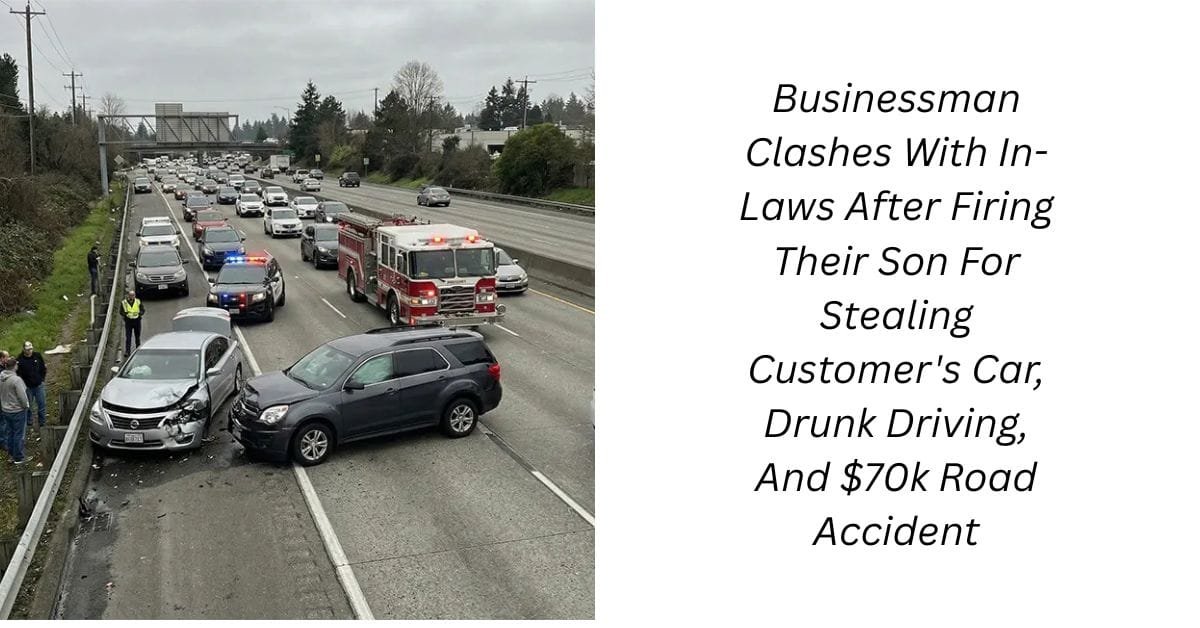
Running a successful business can be difficult enough without family relationships becoming involved, but one businessman found himself caught in an extremely uncomfortable situation after an employee he had hired turned out to be his own in-law’s son. At first, the arrangement seemed ideal. The businessman owned a busy automotive-related company and needed reliable employees who could handle customers, vehicles, and important responsibilities. When his wife’s family recommended their son for a position, he decided to give him a chance. He knew the young man personally and believed that having a family connection might actually make him more trustworthy. Unfortunately, that confidence was eventually shattered after a serious incident involving a customer’s vehicle. According to the businessman, the employee took a customer’s car without proper permission, drove while intoxicated, and ended up causing a major accident that resulted in approximately $70,000 in damages. What made the situation even more complicated was the fact that the employee allegedly returned expecting the family connection to protect him from serious consequences. Instead, the businessman made the difficult decision to fire him immediately.
The trouble reportedly began when the employee was given access to a customer’s vehicle as part of his job. Employees were expected to treat customers’ property with the same care they would give their own belongings, and the businessman had repeatedly emphasized that company vehicles and customer cars were not to be used for personal reasons. Despite those rules, the employee allegedly took the customer’s car without authorization. What happened next turned a workplace violation into a serious legal and financial problem. The employee had apparently been drinking before getting behind the wheel, and while driving the vehicle, he became involved in a major road accident. The collision caused extensive damage to the customer’s car as well as other property involved in the accident. The businessman was later informed that the estimated damage was around $70,000, leaving him shocked by the potential consequences for his company. He immediately began trying to determine what had happened and why an employee had taken a customer’s vehicle without permission in the first place. When he learned that alcohol was allegedly involved, he realized this was no longer something he could overlook as a simple mistake.
The businessman said he was furious, but his first priority was dealing with the consequences for the customer and the company. A customer’s trust is extremely important for any business, particularly when customers are handing over expensive vehicles and expecting them to be handled professionally. The businessman understood that one employee’s reckless decision could damage the company’s reputation and potentially expose the business to serious financial liability. He investigated the circumstances and concluded that the employee had violated several important workplace rules. The fact that the vehicle had allegedly been taken without authorization was serious enough, but combining that with drunk driving made the situation even more dangerous. The businessman reportedly told the employee that he could not continue working for the company. There was no special exception simply because the employee was related to his wife. In his view, protecting the business and maintaining the safety and trust of customers had to come before family relationships. He believed that if he allowed the employee to keep his job after such a serious incident, other workers might conclude that company rules did not really matter.
The firing, however, did not go over well with the employee’s parents. The businessman’s in-laws reportedly confronted him and argued that he had reacted too harshly. They acknowledged that their son had made a serious mistake but believed that family should have been taken into consideration before he was dismissed. They apparently wanted the businessman to give their son another opportunity to prove himself. The businessman refused. He explained that this was not a situation involving a minor workplace error, a missed deadline, or an inexperienced employee making an ordinary mistake. Their son had allegedly taken a customer’s vehicle without permission, driven while intoxicated, and caused an accident involving tens of thousands of dollars in damage. From the businessman’s perspective, allowing him to remain employed would send the wrong message to both customers and employees. His in-laws reportedly accused him of choosing his business over family, while he argued that they were asking him to sacrifice his professional responsibilities because of their relationship. The disagreement quickly became personal, with family members taking sides and accusing one another of being unreasonable.
The situation became even more tense when the in-laws allegedly suggested that the businessman should help cover some of the financial consequences of their son’s actions. They reportedly believed that because the incident occurred while he was working for the company, the businessman should take greater responsibility for the damage. The businessman disagreed and argued that employees cannot simply ignore company rules and then expect their employer to protect them from every consequence. He understood that there could be insurance issues and legal questions that needed to be handled properly, but he refused to treat the matter as a private family problem. The estimated $70,000 in damages was not a small amount that could simply be forgotten. There was a customer involved, potentially multiple vehicles or property involved, and the reputation of the business at stake. The businessman reportedly told his in-laws that if their son had been a stranger applying for the job, nobody would have expected him to keep his position after such an incident. He felt the family was only demanding special treatment because of their relationship.
The conflict eventually affected the businessman’s relationship with his wife as well. She was caught between her husband and her parents, who believed their son deserved another chance. The businessman reportedly tried to explain that firing the employee was not an act of revenge or hatred. It was a professional decision based on conduct that he considered completely unacceptable. He also emphasized that he had initially hired the man because he trusted the family’s recommendation and genuinely wanted to help him build a career. That made the incident especially disappointing. Instead of seeing the firing as a consequence of his own actions, the employee and his family appeared to view it as a betrayal. The businessman felt that this was unfair. He had taken a chance on a relative, and the relative had allegedly put both the business and a customer’s property at risk. He did not believe family loyalty meant ignoring dangerous behavior. In his mind, real loyalty also meant holding people accountable when they make serious mistakes.
Ultimately, the businessman decided that he would stand by his decision despite the pressure from his in-laws. He made it clear that family relationships could continue if everyone was willing to respect boundaries, but he would not rehire the employee simply to keep the peace. The incident left him with an uncomfortable lesson about mixing business and family. What had started as an attempt to help a relative had turned into a situation involving an allegedly stolen customer vehicle, intoxicated driving, a major accident, approximately $70,000 in damages, and a bitter dispute with his in-laws. Some relatives believed the businessman should have shown more compassion, while others felt that firing the employee was the only responsible choice. In the end, the central question was not whether family deserves forgiveness, but whether family connections should protect someone from professional consequences after allegedly putting others, a customer’s property, and a business at serious risk. For the businessman, the answer was clear: family may deserve another chance in personal matters, but when someone’s actions threaten the safety and trust at the heart of a business, accountability has to come first.
Read Story…
AITA for firing my brother-in-law?
I (M39) have been married to my wife (F36, let’s call her Pam) for 15 years. We have a 14 year old son, and Pam has a younger brother (28, let’s call him Dwight). Dwight, his pregnant wife Angela (24) have been facing financial difficulties.
Around six months ago, Dwight reached out to me for help finding a new job. He said he quit the previous job I found for him, claiming an “abusive work environment,” and said he needed a new job urgently since his wife was about to give birth. I own an auto repair shop among other businesses, so I offered him a job at the shop, because I believed Dwight was interested in cars. Pam supported this idea, hoping it would provide him with a stable job.
However, over the subsequent months, it became evident that Dwight wasn’t committed to the job. Instead of helping and learning, he spent his time watching anime on his phone. He frequently arrived late, left without notice, and was generally unproductive.
The cars we repair are usually expensive cars. So, some of our customers appreciate it when we pick up and deliver their cars. In an effort to give him responsibilities, I assigned Dwight to manage customer car deliveries (which happened just a few times per week), a task he continued to perform poorly.
The tipping point occurred when I gave Dwight a customer’s car to deliver, but he called and said his wife Angela needed to go to the hospital. It wasn’t anything serious but he couldn’t deliver the car. I said I could handle it myself, but he said he could do it first thing in the morning.
The next morning at 4 am, my phone rang. It was Dwight. He said he crashed the car he was supposed to deliver. In short, he decided to drive the car to his hometown to “see his boys”, got drunk, and crashed 150 km away from home on his way back. Miraculously, he wasn’t seriously injured. But he trashed the car so I had to replace it. He damaged a lot of roadside barriers as well. The whole thing cost me about $70,000.
The next day I fired Dwight, despite my mother-in-law’s attempts to intervene. I felt Dwight was a risk to my businesses and couldn’t be tolerated. (I also own nightclubs, hotels, etc. All businesses that people leave their cars. People know me here, they talk.) This decision caused a rift in the family, with my wife’s parents and other relatives siding with Dwight, and pressuring me to reconsider.
As a result of her family’s influence, a week after the incident Pam changed her stance and started to want me to hire Dwight again. This was an unexpected shift, as she fully supported my decision at first. I also engaged in a heated confrontation with my in-laws, but I stood my ground and refused to apologize for my decision.
I now find myself isolated from my family (my in-laws, my wife, and my son) who all believe I was harsh and unreasonable towards Dwight. I don’t think I was, so I can’t bring myself to apologize. Am I the asshole here, Reddit? I don’t think I am, so I need other perspectives.
When Family And Business Collide
Running a business can be challenging even under the best circumstances, but things can become especially complicated when family members are involved in the workplace. One businessman learned that lesson the hard way after hiring his in-laws’ son and eventually being forced to fire him following a serious incident involving a customer’s car. What initially seemed like an opportunity to help a relative build a career quickly became a nightmare involving an allegedly unauthorized vehicle, drunk driving, a major road accident, and an estimated $70,000 in damages. The businessman later found himself facing not only the consequences of the employee’s actions but also intense pressure from his own in-laws, who believed their son deserved another chance. What made the situation difficult was that the businessman had never intended to treat his relative differently from any other employee. He believed that working together could be positive as long as everyone respected the rules. Unfortunately, those boundaries were eventually tested in a way he never expected.
The businessman owned a growing company where employees were regularly trusted with valuable customer property. Because of the nature of the business, customers expected their vehicles to be handled carefully and professionally. The businessman understood that trust was one of the most important parts of his reputation. A single careless employee could potentially cause financial losses and damage years of hard work. When his in-laws recommended their son for a job, the businessman decided to give him an opportunity. He already knew the young man and believed that having a family connection meant he could rely on him. His in-laws spoke highly of their son and assured him that he was responsible and capable. Wanting to help the family, the businessman agreed to hire him. He also made it clear from the beginning that family connections would not change workplace expectations. The employee would be treated like everyone else and would be expected to follow the company’s rules.
At first, everything seemed to go smoothly. The employee learned his responsibilities and became familiar with the company’s daily operations. He was given access to customer vehicles when necessary, just like other trusted employees. The businessman said that employees were repeatedly reminded that customer property was never to be used for personal reasons without permission. Those rules were not complicated. If a customer brought a vehicle to the company, employees were expected to leave it alone unless there was a legitimate business reason to move or drive it. The businessman believed those boundaries were obvious, particularly because the vehicles did not belong to the employees. He never imagined that his relative would be the person to violate them so dramatically. Because the employee was part of the family, the businessman had initially been even more willing to trust him. Looking back, he would later question whether that trust had been misplaced.
The incident reportedly happened after the employee gained access to one of the customer’s vehicles. Instead of keeping the vehicle at the business as required, he allegedly took it without receiving proper authorization. The businessman was not immediately aware that the car had been removed. At some point, however, he learned that the vehicle was no longer where it was supposed to be. Initially, he feared there had been a misunderstanding. Perhaps another employee had moved it, or there had been some legitimate reason for the vehicle to be taken elsewhere. But as more details emerged, the situation became increasingly alarming. The employee had apparently taken the customer’s car for reasons unrelated to the company’s business. That alone represented a serious breach of trust, but the situation became much worse when the businessman learned what happened while the employee was driving.
According to the account, the employee had been drinking before getting behind the wheel. The businessman was shocked to learn that a customer’s vehicle had allegedly been taken without permission and then driven while the employee was intoxicated. The decision was not merely irresponsible; it created a potentially dangerous situation for everyone on the road. The businessman knew that customers trusted his company to protect their property, not expose it to unnecessary risks. He also knew that driving under the influence could have severe consequences for the driver and anyone else involved. At that moment, the situation was no longer something that could be handled as an ordinary workplace disciplinary issue. It had become a serious incident with potential legal, financial, and reputational consequences.
The worst happened when the employee was involved in a major road accident. The collision caused extensive damage, and the financial consequences were reportedly estimated at around $70,000. The exact amount became one of the most concerning aspects of the incident because the damage was far beyond what a small business could casually absorb. The businessman suddenly had to deal with questions about insurance, responsibility, the customer’s property, and the company’s reputation. He was also left wondering how someone he had trusted with customer vehicles could have made such a reckless decision. The employee’s actions had potentially exposed the company to enormous financial pressure. Even more importantly, the businessman worried about the people who could have been injured in the accident. The monetary figure was shocking, but the possibility of someone being seriously hurt made the situation even more disturbing.
When the businessman finally spoke with the employee, he reportedly demanded an explanation. The employee allegedly admitted to taking the vehicle but tried to explain the circumstances. The businessman, however, did not believe there was any reasonable justification for what had happened. He reminded the employee that the vehicle belonged to a customer and that company rules specifically prohibited unauthorized personal use. He also pointed out that drinking and driving was an extremely serious decision that could have ended much worse. At that point, the businessman knew he had to make a decision. Keeping the employee employed simply because he was related to the family was not something he was willing to consider. He believed that if another employee had done the same thing, the outcome would have been identical. The employee was fired.
The decision to terminate him was immediate and firm. The businessman explained that the firing was not motivated by personal anger or revenge. He said he was acting as an employer who had a responsibility to protect his customers, his employees, and his company. The employee had allegedly violated trust in several different ways. He had taken property that did not belong to him, used it without permission, driven it while intoxicated, and become involved in a costly accident. From the businessman’s perspective, there was no realistic way to restore the professional relationship. Even if the employee apologized, the businessman would still have to ask himself whether he could ever trust him with another customer’s vehicle. His answer was no.
The businessman expected the firing to be difficult for the employee, but he did not anticipate how strongly his in-laws would react. Once they learned that their son had lost his job, they reportedly contacted the businessman and demanded an explanation. They were apparently angry that he had dismissed their son instead of giving him another opportunity. They argued that mistakes happen and that family members should support one another during difficult situations. The businessman understood the emotional side of their argument, but he disagreed with their characterization of the incident as a simple mistake. In his view, several decisions had been made before the accident ever occurred. Taking the car was one decision. Drinking before driving was another. Getting behind the wheel while intoxicated was yet another. He believed the accident was the consequence of a chain of irresponsible choices rather than an unavoidable accident.
The in-laws reportedly accused the businessman of being too harsh because their son was family. They believed that a family-owned or family-connected business should provide more flexibility to relatives. The businessman strongly disagreed. He explained that the customer did not care about their family relationship. The customer had entrusted the vehicle to a business and expected it to be treated responsibly. If the businessman allowed his employee to escape consequences simply because he was related to him, he would be putting the entire business at risk. Other employees might also begin to believe that rules only applied to people without family connections. That would create an unhealthy workplace environment and potentially lead to even more serious problems.
The conflict became even more complicated when the subject of the $70,000 damage bill came up. The in-laws reportedly believed that because their son had been working for the company, the businessman should accept more responsibility for what happened. The businessman acknowledged that insurance and legal matters might need to be addressed, but he refused to personally absorb the consequences simply to protect his in-laws’ feelings. He believed every part of the incident needed to be handled through the proper channels. If insurance covered certain damages, that was one matter. If the employee faced personal consequences for his decisions, that was another. The businessman did not believe family pressure should determine the outcome.
The businessman also became concerned about the customer’s reaction. From the customer’s perspective, a vehicle had been handed over to a professional company and was allegedly taken without permission by an employee. The customer had every reason to expect the company to take responsibility for what happened. The businessman understood that the company’s reputation could suffer if the matter was handled poorly. He therefore focused on communicating with the customer and addressing the damage rather than spending all his energy defending his employee to his relatives. He believed that the customer deserved honesty and accountability.
Meanwhile, the employee reportedly felt betrayed by the firing. He allegedly believed that his relationship with the businessman should have given him some protection. He reminded his family that the businessman was not a stranger but someone connected to them through marriage. The businessman responded that family relationships could not override professional responsibilities. He had given the employee the job partly because he wanted to help him. That opportunity had come with expectations, and those expectations had allegedly been ignored. The businessman felt particularly disappointed because he had taken a chance on someone based on family trust.
The disagreement eventually reached the businessman’s wife. She was placed in an extremely uncomfortable position because she had to listen to her parents complain about her husband’s decision while also understanding why he felt the employee had to be fired. The businessman reportedly explained to her that he did not want the conflict to damage their marriage or create a permanent family feud. However, he also refused to reverse the decision. He believed that if he gave in to pressure, it would establish a dangerous precedent. Every future workplace decision involving a relative could become a family negotiation instead of a professional judgment.
Some relatives suggested that the businessman should have simply given the employee unpaid leave instead of firing him. They argued that he could have been punished without permanently losing his job. But the businessman believed that the seriousness of the incident made continued employment impossible. Trust is essential when employees are given access to customer property. If that trust disappears, the employment relationship becomes extremely difficult to maintain. The businessman said he could not confidently hand another customer’s keys to the employee after what had happened. That alone was enough for him to conclude that the working relationship had reached its end.
Others suggested that the businessman was being hypocritical because the accident happened while the employee was technically connected to the company. They argued that employers have responsibilities when employees cause problems while working. The businessman acknowledged that there were legal and insurance questions to consider, but he rejected the idea that employment automatically excused misconduct. He believed the employee’s personal choices remained important. Taking a customer’s vehicle without permission was not part of the employee’s job duties. Neither was drinking and driving. The businessman felt it would be unreasonable to expect the company to protect someone from every consequence of a deliberate violation of company rules.
The $70,000 figure also became a major source of anxiety for everyone involved. Even if insurance covered some of the damages, the incident could potentially result in increased premiums, legal costs, lost business, or other expenses. The businessman worried that customers might hear about the accident and begin questioning whether their vehicles were safe at the company. He knew that trust could take years to build and only minutes to destroy. One employee’s reckless behavior could therefore affect dozens of people who had nothing to do with the incident.
The in-laws continued to argue that the businessman should prioritize family harmony. They reportedly felt that firing their son had humiliated him and created unnecessary tension within the family. The businessman responded that he never wanted the incident to happen in the first place. If his relative had followed the rules, none of them would have been dealing with the consequences. He refused to accept the idea that enforcing workplace rules was the cause of the family conflict. In his view, the original behavior created the problem, while the firing was simply the employer’s response to it.
The businessman also questioned whether his in-laws would have reacted differently if the employee had been a stranger. He believed that if an unrelated worker had taken a customer’s vehicle, driven it while intoxicated, and caused tens of thousands of dollars in damage, nobody would have asked the employer to keep that person on staff. The only reason special treatment was being requested, he believed, was because the employee was their son. That double standard frustrated him. He wanted his family to understand that fairness meant applying the same expectations to everyone.
At some point, the businessman reportedly told his in-laws that he was willing to maintain a family relationship, but only if they respected his decision as an employer. He did not want every family gathering to turn into an argument about the employee. He also did not want his wife caught between her husband and her parents. He hoped that time would eventually allow everyone to move past the disagreement. However, he remained firm that the employee would not be rehired simply to restore peace.
The incident forced the businessman to reconsider his approach to hiring relatives. Before this experience, he had believed that hiring family could create opportunities and strengthen relationships. Now he saw the potential risks more clearly. When a relative performs well, everyone is happy. But when something goes wrong, the workplace problem can quickly become a family dispute. A disciplinary decision that would normally be routine can suddenly involve parents, siblings, spouses, and extended relatives. The businessman realized that professional boundaries needed to be established even more clearly when family members worked together.
He also began reviewing the company’s policies regarding customer vehicles. He wanted to make sure that every employee understood exactly when a vehicle could be moved, who could authorize its use, and what consequences would follow from unauthorized use. He reportedly considered implementing stricter key-control procedures and documenting vehicle movements more carefully. These measures were not designed to punish employees but to prevent another incident from happening. After losing so much trust in one employee, he wanted to make sure the business had stronger safeguards in place.
The businessman later admitted that he felt conflicted about the entire situation. On one hand, he was angry and believed the firing was necessary. On the other hand, he understood that the employee was still a member of his extended family, and he did not want to see the young man’s future destroyed. He believed people can learn from serious mistakes, but he did not think learning from a mistake necessarily meant keeping the same job. Sometimes accountability means accepting that certain opportunities have been lost because of one’s own actions.
The employee’s family reportedly saw the situation differently. They believed their son had already suffered enough from the accident and losing his job, and they wanted the businessman to show compassion. The businessman believed compassion and accountability could exist at the same time. He could feel sorry for what had happened while still refusing to ignore the behavior that caused it. In fact, he argued that allowing someone to avoid consequences could prevent them from truly learning from their mistakes. For him, accountability was not about revenge; it was about recognizing the seriousness of one’s actions.
The dispute eventually became less about the original accident and more about trust between family members. The businessman felt that his in-laws had placed him in an impossible position by expecting him to choose family loyalty over his responsibilities to customers. His in-laws felt that he had chosen his company over their son. Both sides believed they were defending something important. The businessman was defending his business and customers, while the in-laws were defending their child. Unfortunately, those priorities were difficult to reconcile.
The story also highlighted a broader issue that many family businesses face: should relatives receive special treatment? Some people believe family members deserve additional chances because personal relationships matter. Others believe that businesses must have consistent standards if they want to survive. In this case, the businessman clearly fell into the second camp. He believed that once a person accepts a professional position, they accept professional responsibilities as well. Being related to the owner does not change the rules.
For the customer whose vehicle was involved, the incident was undoubtedly stressful. Someone had trusted the business with valuable property, only to have that property allegedly used without authorization and involved in a serious accident. The businessman knew that the customer’s experience would influence how people viewed his company. He therefore focused on making sure the customer was treated fairly and that the situation was addressed properly. He believed that protecting the company’s reputation required taking responsibility for the situation rather than hiding behind family connections.
Eventually, the businessman made peace with the fact that some relatives might remain angry with him. He said that he could not control how his in-laws viewed his decision. What he could control was how he ran his company. He had a responsibility to establish boundaries and protect the people who trusted his business. If that meant disappointing relatives, he was prepared to accept the consequences. He hoped that eventually they would understand that the decision was not personal.
Looking back, he reportedly wished he had been even more careful about mixing family and business. He had wanted to help a relative and give him an opportunity, but the arrangement had ultimately created a situation that affected both his professional and personal life. The experience taught him that trust should be earned through consistent behavior, regardless of someone’s relationship to the owner. Family connections can open doors, but they cannot guarantee that someone will remain employed after serious misconduct.
The most difficult part for the businessman was knowing that the entire conflict could have been avoided. If the employee had simply followed the company’s rules, the customer would not have been dealing with a damaged vehicle, the business would not have been facing a potentially enormous financial problem, and the family would not have been arguing about a job. The businessman believed the situation was a powerful reminder that one reckless decision can create consequences far beyond the moment in which it is made.
In the end, the businessman stood by his decision to fire his in-laws’ son. He maintained that the employee’s actions were too serious to overlook and that family relationships could not excuse behavior that allegedly put people, property, and the company at risk. The incident left behind hurt feelings and tension, but it also reinforced the businessman’s belief that clear boundaries are essential when relatives work together. Whether the family eventually forgives him remains uncertain. What is certain is that he chose to protect his customers and business rather than allow family pressure to determine an important professional decision. For him, the lesson was simple: helping family is one thing, but allowing family loyalty to override responsibility is something entirely different.