Entitled Dog Owner Refuses To Pay For The $150 Toy His Dog Chewed On, Gets Called An A-hole
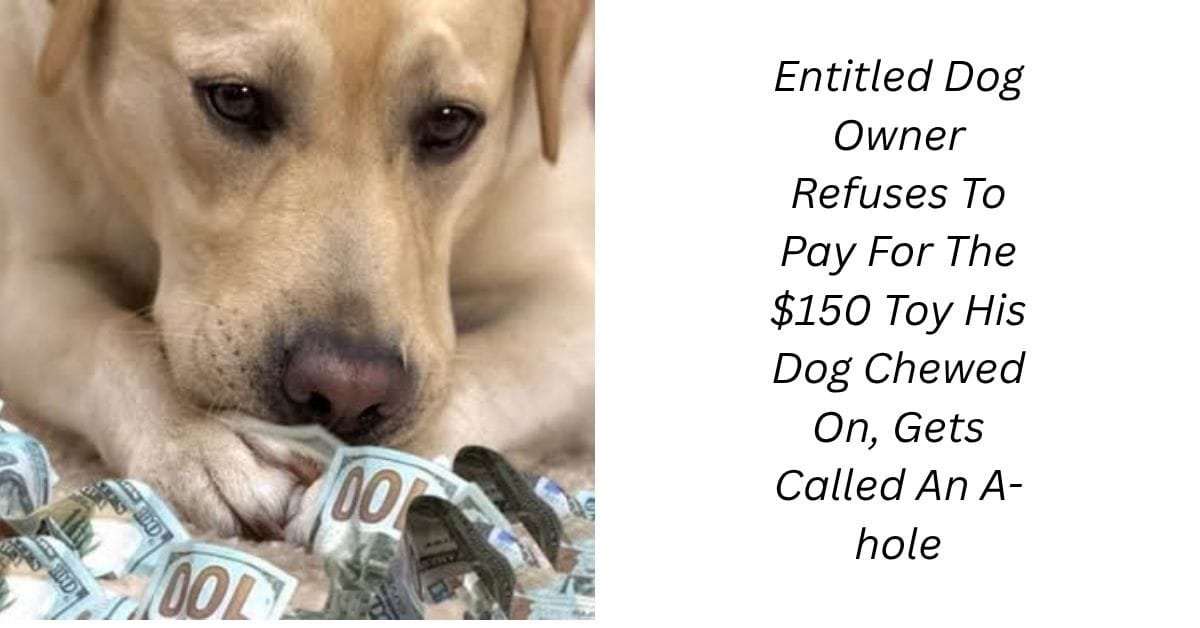
When this pet owner brought his dog into a local store, he probably expected the visit to be quick and uneventful. Like many dog owners, he was used to taking his pet along when running errands and did not think much of allowing the dog to look around while he browsed. The dog appeared curious and energetic, sniffing different items and exploring the store as they walked through the aisles. Nothing initially seemed unusual, and the owner apparently had no reason to believe the visit would turn into an argument. However, while the owner was distracted by other merchandise, his dog managed to get access to a toy displayed inside the store. Before anyone could stop it, the dog began chewing on the toy and caused noticeable damage. What might have been a simple accident quickly became a dispute when the store employee explained that the damaged item would need to be paid for.
The toy was not an ordinary inexpensive dog toy. According to the situation, it was priced at around $150, which immediately made the owner unhappy. He reportedly believed the price was excessive and questioned why he should be responsible for paying that much for something his dog had damaged accidentally. From his perspective, the dog had simply behaved like a dog. Pets were naturally curious, and chewing was hardly an unusual behavior for them. He apparently felt that the store should have displayed the merchandise in a way that prevented animals from reaching it. Rather than accepting responsibility immediately, he began arguing that the store had some responsibility for allowing the toy to be accessible to a dog in the first place.
The employee tried to explain that the toy had been perfectly fine before the dog got hold of it. It was a product being offered for sale, and customers were expected to pay for merchandise if they damaged it. The employee was not demanding payment for an item that had mysteriously disappeared or been defective. The dog had physically chewed the toy, leaving it damaged and unsuitable for another customer to purchase. The store therefore considered it a loss caused by the customer’s pet. From the employee’s perspective, the situation seemed straightforward: the owner brought the dog inside, the dog damaged merchandise, and the owner was responsible for what his pet did.
Instead of resolving the matter calmly, however, the owner reportedly became increasingly defensive. He argued that he should not have to pay $150 because he never intended for his dog to damage anything. He apparently emphasized that the incident had been accidental and suggested that the store was being unreasonable. But the employee pointed out that intent was not really the issue. Nobody was accusing the owner of deliberately sending his dog to destroy the toy. The problem was simply that the merchandise had been damaged while under his supervision. Accidents can still create financial responsibility, especially when another person’s property is involved.
The owner apparently refused to accept that distinction. He continued insisting that the store should absorb the cost because the toy was expensive and the dog had only been playing with it. He reportedly compared the situation to children accidentally breaking things in stores and suggested that accidents happen. But the employee maintained that the store could not sell a chewed-up toy for its original price. Even if the toy could technically be repaired or cleaned, customers would reasonably expect a new product when paying full retail price. The employee also explained that the store had no way of knowing whether the toy had been damaged internally by the dog’s chewing.
At this point, other people nearby began noticing the disagreement. What had started as a private conversation between the owner and employee had become increasingly public. Some customers reportedly watched as the owner argued over the price, while the employee tried to remain professional. The situation was uncomfortable because the amount of money was significant, but the principle seemed even more important. The owner was not being asked to pay for something his dog had merely touched. He was being asked to compensate the store because his dog had damaged an item that belonged to the business.
The owner reportedly argued that $150 was far too much for a dog toy and that the store was taking advantage of him. He questioned whether the toy was actually worth that amount and suggested that the business should simply accept the loss. The employee, however, explained that the price was the store’s listed retail price. Whether the customer personally thought the product was worth $150 did not change the fact that it was being sold at that price. If the owner believed the price was unreasonable, he could have chosen not to buy the toy. Once his dog damaged it, though, the situation was no longer about whether he wanted to purchase it.
Eventually, the employee asked the owner to take responsibility for his dog. That statement apparently made the owner even more upset. He insisted that he was a responsible pet owner and accused the employee of treating him unfairly. He believed that because the dog had not intentionally destroyed the toy, the situation should simply be dismissed. But from the store’s perspective, responsibility did not depend on whether the dog understood what it was doing. Dogs cannot be expected to understand retail property rules. Their owners are responsible for supervising them and dealing with the consequences when their pets cause damage.
The argument also raised a broader issue about bringing pets into public businesses. Many stores welcome dogs, but that does not mean pets are free to interact with merchandise however they want. A dog may sniff something, knock something over, or chew something without understanding that it belongs to the store. That is precisely why owners are expected to keep their pets under control. Being allowed inside a business is a privilege that comes with basic responsibilities. The store was apparently not asking the owner to stop bringing his dog into public places altogether. It simply expected him to take responsibility for what happened during the visit.
Some observers reportedly felt that the owner was making the situation worse by focusing entirely on the price. Even if he believed $150 was unreasonable, he could have handled the matter differently. He could have asked whether the store offered any discount on damaged merchandise, requested to speak with a manager, or calmly discussed possible solutions. Instead, refusing to pay anything made him appear as though he believed the store should simply absorb the entire loss. That attitude was what frustrated people the most. The disagreement was no longer just about a toy. It was about whether someone should be accountable when their pet damages another person’s property.
Eventually, the situation reached the store manager. The manager listened to both sides and inspected the damaged toy. There was apparently little doubt about what had happened. The toy had been in saleable condition before the dog got hold of it, and now it was visibly damaged. The manager explained that the business could not reasonably sell the item to another customer in that condition. The owner was once again asked to pay for it. The manager also reportedly made it clear that the store was not trying to embarrass or punish him. They simply wanted compensation for merchandise that had been damaged.
The owner still did not want to accept responsibility. He reportedly maintained that the store should have prevented the dog from reaching the toy. That argument did not convince the manager. The dog was under the owner’s control, not the store’s. The owner had brought the animal into the business, and the staff could not reasonably monitor every interaction between every customer and every pet. The manager explained that while the store could certainly improve its displays, that did not eliminate the owner’s responsibility for his dog’s behavior.
Eventually, after the discussion had gone on for some time, the owner was reportedly faced with the reality that refusing to pay would not make the damaged merchandise magically usable again. Whether he ultimately paid immediately or continued arguing, the situation had already made an impression on everyone involved. What might have been resolved in a few minutes had turned into a confrontation because he refused to acknowledge a relatively simple responsibility. The $150 price tag may have been frustrating, but the people around him seemed to believe that the principle mattered more than the money.
Online, the reaction to the story was even more direct. Many people called the dog owner an a-hole for refusing to compensate the store. Commenters pointed out that accidents happen all the time, but responsible adults are expected to deal with the consequences. They compared it to accidentally breaking a glass in someone’s home or damaging another person’s property. Nobody needs to intend the damage for the owner to recognize that something went wrong and make an effort to fix it. Several people also argued that the owner’s behavior could make businesses less willing to welcome dogs in the future.
Others focused on the fact that the owner was apparently more concerned about the $150 than about apologizing. They argued that if the situation had been handled with basic courtesy, it might never have become a major confrontation. A simple apology followed by an offer to pay could have ended the entire incident quickly. Even if the owner privately thought the toy was overpriced, that opinion did not change what happened. His dog damaged merchandise, and someone had to absorb the financial loss. The store did not cause the damage, so commenters felt the owner was being unreasonable by expecting employees to pay for it.
The incident ultimately became a lesson in pet ownership and personal responsibility. Owning a dog can be incredibly rewarding, but it also means accepting that animals sometimes behave unpredictably. Responsible ownership is not just about feeding a pet, taking it for walks, and giving it affection. It also means supervising the animal in public and taking responsibility when something goes wrong. The $150 toy may have been expensive, but the larger issue was the owner’s refusal to accept accountability. In the end, many people felt that the store had every right to expect payment for damaged merchandise, while the owner’s attempt to avoid responsibility only made him look entitled. What began as a dog chewing on a toy became a much bigger argument about respect, accountability, and understanding that accidents still have consequences.
Read Story…
AITA for refusing to pay for a $150 plush toy that my dog “destroyed”?
I was walking my golden retriever when we walked past one of my neighbors and their 6-year old, who was holding a stuffed dinosaur. My dog got excited and snatched the toy from her, which really spooked her and her parents.
He was jumping around and shaking the toy for about a minute before I retrieved it and tried handing it back to my neighbors, but they wouldn’t take it back “because it’s been in your dog’s mouth.” Weird, but their choice.
I told them to send me a link to wherever they got the toy from and I’ll buy their kid another one, which seemed to satisfy them. Anyway, I got back home and see the link they sent me and IT’S $150 from one of those custom stores.
I texted them that I’ll get the toy (which I kept with me) properly cleaned and give it back because I’m not paying that much for a toy just because they’re grossed out by one that was once in a dog’s mouth. The toy isn’t broken or torn or anything, it’s just dirty and wet and it won’t be once I wash it.
The neighbors are saying that’s inconsiderate of me and if I’m not going to replace it, I shouldn’t bother with giving back the “disgusting” toy because they’re not going to accept it and said I’m an irresponsible dog owner.
I’m stumped right now because I know it’s my fault my dog took the toy (even though he’s just 8 months old) but I have no idea why I should pay for a new one when the old one is perfectly salvageable.
Dog Owner’s Simple Shopping Trip Takes an Unexpected Turn When His Dog Targets a Store Toy
When this dog owner walked into a local store with his pet, he probably expected the visit to be completely ordinary. He was simply browsing while his dog accompanied him, and there was nothing about the beginning of the visit that suggested it would turn into a confrontation. The dog was curious, sniffing around and looking at the different products displayed throughout the store. The owner seemed comfortable having the animal with him and apparently did not think there was any reason to be particularly concerned. Like many pet owners, he likely assumed his dog would behave well enough while they were inside. Unfortunately, that assumption turned out to be wrong when the dog became interested in one particular item.
Advertisement
The item happened to be a dog toy that was displayed within the animal’s reach. Before the owner realized what was happening, his dog grabbed the toy and began chewing on it. At first, it may have looked like harmless curiosity. Dogs naturally investigate unfamiliar objects with their mouths, and chewing is hardly unusual behavior for them. However, this was not the owner’s personal toy that the dog was playing with. It was merchandise belonging to the store. By the time someone noticed what was happening, the toy had already been damaged badly enough that it could no longer reasonably be sold as new.
An employee approached the owner and explained what had happened. Rather than immediately apologizing and offering to pay for the damaged item, the owner reportedly asked how much the toy cost. When he heard the price was $150, his attitude changed almost immediately. He apparently could not believe that a dog toy could cost that much money and began questioning why he should be expected to pay the full amount. From his perspective, the price seemed unreasonable, especially because his dog had not intentionally destroyed the merchandise. He argued that it had simply been an accident.
The employee tried to explain that the store was not accusing him of deliberately damaging the toy. Nobody was claiming that he had walked into the business intending to cause a loss. The problem was that his dog had chewed merchandise that belonged to the store, and the item could no longer be sold to another customer. The employee believed the owner was responsible for making up the loss. This seemed like a straightforward matter to the staff, but the owner apparently did not see it that way.
He began arguing that the store should have placed the toy somewhere his dog could not reach it. According to him, if merchandise was displayed low enough for an animal to grab, then the business had some responsibility for what happened. He reportedly suggested that it was unfair to expect him to pay $150 simply because his dog had gotten curious. He may have believed that the store was partly responsible for creating the situation, but the employee disagreed. From the store’s perspective, customers were responsible for supervising themselves, their children, and their pets while inside the business.
The owner continued insisting that the toy was overpriced. He apparently questioned whether the store could really expect someone to pay $150 for a product that had been damaged accidentally. But the employee explained that the listed price was the price customers paid for the item when it was in sellable condition. The fact that the owner personally thought the product was too expensive did not change the retail value of the merchandise. If he had not wanted to pay $150 for a dog toy, he was free not to buy one. Once his dog destroyed the item, however, the situation was no longer a normal purchasing decision.
Other customers began noticing the argument as the conversation continued. What could have been a quick discussion between the employee and dog owner was becoming increasingly uncomfortable. People nearby could hear the owner complaining about the price and refusing to accept responsibility. The employee remained focused on explaining the store’s position, but the owner seemed determined to prove that he should not have to pay. Some customers reportedly believed the owner was making the situation much more complicated than it needed to be.
One of the biggest issues was that the owner seemed to believe that an accident meant nobody was responsible. But accidents happen every day, and they can still create consequences. If someone accidentally knocked over an expensive piece of merchandise, for example, the fact that the damage was unintentional would not necessarily mean the store had to absorb the loss. The same basic principle applied here. The dog did not understand that the toy belonged to the store, but the owner did. His responsibility was to supervise the animal and address the consequences when something went wrong.
The employee reportedly pointed out that the dog was under the owner’s supervision. The store could not realistically monitor every pet that entered the building. If animals were allowed inside, their owners had to make sure they behaved appropriately around merchandise and other customers. The employee was not asking the owner to accept blame for something completely beyond his control. The dog had been with him, and the owner had apparently been close enough to notice what was happening once the chewing began.
The owner still refused to accept the explanation. He argued that the store should simply throw the toy away and move on. To him, the business was large enough to absorb the loss. But the employee did not agree with that reasoning. A business cannot remain profitable if customers are allowed to damage merchandise and then simply walk away. Even if $150 might not seem significant to a large company, repeated incidents could add up quickly. More importantly, the store had a basic policy of expecting customers to pay for merchandise they damaged.
At this point, the dispute appeared to become less about the actual toy and more about the owner’s attitude. The employee was trying to explain a simple expectation, while the owner seemed offended that anyone would hold him financially responsible. Several people watching the interaction reportedly felt that he was acting entitled. They pointed out that he had brought the dog into the store and should have been watching it. Nobody was suggesting that he had intentionally caused the damage, but responsibility for an accident was still his.
Eventually, a manager became involved. The employee explained what had happened, and the manager inspected the damaged toy. There was little room for debate about whether the product had been damaged. The dog had clearly chewed it, and it was no longer in the condition required for a customer to purchase it as new. The manager calmly told the owner that the store expected him to pay for the item. Rather than escalating the argument further, the manager reportedly tried to explain why the policy existed.
The owner again focused on the price. He apparently insisted that $150 was excessive and suggested that the store should give him a discount because the damage had been accidental. While the manager may have been willing to discuss possible solutions, the owner seemed unwilling to acknowledge even basic responsibility. His argument remained that he should not have to pay anything at all. That position frustrated the staff because the store had lost a product through no fault of its own.
Some customers sympathized with the owner’s frustration over the expensive price tag. A $150 unexpected expense would certainly be unpleasant for many people. However, they still believed he was handling the situation incorrectly. Being unhappy about the price was understandable, but refusing to accept responsibility was another matter. He could have asked whether there was a less expensive way to resolve the issue or whether the store had any discretion regarding damaged merchandise. Instead, he reportedly acted as though the entire situation was the store’s fault.
The incident also raised questions about how pet owners should behave in businesses that allow animals. Bringing a dog into a store can be convenient, but it does not mean the animal has unlimited freedom. Dogs can knock over products, frighten other customers, interfere with employees, or damage merchandise. Responsible owners are expected to anticipate these possibilities and keep their pets under control. The fact that a store welcomes dogs does not mean it assumes financial responsibility for whatever those dogs do.
The owner apparently believed that because the dog was behaving naturally, he should not be blamed for the consequences. But that reasoning would create an impossible standard. Dogs do not understand property ownership or store rules. They may see an interesting toy and immediately decide to chew it. That is precisely why their owners must supervise them. If a dog has a strong habit of grabbing objects, the owner has an even greater responsibility to watch it closely in public places.
Online commenters were particularly critical after hearing about the incident. Many people immediately sided with the store and called the dog owner an a-hole. They argued that the situation was incredibly simple: his dog damaged someone else’s property, so he should pay for it. Several commenters noted that the dog could not be expected to understand what it was doing, but the owner could. The dog was not responsible for the decision to enter the store; the owner was.
Other commenters focused on the difference between being annoyed and being entitled. They said that nobody would blame the owner for being shocked by an unexpected $150 bill. Anyone would be frustrated if their pet suddenly caused an expensive problem. But being frustrated did not justify refusing to take responsibility. According to the commenters, a mature response would have been to apologize, pay for the damage, and learn from the experience.
Some people also pointed out that the owner’s behavior could have consequences beyond this single incident. Businesses that repeatedly deal with irresponsible pet owners may eventually decide that allowing animals inside is not worth the trouble. That could negatively affect responsible dog owners who follow the rules. If one person’s dog damages merchandise and the owner refuses to compensate the business, the store may become less welcoming to pets in the future. In that sense, the owner’s refusal to accept responsibility could make things more difficult for other customers as well.
The situation was also a reminder that expensive merchandise can be damaged in seconds. The owner may have believed that the toy was only a simple object, but the store had invested money into purchasing that inventory. Once the dog destroyed it, the business lost the ability to sell it for the expected price. Whether the owner personally considered the toy worth $150 was irrelevant. The business had assigned a value to the product, and the damage created a real financial loss.
There was also a lesson about how easily a small accident can become a major conflict when people refuse to communicate calmly. Had the owner immediately apologized and offered to pay, the incident probably would have ended within minutes. Even if he was surprised by the price, he could have expressed his concern respectfully. Instead, the refusal to accept any responsibility caused the situation to escalate and attracted the attention of other customers. What began as a dog chewing on a toy turned into an embarrassing confrontation.
Ultimately, the owner had every right to dislike the price of the toy. He could have decided that $150 was far too expensive and never purchased one himself. What he could not reasonably decide was that the store should absorb the cost after his dog destroyed its merchandise. The distinction between not wanting to buy something and being responsible for damaging something was at the center of the dispute. Once the toy was damaged, the owner’s personal opinion about its value no longer solved the problem.
The story also demonstrated why personal responsibility matters, especially when animals are involved. Pets depend on their owners to make decisions for them. A dog cannot understand why it should not chew a toy sitting within reach. It does not know that the object has a price tag or belongs to a business. The owner does know those things. That means the responsibility ultimately falls on the person who chose to bring the animal into the store.
In the end, the $150 toy became much more than a damaged piece of merchandise. It became a test of the owner’s willingness to accept accountability. He could have turned an unfortunate accident into a simple lesson and walked away with nothing more than an unpleasant memory. Instead, his refusal to pay transformed the situation into a public dispute and left many observers convinced that his attitude was the real problem. The money was significant, but the principle was even more important.
The final takeaway was simple: accidents happen, but responsible people deal with them. Nobody expected the dog to understand the difference between a personal toy and store merchandise. The expectation was placed on the owner, who was supposed to supervise his pet and make things right when something went wrong. Whether the toy was worth $150 or $15, the basic responsibility remained the same. In the eyes of most commenters, the dog was simply being a dog. The owner, however, had a choice—and refusing to take responsibility was what ultimately earned him the a-hole label.




One thought on “Entitled Dog Owner Refuses To Pay For The $150 Toy His Dog Chewed On, Gets Called An A-hole”
Comments are closed.