I Broke My Son Malcolm’s $1,850 Trumpet in 2008—He Had Chosen Band Over Football.
In the autumn of 2008, I believed I was doing what was best for my fifteen-year-old son, Malcolm. He was a strong, athletic teenager, and I had spent years encouraging him to take football seriously. I wanted him to become the kind of young man who was disciplined, competitive, and never walked away from a commitment. So when I discovered that Malcolm had skipped football practice to attend jazz band tryouts, I felt betrayed. What I didn’t understand was that football was my dream for him—not his.
I had bought Malcolm a silver-plated Yamaha trumpet for $1,850 the year before. At the time, I thought it was an expensive gift for a hobby that would eventually disappear. But Malcolm had become serious about music. That afternoon, when I entered his bedroom, I found him practicing after successfully earning first chair in the jazz band. He calmly told me that he no longer wanted to play football because he hated hurting people and wanted to make music instead. His words made me furious, and instead of listening to him, I demanded that he return to the football team.
Malcolm looked at me and said, “They aren’t my team.” Something inside me snapped. I saw his decision as disrespect, weakness, and rejection of everything I had tried to teach him. In anger, I grabbed the trumpet and destroyed it. The sound of the instrument breaking was loud, but the silence that followed was worse. Malcolm stared at me without arguing. I expected him to yell, cry, or fight back, but he simply looked at the broken pieces on the floor. That quiet reaction stayed with me far longer than any argument could have.
For years afterward, I told myself that Malcolm would eventually understand why I had done it. But eighteen years passed, and I began to realize that I had not been protecting my son—I had been trying to control him. The trumpet had not been just an expensive object. It represented something Malcolm loved, something that made him feel like himself. By breaking it, I had shown him that my approval mattered more to me than his happiness.
Then, one Tuesday morning, a heavy olive-green trunk arrived at my house. Rusted brass clasps held it shut, and the name “Malcolm Hayes” was stenciled across the side. I stood there staring at it, wondering why my son had sent something from his past after all these years. When I opened the trunk, I discovered something that forced me to confront the truth about what happened in 2008—and what my decision had cost both of us.
Read Story…
I Broke My Son’s Trumpet—18 Years Later, His Trunk Came Back
The Breaking
The trunk arrived on a Tuesday, delivered by a bored-looking freight driver who left it on my front porch without waiting for a signature. It was heavy, olive-green canvas over a wood frame, bound with rusted brass clasps. Stenciled in fading white paint on the side, slightly chipped from years of neglect, was a name I hadn’t spoken aloud in a decade: Malcolm Hayes.
I dragged it inside, the metal corners gouging parallel tracks into the hardwood floor of the hallway. I didn’t care. The house had been empty for a long time, and a few more scratches wouldn’t change the hollow echo that lived in these rooms.
I broke my son Malcolm’s trumpet in the autumn of 2008. It is a sentence that has played on a loop in my mind for eighteen years, a confession I make to the empty kitchen, to the shaving mirror, to the ceiling at three in the morning. He was fifteen years old, a broad-shouldered kid who carried my genetics but his mother’s quiet, introverted soul. I had spent his entire childhood trying to mold him into the man I thought he needed to be—tough, competitive, rooted in the dirt and sweat of the gridiron. I was a former linebacker whose own college career had been cut short by a blown knee, and I saw my second chance wrapped up in Malcolm’s undeniable athletic frame.
It was a Tuesday then, too. Late October. The air was turning brittle and cold. I had left work early to catch the end of his varsity football practice. I stood by the chain-link fence for forty-five minutes, scanning the defensive line, but number 44 wasn’t there. When I asked the head coach where my son was, the man just spat sunflower seeds into the grass and said, “Skipped. Said he had somewhere more important to be.”
I drove home with my hands gripping the steering wheel so tight my knuckles turned a bruised shade of purple. When I walked through the front door, I didn’t hear the television. I heard a sound that made my jaw clench. It was a golden, soaring note, floating down from his bedroom. Jazz.
I took the stairs two at a time and pushed his bedroom door open. Malcolm was standing by his window, his eyes closed, the silver-plated Yamaha trumpet pressed to his lips. I had paid $1,850 for that instrument the year before. I had convinced myself it was a generous gift, a father indulging a passing hobby. I hadn’t realized it was a lifeline.
“Where were you?” I demanded, my voice shattering the melody.
Malcolm lowered the horn. He didn’t look scared; he looked exhausted. “I had jazz band tryouts, Dad. I made first chair.”
“You skipped practice. You abandoned your team.”
“I’m not going back to football,” he said, his voice terrifyingly calm. “I don’t want to hit people. I want to play.”
The anger that rose in me wasn’t just disappointment; it was a profound, blinding terror that I was losing control of the narrative I had written for my family. “No son of mine quits on his team,” I barked, stepping into the room.
“They aren’t my team,” Malcolm replied, taking a step back, instinctively pulling the trumpet closer to his chest. “This is what I do. This is who I am.”
“With a piece of metal I bought you?” The words tasted like ash even as I said them, but pride is a poison that makes you double down on your worst mistakes. “I paid for that thing. I own it. And if it’s making you a quitter, then it’s gone.”
I reached for it. He tried to turn away, but I was bigger, stronger, and running on blind rage. I grabbed the bell of the trumpet. He held onto the valve casing. For three agonizing seconds, we fought over it like a tug-of-war. Then, with a violent, upward twist, I ripped it from his hands.
I didn’t just take it away. I slammed the silver horn down against the heavy oak corner of his writing desk.
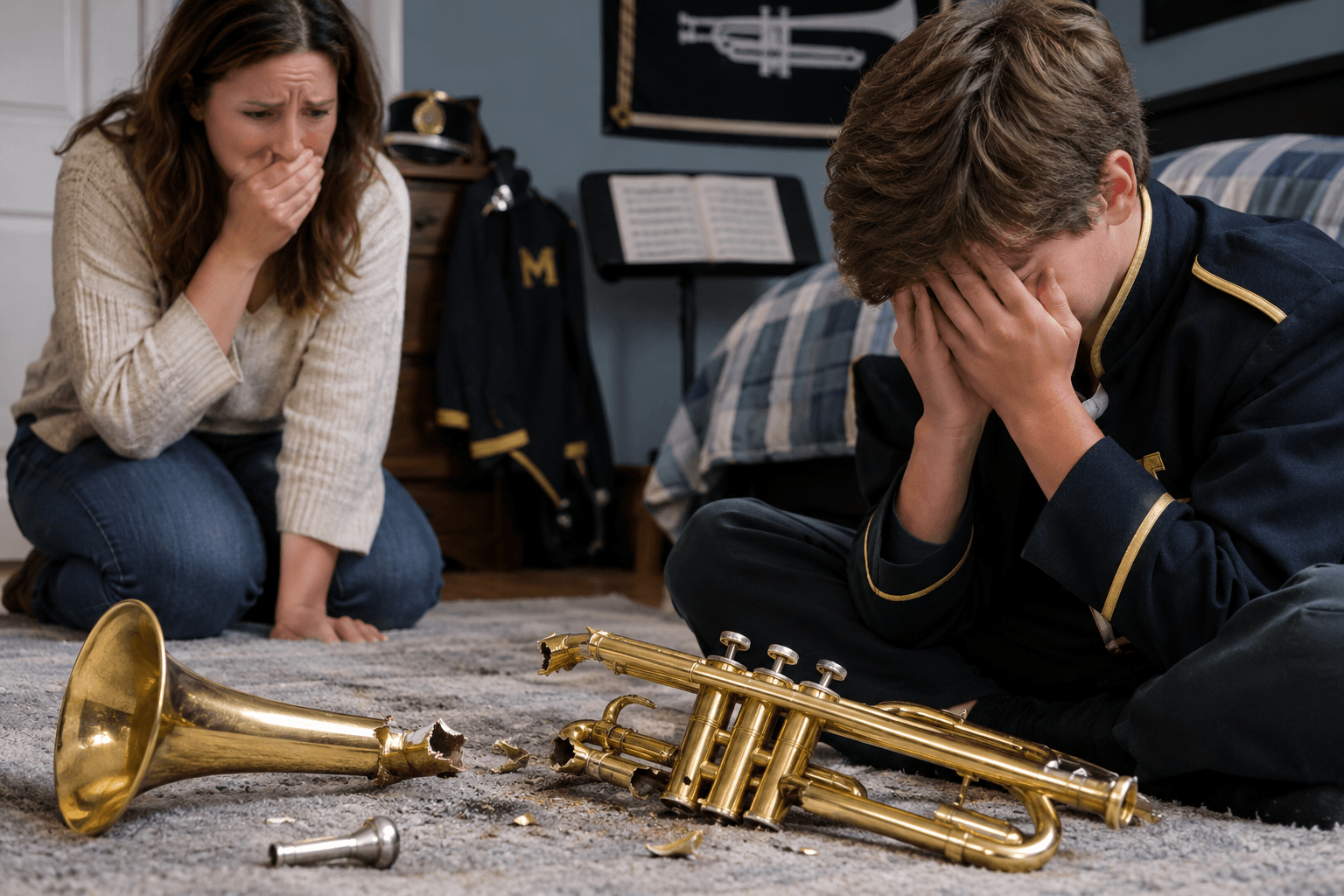
The sound it made wasn’t a musical note. It was a sickening, metallic crunch. The bell caved in, folding over on itself like crushed tin. The leadpipe snapped, and one of the pearl-topped valves popped loose, skittering across the hardwood floor and coming to rest at the tip of Malcolm’s sneaker.
Silence rushed into the room, heavy and suffocating. I stood there, chest heaving, the ruined, mangled brass dangling from my fist. I waited for him to scream, to cry, to throw a punch.
He did nothing. Malcolm just looked down at the broken piece of pearl on the floor, and then he looked at me. Something fundamental shifted behind his eyes. A door closed, locked, and bricked over in the span of a single heartbeat.
“Okay,” was all he said.
He didn’t touch the horn again. He didn’t argue. He finished out his high school years like a ghost haunting the hallways of our home. He did his chores, ate his dinners, and answered my questions with single syllables. The day after his high school graduation, I woke up to find his room entirely empty. He had packed his bags in the middle of the night. He left no note, no forwarding address, and he never came back.
The Unsent Card
Now, eighteen years later, I sat on the cold concrete floor of my basement, staring at the canvas trunk.
The letter taped to the lid had been typed on the letterhead of a summer camp in upstate New York. Camp Oakhaven for the Arts, it read. The camp director wrote that they were renovating an old storage shed and found this trunk tucked away in the back. Malcolm had been a music counselor there in the summer of 2015. When the season ended, he told them he’d be back to collect it, but he never returned their calls. They had tracked me down through an old emergency contact form.
My hands shook as I undid the rusted brass clasps. The hinges screamed in protest as I pushed the heavy lid back.
The air that rose from the trunk smelled of cedar, old fabric, and the faint, metallic scent of valve oil. It was a time capsule of a man I didn’t know.
Carefully, I reached in. The first thing I pulled out was a black suit, folded neatly in a dry-cleaning bag. It was a cheap polyester blend, the kind you buy off the rack at a discount store, but the elbows were worn slick, and the knees were faded. I pressed the fabric to my face. It smelled faintly of stale coffee and rosin. It was a gig suit. He had kept playing. Somehow, somewhere, he had found another horn and kept playing. A jagged sob tore its way out of my throat, a mixture of profound relief and agonizing guilt.
Beneath the suit were stacks of sheet music, heavily annotated in pencil. Complex jazz arrangements, original compositions with titles I didn’t recognize. Midnight in Autumn, The Empty House, Flight.
Then, tucked in the corner, wrapped in a faded microfiber polishing cloth, I felt something hard. I unwrapped it slowly.
It was a mouthpiece. Silver, heavy in the palm of my hand. But the shank—the part that inserts into the trumpet—was deeply cracked and slightly bent. I recognized it instantly. It was the mouthpiece from the Yamaha. When I smashed the horn against the desk, the impact must have fractured the shank. He had dug it out of the wreckage before he left. He had carried it with him.
Why? As a reminder of what he lost? As a scar he could touch?
I set the mouthpiece down on the cold concrete. At the very bottom of the trunk lay a single, crisp white envelope. My name, Dad, was written on the front in Malcolm’s sharp, left-handed scrawl.
I stared at it for a long time. The basement felt suddenly freezing. I didn’t want to open it. I wanted to leave it sealed, to pretend it held some generic, store-bought greeting. But I owed him the courage I had lacked eighteen years ago.
I slid my thumb under the flap and broke the seal.
It was a Father’s Day card, dated June 2015. The printed text inside read, To a father who gave me everything I needed to face the world. The irony of the printed words was like a physical blow. But beneath that, Malcolm had written in black ink. The handwriting was rushed, the pen pressed so hard into the paper it had nearly torn through the cheap cardstock.
I read the words. I read them again, the letters blurring as the tears finally spilled over, hot and shameful, running down into the gray stubble of my beard.
Dad,
You always thought you took my trumpet that day.
What you really took was my voice.
I lowered the card. The silence of the basement pressed in on me, absolute and crushing.
I understood now. I had thought I was breaking a piece of brass, a toy, a distraction. I had thought I was teaching a lesson about commitment. But to a fifteen-year-old boy who didn’t know how to navigate the overwhelming weight of the world, that horn wasn’t an instrument. It was his translator. It was the only way he knew how to speak his joy, his pain, his frustration, and his love.
When I broke it, I didn’t just stop him from playing music. I silenced him. I cut out his tongue and told him to go out and face the world. No wonder he had lived like a ghost in my house. No wonder he had fled the moment he could. I hadn’t made him a man; I had made him an exile.
I sat on the basement steps, the black gig suit in my lap, the cracked mouthpiece resting in my palm like a piece of shrapnel. I sat there as the afternoon sun faded from the small egress window. I sat there as the automatic timer clicked, shutting off the overhead bulb and plunging the basement into total darkness.
I sat in the dark, surrounded by the silence I had built with my own two hands, listening for a golden note that was never, ever coming back.
THE END
I Saw My Son as My Second Chance
In the autumn of 2008, I believed I knew exactly what kind of future my fifteen-year-old son Malcolm needed. He was tall, broad-shouldered, athletic, and naturally strong, so I pushed him toward football with everything I had. I had once been a linebacker myself, and although an injury had ended my college career, I still carried the feeling that I had been robbed of the future I deserved. Somewhere along the way, I began seeing Malcolm as my second chance. I wanted him to become the athlete I had once dreamed of becoming, even if that meant ignoring the fact that he had dreams of his own.
Malcolm had always been quieter than me. While I loved competition, crowds, and the excitement of football, he preferred sitting alone in his room with headphones on, listening to music. The year before everything fell apart, I had bought him a silver-plated Yamaha trumpet for $1,850. At the time, I considered it an expensive gift for a teenage hobby. I expected him to lose interest eventually and return his attention to football. What I didn’t understand was that the trumpet wasn’t a temporary distraction for Malcolm. Music was becoming the one place where he felt completely comfortable being himself.
One cold Tuesday afternoon in late October, I left work early because I wanted to watch the end of Malcolm’s varsity football practice. I stood beside the chain-link fence for nearly forty-five minutes, searching the defensive line for number 44. But Malcolm wasn’t there. When I finally asked the coach where my son had gone, the answer made my stomach tighten. He had skipped practice and told the coach he had somewhere more important to be. I drove home gripping the steering wheel so tightly that my knuckles turned pale. By the time I reached our driveway, I had already convinced myself that Malcolm had deliberately disrespected me.
The moment I entered the house, however, I heard something completely unexpected. Instead of the television or the sound of football highlights, I heard music floating down from upstairs. It was a warm, golden jazz melody coming from Malcolm’s bedroom. I climbed the stairs quickly and pushed open his door. Malcolm stood near the window with his eyes closed, playing the trumpet I had bought him. He looked peaceful, almost happy. When he saw me, he lowered the instrument and waited. I demanded to know where he had been. He simply told me that he had attended jazz band tryouts and had earned first chair.
I could barely believe what I was hearing. I told him that he had abandoned his football team, but Malcolm didn’t become defensive. Instead, he quietly said that he wasn’t going back to football. He didn’t want to hurt people, he said. He wanted to play music. Those words frightened me more than I admitted at the time because they meant Malcolm was making a decision about his own life without asking for my permission. I had spent years imagining his future for him, and suddenly he was telling me that future belonged to him. Instead of listening, I became angry.
I told him that no son of mine quit on his team. Malcolm looked at me and said something I still remember word for word: “They aren’t my team.” He held the trumpet closer to his chest and explained that music wasn’t something he was doing to annoy me. It was something he loved. He said, “This is what I do. This is who I am.” Instead of recognizing the courage it took for my son to say those words, I heard them as a challenge to my authority. My pride took control of the conversation, and I made the mistake that would define our relationship for the next eighteen years.
I pointed at the trumpet and reminded him that I had paid $1,850 for it. I told him that if the instrument was turning him into a quitter, then I had every right to take it away. Malcolm immediately understood what I intended to do. He tried to move away, holding the trumpet against his chest. I reached for it. He resisted. For several seconds, we struggled over the instrument, neither of us willing to let go. I was bigger and stronger, and I was operating on anger rather than reason. Finally, I ripped the trumpet from his hands.
I could have simply put it away. I could have walked out of the room. I could have given myself five minutes to cool down. Instead, I slammed the silver trumpet against the heavy oak corner of Malcolm’s writing desk. The sound was horrible. The bell folded inward, the leadpipe snapped, and one of the pearl-topped valves flew across the floor. It landed beside Malcolm’s sneaker. The room suddenly became completely silent. I stood there holding the mangled instrument, breathing heavily, waiting for Malcolm to react.
He didn’t scream. He didn’t cry. He didn’t accuse me of anything. He simply looked down at the broken piece on the floor and then raised his eyes toward me. Something changed in his expression. It was not the anger of a teenager arguing with his father. It was something much deeper. It looked like a decision. A door seemed to close behind his eyes, and I knew even then that something between us had been permanently damaged. After a long silence, Malcolm quietly said, “Okay.”
That single word was more painful than an argument would have been. Malcolm never touched the broken trumpet again. He continued living in our house, but he seemed to disappear emotionally. He went to school, did his chores, ate dinner at the table, and answered my questions when necessary. But his answers became shorter and shorter. The lively conversations we once had were gone. I told myself that he was simply going through a teenage phase. I refused to believe that my actions had caused the distance between us because admitting that would have meant admitting that I had been wrong.
Malcolm graduated from high school without giving me any indication of what he planned to do next. The morning after graduation, I woke up and discovered that his bedroom was empty. His clothes were gone. His books were gone. The photographs and small objects he had collected over the years were gone. He had packed during the night and left without saying goodbye. There was no note, no address, and no explanation. I searched for him, but every attempt led nowhere. For the first time, I realized that the boy I had tried so hard to control had finally chosen the only thing he could control—whether he remained in my life.
Eighteen years passed. I eventually learned how to live with the silence, though I never truly became comfortable with it. The house felt larger after Malcolm left. His old bedroom remained mostly untouched, and sometimes I would stand outside the door remembering the sound of his trumpet. I wondered whether he had continued playing or whether I had destroyed his love for music along with the instrument. I never knew the answer. Every year that passed made the question heavier.
Then one Tuesday morning, a freight driver left a large olive-green trunk on my front porch. He didn’t wait for a signature. The trunk was made of canvas stretched over a wooden frame, with rusted brass clasps and worn metal corners. On one side, beneath years of scratches and fading paint, was a name that made my chest tighten: Malcolm Hayes. I stood on the porch staring at it for several minutes before dragging it inside. The corners left marks across the hardwood floor, but I didn’t care. I was too stunned to think about anything except my son.
A letter was attached to the top of the trunk. It came from Camp Oakhaven for the Arts, a summer camp in upstate New York. The director explained that they were renovating an old storage building when they discovered the trunk tucked behind several boxes. Malcolm had worked there as a music counselor during the summer of 2015. At the end of the season, he had promised to return for his belongings, but he never came back. The camp had eventually found my name listed as an old emergency contact and decided to send the trunk to me.
My hands trembled as I opened the clasps. The hinges made a long, painful squeal as the lid lifted. A faint smell of cedar, old clothing, paper, and valve oil rose from inside. It felt less like opening a storage trunk and more like opening a sealed room from my son’s life. I had spent eighteen years imagining what Malcolm’s life might have become. Now, for the first time, I had physical evidence of the person he had become without me.
The first thing I pulled out was a black suit inside an old dry-cleaning bag. It was inexpensive and visibly worn. The elbows were shiny from use, and the knees had faded. I pressed the fabric between my fingers and immediately understood what it was: a musician’s gig suit. Malcolm had continued playing. Somehow, somewhere, after I destroyed his trumpet, he had found another instrument and returned to music. A sob escaped me before I could stop it. I felt relief that he had followed his passion, but that relief was tangled with guilt because I realized I had spent eighteen years believing I might have taken that passion away from him.
Under the suit were stacks of sheet music. Some pages were covered in pencil markings, notes, corrections, and small reminders written in the margins. There were jazz arrangements, practice exercises, and original compositions. Several pieces had titles I had never heard before, including one called Midnight in Autumn. I ran my fingers carefully over the pages, imagining Malcolm sitting somewhere alone at a piano or trumpet stand, creating music I had never been there to hear. Every page revealed another part of his life that had existed completely outside my knowledge.
Then I found photographs. Malcolm appeared in some of them with groups of musicians. In one, he was standing on a small outdoor stage with a trumpet in his hands. In another, he was surrounded by children at the summer camp, all of them holding instruments and smiling. He looked older, thinner, and more confident than the teenager I remembered. Most importantly, he looked happy. I stared at those photographs for a long time because they showed me something I had never allowed myself to consider: Malcolm had not needed me to become the person I wanted him to be.
At the bottom of the trunk was a small envelope. My name was written across it in Malcolm’s handwriting. I nearly dropped it. For eighteen years, I had imagined countless conversations with my son, but none of them had ever included him actually speaking to me. Now I was holding something he had addressed to me personally. The envelope had never been mailed. It had remained inside the trunk, hidden among his music and belongings. I sat on the basement floor and stared at my own name until my eyes began to blur.
Inside was a card dated several years earlier. Malcolm had written about the trumpet, the night I broke it, and what he remembered afterward. He didn’t describe me as a monster. He didn’t write a list of everything I had done wrong. Instead, he explained how that moment had taught him something painful: that the people who loved him could still misunderstand him. He wrote that he had eventually learned to stop waiting for permission to become himself. Reading those words hurt because I realized that the lesson he learned had come at a cost he should never have had to pay.
The card also revealed that Malcolm had eventually built a career around music. He had performed with small jazz groups, taught students, arranged music, and worked with young musicians who were struggling to find confidence. The summer camp had been one of several places where he had taught teenagers to play. He wrote that he especially enjoyed helping children whose parents didn’t understand why music mattered so much to them. That sentence stopped me cold. I wondered how many times Malcolm had recognized his younger self in those children.
Near the bottom of the card, Malcolm wrote something that I read again and again. He said he didn’t know whether he would ever be ready to speak to me, but he wanted me to know that breaking the trumpet had not broken his love for music. In fact, it had forced him to discover how deeply he needed it. He had bought another trumpet with money from his first summer job and practiced until his lips hurt. He had played in school, at small clubs, at weddings, and eventually on professional stages. He had built the life he wanted one uncertain step at a time.
I closed my eyes and remembered the boy standing in his bedroom in 2008. I remembered the way he had held that trumpet against his chest. At the time, I thought he was protecting an expensive object. Now I understood that he had been protecting a part of himself. I had mistaken his independence for rebellion and his passion for weakness. I had believed that being a good father meant forcing my son toward the future I considered respectable. Instead, I had taught him that my love came with conditions.
The final item in the trunk was not another piece of sheet music or another photograph. It was a small brass trumpet mouthpiece wrapped carefully in cloth. It was old, scratched, and clearly used. Beneath it was a handwritten note with only one sentence: “Dad, I hope someday you understand that I never wanted to disappoint you. I just wanted you to hear me.” I read the sentence several times. Then I finally began to cry—not because Malcolm had blamed me, but because he hadn’t.
That night, I carried the trunk upstairs and placed it beside the dining-room table. I spent hours looking through everything inside it. For the first time in eighteen years, I allowed myself to remember Malcolm not as the teenager who had disobeyed me, but as the child who had once played music in the kitchen, the boy who had shown me his first trumpet song, and the young man who had tried to tell me what he wanted before I silenced him. I couldn’t change what happened in 2008. I couldn’t repair the trumpet. I couldn’t give Malcolm back the years we had lost.
But I could finally admit the truth. I had broken more than a $1,850 instrument that autumn. I had broken my son’s trust in me. I had broken the belief that his father would listen when he said, “This is who I am.” And while eighteen years had passed, the realization came with one small piece of hope. Malcolm had left me his trunk, his music, his photographs, and an unsent card. He could have thrown everything away. He hadn’t. I didn’t know whether that meant forgiveness was possible, but for the first time, I understood that the next step wasn’t to demand my son come home. It was to become the father who would finally be willing to hear him.