Man Stays With Parents to Help Around Farm While Father Is Recovering From Surgery; They Call Him a Freeloader
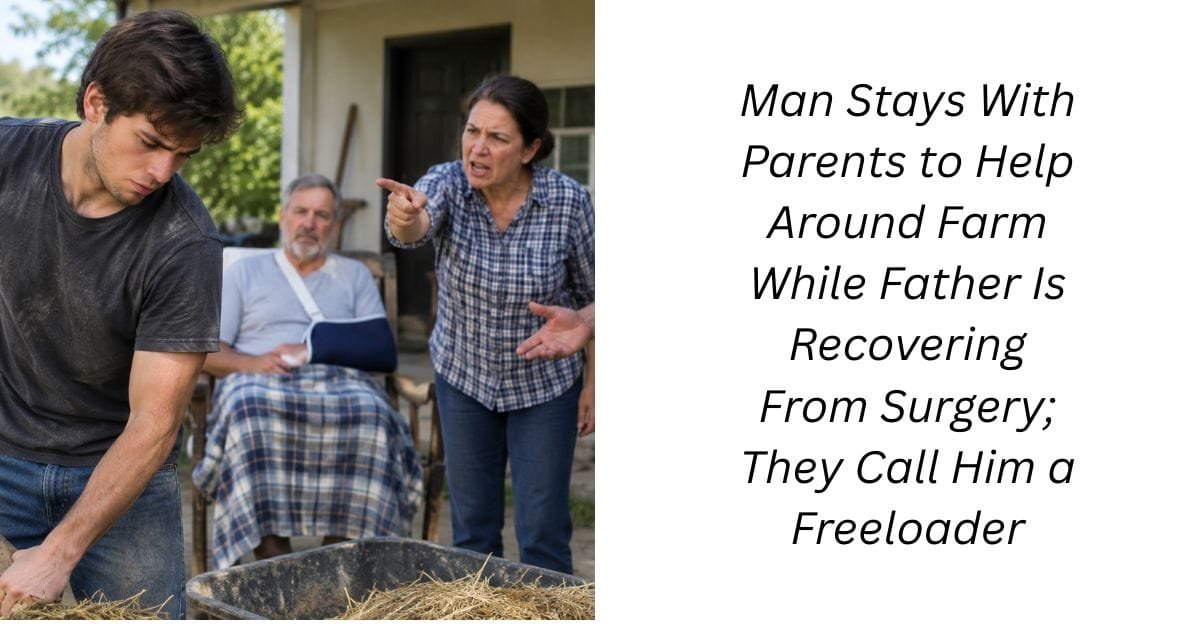
When my father had surgery, I didn’t think twice about putting my own routine on hold to help my parents around the farm. My parents have owned the property for decades, and farming has always been a huge part of their lives. My father normally handles most of the physically demanding work, from repairing equipment and checking fences to feeding animals, maintaining the fields, and dealing with problems that can’t simply wait until someone has free time. Unfortunately, after his surgery, he wasn’t allowed to do most of those things for a while. My mother could handle some of the work, but there were plenty of tasks that were either too heavy or too physically demanding for her to manage alone. I had a job in another town and my own apartment, but I decided to stay at my parents’ house temporarily so I could help keep everything running while Dad recovered. I wasn’t expecting praise or payment. They were my parents, and I saw it as something a family should do for one another during a difficult period.
For the first few weeks, everything seemed completely normal. I woke up early, helped with the morning chores, went to work when necessary, and spent my evenings helping around the property. Some days were exhausting because there was always something that needed attention. If a piece of equipment stopped working, I tried to fix it. If an animal needed attention, I helped. If my mother needed someone to make a supply run or move something heavy, I handled it. My father spent most of his time resting and following his doctor’s instructions. I was happy that he could focus on recovering instead of worrying about whether the farm was falling apart. My parents were grateful, at least initially. My mother frequently thanked me for staying, and my father told me several times that he didn’t know what they would have done without me. Because I was contributing every day, I never felt like I was simply living there for free. I was exchanging my time and labor for the food, room, and basic expenses that came with staying in my childhood home.
The situation changed when some relatives started commenting on my living arrangement. They knew I had temporarily moved back in with my parents, but apparently they didn’t know how much work I was actually doing. One relative made a joking comment during a family gathering about how nice it must be to “move back home and stop paying rent.” I laughed it off because I didn’t want to create an argument. Another person asked whether I planned to stay there indefinitely. I explained that I was only there while Dad recovered and that I was helping with the farm. They nodded, but I could tell they didn’t really understand how much work that involved. Eventually, those comments reached my parents in a different form. Suddenly, my mother started asking whether I was planning to contribute more financially while I was living there. I was confused because nobody had mentioned that before. I reminded her that I was working and spending most of my free time maintaining the property. I also pointed out that if I weren’t there, they would probably have to hire someone to handle many of the tasks I was doing.
Then my father, who was still recovering, unexpectedly called me a freeloader. I honestly thought I had misheard him. He said that while he appreciated some of the help, I was still living under his roof without paying rent and that grown adults shouldn’t expect to stay with their parents for free. I reminded him why I was there in the first place. I wasn’t living in his house because I wanted to avoid rent or because I had nowhere else to go. I had voluntarily given up the convenience of my own place so I could help him recover and keep the farm operating. He said that didn’t change the fact that I was benefiting from living there. That statement really hurt because I had never viewed my arrangement as a financial transaction. I had been thinking of it as helping my father when he was vulnerable. Hearing him reduce everything I was doing to free housing made me feel like none of my effort mattered.
I decided not to argue while my father was still recovering. Instead, I calmly asked my parents what they actually expected from me. If they wanted me to pay a specific amount toward household expenses, I was willing to discuss it. If they wanted me to contribute toward groceries or utilities, that was also something we could work out. What bothered me was being called a freeloader after I had spent weeks doing work that neither of them could easily handle. I explained that I could simply return to my apartment if they no longer wanted me there. The moment I said that, my mother became upset and said that wasn’t what they wanted. She told me they were grateful for my help but admitted that the situation had become stressful because everyone was tired and emotional. I understood that my father’s recovery was difficult, and I knew pain and frustration could affect someone’s mood. But I also felt that being stressed didn’t make it fair to dismiss everything I had sacrificed to help them.
The next day, I made a list of the things I had been doing since moving back. It wasn’t meant as a bill or an accusation. I simply wanted my parents to see the difference between “living here for free” and actually contributing. I listed the daily farm chores, maintenance work, transportation, errands, repairs, and other responsibilities I had taken over. I also pointed out that my father had specifically asked me to handle several of those things because he wasn’t physically able to do them after surgery. My mother looked through the list and became quiet. She admitted that she hadn’t realized how many tasks I was handling because I usually did them without mentioning them. My father initially seemed defensive, but eventually he acknowledged that the farm had continued functioning largely because I had taken over responsibilities he normally handled. He still believed I should contribute something toward household expenses, and I told him that was a reasonable conversation. What I couldn’t accept was being labeled a freeloader simply because the contribution wasn’t being made in cash.
We eventually agreed on a compromise. I would contribute a modest amount toward groceries and utilities while I stayed there, but my parents also acknowledged that my work on the farm had real value. I told them I was comfortable with the arrangement as long as everyone was clear about expectations. My father apologized for calling me a freeloader and admitted that he had been frustrated about losing his independence after surgery. He said he hated needing help and had probably taken some of that frustration out on me. I appreciated the apology, but I told him that his words had still hurt. I wasn’t expecting special treatment because I was his son. I simply wanted him to recognize that I had made a genuine sacrifice to help him. He understood that, and for the first time, we had an honest conversation about how difficult the situation had been for everyone.
What surprised me most was how quickly the atmosphere changed once expectations were clear. I no longer felt like I had to prove that I was contributing, and my parents no longer assumed that I was simply taking advantage of them. I continued helping around the farm, but I also started keeping better track of my own time and responsibilities. My father gradually became more independent as his recovery progressed, and he began taking on small tasks again. Eventually, he was able to return to many of the jobs he had previously handled. My mother also seemed less stressed because she knew there was a clear plan. Looking back, I realized that the real problem wasn’t necessarily money. It was a lack of communication. Everyone had different assumptions about what my stay meant, and nobody had bothered to sit down and discuss them until resentment had already built up.
I eventually returned to my own apartment once my father was healthy enough to manage the farm again. Before I left, my father thanked me sincerely and told me that he hadn’t realized how much I had given up to stay with them. He said he regretted calling me a freeloader and wished he had expressed his frustration differently. I told him that I forgave him, but I also learned an important lesson from the experience. Helping family doesn’t mean you should ignore your own boundaries or allow people to take your contribution for granted. At the same time, family members shouldn’t assume that someone staying in their home is automatically taking advantage of them. Sometimes people contribute through money, and sometimes they contribute through time, labor, transportation, care, or simply being there when someone needs them most.
In the end, I don’t regret staying with my parents during my father’s recovery. Despite everything that happened, I’m glad I was there when he needed help. But I also wish we had discussed expectations from the beginning instead of allowing assumptions to build. My father wasn’t wrong to care about household expenses, and I wasn’t wrong to feel hurt when my weeks of unpaid work were dismissed as freeloading. Both things could be true at the same time. The experience taught me that even families who love each other can misunderstand one another when they don’t communicate clearly. I went back home to help my father recover, not to avoid responsibility, and thankfully, by the time I left, he finally understood that.
Read Story…
AITA for telling my parents to choose between my money and my help?
I work out of town and usually spend my time off on vacation. I will literally work for two weeks then go to an all inclusive for two weeks.
At work I get all my nerds met. Food, maid service, laundry, etc. At all inclusive same deal plus alcohol and “companionship”.
About four months ago my dad had surgery and they asked if I could help out around the farm instead of buggering off on my time off.
So it’s been four months now and they are telling me that I have been freeloading long enough and that if I’m going to be loving at home they expect me to give them money.
LoL. I reminded them that I was only there because they needed help. So I said I wouldn’t be back next month I was going back to my usual schedule. And I told them they had to choose between me giving them money for this time around in which case I would stop helping out with all the chores.
My brother and sister who live close to them and have been helping the weeks I am away at work are calling me an asshole for being so mercenary towards our parents. I said I had no problem spending my time of in the Caribbean and they, and their families, were welcome to do all the chores and stuff while I was away.
I already booked Belize for my next turnaround and I gave my parents $1000 for “rent” for the week I was home this time and I left for Chicago until it is time to go back to work.
“He Moves Back Home To Help His Father Recover”
When my father had surgery, I never imagined that helping my parents would eventually turn into an argument about whether I was a freeloader. My parents have owned their farm for most of their adult lives, and the property has always been a huge part of our family. My father normally handles most of the physically demanding work, including repairing equipment, checking fences, taking care of animals, maintaining the fields, and dealing with all the unexpected problems that come with running a farm. My mother helps wherever she can, but there are certain jobs that simply require more physical strength. When Dad’s doctor told him he needed surgery and would have to limit his activity during recovery, I knew they were going to struggle. I lived in my own apartment several hours away, had my own job and responsibilities, and wasn’t exactly in a position where moving home was convenient. Still, I didn’t hesitate for long. I decided to stay with my parents temporarily so my father could concentrate on getting better instead of worrying about everything waiting for him outside.
Before I moved in, I told my parents that I would stay until Dad was physically able to handle most of his normal responsibilities again. Nobody discussed rent, groceries, utilities, or any formal arrangement. To me, that seemed unnecessary. I wasn’t moving home because I needed somewhere to live. I already had a place. I was coming back because my father needed help. My parents agreed, and my mother seemed genuinely relieved. My father tried to tell me that I didn’t need to put my life on hold, but I told him I wanted to help. He had spent my entire childhood taking care of me and working incredibly hard to provide for our family. If I could give him a few weeks or months of my time while he recovered, it didn’t feel like a sacrifice. It felt like something I should do.
The first few weeks were much busier than I expected. I knew farms required work, but I hadn’t realized how many small responsibilities were involved every single day. I started waking up early to help with the morning chores. I checked on the animals, moved supplies, helped with feeding, handled deliveries, and made sure the equipment was functioning properly. There were also endless little maintenance jobs that my father normally handled without thinking about them. A fence needed repairing. A gate stopped closing correctly. Something needed to be picked up from town. A machine needed basic maintenance. None of these tasks were individually dramatic, but together they consumed hours. I also continued working remotely when I could, so I wasn’t exactly sitting around enjoying a free vacation at my parents’ house.
My father was frustrated by his limitations. He was used to being active and independent, and suddenly he couldn’t do many of the things he had spent decades doing. I could tell that depending on me embarrassed him sometimes. Whenever I offered to help, he would initially say he could handle it himself, even when it was obvious that he couldn’t. I kept reminding him that recovering properly was more important than proving he could still do everything. Some days he listened, and other days he became irritated. I didn’t take it personally. I understood that losing your independence, even temporarily, can be incredibly difficult. My goal was simply to keep things running until he was ready to take over again.
My mother seemed grateful during those early weeks. She often thanked me for taking care of things that would otherwise have fallen on her. She would make meals, I would handle the heavier work, and my father would rest. There was a routine that developed naturally. Nobody talked about money because nobody seemed to think it was necessary. I bought some groceries occasionally, paid for some things myself, and spent most of my time working around the property. I didn’t keep track of every dollar I spent or every hour I worked because I wasn’t there as an employee. I was there as their son. I genuinely believed that helping your parents during a difficult period was something you did because you loved them, not because you expected compensation.
The first hint that something had changed came from a family gathering. One of my relatives asked how long I planned to stay with my parents. I explained that I would probably leave once my father was recovered enough to manage the farm again. The relative laughed and said, “Must be nice getting to live rent-free again.” I smiled awkwardly and said I was mostly there to help with the farm. I didn’t think much more about the comment. However, it apparently wasn’t the only person who had that impression. Over the next few weeks, I started hearing similar remarks from relatives. Some joked that I had moved back home because I didn’t want to pay for my own place. Others asked whether I was “taking advantage” of my parents.
I found the comments strange because nobody asking those questions had actually spent time on the farm with me. They didn’t see me waking up before sunrise. They didn’t see the physical work I was doing or the errands I handled. They simply knew that an adult son had moved back into his parents’ house. From the outside, I suppose it could look like I was enjoying free housing. What they didn’t know was that I had continued paying for my apartment even though I wasn’t living there full-time. I hadn’t canceled my lease because I knew my stay with my parents was temporary. In other words, I was actually paying for two households in some ways while spending most of my time helping my parents.
I tried not to let the comments bother me. I figured my parents knew why I was there, and their opinion was the only one that mattered. But then my mother started asking questions about money. One evening, she asked whether I planned to contribute more toward groceries. I said I was happy to contribute and asked what she had in mind. She mentioned that food costs had increased and that having another adult in the house naturally meant additional expenses. I told her that was reasonable. I had never expected my parents to pay for everything. I offered to cover a larger share of groceries and utilities while I was staying there. She seemed relieved, and I thought the issue was settled.
A few days later, however, the conversation became much more uncomfortable. My father was sitting in the living room recovering when he suddenly said that I needed to start paying rent. I asked what had changed. He said that I was an adult and that adults who live in someone else’s house should contribute financially. I reminded him that I already had my own apartment and wasn’t living there because I needed free housing. I was there because he had surgery and couldn’t manage the farm. He said he appreciated the help, but that didn’t mean I could stay in his house indefinitely without paying anything. I told him I had never planned to stay indefinitely. I had made that clear from the beginning.
Then he used a word that I wasn’t prepared to hear from him. He called me a freeloader.
I honestly didn’t know how to respond. I stared at him for a moment because I thought perhaps he was joking or that I had misunderstood what he meant. But he wasn’t joking. He said that regardless of why I had moved in, I was still living under his roof without paying rent. He said he didn’t want me becoming comfortable there and forgetting that I had my own responsibilities. I reminded him that I had spent weeks doing farm work that he normally did himself. I told him that I had changed my routine, continued paying for my own apartment, and taken on responsibilities because he was recovering from surgery. His response was that I was still benefiting from living at home.
That statement hurt more than I expected. I could have understood a conversation about expenses. I could have understood my parents saying they needed help with groceries or utilities. What I couldn’t understand was being reduced to someone taking advantage of them. I had never asked them to let me stay for free. They had never told me they expected rent. I had made decisions based on the understanding that I was helping my father. Suddenly, it felt like the entire arrangement had been rewritten after the fact. Instead of being their son helping during a crisis, I was being treated like a tenant who had failed to pay.
I told my father that if he genuinely believed I was taking advantage of him, I could leave. I could return to my apartment immediately. He seemed surprised by that response. He said he wasn’t asking me to leave. I told him that was exactly what confused me. If my presence was a burden and my help wasn’t enough to justify staying, then I didn’t understand why I should remain. I didn’t want to live somewhere I was constantly being reminded that I wasn’t contributing enough. My mother immediately tried to calm both of us down. She said that nobody wanted me to leave and that my father was frustrated because he hated being dependent on other people.
I understood that explanation, but I didn’t think it excused what he had said. I told my father that I knew his recovery was difficult and that I understood he was frustrated about losing his independence. But I wasn’t responsible for his inability to work normally. I had chosen to help because I loved him. Being called a freeloader made me regret that decision for the first time. I wasn’t expecting praise every morning or a medal for doing chores. I simply expected my parents to recognize why I was there.
The following morning, I decided to make a list of everything I had been doing since moving back. I wasn’t trying to calculate a dollar amount for my labor or send my parents an invoice. I simply wanted them to understand how much work was actually being done. I wrote down the daily farm chores, repairs, supply runs, transportation, maintenance, animal care, and other responsibilities. I also included the hours I spent working remotely while still helping around the farm. Then I added the fact that I was still paying rent for my apartment in another town. When I showed the list to my mother, she became quiet.
She admitted that she hadn’t realized just how much I had taken over. From her perspective, she saw me moving around the farm every day, but she hadn’t thought about how many individual responsibilities that represented. My father looked through the list later. At first, he didn’t say anything. Then he admitted that several of the things I had listed were jobs he normally handled himself. He said he hadn’t realized how much I had been doing because I never complained about it. I told him that I hadn’t complained because I wasn’t keeping score. I was there to help him recover, not to constantly remind him of everything I was doing.
That conversation changed the tone completely. My father still believed I should contribute financially while staying in the house, and I told him I was willing to do that. I offered to pay a reasonable amount toward groceries, utilities, and other household expenses. What I asked in return was that they stop describing me as someone who was simply living there for free. I told them that financial contribution was only one form of contribution. I was also contributing time, physical labor, and flexibility. My mother agreed. My father eventually nodded and admitted that he had been unfair.
He apologized for calling me a freeloader. He explained that after surgery, he felt useless and dependent, and watching me do work that he normally handled made him feel like he had lost control of his own life. He said that when he called me a freeloader, he wasn’t actually thinking about the farm work. He was angry at himself and frustrated with the situation. I appreciated his honesty, but I told him that his frustration had still hurt me. I could understand why he felt helpless without accepting being insulted for trying to help.
We eventually agreed on a clear arrangement. I would contribute toward household expenses while I stayed there, but there would be no traditional rent because my primary reason for being there was to help with the farm and his recovery. We also agreed that if circumstances changed and I stayed longer than originally planned, we would revisit the arrangement rather than allowing resentment to build. It was a simple solution, and honestly, I wished we had discussed it from the beginning. Most of the conflict had come from assumptions. My parents assumed I understood what they expected, while I assumed they understood why I had moved in.
After that conversation, things improved considerably. I continued helping around the farm, but I became more conscious about communicating what I was doing. If something needed to be handled, I told my parents rather than silently taking care of it. I also started contributing more toward groceries. My father gradually began taking on small tasks again as his recovery progressed. At first, he only supervised. Then he started doing lighter jobs himself. Eventually, he was able to return to some of the physically demanding work he had missed.
One thing that surprised me was how much my father’s attitude changed once he regained some independence. He started thanking me more often. Sometimes he would tell me that he hadn’t realized how much work the farm required until he couldn’t do it himself. He also admitted that having someone else take over those responsibilities had given him peace of mind during recovery. That meant a lot to me because that was exactly why I had stayed. I wanted him to be able to recover without worrying that everything he had built over decades was falling apart.
My mother also apologized for not stepping in sooner when the conversation about money first became uncomfortable. She said she had been caught between wanting to support my father and appreciating everything I was doing. I told her I didn’t blame her. I knew the situation was stressful for everyone. But I also told her that if there were concerns about money, I would rather someone simply tell me directly. I couldn’t solve a problem I didn’t know existed. She agreed that clearer communication would have prevented most of the conflict.
The incident also made me think about how quickly people judge situations from the outside. Someone seeing an adult child living with his parents might automatically assume that person is lazy or financially dependent. But circumstances matter. There is a huge difference between moving back home because you refuse to support yourself and temporarily moving home because a parent needs help recovering from surgery. Even then, every family can have different expectations about money and responsibilities. The important thing is that everyone discusses those expectations instead of silently assuming the other person understands them.
I also realized that helping family doesn’t mean you should ignore your own financial reality. I had been so focused on helping my father that I hadn’t really considered the cost of maintaining my own apartment while living elsewhere. I was happy to do it, but I should have discussed the arrangement more clearly. If I had known my parents expected rent from the beginning, I could have factored that into my decision. The problem wasn’t necessarily that they wanted financial help. The problem was that nobody communicated those expectations until resentment had already built up.
As my father’s recovery continued, my role slowly became less necessary. He started handling more farm responsibilities himself, and I returned to my normal work schedule. Eventually, I knew it was time to go back to my apartment. My parents didn’t ask me to leave. In fact, my mother said she would miss having me around. My father joked that he was finally going to have to start doing his own chores again. We laughed about it, and the tension that had existed weeks earlier seemed almost distant.
Before I left, my father sat down with me and apologized again. He told me that calling me a freeloader had been one of the worst things he could have said after everything I had done. He said he understood now that I hadn’t moved home to benefit from him. I had moved home because I wanted to make his recovery easier. I told him that I forgave him. I also told him that I was glad we had eventually talked honestly because I didn’t want resentment between us. Family relationships can survive difficult conversations when everyone is willing to admit where they were wrong.
When I returned to my own apartment, I felt relieved but also strangely emotional. I had missed my normal routine, but I had also become accustomed to being around my parents every day. The experience had reminded me how quickly circumstances can change. One month, my father was doing everything himself. The next, he needed someone else to help him with basic responsibilities. It made me appreciate the importance of family, but it also taught me that family members aren’t mind readers. Love doesn’t automatically tell people what you need or what you expect from them. Sometimes you have to sit down and have uncomfortable conversations before small misunderstandings become major conflicts.
I don’t regret helping my parents. If my father needed me again under similar circumstances, I would probably still show up. But I would handle the arrangement differently next time. Before moving in, I would discuss finances, responsibilities, how long I expected to stay, and what everyone considered a fair contribution. I wouldn’t assume that because I’m helping physically, my parents automatically see that as enough. And they shouldn’t assume that because I’m staying in their house, I’m automatically taking advantage of them. Both financial and practical contributions can matter.
The biggest lesson for me was that being generous doesn’t mean you shouldn’t communicate your boundaries. I was willing to help my father because I loved him, but that didn’t mean I was willing to be insulted or treated like I had abandoned my responsibilities. At the same time, my parents had every right to discuss household expenses with me. There was nothing wrong with asking me to contribute. The problem was allowing frustration and assumptions to turn a reasonable conversation into an accusation. Once we stopped arguing about whether I was a freeloader and started discussing the actual facts, the solution became obvious.
Looking back now, I think my father used the word because he was scared. He had spent his entire life being the person everyone depended on, and suddenly he was the one who needed help. Seeing me take over his responsibilities probably made him feel older and more vulnerable than he wanted to admit. I don’t excuse what he said, but understanding where it came from helped me let go of some of the anger. Sometimes people lash out at the person closest to them because that person is the safest target for emotions they don’t know how to handle.
In the end, my father recovered, the farm kept running, and I returned to my own life. Our relationship survived the argument, and in some ways, it became stronger because we finally learned to communicate more honestly. My parents understood that my time and labor were meaningful contributions, and I understood that they were allowed to have financial concerns about having another adult in the house. Nobody was completely wrong, and nobody was completely right. We simply had different expectations that had never been spoken aloud.
I still think about that conversation sometimes, especially the moment my father called me a freeloader. It hurt because I had never seen my help as a transaction. I wasn’t counting hours or calculating what my labor was worth. I was simply helping my dad because he was my dad. But I’ve also learned that good intentions don’t eliminate the need for communication. If you’re going to change your living arrangement, even temporarily, everyone needs to understand what that means. Helping someone doesn’t make you entitled to anything, but neither does accepting someone’s help make them a burden.
Ultimately, I went to my parents’ farm because my father needed me. I stayed because I wanted to make his recovery easier. I worked, paid my own bills, helped around the property, and did what I could to keep the farm running until he was strong enough to take over again. Being called a freeloader was painful, but it also forced all of us to have a conversation we should have had from the beginning. In the end, I didn’t need my parents to pay me for helping them, and I didn’t need them to praise me constantly. I simply needed them to understand that I wasn’t taking advantage of them. I was showing up for my family when they needed me most.