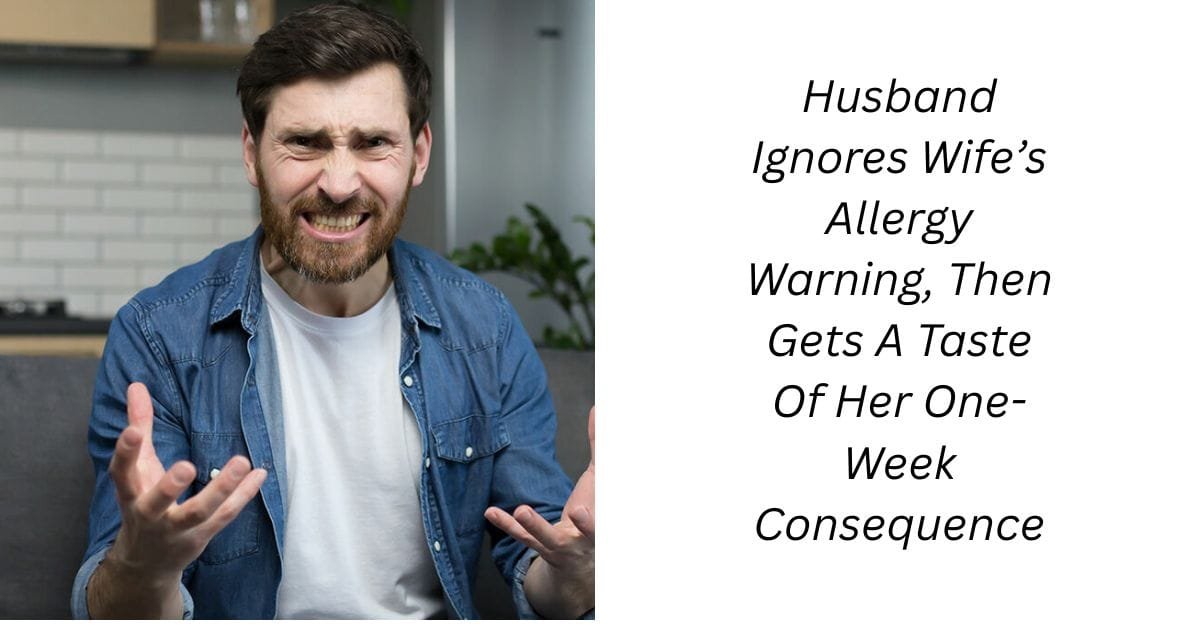
Husband Ignores Wife’s Allergy Warning, Then Gets A Taste Of Her One-Week Consequence
For most of our marriage, I never thought I would have to repeatedly remind my husband about something as serious as my allergies. I have a food allergy that isn’t something I can simply “get over” or ignore. Depending on what I eat, I can experience anything from painful reactions to symptoms that require immediate attention, so I have always been extremely careful about checking ingredients and explaining my restrictions to the people closest to me. My husband knew this from the beginning. He had watched me read labels in restaurants, ask questions before ordering food, and politely turn down dishes when I wasn’t sure what was in them. For years, I assumed that because he loved me, he understood that these precautions weren’t me being difficult. But recently, he started treating my warnings like an inconvenience. He would tell me I was being overly cautious, roll his eyes when I asked him to double-check something, or insist that a tiny amount couldn’t possibly matter. I kept trying to explain that allergies don’t work according to how serious someone else thinks they should be. Eventually, one incident forced me to realize that he wasn’t simply forgetting anymore. He was choosing not to take my warnings seriously.
The incident happened when my husband decided to surprise me by preparing dinner after I had a long day. Normally, I would have appreciated the gesture. He isn’t usually the one who cooks, so I was genuinely touched when he told me he had planned everything himself. I asked him what he had made and whether he had checked the ingredients carefully because there were a few things I absolutely could not eat. He assured me that everything was safe and told me I was worrying too much. I trusted him because he was my husband, and I didn’t want to turn what was supposed to be a thoughtful gesture into an interrogation. Unfortunately, after I had already eaten some of the meal, he casually mentioned that one of the ingredients came from a sauce containing something I had specifically warned him about before. My stomach dropped. I immediately asked him whether he was sure, and he said it was probably such a small amount that it wouldn’t matter. That sentence hurt almost as much as the situation itself. He knew exactly what I was allergic to. I had told him repeatedly. Yet he had decided that my warning was less important than his belief that the amount was insignificant.
I stopped eating immediately and explained that this was exactly why I had been asking him to check everything. I wasn’t angry because the dinner wasn’t perfect. I was angry because he had knowingly taken a risk with my health and then dismissed my concern afterward. He became defensive and said he hadn’t intentionally tried to hurt me. I told him I knew that, but intent wasn’t the issue. If someone tells you that a certain ingredient can make them sick, you don’t get to decide that they are exaggerating simply because you personally don’t understand the risk. He insisted that he had cooked the food with good intentions and that I was ruining the evening by focusing on one ingredient. I couldn’t believe what I was hearing. Somehow, the conversation had shifted from “Why did you ignore my allergy?” to “Why aren’t you grateful for dinner?” I told him that I appreciated the effort, but I couldn’t appreciate being put in danger. He eventually apologized, but it didn’t feel like a genuine understanding of what had happened. It felt more like he wanted the argument to end.
The next morning, I decided that I needed to have a serious conversation with him. I told him that I couldn’t continue living in a house where I had to wonder whether my husband would respect something as basic as a medical warning. He said he understood and promised he would be more careful. I wanted to believe him, but I also realized that apologies meant very little if his behavior didn’t change. So I told him that for the next week, I was going to stop relying on him for anything related to my allergy. I would prepare my own meals, buy my own groceries, and make sure I knew exactly what I was eating. I wasn’t doing it to punish him or play some kind of childish game. I simply needed to protect myself because I couldn’t force him to take my condition seriously. He laughed slightly and asked whether I was really going to “make a whole thing” out of one mistake. That reaction made my decision even easier. I told him that if he thought it was such a small issue, he could experience what it was like to have someone repeatedly dismiss an important boundary and then deal with the consequences.
For the next several days, I kept my routine completely separate when it came to food. I didn’t ask him to cook for me, I didn’t ask him to check ingredients, and I didn’t expect him to prepare anything special. If we went shopping, I purchased what I needed myself. At first, he seemed relieved because there were no more arguments about labels or ingredients. But after a couple of days, he started noticing that I wasn’t relying on him at all. He would come into the kitchen while I was preparing dinner and ask whether I needed help. I would simply say no. He asked if I wanted him to make something for me, and I reminded him that I had already explained why I wasn’t comfortable with that right now. He became frustrated and said I was treating him like someone I couldn’t trust. I told him that was exactly the problem. Trust isn’t something you demand from another person after breaking it. It’s something you rebuild through consistent behavior.
By the middle of the week, the consequences began affecting him more than he expected. Our normal routines had changed. We usually shared grocery shopping, cooked together occasionally, and made meals part of our time as a couple. Now I was doing everything separately. He realized that his decision hadn’t just affected one dinner. It had changed the way I interacted with him. One evening, he asked me directly whether I was trying to teach him a lesson. I told him that I wasn’t trying to teach him anything. I was simply showing him what our relationship looked like when I couldn’t trust him with something important. I also told him that I didn’t want this to become permanent. I wanted my husband to be someone I could depend on, not someone I needed to protect myself from. That seemed to hit him differently. For the first time, he stopped arguing and actually listened.
Later that night, he admitted that he had underestimated how serious my allergy was. He said that because he had never personally seen me have a severe reaction, part of him had convinced himself that I was being overly cautious. I told him that was exactly what made his behavior so dangerous. He didn’t need to witness the worst possible outcome before deciding to respect my warnings. I explained that my precautions existed precisely because I didn’t want to find out what would happen if I took unnecessary risks. He apologized again, but this time there was something different in his voice. He wasn’t asking me to stop being upset. He wasn’t defending his intentions. He was admitting that he had made a choice that he shouldn’t have made. He even asked me to explain what he could do differently in the future, and I appreciated that more than any dramatic apology.
By the end of the week, he had completely changed his approach. He went grocery shopping with me and actually took the time to read labels instead of rushing through the aisles. When he wasn’t sure about an ingredient, he asked instead of guessing. He also told me that if he ever cooked for me again, he would follow whatever precautions I gave him without arguing about whether they were necessary. I told him that was all I had wanted from the beginning. I didn’t need him to understand every medical detail of my allergy. I just needed him to understand that when I say something could make me sick, he should believe me. The week had been uncomfortable for both of us, but it had also forced us to confront a problem that we had been avoiding. He finally understood that what looked like a small inconvenience to him could feel like a serious threat to me.
Looking back, I don’t consider the one-week consequence a punishment. I wasn’t trying to hurt my husband or make him feel guilty. I was protecting myself after the person closest to me decided that my warning wasn’t important enough to follow. The biggest lesson for both of us was that love doesn’t give someone permission to ignore another person’s boundaries, especially when health and safety are involved. My husband eventually understood that trust isn’t built through good intentions alone. It is built when your actions consistently show someone that their safety matters to you. I hope this was the last time I ever have to teach him that lesson, because I don’t want to spend our marriage wondering whether the person sitting across the dinner table is taking my health seriously. I want to trust him completely—and now he knows exactly what he has to do to earn that trust.
Read Story…
AITA for not feeding my husband because he caused me to have an allergic reaction
He technically didn’t cause an allergic reaction but he pushed me into it. I (26f) am allergic to a plant that lives in the state my husband (29m) and I have moved to. We aren’t sure which plant yet but are narrowing it down kinda. My doctor has told me not to do any yardwork whatsoever because I have an allergic reaction every time. Full body rash and swollen joints for like a week. Wearing gloves and protective clothes has not helped.
My husband knows all of this. Yesterday he mowed, and pressured me into helping him rake up grass and weeds. I didn’t want to and I mentioned that I could have an allergic reaction but he said that he needed help and that I would be fine. Against my better judgement I thought that if I just raked and didn’t physically touch anything I would be fine. I didn’t want to refuse him when he insisted.
Today I have a rash all over and a lot of swelling and I feel like shit. I normally meal prep for the next week on Sundays. This morning I half assed threw me some salads in Tupperware for next week and called it a day. I eat a lot of easy stuff that doesn’t require cooking so it’s fine. My husband on the other hand eats like 15 pounds of meat a week as well as vegetables and sides. It usually takes me hours to cook his food and it’s very draining.
I told him he needs to cook his food for the next week, because I’m too tired and my skin feels awful. He got mad and said he’d just eat takeout since he wants to relax on his last day off. So now I have to freeze all the meat so it doesn’t go to waste. He only cooks once or twice a year.
He thinks it’s not fair for me to not feed him since I agreed to rake and it isn’t his fault I had an allergic reaction. Im not trying to punish him but I’m really suffering right now and I just don’t have it in me. I also do think it wasn’t fair for him to pressure me into doing something he knows I medically shouldn’t do.
AITA for not feeding my husband?
Edit: dang you guys really hate my husband haha. He’s actually a pretty decent guy, I think this post just portrayed him in a bad light. He works 80 hours a week to support me while I go to school, and he still manages to do at least half of the cleaning. I talked to him and he said his back was just hurting and he was stressed out from work and he wasn’t thinking. He apologized and brought me dinner while I layed on the couch.
I’m not doing his meal prep this week because I really just can’t but we both came to terms with it. He’ll feed his self and I’ll try to manage my skin as best as I can. It looks awful and feels worse. He’s not a lazy guy, he works hard to make things up in other areas, he just hates cooking. Which, to be fair, I hated yardwork even before we moved to this shitty state where I’m allergic to everything.
Her Husband Started Dismissing Her Allergy
For most of our marriage, I never imagined that I would have to repeatedly explain to my husband that my allergy is not something he gets to decide is serious or harmless. I have lived with this allergy for years, so I have developed habits that might seem excessive to someone who doesn’t understand what an allergic reaction can be like. I check labels, ask questions at restaurants, avoid cross-contamination, and sometimes choose not to eat something if I can’t confirm every ingredient. My husband has known about this from the beginning. He has seen me turn down food at family gatherings and watched me carefully check packages at the grocery store. For a long time, he respected it without question. But over the past year, he started becoming increasingly casual about it. He would say things like, “I’m sure that’s fine,” or “You’ve eaten something similar before,” whenever I hesitated about a particular food. I repeatedly explained that I wasn’t trying to be difficult or dramatic. I was simply trying to avoid getting sick. Unfortunately, he eventually made a decision that showed me he wasn’t just misunderstanding my precautions anymore. He was actively dismissing them.
The incident happened on a night when my husband decided to surprise me with dinner. I had been working a long day and came home exhausted, so when he told me he had prepared everything himself, I was genuinely touched. Cooking isn’t something he normally does, so I appreciated the effort. Before sitting down, I asked him whether he had made sure the ingredients were safe for me. He confidently told me yes. I asked again because there were certain sauces and packaged ingredients that I knew could contain the thing I was allergic to. He rolled his eyes slightly and said he had checked. I trusted him because I had no reason to believe he would knowingly put me at risk. We sat down, started eating, and for a few minutes everything felt normal. Then, completely casually, he mentioned that he had used a particular sauce because it gave the meal a better flavor. My heart immediately sank because I knew that brand sometimes contained an ingredient I couldn’t have. I asked him exactly which sauce he used. He showed me the bottle, and there it was on the label. I immediately stopped eating.
I asked him why he had told me the meal was safe when he hadn’t actually checked the ingredient properly. Instead of immediately apologizing, he looked at the bottle and said the amount of the ingredient was probably so small that it wouldn’t matter. I couldn’t believe what I was hearing. This wasn’t a situation where he accidentally picked up the wrong package after carefully trying to help me. He had assured me that he checked, and now that I had discovered the ingredient, he was trying to convince me that my allergy wasn’t serious enough for me to worry about it. I explained that I couldn’t gamble with my health based on his personal opinion about how much of an ingredient was “too much.” He said he hadn’t meant any harm and that I was making a big deal out of dinner. That sentence hurt me more than I expected. The problem wasn’t the dinner. The problem was that the person I trusted most had decided that his judgment was more important than my knowledge of my own body.
I stopped eating immediately and dealt with the situation as carefully as I could. Thankfully, I wasn’t experiencing a severe reaction at that moment, but I was shaken. I told my husband that this was exactly why I had asked him to check the ingredients before serving me the food. He said he honestly believed it would be fine. I reminded him that believing something is fine doesn’t make it safe. I also told him that if I had been a guest in someone else’s home and explained an allergy, I would expect that person to take me seriously. I certainly wasn’t expecting less from my own husband. He became frustrated and said he had spent time preparing the meal and that I was making him feel like his effort didn’t matter. I told him his effort did matter, but effort doesn’t erase the consequences of ignoring an important safety requirement. You can’t put someone at unnecessary risk and then expect them to focus only on how nice your intentions were.
That night, we argued more seriously than we had in a long time. He insisted that he would never intentionally hurt me. I told him I believed that, but intentional harm wasn’t what I was accusing him of. I was accusing him of being careless with something he already knew was important. There is a huge difference between not wanting to hurt someone and actually taking reasonable steps to keep them safe. He told me I was being overly cautious and that sometimes I treated my allergy like it controlled our entire household. I told him that I wasn’t asking him to change his entire life. I was asking him not to knowingly give me something I had already told him I couldn’t safely eat. He eventually apologized, but his apology was mixed with excuses. He said he was tired, distracted, and didn’t think the ingredient would make a difference. None of those explanations changed the fact that he had ignored my warning.
The next morning, I decided I needed to stop arguing and start setting a boundary. I told my husband that for the next week, I would handle all of my own meals and groceries. I would not ask him to cook for me, check ingredients for me, or prepare anything that I needed to eat. He looked confused and asked whether I was seriously going to “punish” him over one mistake. I told him that I wasn’t punishing him. I was protecting myself. If he couldn’t take responsibility for checking my food properly, then I couldn’t safely depend on him for something as basic as preparing a meal. I explained that the one-week arrangement wasn’t designed to hurt him. It was simply a way for me to remove the risk while we figured out what needed to change. He laughed and said I was being dramatic. I told him that if he thought my precautions were dramatic, then he should understand why I needed control over my own food.
For the first couple of days, he seemed completely unconcerned about my decision. I prepared my breakfast separately, packed my own lunch, and cooked my own dinner. I cleaned the kitchen areas I used and kept my groceries separate so there would be no confusion. My husband continued eating normally. At first, I thought he might actually prefer things this way because there were no arguments about ingredients. But I noticed something else. Our normal routine had changed. We usually shared breakfast on weekends and sometimes cooked dinner together while talking about our day. Suddenly, those little moments disappeared. I wasn’t trying to make a statement every time I cooked for myself. I was simply following the boundary I had set. But my husband began noticing the distance.
On the third day, he asked if I wanted him to make me breakfast. I politely said no and reminded him that I was handling my own meals for the week. He sighed and said he thought I was taking things too far. I told him that from his perspective, it was one meal. From mine, it was a reminder that I couldn’t automatically assume the person preparing my food had checked it carefully. He said he had already apologized. I told him I appreciated the apology, but trust doesn’t instantly return because someone says sorry. If someone makes a mistake involving something important, the solution is changed behavior. He didn’t like hearing that, but I wasn’t trying to hurt his feelings. I simply needed him to understand that I wasn’t going to gamble with my health just to make him feel comfortable.
Later that evening, he asked me whether I was still angry. I told him that I wasn’t interested in staying angry, but I was still disappointed. He asked what he could do to make it better. I said the answer was simple: take my allergy seriously without requiring me to convince him every time. I told him I didn’t expect him to become an expert overnight. If he wasn’t sure about an ingredient, he could ask me or check the label carefully. If he couldn’t verify something, he could simply not use it in food intended for me. There was no reason to guess. He became quiet after that. I think he finally understood that I wasn’t asking for perfection. I was asking for basic consideration.
By the fourth day, he started asking questions instead of making assumptions. While grocery shopping, he sent me pictures of labels and asked whether certain products were safe. Normally, that might have seemed like a small thing, but to me it was a huge difference. Previously, he had acted as though checking ingredients was an annoying extra step. Now he was voluntarily doing it. I thanked him but still kept my original boundary for the rest of the week. I didn’t want him to think that one day of improved behavior automatically erased what had happened. More importantly, I wanted him to understand that safety shouldn’t depend on whether we were currently arguing about it.
That afternoon, my husband admitted something I hadn’t expected. He said that because he had never personally seen me experience the worst kind of reaction, he had gradually convinced himself that my allergy wasn’t as serious as I described. He said he thought I was simply being extremely cautious because I was afraid of getting sick. I told him that was exactly why his thinking was dangerous. He didn’t need to see me collapse or have a medical emergency before deciding to respect my warnings. The precautions existed because neither of us wanted to discover what would happen if I ignored them. I also told him that people don’t have to understand every detail of someone else’s medical condition to respect their boundaries. If someone tells you that a food can make them seriously ill, you believe them.
He apologized again, but this time he didn’t add an excuse afterward. He simply said, “I should have listened.” That sentence meant more to me than his earlier apologies. I told him I appreciated him finally recognizing the real issue. I wasn’t demanding that he feel afraid every time he cooked. I wanted him to understand that my confidence in him depended on knowing he would take reasonable precautions. He asked whether I would ever trust him to cook for me again. I told him yes, but trust would come back gradually. I wasn’t going to hold the incident over his head forever, but I also wasn’t going to pretend it hadn’t happened.
The fifth day was the first time I noticed how much the situation had affected him emotionally. He told me that he missed having our normal dinners together. I told him I missed them too. We usually talked about our day while eating, and food had always been one of the simple routines that made our marriage feel comfortable. But I reminded him that comfort couldn’t come at the expense of safety. He nodded and said he understood. Then he asked if he could prepare something for himself while I cooked my own food. I said of course. He stayed in the kitchen and watched how carefully I checked the ingredients. Instead of making jokes about it, he asked questions. That small change made me realize that he was finally beginning to understand how much thought went into something he had previously considered unnecessary.
On the sixth day, he surprised me by putting together a list of foods and ingredients he knew were safe for me. He had gone through our pantry and separated products that needed to be avoided from the ones that were okay. He also wrote down the names of a few sauces and packaged foods that I had previously mentioned. I was honestly impressed. I told him he didn’t have to do all that, but he said he wanted to because he didn’t want to make the same mistake again. For the first time since the incident, I felt some of the tension between us disappear. I wasn’t suddenly forgetting what happened. I was seeing evidence that he had learned from it.
Still, there was one thing I wanted him to understand clearly. I told him that I never wanted my allergy to become a weapon in our marriage. I didn’t want to threaten him with consequences every time he made a mistake. I didn’t want him walking on eggshells around me, and I didn’t want to feel like I had to supervise him. What I wanted was partnership. That meant knowing that when I said something mattered, he wouldn’t automatically challenge it. He told me he understood. He said that he had initially interpreted my precautions as criticism of his cooking or an accusation that he couldn’t do anything right. He realized now that it wasn’t about him. It was about keeping me safe.
On the seventh day, I decided the consequence was over. I told him that I was ready to start sharing meals again, but I wanted us to establish a clear rule. If either of us was preparing food for the other, we would communicate about ingredients rather than assume. If there was any uncertainty, we would check. My husband agreed immediately. He even said he wanted to cook dinner that night. I hesitated for a moment, but then I agreed as long as he followed the precautions we had discussed. He spent more time preparing the meal than usual. I could see him checking every package carefully, and when he wasn’t sure about one ingredient, he asked me instead of guessing.
That dinner was surprisingly emotional. It wasn’t fancy, and the food itself wasn’t particularly important. What mattered was that I could finally sit at the table without wondering whether something had been overlooked. My husband apologized one more time and told me he finally understood why the incident had frightened me. He admitted that he had treated my allergy like an inconvenience when he should have treated it like part of taking care of his wife. I told him that was all I had wanted. I didn’t need a dramatic gesture. I didn’t need him to feel guilty forever. I just needed him to understand that my health wasn’t something he could make assumptions about.
The week also changed the way I looked at our relationship. Before this happened, I had taken for granted that my husband would naturally respect my boundaries because we had been together for so long. The incident reminded me that even people who love each other can become careless when they get too comfortable. Familiarity can sometimes make people stop listening because they think they already know everything about you. My husband had become so used to seeing me manage my allergy that he stopped seeing the seriousness behind the routine. He had mistaken my experience for exaggeration simply because I handled it calmly.
I also realized that I had contributed to the problem by occasionally laughing off his comments instead of telling him how much they bothered me. Whenever he said I was being too careful, I would usually roll my eyes and move on. I didn’t want to start an argument. But by doing that repeatedly, I may have unintentionally allowed him to think his attitude wasn’t hurting me. I told him that if something involving my safety bothered me in the future, I would address it immediately instead of pretending it didn’t matter. He agreed that he needed to listen instead of becoming defensive.
Some people might think my one-week decision was petty. Maybe from the outside, it looks like I gave my husband a punishment over one dinner. But that isn’t how I saw it. I didn’t stop speaking to him. I didn’t sleep somewhere else. I didn’t refuse to help with anything unrelated. I simply stopped allowing him to be responsible for something he had demonstrated he wasn’t taking seriously. That distinction matters to me. The consequence wasn’t designed to hurt him. It was designed to remove my dependence on someone until I felt confident that the problem had been addressed.
My husband eventually admitted that the week made him realize how much responsibility I normally carried by myself. He said he had never considered how exhausting it could be to constantly check labels, question ingredients, and worry about whether someone else had accidentally contaminated food. I told him that most of the time I don’t even think about it anymore because it has become part of my routine. But that doesn’t mean the risk isn’t real. Having an allergy doesn’t disappear just because someone has learned how to manage it well. He seemed genuinely surprised by that realization.
The biggest change wasn’t actually the grocery shopping or the cooking. It was the way he started responding when I spoke about my allergy. Before, he would sometimes say, “Are you sure?” in a skeptical tone. Now, he says, “Let’s check.” That difference might sound tiny, but it completely changed how safe I felt around him. I no longer felt like I had to defend my own experience every time we discussed food. He finally understood that he didn’t need to agree with every precaution to respect it.
There was still a conversation we needed to have about what would happen if something like this ever occurred again. I told him that if he knowingly ignored an allergy warning a second time, the issue would be much bigger than a one-week separation of meals. It would become a serious question about whether I could safely trust him in situations where my health depended on his judgment. He understood why I needed to say that. I wasn’t threatening him. I was making it clear that some boundaries aren’t negotiable. He told me he never wanted to put me in that position again.
In the weeks after the incident, things gradually returned to normal. We started cooking together again, and occasionally he would ask me to double-check an ingredient even when he was almost certain it was safe. I never mocked him for being overly careful. Instead, I thanked him. He had finally learned that being cautious wasn’t something to be embarrassed about. In fact, it was one of the ways we could take care of each other. Our dinners became comfortable again, but there was a new level of communication between us that hadn’t existed before.
Looking back, I don’t regret giving myself that one week of independence. If anything, I wish I had established the boundary sooner. My husband didn’t need to experience the exact same health concern to understand it. He simply needed to recognize that when I said something could make me sick, that should have been enough. The experience reminded both of us that marriage isn’t just about loving someone when things are easy. It’s also about listening when something matters deeply to them, even if you personally don’t understand it. My husband eventually got the message, and I hope he never forgets it.
The strange thing is that what started as an argument about one ingredient ended up becoming a much bigger conversation about trust. I learned that I needed to communicate more directly, and he learned that my boundaries weren’t suggestions. Neither of us handled everything perfectly at first, but we eventually stopped arguing about who was right and started focusing on what needed to change. That made all the difference. I don’t consider the week a punishment anymore. I consider it the point where my husband finally understood that taking my allergy seriously isn’t about being dramatic, difficult, or overly cautious. It’s about respecting the person he promised to protect and care for.
At the end of the day, I don’t want a husband who is terrified of making a mistake. I want a husband who listens when I tell him something is important. I want someone who would rather spend an extra minute reading a label than take an unnecessary risk with my health. Most importantly, I want to know that when I say, “Please don’t give me that,” he hears the request instead of questioning whether I have earned the right to make it. My husband understands that now. The one-week consequence wasn’t really about food. It was about showing him what happens when trust is ignored. And sometimes, the only way someone realizes how important a boundary is, is when they finally have to live with the consequences of crossing it.