Woman’s Bully Half-Sis Tries To Play Victim In Front Of Friend Group, She Sets The Record Straight
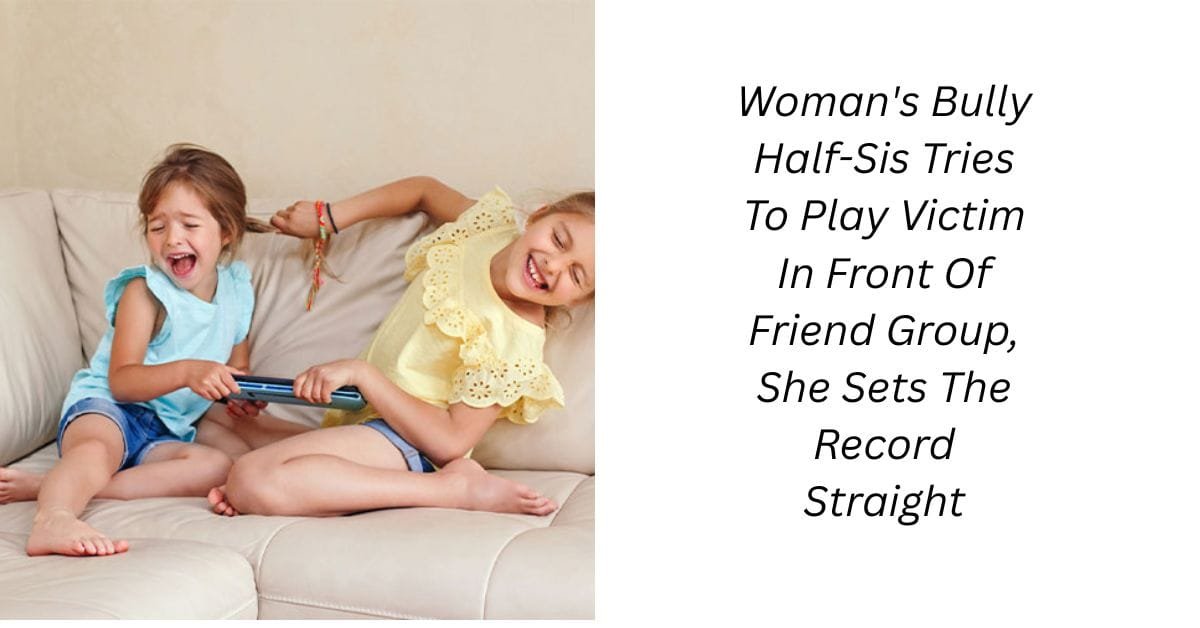
When I was growing up, I always had a complicated relationship with my half-sister, but “complicated” doesn’t really describe how she treated me for most of our childhood. She had a way of making me feel like I was always the embarrassing one, the less attractive one, the less successful one, or simply someone she could use as the punchline whenever other people were around. Because we shared a parent, our family constantly encouraged me to forgive her and keep the peace, even when she was the one starting the problems. Whenever she made cruel comments about my appearance, mocked my choices, or deliberately embarrassed me in front of relatives, I was expected to ignore it because “she’s your sister.” I spent years trying to convince myself that maybe she would eventually grow up. As adults, I thought there was finally enough distance between us that I could have a peaceful life without constantly dealing with her behavior. We weren’t close, but we were civil, and I was perfectly happy keeping things that way. Unfortunately, she apparently wasn’t finished creating problems between us.
The situation became much worse when our mutual friend group started spending more time together. My half-sister had always been good at presenting a completely different version of herself to people who didn’t know her well. Around strangers, she could be funny, charming, generous, and incredibly warm. She knew exactly how to tell a story in a way that made everyone laugh while conveniently leaving out the parts where she had been the one causing the conflict. At first, I didn’t care. I had no interest in exposing her or convincing everyone to take my side. I simply wanted to enjoy time with my friends without discussing our family history. But then she started making subtle comments about me whenever the group was together. She would bring up old incidents and describe herself as the one who had always tried to get along with me, while portraying me as cold, jealous, or unnecessarily difficult. Whenever someone asked why we weren’t closer, she would sigh dramatically and say that she had “tried everything” but I had always rejected her. I knew the truth was completely different, but I kept my mouth shut because I didn’t want our friends dragged into a family dispute. That silence, however, seemed to convince her that she could rewrite the entire story without consequences.
Eventually, she pushed things too far during a group gathering. Several of us were sitting around talking when she suddenly brought up our relationship again. She started telling everyone how hurt she was that I supposedly treated her badly and never gave her a chance to be a real sister. She became emotional while describing herself as the victim, and some of our friends immediately started comforting her. I sat there listening to a version of our childhood that barely resembled reality. According to her story, she had always supported me, while I had supposedly been the one who bullied and excluded her. Normally, I would have let it go, but this time she mentioned several specific incidents that she had completely reversed. She described moments when she had mocked me as though I had been the person who started the argument. She even claimed that I had deliberately embarrassed her in front of family members, when I knew exactly what had happened because she had done it to me first. I finally realized that staying quiet was no longer protecting anyone. It was simply allowing her to turn years of her behavior into a story where she was the innocent victim. So instead of yelling or insulting her, I calmly told the group that if we were going to discuss our history, I was going to tell my side too.
I explained what had actually happened, starting with the incidents she had just mentioned. I didn’t exaggerate, call her names, or demand that everyone hate her. I simply corrected the details and explained how her behavior had affected me over the years. I reminded everyone that I had never claimed to have a perfect relationship with her, but there was a major difference between refusing to be close to someone and bullying them. I also pointed out that I had spent years avoiding conflict with her precisely because I didn’t want our family problems to become everyone else’s problem. As I spoke, the mood in the room changed. A few friends looked surprised, especially because some of the things she had told them previously suddenly made more sense. My half-sister tried interrupting several times, insisting that I was “twisting everything,” but I stayed calm and told her that she was free to remember things differently, but she couldn’t expect me to sit quietly while she presented her version as the only truth. What surprised me most was that some of our friends admitted they had noticed inconsistencies in her stories before but had never wanted to get involved. For the first time, I realized that I didn’t need to convince everyone of anything. I only needed to stop allowing someone else to speak for me.
After that night, I decided that my relationship with my half-sister was going to have very different boundaries. I wasn’t interested in revenge, public humiliation, or getting everyone to choose sides. I simply refused to participate in the cycle anymore. If she wanted to tell people that I was the villain, that was her choice, but I wasn’t going to keep defending myself every time she created another story. Interestingly, once the group had heard both sides, people began treating the situation differently. Some became more cautious around her, while others told me privately that they understood why I had kept my distance. My half-sister was furious that I had “made her look bad,” but I reminded her that I hadn’t made her look like anything. I had simply told the truth after she brought our private history into a public conversation. Maybe she genuinely believed her own version of events, or maybe she had become so used to controlling the narrative that she couldn’t handle anyone challenging it. Either way, I learned something important: keeping quiet to maintain peace only works when the other person respects that peace. Sometimes setting the record straight isn’t about winning an argument. It’s about finally refusing to carry the blame for something you didn’t do.
Read Story…
AITA for exposing my half-sister’s lies about our childhood?
I (24F) have a half-sister (27F), we’ll call her Taylor.
My dad had weekend visitation with Taylor at our house until I was 8, and it was the worst. She bullied me really badly any time I saw her, to the point that I would scream every time my dad even mentioned her coming over. Even if we were kept apart, she would break my things, upset my pets, and tell lies about me. Every week her mom would end up in the kitchen screaming at my parents.
Taylor’s mom died when she was 11. Her mom didn’t have any family able to take her in, and nor did my dad. My dad was the only one who could get custody. When I was told about this, I freaked out. Screaming, crying for hours, calling my grandparents and demanding to live with them, all of it. My mom wasn’t willing to have Taylor in the house on that basis, and I’m pretty sure she said she would move out if my dad pushed the issue.
Taylor ended up being sent to boarding school the next year, and she would go to stay with other members of my dad’s family during breaks. When I was 14 my parents divorced, and I would see Taylor every few months at my dad’s during school breaks. I’d learnt to stand up for myself and she’d grown up so there was no bullying, but we’d bicker – she was hostile and I never backed down. I didn’t see her much after she went to college, and then I went to college far away as well.
We now live in the same small city (I moved here in March). It’s the kind of place where everyone from each generation knows or knows of each other. I had never encountered Taylor socially and never mentioned knowing her, but I had met her boyfriend and his friends are part of my larger social group. The other night, I was at a party, and Taylor and her bf were there as well. We made eye contact and waved, but she pretty much avoided me all night. During the night, our mutual friends asked how I know Taylor, and I said we are half sisters.
They all looked super uncomfortable and I pressed for an explanation. Basically, Taylor’s been telling everyone that she was homeless as a kid because her stepmother and half-sister hated her and demanded she be shipped off to boarding school and made her dad ignore her. Were it not for the fact that it was obviously going to come out sooner or later that we are related, I probably wouldn’t have bothered to set the record straight. As it was, I’m going to be around these people for a long time, and I didn’t feel I should have had to walk around burdened by the weight of her lies. So I told the group the context.
She called me yesterday to yell at me. Apparently she’s being ostracised from the group, her relationship is in trouble, her career opportunities are in jeopardy, etc. I don’t see how any of this is my fault because she’s the one who lied, but according to some people I should have been a bit more gentle in my retelling of the facts because it’s her ‘experience’ and I’ve basically blackballed her.
EDIT – I didn’t have space for this, but just to clarify what I actually said to the friends. I explained that the reason my mom didn’t want Taylor to live with us was because of the bullying, and that when they split my dad still didn’t have Taylor live with him, and that I only stayed with him on weekends (Taylor told them I moved in with my dad so that she couldn’t). I also told them it wasn’t true that I told my dad not to finance Taylor’s business when she was 20…because I didn’t. That was pretty much the gist of it.
Edit 2 (it was suggested I add this from the comments): I know the answer to these.
My mom didn’t say to send her to boarding school. What my mom said was, Taylor is not living in this house with my daughter, if that means we split, then we split. My dad didn’t want to be a full time parent by himself, so he stayed with my mom, and since he didn’t have any other family Taylor could live with for various reasons, he sent her to boarding school.
My dad never cut contact with Taylor. He visited her at school (it was about an hour away) and sometimes he’d see her at other relatives’ places during school breaks. When he moved out, Taylor would occasional spend the day and maybe one break a year at his place.
She Never Had The Sisterly Bond She Hoped For
Growing up, I always knew that my relationship with my half-sister was different from the relationships other siblings seemed to have. We shared one parent, but we never really shared the kind of bond people expected from sisters. From the outside, we probably looked like two siblings who simply weren’t very close, but the truth was much more complicated. She had spent years making me feel small whenever she had the opportunity. Sometimes it was obvious, like making cruel comments about my appearance or embarrassing me in front of relatives. Other times it was subtle, like pretending something I was proud of was ridiculous or making jokes about me and then claiming I was too sensitive when I became upset. Because she was family, everyone always encouraged me to forgive her. I heard things like, “That’s just how she is,” or “You only have one sister,” as if sharing blood meant I had to tolerate anything she did. Eventually, I stopped expecting her to change and started keeping my distance.
As we got older, I thought the distance would make things easier. We no longer lived under the same roof, and I had built a life of my own. I had my own career, my own friendships, and my own priorities. I wasn’t interested in fighting with her or reopening every argument we’d ever had. Whenever we saw each other at family events, I tried to be polite. I said hello, made small talk when necessary, and avoided anything that could turn into an argument. I didn’t hate her, and I didn’t spend my days thinking about what she had done to me. I simply accepted that she was someone I couldn’t have a healthy relationship with. That seemed like the most peaceful solution. Unfortunately, my half-sister apparently didn’t feel the same way. She seemed to become increasingly interested in how other people viewed our relationship, especially whenever there were people around who didn’t know our history.
The problem really started when our social circles began overlapping. A few of my friends became friends with people she knew, and eventually she started appearing at some of the same gatherings. I wasn’t thrilled about it, but I reminded myself that I couldn’t control who attended every dinner, birthday party, or weekend event. I decided I would simply be friendly and keep things civil. My friends knew that my relationship with my half-sister was complicated, but I had never given them a detailed list of everything she had done. I didn’t want them to feel like they had to take sides in a family dispute. I also didn’t want to become the person who constantly complained about a relative. So when people asked why we weren’t close, I usually gave a vague answer about having different personalities and leaving it at that. My half-sister, however, seemed to see our shared friend group as an opportunity to tell her own version of the story.
At first, her comments were so subtle that I wasn’t even sure whether I was imagining them. She would say things like, “My sister and I have never really gotten along,” followed by a dramatic little sigh. If someone asked why, she would shrug and say, “I’ve tried, but she doesn’t really want a relationship with me.” She never directly accused me of anything, but she always managed to position herself as the person who had been rejected. My friends would occasionally look at me afterward, and I could tell they were confused. I would simply smile and change the subject. I didn’t want to react to every little comment because I knew that would make me look defensive. I also believed that eventually people would notice the pattern themselves. What I didn’t realize was that she was slowly building a narrative about me while I was deliberately staying silent.
The more comfortable she became around my friends, the bolder she got. She started telling stories about our childhood that sounded believable if you didn’t know what had actually happened. She would describe herself as the sister who always tried to include me, while portraying me as distant and jealous. In one story, she claimed that she had invited me to an important event years ago and that I had deliberately ignored her. The truth was that she had never invited me at all. In another story, she talked about how she had supposedly defended me when relatives criticized me, when I distinctly remembered her joining in with those comments. Whenever she told these stories, she did it with a smile and a tone that made it sound like she wasn’t trying to attack me. That was what made it so frustrating. If I challenged every false detail, I would look obsessed with the past. If I stayed silent, everyone might assume she was telling the truth.
I decided to continue ignoring it because I didn’t want my friendships to become complicated by family drama. My friends had their own lives and problems, and I didn’t think they needed to hear twenty years of sibling history. Besides, I believed my actions would eventually speak louder than her stories. I treated people respectfully, kept my promises, and never tried to turn anyone against her. I assumed that if she wanted to portray herself as the victim, she would eventually contradict herself. Unfortunately, she seemed very good at reading a room. She knew when to be funny, when to appear vulnerable, and when to tell a story that made people sympathize with her. She wasn’t openly attacking me. She was doing something much more difficult to confront: she was quietly shaping how people saw me.
One evening, several of us were together at a friend’s house for dinner. It was supposed to be a relaxed night. We were eating, talking, laughing, and catching up about work and relationships. My half-sister was there too, and for the first hour everything seemed normal. Then someone casually asked her whether she had any siblings. She immediately mentioned me and laughed before saying, “Yeah, unfortunately, my sister and I have never been very close.” Everyone laughed awkwardly, assuming it was a harmless joke. Then she continued. She said she had spent years trying to have a relationship with me, but I had always pushed her away. She said she didn’t know what she had done to deserve it and that she had eventually accepted that I simply didn’t like her.
I could feel myself getting uncomfortable, but I still didn’t say anything immediately. I watched my friends’ reactions instead. Some looked sympathetic. One person even told her that family relationships could be complicated and that she shouldn’t blame herself for someone else’s behavior. My half-sister nodded sadly and said, “That’s exactly what I’ve had to learn.” Something about that sentence finally pushed me over the edge. It wasn’t just a casual comment anymore. She was deliberately telling a room full of people that I had spent our entire lives mistreating her. And because I had stayed quiet for years, she apparently believed there would be no consequences for saying it. I realized that if I continued saying nothing, I wasn’t protecting my peace anymore. I was allowing a false story about me to become accepted as fact.
Before responding, I took a breath because I knew I could easily lose my temper. There were years of anger sitting underneath the surface, and part of me wanted to list every cruel thing she had ever done. But I didn’t want to turn the evening into a screaming match. I also didn’t want to give her the opportunity to point at me and say, “See? This is exactly how she treats me.” So I calmly said, “I think if we’re going to discuss our relationship in front of everyone, then everyone deserves to hear both sides.” The room became quiet almost immediately. My half-sister looked surprised. She clearly hadn’t expected me to challenge her. She asked what I meant, and I told her that the story she was telling was not the story I remembered.
She immediately became defensive and said she wasn’t trying to make me look bad. She claimed she was simply explaining why we weren’t close. I told her that would have been fine if she had described the situation honestly, but she was presenting herself as the victim while leaving out everything she had done. I didn’t insult her. I didn’t call her a liar. Instead, I gave a few specific examples. I explained that many of the moments she described as me rejecting her had actually happened after she had mocked or embarrassed me. I explained that there had been times when she intentionally excluded me and then complained that I was distant. I explained that when I stopped sharing personal information with her, it wasn’t because I hated her. It was because I had learned that things I told her privately often became jokes later.
My half-sister tried to interrupt me several times. She said I was remembering things incorrectly and accused me of holding grudges from childhood. I told her that I wasn’t claiming to remember every detail perfectly. Nobody remembers childhood exactly the same way. But there was a difference between having different memories and completely reversing who had done what. I also reminded everyone that I had never demanded that anyone dislike her. I had never told my friends that they couldn’t spend time with her. I had never asked them to choose between us. All I had ever done was maintain some distance because I didn’t feel comfortable around her. That distinction seemed to matter to the group. One of my friends asked my half-sister why she had never mentioned these other incidents when she talked about our relationship.
Her answer was that she didn’t think those details were important. That response made me almost laugh because those were exactly the details that changed the entire story. Without them, she looked like the innocent sister who had been rejected for no reason. With them, the situation became much more complicated. I told her that if she genuinely wanted people to understand our relationship, she needed to stop presenting a carefully edited version of events. She said she wasn’t responsible for how people interpreted her stories. I replied that while she couldn’t control people’s reactions, she was responsible for the information she chose to give them. The conversation became increasingly uncomfortable, but at least it was finally honest.
Then something unexpected happened. One of my friends spoke up and said that she had actually noticed some of the inconsistencies before. She explained that my half-sister had told her privately that I was jealous of her, but she couldn’t remember ever seeing me behave that way. Another friend admitted that she had been confused because my half-sister always described me as someone who hated her, yet I had never acted hostile toward her at group events. Instead, I was usually polite and quiet. Hearing that was strangely validating. I hadn’t realized other people were paying attention. I had spent so much time worrying about how my silence might be interpreted that I hadn’t considered that people could also recognize when someone’s story didn’t match their behavior.
My half-sister became visibly upset and accused everyone of ganging up on her. She said this was exactly why she had been afraid to talk about our relationship. She started crying, and for a moment the entire room became uncomfortable again. Part of me felt guilty because I didn’t want to make her cry. Another part of me was angry because I knew this emotional reaction could shift the conversation back in her favor. I reminded myself that her being upset didn’t automatically mean I had done something wrong. I hadn’t attacked her. I hadn’t humiliated her. I had simply responded after she publicly described me as the reason our relationship was broken.
She eventually said that I had always been favored by our parent and that this was the real reason she resented me. That was something I had heard before, but she had never admitted it so openly. She said she had spent years feeling like the second choice and believed I had benefited from things she hadn’t received. I told her that if she had genuine pain about our childhood, I was willing to acknowledge that. I couldn’t change how our family had handled things, and I couldn’t tell her she wasn’t allowed to have those feelings. But her pain didn’t give her permission to rewrite my experiences. I could understand that she had been hurt while still refusing to accept blame for things I hadn’t done.
The conversation eventually moved away from childhood and toward the present. I told her that I didn’t want to fight with her. I didn’t want revenge, and I didn’t want our family or friends to spend their time discussing us. What I wanted was simple: boundaries and honesty. If she didn’t want to have a close relationship with me, that was fine. I had already accepted that. But if she chose to talk about me, especially in front of people we both knew, I expected her to be fair. She responded that she didn’t think she had done anything wrong. I told her that she was entitled to that opinion, but I was equally entitled to correct statements about myself.
After that night, the atmosphere in our friend group changed. Nobody suddenly hated my half-sister, and I wouldn’t have wanted that anyway. But people seemed less willing to automatically accept whatever story she told. They started asking questions instead of immediately sympathizing. I noticed that she became much more careful about bringing me up in conversations. For a while, she barely mentioned our relationship at all. I was relieved. I didn’t want to keep reliving the past. I wanted to return to being someone’s friend instead of being half of a family conflict.
Of course, the issue didn’t completely disappear. A few days later, my half-sister sent me a message saying that I had embarrassed her in front of everyone. She said I could have talked to her privately instead of “making her look like a terrible person.” I read the message several times before responding. I told her that she had chosen to discuss our relationship publicly, so it was unreasonable to expect me to remain silent simply to protect her image. I also told her that if she ever wanted to have a private conversation about our childhood, I was willing to listen. But I wasn’t going to apologize for defending myself.
She responded that I was still being cold and that I clearly didn’t care about having a sister. That statement would have hurt me years ago. This time, however, I realized I didn’t need to prove anything. Caring about someone doesn’t mean accepting mistreatment from them. Wanting peace doesn’t mean surrendering the truth. And refusing to be close to someone who repeatedly hurts you doesn’t automatically make you cruel. I told her that I wished her well and that I hoped someday we could have a healthier relationship, but that relationship couldn’t be built on guilt, manipulation, or competing versions of the past.
The experience also made me think about how easily people can become trapped by the role others assign them. My half-sister had apparently decided years ago that I was the difficult sister, and once she had that story in her head, everything I did became evidence supporting it. If I stayed quiet, I was cold. If I defended myself, I was aggressive. If I kept my distance, I was rejecting her. If I tried to talk about the past, I was holding a grudge. There was no response I could give that would satisfy someone committed to seeing me as the villain. Once I understood that, I stopped trying to win her approval.
I also realized that I had been protecting her feelings at the expense of my own reputation for far too long. I had convinced myself that correcting her would create unnecessary drama, when in reality, the drama already existed. The only difference was that she had been controlling the narrative while I remained silent. There is a big difference between starting a fight and refusing to let someone tell a completely one-sided story about you. I hadn’t wanted my friends to become judges of our family history, but I also didn’t want them unknowingly forming opinions about me based on information that wasn’t true.
Some of my friends later told me they respected the way I handled the situation because I hadn’t screamed or attacked her. That meant more to me than I expected. I had worried that speaking up would make me look just as dramatic as she claimed I was. Instead, it showed me that I could defend myself without becoming cruel. I didn’t need to reveal every private detail from our childhood. I only needed to correct the specific things she had said publicly and explain why our relationship had become distant.
As for my half-sister, I don’t know whether she genuinely believes the version of events she tells people or whether she consciously changes details to gain sympathy. Maybe she remembers certain situations differently because we experienced the same family in very different ways. Maybe some of her pain is real, even if some of her accusations aren’t. I’m willing to accept that possibility. What I’m not willing to accept anymore is being assigned responsibility for everything that went wrong between us.
Today, I still keep my distance from her, but I no longer feel guilty about it. If we are at the same event, I’m polite. If she speaks to me, I respond. I don’t badmouth her to family members or friends, and I don’t try to convince people that she’s a terrible person. I simply let my actions speak for themselves. If she wants to rebuild our relationship someday, I’m not completely closed to the possibility, but it would require honesty from both of us. There would have to be room for both of our experiences instead of one person being permanently cast as the victim and the other as the villain.
Looking back, the strangest part of the entire situation is that I never planned to expose her. I wasn’t waiting for the perfect moment to tell everyone what she had done. I had genuinely hoped that our past could stay in the past. But when she brought that history into a room full of people and presented herself as the only victim, she changed the situation. I wasn’t going to sit quietly while people I cared about were given a completely false impression of who I was. So I set the record straight, not because I wanted to destroy her reputation, but because I finally understood that protecting my peace sometimes requires protecting my truth too.
In the end, I don’t think there was a winner that night. My half-sister was hurt, I was frustrated, and our relationship certainly didn’t become magically better. But something important did change. For the first time, she learned that I wasn’t going to silently accept whatever story she told about me. My friends also learned that family conflicts are rarely as simple as one person being completely innocent and the other being completely terrible. And I learned that I don’t have to carry the burden of keeping everyone comfortable when doing so requires me to remain silent about my own experiences. Maybe someday my half-sister and I will be able to have an honest conversation without an audience, without accusations, and without anyone playing the victim. Until then, I’m choosing distance over drama and honesty over pretending everything is fine.