Woman Worried After BF Seems Entitled To Her Liver, Expects Her To Undergo Surgery For Him
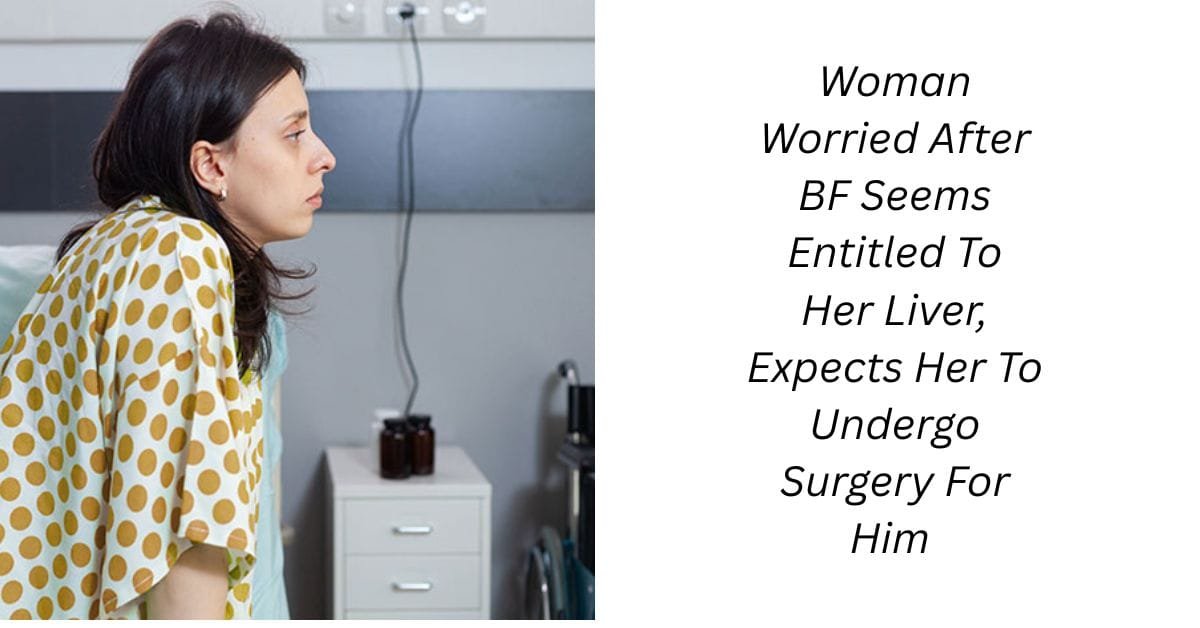
When I first started dating my boyfriend, I never imagined that our relationship would eventually reach a point where I would question whether he actually saw me as a partner or simply as someone who was supposed to sacrifice whatever he needed. We had been together for a while, and in the beginning, he was caring, supportive, and affectionate. I believed we were building a future together, and like most people in serious relationships, I expected that we would eventually face difficult situations and make sacrifices for each other. What I didn’t expect was for one of those sacrifices to involve my own body. My boyfriend developed a serious liver-related health problem, and as his condition became more complicated, the possibility of needing a transplant became part of the conversation. I was devastated watching someone I loved struggle with his health, and naturally, I wanted him to get better. But somewhere along the way, his attitude changed. Instead of talking about possible treatments as something we would discuss together, he began speaking as though my liver was automatically an option available to him. The first time he mentioned that I could potentially be a donor, I assumed he was simply thinking out loud. I never imagined that he had already started expecting me to agree.
At first, I tried to approach the subject rationally. I told him that organ donation was an extremely serious medical decision and that I would need to understand everything involved before even considering it. I would need to speak with doctors, understand the risks, learn about recovery, and think carefully about how surgery could affect my own health and future. Instead of acknowledging how serious that sounded, he responded as though I was making things unnecessarily complicated. He said that couples were supposed to be there for each other during difficult times and that if I truly loved him, I wouldn’t hesitate to help him. That statement immediately made me uncomfortable. Loving someone and being willing to support them doesn’t mean automatically agreeing to undergo major surgery. I tried explaining that I was scared and that I needed time to process everything. He told me that he understood, but his behavior suggested otherwise. He started talking about my potential donation as if it were already decided, saying things like, “Once this is over, we’ll finally be able to move forward.” I remember thinking, “Once what is over?” because I hadn’t agreed to anything.
The situation became even more disturbing when he started discussing the idea with other people as though my decision had already been made. One evening, we were talking with someone close to him, and he casually mentioned that I might be able to donate part of my liver. The person looked at me and said something along the lines of, “That’s incredibly generous of you.” I was stunned because I hadn’t told anyone that I had agreed to donate anything. I corrected them and explained that I was still considering what was medically possible and that no decision had been made. My boyfriend immediately looked annoyed. Later, when we were alone, he asked why I had embarrassed him by making it sound like I wasn’t willing to help. I told him that I hadn’t embarrassed him—I had simply told the truth. I hadn’t promised to undergo surgery. He said that I was focusing too much on technicalities and that everyone already knew I loved him. But that was exactly what scared me. He seemed to believe that my love for him automatically gave him a claim over my body.
I started doing my own research and realized just how serious the situation could be. Even when living donation is medically possible, it is still major surgery, and the donor has to go through an extensive medical evaluation. There are risks, recovery time, and potential complications. I wasn’t simply being asked to give him a small amount of blood or accompany him to a doctor’s appointment. I was being expected to undergo an operation that would permanently alter my body so that he could potentially receive part of my liver. The more I learned, the more frightened I became. I also started thinking about what would happen if the transplant didn’t work or if something went wrong with my own recovery. Would he still expect me to do it? Would his family blame me if I refused? What if we broke up afterward? What if our relationship didn’t survive? These weren’t selfish questions. They were questions about an irreversible medical decision that could affect the rest of my life. Yet whenever I brought them up, my boyfriend seemed irritated rather than concerned.
One night, I finally asked him directly why he seemed so certain that I would become his donor. He looked at me like the answer was obvious and said, “Because you’re my girlfriend.” I asked him whether he understood that I had the right to say no. He became quiet for a moment and then said that technically, yes, I could refuse, but he couldn’t imagine how I could live with myself if I had the opportunity to save him and chose not to. That sentence completely changed how I viewed him. He wasn’t simply asking for help anymore. He was using guilt to pressure me into making a medical decision. I told him that I didn’t want to be forced into something so serious through emotional manipulation. He insisted that he wasn’t manipulating me and that he was simply being honest about what my decision would mean for our relationship. To me, that sounded like an ultimatum disguised as honesty.
After that conversation, I began noticing other comments that I had previously ignored. He talked about our future as though my donation were already part of the plan. He mentioned how grateful his family would be and how everyone would remember that I had “saved his life.” His mother even called me one day and thanked me for standing by him. I was shocked. I asked her what exactly she was thanking me for, and she said she had heard that I was willing to be tested as a donor. I explained that I had not made that decision. There was an awkward silence before she said that she assumed I would do the right thing because I loved him. That conversation made me realize that my boyfriend had apparently been telling his family a version of events that didn’t match reality. I hadn’t agreed to surgery, but somehow everyone around him believed I had. Suddenly, I felt trapped. Saying no wouldn’t simply disappoint my boyfriend. It would mean disappointing an entire group of people who had already convinced themselves that my body was the solution to his medical problem.
I finally told my boyfriend that I needed space to think and that I couldn’t continue discussing the surgery under pressure. His reaction was much worse than I expected. He accused me of abandoning him when he needed me most and said that a real partner wouldn’t hesitate to make such a sacrifice. I reminded him that supporting him could mean helping him research transplant programs, attending appointments, helping with recovery, or simply being emotionally present. There were countless ways I could support him without becoming his donor. He rejected that argument and said none of those things mattered if I could potentially give him what he needed. I realized then that he wasn’t really asking me whether I wanted to donate. In his mind, the only acceptable answer was yes. My fear, my health, and my future seemed secondary to his desperation. I loved him, but I also began wondering whether staying in a relationship where my bodily autonomy was treated as negotiable was healthy for me.
Eventually, I spoke privately with someone I trusted and admitted how frightened and pressured I felt. They told me something that I desperately needed to hear: I could care deeply about my boyfriend and still refuse to undergo major surgery. Those two things were not contradictory. I didn’t owe anyone an organ simply because I was in a relationship with them. A decision involving my body had to be voluntary, informed, and made without coercion. That conversation gave me the confidence to finally tell my boyfriend that I would not agree to anything until I had independently spoken with qualified medical professionals and made my own decision. I also told him that if he continued using guilt, his family, or our relationship as pressure against me, I would have to reconsider the relationship itself. He became extremely upset, but for the first time, I didn’t back down. His medical condition was serious, and I genuinely wanted him to receive the best care possible. But his illness did not give him ownership over my body.
Now I’m left questioning what our relationship is supposed to look like after all of this. I still care about him, and part of me feels guilty for even having doubts while he is dealing with something so serious. But another part of me keeps remembering the way he spoke about my liver as though it belonged to him simply because I was his girlfriend. That has changed something inside me. I don’t want to spend the rest of my life wondering whether every sacrifice I make will eventually become an obligation in his eyes. I want a partner who appreciates what I choose to give rather than assuming I owe it to him. I haven’t made any decision about our future yet, but I know one thing clearly: loving someone does not mean surrendering your right to make decisions about your own body. Now the question is whether our relationship can survive after I finally told him that my answer is not something he gets to decide for me.
Read Story…
AITA for telling my bf I wasn’t donating part of my liver to him?
My bf(31M) in the past had a binge drinking problem before we met. By the time we met he had been sober for years but he had cirrhosis on his liver that doesn’t look to be getting better and had some really bad lab results. He also had a embolism in his lung so had reduces lung function and diabetes.
He went to a liver specialist who mentioned that my bf might need a liver transplant in the future and he came bad pretty bummed about that understandably. He then not seriously but kind of hopefully let me know that I should donate part of my liver to him if we matched. I told him no and I was kind of shocked he would ask. We’ve been dating 8 months and while I like him I’m not convinced he’s the one yet.
He has a lot of qualities I like but some that drive me up the wall including having poor personal hygiene and not looking after his diet and eating mostly fast food(which probably caused the diabetes). He was surprised and then tried to cover it up saying he didn’t expect it and was just joking. I felt like he was serious but didn’t want to seem that way and told him I would only think about doing something so personal for a parent, sibling, or spouse and only if we were on good terms.
Then he joked then he could just ask me to marry him to get my liver and I told him now that he’s mentioned it it would make any marriage proposal seem disingenuous so I wouldn’t get matched to see if I was a candidate beforehand. He got serious and told me the liver isn’t a big transplant and I would still be able to keep part of my liver. I told him it doesn’t matter that the liver regenerates I wouldn’t even think about doing it for just a bf.
He got offended and said he would do it for me if the situation was reversed and I said the problem is the situation isn’t reversed so I’m not convinced he would just because he’s spouting platitudes. He got really angry and stormed out of and hasn’t been back in hours. AITA for being overly honest with him that I wouldn’t donate any liver for him?
“Her Boyfriend’s Health Crisis Changes Everything”
When I first started dating my boyfriend, I never imagined that our relationship would eventually put me in a position where I had to defend my right to make decisions about my own body. We had been together for several years, and for most of that time, I believed we had a loving and supportive relationship. We talked about our future, made plans together, and had discussed marriage and building a life as a couple. I always knew that being in a serious relationship meant supporting each other through difficult circumstances. If he had a bad day, I was there. If he needed help with something, I tried to help. I believed that was what being partners meant. But everything changed when he developed a serious liver condition and doctors began discussing the possibility of a transplant. Suddenly, conversations about our future were no longer about vacations, careers, or a home together. They became conversations about his health, transplant options, and whether I might be able to become a living donor.
When the subject of me potentially donating part of my liver first came up, I wasn’t immediately against it. I was frightened, but I understood why the possibility was being considered. If someone you love is seriously ill, hearing that you might be medically compatible with them can create an overwhelming mixture of emotions. Part of me wanted to do anything possible to help him. At the same time, I knew that donating an organ wasn’t comparable to giving someone money, driving them to an appointment, or taking care of them after a routine procedure. It would involve major surgery and a recovery period, and it could have consequences for my own health. I told my boyfriend that I needed time to understand everything before making any decision. I expected him to say that he understood and that whatever I decided, he would respect it. Instead, he immediately started talking as though my donation was something we simply needed to arrange.
At first, I thought he was just overwhelmed and speaking without thinking. He would say things like, “Once I get the transplant, everything will be okay,” and occasionally mention how lucky we were that I might be able to help. I didn’t want to interpret those comments too seriously because I knew he was scared about his health. But then the language became more direct. He started saying things like, “You’ll get tested, right?” and “We need to find out if you’re a match.” I reminded him that I hadn’t agreed to anything. He looked surprised and said he assumed I would want to help him. That was the first moment I felt something was seriously wrong. I wanted to help him, but he seemed to believe that wanting to help and agreeing to surgery were automatically the same thing.
I tried to explain that I needed to make the decision carefully. I wanted to speak with doctors independently and understand the risks, the recovery process, and how the surgery could affect my life. I also wanted to understand whether I was even medically eligible to donate. He responded by saying that I was overthinking everything. He told me that doctors would explain it all and that I shouldn’t worry until I knew whether I was a match. But that wasn’t the point. Even if I were a perfect match, I still had the right to decide whether I wanted to undergo the procedure. I tried explaining this calmly, but he kept returning to the same argument: if I loved him, why wouldn’t I want to save him? I began realizing that he wasn’t simply hoping I would volunteer. He was already emotionally preparing himself for my agreement.
The pressure increased when his family became involved. His mother called me one evening and spoke to me as though the donation had already been decided. She thanked me for being willing to help her son and told me how much it meant to the entire family. I was stunned because I had never told her that I was willing to donate. I carefully explained that I was still considering the possibility and hadn’t made any commitment. There was a long silence before she said she assumed I would do whatever was necessary because I loved him. That conversation left me deeply uncomfortable. It wasn’t just my boyfriend anymore. His family had apparently been told that I was going to help him, even though I had never agreed to that. I started wondering exactly what he had been telling everyone about me.
When I asked him about it, he admitted that he had told his family that I was “willing to see if I could donate.” Technically, maybe that wasn’t a lie because I had agreed to learn more about the possibility. But the way he presented it made it sound as though the only remaining question was whether I was medically compatible. He insisted that he never promised them that I would definitely donate. I told him that wasn’t how it felt when his mother was thanking me for something I hadn’t agreed to do. He said I was being too sensitive because his family was simply hopeful. I understood that they were desperate for good news, but their hope didn’t create an obligation for me. The more everyone assumed I would say yes, the harder it became for me to feel that I was actually free to say no.
I started researching living liver donation on my own because I wanted to understand exactly what I would be considering. The more I learned, the more serious it felt. This wasn’t a symbolic gesture of love. It was a major medical procedure that required careful evaluation and carried risks for the donor. I read about recovery times, possible complications, the emotional impact of donation, and the extensive testing donors undergo. I also learned that a potential donor has to be evaluated independently because their health matters just as much as the recipient’s. That made me even more uncomfortable with the way my boyfriend was talking about the situation. He seemed to see the process primarily through the question of whether I could help him, rather than whether the procedure was safe and appropriate for me.
One evening, I finally told him that I was scared. I expected him to comfort me, but instead he asked what exactly I was afraid of. I explained that I was worried about surgery, recovery, complications, and what would happen if something went wrong. I also admitted that I was frightened by how quickly everyone seemed to assume that I would agree. He became frustrated and said that he was the one whose life was in danger, not me. That sentence hurt me more than anything else he had said. I knew he was the one who was sick, and I knew his situation was terrifying. But my health wasn’t irrelevant simply because his situation was more serious. I told him that his illness didn’t mean my fears suddenly stopped mattering.
He then said something that I couldn’t stop thinking about afterward. He told me that if the situation were reversed, he would do it for me without hesitation. I told him that he was free to make that choice for himself, but he couldn’t make it for me. He said that he couldn’t understand how someone could watch the person they loved suffer when they had the possibility of helping. I told him that loving someone didn’t mean I had to agree to every medical procedure they needed. There were many ways I could support him without becoming his donor. I could attend appointments, help him emotionally, assist with practical matters, and be there during his recovery. But he seemed to consider those things secondary because they didn’t directly solve the problem he was facing.
After that conversation, I noticed a change in his behavior. He started asking whether I had scheduled testing yet. When I said I hadn’t, he would become irritated. He began sending me information about transplant centers and asking me to call them. At first, I tried to cooperate because I thought gathering information would help both of us. But eventually, it felt like I was being pushed through a process I hadn’t agreed to enter. I told him that I wanted to speak with a doctor myself before doing anything. He said, “Fine, but don’t take forever.” That comment made me realize how much pressure I was under. He wasn’t asking me to consider donation. He was waiting for me to complete the steps he had already decided I should take.
The hardest part was that I genuinely loved him. If I didn’t care about him, the situation would have been much easier. I could have simply walked away from the relationship and refused to discuss the issue. But I did care. I wanted him to get better. I wanted him to have a future. I wanted us to grow old together. That was exactly why the situation was so emotionally complicated. Part of me felt guilty for even considering saying no. Another part of me was angry that my love was being used as evidence that I had no right to refuse. I kept asking myself whether a person could be both loving and unwilling to donate an organ. Eventually, I realized the answer had to be yes.
I spoke with a trusted friend who had no connection to my boyfriend or his family. I didn’t want someone who would automatically take my side simply because they were close to me. I explained everything honestly, including the fact that I was still uncertain about whether I might eventually choose to donate. My friend told me that the most important thing was that the decision had to be mine. She said that if I chose to donate after getting proper medical information and thinking carefully, that would be my decision. If I chose not to donate, that would also be my decision. What concerned her was the pressure I was describing. She asked me whether I believed I could say no without being punished emotionally. I couldn’t answer immediately, and that silence told me more than I wanted to admit.
I eventually asked my boyfriend that exact question. I told him, “If the doctors say I’m a match and I decide not to donate, will you respect my decision?” He didn’t answer right away. Instead, he asked me why I was already talking about refusing. I explained that I needed to know whether my choice would actually be respected. He said that he couldn’t promise he wouldn’t be hurt. I told him that being hurt was different from pressuring me. He agreed, but then added that he couldn’t imagine staying with someone who wouldn’t try to save him. That sounded like an ultimatum. He wasn’t technically saying, “Donate or I’ll leave,” but the message was obvious enough.
That was when I started questioning the foundation of our relationship. We had always talked about unconditional love, but now I was discovering that his idea of love might be very different from mine. To him, love seemed to mean making the ultimate sacrifice when someone needed it. To me, love meant supporting each other while still respecting each other’s autonomy. I didn’t believe a relationship should require either person to surrender control over their body to prove devotion. I also started thinking about what would happen if I underwent surgery and later developed complications. Would he blame himself? Would I blame him? Would resentment grow between us? Even if the surgery went perfectly, would I secretly feel like I had been pressured into it? Those questions made me realize that agreeing under pressure could potentially damage both of us.
Meanwhile, his family continued treating me like I had already volunteered. His mother started talking about how grateful everyone would be after the transplant. A relative even told me that I was “basically saving the family.” I smiled politely because I didn’t know what else to do. Inside, I felt trapped. I hadn’t promised anything, yet everyone was already emotionally invested in the idea of me donating. I began avoiding conversations about the transplant because I knew they would inevitably turn into conversations about what I was going to do. My boyfriend noticed my discomfort and accused me of becoming distant. I told him that it was difficult to remain comfortable when everyone around him was discussing my body as though it were a family resource.
He became angry when I used that phrase. He said I was making him sound like a horrible person when he was simply desperate to survive. I told him I wasn’t calling him horrible. I was describing how the situation felt from my perspective. He said that I should try to understand what he was going through. I reminded him that I did understand. I was terrified for him too. But understanding his fear didn’t mean I had to surrender my own right to make decisions. The conversation ended with him saying that he didn’t know what else to say. I told him that maybe neither of us had anything else to say until we could have a conversation without guilt or pressure.
A few days later, he apologized for some of the things he had said. He admitted that he was scared and that his fear was making him think differently. He said that when doctors first mentioned transplantation, he became obsessed with finding a solution. When he realized that I might potentially be a donor, he started thinking about it as the obvious answer. He said he hadn’t intentionally meant to make me feel like I owed him anything. I appreciated the apology, but I told him that intentions weren’t enough. The pressure was still real. He said he understood and promised to stop bringing it up constantly. For a short time, things became calmer.
I still agreed to speak with a medical professional, but I made it clear that I was doing so for my own information rather than because I had promised to donate. I wanted to understand the medical facts directly from qualified professionals instead of relying on my boyfriend, his family, or things I found online. The conversation helped me understand that potential donation involves extensive evaluation and that a donor’s health and willingness are fundamental parts of the process. I also realized how important it was to have independent support while considering something this serious. I didn’t want to make a decision because I was afraid of disappointing someone. I wanted to make it because I genuinely believed it was right for me.
After learning more, I was still uncertain. That uncertainty itself bothered my boyfriend. He wanted a clear answer immediately, while I needed time. I told him that I couldn’t promise anything until I was completely comfortable. He said he respected that, but his disappointment was obvious. He became quieter around me and occasionally made comments about how different things might have been if I were in his position. I tried not to take those comments personally, but they continued to make me feel guilty. Eventually, I told him that if he couldn’t discuss the situation without making me feel responsible for his survival, we needed some distance.
For the first time, I seriously considered whether I should leave the relationship. That thought terrified me because we had spent years together and had built so many memories. Walking away wasn’t something I wanted. But I also couldn’t ignore what I was learning about him under pressure. People often say you truly learn who someone is when things become difficult. His illness wasn’t his fault, and I never blamed him for being scared. What concerned me was the way his fear had begun turning into expectations about my body. I wondered whether this was a temporary reaction to an impossible situation or whether it revealed something deeper about how he viewed relationships.
I eventually told him that I needed him to separate two completely different questions. The first was whether I loved him and wanted him to survive. The answer to that was yes. The second was whether I was willing to undergo major surgery as a living donor. The answer to that was something only I could determine. He became quiet and finally said he understood the distinction. He admitted that he had been treating the two questions as if they were identical. I told him that they weren’t. Loving him didn’t automatically answer the medical question. He said he wished I would decide quickly, but he agreed to stop pressuring me.
His family wasn’t as understanding. When they realized I wasn’t automatically agreeing to donate, some of them became distant. One relative suggested that I was abandoning him. Another implied that if I refused, I would eventually regret it. Those comments hurt, but they also made me more certain that I needed to protect my decision from outside pressure. I didn’t want my choice to be influenced by guilt from people who would not have to live with the consequences of the surgery. I told my boyfriend that I could not continue discussing the matter with his relatives. If they wanted updates about his health, he could speak with them. My body and my medical decisions were not family business.
Eventually, my boyfriend’s attitude began to change. He started attending appointments and discussing alternative treatment options with his medical team instead of focusing exclusively on me as a potential donor. That was a relief. He also apologized to me for allowing his family to believe that I had already agreed. He admitted that he should have made it clear from the beginning that no decision had been made. I told him that apology mattered because it showed he was beginning to understand the difference between hope and entitlement. He couldn’t control whether I became his donor, but he could control how he treated me while I made that decision.
I also had to be honest with myself. Even if I ultimately chose to donate, I didn’t want to do it because I was afraid he would leave me. I didn’t want to do it because his mother expected it. I didn’t want to do it because his relatives would call me selfish if I refused. If I ever made that choice, it would have to come from my own informed decision and willingness. Anything else would leave me with resentment. I knew that a major medical decision made under emotional pressure could affect both of us for years. I wanted to be certain that whatever happened, I could live with my decision.
One night, we had our most honest conversation since his diagnosis. He admitted that he had been terrified of dying and that the possibility of losing his future had made him desperate. He said that when he realized I might be able to help, he emotionally latched onto the idea because it gave him hope. I told him that I understood his fear, but I couldn’t become the solution simply because the possibility existed. He started crying and apologized. For the first time, I felt like we were talking as two scared people instead of a patient and a potential donor. That conversation didn’t magically solve everything, but it helped restore some of the trust that had been damaged.
I told him that I would continue supporting him through his treatment, regardless of whether I became a donor. I would attend appointments when appropriate, help him organize things, and be there emotionally. But I also told him that I needed him to accept that my answer might be no. He said he would try. I could tell that wasn’t easy for him, but at least he was no longer arguing with the principle itself. That was important to me. A relationship cannot function if one person’s “no” is treated as an insult rather than a boundary.
The situation also changed the way I thought about sacrifice. Before all of this, I believed that loving someone meant being willing to sacrifice anything for them. Now I understand that healthy sacrifice has limits. You can give your time, energy, money, comfort, and support, but there are certain decisions that must remain personal. Medical procedures, bodily autonomy, and major health risks are not things another person can claim simply because you love them. If someone chooses to make an enormous sacrifice for another person, it should be celebrated as a freely given act of generosity, not treated as something they were required to do.
I still don’t know what the future holds for our relationship. His condition remains serious, and I continue to hope that he receives the treatment he needs. I also hope that we can rebuild the trust that was damaged during those difficult months. Part of me worries that he will always resent me if I don’t donate. Another part of me worries that I would resent him if I did donate because I felt pressured into it. Neither outcome would be healthy. That is why I have refused to make the decision based on fear. Whatever happens, I need to know that I made the choice because it was genuinely mine.
What surprised me most throughout this experience was how quickly other people’s expectations can make you question yourself. There were moments when I wondered whether I really was selfish for hesitating. Then I would remind myself that fear doesn’t make me selfish. Wanting medical information doesn’t make me selfish. Wanting time to think doesn’t make me selfish. And having boundaries doesn’t mean I don’t love someone. I can care deeply about my boyfriend and still believe that my body belongs to me. Those two truths can exist at the same time, even when the situation is painful.
My boyfriend and I are still together for now, but our relationship is different. We have had conversations about boundaries that we probably should have had years ago. He understands that supporting him doesn’t mean automatically agreeing to every request, and I understand that his pressure came partly from fear rather than pure selfishness. Whether our relationship survives this experience remains uncertain. But I know that I would rather face that uncertainty honestly than agree to something life-changing simply because I was afraid of losing him. A marriage or long-term relationship built on guilt would not be the future either of us deserves.
At the end of the day, I don’t think the biggest question is whether a girlfriend should be willing to donate part of her liver to save her boyfriend. Every person has different values, circumstances, health considerations, and limits, and such a decision can only belong to the individual considering donation. The bigger question is whether love gives one person the right to expect a major sacrifice from another. For me, the answer is no. I can love him, support him, hope for his recovery, and stand beside him through an incredibly frightening time without surrendering my right to decide what happens to my own body. If I eventually choose to donate, I want it to be because I freely decided that it was something I could and wanted to do—not because someone convinced me that refusing would make me a bad partner. Love should inspire generosity, but it should never turn another person’s body into something you believe you are entitled to.