Mom Abandons Her Daughter Twice, Then Completely Loses It When She Rejects Her New Family
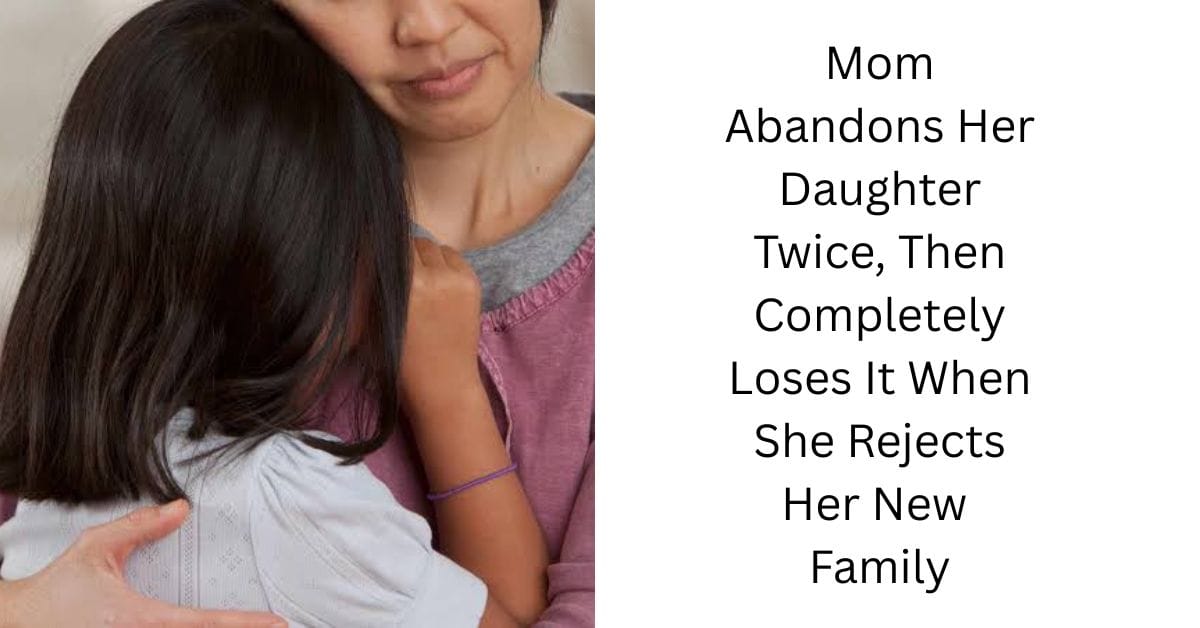
The daughter spent most of her childhood wondering why her mother had walked away. After the divorce, her mother promised that the separation was only temporary and assured her that they would always stay close. Those promises slowly faded into occasional phone calls, forgotten birthdays, and canceled visits until months turned into years. While her father and grandparents worked tirelessly to provide stability, the little girl carried the quiet hope that one day her mother would return and make up for everything she had missed. Instead, she watched from a distance as her mother built a completely new life, remarried, and welcomed another child. Family photos filled with smiling faces appeared on social media, making it painfully clear that her mother had found time and love for her new family while leaving her first daughter feeling invisible.
Years later, after barely maintaining contact, the mother unexpectedly reached out with an invitation to a large family gathering. She spoke as though nothing had happened and insisted that it was finally time for everyone to become “one happy family.” The daughter accepted the invitation, hoping for an honest conversation and perhaps the apology she had dreamed about for years. Instead, she was introduced to relatives as if she had simply been “busy” growing up, while every painful chapter of her childhood was carefully ignored. Whenever she tried to express how deeply the abandonment had affected her, her mother quickly changed the subject or reminded everyone that people should focus on the future instead of the past. It became obvious that the reunion was less about repairing their relationship and more about creating the appearance of a perfect blended family.
The Daughter Refused to Pretend Everything Was Fine
After enduring years of disappointment, the daughter finally reached her limit. She calmly explained that she could not instantly become part of a family that had been built without her and that trust could not be restored with a single dinner invitation. She wished her mother and her new family well but made it clear that she needed distance to protect her own peace. Instead of accepting responsibility, the mother reacted with anger, accusing her daughter of being selfish, unforgiving, and determined to ruin the family she had worked so hard to create. The emotional outburst shocked everyone in the room, especially those who had never heard the full story. In that moment, the daughter realized she was no longer responsible for fixing a relationship she had never broken. Walking away was painful, but for the first time in her life, she chose her own well-being over chasing the love that had always come with conditions.

Advertisement
Read Story…
My mom (42F) walked out on me (22F) as a kid and did nothing to help me when my dad became mentally unstable/unsafe and now she’s angry I don’t want to know her do-over family?
My mom (42F) walked out on me (22F) when I was 5 years old. She and my dad were no longer together at the time. Very early one morning while I was asleep at her house she carried me out to her car and drove me to dad’s house. I woke up as she was beating and kicking his door until he answered and she yelled something at him and then told me to get out of her car and make sure I had everything she packed, there were like two bags, and that was it. I didn’t see her again for 16 years.
Life was good with me and dad for a few years. But when I was 9 he started acting erratic and not himself. My mom’s parents were still in the picture and tried to help. But my dad was getting worse and worse.
My mom’s parents (66F, 68M) informed mom of what was going on and she refused to do anything. When CPS finally got involved after dozens of reports from my grandparents, I was already 14 and my dad was very unstable and unsafe. My mom was contacted and again didn’t want to know about me. So my grandparents took over custody of me.
My dad passed away three years ago after years of mentally struggling. I never found out why he got so sick so suddenly but he was not the dad I knew for the first nine years of my life. That has been difficult but I was lucky to have some family on my side.
Back in February my mom moved her whole family close to my grandparents. My mom had a whole do-over family with a husband (40s/50s) and some kids, but I’m not sure how many she has exactly. My grandparents told her she didn’t get to just get to reappear like nothing happened and have everything be okay between them.
They pointed out her abandoning me twice and showing no concern for my safety. She told them she was planning to make amends with me but that she needed their help. They told her they would need to speak to me first and I told them I had some questions for mom so I’d meet her once.
My mom gave me no answers for why she left or showed no care. She was not very believable when she told me it was the most difficult decision ever. But I do believe she has regrets. I think her biggest regret is burning the bridge with me so I won’t ever be open to a relationship with her current family, including her other children. And before anyone says it. I KNOW the kids are innocent. I KNOW they are technically my half siblings. Those two things don’t change how I feel.
I have seen her twice since then. Both times she showed up unannounced to my grandparents house when I was coming/going from there. I no longer live with them btw. She tried to force introductions but I ignored her. Another time she was visiting my grandparents and she tried to use my grandma’s phone to call me but grandma caught her.
She sent me a social media DM last week that radiated with anger where she called me out for refusing to have a relationship with her do-over family. She also requested we sit down and talk without my grandparents next time.
I don’t want to do this but I’m not sure if my grandparents will have her around because of their other grandchildren. So I’m not sure how to go forward. My grandparents seem torn enough that I don’t want to add more stress on them. This felt like a good place to get additional (I have a therapist) relationship advice. There really is never going to be a real one with me and my mom but I refuse to lose my grandparents either.
She Finally Stopped Waiting for an Apology
As the weeks passed after the confrontation, the daughter stopped expecting another apology. Instead of constantly checking her phone or wondering if her mother would finally acknowledge the pain she had caused, she poured her energy into building a life that felt peaceful and meaningful. She accepted that some wounds heal only when you stop waiting for the person who created them to fix them. Friends noticed that she smiled more often, slept better, and seemed lighter than she had in years. The silence from her mother no longer felt like rejection—it felt like freedom.
Meanwhile, the mother struggled to understand why her daughter refused to respond to repeated messages. She sent cheerful texts filled with family photos, pretending everything was normal, but avoided mentioning the difficult conversation they had shared. When those messages went unanswered, her tone slowly changed from friendly to frustrated. She insisted that her daughter was being dramatic and accused her of punishing everyone for mistakes that happened years ago. The more she was ignored, the more determined she became to force a reconciliation on her own terms.
The daughter’s father watched everything unfold with mixed emotions. He had spent years protecting his child from disappointment without ever speaking badly about her mother. He believed that every child deserved the chance to know both parents, even when one of them failed to show up. Seeing his daughter finally stand up for herself filled him with pride, but it also reminded him of the countless nights he had comforted her after another canceled visit or forgotten birthday. He quietly assured her that choosing peace over guilt was never something she should apologize for.
Members of the mother’s new family slowly began asking uncomfortable questions. Until then, they had only heard one version of the story—that the daughter was distant and difficult. After hearing what had actually happened, several relatives were shocked to learn how many promises had been broken over the years. They realized that the strained relationship had not appeared overnight but had been built on years of neglect, disappointment, and emotional absence. For the first time, the mother’s carefully maintained narrative started to fall apart.
One afternoon, the mother’s younger children innocently asked why their older sister never visited. The question caught her completely off guard. She struggled to explain the situation without admitting that she had chosen to walk away years earlier. Instead, she blamed misunderstandings and claimed that adults sometimes drift apart. Deep down, however, she knew the real answer was far more painful than she wanted to admit, especially because her younger children were beginning to notice the cracks in the image of the perfect family she had created.
The daughter, meanwhile, found support in unexpected places. Coworkers, neighbors, and longtime friends reminded her that family is not always defined by blood but by consistency, trust, and unconditional care. Their encouragement helped her realize that she had spent too much of her life measuring her worth by someone else’s choices. She no longer felt obligated to earn love from a parent who had repeatedly chosen not to be present.
An Unexpected Visit Changed Nothing
Unable to accept the distance, the mother decided to show up unannounced at her daughter’s workplace. She expected an emotional reunion, believing a public setting would pressure her daughter into forgiving her. Instead, her daughter politely stepped outside, listened quietly, and explained that surprise visits only reinforced why healthy boundaries were necessary. She refused to argue, refused to raise her voice, and calmly asked her mother to respect her decision. The conversation ended within minutes, leaving the mother stunned that emotional pressure no longer worked.

Advertisement
Word of the encounter spread throughout the extended family. Relatives who had once encouraged the daughter to “just forgive and forget” started reconsidering their advice after witnessing the mother’s behavior firsthand. They realized forgiveness could never replace accountability and that rebuilding trust required consistent effort rather than emotional manipulation. Several family members privately apologized to the daughter for expecting her to ignore years of hurt simply to keep everyone else comfortable.
The mother became increasingly desperate to repair her public image. She began posting sentimental messages online about the importance of family, hoping others would view her as a loving parent. Friends praised the heartfelt posts, unaware that her daughter had not spoken to her in months. Behind every carefully chosen photograph was a reality that social media could never capture. The daughter chose not to respond publicly, believing that peace was more valuable than proving strangers wrong.
As time went on, the daughter achieved several personal milestones. She earned a promotion at work, moved into a home she had always dreamed of owning, and surrounded herself with people who celebrated her success without conditions. Every accomplishment reminded her that healing did not require her mother’s approval. The confidence she had once searched for in a broken relationship was now growing from within.
Eventually, another family gathering was planned, and once again the daughter received an invitation. This time there were promises that everything would be different and that everyone wanted a fresh start. She appreciated the invitation but declined respectfully. She explained that a fresh start could only happen after honest accountability, not after pretending the past had never existed. Her decision disappointed some relatives, but many quietly admitted they understood her reasoning.
The rejection pushed the mother to an emotional breaking point. She accused her daughter of destroying every opportunity for reconciliation and insisted that she had done her best under difficult circumstances. Yet whenever someone gently asked what specific steps she had taken to repair the relationship, she struggled to answer. She realized that wanting forgiveness was much easier than accepting responsibility for the choices that made forgiveness necessary in the first place.
Months later, the mother finally wrote a letter instead of sending another emotional text. For the first time, she admitted that leaving had been her decision and acknowledged that her daughter had every right to feel hurt. She confessed that fear, selfishness, and poor decisions had shaped years of absence. Although the apology arrived far later than it should have, it was the first message that focused on her daughter’s pain instead of her own disappointment.
The daughter read the letter several times before responding. She thanked her mother for finally taking responsibility but explained that forgiveness and reconciliation were not the same thing. She was willing to let go of resentment for her own peace of mind, but rebuilding a relationship would require patience, honesty, and years of consistent actions. Trust, once broken repeatedly, could not be restored with words alone.
Looking back, the daughter realized that being abandoned twice had taught her an unexpected lesson about self-worth. She understood that love should never have to be begged for and that protecting her emotional well-being was not an act of cruelty. While her mother’s choices had shaped part of her story, they no longer defined its ending. By refusing to return to a relationship built on guilt instead of respect, she finally gave herself the future she had deserved all along—one filled with peace, healthy boundaries, and the confidence to choose people who truly chose her.