My Friend Expected Me To Apologize To Her Son After He Poisoned My Dog With Dark Chocolate
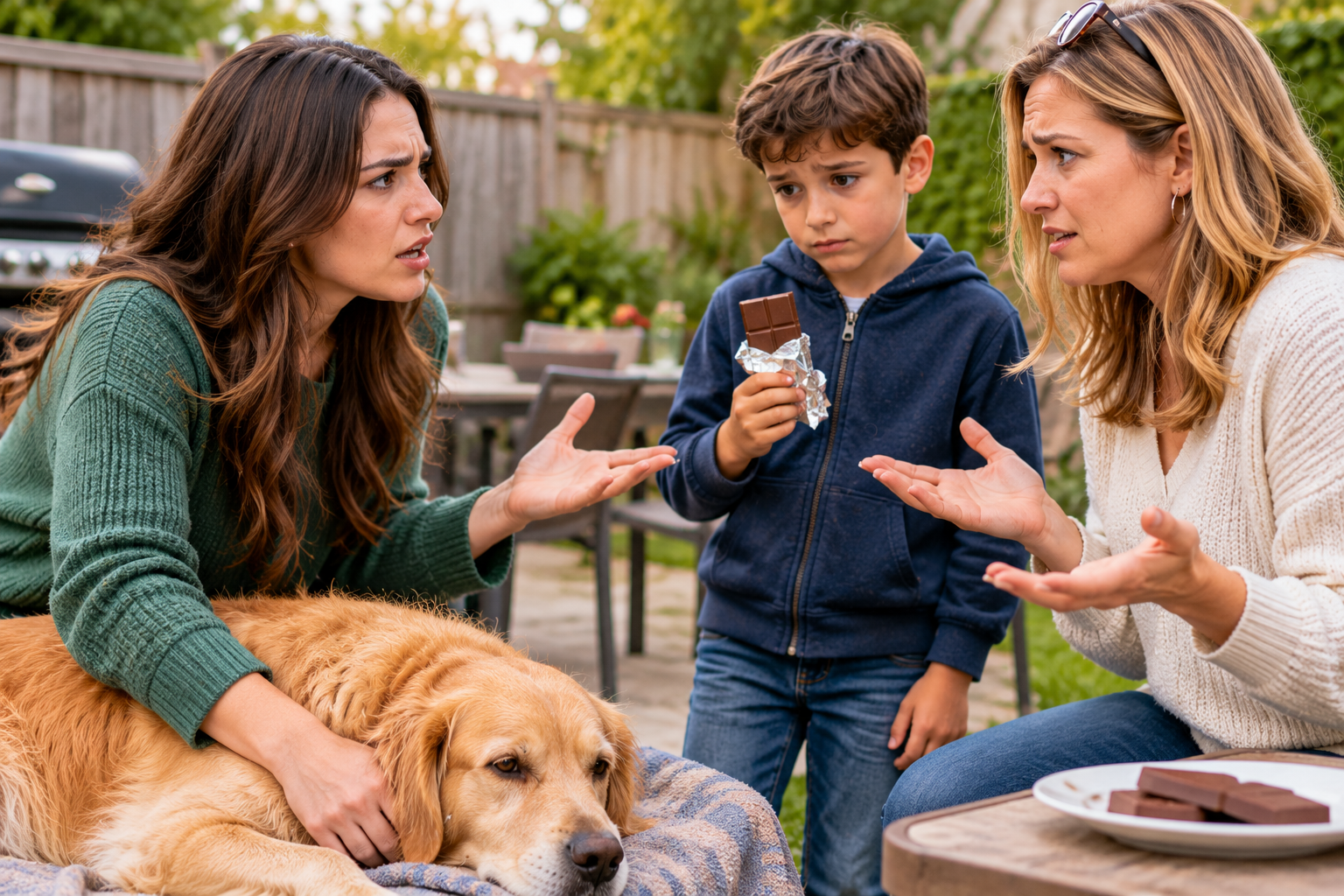
I never imagined that attending a friend’s backyard barbecue would turn into one of the most stressful and expensive experiences of my life. I’m a 30-year-old woman, and I have a dog named Max who has been part of my family for several years. Max is incredibly friendly, gentle, and well-behaved around people, which is why I usually take him with me when I’m invited to outdoor gatherings. However, I’m also very careful about what he eats because certain human foods can be extremely dangerous for dogs. One of the things I never allow anyone to give him is chocolate, especially dark chocolate. I have explained this to friends and family many times, and I always make sure people understand that even a small amount can make a dog seriously sick. Last weekend, my friend invited me to a barbecue at her house. She has a seven-year-old son who is energetic and curious, and although he generally likes animals, he sometimes gets too excited around them. Before I arrived, I reminded my friend that Max would be coming with me and asked her to make sure her son didn’t feed him anything from the table. She assured me it wouldn’t be a problem.
When I arrived, everything seemed perfectly normal. There were several guests, children were playing in the backyard, and everyone was enjoying the food and conversation. Max was walking around happily, greeting people and occasionally sitting near me whenever he wanted attention. My friend’s son came over several times and tried to give him pieces of food. I politely stopped him and explained that Max could only eat his own treats. The first time, he seemed disappointed but walked away. A little later, I noticed him holding a piece of chocolate and immediately told him not to give it to Max. I specifically explained that chocolate could make dogs very sick and that he should never feed it to him. He nodded and went back toward the other children. Unfortunately, that wasn’t the end of it. A few minutes later, I saw him standing near Max again, holding another piece of food. I repeated my warning and told him firmly that he must not feed my dog anything without asking me first. I honestly believed he understood because I had now told him twice. I turned away to speak with another guest, thinking the situation was under control. Then, out of the corner of my eye, I saw him quickly put something into Max’s mouth. When I rushed over, I realized it was a piece of dark chocolate.
I immediately panicked and asked him what he had given Max. He casually told me it was chocolate and said he thought Max would like it. I was horrified because I had already explained twice that chocolate was dangerous for dogs. I quickly checked the remaining piece and realized it was dark chocolate, which can be particularly harmful. I grabbed Max’s leash, told my friend what had happened, and rushed him to an emergency veterinary clinic. During the drive, I kept thinking about how serious the situation could become and whether I had waited too long to notice what happened. The veterinarian examined Max, asked how much chocolate he might have eaten, and explained that the amount and type of chocolate, along with a dog’s weight, determine the level of risk. They recommended immediate treatment and monitoring because of the potential for poisoning. I was terrified when I heard that his condition could become serious without proper care. The clinic treated him and kept him under observation, and thankfully, he eventually started improving. However, the entire experience was extremely stressful, and when I received the final bill, I nearly couldn’t believe it. The total cost was $1,400. I paid it because I wasn’t going to risk Max’s health just to argue about money.
After Max was finally safe, I contacted my friend and explained everything again. I told her that I had warned her son twice, that he had ignored those warnings, and that I believed she should take some responsibility for what happened. I wasn’t demanding that she pay the entire bill, but I thought splitting the $1,400 cost would be a reasonable solution. After all, I had brought Max to her house as an invited guest, and I had specifically asked her to make sure her son didn’t feed him anything. Instead of showing concern or offering to help, she became defensive. She said her son was only seven years old and couldn’t be expected to understand every danger involving animals. She also argued that I should have watched Max more carefully instead of leaving him where children could approach him. I reminded her that I had been watching him, had stopped her son twice, and had clearly explained the danger. She responded that children make mistakes and that I was being unreasonable by expecting her to pay for something her son had done. Then she said something that made me even angrier: she expected me to apologize to her son for yelling at him when I discovered what happened. According to her, I had frightened him and made him feel guilty over an accident. I told her that I wasn’t going to apologize for reacting strongly when I believed my dog had been poisoned.
The argument has continued ever since, and I’m starting to question whether our friendship is worth saving. My friend keeps telling mutual friends that I embarrassed her son in front of everyone and that I should understand he is just a little boy. Some people agree that I should have handled my anger more calmly, but others think she is avoiding responsibility for what happened. I understand that seven-year-olds don’t always make the best decisions, and I don’t believe her son intentionally wanted to hurt Max. However, that doesn’t change the fact that I clearly warned him twice and that his actions resulted in a $1,400 emergency veterinary bill. I also think his mother should have taken my warnings seriously instead of treating them like unnecessary restrictions. I would never expect a child to pay for something like this, but I do expect the parent to acknowledge the seriousness of the situation and at least discuss sharing the expenses. Instead, she is more concerned about receiving an apology than the fact that my dog needed emergency treatment. Max is recovering now, but the experience has left me feeling anxious whenever children are around him. I haven’t apologized to her son, and I haven’t agreed to pay the entire bill without at least having a proper conversation about responsibility. Am I wrong for refusing to apologize to her son and expecting my friend to split the $1,400 vet bill?
Read Story…
A or B: My friend’s 7 yo son fed my dog dark chocolate at her BBQ after I told him twice not to. The vet bill was $1,400. She won’t split it, and now she wants me to apologize to him for yelling
My friend invited me to a backyard barbecue at her house last weekend and specifically told me to bring my dog, Bagel. I’ve had Bagel for several years, and he’s a friendly, well-behaved dog who usually enjoys being around people. He isn’t aggressive, doesn’t bother guests, and is generally happy as long as he gets a little attention. However, I’m extremely careful about what he eats because some human foods can be dangerous for dogs. Chocolate is one of the biggest concerns, especially dark chocolate, which can cause serious health problems even in relatively small amounts.
Before accepting the invitation, I made sure my friend knew Bagel would be coming. She said it was perfectly fine and that her son would be excited to see him. I brought Bagel’s leash, water bowl, and his own treats so there wouldn’t be any reason for anyone to give him food from the table.
When we arrived, the barbecue was already underway. There were several guests sitting in the backyard, children were playing, and my friend had prepared a large selection of food. I found a comfortable chair and secured Bagel’s leash to it so he could relax beside me without wandering around.
Before everyone started eating, I casually mentioned to the people nearby that Bagel couldn’t have human food. I wasn’t trying to be difficult or make anyone uncomfortable. I simply wanted to prevent someone from giving him something that could make him sick. I explained that he had his own treats and that anyone who wanted to give him something could ask me first. Most people understood immediately and continued enjoying the afternoon.
My friend’s seven-year-old son, however, seemed especially interested in feeding Bagel. He kept coming over with different snacks, holding them near his face and asking whether he could give them to him.
The first time he approached with food, I smiled and told him, “Hey buddy, you can pet him, but no food.” I didn’t yell or sound annoyed because I understood that children often want to share whatever they’re eating with animals. He seemed a little disappointed, but he walked away.
A while later, he came back holding another snack and tried to offer it to Bagel. I stopped him again and explained that some foods people enjoy can make dogs really sick. I specifically mentioned chocolate and told him that he should never give Bagel anything from the table. I was careful to explain it in simple words because I didn’t expect a seven-year-old to understand every detail about animal safety.
My friend was close enough to hear both conversations. Instead of helping reinforce what I was saying, she casually commented, “He’s just being friendly.” I didn’t want to turn a fun afternoon into an argument, so I simply repeated that I wasn’t comfortable with anyone feeding my dog. I assumed she understood how serious I was and would make sure her son followed the same rule.
After everyone finished eating, my friend started asking for help carrying some dishes and leftover food inside. I agreed because there were several plates on the outdoor tables, and I didn’t mind helping clean up. I left Bagel secured beside my chair with his leash attached. He was calm, and I could still see the backyard through the glass doors while carrying things inside.
I wasn’t gone for very long, probably only a few minutes, but I never imagined something serious would happen during that short time. When I returned outside, I immediately noticed my friend’s son standing beside Bagel near the dessert table.
He was holding a piece of dark chocolate and putting it directly into Bagel’s mouth. For a moment, I honestly couldn’t process what I was seeing. I had already told him twice not to feed my dog, and his mother had heard both warnings. I rushed toward them and shouted, “Stop!” much louder than I intended.
The boy immediately started crying and stepped away from Bagel. I checked what he had been holding and realized he had given my dog dark chocolate.
I was terrified. I knew chocolate could be toxic to dogs, and dark chocolate can be particularly dangerous because it contains a higher concentration of the substances that affect them. I didn’t know exactly how much Bagel had swallowed, but I could see that he had eaten a significant amount. I immediately picked up his leash, told my friend we needed to leave, and rushed him to the nearest emergency veterinary clinic.
My friend followed me toward the driveway but seemed more concerned about her son crying than what had just happened. She told me I didn’t need to scream at him and that he was only trying to share his dessert. I barely responded because my only priority was getting Bagel medical attention. During the drive, I kept thinking about the warnings I had given earlier. I wondered how something like this could happen after I had made the rules so clear. I also felt guilty for leaving him outside, even though he was secured beside my chair and I had only gone inside to help the host.
At the emergency clinic, the veterinarian examined Bagel and asked several questions about the type of chocolate, the possible amount he had eaten, and when it happened. I explained everything as accurately as I could. After assessing the situation, the veterinarian told me that Bagel had consumed a dangerous amount of dark chocolate for a dog his size and that immediate treatment was necessary. They made him vomit to remove as much of the chocolate as possible, administered activated charcoal to help reduce further absorption, and started IV fluids.
They also decided to keep him overnight for observation because chocolate poisoning can cause serious complications, including an increased heart rate, abnormal heart rhythms, tremors, and seizures. Hearing all of that made me feel sick with worry.
I kept asking whether he would be okay, and the staff reassured me that they were doing everything they could. Unfortunately, emergency veterinary treatment is expensive, and when they eventually gave me the final bill, the total was $1,400. I paid it immediately because there was no way I was going to delay treatment or risk Bagel’s health over money.
Thankfully, Bagel improved overnight, and the veterinarian eventually allowed me to take him home. He was tired and a little uncomfortable, but he was recovering. I was incredibly relieved to have him back, although the entire experience had left me emotionally exhausted.
Once things settled down, I contacted my friend and explained that I had received the final veterinary bill. I sent her a copy and asked whether she would be willing to split the $1,400 cost with me. I wasn’t asking her to pay everything, and I wasn’t suggesting that her seven-year-old son should personally be responsible for the money.
I simply felt that she should contribute because I had specifically warned both of them that Bagel couldn’t have human food. She had heard me twice, dismissed my concerns by saying her son was only being friendly, and hadn’t made sure he followed the rule. I thought splitting the bill would be a reasonable compromise, especially considering how serious the situation could have become. However, her response was completely different from what I expected.
Instead of expressing concern or asking how Bagel was doing, my friend immediately became defensive. She said I should have kept a better eye on my dog and that it wasn’t fair to blame her for something that happened while I was responsible for him. She pointed out that Bagel was my pet and that I had chosen to bring him to a gathering where children were present. I reminded her that she had invited me to bring him and that I had kept him leashed beside my chair.
I also explained that I had warned her son twice, and she had personally heard both warnings. She responded that he was seven years old and couldn’t be expected to understand every possible danger. I agreed that children make mistakes, but I also believed that parents should take responsibility for supervising them, especially after someone clearly explains a safety rule.
Then she brought up the fact that I had shouted at her son. She said he had been crying for a long time afterward and that I had embarrassed him in front of the guests. According to her, I owed him a sincere apology because he hadn’t meant to hurt Bagel.
I haven’t denied that I yelled loudly, and I understand why my friend might have been upset about seeing her son cry. Looking back, I probably could have handled my reaction more calmly. However, I wasn’t thinking about embarrassing anyone when I saw him feeding dark chocolate to my dog. I was frightened because I knew Bagel could become seriously ill, and my reaction came from panic. I don’t believe the boy intentionally wanted to hurt him,
but I also don’t think his intentions erase what happened. My friend is now telling mutual friends that I am being unreasonable and trying to make her pay for an accident involving my own pet. Some people think I should apologize to the child, accept that I was responsible for watching Bagel, and pay the bill myself because $700 isn’t worth losing a friendship. Others believe my friend should at least split the cost because I gave clear warnings and she dismissed them.
I haven’t apologized yet, although I would be willing to explain to her son that I didn’t mean to frighten him. What bothers me most is that my friend seems to care more about my reaction than the fact that Bagel needed emergency treatment after her son ignored two warnings. So now I’m stuck between two choices.
A. Yes. I should apologize to her son, accept that I was responsible for watching Bagel, and pay the entire $1,400 bill myself. He’s only seven, and losing a friendship over $700 might not be worth it.
B. No. I should stand my ground and ask my friend to split the veterinary bill. I warned her son twice, she heard both warnings, and she dismissed my concerns. I can discuss an apology once we’ve settled the financial responsibility.
What would you do in my situation?
My Dog Bagel And Why I’m So Careful About His Safety
I never imagined that a simple backyard barbecue at a friend’s house would turn into one of the most stressful experiences of my life. I’m a 30-year-old woman, and my dog, Bagel, has been an important part of my family for several years. He’s friendly, affectionate, and generally well-behaved around other people. Whenever I take him somewhere, I make sure he has everything he needs, including his leash, water, and his own treats. I don’t mind bringing him to gatherings when people are comfortable with animals, but I’m extremely careful about what he eats. There are certain foods that dogs should never be given, and chocolate is one of the biggest concerns. Dark chocolate is especially dangerous because it contains substances that can cause serious health problems for dogs. I’ve always made this clear to anyone who spends time around Bagel because I don’t want a preventable accident to put his health at risk.
Last weekend, one of my friends invited me to a barbecue at her house. She specifically told me that I should bring Bagel because her seven-year-old son loved dogs and would enjoy having him around. I had visited her home several times before, and she had always been welcoming toward my dog. I didn’t see any reason to refuse the invitation, especially since she personally encouraged me to bring him. Before leaving home, I packed his leash, water bowl, and a small container of dog treats. I also made sure he had eaten before we left so he wouldn’t be hungry and tempted by the food everyone else would be eating. I wasn’t expecting any problems because I assumed the adults would understand that feeding someone else’s pet without permission was not appropriate.
When we arrived, several guests were already sitting in the backyard. My friend had prepared a large amount of food, and there were tables filled with snacks, drinks, desserts, and barbecue dishes. People were talking, children were running around, and the atmosphere was relaxed. I found a comfortable chair near the seating area and secured Bagel’s leash to it so he could sit beside me. He was perfectly happy watching everyone and occasionally approaching guests who wanted to pet him. I didn’t let him wander around freely because I knew there would be food everywhere and children playing nearby. I wanted everyone to enjoy the gathering without having to worry about my dog getting into anything.
Before everyone started eating, I made a point of telling the people sitting near me that Bagel couldn’t have human food. I explained that he had his own treats and that nobody should give him anything from the table. I wasn’t making a big announcement or trying to lecture anyone. I simply wanted to prevent confusion before someone offered him a piece of food. Most of the guests understood immediately. A couple of people even asked what treats he liked, and I showed them the ones I had brought from home. My friend’s son was nearby during this conversation, although I wasn’t specifically addressing him at first. I assumed his mother would explain the same rule if he became interested in feeding Bagel.
Unfortunately, her son quickly became very interested in my dog. He kept approaching him with different snacks, crouching beside him, and holding food near his face. I understood that he was excited because he liked animals, and I didn’t want to discourage him from being friendly. However, I also knew that children sometimes don’t understand why certain foods can be dangerous for pets. The first time he approached Bagel with a snack, I smiled and gently told him, “Hey buddy, you can pet him, but no food.” I explained that Bagel had his own treats and that he wasn’t allowed to eat anything from the barbecue table. The boy looked disappointed for a moment, but he walked away without arguing.
A little while later, he returned with another snack. He seemed to have forgotten what I had told him, or perhaps he thought a different kind of food would be acceptable. I stopped him again and explained that he couldn’t give Bagel anything without asking me first. This time, I specifically told him that some foods people eat can make dogs very sick. I mentioned chocolate because I knew there were desserts on the table, and I wanted to make sure he understood that it wasn’t just a matter of being picky about what Bagel ate. I wasn’t angry with him, and I didn’t raise my voice. I simply wanted him to understand that I was serious about the rule.
My friend was close enough to hear both conversations. Instead of helping me explain the situation to her son, she casually said, “He’s just being friendly.” I remember looking at her and explaining that I knew he liked Bagel, but I didn’t want him feeding my dog anything. She smiled as if I was worrying too much and went back to talking with another guest. I didn’t want to create an uncomfortable situation during her barbecue, so I decided not to argue. I had already explained the rule twice, and I believed that would be enough. I also assumed that because his mother had heard me, she would remind him not to offer Bagel any food.
As the afternoon continued, everyone started preparing for dessert. There were several different items on the table, including cakes, cookies, brownies, and pieces of dark chocolate. Bagel was still sitting beside my chair with his leash attached. He wasn’t barking or bothering anyone, and I was keeping an eye on him while talking to the other guests. At one point, my friend asked whether I could help carry some dishes inside. Several plates needed to be moved, and I didn’t mind helping because she had invited everyone and was clearly busy managing the gathering. I agreed and went inside for a few minutes.
Before leaving the backyard, I checked that Bagel was comfortable and that his leash was secure. He was sitting quietly beside my chair, and I didn’t see anything unusual happening. I honestly believed he would be fine while I helped carry the dishes. I wasn’t leaving him unattended for an extended period or allowing him to roam around the property. I simply went inside to help the person who had invited me. I never imagined that something serious could happen during those few minutes, especially after I had already explained the food restrictions to her son twice.
When I returned outside, I immediately noticed something that made my stomach drop. My friend’s son was standing beside Bagel, holding a piece of dark chocolate from the dessert table. Before I could say anything, I saw him putting it directly into Bagel’s mouth. For a second, I couldn’t believe what I was seeing. I rushed toward them and shouted, “Stop!” much louder than I intended. The boy immediately pulled his hand away and started crying. I wasn’t thinking about how loud my voice sounded or how the other guests would react. All I could think about was the fact that my dog had just been given something I had specifically warned him not to eat.
I immediately checked what was left of the chocolate and asked the boy how much he had given Bagel. He told me he had shared some of his dessert because he thought the dog would like it. I asked whether he had given him more before I came outside, but he seemed confused and couldn’t give me a clear answer. I knew I couldn’t take any chances. I had no idea exactly how much chocolate Bagel had swallowed, and I was particularly worried because it was dark chocolate. I quickly picked up his leash and told my friend that I needed to take him to an emergency veterinary clinic.
My friend followed me toward the driveway and started asking why I had screamed at her son. She said he was only trying to be nice and that I had frightened him unnecessarily. I told her that we could discuss my reaction later because Bagel needed medical attention immediately. She seemed annoyed that I wasn’t comforting her son first, but I couldn’t focus on that at the moment. I was worried about my dog, and I didn’t know how much time we had before symptoms might develop. I placed Bagel in the car and drove straight to the nearest emergency veterinary clinic.
During the drive, I kept looking at Bagel and wondering whether he was going to be okay. I felt angry, frightened, and guilty all at the same time. I was angry because I had warned the boy twice and his mother had heard me both times. I was frightened because chocolate poisoning can be extremely serious for dogs. I also felt guilty because I kept thinking that perhaps I should never have gone inside to help carry the dishes. Even though I had secured Bagel beside my chair, I wondered whether staying outside would have prevented the situation. I knew I couldn’t change what had happened, so I concentrated on getting him to the clinic as quickly as possible.
When we arrived, the veterinary staff immediately asked what Bagel had eaten, how much he might have consumed, and approximately when it happened. I explained that he had been given dark chocolate at a barbecue and that I didn’t know the exact amount. They asked about his weight and took him into the treatment area for an examination. The veterinarian explained that dark chocolate contains a higher concentration of substances that are toxic to dogs, and the amount consumed relative to a dog’s weight can determine how serious the situation becomes. Hearing that made me even more nervous because I knew Bagel wasn’t a particularly large dog.
The veterinarian recommended immediate treatment rather than waiting for symptoms to appear. They explained that they needed to remove as much of the chocolate as possible and monitor him carefully. The staff made Bagel vomit under veterinary supervision, administered activated charcoal, and started IV fluids. They also decided to keep him overnight because they were concerned about possible complications. I was told that chocolate poisoning can affect a dog’s nervous system and heart, potentially causing vomiting, restlessness, abnormal heart rhythms, tremors, or seizures. I sat in the waiting area feeling completely helpless while the veterinary team worked to make sure Bagel was safe.
At one point, the veterinarian came out to speak with me and explained that Bagel had consumed a significant amount of dark chocolate for a dog his size. They told me that bringing him in quickly had been important and that continued observation was necessary. I asked whether he would recover, and the veterinarian said they were cautiously optimistic but needed to monitor his condition. I felt relieved that he was receiving treatment, but I was still terrified. I had never expected to spend an evening in an emergency clinic because someone had decided to give my dog a piece of dessert after I specifically said not to.
The financial part of the situation was another shock. Emergency veterinary treatment is expensive, especially when a dog needs medication, fluids, and overnight monitoring. When the clinic eventually gave me the estimated cost, I was told the total would be around $1,400. I wasn’t prepared for such a large expense, but I didn’t hesitate to approve the treatment. Bagel’s health was more important than the money, and I would never refuse necessary care just because the bill was high. I paid the amount and waited for updates from the veterinary staff. I barely slept that night because I kept thinking about what could have happened if I hadn’t returned to the backyard when I did.
Thankfully, Bagel gradually improved. The veterinary team monitored him throughout the night, and his condition became stable enough for them to discharge him the following day. He was tired and needed rest, but he was finally out of danger. When I brought him home, I felt an enormous sense of relief. I gave him a comfortable place to sleep, followed the veterinarian’s instructions, and kept an eye on him throughout the day. I was grateful that he had recovered, but I couldn’t stop thinking about how easily the situation could have ended differently.
After everything settled down, I decided to contact my friend about the veterinary bill. I sent her a copy of the $1,400 invoice and explained what had happened at the barbecue. I told her that I understood her son hadn’t intended to hurt Bagel, but I had clearly warned him twice not to feed my dog. I also reminded her that she had personally heard both warnings and had dismissed my concerns by saying he was only being friendly. I wasn’t asking her to pay the entire amount. I simply asked whether she would be willing to split the cost with me because I believed she had some responsibility as the parent and host.
I thought my request was reasonable, especially considering that I had brought Bagel because she specifically invited me to do so. I had kept him leashed, brought his own treats, and explained the restrictions before the incident occurred. I wasn’t expecting her to supervise my dog or take responsibility for every little thing that happened at her house. However, when her child repeatedly tried to feed him, I expected her to reinforce the rule instead of dismissing it. I believed that sharing the veterinary expense would be a fair way to acknowledge how serious the situation had become.
Her response was not what I expected. Instead of asking how Bagel was doing or expressing concern about the cost, she immediately became defensive. She told me that Bagel was my responsibility and that I should have watched him more carefully. She argued that her son was only seven years old and that children sometimes make mistakes. According to her, it was unreasonable for me to expect her to pay for something her child had done accidentally. I reminded her that I had never blamed her son for intentionally hurting my dog. I was simply asking her to acknowledge that I had given clear warnings and that she had ignored them.
She then brought up the fact that I had shouted at her son when I saw him feeding Bagel the chocolate. She said he had been extremely upset afterward and had spent part of the evening crying. She told me that I had embarrassed him in front of the other guests and that I owed him a sincere apology. I was surprised that she was focusing so heavily on my reaction rather than what had caused it. I admitted that I had shouted loudly, but I explained that I had reacted out of fear. I had just watched her son feed something dangerous to my dog after I had already told him not to do it twice.
I also told her that I wasn’t proud of frightening a child, and if I had the opportunity to explain things to him calmly, I would. However, I wasn’t going to pretend that my reaction was the main problem. My dog had needed emergency treatment, and I had spent $1,400 because of something that could have been prevented. I believed that the adults involved should have been more concerned about Bagel’s safety. Instead, she continued insisting that I should apologize first and stop trying to make her feel guilty about an accident.
The argument became more uncomfortable when she started discussing the situation with mutual friends. Apparently, she told several people that I had screamed at her innocent seven-year-old son and then demanded money from her because my dog had eaten something. She made it sound as though I had brought Bagel to her house, failed to supervise him, and then decided to blame her family for the consequences. Some people contacted me asking why I was expecting a parent to pay for a veterinary bill when I was responsible for my own pet. Others said that she should have taken my warnings seriously and that a parent cannot simply dismiss a safety rule because a child is being friendly.
I understand that a seven-year-old doesn’t have the same judgment as an adult. I also understand that children sometimes forget instructions, become distracted, or make decisions without thinking about the consequences. I don’t believe her son deliberately wanted to poison Bagel, and I don’t want him to feel that I hate him or that he can never be around animals again. However, I also believe that children need adults to teach them boundaries, especially when those boundaries involve another living creature’s safety. If a child repeatedly ignores a clear warning, the parent should step in rather than dismiss the situation.
What bothers me most is that my friend had several opportunities to prevent this. She heard me explain that Bagel couldn’t eat human food. She heard me warn her son a second time. She even commented that he was just being friendly instead of helping reinforce the rule. I wasn’t asking her to watch Bagel every second or take over my responsibilities as his owner. I simply expected her to make sure her son didn’t keep offering him food after being told not to. If she had taken my warning seriously, I genuinely believe this entire situation could have been avoided.
I have also thought about whether I should apologize simply to keep the friendship from falling apart. I don’t enjoy conflict, and I certainly don’t want a disagreement about money to destroy a friendship that has lasted several years. At the same time, I don’t want to apologize in a way that makes it seem as though I was wrong to react when I saw my dog eating something dangerous. I can admit that my voice was too loud without accepting that I was responsible for the entire situation. I also don’t think apologizing should be a condition for discussing the veterinary bill.
My friend has now made it clear that she won’t contribute anything toward the $1,400 expense unless I apologize to her son first. She believes that I owe him an apology because he was frightened, while I believe she owes me an honest conversation about why she ignored my warnings. I would be willing to tell her son that I didn’t mean to scare him and explain why chocolate is dangerous for dogs. I don’t want him to grow up thinking that sharing food with animals is always harmless. But I also don’t want to accept all the financial responsibility when I made the rules clear before the incident happened.
Bagel is recovering well now, and that is the most important thing to me. I would happily spend the $1,400 again if it meant keeping him safe. However, I still feel that my friend should take some responsibility for what happened at her barbecue. I don’t think the fact that her son is seven automatically means the parent has no responsibility, especially when the parent heard the warnings and dismissed them. I also don’t believe that yelling in a moment of panic makes me a terrible person or means I should forget everything else that happened.
At this point, I’m considering putting some distance between us because the way she handled the situation has changed how I see our friendship. I never expected her to automatically agree with everything I said, but I did expect some concern for my dog’s health and an understanding that the incident could have been much worse. Instead, the entire conversation has become about her son’s feelings and my reaction. I don’t want to turn a child into the villain, but I also don’t want the adults around him to teach him that ignoring someone’s clear instructions has no consequences.
So now I’m wondering whether I’m being unreasonable. Should I apologize to her son for shouting, accept that I was responsible for watching Bagel, and pay the entire $1,400 veterinary bill myself? Or should I stand my ground and continue asking my friend to split the cost because I warned her son twice and she heard both warnings? I understand that the boy is only seven, but I also believe that his mother should have helped prevent this situation instead of dismissing my concerns. Am I wrong for expecting my friend to share the financial responsibility while refusing to apologize as though I caused the entire incident?