The Elm Street Corner Where My Son’s Memory Brought Forty Marines to Our Town at Dawn
When my son Daniel died, I thought the hardest part would be learning how to live in a town where every street seemed to remind me of him. He had grown up in our small community, played baseball at the school field, worked summers at the hardware store, and spent countless evenings sitting on the old bench near the corner of Elm Street. That corner didn’t look special to anyone else. It was simply a quiet intersection with an aging streetlamp, a few maple trees, and a brick building that had been empty for years. But Daniel loved that place. When he was a teenager, he would sit there with his friends after school and talk about joining the Marines someday. He eventually did exactly that, and although his military career took him far from home, he never forgot where he came from. After his death, I began visiting the corner alone, especially early in the morning when the town was still quiet. I never imagined that one morning, dozens of Marines would arrive there before sunrise because of the memory my son had left behind.
Daniel had served for several years and rarely talked about the difficult parts of his work. Whenever he came home, he preferred to tell us funny stories, complain about military food, or tease his younger sister about how much she had changed while he was away. He always said the best thing about returning home was being able to walk around town without anyone needing anything from him. The Elm Street corner became a personal landmark for him. He once told me that whenever life became overwhelming, he imagined himself sitting there again, listening to the traffic and watching the sun come up between the buildings. After he died, I couldn’t bring myself to let that place become forgotten. I started cleaning the area whenever I visited, removing weeds, picking up trash, and replacing flowers that people occasionally left there. Eventually, other residents began leaving small notes, photographs, and American flags in memory of Daniel. What began as one grieving father’s quiet habit slowly became a small memorial that the entire town recognized.
One morning, just before sunrise, I was standing at the corner when I heard the sound of vehicles approaching from several directions. At first, I assumed it was a local event or perhaps a funeral procession. Then I saw the first group of Marines step out of the vehicles. More trucks arrived behind them, and within minutes, nearly forty Marines were standing along Elm Street in uniform. I was completely stunned. Nobody had told me they were coming. One of the Marines approached me and asked if I was Daniel’s father. When I said yes, he stood straight, saluted me, and quietly said that Daniel had spoken about this corner more than anyone realized. The Marines had learned about the small memorial from people who had served with him and from letters Daniel had written during his deployment. To them, the corner wasn’t just a place in a small town. It represented the home Daniel carried with him wherever he went.
As the sun began to rise, the Marines formed a line around the corner. Some had served directly with Daniel, while others had never met him but had heard his story. One man placed a folded American flag beside the bench, while another laid down a photograph of Daniel wearing his uniform and smiling beside a group of fellow Marines. Then their commanding officer explained why they had come. Daniel had apparently written about the corner in a letter before one of his deployments, saying that no matter how far away he traveled, he always pictured himself returning there. His words had eventually been shared among people in his unit, and after his death, they decided they wanted to visit the place he had described so often. I stood there unable to speak as forty Marines remained silent around me. For the first time since losing my son, I understood that his memory didn’t belong only to our family. He had left pieces of himself with people across the country, and somehow those pieces had brought them back to the exact place where his story had begun.
That morning changed the way I thought about grief. I had spent months believing that remembering Daniel meant holding onto the pain of losing him. But watching those Marines stand together at dawn made me realize that remembrance could also be about celebrating the life he had actually lived. The town later decided to restore the corner, repair the old bench, plant new trees, and place a small memorial plaque there. The Marines stayed long enough to help with the first cleanup, and before they left, each one shook my hand. I still visit Elm Street regularly, but I no longer go there only to mourn. Sometimes I sit on the bench and watch the town wake up, just as Daniel once did. The corner is still an ordinary place to most people, but to me it will always be the place where my son’s memory brought forty Marines home at dawn—and reminded me that even after someone is gone, the mark they leave on other lives can continue bringing people together.
Read Story…
For 12 Years, He Honored His Fallen Son—Until Someone Tried to Turn It Into Content
The morning air in our county seat always smelled of wet river silt and diesel exhaust by the time November rolled around, but that dawn on Elm Street felt different. It carried the sharp, clean bite of frost and something heavier, something like a long-held breath finally letting go.
Twelve years earlier, the world had stopped for Frank Miller when a pair of casualty assistance officers stepped onto his porch with a folded wool flag and a curt telegram about his only boy, Lance Corporal David Miller.
David was nineteen when the blast tore through his Humvee in Helmand Province, and Frank had been seventy-three when he finally packed up his lathe in the backyard workshop and carried his first box of handmade wooden flags down to the municipal plaza.
He didn’t do it for money. Everybody in town knew Frank didn’t have a commercial bone in his body. He sat on that old wooden folding chair every single day from eight in the morning until noon, hand-pressing little cotton flags onto cedar dowels he turned himself on a lathe that hummed like an old refrigerator. He sold them for a dollar each, or gave them away to kids who stopped by with sticky fingers, and every single cent he took in went right back into the post office, paying for heavy cardboard boxes stuffed with beef jerky, fresh socks, and hand-tied ribbon flags sent off to active deployment units around the globe.
I used to watch him from across the street while I waited for the hardware store to open. Frank was slow-moving, his shoulders rounded by decades of leaning over lathes and tractors, but his hands were steady when he tied those little gold ribbons. He talked to nobody unless they spoke first, but if you asked him about David, his eyes would clear right up and he would tell you about how his boy could fix a diesel engine before he could drive one.
That was the life Frank built for himself after the telegram. A quiet, stubborn vigil on the corner of Elm and Commerce, keeping his boy’s memory alive one cedar dowel at a time. Until yesterday afternoon.
The afternoon sun was beating down hard on the concrete when Tyler showed up with his ring light and his carbon-fiber gimbal. Tyler was twenty-two, wore neon athletic shorts that cost more than Frank’s winter coat, and talked into his phone screen like the whole county was waiting on his next joke.
He had already harassed the cashier at the diner down the block before he spotted Frank sitting quietly behind his small folding table with its neat rows of miniature flags.
Tyler didn’t even slow down his stride. He shoved his camera right into Frank’s face, broadcasting live to twenty thousand strangers who logged on just to watch people get humiliated for content.
“What is this, ancient history hour?” Tyler shouted, laughing too loud for his own microphone. “Grandpa, nobody wants these dollar-store toothpicks.”
Before Frank could even lift his head from the book he was reading, Tyler swung his boot out and kicked the corner of the folding table. The whole thing flipped over with a sharp clatter. Wooden dowels, metal tins of coins, and two hundred tiny cloth flags scattered across the asphalt, sliding right into the oily gutter water left behind by the noon street sweeper.
Frank didn’t yell. He didn’t jump up swinging his fists the way some men half his age would have done.
He just sat there in his folding chair for a second, his brain processing the sudden violence of it, before he slowly pushed himself up using the arms of the chair.
Tyler kept the camera rolling, panning down to show the flags floating in the gray puddle. “Look at that, content gold,” Tyler laughed, stepping backward down the sidewalk. “Sell this crap somewhere else, old man. This is prime real estate now.”
Frank said nothing to him. He didn’t give the boy the satisfaction of a curse word or a raised fist. Instead, he simply stepped off the curb, ignoring the passing traffic, and got down on his shaking, arthritic knees right there in the dirty gutter water.
He started picking up every single flag. One by one. With his bare, calloused hands, smoothing the damp cotton against his thigh before placing them back into the overturned wooden box.
A few people stopped on the opposite sidewalk, shaking their heads, but nobody stepped in. Sheriff Dan Alvarez happened to be turning his cruiser onto Commerce just as Tyler was backing away, laughing and waving his phone. Dan hit the brakes, his tires crunching on the gravel, but Tyler bolted around the corner into the alley before Dan could reach him.
By five o’clock that evening, Tyler had already edited the clip, adding a mocking soundtrack and a smug caption about clearing out the deadwood. He posted it to his main channel, expecting a rush of likes and shares from teenagers who found amusement in an old veteran picking trash out of a gutter.
He had no idea who was watching.
Three hundred miles away at Camp Pendleton, Staff Sergeant Marcus Cole was sitting in the barracks common room, nursing a cup of cold instant coffee while scrolling through his phone during a rare evening off. Marcus had two deployments behind him and a knee that clicked every time it rained, but what stopped his thumb mid-scroll was the white hair and the bent back of the old man kneeling in the Texas mud.
Marcus stared at the screen, his chest tightening instantly. He knew that face. He knew those hands.
Five years earlier, when Marcus’s platoon was pinned down in a mud-brick compound in Helmand Province with dwindling rations and morale dragging lower than the desert sand, a heavy cardboard box had arrived through the mail drop. Inside wasn’t standard-issue gear. It was thirty handmade cedar-dowelled flags tied with gold ribbon, along with a handwritten note on lined yellow paper that simply read: *To the boys holding the line. My David would have been right there with you. Stay safe.*
Marcus had carried one of those little flags tucked inside the leather cover of his field notebook through every firefight for the next eight months. When he rotated back stateside, he kept it in his locker like a talisman.
Seeing that old man humiliated on a phone screen for the amusement of a punk in neon shorts made Marcus stand up so fast his chair tipped over backward.
He didn’t waste time typing comments. He unlocked his phone, pulled up his contacts, and dialed the president of the regional Texas Veterans Brotherhood chapter, a retired master sergeant named Roy who lived forty miles outside Frank’s town. Then he made two more calls to active-duty buddies stationed at Fort Cavazos.
“Get the trucks,” Marcus said into the phone, his voice flat and hard as iron. “We’re heading to Elm Street.”
By ten o’clock that night, word had spread through veterans’ group chats and local community pages across three counties. It wasn’t organized by an agency or a corporation; it moved like wildfire through the quiet networks of people who still remember what sacrifice actually looks like. Shop owners called their neighbors. VFW members checked their truck tires. By midnight, forty active-duty Marines and retired service members had formed a silent convoy heading southeast through the dark Texas highways.
At 5:30 in the morning, the street corner outside the old municipal plaza was pitch black and dead quiet. There was no traffic, just the hum of the overhead amber streetlights cutting through the predawn fog.
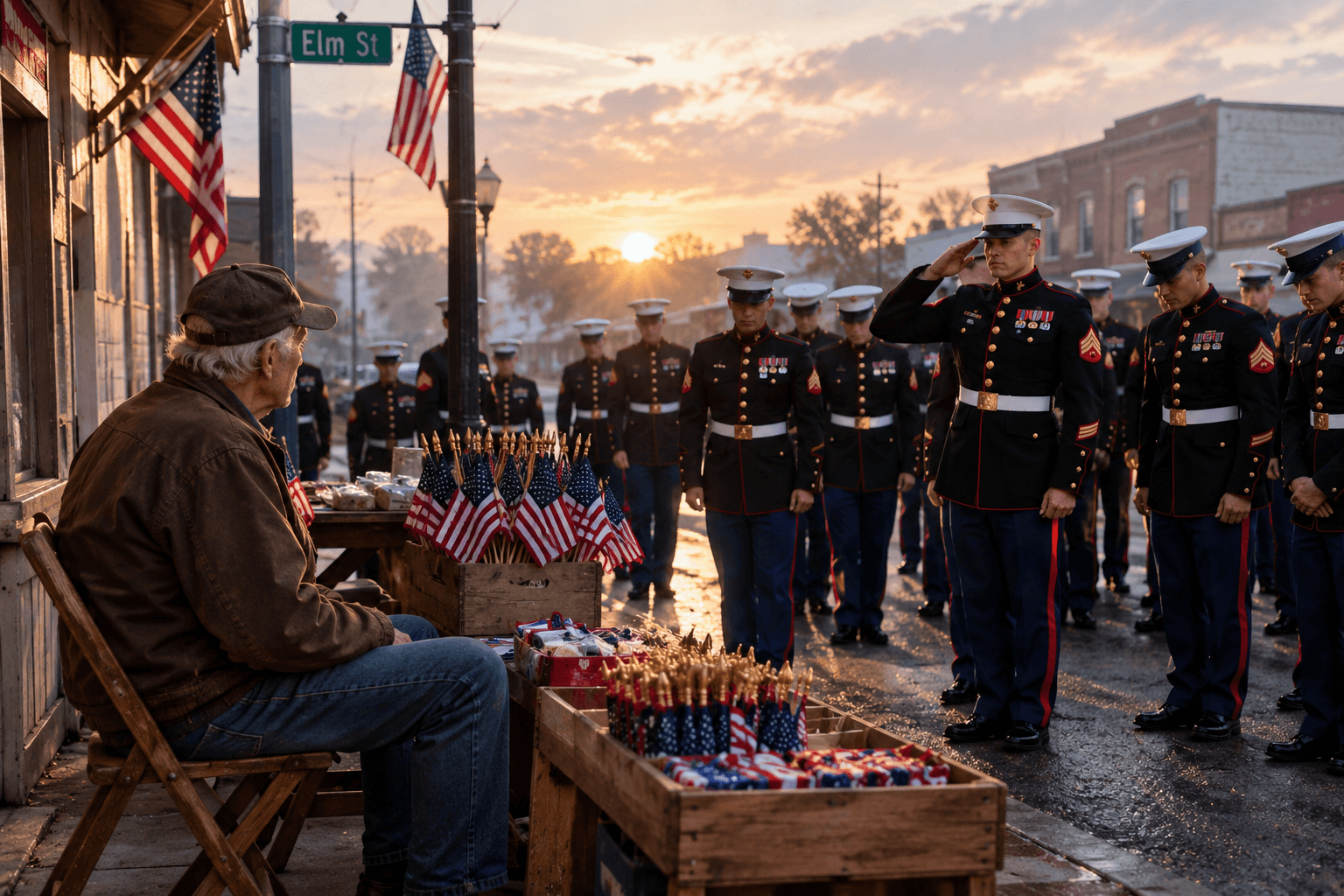
Sheriff Dan Alvarez was already parked fifty yards down the block, his cruiser lights off, watching as four unmarked SUVs and a string of pickup trucks pulled up silently along the curb. Doors opened without a sound. Big men in pristine dress uniforms stepped out onto the damp pavement, their boots clicking rhythmically against the asphalt.
They didn’t mill around or talk loudly. Staff Sergeant Marcus Cole, wearing his Class A uniform with three rows of ribbons gleaming under the streetlamp, gave a single quiet hand signal. Forty Marines moved into tight, flawless formation along the sidewalk, lining the curb for two full blocks.
Behind them, ordinary townspeople began arriving in the gray dawn light. Mrs. Gable from the bakery brought two large insulated boxes of hot coffee. The high school history teacher stood quietly beside the local pharmacist. Mechanics, church volunteers, farmers in creased denim jackets, and mothers with sleepy children walked down the sidewalks, filling the space behind the honor guard until the entire two-block stretch of Elm Street was packed shoulder-to-shoulder in reverent silence.
At 5:58 AM, the familiar rattle of Frank’s beat-up 1998 Ford pickup truck echoed down the block.
Frank turned his wheel toward the municipal plaza, his headlights cutting through the morning fog, expecting to find an empty curb, a patch of dried mud from yesterday’s humiliation, and another long morning of sitting alone with his memories.
He slowed the truck down, squinting through the windshield.
He thought his eyes were playing tricks on him. He put the truck in park right in the middle of the lane, leaving the door half-open, and stepped down onto the asphalt with his box of replacement flags tucked under his arm.
The moment Frank’s boots hit the street, Marcus Cole stepped forward two paces, snapped his heels together, and raised his right hand in a razor-sharp, flawless military salute.
Behind Marcus, forty Marines snapped into unison, their movements echoing like a single gunshot in the quiet morning air.
Frank stopped dead in his tracks. The cardboard box slipped an inch down his forearm, and his jaw went slack. He looked down the entire length of Elm Street, past the storefronts, past the brick courthouse, seeing row after row of silent, standing citizens and uniforms stretching as far as the eye could see.
Marcus dropped his salute, stepped across the curb, and walked right up to the old man. His boots made a heavy, deliberate sound on the pavement.
“Morning, Mr. Miller,” Marcus said, his voice thick with emotion. “We came to buy our flags.”
Frank couldn’t speak. His throat closed up completely, and he just stood there on the pavement as a single tear cut a clean path through the dust on his weathered cheek. He tried to raise a hand to wave, but his arm was shaking too badly.
Marcus reached out, gently taking the heavy cardboard box from Frank’s arms and setting it on a brand-new, hand-built cedar display stand that had been erected right where the old one was kicked over. Beside it stood a polished brass plaque bearing clean, deep-etched lettering.
“You didn’t have to do all this,” Frank finally managed to whisper, his voice cracking right down the middle.
“Yes, we did, Frank,” Marcus said softly, reaching into his uniform pocket and pulling out a small, frayed cotton flag attached to a faded wooden stick, the very one his unit had carried through Helmand Province five years ago. He pressed it gently into Frank’s trembling palm. “You kept us in your prayers when we were out there in the dirt. We’re here to make sure nobody ever forgets why you’re sitting on this corner.”
Before Frank could answer, the line started moving.
It wasn’t a purchase; it was a pilgrimage. The townspeople stepped forward one by one, their faces solemn and proud. Old Mrs. Gable dropped a fifty-dollar bill into Frank’s metal tin without taking change. A young mother led her six-year-old son up to the table, lifting the boy so he could select a flag directly from Frank’s box.
For the next two hours, Frank didn’t sit down once. He stood behind his cedar table, shaking hands that had built lives and buried heroes, handing out crisp miniature flags as the morning sun finally burned through the fog and hit the golden lettering on the new plaque.
Around 8:15 AM, just as the sun was clearing the roof of the hardware store, the crowd parted slightly.
Tyler came walking down the sidewalk from the alley, holding his phone out on a gimbal, grinning broadly as he checked his morning view count. He had spent the night sleeping in his car and figured an early morning follow-up video mocking the old man again would double his numbers.
He rounded the corner, expecting to see Frank sitting alone in the dirt with his scattered flags.
Instead, Tyler walked straight into a wall of forty Marines standing at parade rest, flanked by Sheriff Alvarez and two hundred watchful townspeople.
Tyler stopped dead. The color drained entirely from his face, and his phone shook in his hand. He tried to take a step backward, but Sheriff Alvarez was already standing right behind him, his hand resting casually on his leather duty belt.
“Well, Tyler,” Sheriff Alvarez said, his voice carrying clearly across the quiet street. “You wanted viral. Let’s see how your followers like a misdemeanor vandalism charge and a court summons.”
Tyler stammered something unintelligible, dropping his gimbal as the plastic housing cracked against the concrete. Nobody laughed. Nobody cheered. The crowd simply watched him with cold, flat indifference, the way people look at something unpleasant washed up by the tide. Sheriff Alvarez cuffed him quietly and led him toward the cruiser without a word.
Frank watched the cruiser drive away, then turned back to his table.
The morning air was warm now, smelling of fresh coffee and cedar shavings. Frank looked down at the little boy standing beside him, the child watching him with wide, bright eyes.
Slowly, carefully, Frank reached into his box, pulled out a crisp new miniature American flag, and placed it gently into the breast pocket of the boy’s jacket.
He looked up past the brick storefronts, past the waving flags, and caught the reflection of the morning sun shining right off the brass plaque beside his chair, reading the words carved deep into the wood: *In Loving Memory of Lance Corporal David Miller, Never Forgotten.*
Frank finally let out a long, quiet breath, knowing his boy was standing right there with him in the morning light.
After Daniel’s Death, One Quiet Corner of Elm Street Became My Most Painful Memory
When my son Daniel died, I thought the hardest part would be learning how to wake up every morning without hearing his voice. For months, everything in our small town reminded me of him. The grocery store had the same aisle where he used to steal my shopping cart when he was little. The high school baseball field still had the bleachers where he watched games with his friends. But there was one place that affected me more than anywhere else: the quiet corner of Elm Street. It was an ordinary intersection with an old streetlamp, several maple trees, a worn wooden bench, and a brick building that had been empty for years. To everyone else, it was simply another corner. To Daniel, it had been his favorite place in town.
Daniel had spent much of his childhood in our neighborhood. He wasn’t the loudest kid in school, but he had a way of making people comfortable around him. He loved baseball, old cars, fishing, and anything that involved being outdoors. As a teenager, he and his friends would gather at the Elm Street corner after school. They would sit on the bench, share snacks, listen to music, and talk about their plans for the future. I remember driving past the corner one afternoon and seeing Daniel sitting there with three friends. When I stopped and asked why they weren’t home doing their homework, he laughed and said they were discussing “important matters.” I later learned they were arguing about which one of them would become successful first.
As Daniel grew older, his plans became more serious. He wanted to join the Marines. I was proud of him, but I was also afraid. Every parent wants their child to have opportunities, yet military service carries risks that are impossible to ignore. Daniel understood those risks better than I did. He told me he wanted a life that challenged him and gave him a sense of purpose. Before leaving town, he spent one of his final evenings at the Elm Street corner. I asked him why he kept returning there, and he told me that the place helped him remember who he was before everything became complicated.
After Daniel left for the Marines, our conversations became less frequent but never less important. Whenever he called, he would ask about the weather, his grandparents, his sister, and the town. He always wanted to know whether the old brick building on Elm Street was still empty. Sometimes he joked that he would buy it one day and turn it into a restaurant. Other times he said he wanted to build a small workshop there. I never knew whether he was serious. What I did know was that he missed home more than he admitted.
Daniel eventually completed his training and began serving far from our town. Whenever he came home, one of the first things he did was visit the Elm Street corner. He would sit on the old bench alone for a while before coming home. I once asked what he thought about while sitting there. He smiled and said, “Nothing important. That’s why I like it.” Years later, I realized that answer told me more about him than I understood at the time. The corner represented a place where he didn’t have to be a Marine, a son, a brother, or anyone else’s expectation. He could simply be Daniel.
His military career eventually took him farther away from home. He rarely complained about the difficult parts. When I asked how things were going, he usually answered with something humorous. He didn’t want us worrying. There were moments when his voice sounded tired, but if I pressed him, he would change the subject. He talked about his fellow Marines with enormous respect. He told us that some people who seemed completely different from one another became extremely close because they depended on each other every day.
Then came the phone call that changed our family forever. Daniel was gone. I don’t want to describe the details because the circumstances are still painful, and there are some memories that never become easier to carry. What I remember most clearly is sitting at our kitchen table after the official notification, staring at a cup of coffee I couldn’t bring myself to drink. My wife was crying in the next room, and my daughter was calling relatives. The house was full of people, but I had never felt more alone.
After the funeral, I started visiting Elm Street. At first, I went there because I couldn’t stand staying inside the house. I would sit on the bench and look at the street, remembering Daniel as a teenager. Sometimes I expected him to appear around the corner carrying his backpack. Other times I imagined him sitting beside me complaining about something completely unimportant. I didn’t talk to anyone about these visits. They became my private way of remaining close to him.
Eventually, I began taking care of the corner. There was nothing official about it. I pulled weeds, collected empty bottles, swept leaves away from the bench, and replaced flowers when they died. One morning, I placed a small American flag beside the bench. The following week, someone else left another flag. Then someone left a photograph of Daniel playing baseball. A few days later, there was a handwritten note from someone who had known him in school. Slowly, the corner became a small unofficial memorial.
I was surprised by how many people remembered Daniel. Some had known him since childhood. Others had only met him once or twice. A former teacher told me that Daniel had stayed after class one afternoon to help another student understand an assignment. An older neighbor remembered him carrying groceries from her car. The owner of the hardware store said Daniel had once spent an entire Saturday helping clean the back room without being asked. These were small things, but they helped me see a larger picture of my son. I had known Daniel as a father knows his child. Other people had known him in ways I had never witnessed.
One morning, several months after his death, I went to Elm Street earlier than usual. It was still dark, and the streetlights were glowing through a thin layer of morning fog. I sat on the bench and listened to the distant sound of traffic. Then I heard engines approaching. At first, I thought it was a delivery truck. Then another vehicle appeared, followed by another. Within minutes, several military vehicles were moving slowly toward the intersection.
I stood up because I didn’t understand what was happening. The first group of Marines stepped out of the vehicles in uniform. Then more vehicles arrived. I counted them as they gathered, eventually realizing that there were nearly forty Marines standing along the street. I was stunned. I hadn’t been told about a ceremony. There were no signs or announcements. I wondered if they had come for another event entirely. Then one Marine approached me and asked, “Are you Daniel’s father?”
I told him that I was. He stood straight, introduced himself, and explained that he had served with Daniel. He said they had heard stories about the Elm Street corner and had learned that Daniel used to talk about it whenever he was homesick. I didn’t know what to say. I asked why there were so many of them. He simply said they wanted to see the place Daniel had described so often. Some had served directly alongside him. Others had known him through friends, letters, and stories.
More Marines gathered around the bench. Some carried small American flags, while others had photographs in their hands. One Marine placed a folded flag carefully beside the flowers that townspeople had left. Another placed a photograph of Daniel wearing his uniform. Seeing his face among all those strangers was overwhelming. I had spent months believing that my family was the only group carrying his memory. Suddenly I realized that Daniel had left memories with people far beyond our town.
Their commanding officer eventually explained that Daniel had once written about Elm Street in a letter. He had described the corner as the place he imagined when he wanted to feel at home. He apparently wrote that no matter where the military took him, he could close his eyes and picture the old bench, the maple trees, and the streetlamp glowing above the sidewalk. His fellow Marines remembered those words. After his death, they decided they wanted to visit the place he had described.
I couldn’t stop thinking about that letter. I had no idea Daniel had written those things. He had never told me that the corner meant so much to him. I had always assumed he returned there because it was familiar, not because it represented something deeper. Listening to the Marines talk about him made me realize that Daniel had carried his hometown with him wherever he went. He wasn’t simply remembering a street. He was remembering his family, his childhood, his friends, and the person he had been before he put on the uniform.
The Marines stayed at the corner for a long time. Nobody played loud music or gave a dramatic speech. There was simply a quiet gathering of people who had come because one man mattered to them. Some stood silently. Others shared stories. One Marine told me Daniel had once made everyone laugh during an exhausting day by pretending to give a serious speech about the importance of better coffee. Another remembered how Daniel always checked on people who were having a difficult time.
Hearing those stories was both painful and comforting. I wanted to remember every detail, but at the same time, I wished I could stop time and keep listening. For months, grief had made Daniel feel like someone who belonged entirely to the past. That morning changed something inside me. I realized that he was still present in the stories other people carried. His life hadn’t ended in every place simply because he was gone from our home.
After the Marines left, the town became more involved with the corner. Residents decided that the old bench should be repaired. Someone donated new flowers, another person replaced the damaged street sign, and a local carpenter offered to build a stronger bench. Eventually, the town placed a small memorial plaque near the sidewalk. It wasn’t enormous or elaborate. It simply carried Daniel’s name and a few words about remembering those who serve and the communities they call home.
My daughter became involved with the project too. She collected photographs from Daniel’s childhood and created a small display for a local community event. She had always struggled to talk about her brother after his death, but working on the display gave her a way to remember him without feeling overwhelmed. My wife also began visiting the corner. Sometimes we went together, and sometimes we went separately. We discovered that grief didn’t have to look the same for everyone. We could remember Daniel in our own ways and still share the same love for him.
Months later, I received a letter from one of the Marines who had visited that morning. He thanked our family for allowing them to come to Elm Street and told me that Daniel had spoken about home more often than I realized. The letter ended with a simple sentence saying that the corner had helped them understand the part of Daniel they couldn’t see while serving with him. I kept that letter in the same drawer where I keep Daniel’s childhood photographs. It became one of the things I return to whenever grief becomes particularly heavy.
Today, the Elm Street corner looks different. The old bench has been replaced, the flowers are better maintained, and the plaque is visible from the sidewalk. But I still prefer to remember it the way Daniel knew it. I like the old streetlamp, the uneven pavement, and the maple trees that drop leaves across the sidewalk every autumn. I sometimes sit there before sunrise, when the town is quiet and the streets are nearly empty. I think about my son as a little boy, then as a teenager, and finally as the Marine who carried memories of this ordinary place across the country.
I used to believe that losing someone meant eventually losing the places that reminded you of them. Now I understand that the opposite can happen. A place can become more meaningful because someone loved it. Elm Street was never famous, and there was nothing extraordinary about that corner. But Daniel made it important through the memories he created there. One morning, forty Marines came to our town because they remembered how much that corner meant to him. They stood there at dawn, surrounded by people who had loved him in different ways, and for a few minutes, our small town felt connected to the larger world he had entered. I still miss my son every day. But when I sit on that bench now, I don’t only feel the pain of his absence. I also feel grateful that his memory continues to bring people together.