14YO Sneakily Wears Aunt’s Sapphire Engagement Ring, Mommy Calls It Her Property As It’s Stuck
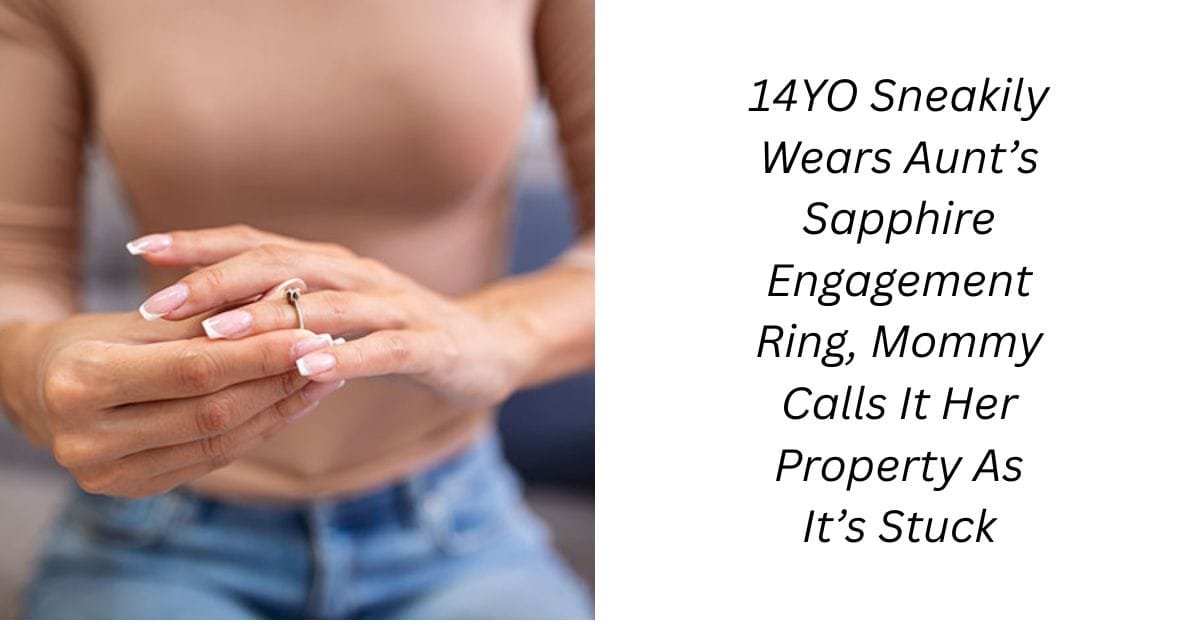
When this 14-year-old girl secretly slipped her aunt’s sapphire engagement ring onto her finger, she probably thought it would be a harmless little experiment. The ring was beautiful, eye-catching, and clearly something that had fascinated her for a long time. She had seen it on her aunt’s hand during family gatherings and knew it was a sentimental piece with a history behind it. According to the story, the teenager apparently waited until she had an opportunity to try it on without asking. What she did not expect was for the ring to become stuck. Instead of simply sliding it back off, the ring refused to move, turning what began as a secret moment of curiosity into a full-blown family conflict. When her mother became involved, the situation became even more complicated because she reportedly insisted that the ring was essentially her daughter’s property. That claim left the aunt shocked, especially considering that the ring had never been given to the teenager in the first place.
The aunt was reportedly upset not only because her expensive engagement ring had been taken without permission, but also because of the emotional meaning attached to it. An engagement ring is not simply another piece of jewelry, especially when it represents a relationship, a major life event, and years of memories. The sapphire made this particular ring even more distinctive, and the aunt had apparently treasured it for a long time. When she discovered that her teenage niece had secretly taken it and put it on, she expected an apology and a straightforward solution. Instead, the situation reportedly became tense when the teenager’s mother defended her daughter. Rather than focusing on why the ring had been taken without permission, the mother allegedly argued that because her daughter had been wearing it and had somehow managed to get it stuck, the ring should now be treated as her property. From the aunt’s perspective, this was difficult to understand. She had not given the ring away, nor had she agreed to let the teenager keep it. The fact that the ring was physically stuck on the girl’s finger did not change who originally owned it.
Things became even more stressful when the family realized that forcing the ring off could potentially hurt the teenager. Everyone suddenly had two separate problems to deal with: recovering the ring and making sure the girl was safe. The aunt reportedly wanted the jewelry removed as soon as possible, but the situation could not simply be solved by pulling harder. The teenager was caught in an uncomfortable position because she had knowingly taken something that did not belong to her, yet she was also facing a genuine physical problem. Her mother, meanwhile, allegedly continued to treat the situation as though the aunt was being unreasonable. This created a strange dynamic in which the person whose property had been taken was being pressured to compromise, while the person who had taken it was being defended. Other family members reportedly became involved as the argument grew, with some believing the teenager had made a foolish mistake that should be handled calmly, while others felt that the mother’s attitude was making the situation far worse than it needed to be.
The aunt reportedly tried to make it clear that she was not interested in humiliating or punishing her niece. Her main concern was getting her ring back and making sure everyone understood that permission mattered. She apparently knew that teenagers sometimes make impulsive decisions without fully thinking through the consequences. Trying on a piece of jewelry out of curiosity could have been treated as a teachable moment if the teenager had immediately admitted what she had done. But according to the story, the problem became much bigger because her mother allegedly refused to acknowledge that the ring belonged to the aunt. The aunt reportedly found herself asking a simple question: how could something become another person’s property simply because they secretly put it on? The argument also raised concerns about boundaries within the family. If a teenager could take something valuable without asking and then have a parent defend the action, what would prevent a similar situation from happening again?
The teenager reportedly became increasingly embarrassed as the adults argued around her. At fourteen, she was old enough to understand that secretly taking someone else’s belongings was wrong, but she was also young enough to panic when the consequences became serious. What may have seemed exciting or funny at first suddenly turned into something much more frightening. The ring was no longer just an accessory she was experimenting with; it was physically stuck, and the adults around her were arguing about ownership. According to the story, the girl eventually had to confront the reality that her decision had created a problem she could not solve on her own. The aunt reportedly remained frustrated but was also concerned about her niece’s safety. That combination of anger and concern made the situation emotionally complicated. She wanted accountability, but she also did not want her niece injured simply because of a bad decision.
What made the disagreement particularly uncomfortable was the mother’s reported argument that the ring was her daughter’s property. That statement allegedly stunned the aunt because ownership does not normally transfer simply because someone possesses an item. The aunt reportedly pointed out that she had never gifted the ring to her niece and had never said the teenager could borrow it. From her perspective, the ring was still hers regardless of where it happened to be at that moment. The mother apparently disagreed, leading to a heated discussion over whether the teenager should be expected to return something she had never legally or knowingly received as a gift. Other relatives reportedly struggled to understand the mother’s position. Some believed she was simply protecting her daughter from embarrassment, while others thought she was setting a dangerous precedent by refusing to make her child take responsibility.
Eventually, the family had to focus on the immediate issue rather than the argument. Since the ring was stuck, they reportedly sought an appropriate way to have it removed safely instead of continuing to fight over who was right. The experience was stressful for everyone, particularly the teenager, who was reportedly frightened by how serious the situation had become. Once the immediate problem was addressed, however, the bigger family issue remained unresolved. The aunt still expected her ring to be returned and wanted acknowledgment that it had been taken without permission. The mother reportedly believed her daughter had somehow gained a claim over it. That disagreement exposed deeper tensions that had apparently existed beneath the surface. What started with one teenager secretly trying on a beautiful sapphire ring had become a debate about parenting, boundaries, respect, responsibility, and whether family members should be allowed to take each other’s belongings without consequences.
For the aunt, the most upsetting part may not have been the temporary loss of the ring itself. It was the attitude surrounding the incident. She reportedly felt that an apology would have gone a long way. If the teenager had admitted that she had been curious, apologized for taking the ring, and promised never to do it again, the situation might have ended quickly. Instead, the mother’s defense allegedly transformed a teenage mistake into a serious family dispute. The aunt reportedly began questioning whether she could safely leave valuable or sentimental belongings around certain relatives in the future. She also wondered whether maintaining boundaries would mean distancing herself from family members who did not respect them. At the same time, some relatives reportedly believed that cutting ties over an incident involving a teenager would be excessive. Others argued that the real problem was not the girl’s curiosity but the adult response that followed.
In the end, the sapphire ring became a symbol of something much larger than jewelry. It represented trust, personal boundaries, and the difference between making a mistake and refusing to take responsibility for one. The teenager may have only intended to see what the ring looked like on her hand, but the decision to take it secretly created consequences she could never have predicted. Her mother’s reported reaction then added another layer to the situation, leaving the aunt wondering whether her own family respected her belongings at all. Even after the physical problem was resolved, the emotional damage remained. The family now had to decide what mattered more: protecting feelings in the short term or teaching the teenager an important lesson about ownership and consent. And perhaps the biggest question was still unanswered—if the mother truly believed that her daughter had a right to the ring, what did she think should happen the next time her daughter decided she wanted something that belonged to someone else?
Read Story…
Sister things i should give my niece my engagement ring because it got stuck on her finger and she’s “traumatized”.
So im going through a divorce and i obviously don’t want to wear my engagement ring anymore, it custom made for me and its truly so beautiful, my ex and i decided we’d save it for my daughter one day, so i have it in my jewelry box. Anyway. My sister was over to picks some things up and she brought her kids, and her daughter (14f) decided to do a little snooping.
I’m a big jewelry fan and it’s kinda the one thing i treat myself on and i love one of a kind pieces. I do not like people touching my stuff in general but especially something unique and expensive. My niece has always like my jewelry and done that thing kids do where they are like “i wish i had something like that” and give you those eyes hoping you’ll gift it to them. She when it came time to leave and she was hiding her hands in her pockets looking super guilty i knew something was up.
She was wearing my engagement ring, and it was stuck and her finger was swollen, we had to go and get it cut off. It’s not gonna be a hard fix but i do have to pay to get the band fixed and my sister doesn’t see why she should be the one to pay. She even suggested that if she pays for it her daughter she get to keep it. Huh??? Whaaaaattt?
Oh and she thinks it’s fine because “it’s not like you wear it anymore” girl goodbye.
Also the little thief had a few other pieces in her pockets of course but this one ring just got stuck and she got caught. But i should reward her with my former, sapphire engagement ring apparently.
And now i remember why i cut my sister off when i got married.
A Secret Attempt to Wear Her Aunt’s Sapphire Ring Turns Into a Family Dispute
When this 14-year-old girl secretly slipped her aunt’s sapphire engagement ring onto her finger, nobody expected a simple act of curiosity to turn into a major family dispute. The ring had always stood out whenever her aunt wore it. Unlike ordinary jewelry, it carried sentimental value and a history that made it particularly important to its owner. The deep blue sapphire caught the light, surrounded by a setting that made the ring impossible to ignore. The teenager had apparently admired it for quite some time, and on one occasion, she decided she wanted to see how it looked on her own hand. Instead of asking permission, however, she reportedly waited until she had an opportunity to take it and quietly slipped it onto her finger. What happened afterward transformed what might have been an innocent mistake into an uncomfortable argument about ownership, responsibility, and family boundaries.
At first, the teenager reportedly believed she could simply try the ring on and put it back before anyone noticed. She may have assumed that because she was family, borrowing the ring for a few minutes would not be considered a serious issue. That assumption quickly proved to be wrong. Once the ring was on her finger, it apparently did not slide off as easily as she expected. She tried to remove it, but the ring had become increasingly difficult to move. Panic began to replace curiosity as she realized she had created a problem. What had started as a secret attempt to wear a beautiful piece of jewelry had suddenly become something much more serious. The ring was not hers, she had never received permission to take it, and now she could not simply return it to its owner.
The aunt reportedly discovered what had happened after noticing that her ring was missing. At first, she may have assumed she had simply misplaced it. Like many people, she probably searched through the usual places before realizing that the ring might have been taken or moved. When she eventually discovered it on her teenage niece’s finger, the situation became immediately obvious. The aunt reportedly asked why the girl had taken the ring without permission. The teenager apparently admitted that she had wanted to try it on. While the aunt may have understood the curiosity behind the decision, she was reportedly upset that the teenager had taken something valuable and sentimental without asking. Her concern became even greater when she realized that the ring was stuck.
The situation suddenly became less about punishment and more about getting the ring safely removed. Nobody wanted the teenager to get hurt, and nobody wanted to damage the ring either. Because fingers can swell when someone becomes frightened or when a ring remains stuck for too long, the family reportedly realized that forcing it off could make the situation worse. The teenager was now dealing with the consequences of a decision that had seemed harmless only moments earlier. She reportedly became embarrassed and anxious as the adults discussed what should be done. Meanwhile, her aunt was caught between being angry about the theft of her property and being concerned about the well-being of her niece.
Then the teenager’s mother reportedly entered the dispute, and her reaction changed everything. Instead of simply apologizing on behalf of her daughter and helping resolve the problem, she allegedly argued that the ring should now be considered her daughter’s property. That statement reportedly left the aunt stunned. From her perspective, nothing about the situation suggested that ownership had changed. She had not gifted the ring to the teenager, had not agreed to lend it permanently, and had not given permission for her niece to take it. The fact that the teenager happened to be wearing it did not mean that the jewelry suddenly belonged to her.
The mother reportedly insisted that the circumstances were different. She allegedly argued that because the ring had been placed on her daughter’s finger and had become stuck, the aunt should stop treating the teenager as though she had deliberately stolen it. According to the mother’s reasoning, the situation had become an accident, and the family should simply accept it. The aunt reportedly disagreed strongly. She understood that the ring being stuck might have been accidental, but she believed taking it without permission had been intentional. Those were two completely different issues in her mind. She could sympathize with the teenager’s predicament without agreeing that the teenager had any claim to the ring.
As the disagreement continued, the teenager reportedly became increasingly uncomfortable. She was caught between her mother and her aunt, two adults who were now arguing about something she had caused. At fourteen, she was old enough to understand that secretly taking someone else’s belongings was wrong, but she may not have anticipated how quickly the situation would escalate. What might have initially felt exciting or playful had become a family confrontation. She reportedly wanted the situation to end, but the disagreement between the adults made that difficult. Every minute the argument continued, the ring remained stuck and the tension inside the family grew.
The aunt reportedly tried to explain that the sentimental value of the ring made the situation particularly upsetting. An engagement ring is often connected to important memories, and this particular sapphire ring apparently had special meaning to her. It was not simply an expensive object sitting in a jewelry box. It represented a relationship and an important chapter of her life. Even if the teenager had only intended to wear it briefly, taking it without permission crossed a personal boundary. The aunt reportedly felt that the family was overlooking that part of the situation by focusing only on the fact that the ring was now stuck.
The mother, however, reportedly continued to defend her daughter. She allegedly suggested that the aunt was making too much of the situation and should be more understanding because the teenager was still young. That argument created another disagreement. The aunt reportedly believed that being fourteen did not mean the girl should be free from consequences. In her view, teenagers need boundaries precisely because they are still learning how to handle responsibility. If every mistake is excused simply because someone is young, they may never learn where the boundaries are. She reportedly wanted the teenager to understand that asking permission mattered, especially when dealing with someone else’s valuable belongings.
Other family members apparently began taking sides as the argument became more intense. Some relatives reportedly thought the teenager had simply made a foolish mistake and that everyone should calm down. Others understood why the aunt was angry and believed the mother was making matters worse by refusing to acknowledge the original problem. The situation became one of those family disputes where the original incident starts to become less important than the arguments surrounding it. Instead of everyone working together to solve the immediate problem, people were debating who was responsible, who was overreacting, and whether the teenager should face consequences.
Meanwhile, the physical issue with the ring remained unresolved. The teenager reportedly still had the sapphire ring stuck on her finger, making the situation increasingly urgent. The family needed to find a safe way to remove it without causing unnecessary injury or damaging the jewelry. The aunt reportedly wanted professional help rather than risking the ring or the teenager’s finger. The mother may have preferred to handle things herself, but the tension between the adults made even simple decisions difficult. Every person involved appeared to have a different opinion about what should happen next.
Eventually, the focus shifted toward getting the ring removed safely. Rather than continuing to argue, the family reportedly considered seeking professional assistance. The teenager was understandably nervous because the entire experience had become far more serious than she had imagined. She had not intended to cause an emergency, and yet she was now at the center of one. The aunt reportedly remained concerned about her niece even though she was still angry about what had happened. That complicated the emotions of the situation. She did not want the teenager to be harmed, but she also did not want concern for her safety to erase the issue of responsibility.
The aunt reportedly made it clear that once the immediate problem was resolved, she expected the ring to be returned. From her perspective, that should never have been a question. The ring belonged to her before the incident, and nothing had happened to transfer ownership. She reportedly could not understand why the teenager’s mother was treating the ring as though it had become a gift. If someone takes another person’s phone without permission and accidentally drops it, the phone does not suddenly become theirs. In the aunt’s mind, the same basic principle applied to her engagement ring.
The mother’s argument reportedly became one of the strangest parts of the entire dispute. She allegedly maintained that because the ring had become stuck on her daughter, the aunt should consider the circumstances and allow the teenager to keep it. The aunt reportedly found that reasoning completely unacceptable. She may have wondered whether the mother would make the same argument if the item involved were even more valuable or emotionally significant. If accidental possession could somehow become ownership, family members might begin worrying about leaving anything valuable within reach. The disagreement therefore became less about one ring and more about whether basic property boundaries were being respected.
The teenager reportedly had to listen as the adults discussed her behavior. At some point, she may have realized that the consequences were not simply about losing the privilege of trying on a piece of jewelry. Her decision had created mistrust. The aunt could now reasonably wonder whether she could leave personal belongings around her niece without worrying about them being taken. That loss of trust may have been more painful than the temporary inconvenience caused by the ring itself. Families often assume that relatives will respect their belongings without needing strict rules, so violating that expectation can create deeper damage than people initially realize.
The aunt reportedly did not believe the teenager was a terrible person. She understood that fourteen-year-olds can make impulsive decisions. Curiosity, peer influence, excitement, and poor judgment can all play a role in teenage behavior. What bothered her was reportedly the lack of accountability afterward. She might have been willing to treat the incident as a mistake if the teenager had immediately admitted what she had done and apologized. Instead, the mother’s defense allegedly shifted the conversation away from the teenager’s decision and toward an argument over ownership.
That distinction became extremely important. There were really two separate questions. The first was why the teenager took the ring without permission. The second was what should happen because the ring became stuck. The aunt reportedly believed the first issue required accountability while the second required practical help. The mother, on the other hand, seemed to combine the two issues into one argument. Because the ring was stuck accidentally, she allegedly believed the teenager should not be blamed for taking it. The aunt reportedly thought that was unfair because the accident happened only after the unauthorized taking.
As the hours passed, the family tension reportedly increased. Conversations that might normally have been calm became arguments. People began revisiting previous disagreements and questioning one another’s parenting choices. The aunt reportedly wondered whether this was an isolated incident or whether the teenager had previously been allowed to get away with similar behavior. The mother reportedly felt that her daughter was being treated too harshly. Neither side seemed willing to back down. The teenager remained caught in the middle, likely wishing she had never touched the ring in the first place.
Eventually, the aunt reportedly explained that she was not demanding an extreme punishment. She did not necessarily want the teenager humiliated or treated like a criminal. What she wanted was a simple acknowledgment that the ring had been taken without permission. She reportedly wanted her niece to understand that family relationships do not eliminate the need for boundaries. In fact, she may have believed family should make people more respectful of one another’s belongings, not less. The aunt reportedly hoped the teenager could learn from the experience rather than simply feel ashamed of it.
The mother reportedly interpreted the aunt’s position differently. She allegedly believed that because the teenager was young, the adults should protect her from what she considered unnecessary criticism. She may have felt that admitting wrongdoing would make her daughter look bad or damage her confidence. But the aunt reportedly believed the opposite. In her view, acknowledging a mistake is not the same as labeling someone a bad person. A teenager can make a bad decision without being a bad person. The important part is learning how to make a better decision next time.
The situation also raised questions about parenting. Some relatives reportedly wondered whether the mother’s instinct to defend her daughter had gone too far. Parents naturally want to protect their children, especially when they are embarrassed or frightened. But there is a difference between protecting a child from harm and protecting them from accountability. In this case, the aunt reportedly believed the mother had crossed that line. The teenager needed help getting the ring off, but she also needed to understand why secretly taking it had been wrong.
There was also the issue of sentimental value. The aunt reportedly explained that even if the ring had been inexpensive, she would still have expected permission to be respected. But because it was an engagement ring with personal meaning, the incident felt even more invasive. Jewelry can carry memories that cannot be replaced simply by buying another piece. Even if the physical ring could eventually be replaced, the emotional history attached to it could not. That was reportedly why the aunt felt particularly hurt by the mother’s suggestion that ownership should somehow change.
The teenager’s embarrassment may have eventually become an important part of the story. At fourteen, being the center of an adult family dispute can be overwhelming. She may have initially been excited by the idea of wearing the beautiful sapphire ring, only to realize that her actions had created a situation she could not control. She reportedly had to face not only the physical discomfort of the stuck ring but also the disappointment of her aunt and the disagreement between her mother and other family members. It was a harsh lesson, but potentially one she would remember for years.
Once the ring was finally dealt with, the family still had to decide what would happen next. The physical problem could be solved, but the emotional disagreement could not be removed as easily. The aunt reportedly wanted the ring back and wanted the incident acknowledged. The mother reportedly remained convinced that her daughter deserved more understanding. The teenager was left between them, knowing that her original decision had started the entire conflict. The question became whether the adults could put aside their anger long enough to teach her something constructive.
Some relatives reportedly believed the whole incident should be forgotten once the ring was returned. They argued that teenagers make mistakes and that families should not allow one foolish decision to permanently damage relationships. Others believed that ignoring the incident would send the wrong message. If the teenager walked away believing that secretly taking someone’s property was acceptable because her mother would defend her, the lesson could be far more damaging than the original mistake. The aunt reportedly leaned toward the second view.
The disagreement also exposed how differently family members viewed ownership. To the aunt, ownership was straightforward: she owned the ring, and her niece had taken it without permission. To the mother, the circumstances surrounding the ring somehow changed the situation. That difference in perspective made compromise difficult. Neither side seemed to be arguing about the same thing. One was focused on boundaries and property, while the other was focused on protecting a teenager from consequences. Until they recognized that distinction, the conflict was unlikely to disappear.
The teenager reportedly had an opportunity to make the situation better by apologizing. A sincere apology would not undo what happened, but it could have shown that she understood why her aunt was upset. The aunt reportedly did not expect a fourteen-year-old to behave perfectly. What she wanted was honesty and responsibility. If the teenager could admit that she should have asked before touching the ring, the incident might eventually become a family story about a terrible mistake rather than a permanent source of resentment.
The mother’s reaction remained the most controversial aspect for some relatives. Defending a child is understandable, but relatives reportedly questioned whether calling the ring the teenager’s property went too far. They believed that statement blurred the difference between an accident and an unauthorized action. The ring being stuck was accidental. Taking it without permission was reportedly not. Those two facts could both be true at the same time. The teenager could deserve compassion for the accident while still being expected to take responsibility for the decision that led to it.
For the aunt, trust may have been the hardest thing to repair. She could eventually get her ring back, but she could not immediately forget that someone had secretly taken it. Whenever she wore the sapphire afterward, she might remember the argument surrounding it rather than simply the memories associated with her engagement. That is what made the incident so emotionally complicated. A valuable object had become the center of a dispute that revealed tensions within the family that might otherwise have remained hidden.
The story also raises a broader question about how adults should respond when teenagers make mistakes. Should parents immediately defend their children, or should they encourage them to acknowledge what they did and repair the damage? There is obviously room for compassion, especially when a young person is frightened. But compassion and accountability do not have to be opposites. A teenager can be comforted while still being told that taking someone else’s property without permission was wrong. In fact, that combination may be one of the most effective ways to teach responsibility.
The aunt reportedly hoped the incident would ultimately become a lesson rather than a permanent family feud. She did not want one fourteen-year-old’s impulsive decision to destroy relationships. But she also did not want the family to pretend that nothing had happened. Her position was reportedly simple: mistakes happen, but people should own them. If the teenager could understand that lesson, then perhaps something positive could eventually come from the entire situation.
For the teenager, the sapphire ring may have become a powerful reminder of consequences. What looked beautiful and exciting when she first slipped it onto her finger quickly became a source of stress, embarrassment, and conflict. She learned that curiosity does not automatically create permission and that even something as simple as trying on jewelry can have consequences when boundaries are ignored. She may also have learned that having someone defend you does not necessarily mean you have done nothing wrong.
The mother’s behavior, meanwhile, could have consequences of its own. By reportedly insisting that the ring was her daughter’s property, she risked turning a relatively manageable teenage mistake into a much larger conflict. Instead of helping her daughter apologize and resolve the situation, she allegedly challenged the aunt’s ownership entirely. That could make reconciliation more difficult. The aunt might now feel that the issue is not simply about a teenager’s poor judgment but about whether her sister or relative respects her rights and boundaries.
In the end, the sapphire engagement ring represented far more than jewelry. It became the center of a dispute involving trust, family loyalty, parenting, responsibility, and personal boundaries. A fourteen-year-old girl had wanted to experience what it felt like to wear a beautiful ring that belonged to her aunt. She took it secretly, discovered that it was stuck, and suddenly found herself at the center of an argument nobody had expected. The aunt wanted her property respected, the mother wanted her daughter protected, and the teenager had to face the consequences of a decision she probably wished she could undo.
Perhaps the biggest lesson is that family should not mean people are entitled to one another’s possessions. Being related can create closeness and trust, but it does not erase the need to ask permission. At the same time, teenagers deserve the opportunity to learn from mistakes rather than being permanently defined by them. The ideal outcome would have been simple: safely remove the ring, return it to its rightful owner, have the teenager apologize, and move forward with a clearer understanding of boundaries. But because the adults reportedly disagreed so strongly about ownership and accountability, what could have been a short lesson became a much bigger family drama.
And that leaves the most uncomfortable question hanging over the entire situation: Was the 14-year-old simply a curious teenager who made a foolish mistake, or did her mother’s decision to call the ring her daughter’s property teach her that taking something without permission could be justified afterward? The answer may determine whether this remains one embarrassing family story or becomes the beginning of a much deeper conflict over trust and boundaries.