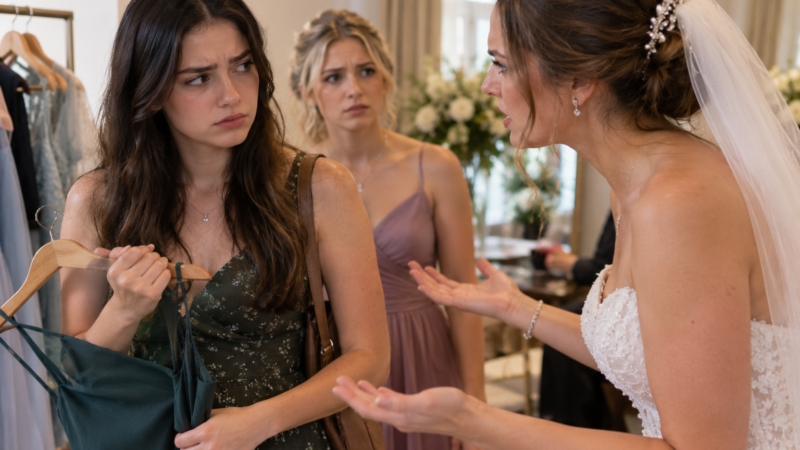
AITA for Not Giving Up My Plans to Help My Aunt on Her Wedding Day?

I never expected that refusing to babysit for a few hours would turn into such a huge family argument, but somehow, that is exactly what happened. My aunt is getting married soon, and while I am genuinely happy for her, my family seems to believe that her wedding automatically means everyone else has to rearrange their lives to accommodate her. I understand that weddings are important occasions, and I would never intentionally do anything to ruin such a special day for someone I love. However, I also have my own responsibilities, commitments, and plans that deserve respect. When my aunt asked me to babysit her children during her wedding celebrations, I politely explained that I already had something important planned. Instead of accepting my answer, she acted as though I had personally betrayed her, and now several members of my family are treating me like I am the most selfish person alive.
For some background, my aunt has two children who are still quite young and require constant attention. I love my cousins, and whenever I have free time, I enjoy spending time with them. I have babysat them on several occasions in the past, usually when my aunt needed to run errands, attend appointments, or take care of something unexpected. Most of the time, I never had a problem helping her because I understood that parenting can be exhausting, and sometimes family members need a little extra support. However, over time, I started noticing that my aunt was becoming increasingly comfortable assuming that I would always be available whenever she needed someone to watch her children. She would sometimes tell me about her plans rather than ask whether I was free, and if I mentioned having other commitments, she would act disappointed until I eventually felt guilty enough to reconsider. I did not want to create unnecessary tension in the family, so I often tried to accommodate her requests. Unfortunately, I think my willingness to help in the past made her believe that my time was always available to her.
When my aunt announced her wedding plans, everyone in the family was excited. She had been looking forward to getting married for a long time, and naturally, people wanted everything to go smoothly. I congratulated her, helped with a few small things when I could, and told her that I hoped she had a wonderful wedding. A little while later, she contacted me and explained that she needed someone to look after her children during the wedding day. Apparently, she and the other adults in the family wanted to enjoy the ceremony, take photographs, socialize with guests, and participate in the celebrations without worrying about the children. She asked if I could take responsibility for them for several hours. At first, I thought she was simply checking whether I was available, so I explained that I already had plans that day that I had been looking forward to for quite some time. I told her I was sorry, but I would not be able to babysit. I assumed that would be the end of the conversation, but I was completely wrong.
My aunt immediately started asking what could possibly be more important than helping family on such a significant occasion. I explained that my plans were not something I could casually cancel at the last minute, and I had already made commitments that I intended to keep. I did not go into every detail because I did not believe I needed to justify my entire schedule simply because I was unavailable to babysit. I also suggested that she could arrange for another relative, a trusted babysitter, or someone specifically hired for the occasion to look after the children. There were still several weeks before the wedding, so I thought she had enough time to explore other options. Instead of considering those suggestions, she became upset and told me that she had expected me to support her on one of the most important days of her life. She said she was not asking me to do anything unreasonable and that looking after my own cousins for a few hours should not be such a big deal. I reminded her that I loved the children, but loving them did not mean I had to be available every time someone needed childcare.
Things became even more uncomfortable when other family members started getting involved. My mother told me that I should reconsider because weddings were stressful and my aunt probably had enough things to worry about already. She said that helping family was part of being close to one another and that I might regret refusing when I realized how much my aunt needed support. Another relative suggested that I was making a simple situation unnecessarily complicated and that I should just change my plans for a few hours. What frustrated me the most was that nobody seemed interested in asking what my plans were or why I had made them in the first place. They simply assumed that whatever I wanted to do was less important than my aunt’s wedding arrangements. I tried explaining that I was not refusing to help because I disliked my aunt or wanted to make her day difficult. I was refusing because I was not available, and I believed she should respect that answer. Unfortunately, every explanation seemed to make them more determined to convince me that I was wrong.
The situation also made me think about how often I had been expected to put my own life aside for the convenience of other people. Whenever my aunt needed help, I was usually one of the first people she contacted because she knew I would try to make things work. If I agreed, everyone was happy, and nobody questioned whether I was tired, busy, or dealing with something of my own. But the moment I said no, my decision became a family discussion. I started wondering whether my relatives appreciated the help I had given in the past or whether they had simply become accustomed to receiving it. I understand that family members sometimes need to make sacrifices for one another, and I am not saying that I would never change my plans to help someone in an emergency. However, this was a planned wedding, not an unexpected crisis. My aunt knew the date, the children needed supervision, and there was time to arrange suitable childcare. I did not think it was fair to make me responsible for solving a problem that I had never agreed to take on in the first place.
A few days later, my aunt contacted me again, hoping that I had changed my mind. This time, she sounded even more upset and told me that she was struggling to find someone else willing to take the children. She said that everyone wanted to attend the wedding, and she had assumed I would be the obvious choice because I was family and already knew the children well. I felt bad hearing that she was having difficulties, because I genuinely did want her wedding to be a happy occasion. Still, I repeated that I could not cancel my existing commitments. I offered to help her think of other arrangements, but she did not seem interested in any option that did not involve me personally taking responsibility for the children. She eventually accused me of caring more about my own entertainment than about her happiness. That comment hurt because it made me feel as though all the times I had helped her before meant nothing simply because I was unable to help on this particular day. I told her that I hoped she found a solution, but I was not going to argue about my decision any longer.
After that conversation, the family group chat became noticeably uncomfortable. Some relatives stopped responding to my messages, while others made indirect comments about people who refused to help family when it mattered most. My aunt’s supporters argued that weddings were once-in-a-lifetime events and that I should be willing to do something small to make her day easier. A few people privately admitted that she should have arranged childcare earlier, but they still encouraged me to give in because it would supposedly prevent unnecessary drama. I started questioning myself because I did not want my refusal to become the reason for a family conflict. Part of me wondered whether changing my plans would be easier than dealing with everyone’s anger. At the same time, another part of me felt frustrated that I was being pressured to surrender something important to me simply to avoid disappointing people who were unwilling to accept my answer. I had not insulted my aunt, criticized her wedding, or refused to let her celebrate. I had only said that I could not babysit.
Now the wedding is approaching, and I still have no intention of cancelling my plans. I love my aunt, and I hope her wedding turns out beautifully. I also love my cousins and would never deliberately put them in an unsafe situation. If I believed the children were going to be left without appropriate supervision, I would take that seriously and try to help find a safe alternative. However, I do not believe that being a relative automatically makes me responsible for providing free childcare whenever other people need it. My aunt had every right to ask me for help, but I believe I had the right to decline without being insulted or guilt-tripped. My family seems to think that because I am not getting married, my plans should come second to hers. I disagree with that idea, although I can understand why she might be stressed and disappointed. So now I am asking for an outside perspective: Am I the asshole for refusing to give up my existing plans to babysit for my aunt on her wedding day, or is my family being unfair by expecting me to rearrange my life simply because she is getting married?
Read Story…
AITAH for refusing to babysit even though my aunt is getting married?
My aunt is 26 years old and is getting married this summer. Everyone in our family has been talking about her wedding for months, and naturally, there has been a lot of excitement about the preparations, the guest list, and all the little details that go into making a wedding special.
I was happy for her because getting married is a big moment in anyone’s life, and I genuinely wanted her to enjoy her special day. However, what started as a simple wedding invitation issue has turned into a surprisingly stressful family conflict that has left me questioning whether I am being unreasonable.
My aunt decided early on that she wanted a child-free wedding. I understand that decision, and I have never believed that someone should be forced to invite children to their wedding if they do not want to. It is her wedding, her money, and her choice. Some people prefer a quiet, formal atmosphere, while others want a celebration where everyone can bring their children along. Neither option is automatically wrong, and I was perfectly willing to respect whatever decision she made for her own celebration.
The part that makes this situation complicated is that I am 17 years old. Even though I am technically still a minor, I am old enough to understand the difference between respecting someone’s boundaries and being expected to take on responsibilities that I never agreed to. I was not particularly upset when I learned that I would not be attending the wedding. I might have enjoyed going, dressing up, seeing relatives, and celebrating with everyone, but I was not going to make a huge issue out of being excluded from one family event.
Honestly, I initially thought the situation was straightforward. My aunt wanted a child-free wedding, so I would not attend, and that would be the end of it. I could spend the day doing something else, relax at home, or make plans with my friends. I did not expect any drama, and I certainly did not think that being left off the guest list would somehow turn into a responsibility that would occupy several days of my summer.
Unfortunately, that was not how things worked out.
A few weeks after my aunt announced her wedding plans, she started talking to me about her childcare situation. She explained that four of my cousins would need supervision while the adults attended the wedding celebrations. Two of those cousins are actually her own children, while the other two are our relatives’ children. All four are still young enough that they cannot simply be left alone for hours, and they require someone responsible to watch them, keep them entertained, prepare or help with meals, and make sure they stay safe.
I love my cousins. They are family, and I want them to be happy and safe. I enjoy spending time with them occasionally, especially when everyone is together for a family gathering and there are plenty of adults around to share the responsibility. However, loving children and wanting to spend a few hours with them is very different from agreeing to become their primary caregiver for several days.
I have never been particularly comfortable looking after young children for extended periods. I do not hate them, and I do not blame them for being young. I simply know my own limits. Children need patience, attention, and energy, and I am not confident that I would be the right person to manage four of them by myself for an extended period. Even adults who genuinely enjoy being around children can find that kind of responsibility exhausting.
Taking care of one child for an afternoon is already a significant commitment. Taking care of four children at different ages, with different personalities, needs, and energy levels, is an entirely different situation. There would be meals to organize, activities to plan, arguments to settle, accidents to handle, and constant questions to answer. Depending on their ages, there might also be bedtime routines, bathing, changing clothes, and other responsibilities that require considerable attention.
I am still a teenager myself. I have school responsibilities, my own interests, and a life that does not revolve around childcare. I do not think being 17 means I am incapable of helping my family, but I also do not think it means I should automatically be available whenever someone needs free babysitting.
At first, my aunt approached the subject as though she were simply asking me for a favor. She explained that finding a reliable babysitter was proving difficult and that she was worried about making arrangements for all four children. She said that professional childcare could be expensive and that she would much rather have someone from the family look after them because she would feel more comfortable knowing they were with a relative.
I understood her concerns. Finding someone trustworthy to supervise four young children is not always easy, especially when several family members are attending the same event. I could appreciate why she wanted a familiar person to help, and I did not dismiss her problem as unimportant. Weddings involve a lot of planning, and childcare is one of those practical details that can become stressful when there are young children involved.
However, I was surprised by how quickly her request started sounding less like a question and more like an expectation.
She repeatedly told me that it would only be fair for me to watch the children because I would not be attending the wedding anyway. According to her, I would not have anything important to do during that time, so helping the family would be the least I could do. She seemed to believe that since I was not invited to the celebration, my time was automatically available to take care of everyone else’s children.
That reasoning did not sit right with me.
Not attending a wedding does not mean that I have no plans, no responsibilities, or no right to decide how I spend my time. Just because I am not going to be dressed up and dancing at a reception does not mean I should be expected to work as an unpaid babysitter. I could still have plans, and even if I did not, I would still be entitled to spend my time however I wanted.
What bothered me even more was the way she described the arrangement. She did not seem to consider that looking after four children for several days would be a serious commitment. Instead, she presented it as a small favor that I should be happy to do because I was not included in the wedding.
I tried to explain my concerns without turning the conversation into an argument. I told her that I loved my cousins but was not comfortable being responsible for all four of them for such a long period. I also explained that I did not think I could handle the situation properly, especially if I were expected to manage everything without another adult helping me.
I was not saying that I would never help with the children. If my aunt needed someone to spend an hour with them while she ran an errand, or if there were a family gathering where several adults could share the responsibility, I would be willing to consider it. My problem was the idea of being responsible for four children for several days simply because the adults wanted to attend a wedding without them.
My aunt did not seem interested in that distinction. She continued to insist that she was struggling to find a babysitter and that family should help family. She made it sound as though refusing would mean I did not care about my cousins or did not want to support her during an important moment in her life.
That made me feel guilty, even though I knew I had not done anything wrong by being honest about my limits.
The conversation became even more frustrating when I suggested a possible alternative. I told her that if she was so concerned about my involvement in the wedding arrangements, I would be willing to attend the wedding instead of staying home to babysit. I was not demanding an invitation, and I was not trying to force her to change her plans. I simply pointed out that I would rather participate in the family celebration than spend several days looking after children while everyone else enjoyed themselves.
I thought that might help her understand why the arrangement felt unfair to me. If she was worried about the children, we could discuss other options. If she genuinely wanted me to be part of the family celebration, perhaps there was a way to work something out.
Instead, she immediately reminded me that the wedding was child-free and that she could not make an exception for me.
I found that response particularly confusing. I understood that she wanted a child-free wedding, but I could not help noticing that she seemed perfectly comfortable treating me as an adult when it came to taking responsibility for four children. When I asked to attend the wedding, I was too young. When she needed someone to provide childcare for several days, I was apparently old enough.
I was not asking her to abandon her rules or invite every child in the family. I was simply trying to understand why my age mattered so much in one situation but seemed irrelevant in another.
If I was too young to attend the celebration because of her policy, then surely she could understand why I might not be the best person to take on such a significant childcare commitment. At the very least, I thought she would recognize that babysitting four children was not an automatic obligation just because I happened to be related to them.
Instead, she continued repeating that the wedding was child-free and that she needed my help.
Eventually, I told her that I would not be watching the children for several days. I tried to keep my response respectful because I did not want a disagreement about wedding arrangements to damage my relationship with my aunt or my cousins. I explained that I understood she was having trouble finding childcare, but I had never agreed to take on the responsibility and was not comfortable doing so.
I also made it clear that I was not refusing because I disliked my cousins or wanted to make her wedding difficult. I was refusing because I did not want to be placed in a situation where I was solely responsible for four young children for an extended period.
I expected her to be disappointed. What I did not expect was for her to take the disagreement to my mother.
My aunt contacted my mom and explained her side of the story. According to what I later heard, she told my mom that she had been struggling to find a babysitter and that I was being unreasonable by refusing to help. She apparently emphasized that I would not even be attending the wedding, so there was no reason for me not to watch the children.
She also argued that I should support my family during an important event rather than make the situation more difficult for everyone.
I was nervous when I learned that she had involved my mom because I assumed my mother might agree with her. After all, the children are my cousins, and I know that many families place a great deal of importance on helping relatives whenever possible. I worried that my mom might tell me I was being selfish or insist that I accept the arrangement to avoid causing further conflict.
Thankfully, my mother understood my perspective.
She told my aunt that if she had decided not to include me in the wedding because I was still considered a child, she could not turn around and expect me to take on the responsibilities of an adult whenever it was convenient for her. My mom pointed out that babysitting four children for several days was not a small favor, especially for someone who was only 17.
She also reminded my aunt that I had not volunteered for the job. I had not offered to look after the children, promised that I would be available, or agreed to any childcare arrangement. My aunt had simply decided that I was the most convenient option because I would not be attending her wedding.
My mother was not suggesting that I should never help my family. She was saying that there was a difference between voluntarily helping someone and being pressured into doing something because they believed I had no better use for my time.
Hearing my mom defend me was a relief. It made me feel as though I was not imagining the unfairness of the situation. At the same time, I knew that her response would probably make my aunt even more upset, especially because my aunt seemed convinced that my refusal was creating an unnecessary problem.
And that is exactly what happened.
After my mother took my side, my aunt became frustrated and started discussing the situation with other family members. Some relatives agreed with her that I should help because we are family and because she has enough wedding-related responsibilities without having to worry about childcare as well. They argued that I was not being asked to do anything unreasonable and that watching my cousins would be a way to show my aunt that I cared about her.
A few people suggested that I was making the issue bigger than it needed to be. In their view, I would be staying home anyway, and spending a few days helping with the children would not be such a terrible sacrifice. They seemed to believe that because I was not attending the wedding, babysitting was the obvious alternative.
Others suggested that I should think about how stressful wedding planning can be. They pointed out that my aunt was trying to organize a major life event and that having a reliable family member take care of the children would make things easier for her. They felt that I should be willing to put aside my personal preferences for the sake of family harmony.
I can understand some of that reasoning. Weddings can be stressful, and I do not want my aunt to feel overwhelmed. I know she wants everything to go smoothly, and I recognize that arranging childcare for four children is not necessarily easy.
However, I also think that people are overlooking the fact that my aunt is asking for a substantial commitment rather than a brief favor. Watching four children for several days could mean giving up my own plans, spending long hours supervising them, and accepting responsibility for their safety and well-being. That is not something I should be expected to agree to simply because someone else has difficulty finding a babysitter.
I also cannot ignore the way my aunt has connected my exclusion from the wedding to her expectation that I should provide childcare. If she had approached me respectfully, explained the situation, and asked whether I would be comfortable helping for a limited period, I might have felt differently. I could have considered whether there was a smaller way to help without taking on the entire responsibility.
Instead, she repeatedly reminded me that I would not be attending the wedding anyway, as though that automatically meant I owed her my time.
That is the part I cannot get past.
I never demanded an invitation. I never complained that she wanted a child-free wedding. I never accused her of being unfair for making that choice. I accepted her decision because I believe people should be allowed to plan their weddings according to their preferences.
But accepting her decision does not mean I have to accept every responsibility she attaches to it.
If she wants a child-free wedding, that is her choice. If she wants to invite only certain relatives, that is also her choice. However, she still needs to arrange appropriate childcare for the children who cannot attend. She cannot simply assume that a teenage relative who has been excluded from the event will automatically be available to solve the problem.
I have also started wondering whether my aunt genuinely sees me as too young to attend the wedding or whether my age is simply a convenient explanation for keeping me off the guest list. I do not know what her actual motivation is, and I do not want to assume the worst about her without evidence.
Still, the situation has made me question her reasoning. She is comfortable saying that I am too young to attend a wedding where adults will be celebrating, but she is also comfortable asking me to supervise four children while those same adults are away for several days.
If she believes I am mature enough to handle that responsibility, why does she insist that I am too young to be included in the celebration? And if she believes I am too young to attend because I am still a minor, why does she think I should be comfortable managing four children without an adult taking responsibility alongside me?
I realize that attending a wedding and babysitting are two different things, and I am not suggesting that the age rules for one must automatically apply to the other. However, I do think the contrast reveals how convenient my age has become in this particular situation.
When my aunt wants to enforce the guest list, I am a child. When she needs someone to take care of her children and the other cousins, I am suddenly old enough to handle an adult-sized responsibility.
I have not told her that I believe she deliberately excluded me just to get free childcare, because I cannot prove that was her intention. It is possible that she genuinely wants a child-free wedding and separately assumed I would be willing to help. However, the way she has handled the situation makes it difficult not to feel that my time and willingness to help have been taken for granted.
I also feel uncomfortable with the idea that refusing to babysit somehow makes me a bad family member. I care about my relatives, but I do not believe that love should be measured by how willing someone is to sacrifice their own time whenever another person makes a request.
Being part of a family should mean that people support each other when they can, but it should also mean that they respect one another’s boundaries. If someone says they are uncomfortable with a responsibility, the response should not automatically be guilt, pressure, or accusations of selfishness.
I would never want my cousins to be left in an unsafe situation, and I would not agree to watch them if I thought they had no other safe option and an emergency required immediate help. But this is a wedding that has been planned in advance. There is time for the adults involved to explore childcare arrangements, ask other relatives who are willing to help, hire a professional babysitter, or consider another suitable option.
The fact that finding a solution may be inconvenient does not mean the responsibility should automatically fall on me.
I also believe that if I did agree to babysit, everyone should understand exactly what they were asking of me. Who would be responsible for the children’s meals?
Would I have to stay overnight? Would another adult be available in case something went wrong? Would I be expected to supervise all four children at once without help? What would happen if one of them became sick or there was an emergency?
These are not unreasonable questions. They are basic considerations when someone is asked to supervise young children, particularly for several days. Yet my aunt seems to view the arrangement as so obvious that she has not really acknowledged the practical difficulties involved.
The more I think about it, the less comfortable I feel with the idea of agreeing simply to stop the arguments. If I say yes because I feel guilty, I will probably spend the entire time feeling resentful. I might also end up in a situation that is more demanding than I expected, which would not be fair to the children either.
They deserve someone who genuinely agrees to take care of them and feels prepared to manage their needs. They should not become the center of a family dispute, and I do not want them to feel that I resent them personally. My disagreement is with the adults’ expectations, not with the children themselves.
I would much rather my aunt find someone who is comfortable supervising them and who has clearly agreed to the arrangement. That would be better for everyone involved.
My mother has continued to support my decision, although she has encouraged me to remain polite and avoid turning the situation into a bigger family argument. She believes I should be able to say no without having to defend myself repeatedly, but she also does not want the disagreement to permanently damage relationships within the family.
I agree with her. I am not interested in punishing my aunt for excluding me, and I am not trying to make her wedding difficult. I simply want her to understand that I am not obligated to spend several days babysitting just because I will not be attending the event.
At this point, I have made my decision. I am not going to take responsibility for all four children for several days, and I do not intend to change my mind just because other relatives think I should be more accommodating.
I am willing to help in reasonable ways when I can, but I want those requests to be treated as requests rather than obligations. I want my family to recognize that I have the right to decide whether I am comfortable taking on a responsibility, particularly one that involves supervising several young children for an extended period.
Still, I cannot help wondering whether I am being too rigid. Maybe my aunt really is overwhelmed, and perhaps agreeing to help would be a kind thing to do for someone who is about to get married. I know family members sometimes have to make sacrifices for one another, and I do not want to become the kind of person who refuses to help simply because a situation is inconvenient.
On the other hand, I feel that a sacrifice should be voluntary. It should not be something another person decides I owe them because they have determined that my time is less valuable than theirs.
My aunt gets to decide who attends her wedding. I get to decide whether I am willing to babysit. Those two decisions should be allowed to exist independently of each other.
I have no intention of demanding an invitation, and I am not asking her to change her child-free policy. All I am asking is that she stop treating my absence from the wedding as proof that I should be available to provide childcare.
So now I am left wondering whether I am being selfish for refusing to help my aunt during an important time in her life, or whether she is being unreasonable by expecting me to take on a major responsibility after deciding I am too young to attend her wedding.
Am I the asshole for refusing to babysit my four cousins for several days after my aunt excluded me from her child-free wedding, or is it reasonable to expect her to make other childcare arrangements instead of assuming I will do it for free?
My Aunt Expected Me to Babysit on Her Wedding Day, but I Refused to Give Up My Plans
I never imagined that refusing to babysit for a few hours would turn into such a massive family argument, but that is exactly what happened. My aunt is getting married soon, and while I am genuinely happy for her, my family seems to believe that her wedding should automatically become everyone else’s responsibility. I understand that weddings are important occasions, and I would never intentionally do anything to ruin such a special day for someone I love. However, I also have my own life, responsibilities, and plans that deserve respect. When my aunt asked me to look after her children during her wedding celebrations, I politely explained that I already had something important planned. Instead of accepting my answer, she became upset, accused me of being selfish, and made it seem as though I was deliberately trying to make her wedding more difficult.
For some background, my aunt has two young children who require quite a lot of attention. They are energetic, curious, and at an age where they cannot simply be left alone while the adults do their own things. I love my cousins, and whenever I spend time with them, I genuinely enjoy their company. They are sweet children, and I have never had any problem playing with them, helping them with small things, or spending time with them during family gatherings. However, loving children and being responsible for them for several hours are two different things. Babysitting requires patience, energy, and attention, especially when the children are young. I do not mind helping occasionally, but I also believe that looking after children should be something someone agrees to do rather than something automatically expected of them.
Over the past few years, I have babysat for my aunt several times. Sometimes she needed to attend appointments, sometimes she wanted to run errands, and other times she simply needed a little break from her parenting responsibilities. Whenever I was available, I usually agreed because I wanted to help her. I never expected money or special treatment in return, and I did not keep track of every hour I spent helping her. I believed that family members should support one another when they reasonably can. However, I gradually noticed that my aunt had started treating my availability as something she could depend on without asking properly. Instead of saying, “Would you be able to watch the children?” she would sometimes tell me that she needed me to babysit on a particular day, as though the decision had already been made.
At first, I did not make a big deal out of this behavior. I assumed she was simply comfortable with me because we were family, and I did not want a small misunderstanding to create tension between us. Sometimes I agreed because I happened to be free, while other times I adjusted my schedule to accommodate her. I thought these little compromises were normal parts of maintaining a good relationship with relatives. Unfortunately, my willingness to help seemed to create an expectation that I would always be available. Whenever I said I had something else to do, she would become disappointed and ask whether my plans could not wait. After hearing that several times, I began feeling as though I had to defend every decision I made, even when I was not doing anything wrong.
When my aunt announced that she was getting married, everyone in the family was excited. She had been looking forward to this new chapter in her life, and naturally, we wanted her to enjoy the occasion. There were conversations about the venue, the guest list, clothing, photographs, and all the other details that go into planning a wedding. I congratulated her and told her that I hoped everything would go smoothly. I was happy for her and understood that organizing a wedding could be stressful. I also knew that having young children at a wedding could create additional challenges, especially when the parents wanted to participate in the ceremony and spend time with their guests. At that point, however, I had no idea that my aunt expected me to take responsibility for solving that particular problem.
A little while later, my aunt contacted me to discuss the wedding arrangements. During the conversation, she explained that she wanted someone to watch her children while she and the other adults enjoyed the celebrations. She said that the children might become restless during the ceremony and reception, and she did not want to spend the entire day chasing them around or worrying about what they were doing. She asked whether I could look after them for several hours. Initially, I thought she was simply checking my availability, so I answered honestly. I told her that I already had plans for that day and would not be able to babysit. I expected her to be disappointed for a moment before looking for another option, but her reaction was much stronger than I anticipated.
My aunt immediately asked what I could possibly have planned that was more important than her wedding. I found the question uncomfortable because it suggested that I needed to prove my plans were sufficiently important before I was allowed to decline. I explained that I had already made commitments and had been looking forward to the day for quite some time. I did not want to cancel everything at the last minute simply because someone had assumed I would be available. I also made it clear that I was not refusing because I disliked her or did not care about her happiness. I simply could not take on the responsibility she was asking me to accept. I thought my explanation was reasonable, but she seemed to interpret it as a personal rejection.
Instead of accepting my answer, my aunt began explaining how much pressure she was under. She said that weddings involved countless details and that the last thing she needed was another problem to solve. According to her, I was making a simple request unnecessarily complicated. She reminded me that I was related to the children and that spending a few hours with them should not be such a big sacrifice. I understood that she was stressed, but I did not think that made it fair to dismiss my existing commitments. I tried to remain calm and suggested that she could ask another relative, hire a babysitter, or arrange for a trusted caregiver to supervise the children. Since the wedding was still several weeks away, I believed there was enough time to find an alternative.
My suggestion did not improve the situation. My aunt immediately pointed out that the other relatives wanted to attend the wedding and enjoy themselves rather than spend the entire event looking after children. I found that argument particularly frustrating because it was essentially the same reason I had given for not accepting the responsibility. Everyone wanted to enjoy the occasion, but somehow, my aunt believed I should be the person who sacrificed my own plans so that everyone else could relax. I asked why my time should automatically be considered less important than everyone else’s. She did not give me a clear answer. Instead, she said that family members sometimes had to make sacrifices for one another, as though that settled the entire discussion.
I agree that family members sometimes need to make sacrifices. If someone is sick, facing an emergency, or genuinely needs urgent assistance, I would want to help whenever possible. I do not believe that everyone should live entirely for themselves or refuse every request that inconveniences them. However, I also believe there is a difference between helping someone during an unexpected crisis and being expected to provide childcare for a planned event. My aunt had known about her wedding for a considerable amount of time, and the need for childcare was not something that had suddenly appeared that morning. She had plenty of opportunities to discuss arrangements with the children’s other parent, relatives, or a professional babysitter. I did not think it was reasonable to treat my refusal as though I had abandoned her during an emergency.
After our conversation, I assumed the matter would eventually settle down. I hoped my aunt would have time to think about the situation and realize that I was not trying to hurt her. Unfortunately, the disagreement soon spread to other family members. My mother contacted me and asked what had happened between my aunt and me. When I explained that I had declined to babysit because I already had plans, my mother sighed and told me that I should reconsider. She said my aunt was probably feeling overwhelmed and that the wedding was one of the most important days of her life. According to my mother, changing my plans for a few hours would be a small gesture that could prevent a lot of unnecessary family drama.
I tried explaining to my mother that the issue was not simply about a few hours. If I had been free that day, I might have agreed to help without giving it much thought. The problem was that I had already made commitments, and I did not appreciate being pressured to cancel them after saying I was unavailable. I also worried that giving in would reinforce the idea that my aunt could make plans around my time without consulting me. My mother responded that I was overthinking the situation and that sometimes it was better to keep the peace than insist on being right. I understood what she meant, but I wondered why keeping the peace always seemed to require me to change my plans rather than everyone else respecting my decision.
My mother then reminded me of all the times my aunt had helped our family. She mentioned occasions when my aunt had attended family gatherings, brought gifts, offered advice, and helped relatives with different things. I did not deny any of that. My aunt has done kind things for our family, and I appreciate them. However, I did not think those past gestures meant I was automatically obligated to provide childcare whenever she needed it. Relationships should involve mutual respect, not an unspoken system in which every favor becomes a reason someone cannot say no in the future. I told my mother that I was not refusing to support my aunt emotionally or refusing to attend the wedding. I simply could not take responsibility for her children that day.
As the disagreement continued, I began thinking about how often I had allowed myself to be pressured into doing things I did not really want to do. I usually tried to be accommodating because I disliked arguments and did not want people to think I was difficult. If a relative asked for help, my first instinct was often to see whether I could make it work, even when doing so meant rearranging my own schedule. Over time, I had started treating my own plans as flexible while treating everyone else’s plans as fixed. This situation made me realize how exhausting that pattern had become. I wanted to be a helpful family member, but I did not want my kindness to become an expectation that I would always put myself last.
A few days later, my aunt contacted me again. This time, she sounded more upset than before and said she had been trying to find someone else to watch the children without much success. Apparently, several relatives had already made their own arrangements for the wedding, and the people she contacted were reluctant to spend the event babysitting. She said she had assumed I would be willing to help because I knew the children well and had babysat them before. I felt sorry that she was having difficulty finding someone, but I also found myself wondering why she had waited so long to make alternative arrangements. I reminded her that I had explained my unavailability when she first asked and that my answer had not changed.
My aunt then told me that I was being unreasonable because the children were my cousins, not strangers. She said that I should want to help them and that spending time with family should not feel like a burden. I explained that I did want to spend time with them, but there was a difference between enjoying a family visit and being responsible for young children throughout a wedding. During an event like that, I would need to supervise them, make sure they ate, keep them entertained, and respond if something went wrong. I would not be able to enjoy the celebration or focus on my own plans. I asked her to understand that I was declining the responsibility, not rejecting the children. Unfortunately, she seemed unwilling to separate those two things.
The conversation eventually became more emotional than I wanted it to be. My aunt said that if I really cared about her, I would make an effort to help her on such an important day. She told me that she would remember how I had treated her when she needed me. Hearing that made me feel guilty, even though I still believed my decision was reasonable. I did not want her to remember the wedding as a time when we argued, and I certainly did not want my relationship with my cousins to suffer. For a moment, I considered cancelling my plans just to end the disagreement. However, I realized that I would be doing it because I felt pressured and guilty, not because I had freely decided I was available to help.
I eventually told my aunt that I hoped she understood I was not trying to make her wedding difficult. I wished her happiness and said I wanted the day to be special for her. I also repeated that I could not babysit and that she needed to make other arrangements. I offered to help her think through possible alternatives if she wanted, but I was not going to keep arguing about whether my existing commitments mattered. My aunt ended the conversation abruptly, and I could tell she was still angry. I felt uncomfortable afterward because I knew the disagreement would probably continue to affect the family atmosphere. Still, I was relieved that I had finally communicated my decision without allowing the conversation to turn into another long negotiation.
Not long afterward, the family group chat became noticeably awkward. Some relatives stopped responding to my messages, while others began making indirect comments about people who refused to help their own family. Nobody mentioned me by name, but the timing made it obvious what they were talking about. One relative wrote that weddings revealed who genuinely cared about you, while another said that people had become too selfish to make small sacrifices. I wanted to respond and explain my side, but I decided against turning the group chat into a public argument. I knew that if I started defending myself against every comment, the situation would become even more exhausting. Instead, I stayed quiet and hoped everyone would eventually calm down.
A few relatives did contact me privately, however, and their opinions were divided. One person told me that my aunt was being unfair because she should have arranged childcare before assuming I would be available. Another said that I should have been more flexible because family weddings were special occasions and babysitting was not an unreasonable request. I could understand both perspectives to some extent. Asking a relative for help is not wrong, and I did not believe my aunt was a bad person simply because she wanted someone familiar to supervise her children. However, asking and expecting are different things. She could have asked me, accepted my answer, and moved on to another option. The conflict developed because she treated my refusal as an insult rather than an ordinary response to a request.
The more I thought about it, the more I realized that my family was focusing on the wrong question. Everyone kept asking whether I could make a sacrifice for my aunt, but very few people were asking why the responsibility had to fall on me in the first place. There were two parents involved in raising the children, and there were several weeks to organize appropriate supervision. The wedding was not happening unexpectedly, and nobody had suddenly become unavailable because of an emergency. Yet somehow, the burden of making the event easier for everyone had landed on the person who had already explained that they had other commitments. I did not think that was a fair arrangement, particularly when the expectation seemed to be based on my previous willingness to help.
I also began wondering whether my aunt had become too accustomed to relying on me because I had rarely set firm boundaries before. In the past, if she asked me to babysit and I had other things planned, I would sometimes move those plans around because I did not want to disappoint her. Perhaps she had interpreted that behavior as proof that I would always find a way to help if she pushed hard enough. I cannot say for certain what she was thinking, but I can see how my own behavior may have contributed to the expectation. Even so, I do not believe that agreeing to help in the past means I must agree every time in the future. People are allowed to change their availability, and a previous favor should not become a permanent obligation.
My aunt’s wedding day is getting closer, and I know the issue has not completely disappeared. I have heard that she is still trying to arrange childcare, although I do not know exactly what solution she will choose. Part of me feels bad that she is dealing with additional stress during the wedding preparations. I genuinely want her to enjoy her day without worrying about the children. At the same time, I cannot take responsibility for every difficulty that arises from her planning decisions. I did not create the childcare problem, and I did not promise to solve it. I hope she finds someone trustworthy who can look after the children safely and give her the opportunity to enjoy the celebration with her partner and guests.
One thing I want to make clear is that I would never want the children to be left unsupervised or placed in an unsafe situation. Whatever disagreement exists between the adults, the children’s well-being should come first. If I learned that there was genuinely no safe arrangement and that the children would be left in danger, I would take that seriously and try to help find an appropriate solution. However, that does not mean I must personally become their babysitter. There is a difference between helping ensure that children are safe and accepting a specific responsibility that I have already declined. I can care about my cousins and still believe that their parents need to make suitable childcare arrangements for an event they have planned.
I have also thought about whether there might have been a better way for me to handle the original conversation. Perhaps I could have explained my plans in more detail or offered to help on another day instead. Maybe a softer response would have prevented some of the hurt feelings. I am willing to admit that the way people communicate can make a difficult situation better or worse. However, I do not think I was obligated to provide a detailed explanation of my personal schedule just to make my refusal acceptable. I answered her question honestly, suggested alternative arrangements, and wished her well. I did not insult her, criticize her marriage, or tell her that her wedding was unimportant. I simply said I could not do what she was asking.
My mother still thinks I should reconsider, mainly because she believes that a little inconvenience on my part could save the family from a much larger argument. She has suggested that I could attend the wedding after babysitting or rearrange my schedule to accommodate both things. I have explained that my plans are not as simple to change as she seems to believe, and I do not want to promise something I cannot realistically do. I also feel that constantly being asked to reconsider sends the message that my original answer was not worth respecting. I am not asking everyone to agree with my decision, but I would appreciate it if they stopped treating my availability as a matter for family discussion. I want to be able to make commitments without worrying that someone will accuse me of being selfish for keeping them.
Despite everything, I do not hate my aunt, and I am not trying to punish her for getting married. I understand that she may be nervous, overwhelmed, and disappointed that the person she expected to help is unavailable. Weddings can bring out strong emotions, especially when people have particular ideas about how their family should support them. I am willing to move past this disagreement once the wedding is over, and I hope we can eventually talk about it calmly. However, moving forward does not mean pretending that the pressure was acceptable. I would like our relationship to become one where we can ask each other for help without assuming that a refusal means a lack of love. I think that would be healthier for everyone involved.
For now, I have decided to keep my original plans. I will continue treating my aunt respectfully, and I hope she has a beautiful wedding. I will also be happy to celebrate with the family in whatever way I can without taking on the babysitting responsibility I have already declined. I do not believe that being a good niece or nephew means sacrificing every personal commitment whenever a relative needs something. Family should be a source of support, but that support should include respect for one another’s time, choices, and boundaries. If I am available to help, I will do so willingly. If I am not available, I should be able to say no without being made to feel like I have betrayed everyone. I hope this situation helps my family understand that distinction.
Now I am genuinely questioning whether I am being unreasonable. On one hand, I understand why my aunt wants to enjoy her wedding without constantly worrying about her children, and I know that having someone familiar babysit them would make her feel more comfortable. I also understand why my relatives believe that helping family is important, especially during major life events. On the other hand, I already had plans, my aunt had time to arrange childcare, and I never agreed to take responsibility for her children. I do not think my own commitments automatically become less important simply because someone else is getting married. I love my family, and I want to support them, but I also want my time and decisions to be respected. So, AITA for refusing to give up my plans to help my aunt on her wedding day, or is my family being unfair by expecting me to rearrange my life because she wants me to babysit?