My Future Mother-in-Law Added Her Own Guests to Our Wedding, So I Sent Her the Bill
I never expected that planning my wedding would turn into a family conflict before the big day even arrived, but that is exactly what happened when I discovered that my future mother-in-law had secretly invited twelve additional guests to our wedding without asking either me or my fiancé. At first, I thought there had been a mistake with our invitations because we started receiving RSVP cards from people neither of us had invited. Some of the names were completely unfamiliar, while one belonged to a couple my fiancé vaguely remembered from his parents’ old neighborhood. Every card indicated that the guests planned to attend. The more I looked at them, the more confused I became. We had carefully prepared our guest list, counted every invitation, and made our plans according to a specific budget. We were paying for the entire wedding ourselves, so discovering that someone had added twelve unexpected guests without our permission was not a small issue.
My fiancé and I had been planning our wedding for months. We started organizing everything in the spring, choosing the venue, discussing the decorations, selecting the invitations, and deciding how many people we could realistically afford to invite. We wanted a beautiful celebration, but we were also trying to be sensible with our money. Weddings are expensive, and even small additions can quickly increase the final bill. We had agreed on a guest list that included our closest relatives, friends, and a few people who had been important in our lives. We carefully considered each invitation because the venue had a limited capacity and the catering company charged us according to the number of guests. Neither of us wanted to spend money entertaining people we did not know simply because someone else decided they should be included. Our families knew we were handling the expenses ourselves, which made what happened next even more frustrating.
The invitations had been ordered from a local printing shop earlier in the year. My future mother-in-law had accompanied us when we visited the shop to choose the design. She was excited about the wedding and offered plenty of opinions about the invitations, the paper, and the decorations. She was particularly enthusiastic about the gold edges on the cards, and after discussing several options, we eventually chose the design she recommended. At the time, I thought she was simply being supportive and wanted to feel involved in the planning process. We did not have a problem with her offering suggestions because we understood that she was excited about her son’s wedding. However, we never gave her permission to order additional invitations, change our guest list, or invite people on our behalf. We assumed that once the original invitations were printed and distributed, that part of the planning process was finished.
Everything started becoming suspicious when I received an email from the printing shop in late September. The email informed me that a reorder of our wedding invitations had been shipped. I immediately wondered why we would need more invitations when we had already sent out the ones we had ordered. I thought the shop might have made an administrative mistake or accidentally attached another customer’s order to our account. I kept meaning to call and ask about it, but wedding preparations were keeping me busy, and I did not get around to it immediately. Then, during the following week, the RSVP cards from unfamiliar people began arriving in our mailbox. Initially, I thought someone might have confused our invitations with another wedding. However, when several more cards arrived with different unfamiliar names, I realized that this was probably not a random mistake. Something had happened that neither my fiancé nor I knew about.
When I finally contacted the printing shop, the employee checked the order details and explained that my future mother-in-law had placed the additional order herself. She had paid for the extra invitations using her own credit card and requested that they be delivered to her house. Because she had accompanied us during the original visit, the shop recognized her and apparently assumed that she was authorized to place another order for the same wedding. I was stunned. I asked whether she had ordered the same design, and the employee confirmed that she had requested additional copies of our invitations. Suddenly, the unexpected RSVP cards made sense. My future mother-in-law had apparently obtained extra invitations and sent them to people she wanted at our wedding. She had done this without telling us, without asking for permission, and without considering whether we had room in our budget for twelve more guests.
I immediately told my fiancé what I had discovered. He was just as surprised as I was, especially when we realized that the extra invitations had gone to twelve people we had never included on our guest list. He recognized one name as belonging to his parents’ former next-door neighbors, but he could not identify most of the others. We sat down together and reviewed the RSVP cards, trying to understand exactly what had happened. All twelve people had responded that they intended to attend. That meant we could not simply ignore the situation and hope it disappeared. We had already provided the venue and caterer with an estimated guest count, and any changes could affect the seating arrangements, food costs, and other details. My fiancé was upset that his mother had made such a significant decision without consulting us. He said that he understood she was excited about the wedding, but excitement did not give her the right to invite people using our invitations.
The most frustrating part was that we were not asking our families to pay for the wedding. My fiancé and I had made a deliberate decision to cover the expenses ourselves because we wanted to organize the celebration according to our preferences and within our financial limits. We were not expecting anyone else to finance our choices, and in return, we believed we should be able to control the guest list. Adding twelve people meant additional meals, drinks, seating, and potentially other costs depending on the venue’s arrangements. Even if the individual cost of each guest seemed manageable to someone else, twelve additional guests could make a noticeable difference to our final bill. We had already worked hard to establish our budget, and we did not think it was fair for someone to make financial decisions on our behalf. My future mother-in-law might have considered the invitations a harmless gesture, but the consequences would ultimately fall on us unless we addressed the situation.
After discussing our options, my fiancé and I decided that we needed to speak directly with his mother. We did not want to start a family argument, but we also did not want to pretend that nothing had happened. When we confronted her, she did not seem particularly ashamed of what she had done. Instead, she explained that she thought the people she invited would appreciate being included and that they were important connections from her past. She argued that weddings were occasions for bringing people together and that twelve extra guests should not be such a big deal. When we explained the financial consequences, she responded that we were making too much of the situation. She also pointed out that she had paid for the additional invitations herself, apparently believing that this meant she had done nothing wrong. I explained that paying for the printing did not mean she had permission to invite people to an event we were organizing and financing.
Eventually, I decided that if my future mother-in-law wanted twelve additional guests at our wedding, she should be responsible for the additional costs associated with them. I told her that we would calculate the per-person charges for the extra guests and send her the bill. I was not asking her to pay for our entire wedding or cover expenses that had nothing to do with her decision. I simply believed that the person who independently expanded our guest list should not expect us to absorb the financial consequences without discussion. My fiancé supported me, although he was worried that the decision would damage his relationship with his mother. She was furious when she realized we were serious and accused us of treating her like a stranger rather than family. Some relatives agreed with her, saying that money should not matter when it came to family celebrations. Others felt she had crossed a boundary by inviting twelve people without permission. Now I am wondering whether sending her the bill was the right way to handle the situation. We are paying for our own wedding, and we never agreed to host these additional guests. So, was I wrong for holding my future mother-in-law financially responsible for the extra people she invited, or was this a reasonable consequence of her deciding to change our wedding plans without asking us first?
Read Story…
AITA for billing my future MIL for the 12 guests she invited to our wedding herself?
Last week we started getting RSVP cards back from people I’d never heard of. They’re OUR reply cards, the same ones that went out with our invitations in September, and they all say yes.
My fiancé recognized the names on one of them as his parents’ old next door neighbors but he didn’t know the rest either.
Back in late September I’d gotten an email from the shop that printed our invitations saying my reorder had shipped. I figured it was a mix up on their end, I kept meaning to call about it.
When I finally did they told me his mom ordered more on her own card and had them sent to her house. She came with us to pick everything out in the spring and she’s the one who talked us into the gold edges, so they knew her.
We’re paying for this whole wedding ourselves.
When we did the guest list she asked for more spots for her friends from church and we told her no, mostly because every person we add costs us $92 for dinner and the bar and we were already over what we wanted to spend.
We called her that night on speaker. I told her we can’t add all these people a month out and she should have asked us before she mailed anything.
She said “it’s my son’s wedding too, these people watched him grow up, I’m not uninviting anybody.”
Thursday morning I texted her the math. If they’re her guests then their plates are on her, 12 people at $92 is $1,104, and if she sends it before the final headcount is due on the 30th they can all come.
Otherwise I’m giving the venue our list the way it was and she can let her friends know.
She didn’t answer Thursday or Friday. Saturday she Venmoed me $92 with “for Barb” in the memo and nothing about anybody else.
I had to go through the cards to figure out which one Barb even is.
Then yesterday the old neighbors texted my fiancé to ask where they should park.
AITA?
My Future MIL Secretly Invited 12 Extra Guests to Our Wedding Without Asking Us
I never imagined that my wedding preparations would turn into a family controversy before the big day even arrived, but that is exactly what happened when I discovered that my future mother-in-law had secretly invited twelve additional guests to our wedding without asking either me or my fiancé. Last week, we started receiving RSVP cards from people whose names we did not recognize. These were the same response cards that had been sent with our wedding invitations in September, and every single one indicated that the person planned to attend. At first, I thought there had been a mistake with the printing company or that someone had accidentally sent our invitations to the wrong people. However, when more cards started arriving, I realized that something unusual was happening. We had carefully prepared our guest list, counted our invitations, and planned our budget around a specific number of people. Discovering that twelve unexpected guests had suddenly appeared on our list was both confusing and frustrating.
My fiancé and I had been planning our wedding for several months. From the beginning, we agreed that we wanted a celebration that felt personal, meaningful, and manageable within our financial limits. We were paying for the entire wedding ourselves, including the venue, catering, decorations, photography, invitations, and other expenses. Neither of our families had offered to cover the costs, and we had not asked them to do so. We were comfortable with that arrangement because we wanted to make our own decisions and avoid unnecessary disagreements about how the wedding should be organized. However, paying for everything ourselves meant that we had to be careful about our spending. We could not simply invite unlimited people and assume that the expenses would somehow work themselves out. Every guest mattered when it came to planning the seating, ordering food, and determining the final cost of the celebration.
We spent a considerable amount of time putting together our original guest list. We included our closest relatives, longtime friends, and people who had played meaningful roles in our lives. There were several people we would have loved to invite but ultimately decided against because of the venue’s capacity and our budget. Those decisions were not always easy, but we understood that a wedding required compromises. We wanted to make sure that the people who attended were individuals we genuinely wanted to celebrate with. We also discussed the guest count with the venue and catering staff so that we could make appropriate arrangements in advance. Once the list was finalized, we ordered the invitations and began sending them out. As far as we were concerned, the guest list was settled, and any significant changes would need to be discussed and agreed upon by both of us.
My future mother-in-law had been involved in some of the early wedding preparations. When we visited the printing shop in the spring to choose our invitations, she accompanied us because she wanted to see the designs and offer her opinion. She was particularly enthusiastic about the invitations with gold edges, and she encouraged us to choose that style instead of a simpler option. We eventually agreed because we liked the design too. At the time, I thought her involvement was harmless and appreciated that she was excited about her son’s upcoming marriage. We did not mind listening to her suggestions because we understood that weddings could be emotional occasions for parents as well. However, there was a clear difference between offering advice and making decisions on our behalf. We had never told her that she could order additional invitations, invite her own guests, or change the number of people attending our wedding.
Everything started becoming suspicious in late September when I received an unexpected email from the printing shop. The message informed me that a reorder of our wedding invitations had been shipped. I stared at the email for a moment because I could not remember requesting any additional invitations. We had already received our original order, and we had distributed the cards to everyone on our guest list. I wondered whether the shop had accidentally created a duplicate order or confused our details with another customer’s information. I kept meaning to contact them, but I had other wedding arrangements to handle, and the email slipped to the back of my mind. I assumed it was probably a minor administrative error that could be corrected with a quick phone call. At that point, I had no idea that the additional order was connected to my future mother-in-law.
A few days later, the first unexpected RSVP card arrived. The name on it meant nothing to me, and I could not remember either my fiancé or me ever discussing inviting that person. I checked our guest list and searched through the invitations we had sent, but I found no connection. When I showed the card to my fiancé, he was equally confused. We wondered whether someone had mistakenly received an invitation intended for another guest. Then another RSVP card arrived, followed by several more over the next few days. Every card contained a name we did not recognize, and every person had confirmed their attendance. The situation was no longer something we could dismiss as a single mistake. We began to suspect that someone had deliberately sent invitations to people who were not on our original guest list.
When I finally contacted the printing shop, I explained that we had received an email about additional invitations even though neither my fiancé nor I had placed another order. The employee checked the records and told me that my future mother-in-law had ordered the extra invitations herself. She had used her own credit card and requested delivery to her home address. The employee explained that the shop recognized her because she had accompanied us during our original visit in the spring. Since she knew the design and had been involved in choosing the invitations, the staff had apparently assumed that she was authorized to place the additional order. I was stunned. I asked whether the shop had simply printed more copies of our original invitation, and the employee confirmed that this was exactly what had happened. Suddenly, the mysterious RSVP cards made sense.
After ending the call, I immediately told my fiancé what I had discovered. He looked genuinely shocked and asked me to repeat the explanation because he could not believe his mother had done something like that without telling us. We sat down together and reviewed every unexpected RSVP card we had received. He recognized one name as belonging to his parents’ former next-door neighbors, but the other names were unfamiliar to both of us. We counted the cards carefully and discovered that twelve additional guests had been invited. All twelve had confirmed that they planned to attend. My fiancé was frustrated because he had never given his mother permission to invite anyone, and he could not understand why she would assume that she had the authority to expand our guest list. We both agreed that we needed to find out exactly why she had done it before deciding how to respond.
The first thing we discussed was the financial impact. We had already paid deposits and made arrangements with the venue and caterer based on our original guest count. Each additional person meant another meal, drinks, seating, and potentially additional service charges. Depending on the venue’s final pricing, the extra guests could also affect other arrangements, such as table settings and the amount of space we needed. Twelve people might not sound like a huge number to someone who was not paying the bill, but the cost could add up quickly. We had spent months trying to balance our budget, and we had already made difficult choices about where to save money. We did not want to discover that our wedding expenses had increased significantly because someone else had decided to invite people we had never intended to host.
What bothered me most was that we had not simply forgotten to invite these people. We had deliberately chosen a particular guest count and made decisions accordingly. There were relatives and acquaintances we had left off the list because we could not afford to invite everyone we knew. Some of those decisions had been emotionally difficult, but we accepted them because we understood our financial limits. Now my future mother-in-law had invited twelve people we did not know, while we had spent weeks discussing which of our own friends and relatives could attend. It felt unfair that someone who was not paying for the wedding had decided to change those arrangements without consulting us. I could not understand why she believed that her desire to include certain people should take priority over the budget and decisions we had carefully made together.
My fiancé suggested that we speak with his mother before making any assumptions about her intentions. Although he was upset, he did not want to immediately accuse her of deliberately trying to create problems. He wondered whether she had misunderstood something we had said earlier or believed that we had agreed to let her invite a few additional people. I considered that possibility too, even though neither of us remembered giving her such permission. We decided that we would ask her directly why she had ordered the extra invitations and whether she understood the consequences of sending them. We wanted to give her an opportunity to explain herself, but we also agreed that we needed to be clear about our boundaries. This was our wedding, and neither of us wanted to spend the next several months dealing with unexpected changes to our plans.
When we contacted her, she did not seem particularly surprised that we had discovered the extra invitations. She admitted that she had ordered them and explained that she wanted to invite people who had been part of her life for many years. She mentioned the former neighbors and several other acquaintances she believed would appreciate being included in such an important family occasion. According to her, these were people she had known for a long time, and she thought it would be nice for them to attend her son’s wedding. She seemed to believe that because she had paid for the printing herself, there was nothing wrong with what she had done. When we explained that we had never agreed to invite these people, she responded that she had not thought the additional invitations would cause a serious problem. Her explanation left us even more frustrated because she seemed to have considered only her own intentions rather than the consequences for us.
I tried to explain that the issue was not whether the people she invited were good people or whether they had known her for a long time. We had no personal objection to them, because we did not know them well enough to have an opinion. The problem was that she had made a decision that belonged to us. Our wedding was not a general family gathering where anyone could invite additional friends without checking with the hosts. It was a planned event with a fixed budget, limited space, and a carefully prepared guest list. I told her that if she wanted to suggest inviting someone, she could have spoken to us before sending invitations. We might have considered her request, depending on the circumstances. However, sending the invitations first and informing us only after the RSVP cards arrived was completely different from asking for permission.
My future mother-in-law responded by saying that we were making too much of a relatively small matter. She argued that twelve people would not change the overall atmosphere of the wedding and that we should be happy to welcome additional guests. She also pointed out that weddings were occasions for bringing people together and that inviting a few extra people was not unusual in her experience. I understood that she might have grown up with different expectations about weddings, but our financial situation and plans were not the same as hers. We were not asking our families to pay for the celebration, and we were not receiving an unlimited budget from anyone else. We had planned everything according to what we could afford. I told her that calling the additional guests a small matter did not make their expenses disappear.
That was when my fiancé became more direct. He told his mother that he appreciated her excitement about the wedding, but he was disappointed that she had made such a significant decision without consulting either of us. He reminded her that we had been handling the planning ourselves and that we had deliberately chosen a guest list we could afford. He also explained that the invitation printing costs were only one part of the issue. Even if she paid for the additional cards, we would still be responsible for the extra catering and other charges unless we made a different arrangement. His mother seemed surprised that he was taking my side so firmly. She apparently expected him to agree with her simply because she was his parent. Instead, he told her that our wedding decisions were something we needed to make together as a couple.
The conversation became increasingly uncomfortable when she insisted that she had only wanted to make the wedding more special. She said she had imagined seeing familiar faces at the celebration and believed the additional guests would make the occasion more enjoyable for her. She also suggested that we should be grateful she was taking an interest in the wedding rather than treating her involvement as a problem. I told her that I was not ungrateful for her interest, and I had never objected to her offering suggestions. However, there was a difference between being involved in the planning process and taking control of decisions that were not hers to make. We had welcomed her opinions about the invitations and other details, but that did not mean she had permission to add people to the guest list whenever she wanted.
After the conversation ended, my fiancé and I sat down again to decide what we should do. We considered several possibilities. We could contact the unexpected guests and explain that the invitations had been sent without our knowledge, although we worried that this would embarrass everyone involved and create an uncomfortable situation. We could accept all twelve guests and absorb the additional expenses ourselves, but that would mean paying for a decision we had never made. Alternatively, we could ask his mother to cover the extra costs created by her invitations. That final option seemed the most reasonable to me because it directly addressed the financial consequences without requiring us to reject the guests personally. My fiancé agreed that his mother should take responsibility for the additional expenses if she wanted those people to attend. We decided to calculate the cost before speaking to her again.
We contacted the venue and catering company to find out exactly how much the twelve additional guests would cost. We wanted to use the actual figures rather than exaggerate the situation or make an arbitrary demand. The venue explained the per-person catering charge and any additional expenses that would apply to the increased guest count. We reviewed the numbers carefully and calculated a reasonable total based on the information we received. The amount was not something we had budgeted for, and it was enough to make a noticeable difference to our wedding expenses. We also considered whether the venue could accommodate the additional people without requiring changes to the seating arrangements. Fortunately, there appeared to be a practical way to include them if the financial side was resolved. This helped us focus on the real issue rather than turning the disagreement into a personal attack.
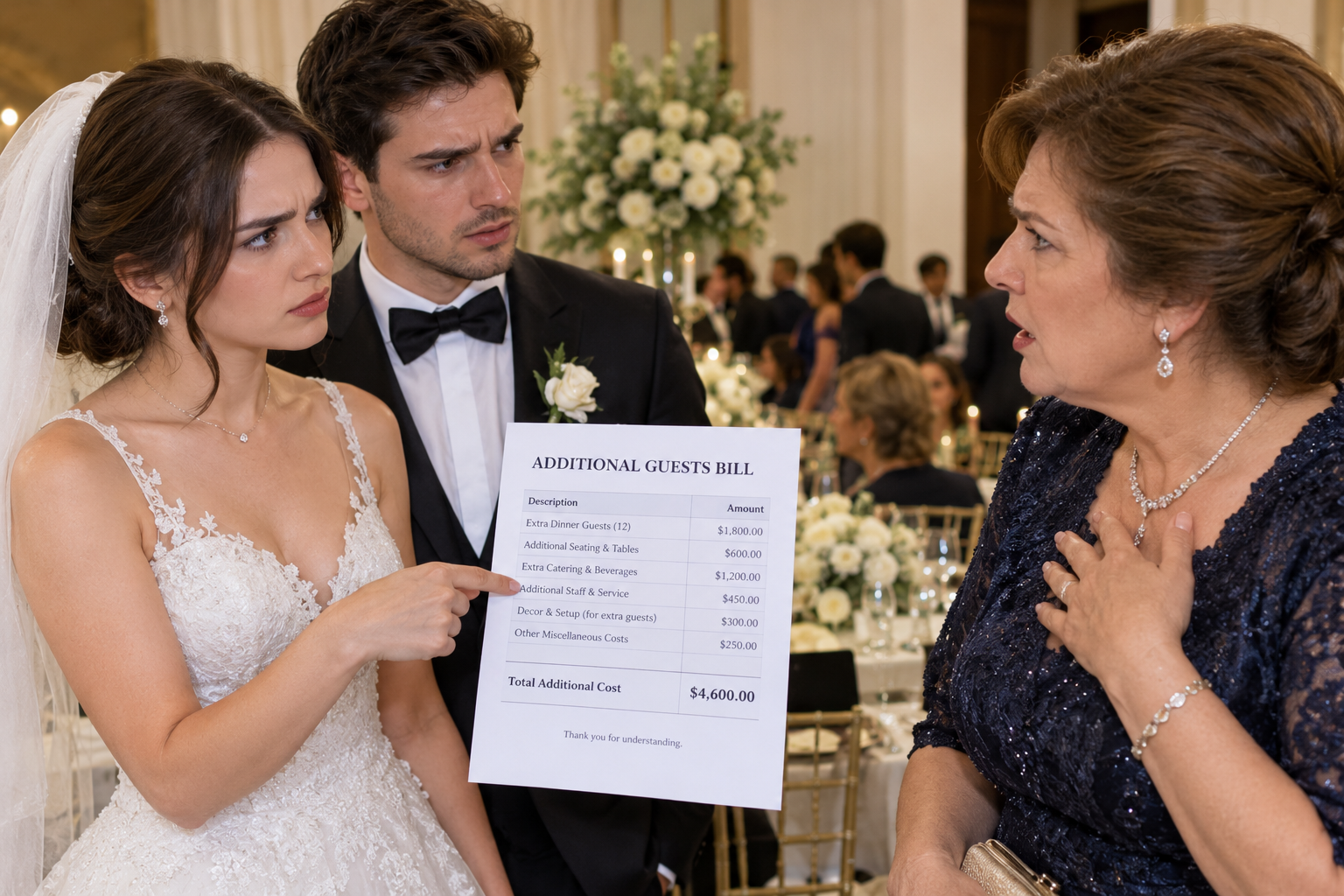
Once we had the figures, I told my fiancé that I wanted to send his mother the bill for the additional guests. I was not asking her to pay for our entire wedding, nor was I trying to charge her for anything we had already agreed to cover. I simply wanted her to understand that inviting twelve people without our permission had created expenses that we had not planned for. If she wanted those guests to attend, I believed she should be responsible for the additional costs associated with her decision. My fiancé agreed with me and said he would support that approach when speaking to his mother. We both knew she might react badly, but we felt that allowing her to make decisions without consequences would only encourage similar problems in the future. We wanted to establish a clear boundary before the wedding day arrived.
When we informed her that we intended to send her the bill, her reaction was immediate and emotional. She accused us of treating her like a stranger and suggested that family members should not keep track of every expense associated with a wedding. She said she had only wanted to invite a few people who mattered to her and could not understand why we were making money the center of the disagreement. I explained that the issue was not about refusing to welcome people or trying to punish her. The issue was that she had independently expanded our guest list and expected us to cover the consequences. We were paying for the wedding ourselves, and we had not agreed to these additional invitations. I told her that if she had asked us first, we could have discussed whether the guests could be included and how the expenses would be handled.
She responded that the twelve guests were not strangers to her and that she had known some of them for decades. She believed that their connection to her should have been enough reason for us to welcome them. I could understand why these relationships mattered to her, especially if she had known the former neighbors for a long time. However, those relationships did not automatically make the guests part of our wedding plans. We were the people getting married, and we had to consider our own relationships, finances, and preferences when organizing the celebration. I explained that we were not questioning her right to maintain friendships or invite people to events she hosted herself. We were simply saying that our wedding was not an event she could independently expand. She seemed unable to accept that distinction, and the conversation ended with everyone feeling frustrated.
The situation became even more complicated when other relatives learned about the disagreement. Some family members supported my future mother-in-law and argued that weddings should be about generosity rather than money. They suggested that we should accept the additional guests and stop worrying about the cost because the event was supposed to be a happy occasion. One relative said that refusing to accommodate the people she invited would create unnecessary embarrassment for the family. Another argued that the amount was probably manageable and that we should not risk damaging our relationship with her over it. I found these comments frustrating because none of those relatives had offered to pay the additional expenses themselves. They were telling us to absorb the costs while acting as though the financial consequences were insignificant.
Other relatives had a different perspective. One person privately told me that my future mother-in-law should have asked permission before sending invitations and that paying for the printing did not give her the right to change our guest list. Another said that it was unfair to expect us to pay for twelve people we had never intended to invite, especially when we were already covering every wedding expense ourselves. These conversations helped me realize that not everyone viewed the situation as a simple disagreement about money. Some people understood that it was also about trust and respect. My fiancé and I had spent months making decisions together, and his mother’s actions had bypassed that process entirely. We wanted our families to feel welcome, but we also wanted them to respect the fact that we were responsible for organizing and financing our own wedding.
My fiancé was particularly disappointed by the way his mother responded to the situation. He told me that he could understand her wanting to include familiar people, but he could not understand why she had not simply asked him before ordering the invitations. He felt that she had assumed she could make the decision because she was his mother and because she had been involved in the early planning. He also worried that if he ignored the situation, she might believe she could make other decisions about our marriage without consulting us. We discussed how important it would be to establish boundaries before the wedding and before we began making other major decisions together. Neither of us wanted every family disagreement to become a test of loyalty, and we did not want his relationship with his mother to suffer unnecessarily. Still, we agreed that being respectful did not mean allowing someone else to control our choices.
I also considered whether there was a less confrontational way to resolve the situation. Perhaps we could simply accept the guests and treat the extra cost as an unfortunate inconvenience. We could avoid further arguments and focus on enjoying the wedding. However, I worried that doing so would send the message that my future mother-in-law’s behavior was acceptable. She had ordered invitations without permission, sent them to people we had not chosen, and waited until the RSVP cards arrived before the situation became apparent. If we quietly absorbed the expenses, there would be little reason for her to understand why the decision had been inappropriate. I did not want to create conflict for the sake of conflict, but I also did not want to ignore a problem that had a direct financial impact on us. We needed a solution that was fair and that made our expectations clear.
Eventually, we decided that we would keep the twelve guests on the list if the venue could accommodate them and the additional expenses were covered. We did not want to embarrass innocent people who had received invitations and reasonably believed they were welcome. They had no way of knowing that the invitations had been sent without our knowledge, and we did not blame them for accepting. Our disagreement was with the person who had sent the invitations, not with the people who received them. We explained that we would provide the final cost of accommodating the additional guests and expected my future mother-in-law to take responsibility for the extra expenses resulting from her decision. We hoped that this approach would allow the wedding to proceed smoothly without forcing us to compromise our budget or create an uncomfortable situation for the invited guests.
My future mother-in-law was still unhappy with our decision. She believed that asking her to cover the additional expenses was disrespectful and insisted that she had only acted out of love for her son. She also suggested that we were allowing money to interfere with family relationships. I told her that I understood she had intended to do something she considered thoughtful, but good intentions did not remove the need to respect other people’s decisions. If she had wanted to invite those people, she could have asked us first. We might have found a way to include some of them, or we might have explained why the guest count could not be increased. Instead, she made the decision herself and left us to deal with the consequences. I hoped she would eventually understand that the issue was not whether she cared about us, but whether she respected our role in planning our own wedding.
As the wedding date approaches, I am trying to keep the disagreement from overshadowing what should be a happy period in our lives. My fiancé and I still want to celebrate with our friends and relatives, and we do not want the entire event to become a discussion about the extra invitations. We have worked hard to plan a day that reflects our relationship and stays within our budget. I want to focus on the ceremony, enjoy time with the people we love, and begin married life without carrying unnecessary resentment into the future. At the same time, I do not regret standing up for our decisions. I believe that couples should be allowed to organize their weddings according to their own preferences and financial circumstances. Family members can offer advice, make suggestions, and express their wishes, but they should not assume they have the authority to make commitments on the couple’s behalf.
Now I am left wondering whether I handled the situation correctly. On one hand, I understand that my future mother-in-law was excited about the wedding and wanted to include people who had been part of her life. Perhaps she genuinely believed that inviting them would make the celebration more meaningful, and I do not want to assume that she intended to cause us problems. On the other hand, we are paying for the entire wedding ourselves, and we never gave her permission to invite twelve additional guests. The extra invitations created expenses and complications that we had not agreed to take on. We did not demand that she pay for our entire wedding or cover costs unrelated to her decision. We simply asked her to take responsibility for the additional expenses created by the people she invited without consulting us. My fiancé supports me, but some relatives believe I am being too strict about money and family boundaries. So, am I wrong for sending my future mother-in-law the bill for the twelve guests she invited to our wedding herself, or is it reasonable to expect her to cover the costs of a decision she made without our permission?