My Father-in-Law Used All My Generator Fuel and Said Family Doesn’t Keep Score
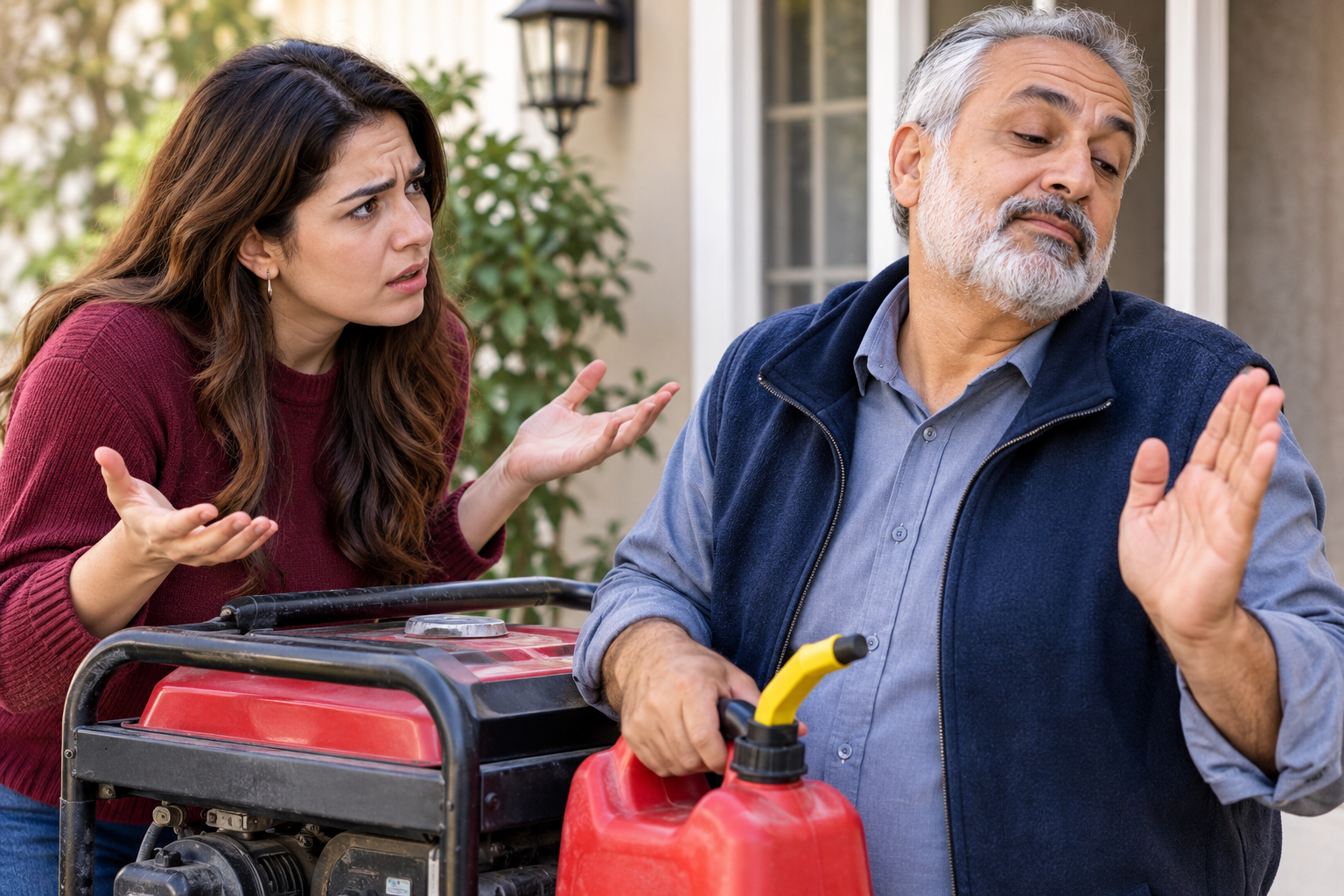
I never imagined that something as simple as putting a lock on my generator would turn into a major family argument, but apparently, setting boundaries with my father-in-law is considered disrespectful. My wife and I have always tried to help our family whenever we could, especially when someone needed something during an emergency. We live in an area where power outages are fairly common, so having a generator is important to us. We purchased ours with our own money because we both work from home occasionally and cannot afford to lose electricity for hours at a time. It wasn’t cheap, and the fuel certainly isn’t free either. We never minded helping relatives when they genuinely needed it, but I never expected someone to treat our property like it belonged to them.
My father-in-law has always been the kind of person who believes family should share everything. At first, I thought that was a nice quality because I grew up believing that relatives should support one another. Whenever he visited our house during a power outage, I allowed him to use the generator if he needed electricity for a few hours. Sometimes he would charge his phone, run a fan, or keep a few household appliances working. I never asked him for money because I understood that emergencies happen, and I didn’t want to make a big deal out of something that seemed relatively small. However, over time, I noticed that he was becoming increasingly comfortable using our generator without asking first.
The first incident happened when my father-in-law came over while we were away. My wife had apparently given him permission to use the generator because his house had lost electricity, and he needed to keep some food from spoiling in his refrigerator. I had no problem with that arrangement. The problem was that he left the generator running for several hours after the electricity returned. By the time we got home, most of the fuel was gone. I mentioned it to my wife, and she said her father probably hadn’t noticed that the power had come back. I decided to let it go because I didn’t want to start an argument over one incident. I simply refilled the tank and assumed he would be more careful next time.
Unfortunately, the second incident was much worse. A few weeks later, my father-in-law contacted my wife and asked whether he could use our generator again. We agreed because there was another power outage in his neighborhood. This time, however, he didn’t just use it for a few hours. He apparently kept it running almost the entire day, even after the electricity returned. He also used a significant amount of fuel without mentioning that he had emptied the tank. When I discovered what had happened, I was genuinely frustrated. Fuel prices aren’t insignificant, and we had purchased that fuel specifically to make sure our own household could manage during an outage. I felt like he was treating our generosity as an unlimited free service.
When I finally brought it up, my father-in-law didn’t seem particularly concerned. I calmly explained that I didn’t mind helping him, but he needed to ask before using the generator and turn it off when it was no longer needed. I also told him that completely draining the tank twice was becoming expensive for us. Instead of acknowledging what I was saying, he laughed and told me that family doesn’t keep score. According to him, helping relatives shouldn’t come with calculations or complaints about a little fuel. I reminded him that I wasn’t asking him to pay for every drop he used. I was simply asking him to respect our property and not assume that we would constantly cover the cost of his electricity.
My wife tried to stay out of the disagreement, but I could tell she was uncomfortable. She said her father probably didn’t mean any harm and that I should avoid making the situation bigger than it needed to be. I told her I understood that he might not have intended to upset us, but the result was still the same. We had already paid to refill the generator once, and now we were doing it again because someone else had used all the fuel. I asked her how she would feel if someone repeatedly borrowed something expensive from us, used it carelessly, and then dismissed our concerns by saying that family members shouldn’t keep track of expenses. She didn’t really have an answer.
After thinking about it, I decided that simply asking him to be more careful wasn’t working. I purchased a small lock and installed it on the generator’s fuel compartment so nobody could access it without permission. I also made sure the generator itself was secured when we weren’t home. My intention wasn’t to punish anyone or prevent my father-in-law from getting help during an emergency. I just wanted to make sure that he couldn’t use our fuel without asking us first. If he genuinely needed electricity, he could contact us, explain the situation, and we could decide whether we were able to help. I didn’t think that was an unreasonable request, especially considering what had happened twice already.
When my father-in-law noticed the lock, he became extremely offended. He called my wife and complained that I was treating him like a stranger. He said he couldn’t believe I would put a lock on something just because he had used some fuel during power outages. He also repeated his favorite statement about family not keeping score, suggesting that I cared more about money than relationships. Apparently, he had also told other relatives about the situation, and a few of them contacted us to say that I was being unnecessarily controlling. One relative even suggested that I should apologize because my father-in-law was embarrassed by the whole situation. I found it ridiculous that nobody seemed interested in discussing why I had needed to install the lock in the first place.
Now my wife thinks I should consider removing the lock to keep the peace, while I believe the lock is staying until her father understands that helping someone doesn’t mean giving them unlimited access to your belongings. I have no problem letting him use the generator when there is a genuine need, but I expect him to ask first, use only what he needs, and turn it off when the electricity returns. I don’t think those are unreasonable conditions. My father-in-law keeps saying that family doesn’t keep score, but I feel that respect and consideration should go both ways. Am I the asshole for putting a lock on my generator after he drained the fuel twice and refused to acknowledge that he was taking advantage of our generosity?
Read Story…
AITA for putting a lock on my generator after my father in law drained it twice and said family doesnt keep score?
We lost power for 5 days during an ice storm last winter and I genuinely swore never again, so that spring I bought a generator. It cost me about $900 and I keep 3 full gas cans in the shed for it. My father in law lives alone across town and his place always loses power in these storms, so when it happens he rides it out at our house.
The big windstorm last month knocked us out for 4 days. I set the generator up to run the fridge, the furnace blower, and 1 space heater in the living room where we all were. Within 2 days all 3 cans were empty. Turns out he’d had a heater going in the guest room AND the sunroom nobody ever sits in, the big TV on all day, and a third heater out in the garage to keep his tools from rusting.
Gas stations were half down and the open ones had long lines. So I asked if he could throw in for the next fill. He laughed and said you don’t keep score with family, and that he was not going to sit in the cold at his age counting pennies. I let it go.
We lost power again a couple weekends later, and he did the exact same thing. I burned through another $40 of gas I’d waited in line an hour for, warming rooms that nobody was even in.
Last spring our basement flooded. I asked this same man if I could borrow his shop vac and his truck. He told me to figure my own stuff out, because that is what being an adult is. He said it almost word for word.
They’re saying another system comes through Thursday. So this week I put a locking cap on the fuel tank and I keep the key. He’s welcome here like always. The fridge, a heater, and everyone’s phones will still run, but the whole-house comfort is done, and if he wants more than that he can bring his own gas.
He found the lock last night and now he’s texting my wife that I’m going to leave her father freezing in the dark over a few dollars of gas. My wife thinks I made my point but could have just talked to him, though I notice she isn’t offering to buy the gas either.
I told them I’m not keeping score here. I just can’t keep burning through gas I waited in line for so he can run every room in a house he doesn’t pay for.
AITA?
When My Father-in-Law Took Advantage of My Kindness, I Finally Had to Set Boundaries
I never imagined that something as simple as owning a generator would eventually become one of the biggest sources of conflict in my family. I have always believed that helping family members is important, especially when they are going through difficult situations. However, I also believe that helping someone should never mean allowing them to take advantage of your kindness. For a long time, I tried to maintain a peaceful relationship with my father-in-law, even when his behavior made things uncomfortable. I never wanted to create unnecessary arguments or make my wife feel caught between me and her father. Unfortunately, his repeated actions eventually pushed me to a point where I had to establish boundaries.
My wife and I have been married for several years, and we have worked hard to build a comfortable life together. We are not wealthy, and almost everything we own has been purchased through careful planning and saving. We both understand the importance of managing our expenses because unexpected costs can quickly become overwhelming. My wife is responsible with money, and I try to be equally careful. We do not mind helping relatives when they genuinely need assistance, but we expect people to respect our belongings and understand that our resources are not unlimited.
A few months ago, we purchased a backup generator for our house. The electricity in our area is not always reliable, and power outages can become extremely frustrating, especially during the summer. We needed something dependable that would keep our refrigerator, fans, lights, and other essential appliances running. The generator was not cheap, and we had to save for quite some time before purchasing it. Along with the generator, we also bought several fuel containers so that we would always have enough gasoline available when the electricity went out.
I was particularly careful about maintaining the generator because I wanted it to last for many years. I regularly checked the oil, cleaned the filters, and made sure the fuel was stored safely. I also kept track of how much gasoline we had because replacing it was becoming increasingly expensive. My wife sometimes joked that I treated the generator like another member of the family, but I honestly did not see anything wrong with being responsible for something we had worked so hard to purchase.
My father-in-law lives approximately twenty minutes away from our house. He is retired, although he still does occasional work around his property. He has always been somewhat demanding, especially when it comes to borrowing things from other people. In his mind, family members should automatically share whatever they own. If someone has a vehicle, he believes relatives should be allowed to use it. If someone has tools, he thinks there is no reason to purchase his own. I had noticed this attitude before, but I never thought it would become a serious problem.
The first time he asked about our generator, he explained that electricity had gone out at his house and he needed a way to keep his refrigerator running. He asked whether he could borrow our generator for a few hours. I immediately agreed because I understood that losing electricity could cause problems, especially if someone had food stored in their refrigerator. I even offered to help him transport it because the generator was relatively heavy. He thanked me and promised to return everything the following morning.
When he returned the generator, I noticed that one of the fuel containers was almost empty. I asked him whether he had used most of the gasoline, and he casually explained that he had needed more fuel than expected. He said he would replace it eventually. I did not make a big deal out of it because I assumed he had simply forgotten how much gasoline he had used. I filled the container again and moved on with my day.
A few weeks later, he contacted my wife and asked whether he could borrow the generator again. This time, he said he needed it because some electrical work was being done at his property. My wife asked me whether I was comfortable lending it to him, and I agreed. I told her that I did not mind helping him as long as he returned the generator in good condition and replaced whatever fuel he used. She said she would explain that to him, so I thought everything was understood.
Unfortunately, when the generator came back, the situation was almost identical. The fuel container was nearly empty again, and there were signs that the generator had been used for several hours. I asked my father-in-law about the gasoline, and he laughed before saying that he had used what he needed. When I reminded him that replacing the fuel was part of our agreement, he told me not to worry because it was only gasoline. According to him, it was not worth discussing such a small expense between family members.
I tried to remain calm because I did not want a minor disagreement to turn into a family argument. However, I explained that the gasoline was not free and that we had purchased it specifically for emergencies at our own house. He nodded as though he understood, but he did not offer to replace anything. My wife later told me that her father probably did not think it was a big deal. I told her that the amount itself was not the main problem. The problem was that he repeatedly ignored something we had clearly discussed.
For a while, I thought the situation had ended. We kept using our generator normally and made sure our fuel containers were full. Then another power outage happened, and I discovered that we had significantly less gasoline than I expected. I checked the containers and realized that several were almost empty. At first, I thought I might have miscalculated how much fuel we had used, but after checking the dates and remembering the previous visits, I started suspecting that my father-in-law had taken more gasoline.
I asked my wife whether her father had visited recently or needed anything from our garage. She hesitated before telling me that he had stopped by while I was at work. Apparently, he had asked her whether he could take some gasoline because he needed it for the generator at his property. She said she assumed he had only taken a small amount. When I explained that several containers were almost empty, she looked genuinely surprised. She had not realized how much fuel he had taken.
I contacted my father-in-law and asked him directly whether he had taken gasoline from our garage. He admitted that he had, but his response was incredibly casual. He explained that he had needed it and thought there was no reason to bother me about it. I asked why he had not called first, especially considering that we had already discussed replacing the fuel several times. Instead of apologizing, he told me that I was making a big issue out of something that cost relatively little.
I explained that we had purchased that gasoline for our own household needs. We had experienced several outages recently, and I did not want to discover that our emergency supplies were missing when we needed them most. I also reminded him that borrowing something did not mean taking whatever came with it without permission. He became irritated and said that I was treating him like a stranger instead of a family member. That comment immediately changed the direction of the conversation.
He told me that family members should not keep track of every little thing they do for each other. He said that when relatives help one another, they should do it without expecting anything in return. I understood the general idea behind what he was saying, but I found it frustrating because he seemed to believe that this principle only applied when he was receiving something. Whenever he needed our generator, gasoline, tools, or assistance, he expected us to help without questions. Yet he rarely offered anything in return or considered how his actions affected our household.
I asked him whether he would be comfortable if I regularly came to his property and took things without asking. I also asked whether he would consider it acceptable if I borrowed his vehicle, used all the fuel, and returned it without replacing anything. He immediately said that those situations were completely different. When I asked him to explain why, he simply repeated that we were family and should not behave like strangers. At that point, I realized that he was not interested in understanding my position.
After that conversation, I spoke privately with my wife. I explained that I was becoming uncomfortable with how her father treated our belongings. I did not want to stop helping him completely, but I also did not want our home to become a place where he could take whatever he wanted whenever he felt like it. My wife admitted that her father could sometimes be unreasonable, but she asked me to be patient because he had always been like this. She also worried that setting strict boundaries might damage their relationship.
I told her that I was not asking her to choose between her father and me. I was asking her to understand that our household deserved the same respect we showed other people. We had purchased the generator together, and the money used to buy the fuel came from our shared budget. It was not fair for her father to make decisions about our property without either of us agreeing. She eventually understood what I was saying, although she still seemed uncomfortable confronting him directly.
A few days later, my father-in-law called again. He wanted to borrow the generator because another electricity problem had occurred at his house. I told him that he could use it if he needed it, but I would arrange the fuel myself and expected everything to be returned in the same condition. He immediately became annoyed and asked why I was suddenly making things complicated. I explained that I was simply trying to prevent the same disagreement from happening again.
He told me that I had changed and that I was becoming unnecessarily possessive about things that should be shared among relatives. I reminded him that I had already lent him the generator several times without asking for payment or any special treatment. All I had requested was that he replace the gasoline he used or at least ask before taking it. He responded by saying that he had never expected me to behave this way and that he thought we were closer than that.
That statement bothered me because it made me feel as though my generosity was being used against me. Apparently, every time I helped him, he considered it something he was automatically entitled to receive again. There was no appreciation, no effort to return the favor, and no recognition that we also had responsibilities. I started wondering whether he would have treated another relative or a neighbor the same way. My suspicion was that he would probably have been much more careful with someone who was not his son-in-law.
The final incident happened when I came home from work one afternoon and noticed that the garage looked different. One of the fuel containers had been moved, and the generator was no longer sitting exactly where I had left it. I checked the containers and discovered that another significant amount of gasoline was missing. My wife eventually admitted that her father had stopped by earlier that day. He had taken the fuel because he needed it and had not thought it necessary to ask either of us.
I was genuinely angry this time. We had already discussed the issue multiple times, and I had clearly explained that I did not want him taking our fuel without permission. It was no longer an innocent misunderstanding or a simple failure to communicate. He knew exactly how I felt, yet he continued doing the same thing. I called him and told him that I was no longer comfortable allowing him unrestricted access to our garage and generator supplies.
He immediately became defensive and accused me of disrespecting him. He said that he had helped raise my wife and that I should be grateful for everything he had done for her. I told him that I respected him as my wife’s father, but that did not mean he could ignore the boundaries of our home. He then brought up several occasions when he had helped us with small things, including giving us furniture when we first got married and helping us move some boxes. I acknowledged those things, but explained that past favors did not give him permanent permission to take our belongings.
My father-in-law became even angrier and repeated his favorite statement: family doesn’t keep score. I finally told him that keeping score and expecting basic respect were two completely different things. I was not asking him to pay me back for every favor or calculate the value of every conversation. I was asking him not to take our fuel without permission. If he needed help, he could simply ask, and we would decide whether we were able to help him. That should not have been such a difficult concept.
After the argument, I decided to install a lock on the garage storage area where we kept the generator and fuel containers. I also moved the spare keys somewhere secure and told my wife that nobody should have access without our permission. I did not do it to embarrass her father or punish him. I did it because repeatedly asking someone to respect a boundary had not worked. I wanted to protect the things we had purchased and make sure our emergency supplies were actually available when our household needed them.
When my father-in-law discovered the lock, he was furious. He contacted my wife and complained that I had effectively treated him like a criminal. He said that he had never expected to be locked out of his own daughter’s house and that I was creating unnecessary tension in the family. My wife was upset because she did not want another argument with her father. However, she also knew that the situation had not happened because of one disagreement. It had developed after several repeated incidents.
Some relatives eventually heard about the disagreement, and a few of them suggested that I should apologize and remove the lock. They argued that gasoline was not worth damaging a family relationship. Others believed that my father-in-law should have respected our property from the beginning. I found it interesting that some people were more concerned about the lock than the repeated occasions when he had taken our fuel without asking. Nobody seemed particularly interested in the fact that we had already tried discussing the issue politely.
I still do not mind helping my father-in-law when he genuinely needs assistance, and I have never believed that family relationships should be based on keeping a record of every favor. However, I also believe that generosity should be voluntary, not something another person can demand simply because they are related to you. I did not purchase a generator and emergency fuel so someone else could repeatedly use everything without considering our needs. My wife and I have worked hard for what we own, and I do not think protecting our property makes me selfish. Now I am left wondering whether I went too far by installing the lock or whether my father-in-law simply became upset because I finally stopped allowing him to take advantage of my kindness.