Petty Guy Uses $4 Beer To Teach His Generous Friend a Lesson
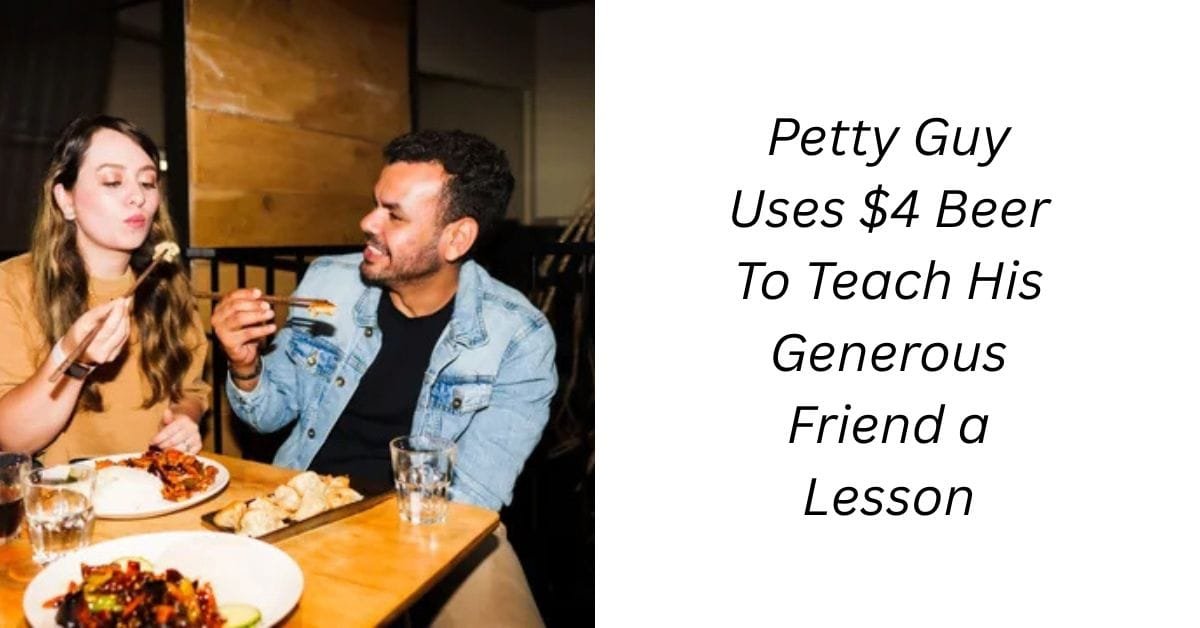
Thirty-five-year-old Daniel had always been the kind of person who believed friendship meant looking out for one another. Whenever he went out with his close friend Marcus, Daniel rarely worried about splitting every dollar perfectly. If Marcus forgot his wallet, Daniel would cover the meal. If they ordered drinks and Marcus was short a few dollars, Daniel would simply pay the difference without making a big deal about it. Daniel was not wealthy, but he had a stable job and believed that being generous with people he cared about was simply part of being a good friend. Marcus, however, had started to notice that Daniel’s generosity was becoming a one-sided habit. Marcus often accepted Daniel’s offers to pay but almost never returned the favor. At first, Marcus ignored it because the amounts were usually small, but over time, he began to feel that Daniel was taking advantage of his kindness.
One Friday evening, the two friends decided to meet at their favorite neighborhood bar after work. They ordered some food, talked about their week, and eventually bought a couple of beers. The atmosphere was relaxed, and Daniel was enjoying himself. When the bill arrived, Daniel automatically reached for his wallet, assuming they would split it as usual. Marcus stopped him and said that he would take care of his own portion this time. Daniel was surprised but did not argue. The problem began when Marcus noticed that one of the beers on the bill belonged to Daniel and cost only four dollars. Instead of simply paying his share, Marcus decided to make a point. He pulled out his phone, carefully calculated the exact amount Daniel owed, and told him that he needed to send him the four dollars immediately. Daniel laughed at first because he thought Marcus was joking. After all the times Daniel had covered meals and drinks without asking for reimbursement, the sudden demand over a $4 beer seemed ridiculous.
Marcus, however, was completely serious. He explained that he was tired of Daniel always expecting him to pay for things and said that he wanted to teach his friend a lesson about money. Daniel was stunned. He reminded Marcus that he had never expected Marcus to cover his expenses and that, in fact, Daniel had repeatedly paid for Marcus when Marcus was unable or unwilling to pay. He even brought up several occasions when Marcus had promised to pay him back but never did. Marcus brushed those examples aside, claiming that Daniel was now trying to make him feel guilty. Daniel realized that the argument was no longer about four dollars. It was about respect and the fact that Marcus had apparently forgotten every act of generosity Daniel had shown him. Rather than arguing over the bill, Daniel sent the exact $4 and quietly put his wallet away. He told Marcus that he had learned something important that night—not about money, but about their friendship.
The next few days made the situation even more uncomfortable. Marcus apparently expected Daniel to apologize for being offended, but Daniel refused to do so. Instead, he stopped automatically paying for anything when they went out together. If they ordered food, Daniel paid only for his own meal. If Marcus forgot money, Daniel no longer stepped in to rescue him. Marcus quickly noticed the change and accused Daniel of becoming petty. Daniel calmly explained that he was simply following Marcus’s new rule: everyone should pay for exactly what they consume. The irony was not lost on either of them. Marcus had tried to use a $4 beer to teach Daniel a lesson about generosity, but his little stunt ended up teaching Daniel that generosity should not be offered to people who treat it as an obligation. Daniel was not angry about the money. What bothered him was realizing that Marcus had accepted his kindness for years while secretly believing that Daniel was somehow the problem.
Eventually, Marcus admitted that he had handled the situation badly. He said he had been frustrated about money and allowed his irritation to build until he decided to make a dramatic point over something that was hardly worth arguing about. Daniel accepted the apology, but their friendship did not immediately return to the way it had been before. He told Marcus that trust and generosity could not be demanded; they had to be mutual. From that point forward, Daniel became more careful about where he directed his kindness. He still believed in helping friends and family, but he no longer confused generosity with allowing someone to take advantage of him. The $4 beer became an inside joke between them eventually, but it also remained a reminder of a valuable lesson. Sometimes the smallest amount of money can expose the biggest problems in a relationship, especially when the real issue is not the price of the drink but whether people appreciate what you have been doing for them.
Read Story…
AITA for not ordering any food so I wouldn’t have to split the bill?
I(27M) have been apart of a small friend group, around 8 people total, basically since college.
For some background, 2 people from the group, Susan and Greg, are just absolute leeches. Going out for lunch? Expect them to order the most expensive on the menu then feed you some sob story about their finances and then dumb half the bill on you.
Last weekend, Dan, one of the people from the group, told me about a casual dinner . I told him how if Susan or Greg were there I wouldn’t be able to come. He tells me that they would be there but I should just put my opinions aside and come just once.
This is kind of where I might be an AH. I agreed with him and told him I would be there. I show up and we all get to talking.
Everyone began putting in their orders, most of them spent about $40. There were only about 6 people there. When it gets to Susan and Greg, they both order expensive dishes, around $200. When it was my turn to order, everyone looked at me, but I just pick up the menu and point to the $4 Miller Lite and sent the waiter away. Dan asked why I hadn’t ordered anything and all I said was that I lost my appetite. The other 2 friends got up as well to cancel their orders and just have drinks.
After the main courses came out, I saw Susan and Greg picking at their food. The waiter then brings over the check. Greg then grabs the waiter and asks him to split the check 6 ways. I stand up and correct him saying the check was to be split 3 ways. Greg looks at me confused and asks why since we “always” split the bill. I reminded him that 3 of us had not eaten any food so we would just be paying for our drinks. So basically at the end of the night, Dan, who probably only ate around $50 worth of food, was stuck with a $146.98 check at the end. (Yes, I remember the exact number.) I swear I saw his jaw drop when he picked that receipt up.
I slid a $10 towards the check, said goodbye everyone, and walked out.
The next morning, I found my phone full of texts from Greg and Susan telling me I was an AH for not ordering any food and forcing them to pay more than they had accounted for. I honestly laughed because the steaks alone were more than what they had paid but to each their own right?
I also got a lot of messages from Dan saying that I could have just not came instead of pulling that stunt and getting him stuck with an outrageous bill.
Edit: At this restaurant, the bar is separate so drinks are on a separate bill if that makes sense. And if anyone is concerned about leaving a tip, I live in Australia.
Edit 2: Hey guys just wanted to clarify some things:
- 90% of restaurants where I live they don’t do separate checks and might separate the bill for you if you’re lucky. BTW. This post is in AUD, so if you want the amounts in USD, you have to convert it.
- Dan could have easily asked Greg and Susan to transfer him the money if he wanted but he’s always been about helping them through their “financial hardship” even though they’re just using him and keeps dragging me into it. I admit what I did was immature but I’m tired of being forced to play along. It’s his money and if he wants to spend it on them, that’s fine, but I’m not paying for them.
- Also Dan’s a really good friend of mine, albeit blind AF. I was just trying to get him to see what kind of people he was “helping”. I will admit it was a tad bit petty.
- Thank you for the gold.
Daniel Believed True Friendship Meant Always Being There for Each Other
Thirty-five-year-old Daniel had always believed that friendship was about being there for one another, especially during small moments when someone needed a little help. He was not the richest person in his social circle, but he had a steady job and managed his money responsibly. Because of that, he never minded occasionally paying for a friend’s coffee, meal, or drink. To Daniel, those small gestures were not transactions that needed to be recorded or repaid immediately. He simply believed that good friends helped each other when they could.
One of Daniel’s closest friends was Marcus, a man he had known for several years. The two had developed a comfortable friendship filled with jokes, weekend outings, sports discussions, and occasional drinks after work. Daniel often felt that Marcus was more like a brother than a friend. Unfortunately, that closeness also meant Daniel had become increasingly comfortable picking up the bill whenever Marcus was short on money.
At first, Daniel never thought much about it. If Marcus forgot his wallet, Daniel would pay. If Marcus was a few dollars short, Daniel would cover him. Sometimes Marcus would say that he would pay Daniel back later, but Daniel rarely followed up because the amounts were usually insignificant. He did not want their friendship to become a constant discussion about who owed whom five or ten dollars.
Over time, however, Daniel noticed that the situation had become one-sided. Marcus seemed perfectly comfortable allowing Daniel to pay, but he rarely offered to return the favor. Even when Marcus had enough money, he sometimes assumed Daniel would handle the bill. Daniel noticed the pattern but continued ignoring it because he did not want to create unnecessary tension over money.
One Friday evening, Daniel and Marcus met at a small neighborhood bar after work. They had both had a stressful week and decided that a couple of drinks and some food would be a good way to relax. They talked about their jobs, laughed about mutual friends, and enjoyed the casual atmosphere.
During the evening, they ordered several things to share. Daniel paid for part of the food without hesitation, as he had done many times before. Marcus did not say anything about it. Later, they each ordered a beer, and the conversation continued for another hour.
When the final bill arrived, Daniel reached for his wallet automatically. He expected them to divide the bill between them or simply settle it casually as they normally did. Instead, Marcus suddenly said that they should calculate everything down to the exact amount.
Daniel looked at him with confusion. Marcus pulled out his phone and started adding up the items. After a few moments, he announced that Daniel owed him exactly four dollars for his beer. Daniel laughed because he assumed Marcus was joking.
“You’re serious?” Daniel asked.
Marcus nodded and said that he wanted Daniel to understand that people should pay for what they consume. According to Marcus, Daniel had become too comfortable with other people picking up his expenses. Daniel could hardly believe what he was hearing.
The irony was obvious to Daniel. He had spent years paying for Marcus without making a big deal about it, and now Marcus was lecturing him about responsibility over a four-dollar beer. Daniel reminded him that he had never expected Marcus to pay for his food or drinks. In fact, Daniel had frequently paid for Marcus when Marcus was the one who could not afford something.
Marcus dismissed those examples. He said that Daniel was making the situation more complicated than it needed to be. Marcus insisted that the point was not the amount of money but the principle behind it. Everyone, he argued, should take responsibility for their own expenses.
Daniel decided not to argue. He pulled out his phone, sent Marcus the four dollars, and put his wallet away. He did not yell or insult his friend. Instead, he simply told Marcus that he understood the message perfectly.
What Marcus did not realize was that Daniel had also received a message from the situation. He suddenly understood that the generosity he had shown Marcus over the years had become something Marcus expected rather than appreciated.
On the drive home that night, Daniel thought about all the times he had helped Marcus. There were restaurant bills, coffee runs, gas money, event tickets, and other small expenses. None of them had seemed important individually, but together they represented a long pattern of generosity.
Daniel realized that he had never expected anything in return, but he had expected basic appreciation. The fact that Marcus could make such a dramatic issue out of a $4 beer while ignoring years of Daniel’s generosity bothered him more than the money itself.
The next time they went out, Daniel behaved differently. When the server brought the bill, he immediately calculated his own portion and paid exactly that amount. He did not offer to cover Marcus’s share, and he did not volunteer to pay for anything extra.
Marcus noticed the change almost immediately. He asked Daniel why he was suddenly being so careful about money. Daniel calmly replied that he was simply following the principle Marcus had introduced at the bar.
Marcus laughed awkwardly and said Daniel was being petty. Daniel reminded him that Marcus had been the one who wanted every expense calculated precisely. If that was the standard Marcus wanted, Daniel was perfectly happy to follow it.
The situation became even more uncomfortable when Marcus forgot his wallet during another outing. In the past, Daniel would have paid without hesitation. This time, however, Daniel simply waited while Marcus figured out another way to pay.
Marcus eventually borrowed money from another friend. Later, he complained that Daniel had changed and was no longer as helpful as before. Daniel responded that he had not changed at all. He had simply stopped doing things that Marcus had apparently never appreciated.
That conversation forced Marcus to think about his own behavior. He began remembering all the occasions when Daniel had paid without asking for anything in return. He also realized that he had rarely offered the same kindness when their situations were reversed.
A few days later, Marcus contacted Daniel and admitted that he had handled the situation badly. He explained that he had been frustrated about money and had allowed that frustration to come out in an immature way. He acknowledged that using a $4 beer as a way to teach Daniel a lesson had been unnecessary and embarrassing.
Daniel appreciated the apology, but he told Marcus that the problem was bigger than four dollars. He said that friendship should not feel like a financial competition. If they wanted to split bills, that was perfectly fine, but both people needed to respect each other rather than turning small expenses into weapons.
Marcus agreed. He also apologized for all the times he had accepted Daniel’s generosity without properly acknowledging it. Daniel told him that he never expected repayment for every little thing, but he did expect their friendship to involve mutual consideration.
The two friends eventually moved past the incident, although the $4 beer became something they occasionally joked about. Whenever someone mentioned splitting a bill down to the last cent, one of them would bring up the infamous beer. The joke helped reduce the tension, but both men remembered what the experience had taught them.
Daniel did not stop being generous after that night. Instead, he became more selective about his generosity. He continued helping people he cared about, but he stopped assuming that every person would value his kindness in the same way he valued theirs.
The experience also taught Daniel that boundaries did not make someone selfish. There was nothing wrong with expecting people to contribute fairly, and there was nothing wrong with refusing to repeatedly pay for someone who treated generosity as an obligation.
For Marcus, the lesson was different. He realized that trying to teach someone else a lesson can easily backfire when you have not examined your own behavior first. His attempt to make Daniel feel irresponsible over a $4 beer ultimately forced him to confront his own lack of appreciation.
In the end, the four-dollar drink was never really about four dollars. It was about years of small actions, unspoken expectations, and the difference between genuine generosity and taking someone’s kindness for granted. Sometimes a tiny disagreement can reveal a much larger problem that has been quietly growing beneath the surface.
Daniel walked away from the experience with a clearer understanding of friendship. He still believed that helping people was important, but he also understood that generosity should be given freely rather than expected automatically. As for Marcus, he learned that if you want people to respect your boundaries, you should be prepared to respect theirs as well.
The story ultimately showed that money can expose weaknesses in even long-standing friendships. Four dollars may seem insignificant, but the attitude behind those four dollars can matter enormously. In Daniel and Marcus’s case, the tiny bill became a reminder that healthy friendships require appreciation, fairness, and mutual respect—not scorekeeping, guilt, or unnecessary lessons.