Generous Sister Creates $14K Emergency Funds For Brothers But One Ruins Everything With Greedy Demands
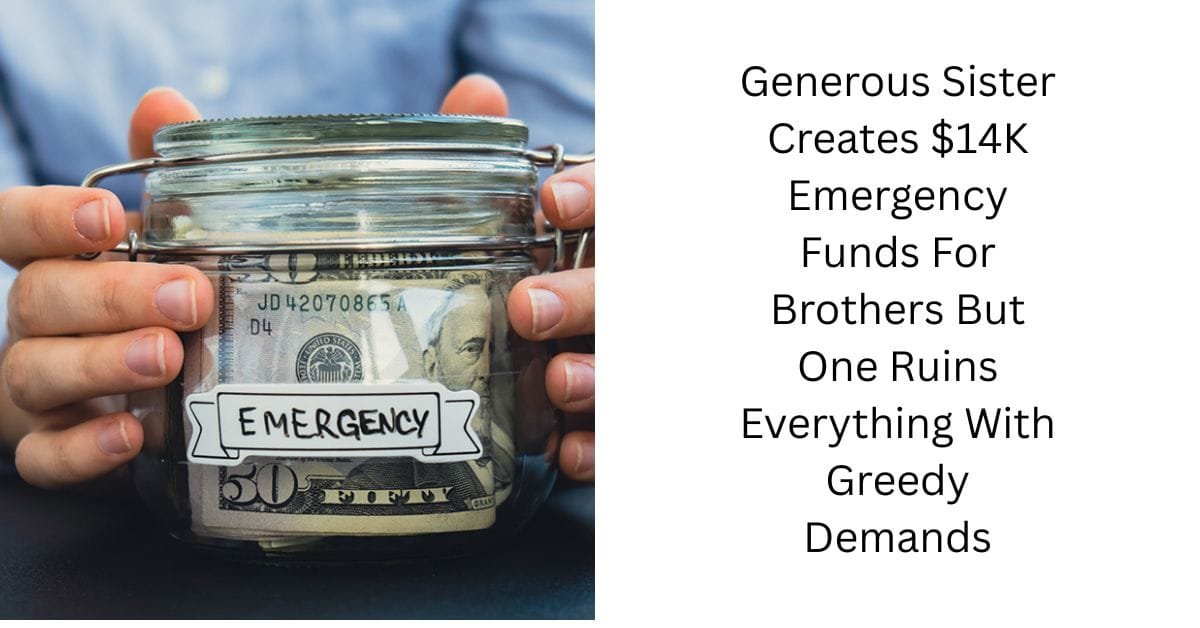
When this woman decided to create emergency funds for her brothers, she wasn’t trying to control their lives or make herself look generous. She simply wanted to make sure her family had something to rely on when unexpected problems appeared. She had always believed that siblings should help each other during difficult times, especially when someone was facing a genuine emergency. After years of saving carefully, she decided to set aside a combined $14,000 specifically for her brothers. The money was intended to provide a safety net for serious situations such as medical bills, urgent home repairs, sudden unemployment, or other unexpected expenses.
The arrangement was meant to be simple and fair. She established separate funds so that each brother would have access to support if a legitimate emergency occurred. She made it clear that the money wasn’t a regular allowance or an account they could freely spend whenever they wanted. It was there for situations that could genuinely affect their stability. Her brothers initially appreciated the gesture, and she felt relieved knowing that she could provide them with some security without having to constantly worry about whether they could handle an unexpected crisis.
For a while, everything seemed to work exactly as she had hoped. Her brothers understood the purpose of the money and respected the boundaries she had established. The woman wasn’t expecting gratitude every day, nor did she want the funds to become a source of family drama. She simply wanted the money to remain available until someone truly needed it. In her mind, creating those accounts was an act of love and responsibility. She had no idea that one brother would eventually challenge the entire arrangement.
The problems began when one of her brothers decided that the amount available to him wasn’t enough. Instead of seeing the fund as an emergency safety net, he began treating it like money that he was entitled to receive. He started asking questions about how much was in the account, how quickly he could access it, and whether his sister could increase his share. When she reminded him that the money was specifically reserved for emergencies, he became frustrated and argued that she had no reason to restrict his access to funds she had created for him.
His demands became increasingly unreasonable. He reportedly suggested that because his sister had saved the money for the family, she should allow him to use his portion however he wanted. He had ideas about purchases and expenses that weren’t genuine emergencies, and he didn’t understand why she was refusing to approve them. The woman tried to explain that the entire purpose of the arrangement was to protect them from serious unexpected problems. If the money disappeared on ordinary purchases, it wouldn’t be available when something truly important happened.
The disagreement became worse when the brother began comparing his situation with their other siblings. He believed that he deserved more because he felt his financial needs were greater. The woman explained that she had deliberately divided the money fairly and that she wasn’t interested in deciding which brother deserved more. She wanted everyone to have the same basic safety net. Her brother interpreted that fairness as a refusal to recognize his individual needs, and the conversations quickly became arguments.
Eventually, the brother made a demand that forced the woman to reconsider the entire arrangement. Instead of simply asking for help, he insisted that she should give him greater control over his portion of the money. He reportedly argued that if she truly trusted him, she would allow him to spend it however he wanted. The woman realized that this was no longer about an emergency fund. It had become a question of entitlement. She had created the money voluntarily, but her brother was beginning to act as though she owed it to him.
Feeling increasingly frustrated, the woman decided she needed to establish a firm boundary. She explained that generosity didn’t mean giving someone unlimited access to resources. She had created the funds because she loved her brothers, not because she wanted to finance every expense they might have. If the money couldn’t be used according to the original purpose, she was prepared to reconsider whether maintaining the accounts made sense at all. Her brother wasn’t happy with the decision and accused her of being unfair, but she refused to change the rules simply because he was demanding more.
In the end, the woman realized that helping family members requires boundaries as much as generosity. The $14,000 emergency funds had been created with good intentions, but one brother’s demands showed her how quickly a thoughtful gesture could become a source of entitlement. She didn’t regret wanting to protect her family, but she learned that people sometimes value a gift less when they begin believing they are automatically entitled to it. Her decision ultimately became a reminder that financial help should come with clear expectations, and that saying “no” to unreasonable demands doesn’t make someone selfish. Sometimes protecting the purpose of a gift is the best way to make sure it remains available when a real emergency finally comes.
Read Story…
AITA for not giving my brother money from an emergency fund set up for him?
I(36f) set up 3 savings accounts in my name that I put money into for my 3 brothers. I started doing this shortly after finding out at 18 my parents set-up similar emergency accounts for only my sister and me in case of divorce or needing to make a hasty exit from a relationship and had been putting money into them our entire lives.
They did not have accounts set up for my brothers and when asked, they said they wouldn’t need the help if they got divorced or didn’t need to worry about abusive spouses. I thought that pretty unfair, especially considering my dad’s own brother had to sleep in his car and couch surf for months after his divorce and other male family members that had it just as rough as some of my aunts.
Between bonuses, saving, and some very lucky casino trips and scratch offs each account has about 14k. Unfortunately 5 months ago my brother “Justin” and his wife filed for divorce. I gave him his money shortly after being told.
Wednesday we had dinner at our parents and Justin was telling us all about an apartment he found that has enough room for him and his kids. My older brother “Andy” asked how he could afford it and Justin told him how much I gave him. Andy and his wife gave me some serious stink eye. After the dinner, Andy called and asked why I didn’t fully pay for an emergency expense they had a few years ago: they needed 3k for a vet expense and I gave them 1500 from my own money.
He then asked I give him all the funds I had set aside for him and I told him no. That it’s for a very specific reason for worst case scenario. Best case scenario either he or any future kids will get a nice chunk of change whenever it’s time to shed my mortal coil. Now Andy and his wife are upset, not talking to me, and telling our family I’m expecting them to divorce.
Am I being an asshole not giving him the money?
She Creates A Financial Safety Net For Her Brothers
When this woman decided to set aside money for her brothers, she wasn’t trying to make herself look generous or gain control over their lives. She had simply reached a point where she felt fortunate enough to help the people she loved. Her family had experienced difficult financial moments before, and she knew that an unexpected expense could quickly create serious stress. Instead of waiting for a crisis to happen, she wanted to create a safety net that could help her brothers when they genuinely needed it.
Over time, she managed to save a total of $14,000 for this purpose. Rather than handing the money over immediately, she decided to establish emergency funds that would remain available for serious situations. She wanted the money to be there if one of her brothers suddenly lost his job, faced an urgent medical expense, needed an essential home repair, or encountered another problem that couldn’t reasonably be handled with his normal income.
She explained the idea carefully to her brothers. The money was not intended to be spending money, vacation money, or a way to purchase things they simply wanted. It was an emergency resource. She hoped that by putting the money aside and setting clear boundaries, she could help them without creating dependency or encouraging careless spending.
At first, all of her brothers seemed grateful. They understood that she didn’t have to do this and appreciated the fact that she had thought about their future. The woman felt good about the arrangement because she believed she had found a way to support her family while still allowing everyone to remain financially responsible.
The accounts were never meant to replace her brothers’ own savings. She wanted them to continue working, budgeting, and preparing for their futures. The emergency funds were simply an additional layer of protection if something went seriously wrong.
For a while, everything went smoothly. Nobody needed to use the money, and the woman was happy knowing that it was available. She didn’t check on her brothers’ finances or expect them to report every expense to her. She trusted them to understand the purpose of the funds.
Then one brother began asking more questions.
At first, his questions seemed harmless. He wanted to know exactly how much money had been set aside for him and what situations would qualify as an emergency. The woman answered honestly and reminded him of the basic rules they had already discussed.
Soon, however, his questions became demands. He started suggesting that he should be able to access the money for expenses that weren’t truly emergencies. He argued that since the money had been saved for him, he should have more freedom to decide how to use it.
The woman tried to explain that this wasn’t how the arrangement worked. She had created the fund specifically so the money would be available when he faced a serious problem. If he spent it on ordinary purchases, there would be nothing left when he actually needed help.
He didn’t seem convinced. Instead, he began arguing that his sister was being overly controlling. He questioned why she was allowed to decide what counted as an emergency when the money had been set aside for his benefit.
The woman reminded him that she was the person who had saved the money. She had never promised to give him unrestricted access to $14,000. Her intention had always been to create a financial safety net, not an unrestricted bank account.
The brother then started comparing his situation with those of their other siblings. He believed that he should receive more because he felt that his financial circumstances were different. He suggested that the money should be divided according to individual needs rather than equally.
The woman understood that people have different financial situations, but she had deliberately created the funds to avoid arguments about who deserved more. She wanted each brother to have the same basic protection.
That decision frustrated him even more. He apparently believed that being treated equally wasn’t necessarily fair if his expenses were higher. The woman explained that she couldn’t constantly adjust the accounts every time someone’s circumstances changed.
The conversations became increasingly uncomfortable. What had started as a loving gesture was beginning to feel like a financial negotiation.
The woman started wondering whether creating the funds had been a mistake. She had expected her brothers to see the money as something valuable that she had voluntarily set aside for their protection. Instead, one brother appeared to view the fund as something he had already earned.
He eventually asked if he could simply withdraw his portion whenever he wanted. The woman refused.
She explained that the entire purpose of an emergency fund was to prevent someone from spending the money before an actual emergency occurred. If he wanted money for everyday expenses, he needed to use his regular income or personal savings.
The brother didn’t accept the answer. He argued that his sister had enough money to help him and that refusing to let him use his portion was unnecessarily strict.
That statement hurt her because it made her realize that her generosity was becoming an expectation. She had chosen to help because she loved her brothers. She had never wanted them to assume that she was financially responsible for their wants.
She decided to make the rules even clearer. The emergency funds would remain available for genuine emergencies, but nobody would be allowed to pressure her into releasing money for unnecessary expenses.
She also told her brothers that the funds were not guaranteed forever. If the arrangement became a source of conflict or entitlement, she could decide to change it.
Her other brothers supported her position. They understood that she had created something generous and that it wasn’t fair for one person to demand special treatment.
The brother who had been making demands felt isolated by their response. He believed everyone was taking his sister’s side without considering his financial difficulties.
The woman told him that she was willing to listen to his concerns. If he had a genuine emergency, she would consider helping him. But she wasn’t willing to hand over thousands of dollars simply because he wanted more control over the account.
That distinction became extremely important.
She didn’t want money to destroy the relationship between the siblings. She had created the funds because she wanted to strengthen the family, not create resentment.
Eventually, the brother realized that his demands had gone too far. He apologized for treating the money as though it belonged to him and admitted that he had become focused on what he could get rather than why his sister had created the fund.
The woman appreciated the apology, but she still decided to keep firm boundaries. Trust could be rebuilt, but she didn’t want to repeat the same mistake by assuming everyone would always respect her generosity.
She explained that if a real emergency ever happened, she would be there for her brothers. However, being supportive didn’t mean agreeing to every financial request.
The experience also changed how she viewed generosity. She realized that giving someone financial help can sometimes create expectations that weren’t there before. Even people who initially appreciate a gift can eventually start seeing it as something they’re entitled to receive.
The $14,000 was still available, but now the family had a much clearer understanding of its purpose. It wasn’t free spending money. It was protection for the future.
The woman didn’t regret saving the money. She was still proud that she had been able to create something that could help her family during difficult times.
What she regretted was allowing the arrangement to become vague enough for one brother to believe that the money was automatically his to spend.
In the end, the situation taught everyone a valuable lesson about generosity and boundaries. Helping family can be an incredible act of love, but it doesn’t mean surrendering control over your own finances or allowing someone else to make unreasonable demands.
The woman hoped that her brothers would never need to use the emergency funds. If they did, she wanted the money to be there when it truly mattered.
Her brother’s greedy demands had nearly ruined what was supposed to be a thoughtful family safety net. But after the conflict, the woman realized that protecting the purpose of her generosity was just as important as offering it in the first place.
Sometimes the most loving thing a person can do for family isn’t simply saying yes. It is creating clear boundaries so that the help remains meaningful, fair, and available when someone genuinely needs it.