Woman Wins Settlement After Devastating Car Accident And Mom Immediately Demands $25,000 For “Giving Her Life”

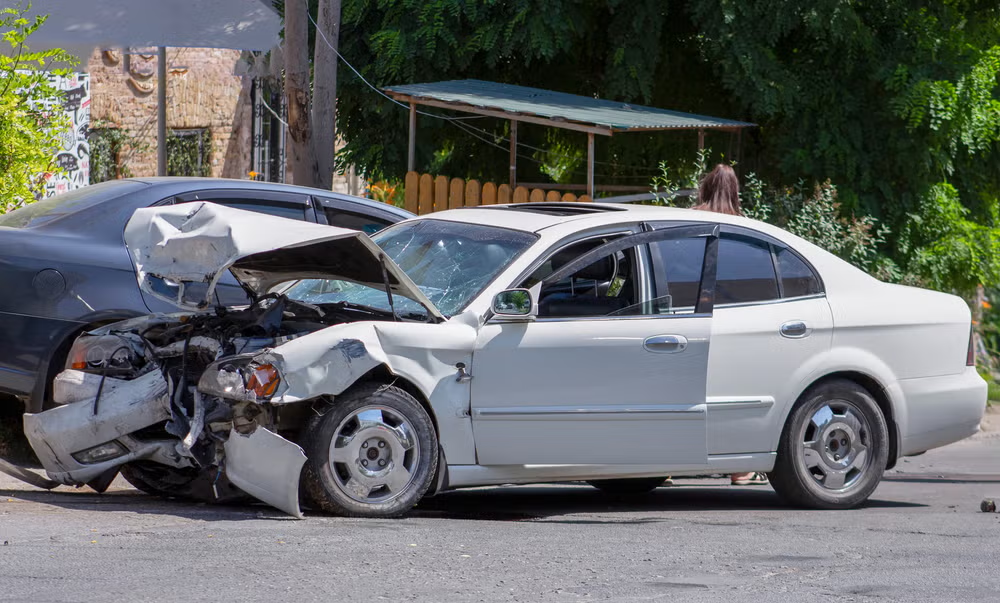
When this woman survived a devastating car accident, she never expected that the financial settlement she eventually received would create a new conflict with her own mother. The accident had changed her life in ways that money could never completely repair. She had faced physical pain, emotional trauma, medical appointments, and uncertainty about her future. After a long legal process, she finally received a settlement that gave her some financial security and allowed her to begin rebuilding her life. She viewed the money as compensation for what she had endured, not as a sudden fortune that could be divided among family members.
Her mother had been aware of the accident and had supported her in some ways during the difficult period. Because of that, the woman initially believed they shared an understanding of what she had been through. She was grateful for any help her mother had provided, but she also knew that the settlement was intended to cover the consequences of her injuries and losses. She planned to use the money carefully, paying outstanding expenses, preparing for future needs, and creating some stability after everything she had experienced.
The situation changed when her mother learned exactly how much money her daughter had received. Instead of simply congratulating her or asking how she was doing, her mother reportedly brought up the idea of receiving a large portion of the settlement. She demanded $25,000, claiming that she deserved the money because she had “given her life” to raising her daughter. The woman was shocked by the request. She understood that her mother had made sacrifices as a parent, but she couldn’t understand why those sacrifices suddenly had a price tag attached to them.
Her mother reportedly argued that raising a child required decades of effort, money, emotional support, and personal sacrifices. She believed her daughter should recognize everything she had done for her by sharing some of the settlement. The woman tried to explain that the settlement wasn’t a reward for becoming an adult. It was compensation related to an accident that had caused her serious hardship. She had not received the money because she had suddenly become wealthy; she received it because something terrible had happened to her.
The disagreement became increasingly emotional. The mother accused her daughter of being selfish and ungrateful for refusing to give her $25,000. She reminded her of everything she had supposedly sacrificed throughout her childhood. The daughter felt deeply hurt because she had never claimed that her mother hadn’t worked hard or made sacrifices. What upset her was the idea that those sacrifices could be used as a reason to claim money that had been awarded to help her recover from a traumatic event.
The woman also worried about her own future. Her injuries had created expenses and uncertainty that she couldn’t simply ignore. She needed to make sure she had enough money for ongoing care, unexpected costs, and rebuilding her financial stability. Giving away $25,000 because her mother demanded it could leave her in a more vulnerable position later. She felt that nobody else should be deciding how she used money that had been provided because of what she personally had suffered.
Eventually, she told her mother that she appreciated everything she had done as a parent, but she wasn’t going to hand over $25,000 simply because she felt entitled to it. She explained that gratitude could be expressed in many ways, but financial demands were different. Her mother reportedly became furious and continued insisting that her daughter owed her something for raising her. The woman realized that the argument was no longer about helping her mother; it was about whether she had the right to control her own settlement.
The conflict forced the woman to rethink her relationship with her mother. She had always believed that family support should be based on love rather than financial expectations. She didn’t want her recovery money to become a source of resentment or guilt. While she remained grateful for the people who had supported her during the accident and its aftermath, she also believed that surviving a traumatic experience gave her the right to prioritize her own recovery and future.
In the end, the woman refused to give her mother the $25,000. She decided to use the settlement responsibly and focus on rebuilding her life after the accident. The situation left their relationship strained, but it also taught her an important lesson about boundaries. A parent can make enormous sacrifices for a child without those sacrifices becoming a lifelong financial debt. The woman understood that she could appreciate her mother’s role in her life while still saying no when a demand crossed a line. Her settlement was meant to help her move forward after a devastating accident, and she believed protecting that future was not selfish—it was necessary.
Read Story…
AITA for using my money won in a lawsuit on my college funds/expenses?
Context: I (20F) am going to school at a university (this is important for context). My mom has not ever really supported the fact I wanted to go to a bigger school as she went to community college. About 2 years ago I was in a car accident and I decided to sue the person responsible for the accident (damages were over $10K, medical bills over $30k). My vehicle was beyond repair and insurance only offered me $1,500 after it was all said and done.
I tried everything and I am left with severe neck and back pain. I also have trouble with strength in my arms and legs. The driver drove drunk and hit me going at an unreasonable amount of speed. It lead to my car flipping over multiple times and needing surgery after.
Recently we went to court and although I only asked for $55K in court, the judge required him and his insurance company to pay $150K to me for damages, medical, and as personal relief as well. I just got the first part of the check on Monday and my mom insisted I give her the entire check ($25K) so she can have some spending money. After I told her no and told her I would be using it for college expenses as I still have three years left, she told me I am not responsible enough to handle it.
I explained I am meeting with an accountant on Friday and we are going to open up an account specifically for this and I won’t touch the money unless I absolutely need to. She still didn’t like that and called me the a-hole for not giving her the check. Her biggest reason after I talked to my grandma was “I gave her life. I’m entitled to something”. I am really considering cutting contact with my mom if she continues to behave this way but I am wanting to better my future. So AITA for this?
Edit: Wow. Thank you all so much for the advice. I am blown away by this community I’m not gonna lie. You all have really helped me see what I thought I was in the wrong for. I did end up calling both an accountant and financial advisor and we have a game plan set for where money will be going. I also decided I am going to start a will in the event something were to happen to me. I have that attorney appointment next week.
I am gonna be nice and give my mom something out of that but if she goes before me, I can easily have it fixed. On the other hand, my fiancé and I both had a sit down conversation with my mom. We not only showed her some of the comments on this post but explained to her the necessity of me still having an education and job after I get the last few checks. I am going to school to work in business/healthcare management so who knows…. In 10 years I could be a board member of a hospital or running my own hospital lol. Mom did finally see where she was in the wrong and apologized but that isn’t going to fix everything right now.
I still don’t trust her but time will tell how she feels. Thank you all again for helping me because honestly I really felt like at some point I’d have to give her my money. So seriously everyone thank you!
Update: Hey y’all, it’s been a few months so I wanted to let you guys know my progress. My money is currently secure in a savings account that only I can access. It’s with a bank I do not typically bank with and no one but my MIL knows the name of the bank. She has been really supportive and helpful through this process. I have been making major progress in physical therapy and should be done by summer of next year.
I also joined a sorority at my college and while I know probably not the best money move, the benefits outweighed the cons for me. My mom and I are also both going through intense individual and family therapy to help with our issues that have stemmed back for years before the settlement. So we are working things out but right now, I am not living with her nor am I financially supporting her. My fiancé (as of October) just found out we were pregnant and will be telling his mom on Christmas. We are very excited for what seems to be a bright future ahead of us. My financial advisor has also helped set up my account to where a small portion was put into a stock that is doing really well at the moment and I plan to sell it before the recession. Overall, I’m doing well guys. Thank you all again for your opinions. I have really appreciated it.
A Devastating Car Accident Changes Her Life Forever
When this woman survived a devastating car accident, she never expected the aftermath to become one of the most difficult periods of her life. The accident left her dealing with physical injuries, emotional trauma, medical expenses, and uncertainty about what her future would look like. Recovery was not something that happened overnight. There were appointments, bills, paperwork, and difficult days when even ordinary tasks felt exhausting.
Advertisement
For months, she focused on getting her life back on track. She had to make decisions about treatment, work, finances, and her long-term plans. Like many people recovering from a serious accident, she quickly learned that surviving the crash was only the beginning. The consequences could continue long after the vehicles were repaired and the initial shock had faded.
Eventually, a legal settlement was reached. The amount of money was significant enough to provide her with some financial breathing room, but she didn’t view it as a windfall. To her, the settlement represented compensation for losses and difficulties caused by the accident. She knew she would need to be responsible with the money because her future expenses were still uncertain.
Her plans were relatively simple. She wanted to pay important bills, rebuild her savings, and make sure she had money available if additional medical or living expenses appeared. She also wanted to create some stability after months of uncertainty. For the first time since the accident, she felt that she could finally start looking forward rather than constantly worrying about what might happen next.
Her mother had been aware of everything she had gone through. During the recovery period, the woman believed that her mother understood how difficult the experience had been. While their relationship wasn’t perfect, she appreciated the support her mother had provided during certain moments.
Because of that history, the woman expected her mother to be happy when the settlement was finalized. She thought her mother would see the money as an opportunity for her daughter to regain some independence after such a terrible experience.
Instead, the conversation took an unexpected turn.
Her mother learned how much the settlement was worth and began talking about receiving a portion of it. At first, the woman assumed her mother was joking. She couldn’t imagine why anyone would expect money that had been awarded because of her injuries.
Then her mother made the request directly.
She wanted $25,000.
The woman was stunned. She asked why her mother believed she should receive such a large amount. Her mother responded by talking about everything she had sacrificed while raising her daughter.
According to her mother, becoming a parent had required her to give up opportunities, spend money, work hard, and devote decades of her life to her child. She described motherhood as something that had cost her personally and suggested that her daughter should repay her now that she had received a substantial settlement.
The phrase that hurt the woman the most was when her mother essentially argued that she had “given her life” for her daughter.
The woman understood that parenting required sacrifices. She wasn’t denying that her mother had worked hard or experienced difficulties. What she couldn’t accept was the idea that those sacrifices created a $25,000 debt that suddenly became payable because of an accident settlement.
She explained that the settlement wasn’t money she had won in a competition. It wasn’t a lottery prize or an inheritance. It was connected to an event that had caused her serious physical and emotional hardship.
Her mother didn’t seem to accept that distinction.
She argued that her daughter was being ungrateful. She reminded her of the years she had spent caring for her and claimed that refusing to share the settlement showed that she cared more about money than family.
The woman found the accusation deeply painful. She had never considered herself ungrateful. She had always believed that appreciating a parent meant recognizing their efforts, not automatically giving them money whenever she received it.
She also began thinking about what the settlement actually needed to cover. Her recovery was not necessarily finished. She still had expenses to consider, and there was no guarantee that her health or ability to work would return to exactly what it had been before the accident.
Giving away $25,000 could have a real impact on her financial security.
She tried to explain this to her mother, hoping that a practical explanation would end the argument. She said she needed to protect her future and use the settlement for the consequences of the accident.
Instead of understanding, her mother became more upset.
She insisted that $25,000 wasn’t too much considering everything she had done for her daughter. She apparently believed that the money represented a chance for her daughter to finally show appreciation in a meaningful way.
The woman felt trapped between guilt and anger. Part of her wondered whether she should simply give her mother the money to end the conflict. Another part of her knew that doing so would make her resentful and could leave her financially less secure.
She eventually decided that giving in would not solve the underlying problem. If she handed over the money because she felt pressured, she might spend years wondering whether she had been manipulated into doing something she didn’t actually want to do.
So she said no.
She told her mother that she was grateful for the things she had done as a parent, but gratitude didn’t mean owing a specific amount of money. She also explained that she wasn’t going to allow her settlement to become a measure of how much she loved her family.
Her mother’s reaction reportedly made the situation even more painful. Instead of accepting the decision, she accused her daughter of changing now that she had money.
The woman responded that she hadn’t changed. The accident had simply made her realize how important financial security was. After experiencing how quickly life could change, she didn’t want to make a major financial decision based on pressure or guilt.
The disagreement eventually created serious tension between them. Other family members became aware of the conflict, and the woman found herself questioning whether she had been unreasonable.
Some people believed that the mother had sacrificed a lot and deserved some recognition. Others believed that a parent shouldn’t expect financial compensation simply for raising their child.
The woman herself remained conflicted. She didn’t want to punish her mother or pretend that her childhood sacrifices meant nothing. But she also didn’t believe that those sacrifices should be converted into a bill.
Over time, she became more comfortable with her decision. She realized that saying no didn’t erase everything her mother had done for her. It simply meant that she had the right to decide what happened to money intended to help her recover.
She began using the settlement carefully. Instead of making extravagant purchases, she focused on practical needs and creating a financial cushion. Every decision reminded her of why she had refused to give away a large portion of the money.
The experience also changed how she understood family boundaries. She learned that love doesn’t require someone to surrender their financial security. Helping family members can be generous, but help should be voluntary rather than demanded through guilt.
She still hoped that her relationship with her mother could eventually improve. She didn’t want the settlement to permanently define their relationship. At the same time, she knew that reconciliation couldn’t require her to surrender her boundaries.
In the end, the woman concluded that the settlement belonged to her because it was connected to what she had personally endured. She could choose to help someone else with it if she genuinely wanted to, but nobody had the right to demand a specific amount.
Her mother’s statement about “giving her life” continued to bother her because it made motherhood sound like a transaction. She believed parents can sacrifice enormously for their children without expecting a financial repayment when those children eventually have money.
The accident had already taken enough from her. She didn’t want the settlement that was supposed to help rebuild her life to become another source of pain.
Ultimately, she stood by her decision not to give her mother the $25,000. She remained grateful for the good things her mother had done, but she refused to let guilt determine her financial future. For her, the most important lesson was simple: appreciating what someone has done for you does not mean surrendering your right to protect yourself. Sometimes saying no to a family member isn’t an act of selfishness—it is an act of self-respect.