“AITA for telling my brother it was tacky to have a wedding with no alcohol?”
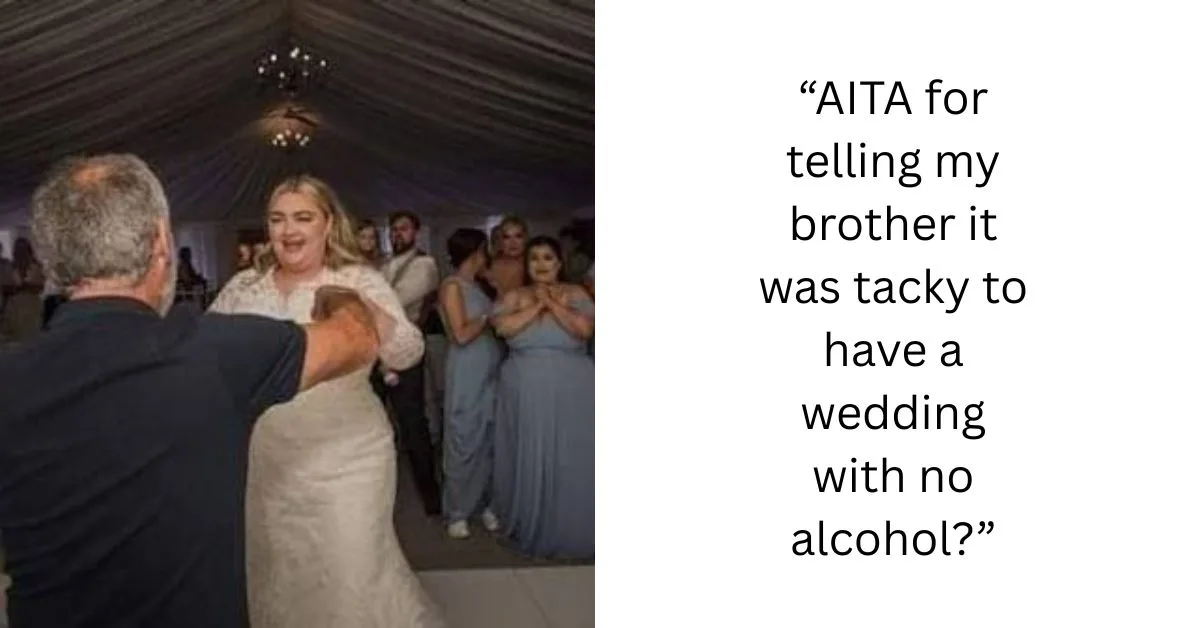
Weddings can be surprisingly complicated because everyone has different expectations about what makes a celebration feel special. One woman recently found herself in an uncomfortable argument with her brother after he and his fiancée decided to have a completely alcohol-free wedding. She understood that it was their wedding and that they had every right to make their own choices, but she privately believed the decision would make the reception feel awkward and overly restrictive. Unfortunately, instead of keeping that opinion to herself, she told her brother that she thought an alcohol-free wedding was “tacky,” and the comment created much more tension than she expected.
The brother and his fiancée had apparently made the decision together because neither of them wanted alcohol at their wedding. They had their own reasons, and they wanted the day to reflect their personalities and values rather than follow traditional expectations. They planned to serve food, desserts, non-alcoholic drinks, music, and other entertainment, so they were not trying to make the celebration boring. From their perspective, guests were attending to celebrate their marriage, not to drink. They also did not want to spend a large amount of money on alcohol when they could use the money for other parts of the wedding.
The sister, however, strongly disagreed with the decision. She believed that many guests expected alcohol at weddings and that having none would make the reception feel less festive. She argued that people could simply choose whether or not to drink, so completely removing alcohol seemed unnecessary to her. During a conversation with her brother, she apparently expressed her opinion more bluntly than she intended and described the decision as “tacky.” Her brother was offended and told her that she was being disrespectful about a choice that had nothing to do with her. He reminded her that it was their wedding and that they were paying for it themselves.
After the conversation, the sister began wondering whether she had crossed a line. She still believed that an alcohol-free wedding would be less enjoyable for some guests, but she realized that calling her brother’s wedding “tacky” was unnecessarily harsh. She could have simply said that she personally preferred weddings where alcohol was available without insulting their plans. Her brother, meanwhile, felt that the comment showed a lack of respect for his and his fiancée’s choices and made him question whether she actually supported their marriage. Other family members became involved, with some agreeing that she was entitled to her opinion while others believed she should apologize.
In the end, the central question is whether expressing an honest opinion becomes wrong when the opinion is delivered in a hurtful way. The brother and his fiancée have every right to decide whether alcohol will be served at their wedding, just as guests have the right to decide whether they want to attend. The sister may genuinely believe that alcohol makes weddings more enjoyable, but calling someone else’s celebration “tacky” simply because it does not match her preferences can easily come across as judgmental. So, AITA for telling my brother that I thought his alcohol-free wedding was tacky, even though I was only expressing my honest opinion?
Read Story…
AITAH for telling my brother it was tacky to have a wedding with no alcohol?
Brother got married 2 weeks ago (July 1). 48 guests total, all local/from the city that’s about 30 minutes away from the venue. They told everyone there was no need for gifts. Venue was a reception hall with an outdoor courtyard. The ceremony started at 4:30 pm. Dinner was served at 5:30 pm and was followed by dancing and mingling until 8:30-9:00 pm when the reception ended and everyone went home.
The wedding had no alcohol. No one knew that or was told ahead of time. The wine on the tables for dinner was sparkling and 0% alcohol. After dinner the bar only served water, juice, pop, mocktails and 0% alcohol wine and beer. The venue was out in the country and not near anything. The city was 30 minutes away. There was nowhere to get alcohol anywhere at the venue or nearby. There were no kids there. There was no religious reason and neither my brother, his wife or anyone at the wedding are recovering alcoholics.
I’m not the only one who was upset. My brother said since was just a short ceremony, dinner and a short reception they didn’t see the need to serve alcohol. They were trying to keep the total cost of the wedding under £5000. I told my brother it was tacky and made the wedding look shabby. I’m not even the only one who feels that way even though my brother is really angry at me. I want to know if I’m TA? I’m not even the only one who was upset. It’s normal and expected thing to have the alcohol flowing at a wedding.
Edited to add: In case it isn’t clear I think my brother was totally wrong here.
Woman Calls Her Brother’s Alcohol-Free Wedding “Tacky” and Sparks a Family Argument
Weddings are deeply personal celebrations, and every couple has the right to decide what kind of event they want. But when families have very different ideas about what a wedding should look like, even a simple disagreement can become surprisingly emotional. One woman recently found herself at the center of a family argument after telling her brother that she thought his decision to have an alcohol-free wedding was “tacky.” She admits that the word was harsh, but she also believes she was simply being honest about how she felt.
Her brother and his fiancée had decided early in their wedding planning that they did not want alcohol served at the reception. It was not an accidental omission or a decision based on budget problems. They had discussed it together and deliberately wanted a celebration where alcohol was not part of the event. They planned to provide plenty of food, desserts, coffee, soft drinks, mocktails, and other refreshments.
The couple also wanted their wedding to be family-friendly. They expected children, older relatives, and people who simply did not drink to attend. They believed that guests could have a great time without alcohol and that the focus should remain on the marriage itself.
The sister, however, had a completely different opinion.
She had attended many weddings over the years and was used to receptions where alcohol was available. In her mind, drinks were simply part of the celebration. She did not think everyone had to drink, but she believed guests should have the option.
She also believed alcohol helped create a more relaxed atmosphere at receptions. People could talk, dance, laugh, and socialize without feeling as formal as they might during the ceremony.
When she heard that her brother’s wedding would have no alcohol at all, she initially assumed the decision might change as the planning continued.
It did not.
The couple remained firm.
They explained that they were comfortable with their decision and did not want alcohol at their wedding. They were paying for the event themselves, so they felt they should be able to organize it according to their preferences.
The sister understood that argument, at least technically.
She knew it was their wedding.
But she still thought the choice was strange.
She began worrying about how the reception would feel. She imagined dozens of guests sitting around drinking soda and coffee while waiting for the evening to end. She wondered whether people would dance as much or stay as long without alcohol.
Instead of keeping those thoughts to herself, she eventually brought them up with her brother.
The conversation started casually.
Her brother was talking about the reception plans and mentioned some of the drinks they had chosen. The sister asked whether there would be wine or beer available.
When he said there would not be any alcohol, she expressed her surprise.
She told him she thought it was unusual.
He responded that they simply did not want alcohol at their wedding.
She then made the comment that created the entire conflict.
She called the decision “tacky.”
Her brother immediately became defensive.
He asked why she would describe his wedding as tacky simply because he and his fiancée had chosen not to serve alcohol.
She tried to explain that she was not criticizing their relationship or saying the wedding would actually be bad. She claimed she was only expressing her opinion about the reception.
But her brother did not see it that way.
To him, the word “tacky” was insulting.
He told her that she was treating her personal preferences as though they were objective rules for how a wedding should be organized.
That accusation made her stop and think.
She realized that she might have been judging their wedding based entirely on what she personally considered normal.
The couple did not want alcohol.
That was their choice.
Nobody was forcing her to organize her own wedding the same way.
Still, she continued to believe that guests would probably have more fun if alcohol were available.
She pointed out that nobody was forcing anyone to drink. Guests who did not want alcohol could simply have soda or another beverage.
Her brother replied that the opposite was also true.
Nobody was forcing guests to attend.
If someone could not enjoy a wedding without alcohol, they could choose not to come.
That response irritated her because she felt he was being unnecessarily dramatic.
She argued that weddings are social events, and hosts should consider what their guests will enjoy.
Her brother responded that hosts can consider their guests without giving up every personal preference.
That became the central disagreement.
The sister believed the couple should compromise.
The brother believed they did not need to compromise on something they considered important simply because other people preferred something different.
Other relatives eventually heard about the argument.
The family became divided.
Some people agreed with the sister and said that alcohol-free weddings can sometimes feel less festive.
Others said she had no right to insult the couple’s plans.
One relative pointed out that plenty of people have weddings without alcohol for religious, personal, financial, or health-related reasons.
Another relative said that even if the sister personally disliked the idea, she could have expressed that opinion without calling the wedding tacky.
That was probably the criticism that bothered her most.
She started thinking about the exact wording she had used.
She could have said, “I personally prefer weddings with alcohol.”
She could have said, “I’m surprised you’re not serving drinks.”
She could even have joked about how different their reception would be from other weddings.
Instead, she chose a word that sounded like a judgment about their taste.
The sister eventually realized that her brother was not upset because she disagreed with him.
He was upset because she made him feel embarrassed about a decision that he and his fiancée had made together.
That distinction mattered.
People can disagree about almost anything, but there is a difference between expressing a preference and insulting someone else’s choices.
The sister also began wondering whether her opinion had been influenced by cultural expectations.
She had grown up attending weddings where alcohol was common.
To her, a wedding without alcohol seemed unusual.
But unusual does not necessarily mean wrong.
Her brother and his fiancée apparently wanted something different.
They wanted their guests to focus on the ceremony, dinner, music, dancing, and time together rather than drinking.
There was nothing inherently disrespectful about that.
The sister eventually apologized for calling the decision tacky, although she still admitted that she preferred weddings where alcohol was served.
Her brother accepted the apology but told her that he hoped she would stop trying to convince them to change their plans.
He said that the wedding was supposed to reflect their personalities, not the expectations of relatives.
That statement stayed with her.
She realized that she had been treating the reception almost as though it were a public event that needed to satisfy everyone.
But the wedding belonged to the couple.
They were paying for it.
They were making the arrangements.
And they were the ones who would remember the day long after the guests went home.
She still believes some guests might prefer having alcohol available.
That may be true.
But she also realized that guests have different preferences about food, music, decorations, seating, dress codes, and countless other details.
A couple cannot satisfy everyone.
At some point, they have to make the wedding they actually want.
The argument also made her think about the difference between being honest and being unnecessarily blunt.
Honesty does not require saying every opinion exactly as it comes to mind.
Sometimes the kinder thing is to recognize that a particular preference belongs to someone else.
She could dislike the idea without making her brother feel embarrassed about it.
She could even privately think the reception would be less enjoyable without alcohol.
But there was no real benefit to telling him that his wedding was tacky.
Now the family is preparing for the wedding, and the sister says she intends to attend and support her brother despite disagreeing with some of his choices.
She has accepted that there will be no alcohol.
She plans to enjoy the food, music, dancing, and company instead.
She also admits that she may have been making assumptions about how much guests actually need alcohol to have fun.
Maybe the reception will be lively.
Maybe people will dance more than expected.
Maybe the absence of alcohol will not matter at all.
And if the guests have a wonderful evening without it, she knows she will have to admit that her assumptions were wrong.
Looking back, she understands why her brother was hurt.
He was not asking her to love every decision he made.
He was asking her to respect his right to make those decisions.
That is something she now believes she can do.
The biggest lesson she took from the argument is that weddings are not standardized events. There is no universal rule saying every wedding must include alcohol, dancing, expensive decorations, a huge guest list, or any other traditional element.
Every couple gets to decide what feels meaningful to them.
The sister may still prefer a wedding with a fully stocked bar, and there is nothing wrong with that.
Her brother prefers an alcohol-free celebration, and there is nothing wrong with that either.
The real problem was not the absence of alcohol.
It was the way she communicated her disagreement.
She now wonders whether she was simply being honest or whether she crossed a line by insulting something that was important to her brother.
She also wonders whether family members should be more careful about giving unsolicited opinions during wedding planning, especially when the couple has already made a decision.
After all, there is a difference between being asked for advice and being told that your choices are embarrassing.
Her brother’s wedding will happen whether she approves of every detail or not.
And perhaps the best thing she can do now is show up, celebrate with him, and allow the couple to enjoy the day they planned.
In the end, she is still asking herself the same question: AITA for telling my brother that I thought it was tacky to have a wedding with no alcohol? She believes she was expressing a genuine opinion, but she now recognizes that the way she expressed it may have been disrespectful. Her brother and his fiancée never asked her to approve of their decision; they simply wanted her to respect it. Maybe the real issue was never whether a wedding needs alcohol, but whether being honest gives someone the right to insult another person’s choices.