Frustrated Parent Pulls Out Wedding Funds And Urges Lovestruck Son To Reconsider Entire Marriage Because His Fiancée Insists On $10k Dress
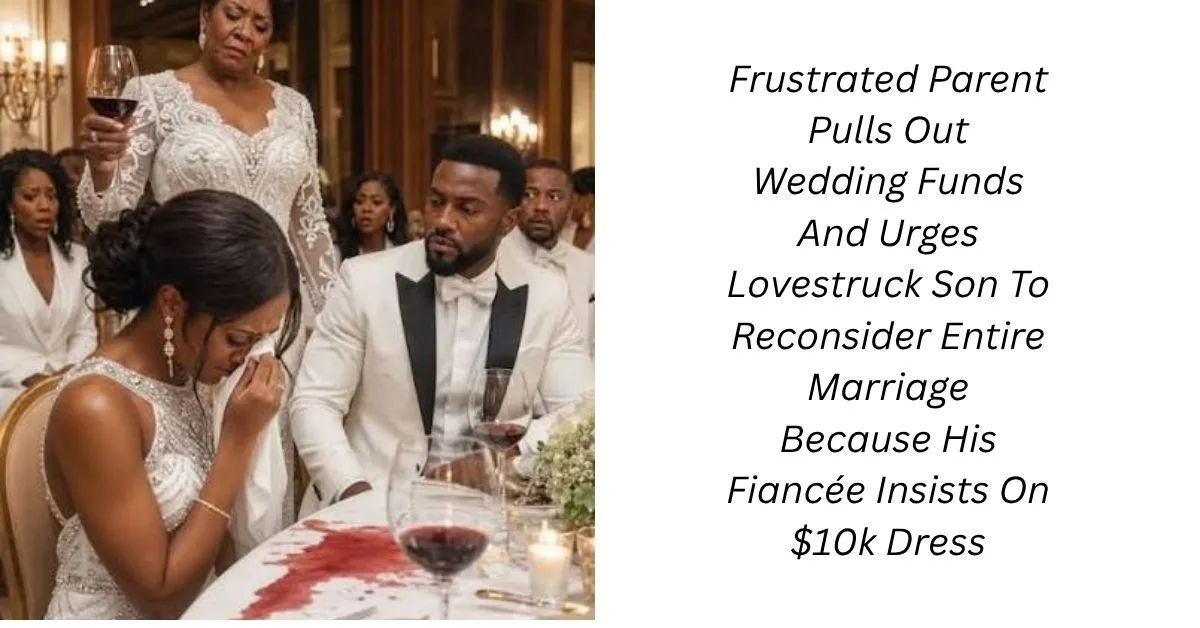
When this parent first learned that their son was getting married, they were genuinely excited for him. Like many parents, they wanted to see their child settle down with someone who loved and respected him, and they were happy to help make the wedding special. The couple had been planning their big day for months, discussing everything from the venue and guest list to food, decorations, photography, and their honeymoon. The parent had offered financial assistance because they believed a wedding was an important milestone and wanted their son to begin married life without unnecessary financial pressure. At first, there seemed to be no reason to worry. However, that changed when the bride-to-be revealed that she had her heart set on a wedding dress costing around $10,000.
The expensive dress immediately caught the parent’s attention because the couple had originally talked about having a reasonable wedding budget. The parent understood that a wedding dress could be meaningful and that the bride should feel beautiful on her wedding day. They were not against spending money on something special. What concerned them was the size of the expense compared with everything else the couple was trying to pay for. A $10,000 dress would consume a significant portion of the wedding budget, leaving less money for other important expenses. When the parent questioned whether the dress could be purchased for less, the fiancée reportedly made it clear that she did not want to compromise. She had found the dress she wanted, believed she deserved it, and apparently viewed the price as something that should not stand in the way of her dream wedding.
The conversation became even more uncomfortable when the parent learned that their son was willing to go along with the decision despite the financial consequences. He was deeply in love with his fiancée and did not want to disappoint her. From his perspective, the wedding was supposed to be about making his future wife happy, and he believed that spending more on her dress might be worth it. He apparently did not see the issue as a serious warning sign. Instead, he viewed it as one expensive decision that could be handled somehow. His parent, however, saw things differently. They worried that the dress might not actually be the biggest problem. If the couple could not agree on a major financial decision before getting married, what would happen when they faced larger expenses such as a mortgage, children, medical bills, or unexpected emergencies?
The parent eventually decided that simply expressing concern was not enough. They had already promised to contribute a substantial amount toward the wedding, but they no longer felt comfortable handing over the money without conditions. They told their son that they were withdrawing their financial support. The decision was not made because they wanted to control the wedding or punish the couple. Instead, they wanted their son to understand that financial assistance came from a desire to help, not from an obligation to fund every demand. In their eyes, paying thousands of dollars toward a wedding while watching the couple make decisions they considered irresponsible would only encourage unhealthy financial habits. Their son was reportedly shocked and upset by the decision, especially because he had assumed the promised money would still be available.
The situation quickly turned into a much larger argument between the parent and son. The son accused his parent of judging his fiancée and interfering in their relationship. He argued that the money was supposed to help them celebrate their marriage and that his fiancée’s dress should not be treated as proof that she was irresponsible. He also insisted that they were adults capable of making their own choices. The parent agreed that they were adults, but pointed out that accepting a large financial contribution also meant understanding that the person providing it had the right to decide whether they were still comfortable giving it. The disagreement became less about the actual dress and more about values, priorities, and the kind of financial partnership the couple intended to have after the wedding.
The parent then gave their son some advice that was much harder for him to hear. Rather than simply telling him to choose a cheaper dress, they urged him to step back and reconsider the entire marriage. They explained that they were not claiming to know whether his fiancée was a good or bad person. Instead, they wanted him to examine how the couple handled disagreements, especially when money was involved. A $10,000 wedding dress could eventually be forgotten, but the financial habits and communication patterns surrounding the decision could remain for years. The parent encouraged their son to ask himself whether he genuinely agreed with the spending or was simply afraid of upsetting the woman he loved. They also asked whether the couple had discussed debt, savings, future goals, and how they would handle major purchases once they were married.
For the son, the advice felt like an attack on his relationship. He believed his parent was taking one disagreement and turning it into a judgment about his future wife. He argued that every couple has different priorities and that wanting an expensive dress did not automatically mean someone would be a bad spouse. His fiancée reportedly supported him in pushing back against his parent, making the conflict even more intense. At the same time, the parent maintained that the issue was never simply about the dress. They were concerned about the attitude behind the demand and the possibility that their son was ignoring uncomfortable questions because he was deeply in love. They wanted him to understand that marriage required more than affection. It also required communication, compromise, financial responsibility, and the ability to make major decisions together.
As the disagreement continued, the son found himself caught between the woman he planned to marry and the parent who had spent years supporting him. He had to decide whether the wedding should move forward without the promised financial assistance or whether he should pause everything and have a serious conversation with his fiancée. The parent made it clear that they would not force him to cancel the wedding. They simply wanted him to make the decision with his eyes open. They also emphasized that if the couple could comfortably afford the dress themselves and genuinely agreed on the purchase, that was their choice. Their objection was to using family money for a wedding while simultaneously refusing to reconsider a luxury expense that seemed excessive to the person providing that money.
In the end, the controversy left everyone questioning what the real problem was. Was the parent being overly controlling by withdrawing promised wedding funds over one expensive dress, or were they justified in seeing the situation as a warning sign about the couple’s approach to money and compromise? Some people might argue that a bride should be allowed to spend whatever she wants on her wedding dress, especially if it is one of the most important outfits she will ever wear. Others might say that demanding a $10,000 dress while relying on parents to finance the wedding crosses a line, particularly when the couple had already agreed to a different budget. For the son, the most difficult question was no longer how much the dress cost. It was whether he and his fiancée could sit down, disagree honestly, compromise when necessary, and build a financial future together. And until they could answer that question, his parent’s warning about reconsidering the marriage may have been much more important than the dress itself.
Read Story…
AITA for telling my future DIL I’m not giving her money for her wedding anymore?
Originally I was going to help my son in his girlfriend Sammie 19 for their wedding giving them money because both work at a restaurant for minimum wage.
So far my relationship with Sammie was ok but I noticed she has a habit if buying clothes outside of her means. I see her with those YSL bags and she wears Golden Goose sneakers.
Wedding dress shopping because a nightmare when she insists on a 10k dress while I went with her mother and the bridesmaids.
I asked her doesn’t that seem excessive for the small wedding you are having and she said since I’m paying for the weddings I can afford the dress I want.
Her getting a 10k dress defeats my whole purpose of paying for the wedding because I didn’t want my son to be in a boat load of debt.
It started as an argument with her mother about how her daughter is a princess and I said no her daughter works a Chili’s and doesn’t even have a high school education while my son has been taking classes at community college so he doesn’t take out a dreaded student loan. (I also pay for that)
Everyone was extremely angry with me after that and I told my son I no longer support his marriage and I will take the wedding funds for his education but please don’t marry Sammie.
He hasn’t been talking to me saying he loves her and it was really awful of me to withdraw money from the weddings because Sammie and her mom put the downpayment of the dress on Sammie’s mom credit card.
As of right now if I don’t help with the wedding I’m not invited if I do not help with paying it. My son is acting stupid about the whole thing and I don’t know how to talk some sense into him without being an even bigger asshole.
A Parent’s Initial Support for His Son’s Marriage
When this parent first learned that his son was planning to get married, he was genuinely happy for him. He had always hoped his son would eventually find someone he loved and build a stable future with. When his son introduced him to his girlfriend, Sammie, who was 19, the relationship initially seemed harmless and exciting. The couple both worked at a restaurant for minimum wage, and because they were young and just starting their adult lives, the parent understood that money was going to be tight.
Because of that, the parent decided to help them financially with the wedding. He did not expect his son and Sammie to pay for everything themselves. He knew that a wedding could become expensive very quickly, and he wanted to give them a good start. He had planned to contribute a significant amount of money so they could cover the venue, food, decorations, photography, clothing, and other expenses without beginning their marriage under a mountain of debt.
At first, the wedding plans seemed relatively reasonable. The couple talked about having a nice celebration with family and friends, but they did not appear to be planning an extravagant event. The parent was comfortable with the idea because he believed helping his son with a modest wedding was something he could do without causing financial problems for himself.
Then Sammie found a wedding dress.
It was not just any wedding dress. The dress she wanted reportedly cost around $10,000. When the parent first heard the price, he assumed there had been some misunderstanding. Ten thousand dollars seemed like an enormous amount for a dress, especially considering that both his son and Sammie were working minimum-wage jobs at a restaurant.
He asked his son whether the dress really cost that much. His son confirmed that it did. Sammie had apparently fallen in love with the dress and considered it her dream wedding gown. According to the son, she had spent considerable time looking at different dresses and believed this particular one was perfect.
The parent understood that a wedding dress could be emotionally important. He did not want to tell Sammie that she was not allowed to have the dress she wanted. However, he could not ignore the financial reality. Ten thousand dollars was more than what some people spend on an entire wedding, and he was the person who had agreed to help finance the celebration.
He began asking practical questions. Who would actually be paying for the dress? Was the couple planning to use savings? Were they going to borrow money? Was the $10,000 included in the original wedding budget? And most importantly, did they understand how much of the available wedding money would disappear because of one item?
The answers made him increasingly uncomfortable.
His son seemed completely willing to support Sammie’s decision. He was deeply in love with her and apparently did not want to start their marriage by telling her that she could not have the dress she wanted. He told his parent that this was supposed to be one of the happiest days of their lives and that Sammie deserved to feel beautiful.
The parent responded that he understood the emotional side of the decision, but marriage also required people to make difficult financial choices. He was worried that his son was focusing so heavily on keeping his girlfriend happy that he was ignoring the larger consequences of their decisions.
The conversation became tense when the parent asked whether his son personally thought spending $10,000 on a dress was a good idea. His son reportedly struggled to give a direct answer. Instead, he defended Sammie and explained that she had dreamed about her wedding dress for a long time.
That answer worried the parent more than the dress itself.
He began wondering whether his son actually agreed with the expense or whether he was simply afraid to disagree with his future wife. The parent knew that young couples could easily confuse keeping the peace with having a healthy relationship. Sometimes one person agrees to something simply because saying no feels impossible.
The parent then reminded his son that the money being discussed was not unlimited. He had worked hard for his savings and had offered to contribute because he wanted to help, not because he was obligated to finance every decision the couple made.
He explained that if his son and Sammie could afford the dress themselves, they were free to purchase it. He did not believe it was his place to dictate how two adults spent their own money. But if they expected him to provide wedding funds while using a large portion of that money on a luxury dress, he had every right to reconsider his contribution.
His son apparently did not take that well.
He accused his parent of being unfair and said that the wedding was about him and Sammie, not about what anyone else thought they should spend. He argued that his parent had offered to help voluntarily and should not suddenly attach conditions to the money.
The parent disagreed.
From his perspective, there was a difference between helping with a wedding and agreeing to fund an extravagant purchase. He had never promised to pay for whatever the couple wanted. He had simply offered financial assistance because he wanted his son to have a good beginning.
As the argument continued, the parent began thinking beyond the wedding.
He started considering what would happen after the ceremony. The dress would eventually be placed in storage. The flowers would disappear. The food would be eaten. The decorations would come down. The wedding day itself would become a memory.
But the financial habits established before the marriage could last for decades.
The parent wondered how his son and Sammie would handle rent, car payments, credit cards, emergencies, vacations, and eventually possibly children. If they could not agree about a $10,000 dress, what would happen when they had to make decisions involving tens of thousands of dollars?
He also became concerned about their age. Sammie was only 19, and his son was apparently still young himself. Both were working minimum-wage restaurant jobs. The parent did not believe being young automatically meant they were irresponsible, but he thought their financial circumstances made a $10,000 dress particularly difficult to justify.
He tried to explain that his concern was not about humiliating Sammie or criticizing her personally. He wanted his son to slow down and think carefully before making a lifelong commitment.
That was when he said something his son did not expect.
He told his son that he should reconsider the marriage.
The parent was not necessarily telling him to break up immediately. Instead, he wanted him to step back from the excitement of the wedding and seriously evaluate the relationship. He asked his son whether he was marrying Sammie because they were genuinely prepared to build a life together or because they were young, deeply in love, and caught up in the excitement of getting married.
His son became extremely upset.
To him, his parent’s comments sounded like an attack on Sammie. He believed his parent was judging her based on one expensive wedding decision. He insisted that Sammie was a good person and that wanting an expensive dress did not make her a bad partner.
The parent agreed with that in principle. He never claimed that the price of a wedding dress determined someone’s character. His concern was about the attitude surrounding the purchase and the couple’s willingness to compromise.
He asked his son a simple question: What happens if one partner wants something expensive and the other partner thinks it is financially irresponsible?
A healthy marriage, he argued, requires both people to discuss the disagreement and find a solution they can live with. It cannot always be about one person getting exactly what they want because the other person is afraid to say no.
The son apparently remained convinced that everything would work out.
He believed that once he and Sammie were married, they would become more financially stable. He also believed that their current minimum-wage jobs did not necessarily represent their future. They were young, he argued, and had plenty of time to build careers and increase their income.
The parent understood that people could improve their financial situation over time. But he did not think future possibilities should be used to justify spending money they did not currently have.
Eventually, the parent made his final decision.
He pulled out the wedding funds.
He told his son that he would no longer provide the money he had originally promised. The decision was painful because he genuinely wanted to help. He knew his son would probably be angry, and he understood that withdrawing financial support could create even more tension between them.
Still, he believed it was better to step away financially than to contribute to a wedding he no longer felt comfortable supporting.
His son was furious.
He reportedly accused his parent of abandoning him at the worst possible time. He said the wedding plans had already been made and that changing the financial arrangement so close to the event was unfair.
The parent replied that the circumstances had changed. He had agreed to help based on one set of expectations, but he no longer believed the couple was approaching the wedding in a financially responsible way.
Sammie also reportedly became upset over the situation.
From her perspective, the dress was not simply an expensive piece of clothing. It represented something she had dreamed about, and she felt that the parent was reducing her wedding dreams to a financial calculation.
The parent could understand why she felt that way, but he still refused to change his decision.
He told the couple that if the $10,000 dress was truly important to them, they could buy it with their own money. He was not trying to prevent them from having it. He simply did not want his contribution to be used for something he considered unnecessary and financially excessive.
The situation eventually left the entire family divided.
Some relatives believed the parent had gone too far. They argued that he had offered to help and should honor his original promise. They felt that the dress was a personal choice and that the couple should be allowed to spend their wedding money however they wanted.
Others sided with the parent.
They believed a $10,000 dress was difficult to justify when both members of the couple were earning minimum wage. They also believed the parent’s decision forced his son to confront an important question before getting married: Could he and Sammie actually make financial decisions together?
That question remained unanswered.
The parent still loved his son and did not want to control his life. He knew that ultimately the decision belonged to his son. If his son wanted to marry Sammie, no amount of parental advice could guarantee that he would change his mind.
But the parent hoped that withdrawing the wedding funds would at least force his son to slow down.
The wedding dress had become a symbol of something much larger. It was no longer simply about fabric, designer labels, or a $10,000 price tag. It was about expectations, compromise, financial responsibility, and whether two young people were ready to build a life together.
Now the son has to decide what matters more: moving forward with the wedding exactly as planned, finding a compromise with Sammie, or taking his parent’s warning seriously and reconsidering whether they are truly ready for marriage. The parent knows he may never be forgiven if his son believes he ruined the wedding. But he also believes that losing the wedding funds is far less serious than watching his son enter a marriage without first asking the difficult questions. And with the big day approaching, everyone is left wondering whether the $10,000 dress was really the problem—or whether it simply exposed problems that were already there.