Landlord Says Washer And Dryer Aren’t His Problem, Tenant Makes Sure They Aren’t His Property Either
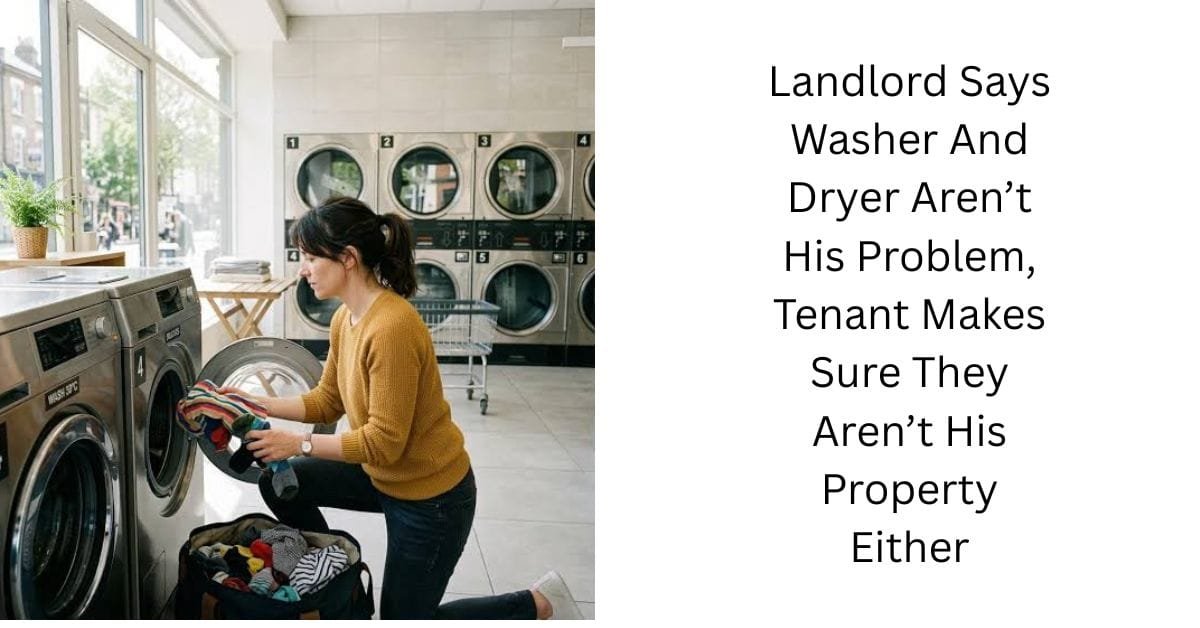
When the tenant first moved into the apartment, one of the things that made the place feel like a good deal was the washer and dryer already sitting in the laundry area. The appliances were old, but they worked well enough, and the tenant assumed they were included with the rental. Nothing in the apartment listing clearly explained who owned them, but because they were already installed and available for use, the tenant naturally believed they were part of the property. For several months, everything worked without a problem. Then one afternoon, the washing machine suddenly stopped draining properly. The tenant tried the basic troubleshooting steps and even checked the hoses, but the problem remained. Since the appliances had been there when the tenant moved in, they contacted the landlord and asked if someone could take a look. The landlord’s response was surprisingly blunt: the washer and dryer were “not his problem.” According to him, the tenant was responsible for dealing with them because they were old appliances and he had never promised to maintain them. The tenant was confused because if the appliances were not the landlord’s responsibility, they wanted to know exactly whose responsibility they were.
The tenant went back through the rental agreement and carefully read everything related to appliances, repairs, and maintenance. There was no clear clause saying the tenant had to maintain or replace the washer and dryer. In fact, the appliances were shown in photographs from the original rental listing, and the tenant had messages from before moving in where the landlord had specifically mentioned the laundry facilities as one of the apartment’s features. When the tenant contacted him again, the landlord repeated that he did not care about the appliances and said the tenant could “figure it out.” He even suggested that if the tenant wanted a new washer or dryer, they could simply buy one themselves. That response irritated the tenant, but instead of arguing, they decided to take the landlord at his word. If the washer and dryer truly were not his responsibility, the tenant reasoned, then perhaps they should not remain his property either. The tenant contacted a repair technician to determine whether the washer could be fixed cheaply. Unfortunately, the repair estimate was high enough that replacing it made more financial sense. At that point, the tenant made a decision that would eventually catch the landlord completely off guard.
Rather than spending money repairing an appliance they believed the landlord had abandoned responsibility for, the tenant purchased their own washer and dryer. Before doing anything, they made sure they understood the rules of the rental agreement and communicated with the landlord in writing. They explained that since he had confirmed the existing machines were not his responsibility, they would be removing the old appliances and replacing them with their own. The landlord initially did not seem interested. He simply replied that the tenant could do whatever they wanted as long as they did not damage the apartment. The tenant arranged for the old machines to be removed carefully and stored temporarily while they purchased replacements. The new washer and dryer were much more efficient and noticeably improved the tenant’s laundry routine. For the first time, the tenant felt that the issue was resolved. They had their own appliances, the landlord had made it clear that he did not want responsibility for the old ones, and everyone could move on. But several weeks later, the landlord suddenly contacted the tenant and asked where the original washer and dryer were.
The tenant reminded him of the conversation. The landlord became irritated and insisted that the appliances had always belonged to the apartment, even though he had previously said they were not his problem. He demanded that the tenant return the original machines immediately. The tenant responded by sending screenshots of their previous messages, including the landlord’s statement that the washer and dryer were not his responsibility and that the tenant should “figure it out.” The tenant also explained that the old appliances had been removed because they were broken and that they had purchased replacements at their own expense. The landlord argued that removing the appliances without his permission was unacceptable, but the tenant pointed out that they had specifically informed him beforehand and he had not objected. What made the situation even more awkward was that the landlord suddenly seemed very interested in appliances he had previously claimed not to care about. The tenant suspected that the landlord had realized he could potentially use the appliances for another rental unit or sell them, but by then the situation had become a question of ownership and responsibility. The tenant had carefully documented every conversation, every expense, and the condition of the original machines.
Eventually, the landlord backed down, but the experience permanently changed the tenant’s relationship with him. The tenant kept the new washer and dryer as their personal property and made sure all future communication with the landlord was in writing. The landlord had wanted the benefits of having appliances available in the apartment without accepting responsibility for maintaining them, but his own statement created an awkward situation when the tenant decided to replace those appliances with their own. The biggest lesson for the tenant was simple: rental arrangements should never depend on assumptions or verbal promises. If an appliance is included in a rental, both sides should know who owns it, who maintains it, and what happens when it breaks. By refusing to keep paying for something the landlord insisted was not his responsibility, the tenant protected themselves from future repair costs and ended up with appliances they actually owned. The landlord may have thought saying “not my problem” would make the issue disappear, but the tenant took those words seriously—and made sure that if the washer and dryer weren’t his problem, they weren’t his property either.
Read Story…
Landlord refused to fix appliances, so I sold them
Several years ago we rented a nice house in a nice neighborhood. It came with a laundry room complete with a very premium washer and a gas-dryer. After about a month, the dryer *burned* a load of laundry… It actually singed and charred the clothes. I immediately took pictures and emailed the landlord to try and recoup the cost of our clothes ($300?) and have the dryer fixed. He responded:
> “The lease is clear and does not include a washer or dryer. If those appliances are present, they were left from a previous tenant and are not mine. I am not responsible for anything I do not provide which would be documented in the lease.”
I was pissed and I paid out of pocket for the repairs and to replace the clothes.
About three months later, we met a few former tenants and started talking about the house. They actually did quite a few improvements to the home and left the home in better condition than when they moved in, and the landlord still refused to refund their deposit. A neighbor confirmed that he hasn’t returned a single deposit and suggested we read the lease to the letter, because the guy was a jerk about everything. Apparently, it was a nice house because of the tenants, not the landlord.
Well, fast forward 10 months to the end of our lease, and I read that thing carefully. **I then listed and sold the washer and dryer!!!** Not even 2 hours after we turned the keys in, I got an angry voicemail demanding we return his overpriced washer and dryer.
My response was a simple reply to his email declining his ownership of the appliances:
>I received your voicemail and I’m not sure which appliances you are referring to. As you stated, the lease clearly states there was not a washer/dryer included and you confirm that below. The lease also states, “Tenant is responsible for all reasonable costs incurred by Landlord to remove, haul, store, or dispose of property left behind.”
He still refused to give us our deposit, for a plethora of other negligible things. But, I still came out ahead because I pocketed about the same as our deposit, the repair costs, the burnt clothes, and maybe $100 for my troubles.
Edit: fixed a typos which redditors can’t get past: cinged=singed, her=the
Responses to the arguments in comments:
The neighbor lady was very friendly and remained friend with some of the former tenants. She had us over for a BBQ and we met two different sets of former tenants. The neighbors all hated him from when he lived there for the two year minimum. We also learned that the LL had a reputation across town for “it’s not personal, it’s business” and was a was a well known jerk.
Yes, premium washers and dryers fetch a high price. Look at Speed Queen resale values. They arent your disposable Whirlpool/Maytag. I have no idea where they came from; his day job was a realtor, so perhaps he got them from a house he bought/sold?
To the landlords that call me a thief: LL denied ownership in writing and the lease states I would be charged for abandoned property. I was covering my ass by disposing of them.
No, we didn’t go to court here in the Colorado. I honestly doubt 90% of people who say that have ever done so. This was also long enough ago that we wrote down the observed damages instead of pictures, and we clearly missed things. He then hired an expensive forensic-like company to do a full UV scan of the house to document and justify repainting and clean/replace carpet and such. If you haven’t seen what a quality short-wave UV light does, you don’t understand (it’s not that cheap thing you get on Amazon). Now that I am older and wiser, I would fight him on that; back then it scared me.
Lots of deleted “this is AI” comments… It’s not, but I appreciate your fight against the machines. With a fist full of advanced degrees, and having spent 30% of ever working day reading and another 30% writing, I bet they use my content to train the bots.
“Everything Seemed Fine Until the Washer Broke”
When the tenant first moved into the apartment, the washer and dryer in the laundry room seemed like one of those small conveniences that made renting the place worthwhile. They were not new or particularly attractive, but they were clean, functional, and already installed when the tenant arrived. The rental listing had even shown the laundry area, although it did not clearly explain whether the machines were included as part of the rental or simply left behind by a previous tenant. Since the landlord never mentioned anything unusual about them during the move-in process, the tenant naturally assumed they came with the apartment. For several months, nobody had a reason to discuss the issue. The tenant used the machines regularly, paid the rent on time, and otherwise had a normal relationship with the landlord. Everything changed when the washing machine suddenly stopped working properly.
The problem started with a strange noise during a normal load of laundry. The machine began shaking violently during the spin cycle, and shortly afterward, it stopped draining completely. The tenant tried turning it off and restarting it, checked the obvious connections, and looked up basic troubleshooting instructions. Nothing worked. Because the machine had been there when the tenant moved in, the tenant assumed the landlord would arrange a repair. They sent him a message explaining what had happened and asked whether he had a preferred repair company. The landlord’s response was short and unexpected. He said that the washer was old, that he had never promised to maintain it, and that the problem was not his responsibility.
The tenant initially thought there had been some misunderstanding. They asked whether the same applied to the dryer because both machines had been in the apartment before the lease began. The landlord replied that neither appliance was his problem. He told the tenant that if they wanted to use them, they could repair them themselves. If they did not want to deal with the repair, they could simply stop using them. The tenant found the answer frustrating but decided not to argue. They had never wanted a conflict with their landlord, especially over an appliance. Instead, they decided to carefully review the lease and the original rental advertisement before responding again.
Reading the lease raised even more questions. There was a section discussing repairs and maintenance, but it did not specifically identify the washer and dryer as tenant-owned appliances. There was also no clause saying the tenant was responsible for replacing them if they failed. The appliances were already installed when the tenant received the keys, and the tenant had not purchased or brought them into the apartment. The original rental advertisement also mentioned an in-unit laundry area, although it did not provide detailed information about the ownership of the machines. The tenant took screenshots of the listing and saved the messages with the landlord. They were beginning to realize that the difference between “not my responsibility” and “not my property” could become important.
The tenant contacted the landlord one more time and asked a very simple question: if the washer and dryer were not his responsibility, who did he believe owned them? The landlord did not give a clear answer. Instead, he said that the tenant was overthinking the situation and that the machines had been there for years. He told the tenant that landlords did not have to replace every old appliance that stopped working. The tenant agreed that replacing an appliance could be expensive, but they pointed out that they had never purchased the machine and had never agreed to maintain it. The landlord responded that the tenant could buy their own washer if they wanted one. That sentence would become extremely important later.
At that point, the tenant decided to investigate how much it would cost to repair the washer. A technician came out, inspected the machine, and explained that several components were worn out. The repair was possible, but the estimated cost was high enough that the tenant would be spending a significant amount of money on an appliance that was already old. The technician also warned that other parts could fail soon because of the machine’s age. The tenant thanked him and decided not to proceed with the repair. They started looking at reasonably priced replacement machines instead.
The tenant also considered the dryer. Although it was still working, it was the same age as the washer and had already started making unusual sounds. The tenant did not want to spend money repairing one machine only to have the other fail shortly afterward. They began considering buying their own washer and dryer as a set. It was a significant expense, but the tenant reasoned that if they owned the new machines, they could take them with them when they eventually moved. More importantly, they would no longer depend on the landlord for appliances he had already said were not his responsibility.
Before purchasing anything, however, the tenant sent the landlord another written message. They explained that because he had confirmed the existing washer and dryer were not his responsibility, they planned to purchase their own machines and remove the old ones. They asked whether there was anything they needed to know regarding installation. The landlord responded that the tenant could do whatever they wanted as long as they did not damage the apartment. There was no objection, no warning that the machines belonged to him, and no request that the old appliances remain on the property.
The tenant took that response as permission to move forward. They purchased a new washer and dryer, arranged professional delivery, and made sure the installation would not damage the plumbing, flooring, walls, or electrical connections. They also made arrangements for the old washer and dryer to be removed. Since the tenant did not want to create any future disagreement, they photographed the appliances before they were taken away. They photographed their condition, the laundry area, and the installation points. They kept receipts for the new machines and copies of their communication with the landlord.
The new appliances immediately made life easier. They were quieter, more efficient, and much better suited to the tenant’s needs. The tenant was satisfied with the purchase and believed the entire issue had finally been resolved. The old machines were gone, the landlord had been informed, and the tenant now had appliances they personally owned. There was no reason for the landlord to care about them because, according to his own messages, they had never been his responsibility in the first place.
Several weeks passed without any problem. Then the landlord unexpectedly contacted the tenant asking about the original washer and dryer. The tenant initially assumed he was simply checking whether they had been removed. They replied that the machines had been taken out and replaced with the tenant’s own appliances. The landlord’s response was completely different from what the tenant expected. He demanded to know where the old machines were and insisted that they should still be in the apartment.
The tenant reminded him of their previous conversation. They sent screenshots showing that the landlord had said the appliances were not his problem and that the tenant could buy their own. The landlord suddenly claimed that he had never meant the appliances were not his property. He said he simply meant that he did not want to pay for repairs. The tenant pointed out that those were two different things. If the machines were his property, then he should have clearly said so when the tenant asked. Instead, he had repeatedly told the tenant that they were not his responsibility and had given permission to replace them.
The landlord became increasingly frustrated. He argued that the appliances had been installed in the apartment for years and therefore should not have been removed. The tenant responded that they had not secretly taken anything. They had informed him in writing and received no objection. The landlord had even told them to do whatever they wanted as long as the apartment itself was not damaged. The tenant had followed that instruction carefully. The new machines had been professionally installed, and the laundry area was in better condition than before.
The landlord then demanded that the tenant return the old machines. The tenant explained that they had already paid to have them removed and had disposed of them because they were broken and the landlord had explicitly refused responsibility for them. The landlord accused the tenant of intentionally getting rid of his property. The tenant calmly replied that this was the first time he had ever described the appliances as his property. Until that moment, every conversation had been about how the machines were apparently not his responsibility.
This was where the tenant realized how easily vague language could create problems. The landlord wanted the tenant to accept the costs and inconvenience associated with broken appliances while still retaining ownership whenever it became convenient. The tenant refused to accept that arrangement. They had not removed the machines to profit from them or damage the landlord’s property. They had replaced them because the landlord had refused to address the problem and had told them to handle it themselves.
The tenant organized every piece of documentation they had. They had the original rental listing, photographs from move-in day, messages about the broken washer, the landlord’s statements about responsibility, the message informing him about the replacement, receipts for the new appliances, and photographs showing the condition of the laundry area. Instead of continuing the argument emotionally, they sent the landlord a clear timeline of what had happened. They explained that they had acted based on his written statements and had made every effort to avoid damaging the property.
The landlord eventually stopped responding for several days. During that time, the tenant worried that the disagreement might somehow affect the rental relationship. They wondered whether they should have handled things differently or whether they should have insisted on getting explicit written confirmation that the landlord was abandoning the old machines. The situation had become much bigger than a broken washer. It was now about trust and responsibility between a landlord and tenant.
A few days later, the landlord returned with another message. His tone had changed. Instead of demanding the old machines back, he said he wanted to clarify the situation for future tenants. He admitted that he had considered the washer and dryer “part of the apartment” but did not consider himself responsible for repairing them. The tenant pointed out that this was exactly the ambiguity that had caused the dispute. If an appliance belongs to the property but the landlord refuses to maintain it, the rental agreement should say that clearly.
The tenant suggested that the landlord update the lease and move-in documentation for future renters. If appliances were included but not maintained, that should be written clearly. If tenants were allowed to replace them, the agreement should explain what happened to the original machines. The landlord did not immediately agree with everything, but he acknowledged that the situation had exposed a gap in his rental paperwork.
The tenant also learned something important about renting: never assume that an appliance’s presence automatically tells you who owns it or who is responsible for it. A washer, dryer, refrigerator, dishwasher, or air conditioner may be physically inside a rental unit, but responsibility for maintenance and ownership can depend on the lease and local rules. Verbal statements can also become difficult to prove if a dispute develops. That was why the tenant was so relieved to have saved the messages.
Some friends told the tenant they had been too aggressive by removing the old appliances. Others said the landlord had created the entire situation himself by refusing to take responsibility while still expecting control over the machines. The tenant understood both perspectives, but one fact remained clear: they had communicated before making the change. They had not acted secretly. They had spent their own money on replacements and had tried to handle the situation professionally.
What bothered the tenant most was not the money. It was the sudden change in the landlord’s position. When the washer broke, he wanted nothing to do with it. When the tenant replaced it, he suddenly wanted ownership recognized. The tenant felt that the landlord had tried to have it both ways. He wanted the tenant to absorb the inconvenience of an old appliance but also wanted to retain control over it. That was exactly the kind of ambiguity the tenant no longer wanted to deal with.
The tenant kept the new washer and dryer and continued using them without further problems. They also added the purchase receipts and installation documents to their rental records. From then on, whenever there was any question about maintenance or property in the apartment, the tenant communicated by email or text instead of relying on verbal conversations. They were not trying to create hostility. They simply wanted a clear record of what had been agreed upon.
The relationship with the landlord became more distant after the incident. They remained polite, paid rent on time, and followed the lease, but the tenant no longer assumed that casual statements would be enough. If the landlord said something important, the tenant politely asked for it in writing. The landlord seemed slightly annoyed at first, but eventually the new system actually made communication easier. There were fewer misunderstandings because both sides could look back at what had been discussed.
The tenant also became more careful when talking to friends about renting. They explained that renters should photograph the condition of an apartment when moving in, save the original listing, keep receipts for anything they purchase for the property, and read the lease carefully. Most importantly, they said tenants should clarify who owns and maintains appliances that are already inside the unit. A few minutes of documentation at the beginning of a lease can prevent weeks of arguments later.
The story eventually became a strange example of how one sentence can come back to haunt someone. The landlord had said the washer and dryer were not his problem. The tenant took that statement seriously and stopped treating the appliances as something they were obligated to maintain for him. When the tenant purchased replacements, the landlord suddenly wanted the old machines treated as his property. But by then, the tenant had a complete record showing exactly what had happened.
In the end, the tenant did not feel like they had “won” a battle against their landlord. They felt they had learned an important lesson about boundaries, documentation, and clear agreements. The real problem had never been the washer or dryer. It was the expectation that one person could avoid responsibility while still keeping control. The tenant simply refused to continue living under that arrangement. When the landlord said the appliances weren’t his problem, the tenant made sure they weren’t his property either—and from that point forward, every responsibility between them was put in writing.