Waiter Tipped With Fake $100 Bill By Customer Who Wants To Impress His Date, Plots Her Petty Revenge Which Left Him Embarrassed
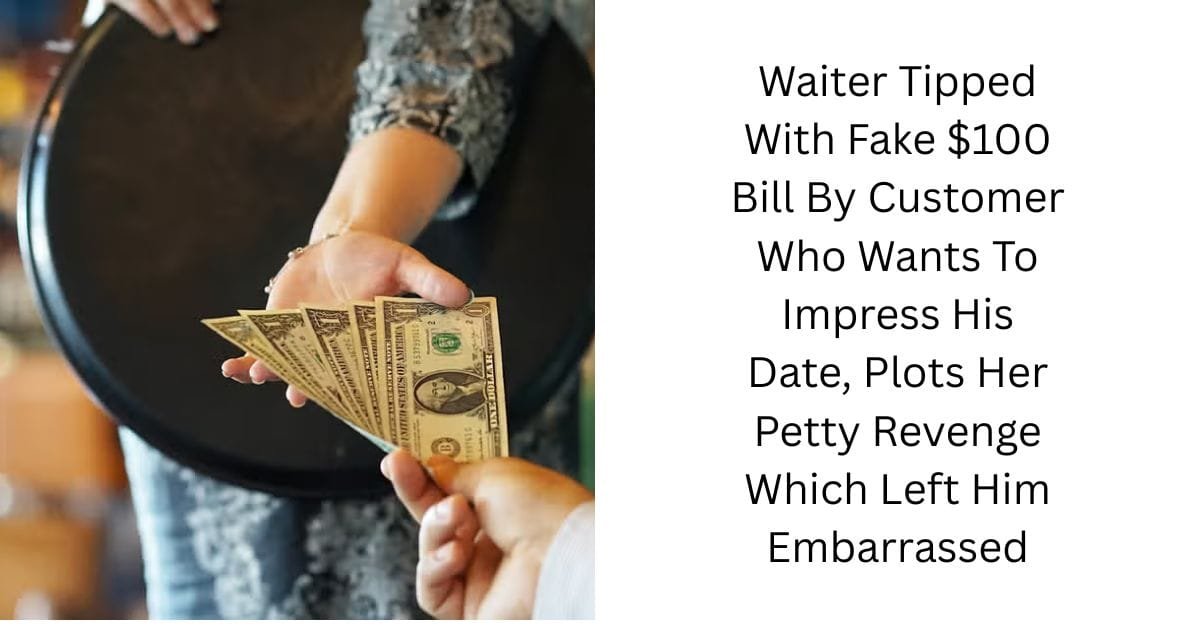
The waiter had seen the customer many times before, so he already knew what to expect whenever the man walked into the restaurant. He was usually quiet, kept to himself, and often sat at the bar watching whatever sports game happened to be on. Sometimes he came alone, and other times he arrived with a couple of friends. He was never openly rude, but he was not exactly the kind of customer servers looked forward to either. His tips were usually small, and there was nothing about his visits that made him particularly memorable. That changed completely one evening when he arrived with a woman the waiter had never seen before. Instead of sitting at the bar like he normally did, the man chose a table in one of the quieter sections of the restaurant, and by coincidence, that table was assigned to the waiter. At first, everything seemed completely normal. The couple ordered their food, talked throughout the meal, and appeared to be enjoying themselves. The waiter treated them like any other customers, making sure their drinks were filled and checking on them throughout the evening. There was nothing unusual about the interaction until they finished dinner and asked for the check.
When the waiter returned with the bill, he noticed the couple were still talking and laughing together. He placed the check on the table and stepped away briefly, expecting them to take care of it as usual. As he was returning, however, he heard the man say something that immediately caught his attention. “Watch this,” the man reportedly told his date. The waiter looked over just in time to see the customer pull out what appeared to be a crisp hundred-dollar bill and place it dramatically on the table. The man noticed that the waiter had seen the gesture and immediately laughed, saying something along the lines of, “Oh, you weren’t supposed to see that!” The waiter assumed the customer was simply joking around, but inside, he was absolutely thrilled. A hundred-dollar tip would have been enormous compared with what this customer normally left, and after working a long shift, the waiter was already imagining what he could do with the unexpected money. He did not want to interrupt their date or make the moment awkward, so he simply walked away and waited for them to finish. The fact that the customer seemed determined to impress his date did not bother him. If anything, he thought it was funny. As far as he was concerned, a good tip was a good tip, regardless of the reason behind it.
The couple eventually left, and the waiter waited until they were safely out of the restaurant before returning to the table. He picked up the hundred-dollar bill, unfolded it, and immediately realized something was wrong. It was not real money. It was one of those novelty fake hundred-dollar bills designed to look convincing from a distance, the kind people sometimes use for jokes or pranks. For several seconds, the waiter simply stared at it in disbelief. His excitement disappeared almost instantly. What made the situation worse was realizing that the entire thing had probably been planned. The customer had not accidentally left the wrong bill behind. He had deliberately placed it on the table where his date could see it, made sure the waiter noticed, and then walked away knowing the waiter would probably believe it was a generous tip. The waiter felt embarrassed, but more than anything, he was angry. He had spent the entire evening doing his job properly, taking care of the couple and giving them good service, only to discover that the impressive gesture had been nothing more than a performance. The customer had apparently wanted his date to believe he was generous while using the waiter as part of the joke.
The waiter immediately showed the fake bill to his manager and explained exactly what had happened. His manager was stunned and agreed that it was an incredibly childish thing to do. They both knew that servers depended on tips, and although no customer was obligated to leave an enormous tip, deliberately pretending to leave a hundred dollars just to create an impression was completely different. The waiter considered throwing the fake bill away, but instead he decided to keep it. He slipped it into his belongings and told himself that one day he would find an appropriate way to return the embarrassment to the customer. He did not want to create a scene or risk his job by confronting him. Instead, he decided to wait. The customer continued coming into the restaurant over the following weeks, usually behaving as though nothing had ever happened. He still sat at the bar, watched sports, and left his usual mediocre tips. Every time the waiter saw him, he remembered the fake hundred-dollar bill. The customer probably assumed the joke had been forgotten, but the waiter had kept the evidence.
Eventually, the opportunity he had been waiting for arrived. One evening, the same customer came into the restaurant again, and once again he was accompanied by the same woman. The waiter recognized her immediately. He wondered whether she knew what had happened the previous time, but he had no way of knowing whether she had been involved in the prank. Rather than immediately assuming she had been part of it, he decided to give her the benefit of the doubt. During their meal, the waiter treated them professionally and acted as though nothing unusual had ever happened. The customer seemed completely relaxed, apparently having no idea that the waiter remembered everything. Toward the end of the meal, the customer once again began acting confident and charming in front of his date. He joked with her, talked about how successful he was, and generally behaved like someone who wanted to make a strong impression. That was when the waiter realized he could turn the customer’s own habit against him without being rude, threatening, or destructive. He simply needed to let the man create the embarrassing moment himself.
When the couple asked for the check, the waiter brought it over and stepped away. A few moments later, the customer called him back and asked for a pen. The waiter handed one over, then casually reached into his pocket and pulled out the fake hundred-dollar bill from the previous visit. He placed it on the table and said, with a completely straight face, “You left this here last time. I figured you might want it back.” The customer’s expression reportedly changed immediately. His date looked at him, then at the fake bill, clearly confused. The customer recognized it instantly and became visibly uncomfortable. He tried to laugh it off, but the waiter calmly explained that he had found it after they left and had kept it because he thought the customer might want his “tip” back. The woman began asking questions, and suddenly the impressive image the man had been trying to create started falling apart. The waiter did not insult him or raise his voice. He simply gave him the same fake hundred-dollar bill he had used to make himself look generous and allowed the customer to explain why he had used it in the first place.
The customer reportedly tried to claim that it had only been a joke and that the waiter was taking things too seriously. The waiter responded that he understood jokes, but there was a difference between making a harmless joke with friends and deliberately making a server believe they had received a hundred-dollar tip when they had not. The woman seemed especially surprised that the man had done it during their first date, apparently because she had believed the dramatic gesture was genuine. The customer became increasingly uncomfortable as he realized the waiter had not only remembered the prank but had also kept the fake bill as proof. Eventually, the woman reportedly told him that she found the whole thing immature and unnecessary. The waiter finished the interaction professionally and returned to work, never knowing exactly what happened between the couple afterward. But for him, the revenge had already worked. He had not cost the customer money, damaged anything, or caused a public confrontation. He had simply exposed the fake generosity for what it really was. The man had wanted to impress his date by pretending to be generous, only to discover that the same fake hundred-dollar bill would eventually become the thing that embarrassed him most.
Read Story…
The customer who tipped a fake $100 bill.
This is not my story, this happened to my friend, they don’t use Reddit and when they told me this I had to share because I love it and I’d never expect it from the friend who did it.
I work as a server, this one guy always comes in the restaurant I work at, he usually is pretty quiet and and never tips too well. Most of the time he comes with a couple of friends or by himself and sits at the bar and watches a sports game. Ive never had a problem with him until he came in one time with a date. I’ve never seen the woman before so I assume they were new to dating. Anyways, they sit at a table this time in a more quiet part of the restaurant and they were sat at one of my tables. I had no problem with them and everything was going fine. They asked for the check and I went right around the corner from their table, it was close by so I was quick. As I was coming back to the table the guy says to the woman watch this as he puts down a hundred dollar bill on the table. He saw me see and he was joking like oh you weren’t supposed to see that!
I was ecstatic either way even though it was so obvious he was trying to impress the woman. I didn’t care, I waited til they left to go grab the hundred dollar bill. Well, when I unfolded it it was one of the fake $100 bills I guess for pranks, that means this freaking guy planned this out to impress this woman. It was so frustrating because I needed the money but at the same time I thought it was because I did a great job. Either the woman was in on it or he decided to be a jerk in 2 different ways. Told my manager and he was like wow that’s ridiculous. I decided to hold on to it because I knew the day would come when I could get back at this guy.
2 weeks later…. My manager recognizes the guy and while I was working at the time, I was in a different side of the restaurant which was already full, my manager found me and asked if I wanted that customers table as well and told me he was with the woman from last time. I often joked with my manager about throwing the fake $100 back on the table in front of that woman if he ever came back to embarrass him. I thought to myself, yeah I may be busy already, but I also thought sure, what’s one more table. Told my manager absolutely, no problem with a smirk on my face.
Before I went over to their table I ran out to my car to grab the fake $100 that was sitting in my cup holder for this exact moment. I get to their table and they instantly recognize me, the woman seemed normal but the guy looked like he was nervous. I pretended nothing happened all the way until I got their check.
When I brought the check back, I placed it down on the table as well as the fake 100 but left it unfolded so the fake part was showing. I looked at the guy and said hey, not sure if you remember me from last time but I believe you forgot this, just returning it because I believed it was too much. The woman looked very confused so I instantly knew she was not apart of it but the guy got all nervous and said I don’t know what that is! I said oh my mistake and laughed and said to the woman have a good night, and walked away.
When I came back there was a big $0.00 on the signed copy and a $50 bill(real this time) where the woman was sitting after they had left. One can only assume that the guy didn’t want to tip on his card so he wrote obnoxiously big zeros on the tip and that $50 just happened to be where the woman was sitting, so I’m hoping she had placed it there.
Now I don’t know what happened with the couple or if they stayed together but I haven’t seen them back since and it’s been a few weeks and I really hope she looks for his red flags now.
“A Familiar Face at the Restaurant”
The waiter had seen the customer countless times before, so he already had a pretty good idea of what to expect whenever the man walked into the restaurant. He was a regular, but not exactly the kind of regular who made servers excited to see him. Most of the time, he came in alone or with a couple of friends, sat at the bar, ordered something simple, and spent most of his visit watching whatever sports game was playing on the television. He was usually quiet and kept to himself, so the waiter had never had a serious problem with him. The only thing that stood out was his tipping. The man rarely left anything impressive, and the waiter had long ago learned not to expect much from him. Still, he was a paying customer, and the waiter always treated him professionally. There was never any reason for him to think that this ordinary regular would eventually become the subject of one of the strangest and most satisfying moments of his time working at the restaurant.
Advertisement
One evening, however, the customer arrived with a woman the waiter had never seen before. The change in his behavior was immediately noticeable. Instead of heading toward the bar like he normally did, he looked around the restaurant and chose a table in one of the quieter sections. The woman appeared to be someone new in his life, and based on the way he was acting, the waiter assumed they were probably on a date. He did not think much of it at first. The waiter had served hundreds of couples, and most dates were completely ordinary. He simply approached the table, introduced himself, took their drink orders, and made sure they had everything they needed. The customer seemed unusually attentive toward the woman, laughing at her jokes and talking enthusiastically about himself. The waiter noticed that the man appeared to be trying especially hard to make a good impression, but he had no reason to interfere. As long as they were polite and the meal went smoothly, he was happy to stay out of their business.
For most of the evening, everything went perfectly. The couple ordered their food, talked comfortably, and seemed to be enjoying themselves. The waiter checked on them several times and made sure their drinks were refilled when necessary. There were no complaints about the food, no arguments, and no strange requests. From the waiter’s perspective, it was simply another table during another shift. When they finally finished their meal, the customer asked for the check. The waiter brought it over and then stepped away briefly so they could look over the bill and decide how they wanted to pay. He had no idea that the next few minutes would completely change his opinion of the customer. What happened next was not something he expected from a man he had served so many times before.
As the waiter returned to the area near their table, he noticed the customer suddenly turn toward his date with an excited expression. The man said something like, “Watch this,” and then reached into his wallet. The waiter happened to be close enough to see what happened next. The customer pulled out what appeared to be a crisp hundred-dollar bill and placed it dramatically on the table. He seemed very pleased with himself, almost as if he were performing a trick for his date. Then he noticed that the waiter had seen the money and immediately laughed, saying, “Oh, you weren’t supposed to see that!” The waiter understood exactly what the man was trying to do. He was clearly attempting to impress the woman by appearing generous. But instead of being annoyed by the performance, the waiter was thrilled by what he believed was about to happen.
A hundred-dollar tip would have been far more than the waiter expected from this customer. Since the man normally tipped poorly, seeing that large bill sitting on the table felt like an unexpected reward. The waiter immediately assumed that the customer’s date had brought out a different side of him. Maybe he wanted to impress her. Maybe he had decided to be generous for once. Whatever the reason, the waiter did not care. He had worked hard throughout the evening, and the possibility of receiving such a large tip made him feel appreciated. He decided not to interrupt the couple’s moment. Instead, he continued doing his job and waited patiently for them to finish their conversation. He did not reach for the money or make any comment about it. He simply assumed that once they left, he would be able to collect what he believed was an incredibly generous tip.
Eventually, the couple got up and left the restaurant. The waiter waited until they were well on their way out before returning to the table. He picked up the hundred-dollar bill with a smile, already thinking about how useful the extra money would be. But the moment he unfolded it, his excitement disappeared. Something about the bill immediately looked strange. After taking a closer look, he realized that it was not real money at all. It was one of those novelty fake hundred-dollar bills commonly used for pranks. For a few seconds, he simply stood there staring at it. He could hardly believe what he was seeing. The entire impressive display had been fake from the beginning. The customer had deliberately put the bill down where both his date and the waiter could see it, apparently knowing that the waiter would assume it was a real tip.
The realization made the situation much more frustrating. The waiter understood that the customer had not accidentally used the wrong bill. This had clearly been planned. The man had wanted to create the appearance of being extremely generous in front of his date without actually giving away a hundred dollars. The waiter had unknowingly become part of the performance. He had spent the evening doing his job properly, only to be used as a prop in someone’s attempt to look impressive. What bothered him most was not simply losing the money. He understood that customers were not required to leave huge tips. If the man had left five dollars or nothing at all, that was one thing. But deliberately creating the impression that he had left a hundred-dollar tip just to impress someone felt insulting.
The waiter took the fake bill to his manager and explained exactly what had happened. His manager looked at the bill and was immediately shocked. He agreed that the customer’s behavior was ridiculous, especially because the prank involved someone who relied on tips as part of their income. They both laughed at how absurd the situation was, but the waiter was still irritated. He decided that he was not going to confront the customer immediately. There was no point in starting an argument in the restaurant or risking his job over a childish prank. Instead, he folded the fake bill and kept it. He told himself that he would hold on to it until the right opportunity came along. He had no idea when that opportunity would arrive, but he had a feeling it eventually would.
Over the following weeks, the customer continued coming into the restaurant as if nothing had happened. He sat at the bar, watched sports, talked with friends, and behaved normally. Every time the waiter saw him, he remembered the fake hundred-dollar bill. The customer seemed completely unaware that the waiter had kept it. He probably assumed the prank was over and forgotten. The waiter never mentioned it. He simply continued doing his job and quietly waited. He did not want revenge that would get him fired or cause serious trouble. He wanted something much simpler: a moment where the customer would understand exactly how embarrassing his little performance had been.
Then one evening, the customer walked through the door accompanied by the same woman. The waiter immediately recognized her. For a moment, he wondered whether she had known about the fake bill the first time. Perhaps she had been involved in the prank. Perhaps she had thought it was funny. Or perhaps she had genuinely believed the customer had left a hundred-dollar tip. The waiter decided he would not assume anything. He would treat her normally and let the situation reveal itself naturally. The couple were seated, ordered their food, and began talking. The customer once again seemed eager to impress her. He spoke confidently, laughed loudly, and seemed determined to present himself as someone who had everything under control.
The waiter continued serving them without mentioning their previous visit. He did not want the customer to become suspicious. He refilled their drinks, checked on their food, and remained completely professional. Meanwhile, the fake hundred-dollar bill was still safely tucked away. The waiter knew exactly where it was. He had kept it because he knew that someday it might be useful. Watching the customer behave as though he had never done anything wrong made the waiter even more determined to make his point. He did not want to humiliate the man’s date. He did not want to embarrass an innocent person. He wanted the customer to experience a small dose of the same embarrassment he had caused someone else.
The meal continued without incident. The couple seemed to be having a good time, and the waiter began wondering whether the woman had any idea what kind of person she was sitting across from. The customer seemed especially focused on looking generous and successful. He made comments about money and acted as though spending was never a concern. The waiter found the behavior almost comical given what he knew. The man had literally used a fake hundred-dollar bill to pretend to be generous. Yet here he was, still trying to create the same image. The waiter realized that if he handled the situation correctly, he would not have to say much at all. The truth would embarrass the customer on its own.
When the couple eventually finished eating, they asked for the check. The waiter brought it over and stepped away. He waited patiently while they looked over the bill. The customer appeared relaxed and confident, apparently expecting another ordinary evening. Then he asked the waiter for a pen. The waiter handed one to him. That was when he decided the moment had arrived. He reached into his pocket and pulled out the same fake hundred-dollar bill from their previous visit. He placed it gently on the table and looked directly at the customer. Then he said calmly, “I believe you left this here last time.”
The customer’s expression reportedly changed almost instantly. He recognized the bill immediately. For a second, he did not know what to say. His date looked at the fake money, then looked at him, clearly confused. The customer tried to laugh, as though the situation were no big deal. But the waiter could see that he was uncomfortable. The woman asked what the bill was, and the customer attempted to brush the situation aside by calling it a joke. That only made things more awkward because the waiter calmly explained that he had initially believed it was a real hundred-dollar tip. He said he had only discovered it was fake after the couple had left. He did not insult the customer or raise his voice. He simply explained what had happened.
The woman appeared genuinely surprised. She asked whether the customer had really placed the fake bill on the table knowing that the waiter would see it. The customer tried to explain that he had only been joking and that he never intended to hurt anyone. But the waiter quietly pointed out that the customer had deliberately used the bill to make himself appear generous. The man became increasingly defensive. He insisted that nobody had actually lost anything because it was only a fake bill. The waiter responded that the point was not whether the restaurant had lost money. The point was that he had been intentionally deceived for the sake of someone else’s impression.
The conversation became uncomfortable enough that other people nearby began noticing the tension. The waiter still remained calm. He had no interest in turning the situation into a loud confrontation. In fact, the calmer he stayed, the more embarrassed the customer seemed to become. The customer had apparently expected to control the entire image of the evening, but suddenly the story was no longer going the way he wanted. Instead of appearing generous in front of his date, he was now being forced to explain why he had staged a fake tip for a server. The very trick he had used to impress her had become evidence that he was willing to embarrass someone else just to look good.
The woman then asked the waiter whether he had kept the fake bill all this time. He nodded and explained that he had kept it because he had a feeling the opportunity to return it would eventually come. She seemed amused by that answer but also disappointed in the customer. The man tried to argue that the waiter was holding a grudge over something that had happened weeks earlier. The waiter admitted that he had been annoyed, but said he had not planned anything complicated. He simply wanted to give the man his fake hundred-dollar bill back. The customer had created the original situation, and now he was dealing with the consequences of having been recognized.
What made the moment even more awkward was that the woman seemed to understand why the waiter was upset. She reportedly told the customer that pretending to give someone a huge tip just to look generous was not nearly as impressive as he apparently thought it was. The customer became quiet. The image he had been trying so hard to create had completely collapsed. He had wanted his date to see him as generous, confident, and successful. Instead, she was now seeing someone who had deliberately tricked a server because he wanted attention. The waiter could not help but notice the irony. The fake hundred-dollar bill had been designed to make the customer look good, but in the end, it had done exactly the opposite.
The waiter eventually told the couple that he still expected them to pay their actual bill and that there was no problem with the payment. He was not trying to steal from them or cause financial trouble. His only purpose had been to return the novelty bill and make sure the customer understood that the prank had not been forgotten. The customer paid the check and left the fake bill on the table for a moment before finally taking it back. The woman seemed much quieter as they prepared to leave. The customer no longer had the confident attitude he had displayed earlier. Whatever conversation happened between them after they walked out of the restaurant was something the waiter would never know.
Back at the restaurant, the waiter showed his manager what had happened. His manager laughed and admitted that the customer had essentially embarrassed himself. The waiter felt relieved that the situation had ended without an argument or any serious consequences. He had not needed to yell, insult the man, or cause a scene. He simply waited for the right opportunity and returned the prank to its creator. The fake bill had done all the talking. The manager told him that sometimes the best revenge was simply allowing someone to realize how foolish their own behavior looked when the tables were turned.
The story also made the waiter think about how often people did things for appearances without considering who might be affected. The customer had apparently cared more about impressing his date than about treating the server with basic respect. He could have left whatever tip he genuinely wanted. He could have made a joke with his date that did not involve deceiving another person. Instead, he chose to create a fake moment of generosity. The waiter understood that the amount of money was not really the heart of the issue. It was the intention behind the prank. The customer wanted to look good while making someone else believe they had received something valuable.
Interestingly, the waiter never found out exactly what happened between the customer and the woman afterward. He saw them leave together, but they seemed much less cheerful than they had been during the beginning of the evening. He did not ask anyone about them and did not care to find out. For him, the matter was finished. He had made his point and returned to his work. Whatever the woman thought about the customer was now between them. The waiter had no desire to interfere in their relationship. He simply hoped the man had learned that embarrassing other people was a risky way to make himself look impressive.
The customer continued coming to the restaurant after that night, but his behavior around the waiter was noticeably different. He no longer made dramatic gestures involving money. He kept his visits short and seemed much more cautious whenever the waiter approached his table. The waiter never brought up the fake bill again. There was no need. They both knew what had happened. The customer had received the message. The waiter also noticed that the man’s tips became slightly better afterward, although he never knew whether that was because the customer felt guilty or simply did not want another awkward encounter.
In the end, the waiter considered the situation a lesson in how quickly an attempt to impress someone can backfire. The customer had wanted his date to see a generous man putting down a hundred-dollar tip. Instead, she eventually discovered that the bill was fake and that the entire gesture had been designed to create an illusion. What began as an attempt to look impressive ended with the customer explaining himself while the waiter calmly watched. The waiter never needed to cause real harm or create a major confrontation. He simply held onto the evidence and waited for the perfect opportunity. Sometimes petty revenge does not require shouting, threats, or dramatic consequences. Sometimes all it takes is remembering exactly what happened and handing someone their own joke back when they least expect it.