Teen Breaks Up With Boyfriend Who Made Her Split Bill For Celebratory Meal To Make A Point
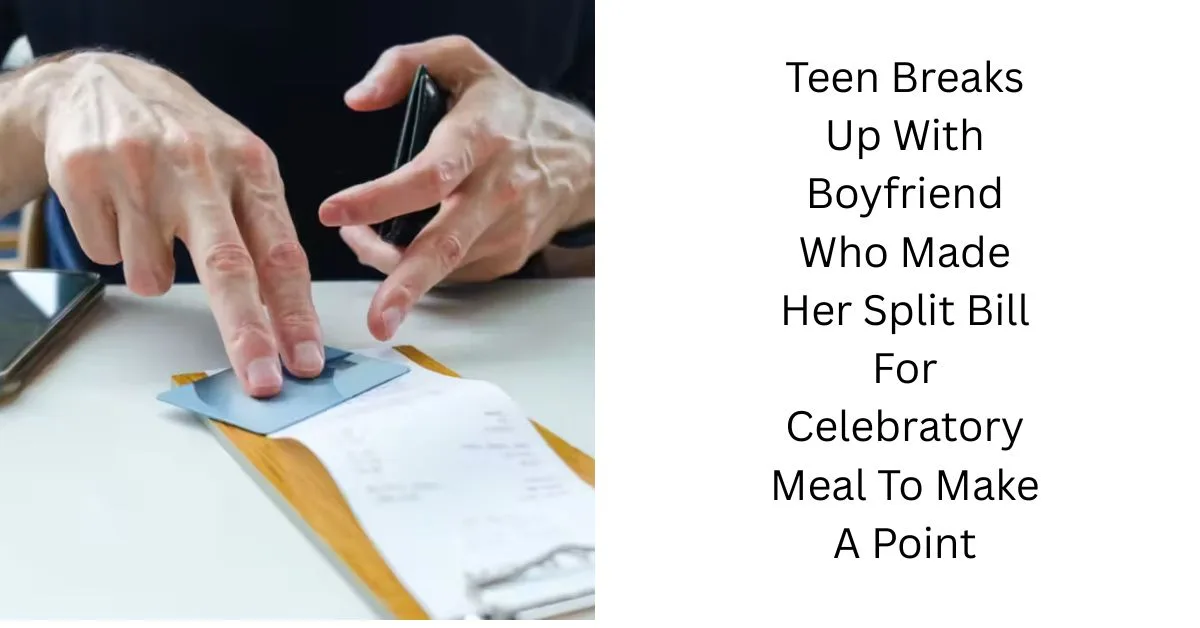
When the teenage girl agreed to celebrate an important achievement with her boyfriend, she expected the evening to be special. She had worked hard for something she was proud of, and her boyfriend had suggested going out for a nice meal together to celebrate. She was excited because she thought the dinner would be a chance for them to enjoy each other’s company and recognize a moment that meant a lot to her. Neither of them had talked about the exact cost or how they would pay beforehand, so she assumed they would simply figure it out when the bill arrived. She was not expecting an expensive gift or for her boyfriend to pay for everything. What she did expect was some basic consideration, especially because he had been the one to suggest the celebration. Instead, the dinner ended with an argument that completely changed the way she viewed their relationship.
The evening started pleasantly enough. They chose a restaurant that was nicer than the places they normally visited, ordered their food, talked about school, and laughed about some of the things that had happened recently. Her boyfriend congratulated her several times and told her that she deserved to celebrate. Because of his attitude, she felt genuinely appreciated. She ordered a meal she liked, along with a drink, and did not think twice about the money because she believed they were having a celebration together. She noticed that her boyfriend was also ordering whatever he wanted, including appetizers and an expensive dessert. Nothing about the evening suggested that there would be an issue when the check arrived.
When the server placed the bill on the table, her boyfriend suddenly changed his tone. Instead of casually suggesting that they split it or asking how she wanted to handle the payment, he immediately announced that they were going half-and-half. The girl was surprised but did not object. She reached for her wallet, assuming that perhaps he simply preferred keeping finances separate. She was willing to pay her share because she did not believe relationships should automatically involve one person paying for everything. However, she noticed that his portion of the meal had been significantly more expensive because of what he had ordered. When she pointed that out, he said it did not matter because splitting the bill evenly was “fair.”
She reluctantly agreed to split the bill, but then her boyfriend revealed that there was another reason behind his decision. He told her that he wanted to “make a point.” According to him, he did not want her to become accustomed to having people pay for her simply because she was celebrating something. He said he wanted her to understand that being independent meant paying her own way. The girl was confused because she had never asked him to pay for her meal. He had suggested the restaurant and had described the evening as a celebration. She asked him why he had waited until the bill arrived to teach her some kind of lesson instead of simply discussing money with her beforehand.
Her boyfriend insisted that she was overreacting. He said that splitting a bill was normal and that she should not be upset about something so small. But for her, the issue was no longer the amount of money. She could afford her portion, and she had no problem contributing. What bothered her was the intention behind his decision. He had turned what was supposed to be a celebration into an unexpected test of her character. She felt as though he had deliberately created a situation where she would have to prove that she was independent, even though she had never suggested otherwise.
The girl asked him whether he had invited her out because he genuinely wanted to celebrate with her or because he wanted an opportunity to teach her a lesson. That question made him defensive. He said she was making him look like a bad boyfriend for doing something completely reasonable. He reminded her that they were both young and that neither of them had unlimited money. She agreed with that part. She told him she would have been perfectly happy with a cheaper restaurant, a simple meal, or even getting snacks and celebrating somewhere else. The money itself was never the problem. The problem was that he had intentionally withheld his expectations until the end of the evening.
As they continued talking, the girl began thinking about other moments in their relationship. She remembered times when her boyfriend had criticized the way she spent money or made comments about what she ordered. She had previously dismissed those comments as jokes. She also remembered that whenever they disagreed, he sometimes turned ordinary situations into lessons about responsibility or maturity. He seemed to enjoy proving that he was more practical or more financially responsible than she was. Until that night, she had never considered those moments part of a larger pattern.
Her boyfriend then told her that if she was genuinely upset about paying half, maybe she was more dependent than she realized. That comment was the moment something inside her changed. She realized he was no longer discussing dinner. He was judging her personality based on a situation he had created himself. She looked at him and calmly explained that independence did not mean accepting unfair or unexpected tests from a partner. It meant being capable of taking care of yourself while also being honest about expectations. She told him that if he wanted to split the bill, he could simply have said so before they ordered.
The conversation became increasingly uncomfortable, and the girl decided she did not want to spend the rest of the evening arguing. She paid the amount they had agreed upon and left the restaurant. On the way home, she kept thinking about what had happened. Part of her wondered whether she had been too sensitive. After all, couples split bills all the time. But another part of her knew that if the situation had simply been about sharing the cost, she would not have been upset. What hurt was being told afterward that the entire situation had been designed to “teach” her something.
That night, she talked to a trusted friend about what happened. Her friend listened and asked one simple question: “If he wanted to split the bill, why didn’t he tell you before you ordered?” The girl realized she did not have a good answer. Her boyfriend could have easily said, “Let’s split this,” before they chose their meals. She would have agreed without a second thought. Instead, he had allowed her to believe they were going out to celebrate and then used the bill as an opportunity to make a statement about her independence.
The next day, the girl decided to talk to her boyfriend one final time. She told him that she was not angry about paying her share. She was disappointed by the way he handled the situation. She explained that relationships require communication, and she did not want to date someone who deliberately created situations to test or embarrass her. Her boyfriend again argued that he had done nothing wrong. He said she needed to learn not to expect special treatment. She told him that she had never expected special treatment from him. She had simply expected him to treat her with respect.
When he refused to acknowledge her point, she realized they were looking at the situation in completely different ways. He believed that proving a point was more important than considering how his actions would affect her. She believed that a relationship should be based on honest communication rather than hidden tests. She also realized that if something this small had created such a major disagreement, future problems could become even harder to handle. Money, responsibilities, expectations, and boundaries would only become more important as they got older.
The girl ultimately decided to end the relationship. Her decision was not based on the cost of the meal or a belief that her boyfriend should always pay. She broke up with him because she did not like the way he had intentionally turned a happy occasion into a lesson at her expense. She told him that she wanted a relationship where both people could discuss expectations openly instead of setting traps for each other. Her boyfriend was surprised and accused her of ending their relationship over “one dinner,” but she explained that the dinner had simply revealed a larger difference in how they viewed respect and communication.
After the breakup, some people who heard the story sided with the boyfriend. They argued that splitting a bill was completely normal and that nobody should expect a partner to pay for them. The girl agreed with them. She never believed that her boyfriend owed her a free meal. What she disagreed with was the idea that secretly changing the meaning of a celebration and then using the bill to make a point was a healthy way to treat someone. She also believed that if two people are going to share expenses, they should be clear about it before ordering rather than turning payment into a surprise test.
In the end, the girl walked away from the relationship feeling more confident about her decision. The experience taught her that financial independence and emotional respect are not opposites. She could pay her own bills and still expect honesty from someone she was dating. She could split a meal and still believe that a partner should communicate expectations. Most importantly, she realized that she did not need to accept someone’s “lesson” simply because they claimed it was meant to make her stronger or more independent. Sometimes a small disagreement reveals a much bigger problem, and for her, that celebratory dinner revealed that she wanted a partner who would talk to her—not test her.
Read Story…
“Am I overreacting by refusing to split the bill after what my boyfriend did?”
The OP was surprised when her boyfriend expected to split the bill at their latest dinner.
“My boyfriend (23 Male) invited me (18 Female) out for dinner, because he said he wanted to celebrate me getting a new job.”
“Everything was normal until the bill came. He looked at me and said, ‘We’ll just split it, right?'”
“I was surprised because he was the one who invited me, but I said okay.”
The OP was uncomfortable when she found out her boyfriend pranked her.
“Later that night, one of his friends accidentally mentioned that before I got there, my boyfriend had been joking that since I had ‘a real paycheck now,’ he didn’t have to pay for me anymore.”
“When I asked him about it, he laughed and said it was ‘just a joke’ but also admitted that’s why he suggested splitting the bill.”
The OP was no longer interested in dating her boyfriend.
“I sent him my half, but I told him I wasn’t interested in going on dates with someone who invited me out just to make a point.”
“Now he’s saying I’m making him look cheap over ‘one joke,’ and a couple of our mutual friends think I’m taking it way too personally.”
“AIO?”
Fellow Redditors weighed in:
- NOR: Not Overreacting
- YOR: You’re Overreacting
Some pointed out that the ex made himself look cheap when he invited his girlfriend out to celebrate and didn’t cover the bill.
“He’s making himself look cheap by being a cheap a**hole. Not you, hun. Congratulations on your new job. Now find a new man to go with it.” – Secure_Sun8984
“NOR. That was not much of a ‘celebration.'” – Melodic_Policy765
“Splitting the bill is fine in general, BUT HE INVITED YOU TO CELEBRATE. That means he needs to pay.”
“NOR at all. He’s five years older than you (and it’s a big five years at this point in your life). He’s seeing how far he can push you while keeping his pretty young girlfriend on his arm and in his bed.”
“End it now.” – bourbonontherox
“NOR. It’s weird to invite your girlfriend out to celebrate her and then ask her to split it, but ultimately something you can get over. But him saying that is trashy and childish. I’d be out.” – quillubo
“Insensitive joke aside, it’s literally basic courtesy that if you are inviting someone out, particularly for celebrating something (job, birthday, anniversary whatever), you are the one to pay. That move alone was cheap.” – Sundayscaries333
“If I was broke as f**k and invited my girlfriend out to celebrate her new job, I wouldn’t care how much she was earning. I would find a way to pay because I invited her and it’s to celebrate her.”
“For non-celebratory dinners, we can agree beforehand how we are going to pay. You don’t celebrate someone by asking them to pay for their part of it. Imagine it was your birthday and someone got you a great gift but asked you to pay for half immediately after they gave it to you.”
“From what OP wrote, it sounds like her BF could afford to pay for all of dinner but decided not to because of a joke. The dinner was about her and for her. Chances are, when she got paid the first time, she would have offered to take him out because she’s proud of her accomplishment and new income.” – Prize_Staff_7941
“NOR. He already admitted it wasn’t ‘just a joke.’ If it were actually just a joke, he’d have said so almost immediately after suggesting they split the bill, and then he would have covered 100% of it because he invited her out to celebrate her achievement.”
“There’s a reason why this dude is dating someone five years younger than he is; the women his age won’t put up with his bulls**t, so he’s hoping someone younger will be too naïve or unconfident to call him on it.”
“NOR, OP. Kick him to the curb now and don’t spend another penny or minute on him.” – atropos81092
“I f**king love seeing young women advocate for themselves and take no s**t.”
“It takes most people years to learn that lesson. Good for you for walking away. Never let anyone convince you to settle for less.”
“NOR.” – NoDanaOnlyZuul
Others were certain that the age difference was a key factor in how the OP’s ex was behaving.
“18 and 23, huh? And how long have y’all been together exactly?”
“It’s not a bad thing to want to split the bill, but it is something you talk about before the date, not something you joke about to your friends behind your partner’s back.”
“But what behavior can we expect from a 23-year-old dude dating someone who’s probably fresh out of high school?” – unholyhello
“So he’s 23 but acts like he’s eight. You really think you overreacted?”
“And your friends don’t know what they’re talking about. A real man would’ve gotten you flowers and paid for dinner to celebrate, not turned it into a ‘gotcha’ moment.”
“Eff that nonsense.” – Electronic-Pack-8449
“I was 21 or 22 and took an 18-year-old coworker on a date. That one date was enough to think, ‘Yeah, these are some formative years she’s missing.’ I broke it off right then and there and cringe about it now.”
“Fresh out of high school and graduating college might only be a few years, but the development that happens during that time is exponential.”
“OP’s date might be 23, but he has the mentality of a high schooler.” – K__Geedorah
“Your friends are probably also around 18, right? OP and your friends: you don’t need to be dating 23-year-olds.”
“They’re not ‘mature.’ They’re looking for someone to manipulate. If you must date someone, find someone closer to your own age.”
“It would be different if you were 28 and he were 33.” – Micojageo
“As soon as I saw the age difference, I knew.”
“OP, babe, get with someone your age. That man has five years more experience in adulting than you. He sees a hot young thing that he can manipulate. Throw the whole man out.” – MamaOnica
“NOR. You made the right choice getting rid of a guy who’s five years older than you and treated you this way, and as a girl dad, my advice is don’t look back because you aren’t going that way.” – Full-Librarian1115
“I hope that OP finds someone to date who values her for her, not a paycheck. I would be soo upset and exhausted when a boyfriend invites me to a dinner to celebrate my new job or promotion and then says let’s split the bill.”
“No dawg. I will pay for whatever I ordered, and you get your own tab. I’m definitely going to block and delete him. You know how valuable you are. You were shown how he thinks, so now it’s time to leave him alone. Cheap b**tard!”
“Trust and believe me, so many other people will want to date you. Don’t waste your time and energy with him.” – Katiedidit37
“NOR. He sounds like a boy whose frontal cortex is still far from developing despite the age difference. I’d be willing to bet you could find someone who wanted to genuinely celebrate your milestones without trying to embarrass you.” – Jrm12334
“It’s nice when the trash takes itself out. Imagine inviting someone out to celebrate their success just to use it as a weird tactical move to save twenty bucks.”
“Good on her for paying her half and immediately changing her subscription status to single.”
“He saved her months of future headache by displaying his entire circus on day one of her new job.” – ultrivon
The subReddit was angry on the OP’s behalf, namely because her ex-boyfriend ruined what should have been a celebratory moment by making a petty point.
If the ex were interested in being with someone who split the bill rather than covering it, that would be fair. But that should also be discussed in private, not dropped on his partner at a moment’s notice with the potential to embarrass them, especially during what should be a happy moment.
But embarrassment and taking the wind out of the OP’s sails in light of her achievement was likely exactly what her ex was going for, and being only 18, she had plenty of time to find someone who’d truly celebrate her wins.
“A Celebration Dinner With a Hidden Agenda”
When the teenage girl agreed to go out for dinner with her boyfriend to celebrate an achievement she was proud of, she thought it would be a simple and happy evening. She had worked hard for the accomplishment, and her boyfriend had been one of the first people to congratulate her. He suggested they go somewhere nice for dinner, telling her that she deserved to celebrate after all the effort she had put in. She was genuinely excited because she did not see the evening as an expensive date or expect him to buy her anything special. She simply wanted to spend time with him and enjoy the moment together. Money had never been a major issue between them before, and neither of them had specifically discussed who would pay for the meal. She assumed they would figure it out naturally when the bill arrived. What she did not know was that her boyfriend had already decided that the dinner would become an opportunity to “teach her a lesson.”

Advertisement
The evening began exactly the way she had hoped. They arrived at the restaurant, talked about her achievement, laughed about school, and discussed what they wanted to order. Her boyfriend repeatedly told her how proud he was of her. Because of his attitude, she felt appreciated and believed he genuinely wanted to celebrate her success. They ordered their meals, shared an appetizer, and eventually ordered dessert. The restaurant was more expensive than the casual places they normally visited, but because her boyfriend had suggested it specifically as a celebration, she did not think much about the price. She was also careful not to order excessively or take advantage of the situation. She chose a normal meal and a drink while her boyfriend ordered several items of his own.
Throughout dinner, there was no indication that anything was wrong. They talked about future plans and joked about some embarrassing moments from school. Her boyfriend seemed happy, and she relaxed enough to forget about everything else. She thought the evening was going to become one of those memories she would look back on fondly. That was why the moment the server placed the check on the table felt so surprising. Instead of casually discussing payment, her boyfriend immediately said they would split the bill evenly. She paused for a second, then nodded. She had no problem paying her share. She did, however, notice that they had not ordered equally. His food and drinks had cost more than hers, so an exact half-and-half split meant she would be paying for part of what he had chosen.
The girl asked whether they could simply each pay for what they had ordered. Her boyfriend immediately said no. He told her that splitting the entire bill down the middle was easier and that it was “fair.” She did not want to create a scene in the restaurant, so she agreed. As she reached for her wallet, she assumed the conversation would end there. Instead, her boyfriend began explaining why he had insisted on splitting the bill. He said he wanted to make a point about independence and did not want her to become the type of person who expected a boyfriend to pay whenever they went out.
The comment caught her completely off guard. She told him that she had never expected him to pay. In fact, she had not even asked him to pay for the dinner. He was the person who suggested going to the restaurant, and he had presented the evening as a celebration. Her boyfriend responded that this was exactly why he wanted to make the point. He said he wanted her to understand that being independent meant being prepared to pay for herself. She stared at him, confused by the logic. She had already been prepared to pay for herself. There had never been an argument about that. What bothered her was that he had apparently created a lesson she never asked for.
The girl asked him why he had not simply told her before dinner that they would be splitting the cost. He said that doing so would have defeated the purpose because he wanted to see how she reacted when the bill arrived. That statement made her uncomfortable. She realized she had not just been asked to share the cost of a meal. She had unknowingly been placed in a test. Her boyfriend had watched her order food without telling her that he intended to use the final bill as a lesson about financial independence. She wondered what he would have done if she had been unable to afford her half.
He brushed off her concerns and told her she was making the situation far more serious than it needed to be. According to him, couples should be able to split bills without drama. The girl agreed with that principle, but she pointed out that this was not what the argument was about. She was not upset because she had to contribute. She was upset because he had intentionally turned a celebration into a test without telling her. She also felt embarrassed because she had believed they were simply enjoying a special dinner together. Instead, she discovered that her boyfriend had been judging her behavior and waiting to see whether she would object to paying.
The conversation became more uncomfortable when he suggested that her reaction proved she still had some growing up to do. He said that if she was upset about splitting a bill, maybe she had become too accustomed to other people doing things for her. The girl immediately pushed back. She told him that there was a major difference between accepting help and expecting it. She had never demanded that he pay. She would have been perfectly comfortable going somewhere cheaper, getting fast food, or even celebrating at home. What she could not understand was why someone who claimed to care about her would deliberately create an uncomfortable situation just to prove a point.
As they continued talking, the girl began remembering other moments that had seemed insignificant at the time. Her boyfriend had occasionally made comments about how she spent money. He had teased her about buying certain things and sometimes acted as though he was more responsible than she was. She had always assumed those comments were harmless. Now, however, they seemed connected. Perhaps the dinner was not an isolated incident. Perhaps he genuinely believed that his role in the relationship included teaching her how she should behave.
That realization bothered her more than the bill itself. She did not want a boyfriend who treated ordinary disagreements as opportunities to establish himself as the wiser or more mature person. She wanted someone who could communicate directly. If he wanted to split the bill, she was happy to know that beforehand. If he wanted to keep dates inexpensive, she would have understood. If he had financial concerns, she would have listened. What she did not want was a hidden test followed by criticism when she did not respond exactly as he expected.
The girl finished paying her portion and decided she wanted to leave. Her boyfriend asked why she was being dramatic and reminded her that it was supposed to be a celebration. She told him that he had ruined the celebration himself. The meal was no longer about her accomplishment. It had become a conversation about money, independence, and whether she could trust him to communicate honestly. She walked out of the restaurant feeling disappointed rather than angry. She had gone there expecting to feel proud and appreciated, but she left wondering whether her boyfriend actually respected her.
On the way home, she replayed the entire evening in her head. She kept asking herself whether she was overreacting. After all, splitting a restaurant bill was not unusual. She knew plenty of couples who divided expenses equally. Her friends often did the same thing. But the more she thought about it, the more she realized that the amount of money was irrelevant. If he had told her before they ordered that they were splitting the bill, she would have accepted it without hesitation. The problem was the hidden intention behind his decision.
The next day, she talked to a close friend about what had happened. Her friend listened carefully and then asked why the boyfriend had not simply communicated his expectations before they ordered. The question immediately made sense. There was no practical reason for him to wait until the check arrived. If he believed splitting the bill was important, he could have said so at the beginning. The fact that he specifically wanted to surprise her with it suggested that the lesson mattered more to him than the actual payment.
The girl decided to speak with her boyfriend one more time before making any final decision about their relationship. She explained that she was not demanding that he pay for future dates. She told him she was willing to split bills, alternate payments, choose cheaper places, or handle expenses however they mutually agreed. She simply wanted clear communication. Her boyfriend, however, continued defending his decision. He said that she needed to become more independent and that he had done nothing wrong.
She asked him what he believed she had done that was financially dependent. He could not give her a specific example. She reminded him that she had offered to pay, had not complained about the price, and had never asked him to cover her expenses. She told him that he had created an imaginary problem and then used the situation to prove that the problem existed. Her boyfriend became frustrated and said she was refusing to learn the lesson he had been trying to teach.
That was the moment she realized they were not going to see the situation the same way. He believed that because he considered his intentions good, his actions were automatically justified. She believed that respect required considering how the other person experienced the situation. He wanted her to accept his “lesson.” She wanted him to understand why the way he delivered it had hurt her. Neither seemed willing to compromise on that fundamental difference.
The girl also started thinking about the future. They were both young, but she knew that relationships become more complicated as people get older. Money, jobs, school, housing, family responsibilities, and other major decisions would eventually matter much more than a restaurant bill. If her boyfriend believed it was acceptable to secretly test her over something as small as dinner, she wondered what would happen when they faced a genuinely serious disagreement.
She decided she did not want to wait until the problems became bigger. She told her boyfriend that she was ending the relationship. He was shocked. He accused her of breaking up with him over a meal and said she was throwing away their relationship because of something insignificant. She calmly explained that the meal was not the reason. The meal had simply shown her how differently they viewed communication, respect, and trust.
Her boyfriend tried to argue that she was being unreasonable. He said he had been trying to help her become more mature and independent. She told him that independence did not mean allowing another person to manipulate a situation to make a point. She could take care of herself and still expect honesty from someone she was dating. She could pay her own way without accepting unnecessary tests. Most importantly, she could choose to leave a relationship when she felt that her values and her partner’s values no longer matched.
After the breakup, some people who heard about the situation sided with the boyfriend. They argued that splitting a bill was completely normal and that the girl should not expect a boyfriend to pay for her. She agreed with the first part. She had never believed that a boyfriend was automatically responsible for paying for everything. But she also believed that people were missing the actual issue. The disagreement was about how the payment was handled and why he deliberately withheld information until the end of the meal.
Other people understood her perspective immediately. They pointed out that financial expectations should be discussed openly, especially when one person suggests an expensive restaurant. Nobody should have to guess whether a dinner is a treat, a shared expense, or a test of character. A simple conversation before ordering could have prevented the entire conflict. The boyfriend had chosen not to have that conversation because he wanted to make a point, and that decision ultimately cost him the relationship.
The girl did not regret paying her share. In fact, she said she would have been comfortable paying the entire amount if the circumstances had been different and if they had mutually agreed to it. What she regretted was believing that the dinner was a celebration when her boyfriend had secretly turned it into a test. She felt that a person who genuinely cared about her would have communicated instead of trying to catch her off guard.
The experience also taught her an important lesson about relationships and boundaries. She realized that people can disagree about money without either person being wrong. Some couples split everything, some alternate payments, some combine finances, and others handle expenses differently. There is no single arrangement that works for everyone. What matters is that both people understand the arrangement and feel respected by it.
Ultimately, the teenage girl walked away from the relationship because she realized she wanted a partner who would communicate rather than manipulate situations to make a point. The dinner itself was not expensive enough to destroy a relationship, and the bill was never the real issue. What mattered was the hidden test, the criticism that followed, and her boyfriend’s refusal to understand why it had upset her. She learned that independence does not mean accepting every lesson someone decides to teach you, especially when you never asked for one. Sometimes a seemingly small disagreement reveals a much larger difference in values, and for this teen, one celebratory dinner was enough to show her that she and her boyfriend wanted very different kinds of relationships.