Mom Gets Shamed For Wanting To Wear A Bikini, Then Decides She Doesn’t Need Her Friend’s Approval
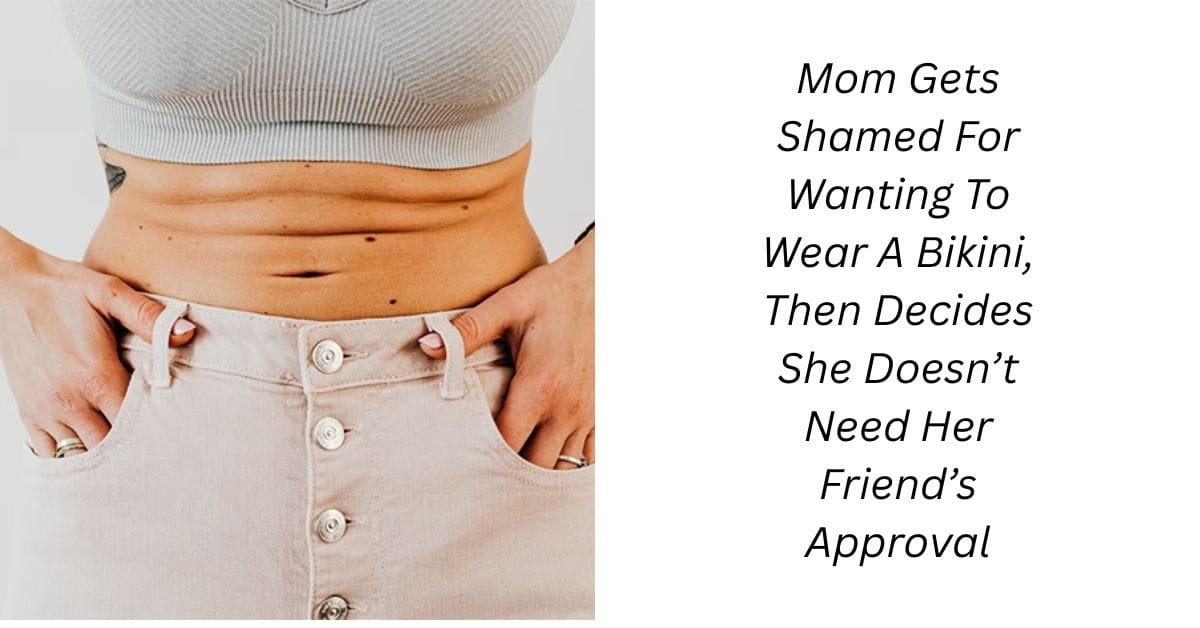
What should have been a simple decision about wearing a bikini turned into an uncomfortable disagreement between two friends when one mother was made to feel ashamed of her body. The woman had been looking forward to spending some time at the beach or pool and wanted to wear a bikini that she felt comfortable and confident in. After becoming a mother, she had noticed that people sometimes treated her differently, as though having children meant she was no longer supposed to care about fashion, confidence, or how she felt in her own body. She didn’t see anything wrong with wanting to wear a swimsuit she liked. To her, being a mother did not mean she had to hide herself or stop enjoying activities simply because someone else might have an opinion.
The problem began when she shared her plan with a close friend. Instead of being supportive, the friend made comments that immediately changed the mood. She suggested that the bikini was too revealing and questioned whether a mother should really be wearing something like that. The comments made the woman uncomfortable because they were not presented as friendly advice. They sounded more like criticism. She began wondering whether she had somehow crossed an invisible line simply by wanting to feel attractive and confident. Although she initially tried to laugh it off, the conversation stayed in her mind. She couldn’t understand why something as personal as her choice of swimwear had become a reason for someone else to judge her.
What hurt her most was the assumption behind her friend’s comments. The woman felt that becoming a mother had somehow caused people to believe that her appearance should now be controlled by a different set of rules. She understood that everyone had different opinions about clothing, but she didn’t believe another person had the right to decide what she should wear. She had responsibilities as a parent, but those responsibilities did not erase her identity as an individual. She could be a caring mother while also enjoying a day at the beach, wearing clothes she liked, and feeling confident about herself. The more she thought about it, the more she realized that the criticism said more about her friend’s expectations than it did about her.
Eventually, the woman decided she was no longer interested in seeking her friend’s approval. She explained that she appreciated genuine concern, but she wasn’t going to let someone else’s opinion determine how she felt about herself. She had spent too much time worrying about whether other people thought she looked appropriate when she should have been focused on enjoying her own life. She also realized that confidence doesn’t have to come from everyone around you agreeing with your choices. Sometimes it comes from deciding that you know yourself well enough to make your own decisions. Her friend may not have liked the bikini, but that didn’t mean the woman had to change her plans.
In the end, the situation became a lesson about body confidence, friendship, and personal boundaries. The woman wasn’t asking everyone to love her swimsuit or agree with her fashion choices. She simply wanted the freedom to decide what made her comfortable. Being a mother was an important part of who she was, but it wasn’t the only part of her identity. She refused to believe that motherhood meant giving up her right to feel confident, attractive, and comfortable in her own skin. Instead of allowing criticism to ruin her plans, she chose to wear what she wanted and enjoy the experience without constantly worrying about someone else’s approval. For her, the most important realization was simple: she didn’t need permission to feel good about herself.
Read Story…
AITA for not forgiving my friend over what she said about my body?
I’m a bit at war with myself because I’ve been called petty before, and I hold grudges. So I know these things are part of my personality, but I don’t know if I’m overreacting and taking it too far.
So I (31F) was looking for bathing suits online, with my friend (30F). We’re getting into beach season where we are, and Covid restrictions have been lifted in our area.
I have 2 young kids, and as you can imagine, stretch marks on my stomach, thighs, and breasts. I mean, nothing too crazy or severe, but I think, looking at me you can tell I’ve been pregnant. I have a mixture of one-piece bathing suits, and two-piece sets. That day, I happened to be looking at two-pieces.
My friend, who has a history of being oh-so-helpful-and-honest, asked me why I was looking for two-piece suits. I showed her the picture of the current suit I had loaded up on a website, a cute bikini set with high rise bottoms. I said I thought I’d look decent in it.
Friend says, “But you have stretch marks all over, and you have the mom pouch. You should probably look for a one-piece to cover yourself up.”
My defenses went up, but I calmly replied, “Okay well, imma go out on a limb and say most people have some form of stretch marks somewhere on their body, be it from pregnancy, sudden weight gain or loss, etc.”
Friend: “But you won’t look sexy at the beach when we go.”
Me: “I guess I’m not looking to be sexy? I’m married, I’m not there to pick up guys, I just want to tan my back and tummy at the beach.”
Friend: “Just because ‘lots of people have stretch marks’ doesn’t make them pretty to look at, though.”
Me: “…….”
Friend: “Isn’t that what you said? That even if something is common or popular, it doesn’t mean it’s good.”
I knew exactly what she was quoting me on. Wanna know, redditors? Ages ago, a group of us were discussing politics and history and blah blah, and at one point in the conversation I said, “Hitler won the popular vote. Just because he rose to power doesn’t mean he was right.”
Y’all, she made a comparison between Hitler and stretch marks being unsightly.
After a long pause, I said, “I guess we won’t be going to the beach together then, I wouldn’t wanna subject you to my disgusting body.”
She rolled her eyes at me and said, “Ugh, don’t take it to the extreme. I was just trying to be helpful. People will stare.”
The rest of our visit was quiet and awkward, and I’m still miffed. She’s trying to pretend nothing happened, but I’ve been distant. She texted me “Seriously? You’re blowing this out of proportion. I’m not apologizing for something I said with good intentions.”
And… yeah, I guess that’s it. I’m pissed off and not really being as friendly as normal. Am I being too petty? Am I blowing it out of proportion?
AITA?
EDIT: You guys, I’ve been flooded with so many comments, chats, and messages telling me not to take her comments to heart and wear whatever bathing suit makes me happy. And that is precisely what I intend to do. Thank you guys so so much for the kindness.
A question that popped up multiple times: Why am I her friend? I’m… not really sure by this point, honestly. I guess because of history? Familiarity? I dunno. Been friends 6 years or so.
I’m okay with my body. I mean, sure it’d be cool if I could be a bit more toned and didn’t indulge in that slice of cake the other day… but I’m not gonna hide myself away and wear a burlap sack in the confines of my house for the rest of my life. And I agree with the commenters, most of the time, no one’s even looking at you anyway!
Hitting the beach with my husband and kiddos, y’all. Peace out.
A Mother Refuses to Feel Ashamed of Wearing a Bikini
What should have been a simple decision about swimwear turned into an emotional confrontation when a mother was made to feel ashamed for wanting to wear a bikini. She had been looking forward to spending a relaxing day at the beach with friends and family. After years of putting other people’s needs before her own, she wanted to do something that made her feel confident and comfortable. She found a bikini she genuinely liked and felt excited about wearing it. To her, there was nothing unusual about the decision. She was a grown woman, she knew her own body, and she believed she should be able to choose her own clothes without being judged.
The woman had always understood that becoming a mother would change many aspects of her life. Her priorities had changed, her schedule had become busier, and much of her attention naturally went toward her children. However, she never believed that motherhood meant completely giving up her individuality. She still enjoyed getting dressed nicely, spending time with friends, going on outings, and feeling good about herself. Wearing a bikini was simply another personal choice. It wasn’t an attempt to attract attention or prove anything to anyone. She just wanted to enjoy a summer day like everyone else.
At first, she was excited to tell one of her friends about her plans. She expected the friend to respond positively or at least casually. Instead, the reaction was surprisingly judgmental. The friend questioned why she would want to wear a bikini now that she was a mother. The comments suggested that there was something inappropriate about a mom showing that much skin. The woman was caught off guard because she had never expected such criticism from someone she considered a close friend.
The conversation quickly became uncomfortable. The friend continued making remarks about the bikini and suggested that a more conservative swimsuit would be more suitable. The woman tried not to take the comments personally, but it became increasingly difficult. She understood that people could have different tastes in clothing, but the issue wasn’t really about fashion anymore. It felt as though her friend was trying to establish rules about what a mother was supposed to look like.
What bothered her most was the idea that motherhood had somehow changed the standards applied to her body. She wondered why being a mother meant she was expected to dress differently from other adult women. She hadn’t stopped being an individual simply because she had children. She still had preferences, insecurities, interests, and a desire to feel confident. She couldn’t understand why those things suddenly needed someone else’s permission.
For a while, the criticism made her question herself. She looked at the bikini again and wondered whether she really should wear it. Maybe her friend was right, she thought. Maybe people would stare. Maybe other parents would judge her. Maybe she would feel uncomfortable once she was actually at the beach. These thoughts started replacing the excitement she had initially felt.
The more she thought about it, however, the more she realized that she was allowing someone else’s opinion to control her confidence. Her friend hadn’t told her that the bikini was unsafe or inappropriate for a specific situation. The criticism was based primarily on the idea that a mother should dress a certain way. That realization made the woman reconsider the entire conversation.
She began asking herself an important question: why should becoming a mother mean that she has to stop enjoying her appearance? She had worked hard to raise her children and manage her responsibilities. She didn’t believe that taking care of herself or wearing something she liked made her a bad parent. In fact, she felt that having confidence in herself could be a positive example for her children.
The woman also realized that body confidence is not something that should disappear after having children. Pregnancy, childbirth, aging, and everyday life can change a person’s body, and many mothers struggle with those changes. She had experienced her own insecurities and knew that feeling comfortable in her body wasn’t always easy. Wearing the bikini was partly about accepting herself rather than trying to meet someone else’s expectations.
Her friend, however, seemed to view the situation differently. The friend believed she was simply being honest and giving advice. From her perspective, she may have thought she was helping the woman avoid unwanted attention or criticism. But the way the advice was delivered made a significant difference. Instead of saying that the choice wasn’t her personal preference, she made the woman feel as though she was doing something wrong.
That distinction became important. Friends can have different opinions, and disagreement doesn’t automatically mean a friendship is unhealthy. The problem occurs when an opinion becomes judgment. The woman would have been perfectly comfortable hearing that her friend personally preferred a different swimsuit. What she couldn’t accept was being made to feel ashamed because she was a mother who wanted to wear a bikini.
Eventually, she decided to confront the issue directly. She told her friend that she understood they had different opinions, but she didn’t appreciate being judged for her clothing. She explained that she wasn’t asking for permission to wear the bikini. She was simply sharing something she was excited about. The conversation was difficult because neither woman wanted to completely back down.
The mother explained that she had spent years worrying about what other people thought. She had worried about being a good enough parent, looking presentable enough, making the right decisions, and meeting everyone’s expectations. She didn’t want to add another unnecessary rule to that list. She didn’t want to spend a day at the beach wondering whether her friend’s approval was more important than her own comfort.
She also pointed out that a person’s clothing does not determine their character. Wearing a bikini did not make her less responsible, less respectful, or less devoted to her children. Her parenting was reflected in how she treated her kids, how she supported them, and how she handled her responsibilities. A swimsuit was simply clothing.
The conversation caused her to reflect on their friendship as well. She wondered whether this was an isolated incident or part of a larger pattern. Had her friend always been quietly judging her choices? Had she simply never noticed before? Sometimes a single disagreement can reveal differences in values that were previously hidden beneath years of friendship.
Despite those questions, the woman didn’t immediately decide to end the friendship. She believed people could make mistakes and say insensitive things without necessarily being bad people. What mattered to her was whether her friend could understand why the comments had been hurtful. She wanted respect, not complete agreement.
Eventually, the woman made her decision. She was going to wear the bikini. Not because she wanted to prove her friend wrong, but because she genuinely liked it. She didn’t want the choice to become a battle or a statement. She simply wanted to enjoy her day without feeling embarrassed about her body.
When the day finally arrived, she admitted that she felt nervous at first. The criticism had planted doubt in her mind, and it took some effort to push those thoughts aside. But once she arrived at the beach and started enjoying herself, those worries gradually became less important. She realized that most people were far more focused on their own activities than on what she was wearing.
She spent time relaxing, talking, laughing, and enjoying the day. Her children were happy to see her enjoying herself, and she began feeling more comfortable with her decision. The bikini wasn’t magically going to solve all her insecurities, but wearing it despite her fears gave her a small sense of freedom.
The experience also changed the way she thought about confidence. She realized that confidence doesn’t necessarily mean believing you look perfect. Sometimes confidence simply means refusing to let fear or criticism stop you from doing something you enjoy. She didn’t need everyone to approve of her appearance before she could feel comfortable in her own skin.
Her friend eventually had to decide how she would respond as well. If she continued criticizing the woman, the friendship could become increasingly strained. If she acknowledged that her comments had crossed a line, they could potentially move forward. The mother wasn’t demanding that her friend suddenly love bikinis. She simply wanted her friend to respect that the decision belonged to her.
The woman also recognized that social expectations surrounding mothers can be surprisingly strong. Mothers are often expected to look a certain way, behave a certain way, and prioritize everyone else before themselves. While responsibility is an important part of parenting, she believed there was a difference between being responsible and completely losing your identity.
She wanted her children to grow up understanding that people should be judged by their character rather than their clothing. If she constantly taught them that appearance determines whether someone deserves respect, she would be sending the opposite message. By making her own decision confidently, she hoped she was demonstrating that personal choices should be respected when they don’t harm anyone else.
Looking back, she admitted that the entire situation had initially hurt her feelings. Being criticized by a stranger might have been easier to dismiss, but hearing it from a friend made the comments much more painful. Friends are supposed to be people with whom you can feel comfortable being yourself. When that safety disappears, even a small comment can have a surprisingly large impact.
In the end, the woman learned that she didn’t need her friend’s approval to feel comfortable with herself. She could listen to someone’s opinion without automatically accepting it. She could respect a friend’s personal preferences while still making her own choices. Most importantly, she could be a mother and still be a woman with her own style, confidence, and identity.
The situation ultimately became less about a bikini and more about boundaries. The woman wasn’t trying to convince everyone that her choice was right for them. She was simply refusing to let someone else decide what was right for her. She understood that people would always have opinions, and she couldn’t control all of them. What she could control was whether those opinions determined how she felt about herself.
Her experience ended with a lesson that many people can relate to: approval from others can feel reassuring, but it shouldn’t be the foundation of self-confidence. A person doesn’t become less deserving of feeling attractive, comfortable, or confident because they become a parent. The woman chose to stop apologizing for a harmless personal choice and started trusting her own judgment. In doing so, she discovered that sometimes the most empowering response to criticism is simply realizing that you don’t need permission to be yourself.