My Neighbor Crossed the Line by Stealing My Water, So I Made Sure He Faced the Consequences
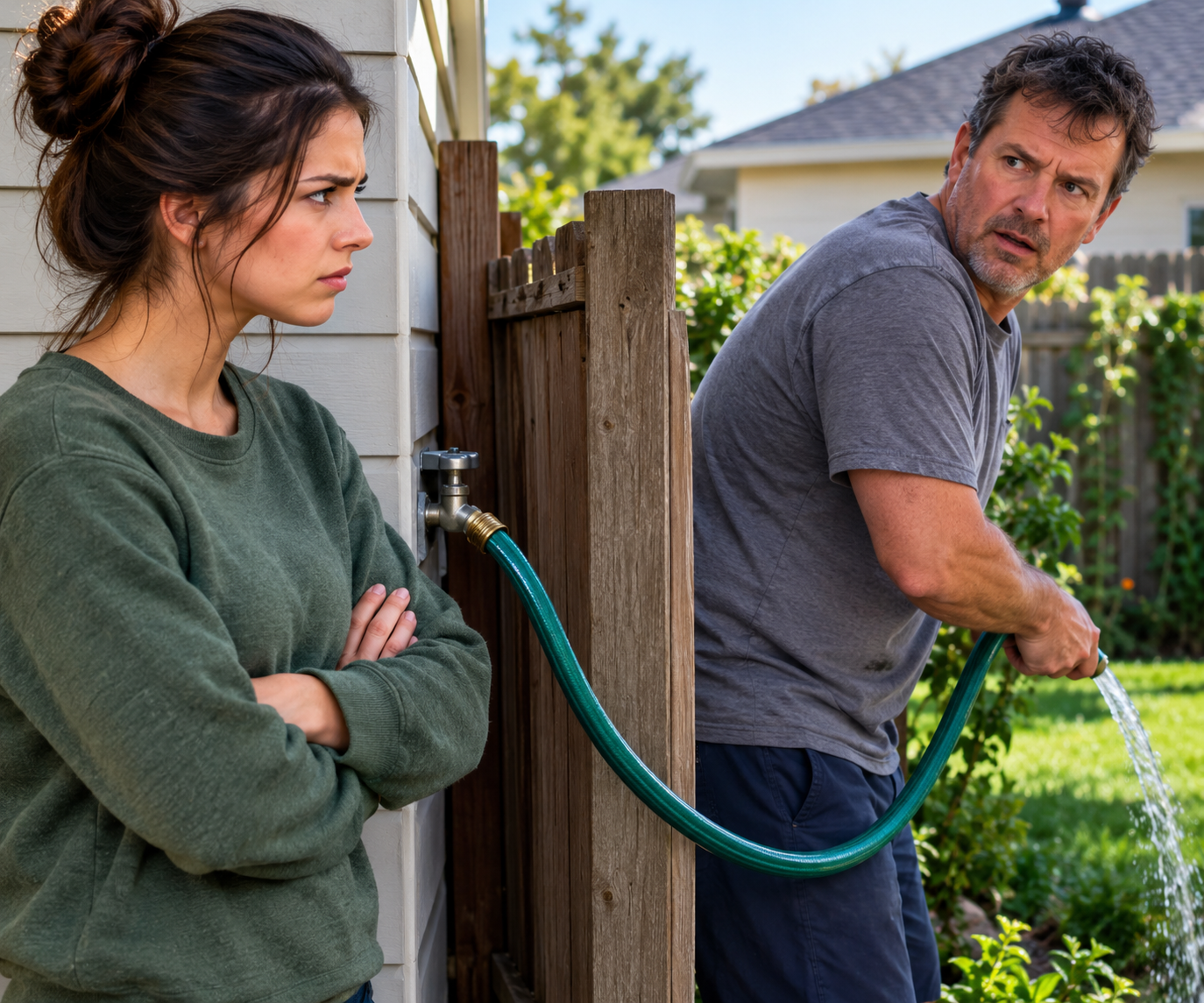
I never expected a problem with my neighbor to turn into one of the most frustrating experiences I had ever dealt with, especially over something as basic as water. I had always believed that being a good neighbor meant respecting each other’s property, maintaining reasonable boundaries, and trying to solve disagreements without unnecessary drama. I was never the kind of person who looked for arguments, and I generally preferred to mind my own business. My neighbor and I had lived near each other for some time, and although we were not particularly close, we had always managed to maintain a polite relationship. We exchanged greetings occasionally and sometimes had brief conversations outside our homes. Everything seemed perfectly normal until I started noticing that my water usage was unusually high. At first, I assumed there might be a leak somewhere in my plumbing system. I checked the taps, inspected the visible pipes, and tried to figure out what could be causing the problem. I had no idea that the real issue was much closer to home than I imagined.
After several days of noticing the same problem, I decided to investigate more carefully. My water bill was increasing, and the amount of water I appeared to be using did not match my actual daily routine. I was not suddenly taking longer showers, watering my garden excessively, or doing anything that would explain the difference. I contacted someone to inspect the plumbing, hoping to discover a simple technical problem that could be fixed quickly. During the inspection, we noticed something suspicious involving the water connection near the boundary between my property and my neighbor’s. Further investigation revealed that my neighbor had apparently connected a line to my supply without my permission. I was shocked. I had spent days worrying about a possible leak and wondering why my expenses were increasing, while someone living right next door had been benefiting from water I was paying for. What made the discovery even more frustrating was the fact that my neighbor had never approached me to ask for help, even though a simple conversation might have prevented the entire situation.
I decided to speak to my neighbor directly before taking any further action. I approached him calmly and explained what I had discovered. I expected him to look embarrassed, apologize, and offer to resolve the matter. Instead, he immediately became defensive. He tried to make the situation sound insignificant, suggesting that the amount of water he had used was too small to matter. He also acted as though I was being unreasonable for objecting to something that had supposedly helped him save money. I reminded him that the water was connected to my supply, that I was responsible for paying the bill, and that he had never asked for permission to use it. His response was essentially that neighbors should help each other. I agreed that neighbors could help one another, but there was a major difference between voluntarily helping someone and having that person secretly take something from you. If he had approached me honestly and explained that he was experiencing a problem, I might have considered whether there was a reasonable way to help. But he had chosen to take advantage of the situation instead. When I asked him to disconnect the unauthorized line and stop using my water, he acted annoyed rather than apologetic.
That conversation changed the way I viewed our relationship. I realized that being overly accommodating could sometimes encourage people to believe they were entitled to more than I had agreed to give. I was not interested in starting a feud, but I also refused to keep paying for something another person was using without permission. I documented what I had found, kept records of the unusual water usage, and arranged for the connection to be inspected and corrected by a qualified professional. I also contacted the appropriate water provider to ask about the proper procedure for dealing with an unauthorized connection. I wanted everything handled properly rather than risking damage to the plumbing or creating another problem by taking matters into my own hands. My neighbor was not pleased when he realized I was serious. He complained that I was making things difficult for him and suggested that I should have simply let the matter go. I told him that he had been free to ask for help, but he was not free to take my property without permission. I was no longer willing to accept excuses or allow the situation to continue just because confronting him was uncomfortable.
Once the unauthorized connection was addressed, my water usage returned to a more normal level, and I finally felt that I had regained control over my own property. The experience was frustrating, but it taught me an important lesson about boundaries and responsibility. My neighbor had apparently assumed that I would either never discover what he was doing or would feel too uncomfortable to challenge him once I found out. Instead, I dealt with the issue through documentation, professional assistance, and the appropriate channels. I did not need to threaten him, damage his property, or create a dangerous situation to make my point. The consequences came from his own decision to use a resource that did not belong to him. Our relationship has been much more distant since then, and I am perfectly comfortable keeping it that way. I still believe in helping people when they genuinely need assistance, but I also believe that help should be requested rather than taken. Now I am left wondering how other people would have handled the situation. Would you have given your neighbor another chance after discovering that he had secretly been using your water, or would you have taken the same steps to protect your property and make sure it never happened again?
Read Story…
Neighbor was stealing water from my supply, so I ruined him.
I live in Asia, and just purchased a new house. Now, the previous owners were family friends who needed cash urgently and haven’t been living in my country for nearly 3 years. So I got it for a great price in the middle of the capital city.
The sale was finalized at the start of this month and I moved in right after. The house was definitely a fixer upper, as the previous owners had left mid renovation and the main door was locked with just a padlock, not even a door lock.
The house had no gate, meaning anyone could just walk right on in. The first day I moved in, someone’s bike was parked in the garage. I just parked it on the road on the same day I had a gate installed. An angry man was knocking on my gate later and I didn’t bother answering, but through my window I could see him giving up and taking the bike after 15 minutes.
So already, I wasn’t digging the neighborhood. But I didn’t have any incidents after that, aside from people not knowing that this was no longer an abandoned house, so my gate was blocked more often than never but a “No Parking” sign on my gate fixed that issue.
Last week, I was having a shower in my bathroom and I noticed my water pressure was lower than usual. I also heard my next door neighbors water pump going. Now this neighbor, an old guy, lived in a 3 storied house, the first being the lowest and the one he lived in. The other two floors were rented out to tenants.
This guy wasn’t happy about the house being sold, and voiced many concerns to my friends the previous owners. He was super angry about it, and my friends did warn me but I’m a 6ft guy with 3 dogs. No way he was doing anything and yep, he didn’t.
So with this living situation, a water pump is needed to pump water to the tanks on the roof, since the public supply’s pressure is not enough to get it up 3 stories.
Now, I heard the water pump going and immediately was suspicious. Sure, coincidences exist, but it wouldn’t hurt to check it out. I waited till his pump turned off, and then turned on different taps in the house. Sure enough, the pressure was back to normal.
This made me even more suspicious, but if he was stealing water, it also made sense. The water bills had been going up over the years this house wasn’t lived in, but the house also had some water leaks.
So it was chalked up to that, even if the bills were too high to be caused just by leaks. Now it’s starting to make sense.
At some point in the last 3 years, this old miser thought he’d save the cost of paying for water, and waltzed into the property and is siphoning water from my lines. I couldn’t find where exactly he was siphoning water from, but after checking my pressure multiple times, I was pretty sure.
So I sat on it for a few days, thinking if I should confront him, go the legal path or just let it be. Now, water in my country is very cheap. My total bill, even with washing 3 animals, a car every week and watering my garden only cost like $5 per month, even with the neighbor also stealing some of it.
But it wasn’t about how much I was paying or who was paying for it. It’s about entitled old people who think that they’re deserving of using other people’s resources without paying for it, and then getting away with it. It didn’t sit right with me, and I really wanted to teach him a lesson.
What I did was really simple. I just turned off my water from the mains. I wouldn’t have to break into his property, nor would I be breaking any laws. It was the best way of getting back at him without needing to even lift a muscle.
So on Monday, just 4 days ago, I waited till the pump flicked on, and turned off the supply. Now, the way household tanks work in my country, is that there’s a ball valve in the tank which detects the level of water and turns on the pump. If the level doesn’t increase, the valve stays open which electronically sends a signal to the pump to stay on until the level gets to a point at which the valve closes and also shuts off the pump.
However, the level wasn’t increasing and anyone knows that starving a pump of water isn’t a good idea. This way, my expectation was that I’d burn out his pump and cause issues with his tenants.
What I didn’t account for is that his pump running constantly would mess up the fuses by constantly drawing power overnight and absolutely destroy his wiring. If he decided to upgrade his household wiring to a more modern standard, this would’ve been prevented. This house clearly still had 90s era wiring.
At around 3AM, I heard all residents in the house waking up and talking in hushed voices about why just their house in the neighborhood doesn’t have power or water. I found out about the power part, because the tenants devolved into shouting at their landlord.
Our tenant protection laws are very important, and power and water are classed as essential even on a state level. Cutting those services are grounds for lawsuits, unless due to weather or some other unavoidable reason.
In this case, the landlord is responsible for keeping the house wiring up to date and in good condition, alongside the supply of water. So the tenants were not happy and one of them immediately moved out two days later when it was informed that water and power will not be returning the very same day this happened.
Both tenants in the two floors lodged a complaint with the police, and if a person is in clear breach of laws, the police have the authority to fine or penalize the person without a court judgment. It can be challenged in court if the person thinks that they were unfairly penalized, but they still have to pay the fines and will only be refunded if and when the court finds the fines unlawful.
So now, the landlord lost both tenants and has to pay a fine of $500, which is a lot of money in our country. He also has to refund the security deposits of both tenants, and cannot rent out until both issues are fixed, which will cost him more money.
As of right now, he’s moving out on Sunday to his daughter’s place since he cannot afford to live alone. The tenants were his only source of income, and he’s a retired mechanic, so he has no other income.
He did find out why the motor kept drawing power, overloaded the wiring and burned out. He came by to my gate and asked me if I turned off my water, and I said “oh yeah, my tank had a new leak on a pipe and I turned it off till the next day until the plumber came by to fix the issue”.
Y’all, the look on his face. He kept a straight one, but I just knew he was holding back.
He just said “oh okay” and went back inside. Not sure if he knows I know, but I don’t care because he can’t do anything.
I’m getting a plumber down next week to correct my plumbing and remove any pipes that leave my property. So I got rid of my water issue and a neighbor who could potentially be a pain in the ass, by simply flicking a tap off. Two birds one stone I’d say.
TLDR: Bought an abandoned house, neighbor was siphoning water from my supply. Turned off my water supply when the motor was running, motor burned out the wiring in the house and cut off water and power to him and his tenants. Tenants lodged police complaints and the landlord got fined, is now destitute and forced to move in with his daughter.
My Neighbor Took Advantage of My Trust by Stealing My Water, So I Made Sure He Faced the Consequences
I never imagined that a simple problem with my water supply would turn into a major dispute with my neighbor. I have always believed that living in a neighborhood requires a certain level of mutual respect. People do not have to be best friends, invite each other over for dinner, or agree about everything, but they should respect one another’s property and personal boundaries. For years, I had tried to maintain a peaceful relationship with the people living around me. I greeted my neighbors when I saw them, helped when I reasonably could, and avoided getting involved in unnecessary arguments. My neighbor was someone I had known for quite some time. We were not particularly close, but we had always exchanged polite greetings and occasionally chatted outside our homes. I had no reason to suspect that he would ever do anything dishonest toward me. Unfortunately, that changed when I began noticing something unusual about my water usage. What initially seemed like a minor plumbing issue eventually revealed that someone had been taking advantage of my trust in a way I never expected.
The problem began when my water bill gradually became higher than usual. At first, I did not think much of it because utility costs can fluctuate, and I assumed there might be a reasonable explanation. I checked my daily routine to see whether I had been using more water than normal. I had not changed my shower habits, started washing clothes more frequently, or begun watering my garden excessively. Everything seemed much the same as before. Still, the amount of water I appeared to be using did not make sense. I began paying closer attention to the meter and comparing the readings over several days. The numbers continued to suggest that something was wrong. I initially suspected a hidden leak somewhere in the plumbing, perhaps beneath the ground or along a pipe I could not easily inspect. I knew even a small leak could waste a surprising amount of water over time, so I decided it was better to investigate the problem before it became more expensive.
I started by checking the taps, toilets, and visible pipes around my property. I made sure nothing was dripping and looked for damp patches that might indicate a leak. I also paid attention to whether the water meter continued moving when all the taps and water-using appliances were switched off. Some of the readings seemed unusual enough that I decided to ask a professional to inspect the system. I did not want to start accusing anyone without evidence, especially because problems with plumbing can sometimes be difficult to identify. My goal was simply to find the source of the extra usage and fix it. I scheduled an inspection and explained what I had noticed. At that point, I still believed the problem would turn out to be something ordinary, such as a damaged pipe or a faulty connection. I had no idea that the investigation would lead to a discovery involving the person who lived right next door.
When the inspection began, we examined the accessible plumbing and the area where the water connection ran near the boundary of my property. During that process, something about the arrangement of the pipes appeared suspicious. There seemed to be a connection that did not belong to my normal plumbing system. After examining it more closely, the professional explained that the line appeared to provide water to a separate connection beyond the system I was supposed to be supplying. Further checks suggested that the connection was linked to my neighbor’s property. I was stunned. I had spent days wondering whether I had a leak, a faulty meter, or some other technical problem, while the explanation appeared to be that water from my supply was being diverted elsewhere. I asked the professional to explain exactly what the evidence showed and what would be needed to confirm the unauthorized connection. I wanted to be certain of the facts before confronting anyone, because an accusation this serious could permanently damage a relationship.
Once I understood what the inspection had uncovered, my initial confusion turned into anger. My neighbor had access to his own property and could have spoken to me if he needed assistance with a water problem. Instead, it appeared that he had arranged to use my supply without asking for permission. I could not understand how someone could justify doing something like that to a person living only a few steps away. The issue was not simply the cost of the water, although I was understandably concerned about paying a bill that did not reflect my own usage. It was also the dishonesty. I had trusted that my neighbor would respect my property in the same way I respected his. I had never given him permission to use my supply, and he had never approached me to discuss sharing water or making any arrangement that would be fair to both of us. The more I thought about it, the more I realized that this was not a harmless misunderstanding that I could simply ignore.
Before taking formal action, I decided to speak to my neighbor directly. I wanted to give him an opportunity to explain what had happened and correct the situation voluntarily. I approached him at a reasonable time and calmly told him what the inspection had revealed. I explained that my water usage had increased unexpectedly and that a professional had found a connection that appeared to be drawing water from my supply. I asked him whether he knew anything about it. For a moment, he seemed surprised that I had discovered the problem, but his reaction quickly became defensive. Instead of asking to see the findings or offering to investigate the matter together, he began making excuses. He suggested that the amount of water involved was insignificant and that I was making the situation seem much worse than it really was. I was disappointed by his response because I had approached him hoping for an honest conversation. Rather than taking responsibility, he seemed more interested in convincing me that I had no reason to complain.
I reminded him that the water was coming through a supply for which I was responsible, and that I was the person receiving the bill. Even if he believed the amount was small, that did not give him permission to use it. I asked him whether he would consider it acceptable if I connected something to his electricity supply or started using his property without telling him. He did not appreciate the comparison and insisted that water was different because it was a basic necessity. I agreed that water was essential, but I explained that its importance made honesty and responsible use even more necessary. If he was having difficulty paying for water or had experienced a problem with his own connection, he could have discussed the situation with me. Depending on the circumstances, I might have been willing to help him find a solution. What I could not accept was discovering that he had apparently decided on his own that my resources were available for his use. A neighborly relationship could not survive if one person believed that another person’s property was theirs to use whenever convenient.
My neighbor then tried to make the disagreement about my attitude rather than his actions. He suggested that people who lived near each other should be willing to help one another and that I was being unnecessarily strict. I found this argument particularly frustrating because I had never refused to help him with a genuine request. There was a difference between generosity and being taken advantage of. Generosity involved making a choice to help someone, while what had happened here appeared to involve a choice made for me without my consent. I told him that I was not objecting to the idea of neighbors helping one another. I was objecting to the fact that he had apparently taken water without asking. I also explained that I would not agree to continue supplying his property through an unauthorized connection. I expected him to understand that my position was reasonable, even if he did not like it. Instead, he acted as though I had personally insulted him by insisting that he respect a boundary he should never have crossed.
I ended the conversation by telling him that the connection needed to be properly addressed. I did not threaten him or attempt to intimidate him. I simply explained that I would have the plumbing corrected and would contact the relevant water provider if necessary. He complained that I was escalating a small disagreement into a serious issue, but I no longer felt comfortable relying on his promises. Once I returned home, I wrote down what had happened during our conversation while the details were still fresh in my mind. I also kept the inspection information and the records showing the unusual water usage. I had learned that relying on memory alone could create problems if the dispute continued. I wanted to have a clear account of what I had discovered, what I had discussed with my neighbor, and what steps I had taken to resolve the situation. My intention was not to build a case against him out of spite. I simply wanted to protect my property and make sure that the issue was handled accurately and fairly.
After the conversation, I expected my neighbor to arrange for the connection to be disconnected or at least cooperate with the process. Instead, he continued behaving as though I would eventually forget about the problem. We exchanged a few words over the following days, but he did not offer a meaningful apology or acknowledge the seriousness of what had happened. When I asked whether he had arranged to correct the connection, he became irritated and said that I was putting unnecessary pressure on him. That response convinced me that I needed to stop treating the situation as a private disagreement that could be resolved through informal conversation alone. I had already explained my concerns and given him an opportunity to address them. I could not force him to accept my point of view, but I could take reasonable steps to ensure that my water supply was no longer being used without permission. I decided to move forward with a professional repair and contact the appropriate provider for guidance about the suspected unauthorized connection.
The next step was to have the plumbing inspected and corrected by a qualified professional. I wanted the work done properly because water systems can be complicated, and careless changes can cause leaks, contamination risks, or damage to pipes. I made sure the person handling the work understood what had been discovered and knew that the goal was to restore my supply to its proper configuration. I also asked for documentation of the inspection and any work performed. Having a professional involved meant that I did not need to touch my neighbor’s property or attempt to disconnect anything myself. It also helped establish a reliable record of the problem. My neighbor was not happy when he learned that I was proceeding with the repair, but I explained that I had no intention of leaving a questionable connection in place. I was responsible for my own water supply, and I had every reason to ensure that it was secure and functioning as intended.
I also contacted the relevant water provider to explain the situation and ask what procedures applied to an unauthorized connection. I did not want to assume that I understood every regulation or technical requirement. I wanted to know how to report the problem, what evidence might be needed, and whether the provider needed to inspect the connection itself. I explained that I had noticed unusual water usage and that a professional inspection had identified a line that appeared to be connected to my supply without permission. I provided the information I had and followed the guidance I received. This step was important because it moved the dispute away from personal accusations and toward a process that could be assessed objectively. If the connection had been installed improperly or in violation of the provider’s rules, I wanted that issue addressed by the people responsible for managing the system. I also wanted to avoid any suggestion that I had taken unauthorized action against my neighbor’s property.
As the situation progressed, my neighbor began telling people that I was being unreasonable. I heard that he had described me as someone who cared more about money than about maintaining good relationships with the people around me. At first, I was tempted to defend myself to everyone who mentioned the dispute. I wanted people to understand that I had not suddenly become hostile toward my neighbor without a reason. However, I soon realized that responding to every comment would only create more arguments. I knew what had prompted my decision, and I had documentation to support the steps I was taking. I did not need to turn every conversation into a debate about his character. If someone asked me directly, I explained that an inspection had identified a connection that appeared to be using my water without permission and that I was handling the issue through the appropriate channels. I tried to keep my explanation factual rather than exaggerating what had happened or encouraging people to take sides.
The experience made me think carefully about how easily a small community disagreement can become personal. When people live near one another, they often develop expectations about what neighbors should do for each other. Those expectations can be positive when they encourage kindness, cooperation, and mutual support. However, they can also become a problem when someone uses the idea of being a good neighbor to pressure another person into accepting behavior that would otherwise be unacceptable. My neighbor seemed to believe that I should overlook his actions because we lived nearby. But proximity did not mean that he was entitled to use my resources. I had bills to pay, responsibilities to manage, and a household of my own to look after. I was willing to be considerate, but I was not willing to let someone else decide how much of my property I should provide for their benefit. A respectful relationship requires both people to understand that kindness is offered freely, not demanded as a right.
One of the most frustrating parts of the situation was realizing how long I might have continued paying for the extra water if I had not investigated the problem. I could have assumed that my bill was simply increasing because of rising costs or an unnoticed leak. If I had ignored the unusual readings, the unauthorized connection might have remained in place for much longer. I was relieved that I had paid attention to the numbers and decided to seek professional advice instead of accepting the situation without question. The experience also reminded me that keeping accurate records is useful even when a problem initially seems minor. Utility bills, meter readings, inspection notes, and written communication can help distinguish an actual issue from a misunderstanding. I had not gathered those records because I wanted to punish my neighbor. I gathered them because I needed to understand what was happening and make an informed decision about how to fix it.
Eventually, the unauthorized connection was addressed, and the water supply was returned to the proper arrangement. I continued monitoring my meter and bills to make sure that the unusual usage did not continue. Over time, the readings became more consistent with my household’s actual consumption. That gave me confidence that the main problem had been resolved. I still had to deal with the inconvenience and expense of investigating the situation, but at least I was no longer left wondering whether someone else was drawing water from my supply. My neighbor did not offer the kind of apology I had hoped for, and we did not have a friendly conversation afterward that magically repaired the relationship. However, I had not taken action because I expected him to become my friend. I had taken action because I wanted the unauthorized use to stop. In that respect, the outcome was what I had needed from the beginning.
My neighbor continued to act unhappy about the situation, and I heard a few complaints about how difficult I had made things for him. He apparently believed I should have allowed him to continue using the water or found some informal compromise that did not require professional involvement. I considered that argument, but I kept returning to the same question: why had he not asked me first? If he genuinely needed help, a conversation could have opened the door to a reasonable arrangement. Instead, he had apparently decided that he could use my supply without telling me and then criticize me when I objected. I was not responsible for solving a problem he had chosen to handle dishonestly. If he was experiencing financial difficulty or a water access issue, there were legitimate ways to seek assistance. He could have contacted the provider, investigated his own plumbing, or asked whether I was willing to discuss a temporary arrangement. Secretly using my water was not a fair substitute for those options.
I also thought about whether I should have handled the confrontation differently. Perhaps I could have asked more questions before explaining what the inspection suggested. Perhaps my neighbor would have responded better if I had approached the discussion at another time. I was willing to consider those possibilities because I did not believe that every conflict had to end with one person being completely right and the other completely wrong. However, I could not ignore the basic facts. My water usage had changed unexpectedly, a professional had identified a suspicious connection, and my neighbor had responded defensively rather than cooperating with a clear solution. Even if I could have chosen different words, that would not have made unauthorized use acceptable. I could take responsibility for keeping my own communication calm without taking responsibility for the decision that had created the problem. That distinction helped me move past the frustration and focus on what I could control.
The incident also changed the way I approached boundaries with people in my neighborhood. I did not become rude or suspicious of every person who lived nearby, and I did not stop believing that neighbors should help one another. Instead, I became more careful about making sure that any arrangement involving my property was clear and mutually agreed upon. If someone needed help, I could listen and decide what I was comfortable offering. If I agreed to share a resource or assist with a problem, I would want the terms to be understood by both sides. That approach was not about being selfish. It was about preventing misunderstandings and making sure that kindness did not become an excuse for one person to take advantage of another. I wanted to remain the kind of neighbor who could offer help when it was appropriate, but I also wanted to be confident that my generosity would be respected rather than treated as an unlimited entitlement.
Some people might think that taking the matter to the water provider was excessive, especially if the amount of water involved was not enormous. I understand why someone might prefer to settle a neighborhood dispute privately. Informal solutions can be effective when both parties are honest and willing to cooperate. I had attempted that approach by speaking to my neighbor directly and giving him an opportunity to address the issue. His response did not reassure me that the connection would be corrected voluntarily. Once I realized that the problem might continue, I believed professional assistance was the most sensible option. Water infrastructure is not something I wanted to modify carelessly, and I did not want to create additional problems by handling the matter myself. Contacting the appropriate provider was not an attempt to ruin my neighbor’s life. It was a way to protect my supply, establish the facts, and ensure that any necessary corrective action followed the proper process.
The financial aspect mattered, but it was not the only reason I refused to let the situation go. Paying for water that another person used without permission was unfair, and I did not want that expense to continue. But the breach of trust bothered me even more. We lived close enough that my neighbor could have spoken to me at almost any time. He could have explained his circumstances and asked whether I was willing to help. Even if I had declined, at least he would have given me the choice. Instead, the apparent secrecy made me question whether he had counted on my not noticing. I began to understand that some conflicts become so upsetting because they reveal something about how another person views your boundaries. It is difficult to maintain trust when someone treats your consent as an unnecessary detail. After that experience, I knew I needed to judge our relationship by his actions rather than by the polite greetings we had exchanged before.
As time passed, the dispute became less central to my daily life. I stopped thinking about it every time I saw my neighbor outside and focused instead on my own responsibilities. We remained civil when our paths crossed, but I no longer felt any obligation to maintain the same level of friendliness we had enjoyed before. I was not interested in continuing the argument, bringing it up repeatedly, or encouraging other people to become involved. The matter had been addressed, and I wanted to leave it there. If my neighbor had learned anything from the experience, that was up to him. I hoped he would understand that being part of a neighborhood did not give anyone permission to take another person’s resources. I also hoped that, in the future, he would approach people honestly if he needed assistance. I had no desire to see him suffer, but I did expect him to respect the same boundaries that everyone else was expected to respect.
Looking back, I am glad I investigated the unusual water usage rather than dismissing it as a minor inconvenience. It would have been easy to complain about the bill, pay it, and move on without understanding why it had increased. Instead, I checked the system, sought professional advice, documented what was found, and used the proper channels to address the suspected unauthorized connection. Those steps helped me resolve the issue without resorting to retaliation or risking damage to anyone’s property. I learned that standing up for yourself does not require shouting, threatening people, or trying to make them suffer. Sometimes it means calmly stating what is unacceptable, documenting the facts, and following through when someone refuses to respect a reasonable boundary. The consequences my neighbor faced came from the issue being properly addressed, not from me inventing a way to get revenge. That distinction matters to me because I wanted a solution, not an endless feud.
I still believe that people should try to resolve disagreements peacefully whenever possible. Neighbors may need to cooperate over shared spaces, noise, repairs, parking, and other everyday issues. A little patience and understanding can prevent many problems from becoming serious conflicts. But cooperation only works when everyone participates honestly. One person cannot secretly take what belongs to another and then demand forgiveness by claiming that neighbors should help each other. Respect must go both ways. If my neighbor had approached me honestly, I might have considered helping him, depending on what he needed and what was practical. Instead, he created a situation in which I had to investigate my own water usage and take steps to protect my supply. I cannot change the choices he made, but I can decide how I respond to them. I chose to handle the problem through proper channels, restore my water connection, and establish a boundary that I expected him to respect.
In the end, the situation taught me that being a good neighbor does not mean allowing someone to take advantage of you. I had tried to maintain a polite relationship, assumed the increased water usage was caused by a technical problem, and even gave my neighbor an opportunity to explain himself before taking further action. When that did not lead to a satisfactory resolution, I documented the issue, involved a qualified professional, and contacted the appropriate provider. The unauthorized connection was addressed, my water usage returned to a more normal level, and I was able to move forward without constantly worrying about what was happening to my supply. My relationship with my neighbor is no longer as friendly as it once was, but I can live with that. I would rather have a distant but respectful relationship than a friendly one built on someone taking advantage of me. So, was I wrong for making sure my neighbor faced the consequences after I discovered he had been stealing my water, or was I simply protecting my property and standing up for myself?