My Roommate’s Boyfriend Ate My $20 Nachos and Somehow Thought I Was the Problem
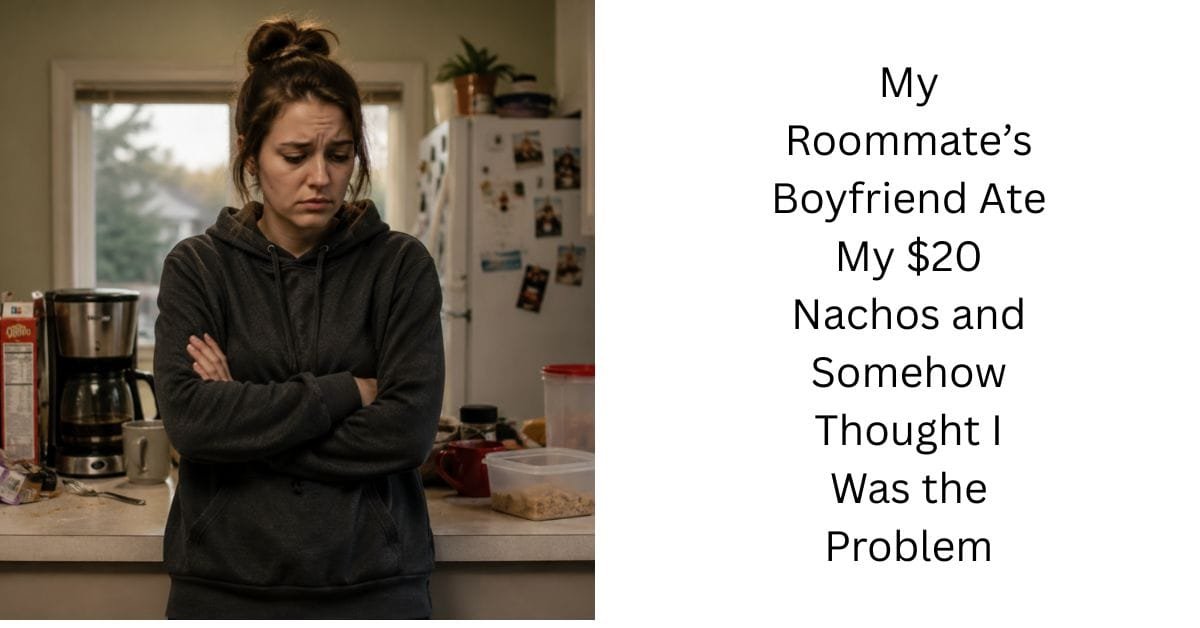
Living with a roommate can be an adventure. You learn quickly that sharing a home means sharing certain responsibilities, compromising on noise, cleaning, guests, and sometimes even food. But there are some boundaries that should never need to be explained, especially when you are an adult living with another adult. One of those boundaries is simple: if someone buys food for themselves, you don’t eat it without permission. Unfortunately, my roommate’s boyfriend apparently never learned that lesson. What started as a $20 order of nachos turned into one of the strangest arguments I have ever had with another person, mostly because he somehow managed to convince himself that I was the unreasonable one.
I live with my roommate, “Maya,” and we’ve been sharing an apartment for almost a year. For the most part, we get along well. We have different schedules, but we’ve always managed to respect each other’s space. Maya has a boyfriend, “Jake,” who visits fairly often. I don’t particularly like or dislike him. He’s friendly enough when we talk, although he has a habit of acting extremely comfortable in our apartment. By “comfortable,” I mean he sometimes walks into the kitchen, opens the refrigerator, grabs drinks, and helps himself to snacks without asking. Usually, I don’t care because most of the food he takes belongs to Maya. But I had never given him permission to eat my personal food, and I assumed that was common sense.
One Friday evening, I had a terrible day at work and decided to treat myself. I ordered a large portion of loaded nachos from a restaurant nearby. They weren’t cheap. Between the nachos, extra toppings, delivery fee, and tip, the total came to just over $20. I wasn’t ordering them for the entire apartment. They were my dinner, and I was looking forward to eating them while watching a movie in my room. When the delivery arrived, I put the container on the kitchen counter while I grabbed a drink from the refrigerator. I had barely been in my room for ten minutes when I came back for my food. The container was open, and a huge portion of the nachos was gone.
At first, I honestly thought Maya had eaten some. I asked her, “Did you take my nachos?” She immediately said no. Then she looked toward Jake, who was sitting on the couch watching television. I asked him if he had eaten them. He didn’t even look embarrassed. He simply said, “Yeah, I was hungry.” I stared at him for a few seconds because I genuinely couldn’t believe how casually he said it. I told him those were my dinner and that he should have asked before taking them. His response was, “There were a lot of them. I didn’t think you’d mind.” That sentence somehow made me even more annoyed. The issue wasn’t whether there were ten nachos or one nacho left. They weren’t his.
I told him that if he wanted food, he could order something or ask Maya if she had anything he could eat. Instead of apologizing, he laughed and said I was being dramatic over “a few chips and cheese.” I reminded him that the order had cost me more than $20 and that I had specifically ordered it for myself. He shrugged and said, “Okay, I’ll buy you another one.” At that point, I thought the situation was finally going to end. I said, “Fine. Just replace it.” But then he started complaining that the restaurant was too expensive and that I was making him feel guilty over something “so small.” I couldn’t understand how replacing the food he had taken without permission had suddenly become an unreasonable demand.
The argument got worse when Maya entered the conversation. Instead of telling Jake that he should have asked, she told me that I was making the apartment uncomfortable over food. She said, “He’s my boyfriend. He’s here all the time. You can’t expect him to ask permission every time he takes something from the kitchen.” I reminded her that I wasn’t asking him to request permission for everything in the apartment. I was asking him not to eat food that clearly wasn’t his. I also pointed out that we had never agreed to share groceries or takeout. Maya became defensive and said I was acting “possessive” about food. Jake then added, “Honestly, if you didn’t want anyone touching them, you should have put them in your room.”
That comment completely changed the mood. I looked at him and asked why I should have to hide my dinner inside my bedroom simply because he couldn’t respect something sitting on a shared kitchen counter. He said I was “overreacting.” I told him the problem wasn’t the nachos anymore. The problem was that he had taken something that wasn’t his, refused to apologize, and was now blaming me for expecting basic consideration. Maya tried to calm things down, but she kept defending him. Eventually, Jake said he would give me $20 if it would “make me stop complaining.” I told him I didn’t want money as an apology; I wanted him to understand that he shouldn’t take other people’s belongings without asking. He rolled his eyes and walked away.
The next morning, I noticed something interesting. Maya had apparently told another friend about the argument, because I received a message from someone I barely knew saying I needed to “learn how to live with people.” According to the story that had been passed around, I had apparently screamed at Jake over a few nachos and demanded that he pay me $20. I couldn’t believe how completely the story had changed. I hadn’t screamed, I hadn’t demanded money, and I certainly hadn’t started the argument. I had simply asked why someone ate my dinner without permission. When I showed Maya the message and asked why she was telling people that version of events, she said she didn’t want to make Jake look bad. That was when I realized the issue was much bigger than food.
After that, I changed the way I handled shared living. I started labeling my groceries and keeping expensive takeout in my room if Jake was visiting. I also had a serious conversation with Maya about boundaries. I told her that I didn’t care how often Jake visited, but he wasn’t entitled to my belongings simply because he was her boyfriend. Maya eventually admitted that Jake should have asked, although she still thought I had made the situation bigger than necessary. Jake never actually apologized. A few weeks later, he brought home a large order of nachos and jokingly offered me some, saying, “Don’t worry, these are mine.” I just laughed because at that point the entire situation had become almost absurd.
Looking back, the $20 nachos were never really about the money. If Jake had eaten them, realized his mistake, apologized, and replaced them, I probably would have forgotten the entire thing within a day. What bothered me was the entitlement and the way the blame was shifted onto me for having a reasonable boundary. Sometimes small incidents reveal much larger problems. A person who respects you doesn’t need a complicated explanation before understanding that your food is yours. And if someone takes something without asking, the normal response is to apologize—not convince you that you’re the problem for being upset. So, was I wrong for expecting my roommate’s boyfriend to ask before eating my $20 dinner, or should I have simply kept my nachos locked away from the beginning?
Read Story…
Roommates boyfriend ate my nachos and i will hold this grudge until the end if time
So i (18F) live in an apartment with three other girls, this is about who we will call Emily (19F) and her boyfriend Jay( who doesn’t live with us). I ordered DoorDash as a little treat for myself, i don’t do this often because it’s expensive and I’m broke but I deserve it after some big accomplishments I’ve had recently, there’s this place i really love with amazing nachos and so i thought I’d order them on my way home so they’d be there when i got there.
I texted the group chat being like “hey just a heads up i ordered DoorDash so if they ring the door before i get home would you maybe just put the bag inside?” One’s gone for the weekend the other said she’s not home but Emily said sure. Cool, super easy and we all bring in each other’s packages all the time.
Anyway i get the notification that it was delivered like 10 mins before i get home, text Emily and she confirmed she brought it in. So i get home, all excited for my nachos and Jay(who i didn’t know was there) and two others guys are sitting in our leaving room eating my nachos, watching tv and drinking our liquor that my roomies and i bought. Emily is in her room doing her makeup.
I’m pissed off and kinda flip out and Jay tells me to calm down and that nachos and a shareable food and i can share with them. I’m like um no i payed for those in not sharing and i except someone to pay my back asap. I ask him why he would eat my food and he said he thought they were for the house, like why would you think that?
I asked Emily if she told him that and she was surprised they are my stuff and said she never said he could eat them and that she’ll pay me back when she can but “it’s just food”
lol ok sweetpea I’m gonna be watching the door for your Amazon package like a hawk then. And your loser boyfriend has been voted off the island.
I Never Expected My Roommate’s Boyfriend to Eat My Dinner
Living with a roommate means learning how to share a space with someone who may have completely different habits, routines, and expectations. You have to compromise about cleaning, noise, guests, groceries, and even how much time you spend in common areas. I always understood that. What I didn’t expect was that one of the biggest arguments in my apartment would start because my roommate’s boyfriend ate my dinner. Not just a bite or two, but enough of my $20 loaded nachos that there was barely enough left for a proper meal. The strange part wasn’t even that he ate them. It was the fact that when I confronted him, he somehow managed to make me feel like I was the unreasonable person for being upset.
My roommate, who I’ll call Emily, and I have been living together for almost a year. We aren’t best friends, but we’re friendly, respectful, and generally get along. We split rent and utilities, keep our own groceries separate, and usually give each other plenty of privacy. We never established a formal rule saying, “Don’t eat my food without asking,” because honestly, I thought that was basic courtesy. If I bought something specifically for myself, Emily generally knew it wasn’t communal food. If she wanted something, she would ask, and I did the same with her things. For months, this system worked perfectly well.
Emily’s boyfriend, Ryan, started spending more time at our apartment over the past few months. I didn’t really have an issue with him being there. He was polite enough, and I wasn’t going to tell my roommate who she could date. The only thing that occasionally bothered me was how comfortable he had become in our shared space. He would open the refrigerator without asking, grab drinks, look through the cabinets, and sometimes take snacks. Most of the time, I assumed the things he was taking belonged to Emily. I didn’t want to be the person who monitored every sandwich or bottle of soda in the kitchen, so I ignored it.
Then came the Friday night that started the whole argument. I had one of those exhausting days where absolutely nothing seemed to go right. I had been looking forward to getting home, changing into comfortable clothes, watching something mindless, and eating something delicious. Instead of cooking, I decided to order loaded nachos from my favorite Mexican restaurant. They were expensive, especially after adding extra cheese, steak, guacamole, delivery fees, and a tip. By the time everything was finalized, the total came to just over $20. Normally, I wouldn’t spend that much on nachos, but I had decided that I deserved a small treat after a stressful week.
When the delivery arrived, I brought the container into the kitchen because I needed to grab a drink before going to my bedroom. I placed the nachos on the counter, took a bottle of water from the refrigerator, and went to my room. I planned to eat them while watching a movie. I hadn’t even been gone for fifteen minutes when I remembered that I had forgotten a fork. I walked back into the kitchen expecting to find my food exactly where I had left it.
Instead, I found the container open.
At first, I thought Emily had taken some. That wouldn’t have bothered me much if she had asked, because we’ve shared food before. But then I noticed how much was missing. Almost half of the nachos were gone, and some of the best parts—the steak, melted cheese, and guacamole—had disappeared completely. I stood there staring at the container for a moment, genuinely confused. Then I looked toward the living room, where Ryan was sitting comfortably on the couch watching television.
I asked Emily if she had eaten my nachos. She immediately said no. Then she glanced toward Ryan. I looked at him and asked, “Did you eat my food?” He didn’t seem embarrassed or surprised. He simply said, “Yeah, I was hungry.” The casual way he said it was almost more shocking than the fact that he had eaten them. There was no hesitation, no apology, and no “I thought they were mine.” He knew they weren’t his. He had simply seen food sitting on the counter and decided he wanted some.
I asked him why he didn’t ask first. He shrugged and said, “I didn’t think it was a big deal.” I told him that it was my dinner and that I had specifically bought it for myself. He laughed and said, “There were a ton of them.” I explained that the quantity didn’t matter. If I buy twenty dollars worth of food, I don’t expect someone else to decide how much of it they’re entitled to eat. He looked at me like I was making absolutely no sense.
Then he said something that immediately irritated me: “I’ll just buy you another one.”
I told him that replacing the food was fine, but he should still understand that he shouldn’t take other people’s things without asking. Instead of apologizing, he started complaining about the price. He said he wasn’t paying twenty dollars for “some nachos” and that I was acting ridiculous. I reminded him that he had eaten them, not me. If he didn’t want to pay the same price, he could have ordered something cheaper for himself.
That’s when Emily finally joined the conversation.
Instead of backing me up, she said, “Can we please not turn this into a huge thing?” I told her I wasn’t trying to make it huge. I just wanted Ryan to acknowledge that he had taken my food without permission. Emily responded that he was her boyfriend and that he was at our apartment all the time. According to her, I needed to understand that he was going to eat things occasionally.
I reminded her that there was a difference between sharing food and someone helping themselves without asking. She said I was being too strict about food. I pointed out that our groceries were separate and that we had never agreed to share everything. She responded, “But it’s just food.” That phrase bothered me more than I expected. It wasn’t “just food” to me. It was something I had purchased with my own money specifically for myself after a difficult day.
Ryan then joined in again and said, “Honestly, if you cared that much about them, you should’ve put them in your room.”
I stared at him because I couldn’t believe what I was hearing. According to his logic, I was responsible for preventing him from taking my belongings. I asked him whether I was supposed to hide every item I owned whenever he came over. Was I supposed to keep my groceries locked away because he might decide he wanted them? He said I was exaggerating.
I told him that I shouldn’t have to hide my dinner in my bedroom simply because an adult guest couldn’t respect something that clearly wasn’t his. That seemed to make him angry. He said I was treating him like a stranger and making him feel unwelcome. I responded that he was a guest in someone else’s home and that being a guest didn’t mean he had unlimited access to everything in the apartment.
Emily looked uncomfortable at that point, but instead of asking Ryan to apologize, she asked me to “let it go.” I told her I would gladly let it go if he simply said, “Sorry, I should have asked.” Ryan refused. He said he wasn’t apologizing for eating food that was sitting in a common area. That statement made the situation even clearer to me. He wasn’t confused about the boundary. He simply didn’t agree that the boundary should apply to him.
Eventually, Ryan pulled out his phone and said he would send me twenty dollars. I told him that wasn’t the point. If he had apologized and offered to replace the meal, I would have accepted it. But I didn’t want him to think he could ignore someone’s boundaries and solve everything with money. He responded, “Well, apparently twenty dollars is such a big deal to you.” I told him that it wasn’t about being unable to afford another meal. It was about respect.
The argument ended without a real resolution. Ryan went back to watching television, Emily went into her bedroom, and I was left standing in the kitchen looking at my half-eaten dinner. I ended up throwing the remaining nachos away because they had become soggy and cold. What had started as a simple plan to enjoy dinner had turned into an argument that lasted nearly an hour.
The next morning, I thought things would be calmer. Instead, I noticed that Emily was unusually quiet around me. When I asked whether she was still upset, she said she thought I had embarrassed Ryan. I couldn’t understand how I had embarrassed him when he was the person who had eaten my food. She said I could have handled it more privately. I told her we were already inside the apartment and that I hadn’t yelled at him or insulted him.
Then she admitted that she had told one of her friends about the incident.
According to the story her friend had heard, I had “freaked out” because Ryan ate a few nachos and demanded twenty dollars from him. Apparently, I was now the roommate who “doesn’t share anything” and makes guests uncomfortable. I was stunned. I explained to Emily that this wasn’t what happened. I didn’t demand twenty dollars. Ryan offered to give me twenty dollars because he didn’t want to admit that he had done something wrong.
Emily shrugged and said, “That’s not how he remembers it.”
That was the moment I realized the problem wasn’t really the nachos. It was the complete lack of accountability. Ryan had taken something without asking, dismissed my concern, blamed me for not hiding it, and then somehow became the victim of the situation. Emily had also chosen to protect his feelings instead of acknowledging my completely reasonable complaint.
After that, I started changing how I handled my belongings in the apartment. I labeled some of my groceries. I stopped leaving takeout unattended in the kitchen. I kept certain snacks in my bedroom. I even started taking pictures of my grocery receipts because I didn’t want another argument about what belonged to whom. It felt ridiculous, but I didn’t know what else to do.
A few days later, Ryan came over again. He walked into the kitchen, opened the refrigerator, and stood there looking around. I watched him carefully. He eventually picked up one of my drinks and looked at me. I said, “That’s mine.” He put it back and laughed, saying, “Don’t worry, I know the rules now.” I didn’t find it funny.
Emily later told me that I was making the apartment feel tense. I told her that the tension wasn’t created by me setting a boundary. It was created because her boyfriend refused to respect one. I also told her that if she wanted Ryan to have access to shared food, we could create a clear system for that. I was perfectly willing to label communal items and separate personal groceries.
To her credit, Emily eventually agreed that we needed clearer boundaries. She admitted that Ryan had probably gotten too comfortable because she had never corrected him when he took things. She also admitted that she should have supported me during the original argument. That conversation helped somewhat, although Ryan himself never gave me a sincere apology.
Interestingly, a couple of weeks later, Ryan ordered nachos for himself. When the delivery arrived, he deliberately brought the container into the living room and announced, “These are mine, by the way.” Then he looked at me and laughed. I just nodded. It was an awkward attempt at humor, but at least he seemed to understand the point now.
Looking back, I don’t regret speaking up. Maybe some people would say that arguing over $20 worth of nachos is unnecessary. If the story were simply “my roommate’s boyfriend ate a few nachos and I demanded money,” I might agree. But that wasn’t what happened. The real issue was that someone entered my home, took something I had paid for, refused to acknowledge that it was wrong, and then tried to make me responsible for his decision.
The strangest part is that replacing the food would have taken five minutes. An apology would have taken ten seconds. Instead, everyone spent far more energy arguing about whether I had the right to be upset. That’s what made the situation so frustrating. Sometimes a small incident reveals how people view boundaries, respect, and accountability.
So now I have a simple rule when it comes to roommates and their partners: if it’s not yours, ask first. It doesn’t matter whether it’s a $20 dinner, a $2 snack, or a bottle of soda. Respecting someone else’s belongings costs absolutely nothing. And if you make a mistake, apologizing is usually much easier than creating an entire argument to prove that you were somehow justified.
The funny thing is that I eventually stopped caring about the nachos. What I remember is the moment Ryan told me that I should have hidden my own food if I didn’t want him eating it. That sentence told me everything I needed to know. I wasn’t upset because someone ate my dinner. I was upset because someone believed his desire to eat it was more important than my right to say no. And honestly, that’s a boundary I don’t think I should ever have to apologize for.