Redditor Called ‘Creepy’ For Keeping A Tally Of All The Times Boyfriend Has Borrowed Money And Not Paid It Back
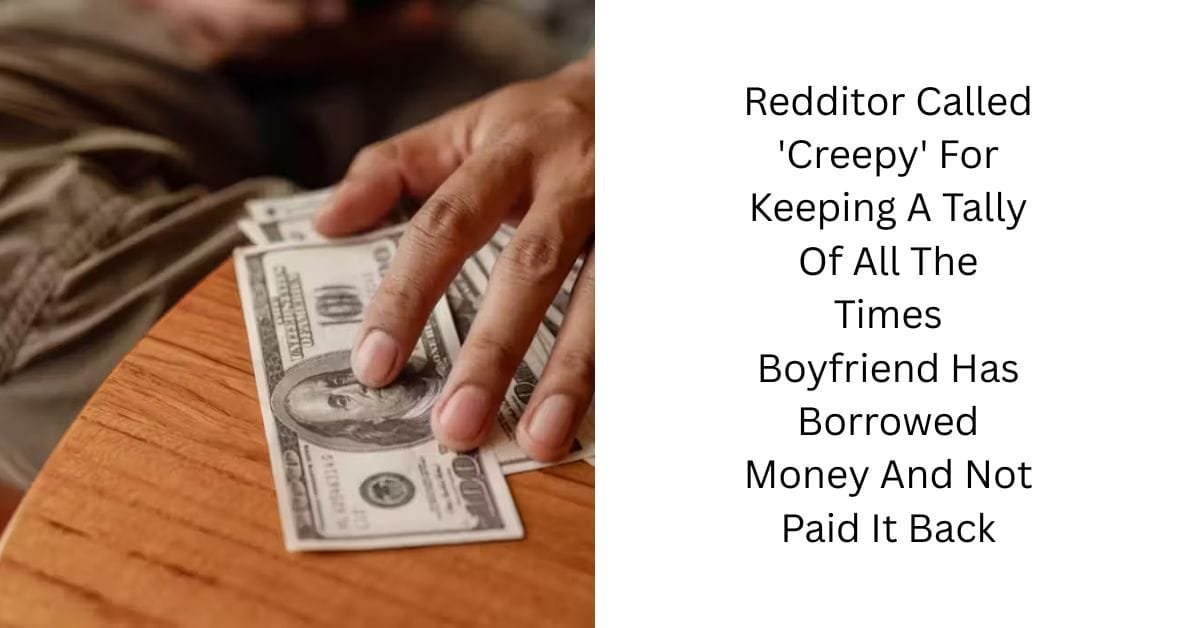
When Emily first started dating Ryan, she never imagined that money would become one of the biggest sources of tension in their relationship. They had been together for more than two years and generally considered themselves happy. Ryan was charming, affectionate, and supportive in many areas of their lives, but he had always been less responsible with money than Emily. In the beginning, his financial requests were small. He might ask her to cover dinner because his paycheck was delayed, borrow money for gas, or ask her to pay for a bill with the promise that he would reimburse her later. Emily never thought much of it. She considered these normal favors between partners and trusted him when he said he would pay her back. However, as time passed, the small amounts became more frequent. Ryan began asking for larger sums, and his promises to repay her were increasingly forgotten. Emily eventually realized that she was no longer occasionally helping her boyfriend. She was quietly becoming his backup bank account.
Emily initially tried to keep track of the money in her head, but that quickly became impossible. There were too many separate occasions, and some of the amounts were small enough that she didn’t want to start an argument over them. Still, when she added everything together, she was shocked by the total. Ryan owed her money from restaurant bills, utility payments, car expenses, online purchases, and several emergency requests. Every time she mentioned one of the unpaid amounts, Ryan would say he hadn’t forgotten and would pay her when he had more money. Emily believed him for a long time. Eventually, however, she started writing down each amount in a simple note on her phone. She recorded the date, how much she had given him, and what he said the money was for. She wasn’t doing it because she wanted to embarrass him. She simply needed an accurate record because the situation had become too complicated to remember.
The situation came to a head when Ryan accidentally saw the note on Emily’s phone. He read through the list and immediately became angry. Instead of being embarrassed about the amount he owed, he accused Emily of being obsessive. He called the tally “creepy” and said that keeping records of every favor she had done for him made their relationship feel like a business transaction. Emily was stunned. She explained that she wasn’t keeping track of ordinary favors or expecting repayment for every coffee or dinner she had ever purchased. The list specifically contained money Ryan had borrowed with an explicit promise to return it. She told him that if he had paid her back as promised, there would have been nothing to keep track of. Ryan insisted that she was making money more important than their relationship. Emily responded that the opposite was true: she had avoided confronting him for months because she cared about their relationship and didn’t want constant arguments over money.
After the argument, Emily decided she could no longer continue ignoring the problem. She showed Ryan the total amount he owed and asked him to create a repayment plan. She wasn’t demanding that he return everything immediately. She simply wanted him to demonstrate that he took the debt seriously. Ryan became defensive again and said he couldn’t believe his girlfriend was treating him like a debtor. Emily reminded him that he had repeatedly called the money a loan and promised to repay it. She also pointed out that she had never charged him interest or demanded money when he was genuinely struggling. What she wanted was basic accountability. Ryan argued that couples should help each other without keeping score. Emily agreed in principle, but she told him that there was a difference between helping a partner and repeatedly lending money to someone who never follows through on repayment.
The disagreement made Emily look at their relationship differently. She started wondering whether Ryan’s financial behavior was part of a larger pattern. Whenever something went wrong, he expected her to solve it. When he made poor financial decisions, she softened the consequences. When he overspent, she covered the gap. He always had an explanation, but rarely took responsibility. Emily realized that the problem wasn’t simply the amount of money involved. It was the expectation that she would continue rescuing him without asking difficult questions. She also noticed that Ryan seemed more upset about being held accountable than he had been about failing to repay her. That realization worried her. She began wondering whether he truly saw their relationship as an equal partnership or whether he had become comfortable with her carrying responsibilities that should have been shared.
Eventually, Ryan admitted that he had become dependent on Emily’s willingness to help. He said he had convinced himself that because they were a couple, the money wasn’t really a serious issue. He also admitted that seeing the list embarrassed him because it showed just how many times he had promised to repay her without following through. Emily appreciated the honesty but told him that an apology wasn’t enough. They agreed on a repayment schedule, and Ryan began making smaller payments each month. Emily also established a new boundary: she would no longer lend him money unless there was a genuine emergency, and she wouldn’t cover expenses that resulted from his irresponsible spending. Ryan initially struggled with the change, but eventually began managing his finances more carefully. Their relationship didn’t become perfect overnight, but the financial imbalance started to improve.
Looking back, Emily no longer felt embarrassed about keeping a tally. She realized that documenting money she had lent wasn’t “creepy”; it was a practical way to understand what was happening when verbal promises kept being forgotten. The real problem wasn’t that she had written down the amounts. The problem was that Ryan had repeatedly borrowed money without repaying it and then criticized her when she finally kept a record. Their experience taught Emily that healthy relationships can include financial support, but support should never become one-sided or automatic. Partners should be able to discuss money openly without shame, guilt, or manipulation. Keeping track of a debt isn’t a sign that you don’t love someone. Sometimes it’s simply a sign that you finally decided your generosity needed boundaries.
Read Story…
“Am I overreacting by keeping a list of every time my boyfriend borrowed money from me and said he would pay me back?”
The OP’s boyfriend had a bad habit of not paying back the money he borrowed.
“My boyfriend always asks me to cover small things and says he’ll send the money later.”
“It’s usually $10 here or $30 there, but he almost never remembers unless I bring it up.”
The OP started keeping track of what was not repaid.
“After having the same argument twice, I started keeping a note on my laptop with the date, amount, and what it was for.”
“He saw it yesterday while we were ordering food and got really upset.”
“I’d been playing ‘Big Roller’ on my laptop while we were deciding what to get, and then I opened the note to add what he owed me for dinner.”
“The total on the list was $436.”
The OP’s boyfriend was more upset about the spreadsheet than owing his partner almost $500.
“He sent it all immediately but said the list was creepy and made him feel like I had been collecting evidence against him.”
“Maybe I should have told him I was tracking it, but I also feel like I wouldn’t need a list if he paid me back when he said he would.”
“AIO?”
Fellow Redditors weighed in:
- NOR: Not Overreacting
- YOR: You’re Overreacting
Some clocked the boyfriend’s deflection of being terrible at returning money.
“I love that it’s posed as creepy that you have a ‘list of evidence’ against him, not the fact that the only reason there’s a list in the first place is because he has a convenient memory to forget paying. Great deflection.” – bloveulongtime
“Calling the receipt creepy instead of addressing why $436 quietly piled up is such a classic move. He paid instantly the second it was in writing too, so clearly the memory issue wasn’t actually a memory issue.” – blushrippling
“It’s not creepy, and he doesn’t think it is, either; he just felt guilty and lashed out.” – hilarysaurus
“Deflection. He should be keeping track, so not only does she have to give interest-free loans, but also has to keep tabs on everything because he lies? Psycho, lose him…” – Ok-Flight9440
“Mooch got busted. They don’t like that.”
“They always get so offended when you bring out actual receipts. Like, sorry, I didn’t just let you drain my bank account in peace, bro.” – Spiritual_Dee
“I was owed nearly $2,000 by my ex, most accrued by me paying the upfront cost (and building for him) his gaming pc. I felt like I had to stay in a miserable relationship way longer than I wanted because of it. Eventually, he was left some money as inheritance when his gran passed.”
“He started telling me about all these things he wanted to buy with it. I had enough, pulled up the note on my phone, and said, ‘Maybe you could pay me back the money you have owed me for the past three years first?'”
“He got so stroppy about it. Like I had ruined his life for daring to actually want my savings back. He was referred to as a mooch between my friends and me, and thankfully I eventually managed to get him off my tenancy and kick him out. He went to mooch of someone else pretty quick.” – Buxom__Babe
“You’re being financially responsible; he’s overreacting. Maybe he’s butthurt at seeing how careless he is, or over the fact that he just got busted treating you like an ATM. NOR.” – interestedinsharks
“$436 forgotten over time says a lot more about how much he values her time and trust than the actual dollar amount. Reasonable thing to sit with.” – BigYam6156
“NOR. You shouldn’t have needed to keep a list. Hopefully he’ll be more attentive going forward.” – Apock-
“NOR. Awww, poor little moocher thought his mooching was going unnoticed. Assuming your joint expenses, like ordering food, are generally shared, he’s just mad he got busted.” – loricomments
“If his intention was to always pay you back, the note wouldn’t have bothered him. In fact, he may have even been grateful for the reminder. You busted him. His reaction reveals his true intentions.” – Narrow-Helicopter-43
Others encouraged the OP to rethink the relationship, imagining how this could escalate.
“NOR, but I’d rethink a relationship like this. It’s not about the money; it’s about him purposefully using you and stealing from you.” – plantverdant
“NOR, but do you really want to date someone so financially irresponsible?” – illsleep
“NOR. I meeeeeaaaan… it is hard to argue a communication issue when he has said he would pay her back over $400 worth of times and just didn’t.”
“A few times is an honest mistake. What he is doing is deliberate and therefore, taking advantage. That is definitely breakup-worthy. Then he has the audacity to get defensive and call her creepy?? Get out of here.” – SaveItUp1998
“Naw. This guy is a child, and he’s not trustworthy. He’s just going to be another guy making us look bad, and OP will marry him and be posting mental load bulls**t.”
“Just dump him and date adults.” – DietAny5009
“If OP had to start a list, it was clearly a problem. Anytime someone in a relationship has to start keeping track of things, it’s a problem. Probably because they argue, and she says, ‘You never pay me back for xyz,’ and then he goes, ‘Yes, I did, I paid you back for x, I just gotta give you y and z.'”
“Or it’s ‘I only forgot to pay you back once or twice.’ Now OP will whip out the list and be like, ‘Actually…'”
“I used to give my ex money towards his house (not my house, he was a boyfriend, and I paid for everything else like groceries, household stuff, also cooked and cleaned) bc he’d whine about money; then EVERY fight he’d bring it up and say I’d never give him money. Guess what… I started keeping a list of what day I gave money and how much. PS, it was never enough.” – Fast-Presence5817
“NOR. You wouldn’t need a list if you stopped lending him money. You also wouldn’t need to list if you left him.” – Life_Scratch_2807
“Does he ever pay for anything, or is it always you?”
“I had a friend who would keep track of favors owed and favors given. He was an absolute sociopath, so my feelings on stuff like this are pretty biased, but I think anytime anyone is doing this, it’s a red flag.”
“If you don’t like paying for things for your boyfriend, tell him so, or ask him to pay you back sooner. He’s absolutely right that it does seem like you were collecting evidence against him… I mean, that’s exactly what you were doing, right?”
“I wouldn’t expect your relationship to last much longer.” – extralife_mike
“My husband is attached to my credit card, and every couple months he would say, ‘Oh man, I need to pay you back!’ (I wouldn’t tell him he needed to; it was just an integrity thing.)”
“We would go through every transaction, including money that I owed him as well, and he’d be upset over how much he owed me every time. It clicked that we sometimes spend money a bit too carelessly, LOL.”
“Obligatory NOR. You shouldn’t keep a tally; you’re a team. But if he doesn’t keep his word and is frequently spending your money without reciprocation, he sucks.” – GhostInTheEcho
“NOR. Sometimes I can understand if it’s an embarrassment thing, say they don’t want to admit they’re financially struggling (though at some point soon they should communicate that).””
“The fact that he was able to pay it all immediately just shows that he was a leech, and it’s pretty ironic he called it creepy yet can’t reflect on his own actions. Yikes.” – ParticularSilver9535
“You’re literally at a point where you have to keep a list.”
“You have some soul-searching to do regarding your next step(s). NOR.” – Woe_Bringer
“Don’t ever have kids, get divorced, and expect child support from him.” – filmguy36
The subReddit side-eyed the OP’s boyfriend for using this discovery as a way to make the OP the problem, rather than seeing his repeated borrowing of money without paying it back as the actual problem. Because until they argued about the money, the OP didn’t have a spreadsheet; if he’d just paid them back when he said he would, there never would have been a spreadsheet.
A Relationship That Started With Small Financial Favors
When Emily first started dating Ryan, money was never something she expected to become a serious problem in their relationship. They had been together for more than two years, and for the most part, they considered themselves happy. Ryan was affectionate, funny, and supportive in many ways. However, he had always been somewhat careless with money. In the beginning, his requests were small enough that Emily barely noticed them. He might ask her to pay for dinner because his paycheck was delayed, borrow money for gas, or ask her to cover a bill until he got paid. Each time, he promised to repay her. Because the amounts were usually small, Emily didn’t feel comfortable making a big issue out of them.
Emily believed that relationships involved helping one another during difficult moments. If Ryan was short on money one week, she didn’t mind covering something. She wasn’t expecting him to reimburse her immediately every single time. She saw herself as his partner, not his accountant. Ryan also made it clear that he appreciated her generosity. He would thank her, promise that the money was coming back, and tell her that he would do the same for her if their situations were ever reversed. Those assurances made Emily comfortable with helping him. Unfortunately, the favors slowly became a pattern.
As their relationship continued, Ryan started asking for money more often. What had once been occasional requests became something Emily expected every few weeks. Sometimes he needed help paying a utility bill. Other times, he needed money for his car or said he had forgotten about an upcoming expense. There were also times when he simply wanted to buy something and promised to repay her after his next paycheck. Emily continued helping because she didn’t want to appear selfish or unsupportive. She assumed that once Ryan got his finances under control, everything would balance out.
The problem was that Ryan rarely followed through on those promises. When Emily reminded him about money he owed, he usually had another explanation. His paycheck had been smaller than expected. An unexpected bill had appeared. His car needed repairs. He would pay her next week. Then next week would become next month. Eventually, Emily realized that she had heard the same promises so many times that they had stopped meaning anything. Still, she didn’t want to constantly argue with her boyfriend over money.
Emily worried that keeping track of every dollar would make her seem cold or materialistic. She had seen couples argue over splitting restaurant bills down to the last cent, and she didn’t want her relationship to become like that. She told herself that Ryan would eventually repay her. She also didn’t want him to feel as though she was judging him because he was struggling financially. For a while, she decided to let the issue go. But eventually, she realized that letting something go didn’t make it disappear.
After one particularly large loan, Emily decided she needed to know exactly how much money she had given Ryan. She opened a note on her phone and started writing down the amounts. She included the date, the amount, and what Ryan had said the money was for. It wasn’t a complicated spreadsheet or some secret investigation. It was simply a list that helped her remember. Emily wasn’t trying to use the information against him. She wanted an accurate picture of the situation because she had stopped being able to remember every transaction.
After adding everything together, Emily was genuinely surprised. The individual amounts had never seemed particularly serious, but together they had become a significant sum. She realized that she had been financially supporting Ryan far more than she had understood. Some of the money had been borrowed months earlier, while other amounts were more recent. Almost none of it had been repaid. Emily stared at the total and wondered how she had allowed the situation to continue for so long.
The issue finally exploded when Ryan happened to see the note on Emily’s phone. He read the list and immediately asked what it was. Emily explained that it was a record of the money he had borrowed. Instead of apologizing, Ryan became angry. He asked why she was keeping a tally of everything he owed. Emily said she needed to keep track because there had been so many separate transactions. Ryan didn’t seem satisfied with that explanation.
Ryan told Emily that the list was creepy and obsessive. He said it made their relationship feel like a business arrangement rather than a romantic partnership. He asked how she could possibly sit around recording every time he needed help. Emily was hurt by the accusation. She explained that she wasn’t keeping track of every cup of coffee or dinner she had ever purchased for him. The list only included money he had specifically borrowed and promised to return.
Emily asked Ryan why he was more upset about the list than about the fact that he hadn’t repaid the money. That question made him quiet for a moment. She explained that if he had kept his promises, the list would have eventually become unnecessary. She wasn’t trying to shame him. She was trying to understand the financial situation they had created together. Ryan insisted that couples shouldn’t keep score, but Emily pointed out that he was the one who had repeatedly described the money as something he would repay.
Their disagreement quickly became an argument about trust. Ryan accused Emily of being overly focused on finances. Emily said that financial responsibility was part of being an adult. She wasn’t asking him to give her money he didn’t have. She simply wanted him to acknowledge what he had borrowed. She also reminded him that she had never charged him interest or demanded immediate repayment. She had given him plenty of time because she cared about him.
After the argument, Emily spent some time thinking about her own behavior. She realized that she had contributed to the situation by being afraid to say no. Whenever Ryan asked for money, she worried that refusing would make her seem uncaring. Whenever he failed to repay her, she hesitated to bring it up because she didn’t want an argument. In trying to keep the peace, she had allowed resentment to build quietly. The tally wasn’t the cause of the problem. It was evidence that the problem had already existed for a long time.
Emily eventually sat down with Ryan and told him that things had to change. She wasn’t demanding that he return everything immediately. She asked him to create a realistic repayment plan based on what he could actually afford. She also told him that she would no longer continue lending him money while old debts remained unpaid. Ryan initially resisted the idea, saying that it was embarrassing to have his girlfriend treat him like a debtor.
Emily told him that loving someone didn’t mean ignoring irresponsible behavior. She said she would always want to support him when he genuinely needed help, but support couldn’t mean repeatedly rescuing him from the consequences of his decisions. She also pointed out that she had her own financial goals and responsibilities. Every dollar she gave him was money she couldn’t use for her own future. Ryan eventually admitted that he hadn’t thought about the situation from that perspective.
After several difficult conversations, Ryan admitted that he had become too comfortable relying on Emily. He said that because she had always helped him, he had started assuming she would continue doing so. He also admitted that he sometimes spent money on things he didn’t really need because he knew Emily could help if he ran short. Hearing that was painful for Emily because it confirmed that her generosity had unintentionally encouraged his behavior.
Ryan eventually agreed to a repayment schedule. He couldn’t afford to return everything immediately, but he could make smaller payments each month. Emily accepted the arrangement as long as he followed through. The first payment was modest, but it meant something to her. For once, Ryan wasn’t simply promising that he would repay her someday. He was actually doing it.
Emily also made an important decision: she would no longer automatically lend Ryan money. If he had a genuine emergency, they could discuss it, but she would not cover unnecessary purchases or repeated overspending. She told him that she didn’t want their relationship to depend on her financial support. Ryan wasn’t thrilled about the new boundary, but he eventually understood why it was necessary.
For a while, things between them were awkward. Ryan felt embarrassed about the debt, while Emily worried that setting boundaries had damaged their relationship. However, the conversations eventually became easier. They began talking more openly about money instead of avoiding the subject. Ryan started budgeting more carefully, and Emily stopped feeling responsible for fixing every financial problem that appeared.
Emily eventually realized that the list itself wasn’t what mattered. She could delete the note from her phone tomorrow and it wouldn’t change what had happened. The real issue was that Ryan had repeatedly borrowed money without repaying it and then criticized her for documenting the debt. The tally simply made an invisible problem visible. It gave Emily a clear picture of how much she had been giving and how little had been returned.
Several months later, Ryan apologized for calling the list creepy. He admitted that he had reacted defensively because seeing the total embarrassed him. He said he knew he had taken advantage of Emily’s kindness, even if he hadn’t intentionally planned to do so. Emily appreciated the apology, but she told him that rebuilding trust would take more than words. She needed to see continued responsibility.
One of the biggest changes was in Emily herself. She learned that saying no didn’t make her a bad girlfriend. She could love someone without paying their bills. She could support someone emotionally without solving every financial problem. Most importantly, she realized that boundaries were not punishments. They were a way of protecting the health of the relationship and preventing resentment from taking over.
Over time, Ryan began managing his finances more responsibly. He reduced unnecessary spending and started putting money aside before spending on entertainment. He also became more careful about borrowing. Instead of automatically asking Emily whenever he was short, he looked for other solutions first. The changes didn’t happen instantly, but they showed that he was taking the situation seriously.
Eventually, Emily and Ryan were able to discuss finances without immediately arguing. They started talking about savings, expenses, and future plans. They didn’t necessarily combine all of their finances, but they developed a better understanding of each other’s financial habits. Emily no longer felt like she had to secretly track everything because they were communicating openly.
Emily came away from the experience with a different understanding of what a healthy relationship should look like. She still believed couples should help each other, but she no longer believed that generosity required ignoring patterns of irresponsible behavior. She also understood that keeping a record of a legitimate debt wasn’t inherently controlling or creepy. Sometimes documentation is simply practical, especially when verbal promises have repeatedly failed.
In the end, Emily realized that the real problem wasn’t the tally on her phone. The real problem was that Ryan had borrowed money repeatedly, failed to repay it, and expected her to remain silent because they were in a relationship. Her record simply forced both of them to confront something they had been avoiding. Love doesn’t mean keeping score over every little thing, but when one partner repeatedly borrows money and doesn’t repay it, keeping an accurate record isn’t creepy—it can be the first step toward recognizing an unhealthy pattern and setting the boundaries needed to fix it.






One thought on “Redditor Called ‘Creepy’ For Keeping A Tally Of All The Times Boyfriend Has Borrowed Money And Not Paid It Back”
Comments are closed.