Woman Refuses To Change Married Name Amid Divorce After Husband Forced Her To Take It Despite Her Career Concerns
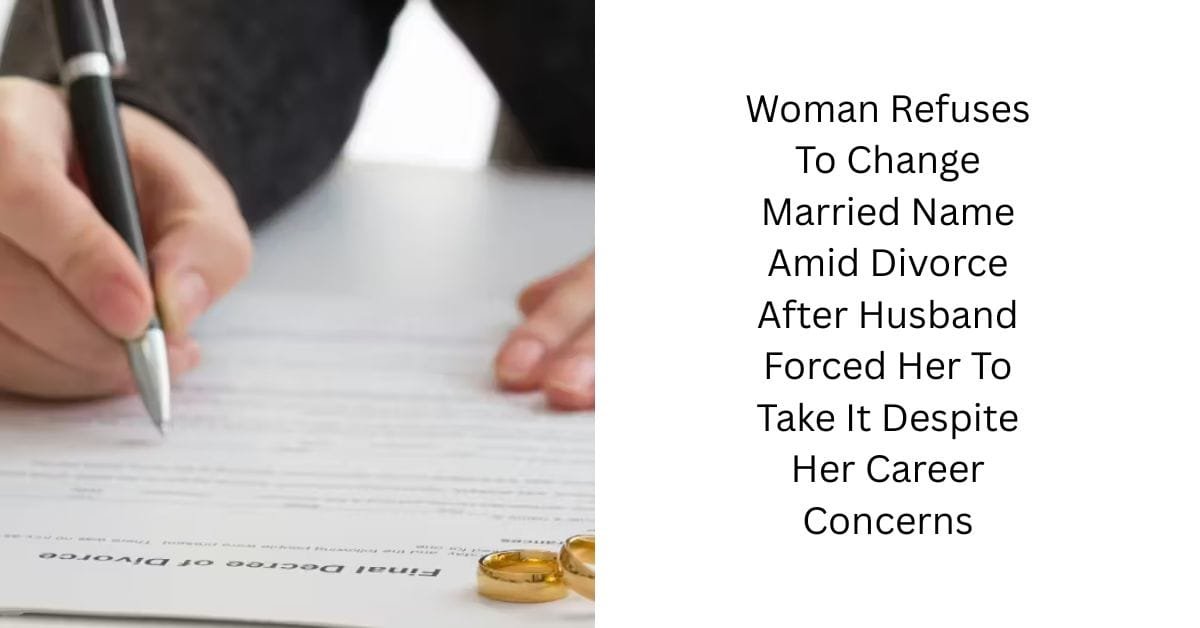
When Claire married Daniel several years ago, she had already built a strong professional identity under her maiden name. She had spent years developing her career, building relationships with clients, earning qualifications, and establishing a reputation that was closely connected to her original surname. Before the wedding, she and Daniel discussed whether she would change her name after marriage. Claire explained that she preferred to keep her maiden name professionally because changing it could create confusion for clients and make it harder to connect her previous work with her new identity. Daniel strongly disagreed. He believed that taking her husband’s surname was an important part of marriage and repeatedly pressured her to change it. Eventually, Claire gave in, partly because she didn’t want their wedding plans to become an endless argument. She changed her legal name and began using Daniel’s surname, even though she never felt completely comfortable with the decision.
Claire soon discovered that her concerns had been justified. Updating her professional records, email accounts, certifications, social media profiles, business contacts, and other documents became a frustrating process. Some clients didn’t immediately recognize her under her new surname, while others assumed she was a different person. She had to explain repeatedly that she was the same professional they had previously worked with. Daniel didn’t understand why the transition bothered her so much. He believed that changing her name was simply part of being married and that everyone would eventually adjust. Claire tried to explain that for him, the change was symbolic, but for her, it affected years of professional recognition. She didn’t regret marrying him at the time, but she increasingly regretted allowing herself to be pressured into changing something so important to her identity.
Unfortunately, the disagreement over her name became just one example of larger problems in their marriage. Over the years, Claire began feeling that Daniel often expected her to compromise whenever they disagreed. He had insisted that she take his surname, and there were other decisions where she felt her preferences were treated as less important than his. Eventually, their relationship deteriorated to the point where they decided to divorce. The process was emotionally difficult, but Claire also felt a sense of relief because she finally had the opportunity to make decisions about her own life without being pressured. One of the first things she considered was changing her surname back. However, after thinking about everything she had experienced, she realized she didn’t actually want to do that immediately. The name she had been forced to adopt had become connected to her career and adult life, and she no longer wanted her ex-husband’s demands to determine what she did with it.
When Claire told her family and friends that she intended to keep her married surname after the divorce, some people were confused. They assumed that returning to her maiden name would be the obvious choice. Claire explained that the name was no longer simply Daniel’s name in her mind. She had used it professionally for years, built a reputation under it, and become comfortable with it. More importantly, she wanted the decision to finally be hers. Daniel was reportedly unhappy when he learned that she wasn’t planning to change it back. He argued that she had only taken the name because she was his wife and that keeping it after their divorce felt inappropriate to him. Claire disagreed. She reminded him that he had pressured her into taking the name in the first place. Now that the marriage was ending, she believed he had no right to dictate whether she kept it.
Claire eventually realized that the most important issue wasn’t whether she kept her married name or returned to her maiden name. The real issue was that she finally had control over the decision. During the marriage, she had changed her name largely because Daniel wanted her to. During the divorce, she refused to make another major personal decision simply because he wanted something different. If keeping the surname made her professional and personal life easier, she saw no reason to change it. If she eventually decided to return to her maiden name, that would also be her choice. Her experience taught her that a name can carry professional history, personal identity, and emotional meaning, and no spouse should assume they automatically have the right to decide what another adult calls themselves. After years of allowing her husband’s preferences to influence her identity, Claire wasn’t going to let him control her name one more time simply because their marriage was ending.
Read Story…
“AITA for refusing to change my name?”
The original poster (OP) explained:
“I (33, female) recently left my husband, and one of the things we’re fighting about now is my last name.”
“For some background: I have a PhD in computer science and work in academia. I’ve published papers, presented at conferences, reviewed research, and built a professional reputation that’s tied to my legal name.”
“When we got married, I did not want to change my last name. I wanted to keep my maiden name because all of my degrees and early publications were under it, and I knew changing names would make things more complicated professionally.”
“My husband insisted it was a dealbreaker. He said he couldn’t marry someone who wouldn’t take his name. I remember specifically explaining that my career would be tied to whatever name I used.”
“I still remember his response because it bothered me even then. He laughed and said something along the lines of, ‘That’s good. Then you won’t be able to just leave me over stupid sh*t like dreaming I did something wrong’.”
“For context, I’ve been the primary earner throughout our marriage. My husband has mostly been unemployed. He’s done things like Uber on and off (using a car I bought), but I’ve paid the mortgage, bills, insurance, and pretty much everything else.”
“I’ve now left him for reasons like that.”
“The issue is that he now wants me to change my last name back immediately.”
“Ironically, I’m refusing for exactly the reason I gave him years ago. Since getting married, I’ve published even more papers, supervised graduate students, received grants, and become known professionally under my married name.”
“Changing it now would create confusion with citations, collaborators, students, and my professional identity. Plenty of academics keep the same name after divorce for exactly this reason.”
“He’s furious. He says I’m ‘stealing’ his family name and damaging the reputation of his family by continuing to use it without staying in it.”
“His family does have a history locally. Several older relatives were major landowners and business owners decades ago, so the surname is somewhat recognizable where we live. But my husband himself isn’t a public figure, and neither are his parents or siblings and they have mostly lost the wealth now due to gambling and bad decisions.”
“I pointed out that he was the one who insisted I take the name despite knowing it would become attached to my career. He says that’s different because we were married then, and now I’m ‘using’ his family’s name without belonging to the family anymore.”
The OP summed up why they might be the a**hole in their situation.
“I refused to change my name which might make me an a**hole as it is a name I took from my ex.”
Redditors weighed in by declaring:
- NTA – Not The A**hole
- YTA – You’re The A**hole
- NAH – No A**holes Here
- ESH – Everyone Sucks Here
- INFO – more information needed
Redditors decided the OP wwasnot the a**hole (NTA).
“NTA one of the benefits of getting divorced is no longer having to care what his opinions are. It’s now your name, you can use it or change it but it’s your choice and he doesn’t get an opinion. If he’s upset about it that’s his problem.” ~ Raddatatta
“NTA. Tell him ‘No’ and here’s a restraining order seem to be appropriate here. If you’re a college professor and he’s a bum, then you f*cked up a little when you married him. Don’t do yourself any more damage by having to restart your identity. He probably can’t even get the courts to force you, so he can Uber on up the road.” ~ Tazmosis85
“He’s still trying to control what OP does. She needs to stand firm and acknowledge he has NO say in anything anymore. NTA.” ~ WitchesCotillion
“Tell him that at this point you bring more prestige to the last name than he does so really he should change his last name to stop tarnishing your reputation.” ~ TechnologyLittle2940
“Yeah, you, the PhD holding breadwinner are damaging his family’s name more than the jobless layabout living off his wife’s money. If I were his mother, I’d adopt you as my favourite daughter so I could have a child to be proud of in front of the neighbours. NTA.” ~ parsleyleaves
“NTA. You are divorcing him, so why are you still discussing it with him? Who cares what he thinks? It isn’t enough to have whether or not you change your name.” ~ Adventurous_Tree3386
“He can go to hell. I also have a PhD and ALSO didn’t want to change my name when I got married for the same reason. You changed it for him then, now you’re keeping it for you. NTA.” ~ sacarla
“I know several married academic women who haven’t changed their names because of research papers etc… and it’s literally a non issue. No one has ever questioned it. OP’s ex husband is a clown who created the problem he’s now whining about.” ~ Fallenangel152
“NTA Apparently he’s never met a divorced person before. People retain names all the time.”
“Weird thing to be mad about. Kinda sounds like he’s just upset at the divorce.” ~ chainedtothebottle
“Kinda sounds like he’s an AH in general, not just upset about the divorce.”
“He forced her to change her name the first time, laughing about the consequences for her and making it sound like a control thing. Now he’s trying to force her to change her name again, but he’s not able to control her this time so he’s throwing a hissy fit.” ~ FreeFortuna
“Tell him you’re actually improving on his family name. Now there’s someone with intelligence, education and academic respect tied to it. Not just an Uber driver!” ~ Muted_Piccolo278
“NTA. Why are you even entertaining his bullsh*t? You married controlling a**hole and you are divorcing a jobless controlling a**hole.”
“This clown is acting like his last name is tied to British royalty. When in reality it’s just the last name of a jobless misogynist bum. Ignore him. I hope you have a good lawyer because he sounds vindictive.” ~ Ok_Tonight_3703
“NTA. It’s your name now. Even if you hadn’t married him, you could have legally changed your name to whatever it is. He’s an a-hole for forcing you to change it to his in the first place, and just as much an a-hole to demanding you to change it back again.” ~ ghese
“So, he’s an unemployed bum and you’re a renowned scientist, but you are the one damaging the reputation of his last name?”
“Tell him that you’ll give it back when he gives back half of the money you spent on keeping his sorry ass clothed and fed, the mortgage and bills for all those years.”
“Definitevly NTA!” ~ VegetableReward5201
“He cannot be too picky about casting a poor reflection on his family name, given that he has made no attempts to further himself in life. He’s just bitter because everyone in town knows the Dr. in the family isn’t him. NTA and he can piss straight off!” ~ Electronic_Wait_7500
“NTA. I’ve seen this from both sides. My wife never changed her last name because it is a rather a famous last name. I love the name too, I always joke that I should have changed my last name to her’s.”
“On the other hand, my mother and father are long divorced (they were divorced over 35 years ago). My mom still uses my dad’s last name and my dad doesn’t care. Those are examples of how things should be.”
“Here’s the reality for him. No one owns a name in such a way they can stop other people from using it. If I wanted to change my name to Henry Ford, there is nothing the Ford Motor Company can do about it to stop me.”
“Likewise, some local celebrity around your last name cannot compel you not to use it. And to be clear, it is now your last name, not just his. Even more importantly, your ex doesn’t get to dictate what you do. NTA all day long.” ~ Bowman74
If OP’s husband hadn’t. ade the name change an ultimatum for the marriage, this wouldn’t be an issue. Since he did, he can deal with the consequences of his actions.
She Had Built Her Career Under Her Maiden Name
When Claire married Daniel, she was already well established in her professional life. She had spent years building a reputation under her maiden surname, and her clients, colleagues, professional contacts, and previous work were all connected to that name. Claire had never viewed her surname as something insignificant. To her, it represented years of education, effort, and accomplishments. Before the wedding, she explained to Daniel that she wanted to keep using her maiden name, especially at work. She believed changing it could create unnecessary confusion and force her to rebuild part of the professional identity she had worked so hard to establish.
Daniel strongly believed that a married woman should take her husband’s surname. He viewed the tradition as an important symbol of commitment and family unity. Claire understood that the tradition mattered to him, but she didn’t feel the same way. She told him that marriage didn’t require her to abandon a name that was already part of her identity. Instead of accepting her decision, Daniel repeatedly argued with her about it. He told her that keeping her maiden name would make him feel as though she wasn’t fully committed to their marriage.
The discussions became increasingly exhausting. Claire didn’t want their engagement and wedding planning to become consumed by an argument over a surname. Eventually, she agreed to take Daniel’s last name. She hoped that compromising on the issue would make him happy and allow them to move forward. Although she technically made the decision herself, she knew that pressure from Daniel had played a major role. She privately wondered whether she would regret it later.
After the wedding, Claire discovered just how much work was involved in changing a name. She had to update identification documents, financial records, professional accounts, memberships, licenses, email addresses, and other paperwork. The process was time-consuming and frustrating. More importantly, changing her professional identity created confusion among people who had known her under her maiden name for years. Some clients didn’t immediately recognize her after the change.
Claire had warned Daniel that changing her surname could affect her professional reputation, and she soon saw evidence of that. People searching for her previous work sometimes struggled to connect it with her new name. She occasionally had to explain that she was the same person they had worked with before. While none of these problems destroyed her career, they created unnecessary complications that could have been avoided if she had kept her original name professionally.
When Claire complained about the difficulties, Daniel told her that she was making the situation more complicated than it needed to be. He argued that millions of married women changed their surnames and managed to continue their careers. Claire understood that, but she pointed out that every profession was different. Her concern wasn’t that changing her name made employment impossible. Her concern was that she had already established valuable professional recognition under another name.
As their marriage continued, Claire began noticing that the surname argument wasn’t an isolated disagreement. Daniel often expected her to compromise when they disagreed. He frequently presented his preferences as though they were the obvious choices and treated her concerns as secondary. Claire started wondering whether she had given up too much simply to avoid conflict. The surname became a symbol of how often she had prioritized keeping Daniel happy over listening to herself.
After several years, the relationship developed serious problems. Arguments became more frequent, communication deteriorated, and both partners became increasingly unhappy. Claire eventually realized that staying married simply because they had once loved each other wasn’t enough. They tried to work through their problems, but the relationship continued to deteriorate. Eventually, they decided that divorce was the healthiest option.
Once the divorce process began, Claire assumed she would immediately change her surname back. She initially thought returning to her maiden name would be the natural next step. However, as she considered the practical consequences, she became less certain. She had now used Daniel’s surname for years. Her professional contacts knew her by that name, and changing it again could create another round of paperwork and confusion.
Claire realized something else. The surname might have originally been adopted because Daniel pressured her, but over the years it had become part of her own identity. She had achieved professional milestones while using it. She had developed friendships and professional relationships under it. She didn’t necessarily want to erase that chapter of her life simply because the marriage was ending.
When Claire told some friends that she was considering keeping the surname, they were surprised. Several assumed she would immediately return to her maiden name. They asked why she would want to keep a name associated with a failed marriage. Claire explained that the name no longer belonged exclusively to Daniel. It had become part of her own adult identity as well.
Claire’s family had different opinions. Some relatives believed she should return to her maiden name because it was the name she had been born with. Others supported her decision to keep the surname if it made her professional and personal life easier. Claire appreciated the different perspectives but realized that the decision ultimately belonged to her.
When Daniel learned that Claire intended to keep his surname after the divorce, he became upset. He told her that the name represented their marriage and that she shouldn’t continue using it once the relationship was over. Claire found his reaction ironic. He had spent years insisting that she take the name, but now that they were divorcing, he wanted to decide when she should give it back.
Claire told Daniel that he didn’t get to control her identity anymore. She reminded him that she had originally wanted to keep her maiden name because of her career, but he had repeatedly pressured her until she agreed to change it. Now that the marriage was ending, she wasn’t willing to make another major decision simply because he preferred it.
Daniel seemed to believe that Claire was keeping the surname to remain connected to him. She explained that this wasn’t the case. She wasn’t trying to preserve the marriage or make a statement about their relationship. She was considering the name because it was now connected to her professional history and because changing it again would create unnecessary complications.
Claire had spent years working under her married surname. She had earned promotions, completed major projects, built relationships, and developed a reputation using that name. Returning to her maiden name could make some people assume she was a completely different professional. She didn’t want to spend additional time explaining a personal decision to every client and colleague.
For Claire, the most important part was that she was finally making the choice herself. During her marriage, she had allowed Daniel’s wishes to influence her decision. During the divorce, she wanted to make the decision based on what worked best for her. Whether she ultimately kept the surname permanently or changed it later, she wanted the decision to belong to her alone.
Claire also rejected the idea that a surname automatically represented marital loyalty. A name could represent family, career, history, convenience, or simply personal preference. People could change their names for many reasons, and they could keep them after relationships ended. She no longer believed that Daniel had the authority to decide what her surname meant.
Although Daniel remained unhappy, Claire stopped arguing about the issue. She simply told him that she had made her decision. Once he realized she wasn’t going to change her mind because of pressure, the arguments eventually became less intense. They still had disagreements about other aspects of the divorce, but the surname was no longer something Claire was willing to negotiate.
Claire came away from the marriage with a stronger understanding of personal boundaries. She realized that compromise was healthy when both people genuinely wanted to meet in the middle. But repeatedly giving up important personal choices just to avoid conflict could eventually create resentment. She wished she had trusted her original instincts before the wedding instead of allowing herself to be pressured.
In the end, Claire’s decision wasn’t really about keeping Daniel’s surname. It was about refusing to let Daniel decide what she should do with it. He had pressured her into taking the name when they married, and she wasn’t going to allow him to pressure her into giving it back simply because they were divorcing. If she eventually returned to her maiden name, it would be because she wanted to—not because someone else told her she should. A marriage may end, but that doesn’t mean one person automatically gets to control the other’s identity afterward. Sometimes the most important thing a person can reclaim after a difficult relationship isn’t a name—it is the right to decide what that name means for themselves.