Years After My Dad’s Death, I’m Considering Reconnecting With His Second Wife
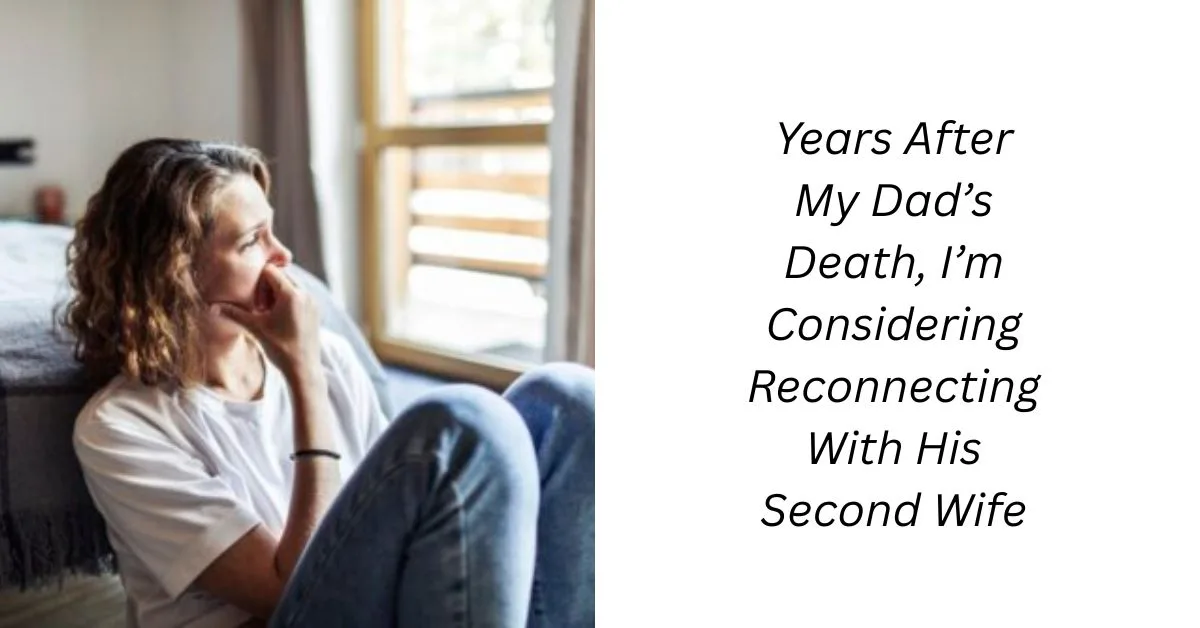
Years after my father passed away, I recently found myself thinking about his second wife and wondering whether I should reach out to her. When my dad was alive, our family situation was complicated, and his second marriage created feelings that I didn’t always know how to handle. At the time, I was focused on protecting myself emotionally and maintaining some distance from the parts of his life that felt difficult. After his death, I assumed those feelings would eventually fade. Instead, as the years passed, I started thinking about the people who had known my father in ways I hadn’t. His second wife shared a significant part of his life, and although our relationship was never particularly close, she may have memories and stories about him that I will never be able to get anywhere else. Lately, I’ve found myself wondering what she remembers, how she experienced those years with him, and whether she ever thinks about our family. The idea of contacting her makes me nervous because I don’t know how she would react or whether she would even want to hear from me after all this time.
Part of my hesitation comes from the complicated history between us. My father’s second marriage wasn’t something I immediately accepted, and there were moments when I felt angry, confused, and even pushed aside. I don’t want to rewrite the past and pretend everything was perfect because it wasn’t. There were disagreements and emotional moments that affected how I viewed both my father and his relationship with her. At the time, keeping my distance seemed like the easiest way to protect my own peace. However, I am older now, and I see many things differently than I did back then. I understand that adults can make complicated choices, relationships can be messy, and people can hurt one another without necessarily intending to. I also realize that my father’s second wife wasn’t responsible for every difficult feeling I experienced. Some of my anger was really connected to my father’s choices and the circumstances surrounding his second marriage. With time, I’ve become less interested in assigning blame and more interested in understanding what actually happened.
Another reason I’m considering reaching out is because I realize how many questions I still have about my father. After someone dies, memories become incredibly valuable. I remember him as my dad, but his second wife knew him as a husband and as a person who lived a different part of his adult life. She probably saw sides of him that I never witnessed. She might remember his routines, his sense of humor, the things that made him happy, or even small stories that would help me understand him better. I don’t expect her to provide some perfect explanation for everything that happened in our family. I simply wonder whether talking to someone who shared so much time with him might help me fill in some missing pieces. At the same time, I don’t want to reopen old wounds or make her uncomfortable. She may have her own grief, memories, and reasons for maintaining distance. I know that reaching out after so many years could feel unexpected, especially if she believed our relationship had ended permanently.
For now, I’m thinking about sending a simple message rather than making a dramatic attempt to reconnect. I could acknowledge that it’s been a long time, say that I’ve been thinking about my dad, and ask how she is doing. I don’t want to immediately bring up old family conflicts or demand answers about the past. If she responds positively, perhaps we could slowly have a conversation and see where it goes. If she doesn’t respond, I would have to accept that as her choice. I’m also trying to prepare myself for the possibility that she remembers things differently from me. Her version of my father’s life might not match the memories I have, and that’s okay. People can experience the same person and the same events in completely different ways. What matters to me now is approaching the situation with maturity rather than resentment.
Ultimately, I don’t know whether reconnecting with my father’s second wife is the right decision, but I keep coming back to the idea that I might regret never trying. Life has already taught me that some opportunities for understanding disappear permanently when we wait too long. I’m not looking to replace anyone, change the past, or create a new family relationship overnight. I simply want to know whether there is a respectful way to open the door and see what happens. Maybe she would welcome hearing from me. Maybe she wouldn’t. Either way, I think I’m finally at a point where I can reach out without carrying the same anger I had years ago. My father is gone, and I can’t ask him the questions I wish I’d asked when he was alive. But perhaps someone who shared an important chapter of his life can help me understand that chapter a little better. Now I’m left wondering: Should I reach out to my late father’s second wife after all these years, or is it better to leave the past where it is?
Read Story…
“Should I Reach Out To My Late Father’s Second Wife?”
When I was about four years old over 45 years ago, my father and my mother divorced. My father chose not to stay in our lives, which eventually meant that my cool aunt was out of my life, too. Fast-forward to many years later, after I was grown and my father had passed away, my aunt reached out and we reconnected. She invited my son and me to come visit her several times and we did. She answered questions and filled in the gaps my father’s absence had created. She would send items that had belonged to him and sometimes included a little bit of a history behind them and pictures of him. I was grateful since I did not really know him while he was alive.
Then in 2021, my aunt and I had a falling out mostly due to political differences (she is much more conservative than I am). She eventually sent me a text that said “have a nice life” and I mostly haven’t heard from her since. She did reply when I asked about medical history for a procedure I was about to have, but that was it.
I am now writing this on the second anniversary of my mother’s passing. I did not have a very good relationship with her either. Her dying means that that only living relative connected to my father is a woman he married after my parents’ divorce. I do not recall ever meeting or speaking with her as a child, nor do I remember her ever reaching out to me when my dad was ill or after he died. Today I sent a message to my aunt asking for this woman’s name and contact information so I might connect with her. My aunt replied, saying that the second wife does not wish to be contacted and added that she hopes I can understand and respect her wishes. This makes me quite sad.
Sometimes I wonder what it would be like to have my aunt, father, and mother in my life. I also wonder what it would be like to talk to this woman – my father’s second wife – and hear about her time with my dad. I did end up finding contact information for her and I’m debating whether or not to reach out via mail. If what I found is accurate, she is 88 years old and residing in a nursing home halfway across the country. I don’t know if my aunt was being truthful about the wife’s decision to have no contact. (My aunt lied to me about another matter I never confronted her on). I would have no choice but to respect her wishes if she did not wish to communicate with me. But should I at least try? I know what it’s like to witness the end of life and hear regrets about not doing or saying something before their last breaths are taken. — A Daughter Looking For Answers
I don’t think it’s a good idea to reach out to your father’s second wife. Yes, there’s a good chance that your aunt lied to you about the woman not wanting to be contacted, but you have to ask yourself why she would lie about that. Maybe it’s to protect you? Maybe this woman, whose name you didn’t even know, never heard about you. It’s possible that the father you had no contact with from the time you were four years old never told his second wife that he even had a daughter. Maybe that’s why she didn’t reach out when your dad was ill and dying. You also don’t mention whether the two were still married when your father died, and maybe you don’t know whether they were or not.
There’s a lot you don’t know, and I appreciate your desire for clarity and for a better understanding of what your father was like and why he didn’t maintain a relationship with you, but I’m not sure this 88-year-old stranger in a nursing home however far away, who may not know you exist is going to be able to give you answers that satisfy you or make you feel good. At best, your letter reaches a woman who is receptive and has the mental faculties to answer your questions. And what do you think she could possibly say to help explain your father’s disappearance from your life 45 years ago? What information could she possibly share that your aunt hasn’t already that could begin to make up for the pain and rejection your father’s absence caused?
I’m concerned that the possibility of this interaction going well is so minimal that it isn’t worth the risk of re-opening old wounds (or confusing an old woman whose mental and physical health is unknown to you). And if these old wounds never really healed, I don’t think that this is the best person to provide aid. A good therapist, your friends and/or a romantic partner if you have one, and maybe even your son if he’s old enough, are in a better position to support you. But if you insist on reaching out to this woman, I would limit it to one single, short letter that provides information rather than asks for something. You could give your name, tell her that you were related to her former/late husband, and invite her to reach out if she would like to learn more about how you were related to him. Then, accept that you may never hear from her, and even if you do, she is unlikely to give you what you want, which I suspect is any sign at all that you were loved by your father or an explanation as to why you were abandoned if you were.
Given your personal history, maybe the past isn’t the best place to look for love or a sign that you matter. Instead, look to the people who show up for you now. That’s where you’re going to find what it is I suspect you’re really looking for. That’s where you’ll be reminded that your father’s actions are a reflection of HIS character, and not a measure of your value.
After 40 Years Without My Dad, I’m Finally Searching For Answers About The Life He Left Behind
More than four decades after my parents divorced, I have found myself thinking about my father in a way I never expected. I was only about four years old when my parents separated, and my father eventually chose not to remain involved in my life. As a child, I didn’t understand why he disappeared or what had happened between my parents. I simply grew up without him, carrying questions that became more complicated as I got older.
Because my father was absent for so much of my childhood, I also lost contact with some relatives connected to his side of the family. One of the people I missed most was my aunt. I remembered her fondly from when I was young, but after my parents’ divorce and my father’s disappearance, she was no longer part of my everyday life. For years, I assumed that chapter of my life was simply over.
Many years later, after I was already an adult and my father had passed away, my aunt unexpectedly reached out to me. Reconnecting with her was emotional because she was one of the few people who could tell me things about my father’s side of the family. She welcomed me back into her life, and eventually invited me and my son to visit her several times.
Those visits meant more to me than I can easily explain. My aunt answered questions I had carried for years and helped fill in some of the gaps created by my father’s absence. She shared stories about him, talked about family history, and sometimes sent me belongings that had once belonged to him. She would occasionally include old photographs or a small explanation about the history behind an item.
For someone who barely knew her father while he was alive, those things were incredibly meaningful. Even though I couldn’t change the fact that he had been absent, having photographs and personal belongings gave me small pieces of a person I had spent most of my life wondering about. My aunt became an important connection to that part of my past.
Unfortunately, our relationship eventually became complicated again. In 2021, my aunt and I had a serious falling out. Much of it came from political differences. She is significantly more conservative than I am, and conversations that once felt comfortable eventually became arguments. Over time, the disagreement became serious enough that she sent me a message saying, “Have a nice life.”
After that, we barely spoke. It was painful because I had been grateful that she had returned to my life, and suddenly it felt like I was losing another connection to my father. She did respond when I contacted her about my family’s medical history before a procedure, so we weren’t completely cut off, but our relationship was nothing like it had been before.
Then my mother passed away. Her death brought up a lot of emotions because, although she had been my mother, our relationship had never been especially close either. On the second anniversary of her death, I found myself thinking about how few people from my parents’ generation were still alive.
That realization hit me harder than I expected. My father was gone. My mother was gone. My relationship with my aunt had effectively ended. Suddenly, there was only one living person I knew of who had been connected to my father as an adult: the woman he married after my parents divorced.
The strange thing is that I don’t remember ever meeting her. I don’t remember speaking with her when I was a child, and I don’t remember her reaching out when my father became ill or after he died. For most of my life, she was simply a name or an unknown part of my father’s history.
But as I got older, curiosity began replacing some of the anger and confusion I had carried for years. I started wondering what my father was like when I wasn’t around. What did he enjoy? What kind of person was he at home? What stories did he tell? Did he ever talk about me?
Those questions became especially powerful after my mother’s death. I realized that there would never be another opportunity to ask my father directly. Whatever answers existed were now scattered among the people who had known him during different periods of his life.
So I contacted my aunt and asked whether she could give me the name and contact information of my father’s second wife. I explained that I wasn’t trying to cause trouble or reopen old family conflicts. I simply wanted to know whether there was a possibility of speaking with someone who had shared an important part of my father’s life.
Her response wasn’t what I expected. She told me that my father’s second wife did not want to be contacted. She added that she hoped I would understand and respect the woman’s wishes. Reading those words made me incredibly sad, partly because I didn’t know whether they were true.
My aunt had lied to me about another matter in the past, something I never confronted her about. Because of that, I couldn’t help wondering whether she was being completely honest this time. Perhaps she was protecting the woman from an unexpected contact. Perhaps she simply didn’t want me reaching into another part of the family history.
Eventually, I managed to find contact information for my father’s second wife on my own. According to what I found, she is now in her eighties and living in a nursing home far away. Knowing that she is elderly made the decision feel more urgent. I began thinking about how little time might remain if I wanted to hear her stories.
At the same time, I knew that her age and circumstances made this complicated. She may not remember my father in the same way I imagine. She may have her own painful memories. She may not even know that I have spent decades wondering about him.
Part of me wants to write a letter simply to introduce myself. I wouldn’t demand answers or ask her to explain my father’s decisions. I could simply tell her who I am, explain that I am his daughter, and say that I would appreciate hearing anything she might want to share about him.
Another part of me worries that contacting her could reopen wounds that I have spent years trying to live with. What if she tells me something painful? What if she confirms that my father intentionally chose not to have a relationship with me? What if she doesn’t remember much at all? There is also the possibility that she doesn’t respond, and that silence could hurt more than I expect.
I keep thinking about something I have learned from watching people reach the end of their lives: regret can be incredibly powerful. Sometimes people regret the conversations they never had, the questions they never asked, or the opportunities they allowed to disappear because they were afraid of the outcome.
I don’t expect my father’s second wife to magically explain why he abandoned me. She wasn’t responsible for his decisions, and she may not have known everything that happened. But she could have memories of him that no one else can provide. Even one small story about my father might help me understand the person he became after leaving my childhood.
At this point, I am leaning toward sending one respectful letter. I would make it clear that there is absolutely no obligation to respond. If she truly doesn’t want contact, I would respect that completely. I wouldn’t call repeatedly, send multiple messages, or involve anyone else. One letter would simply give her the choice.
Maybe she will respond and tell me stories that I never knew. Maybe she will say she doesn’t remember much. Maybe she will choose not to respond at all. Whatever happens, I am trying to remind myself that my father’s absence was never proof that I wasn’t worthy of love.
I spent much of my life wondering why my father didn’t choose to be part of my life. Now, after all these years, I realize that I may never receive a completely satisfying answer. But perhaps I can still find some understanding without allowing his choices to define my value. If I do reach out, it won’t be because I expect this woman to repair the past. It will simply be because I want to give myself one final opportunity to ask a question I have carried for most of my life.