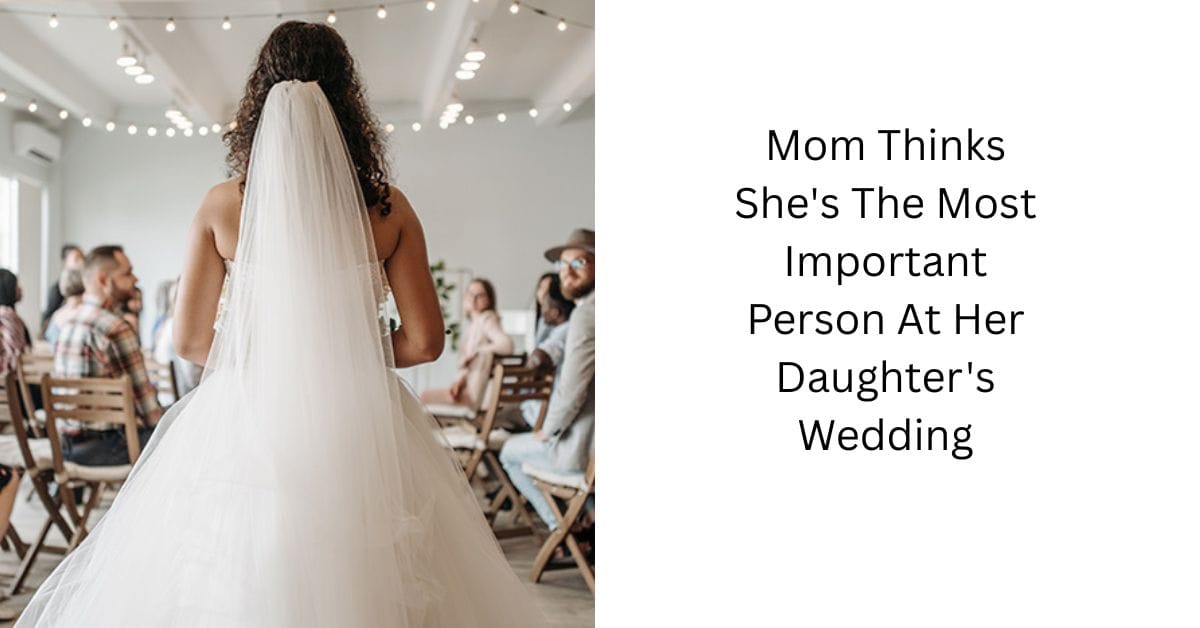
Mom Thinks She’s The Most Important Person At Her Daughter’s Wedding
For as long as Emily could remember, her mother had always enjoyed being the center of attention. Whether it was family birthdays, holiday gatherings, or school celebrations, she had a way of turning almost every occasion into something that revolved around her. As Emily grew older, she learned to avoid unnecessary arguments by quietly compromising whenever her mother insisted on having things her way. When Emily became engaged to her longtime partner, Ryan, she promised herself that her wedding would be different. She wanted a day focused on celebrating their love, surrounded by family and close friends, without unnecessary drama. At first, her mother appeared genuinely supportive, eagerly offering to help with planning and promising to make the experience as stress-free as possible. Emily accepted the offer with gratitude, believing that working together might even strengthen their relationship. Unfortunately, it didn’t take long before those good intentions began turning into demands that left Emily questioning whether the wedding was becoming more about her mother’s wishes than her own.
Every Wedding Decision Became an Argument
The first disagreements seemed relatively minor. Emily chose a simple outdoor venue with elegant decorations because she wanted an intimate ceremony, but her mother insisted the location wasn’t impressive enough for guests. She criticized the color palette, suggested replacing the flowers with more expensive arrangements, and even questioned Emily’s choice of wedding dress, claiming it wasn’t glamorous enough for such an important occasion. Whenever Emily explained that she and Ryan were paying for the wedding themselves and wanted to stay within their budget, her mother dismissed those concerns, arguing that weddings only happen once and should spare no expense. Planning meetings that were supposed to be exciting gradually became exhausting. Vendors often looked uncomfortably between mother and daughter as disagreements unfolded over nearly every decision, from invitations and seating arrangements to the style of the wedding cake. Emily found herself spending more time defending her own choices than actually enjoying the process of preparing for one of the happiest days of her life.
Advertisement
As the wedding day approached, her mother’s behavior became even more controlling. Without asking permission, she contacted several vendors directly to suggest changes Emily had already rejected. She attempted to rearrange the guest list so more of her own friends could attend, despite the venue having limited seating. During the rehearsal dinner, she repeatedly interrupted conversations to tell guests how much work she had personally put into making the wedding happen, giving the impression that the celebration was largely her accomplishment. Ryan quietly noticed Emily becoming increasingly overwhelmed and reminded her that the wedding was about the commitment they were making to each other—not about pleasing everyone else. Even so, Emily hoped her mother would relax once the ceremony finally began. She wanted to believe the excitement of the day would encourage everyone to focus on celebrating rather than competing for attention.
The Bride Wasn’t the Center of Attention
Instead, the ceremony itself nearly became overshadowed by another unexpected moment. Just before Emily was scheduled to walk down the aisle, her mother complained loudly that photographers weren’t taking enough pictures of her getting ready. During the reception, she repeatedly interrupted conversations to tell guests stories about raising Emily, often making herself the main character instead of celebrating the newlyweds. At one point, she even approached the master of ceremonies asking for extra time to deliver another speech because she felt the first one hadn’t fully expressed her importance in Emily’s life. Several guests exchanged confused glances as the focus drifted away from the bride and groom. Emily remained polite throughout the evening, but inside she felt disappointed that the joyful atmosphere she had envisioned was constantly being interrupted by someone else’s need for recognition.
Advertisement
Later that evening, after most guests had begun dancing, Emily quietly asked her mother if they could speak privately. Rather than arguing, she calmly explained how hurt she felt watching important moments of the wedding repeatedly shift away from the celebration of her marriage. She thanked her mother for the support she had provided during the planning process but gently reminded her that the wedding belonged to Emily and Ryan, not anyone else. At first, her mother became defensive, insisting she had only been trying to make the day special. However, after hearing several examples and realizing how emotional Emily had become, she slowly understood how her actions had affected the celebration. It wasn’t an easy conversation, but it was one of the most honest discussions they had ever shared.
In the weeks after the wedding, both women reflected on everything that had happened. Emily realized that setting respectful boundaries was essential, even with close family members, while her mother admitted she had allowed her desire to feel important to overshadow her daughter’s happiness. Their relationship gradually improved because they finally began communicating more openly instead of avoiding difficult conversations. Looking back, Emily remembered her wedding not for the moments of tension but for the love she shared with Ryan and the friends and family who genuinely celebrated their new beginning. The experience became a valuable reminder that weddings are meant to honor the couple starting their life together. No matter how excited relatives may be, the happiest celebrations happen when everyone supports the bride and groom instead of competing to be the center of attention.
My Mother Ruined My Wedding and We Haven’t Spoken Since
I want to share what happened at my wedding in September 2024. It’s something I have been processing ever since and feel like I am continually being gaslit that I’m overreacting.
This is what the timeline of my wedding was supposed to be:
– Reception begins with grand entrance and transitions directly into bride and groom’s first dance
– After first dance folks find their seats, speeches begin
– Once speeches are over, dinner begins
– Parents Dances (Father/Daughter and Mother/Son)
– Cake cutting and opening of dance floor
The day started beautifully. The grand entrance went smoothly, the first dance happened, and we were both nervous but proud of how it went. The speeches followed, some funny, some emotional, some a mix of both. I cried through most of them. It was exactly what you hope that part of the day feels like.
Then it was time for dinner.
I had barely eaten all day. One of my only real priorities going into the reception was to sit down, eat, and get to greet our guests. My husband and I had just started making the rounds when my mother approached our table and told me the music was boring, that it was too slow and folky, and that people wanted to dance. I acknowledged it and moved on. Or tried to.
What I didn’t know at the time was that my mother had also gone up to one of my bridesmaids and told her to go tell the DJ to “stop playing so much fucking slow folk music.” My bridesmaid came and found me instead, and took me outside with another friend to decompress.
My mother followed us outside. She told me that everyone was complaining, that no one was having fun, that people were bored. She implied I wasn’t moving through the timeline fast enough, the cake, the dances, opening the dance floor. I told her, clearly and calmly, that I was trying to eat dinner and say hello to our guests. Her response was that she was just telling me what people were saying. She was eventually brought back inside by other guests who recognized what was happening.
What I found out later was that while I was outside, my mother had opened the dance floor herself, without us, and confused guests had started to join her. I don’t care if people dance or not, it was more that we were going to have the parent dances before opening up the dance floor. Two of my friends physically blocked the dance floor to hold the space until my husband and I could re-enter on our own terms. The DJ staff were shaken. They told my friends she had said she “paid for this motherfucker.” While, yes, she did help pay for a portion of the wedding, my husband and I also contributed significantly as well as his parents.
I made the decision to cut the cake privately, without announcement, and to do the scheduled dances just to get through them. I didn’t want to be there anymore. I did them anyway.
Later in the evening, as my husband and I were walking together, my mother intercepted us and asked to speak with me privately outside. My bridesmaid tried to follow as a buffer and had a hand held up at her. Outside, my mother told me that I had been disrespectful, that I had talked down to people, that guests were outside getting high because they were so bored, that the music was my fault, and that she had paid a significant amount of money for this wedding.
None of it was true. My friends confirmed that. The guests were having a good time. No one was complaining. It was just her.
After that, my friends formed a quiet wall and didn’t let her near me again for the rest of the night. My mother and father left early. My friends and I went to the bathroom, came back out, and danced.
I asked my parents for space for my husband and I to process everything that had happened. It was a few months later that I received an email from them placing the blame entirely on me. It read very much as a prosecution rather than a reconciliation, key points can be found here:
- every incident was retold from my mom’s point of view with her actions justified and mine condemned
- argues that my mom’s traumatic history is used as an argument rather than shared vulnerability
- states my parents can live without me (they adopted me, and I already have trauma over my adoption)
- adds conditional love at the end “Our door is always open..and you will have to work very hard at earning back our respect”
A lot of blame was placed on me in the email, and not at all to say I am blameless, but it feels like a lot of pointing fingers:
- “You showed zero respect and love”
- “You can twist this any way you want. The bottom line is that you don’t love or respect your mom. And this is all on you!”
- “You outdid yourself this time.”
- “You have not only caused us pain, but pain to many others who love us. You should be ashamed”
- “Do you think for a second that you are on equal ground with us, because you are not.”
All this to say, I can get over what happened at my wedding, it’s the behavior and email that followed the wedding that sealed it for me to go no contact.
Thanks for listening to my rant.
The Memories Weren’t as Perfect as They Seemed
The morning after the wedding, Emily expected to feel nothing but happiness as she looked through the first photos shared by friends and relatives. Instead, she found herself experiencing mixed emotions. While many pictures beautifully captured her and Ryan exchanging vows, laughing with loved ones, and celebrating their first dance, she also noticed how many moments had been interrupted by her mother’s attempts to remain at the center of attention. In several photographs, her mother had positioned herself directly beside the couple even when the photographer had clearly been trying to capture intimate moments between the bride and groom. Other pictures showed her waving photographers over or directing guests to stand where she preferred instead of following the wedding coordinator’s instructions. Emily wasn’t angry because of the photographs themselves. What hurt was realizing how often the focus had shifted away from the marriage she and Ryan had spent months planning. Looking through the album should have reminded her only of joy, yet it also highlighted how difficult it had been to fully enjoy such an important day while constantly managing someone else’s expectations.
Advertisement
A few days later, Ryan gently encouraged Emily to talk openly about everything that had been bothering her since the wedding. He reminded her that avoiding difficult conversations had never improved their relationship with her mother in the past. After thinking carefully, Emily invited her mother to lunch at a quiet café where they could speak privately without distractions. Rather than accusing her of ruining the wedding, Emily calmly explained how each interruption had made her feel. She described the planning process, the constant disagreements, and the disappointment of watching meaningful moments become overshadowed by unnecessary attention-seeking. At first, her mother defended herself by insisting she had only wanted the wedding to be perfect and believed her experience as a parent gave her the right to be heavily involved. However, as Emily continued sharing specific examples without raising her voice, her mother’s expression gradually changed. For perhaps the first time, she began seeing the wedding not through her own perspective, but through her daughter’s eyes. The conversation became emotional for both of them, yet it also opened the door to a level of honesty they had rarely shared before.
Emily’s mother remained quiet for several moments before finally admitting that she had never intended to hurt her daughter. She explained that ever since Emily announced her engagement, she had become overwhelmed with emotions. Watching her only daughter prepare to start a new chapter of life made her feel proud, excited, and unexpectedly anxious. Instead of expressing those feelings honestly, she had thrown herself into every wedding decision, convincing herself that being deeply involved would help her cope with the changes ahead. Somewhere along the way, however, helping had gradually turned into controlling. She realized she had spent so much energy trying to create what she believed was the perfect wedding that she had forgotten whose wedding it actually was. Hearing those words didn’t erase Emily’s disappointment, but it helped her understand that her mother’s behavior came from misplaced emotions rather than intentional cruelty.
Although the conversation became more understanding, Emily decided it was time to establish healthier boundaries for the future. She gently explained that she wanted her mother to remain an important part of her life, but that major decisions in her marriage would ultimately belong to her and Ryan. Her mother listened carefully before nodding in agreement. For years, Emily had avoided difficult conversations because she feared hurting her mother’s feelings. Looking back, she realized that staying silent had allowed small frustrations to grow into larger conflicts. Ryan later told Emily how proud he was of the calm, respectful way she handled the discussion. Instead of turning it into another argument, she had focused on honesty, understanding, and finding a better path forward for everyone involved.
Over the following months, their relationship slowly began to improve. Emily noticed small but meaningful changes in her mother’s behavior. During family gatherings, she became more willing to listen instead of directing every conversation. When Emily and Ryan decorated their new home, her mother offered suggestions only after being asked, rather than insisting her own preferences were the only correct choice. Those changes didn’t happen overnight, but each small effort demonstrated a genuine desire to respect the boundaries they had discussed. Emily also made an effort to include her mother in meaningful moments, showing that setting boundaries didn’t mean pushing family away. Instead, it allowed everyone to enjoy one another’s company without constant tension or competition.
Several months later, the family gathered once again for Emily’s birthday celebration. This time, relatives immediately noticed a different atmosphere. Her mother happily greeted guests, enjoyed conversations, and participated in the celebration without trying to become the center of attention. Instead of making long speeches or directing every activity, she quietly helped serve food, laughed with relatives, and encouraged everyone to celebrate Emily. At one point, Ryan smiled as he watched his mother-in-law proudly step aside so the photographer could capture a picture of the birthday girl surrounded by friends. It was a small moment, but it symbolized how much progress had been made since the wedding.
Looking back at the wedding photographs several months later, Emily found herself focusing less on the awkward moments and more on the love that surrounded the day. She remembered Ryan’s smile as she walked down the aisle, the excitement of celebrating with family and friends, and the promises they made to one another during the ceremony. The difficult memories no longer carried the same weight because she had finally expressed feelings she had been holding inside for years. More importantly, she realized that relationships become stronger when people are willing to communicate honestly instead of allowing resentment to quietly grow.
Emily’s mother also admitted to close friends that the wedding had taught her an important lesson. She realized that loving someone doesn’t mean controlling every important moment in their life. Sometimes the greatest act of love is stepping back and allowing those you care about to create their own memories, even if they make different choices than you would have made yourself. She came to understand that parents remain important long after their children become adults, but their role changes from making decisions to offering encouragement and support. Accepting that change wasn’t easy, yet it ultimately brought her closer to her daughter than constant control ever could.
Years later, whenever Emily and Ryan celebrated their wedding anniversary, they rarely talked about the disagreements that had surrounded the planning process. Instead, they remembered the happiness of beginning their life together and the valuable lesson the experience had taught their entire family. Healthy relationships are built not only on love but also on respect, communication, and the willingness to recognize when personal emotions begin overshadowing someone else’s special moment. Emily’s wedding became more than just a celebration of marriage—it became the turning point that helped her family develop healthier boundaries and deeper understanding. In the end, everyone realized that the most meaningful role a parent can play on a child’s wedding day is not to be the center of attention, but to proudly stand beside them as they begin a new chapter of life.