17YO Traumatized With Dad’s Reaction To Her Illness, Ends Up Keeping It A Secret But Drama Ensues
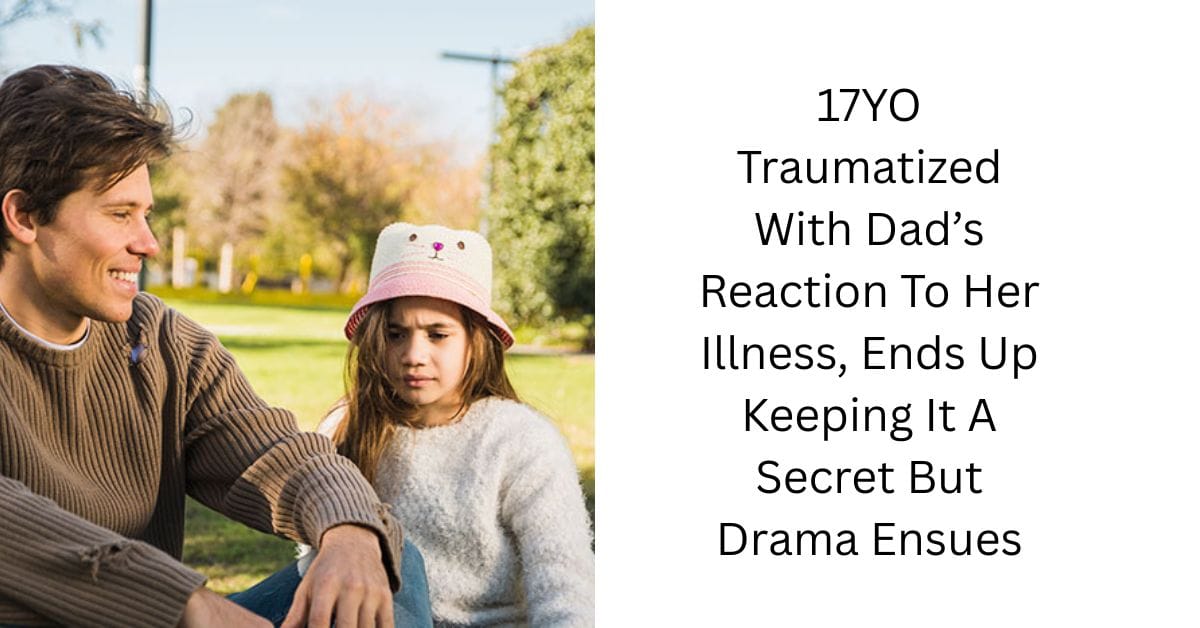
At 17 years old, Emma was already dealing with the difficult challenges that come with growing up, but nothing prepared her for how her father would react when she became seriously concerned about her health. Like many teenagers, she hoped that her family would be the first place where she could find comfort and support during difficult times. Instead, after seeing her father’s reaction to her illness, Emma became afraid of being honest about what she was experiencing. The fear of being judged or misunderstood led her to hide her struggles, creating a situation that eventually caused even more tension within the family.
Emma had always shared a close relationship with her family, especially her father, and she believed she could depend on him when things became difficult. However, when she started noticing changes in her health, she hesitated to talk about them. She worried that her father would become angry, disappointed, or blame her for something she could not fully control. After finally opening up about her condition, his response was not what she expected, and the emotional impact stayed with her long after the conversation ended.
Feeling hurt and unsupported, Emma decided to keep her health struggles private. She convinced herself that hiding the problem would prevent more arguments and protect her relationship with her father. However, keeping such an important part of her life a secret became increasingly difficult. She had to deal with doctor visits, personal fears, and emotional stress without fully explaining what was happening to the people closest to her.
As time passed, Emma’s family began noticing that something was different. Her behavior changed, and they started asking questions about why she seemed distant and why she avoided certain conversations. The secrecy created misunderstandings, and instead of solving the problem, it caused more conflict. Eventually, the truth began to come out, leading to emotional conversations that forced everyone to face the situation they had been avoiding.
When Emma finally explained why she had hidden her illness, her family realized that their reaction had played a major role in making her feel unsafe. Her father began to understand that his words and actions had affected her more deeply than he had realized. Although repairing their relationship would take time, the conversation allowed them to begin rebuilding trust and learning how to communicate with more compassion.

Advertisement
Read Story…
I [17F] have Celiac Disease, my new friend group [16-22F/M] thinks I’m anorexic and plan on having an intervention
My parents divorced when I was very young. My mom got me for most of the year, and my dad got me for the Summer.
I hated going to my dad’s house. Partially because he was very stubborn and rude and always had to do things his way, but also because every time I went to my dad’s house I got violently sick. Nausea, rashes, pain, muscle cramps, and then when I got older, I’d start missing my periods. (TMI?) I went to a doctor, but he said it was a psychosomatic problem related to stress and directed me to see a therapist. My dad didn’t let me see a therapist because he thought it was total crap. My mom took me to one a few times, but by then my symptoms had cleared up so we couldn’t tell if it helped at all.
One thing that really pissed me off was that my dad ate a lot of junk food and drank soda instead of water, and he mocked me mercilessly if I tried to eat healthy. I think it reminded him of my mom, because she’s always been a bit of a health nut. I would sneak carrots into the house, and if he found them he’d throw them out. At my mom’s house, I’d eat vegetables and organic chicken. Sometimes a food would make me feel sick, but I’d just stop eating that food and it was fine. I got into the habit of turning down any food offered to me because I didn’t know if it was safe. I just explained it away as being a picky eater.
And then, when I was 16, a new girl moved to my school. I became friends with her, and after a couple months I noticed that she avoided all the same foods as me. I mentioned it in passing like “hey isn’t that weird?” and she got concerned and told me that she had Celiac Disease and I should get myself checked. I got checked, and sure enough, I had it. Everything suddenly made sense.
I was so excited to finally understand what was wrong that I told everybody I knew. I told all of the people who I thought were my friends. And they…didn’t really react well. They acted fine at first, but I noticed that they were all doing the “slow fade” on me. I confronted my closest friend about it and she said that they all thought I was faking it for attention. They’d only heard about gluten free diets as a stupid fad. I broke down crying and told her all about how horrible I felt when I had to go to my dad’s house and how I couldn’t believe that she didn’t believe me, and she was horrified. She turned around and became my biggest supporter. She talked to the others, but they still thought I was full of shit and feeding her lies, so we decided it was best to break it off with them.
My birthday is in August, so I had two more Summers with my dad left to go through after I found out. He took the revelation about my disease even worse than my ex-friends. He would scream that I thought I was better than him and I was making up medical problems because I wanted to be special and that he wouldn’t put up with that shit. I offered to take him with me to the doctor but he said that doctors are scam artists and he didn’t believe anything they said. It was horrible. It got to the point where he started sabotaging my food and cursing at me when I got sick.
So, I’ve gotten pretty wary about telling people about the disease. Between my personal experiences and hearing people make fun of gluten-free food on TV and the internet, I’ve decided I’m not comfortable with telling new people. I know that’s cowardly, but I’m so afraid of what people will think of me.
This is my last Summer with my dad, and it’s the last Summer with my dad. He can rot in Hell for all I care, he treats me like shit. I’ve only got to tough it out for another few weeks, that’s not my problem. I can already hear your advice about leaving my dad’s house or calling CPS and respectfully, I’ve made my decision that it’s easier just to stay for the next three weeks and then leave forever. Please don’t focus on that part.
This is the problem I need help with:
My best friend and I have made a new group of friends. They’re great people, really fun. We play roleplaying games every weekend. We’ve been hanging out since May. There’s ten or eleven of them depending on whether you count this guy who doesn’t regularly attend games.
My best friend approached me yesterday and told me that the rest of the group has been talking behind my back. They’ve put together the fact that I constantly turn down food and that I’m very picky about what I eat and that I’ve been getting thinner and acting sick (because I’ve been living with my dad) and come to the conclusion that I have anorexia. They’re planning on staging an intervention for me next weekend.
Guys, I don’t know what to do. This is such an awkward situation. I know I should tell them but I’m so scared they’re going to reject me. They’ve already got this idea in their heads about what’s wrong, at this point I’m afraid they’ll think I’m just making excuses. And I’ve been burned before. I lost a ton of friends by telling them about my disease. Yeah, they were dicks, but it fucking hurt. How do I do this? How do I explain it so they’ll believe me? I can’t handle any more people calling me a liar, I’ll have a mental breakdown. This disease has ruined my life in so many ways, I just wanted to have this one part of my life separate from that. Please, reddit, give me advice.
TLDR: I can’t eat gluten, that means I have to turn down food a lot and I’m in a situation where it’s forced on me so I’m sick and losing weight. The last friends I told accused me of lying and broke it off with me, so I haven’t told my new friends. They got the wrong idea and now think I’m anorexic. They’re going to hold an intervention next weekend and I have no idea what to say.
Update July 26, 2015 (6 days later)
Hey guys. Thanks for all your help. The “intervention” was yesterday and I figured you guys would want to know how everything went.
TLDR: It went well.
A few hours before game started, one of my friends (let’s call him Zach) texted me asking to come to his house (he hosts the games) early because he wanted to discuss [gaming terms that will be nonsense to most of you]. I figured this was probably the intervention and texted my best friend (I think there was some confusion in the last post, this is the friend who was with my other friend group who I poured my heart out to then she followed me to the new group. Let’s call her Laura.) to ask if she’d been invited too. She hadn’t, so I asked her to come with me.
Before I went to his house, I did something a little cheeky inspired by one of the comments on the last post (thanks u/idhavetocharge). I went and picked up some gluten-free chinese food from a place I frequent. They have this amazing vegetable fried rice that I’ve fallen in love with. They’re really careful about cross contamination, I’ve been eating there for years and never gotten sick. I brought the food with me to Zach’s house, along with Laura and my notebooks and dice for roleplaying.
Zach seemed really taken aback that Laura was there. I asked him if he had a problem with it, because if we were going to talk about [complicated gaming things] then she should be part of the conversation because of [qualifications] (ugh I’m really sorry, I’m trying not to drop a crapton of gaming jargon on y’all). He awkwardly said that it was fine. Then I said something like, “Is it alright if I eat something while we do this? I missed lunch and I’m really hungry.” And pulled out the chinese food. He said it was fine but seemed kind of alarmed, like I was freaking him out.
I started eating and he started his pitch. “u/helphelpceliac, I didn’t actually call you here to talk about [game crap]. Me and some of the others have noticed some things recently that we’re concerned about and they elected me to talk to you about it.”
I said, “Okay…”
He listed off a bunch of things that I’ve been doing that made them worry about me. The way they never saw me eat anything, that I always seemed sick and was getting thinner, the fact that I always seemed uncomfortable and nervous when the topic of food came up, that I turned down everything offered to me, and then he finally dropped the bombshell. “u/helphelpceliac, Michael’s older sister is anorexic, and she acts a lot like you do. We think you might be anorexic.”
I swallowed my food and tried not to look nervous. “I’m not.” I told him.
He started talking about how nobody thinks they’re anorexic but there’s clearly something going on with me and he started just rambling so I cut him off.
“I do have a problem. It’s not anorexia. Can I talk?”
He reluctantly agreed. I think he was afraid I was going to say that I was too fat and my problem was that I needed to lose weight or something. Like, he really got committed to the idea that I was anorexic.
I’m going to try to paraphrase what I said here because I was very proud of myself for it. “I know I’m losing weight in an unhealthy way, but it’s not on purpose. I have a disease that means I can’t eat grains like wheat, barley, and rye. When I do, I get very sick and my body starts ripping up my stomach and I can’t digest much of anything, even things that don’t have those grains in them. It’s not just an allergy, it does serious long-term damage to me. If I ate a piece of bread, I would break out in rashes, I’d start throwing up, and I might get stuff that seems unrelated like horrible muscle cramps. When I turn down food, it’s because you guys offer me stuff like Doritos and PB&Js. If I ate that stuff, it would make me violently ill. I turn it down to keep from making my health problems even worse. And the reason my symptoms have been popping up and I’ve been getting sick and losing weight is that right now I’m living in a family situation where I’m forced to eat the foods that my body reacts badly to. When I first met you guys I was living with my mom, and she accommodated me really well. But right now I’m living with my dad, and he sabotages my food because he thinks I’m making my disease up and that my doctor is a fraud.”
Zach took out actual notecards and looked through them. He literally had a script for the intervention. That’s what I get for hanging out with the kind of dramatic people who play tabletop RPG’s, I guess. He was quiet for a really long time. Then he had a few questions.
- “But then why do you turn down, like, Coke?”
“Because Coke is nasty but I didn’t want to complain and make you guys buy root beer just for me.”
2. “Why didn’t you just tell us this stuff?”
Laura took this one and explained what happened with our last friend group.
3. “Okay, so like what would I probably have in the house right now that you’d be willing to eat in front of me?”
I wanted to facepalm at this one. I asked if he was serious. He was.
“I don’t know, have you got celery?”
He shook his head.
“Yogurt?”
Nope.
“An apple?”
Nope.
“Seriously?”
He nodded.
“Have you got some freaking popcorn? Like, air-popped popcorn?”
That he did have. So I ate some popcorn in front of him, and he finally seemed to accept what I was saying. He awkwardly changed the subject to gaming things and we talked about that until the rest of the group started to show up.
When Michael got there, Zach took him aside and started talking to him in a way that I guess they thought was subtle? They kept looking over at me and they weren’t keeping their voices down very well. Michael asked if I seemed defensive and Zach shrugged and said not really. I pointedly ate popcorn for the rest of the game. Michael texted me after the game and apologized for assuming that I was anorexic and asked what snacks they could put out for me. I actually cried a little bit. I was worried about getting kicked out but they immediately moved to accommodating me. They’re nice people.
So everything worked out fine. Sorry for the anticlimax. 😛
Actual TLDR: I convinced them that I’m not anorexic and it seems like they’re accepting me. Thanks for your help!
A 17-Year-Old’s Silent Battle Begins
At just 17 years old, Emma believed that no matter what happened, her family would always be her biggest source of comfort. Like many teenagers, she trusted her parents to support her through life’s challenges. However, when she began experiencing unusual health problems, she quickly realized that asking for help would not be as easy as she had imagined. What started as concern about her illness soon turned into emotional pain after her father’s unexpected reaction left her feeling hurt, misunderstood, and completely alone.

Advertisement
Emma had always been a responsible student who balanced school, friendships, and family responsibilities. She rarely complained and preferred solving problems on her own. When she started noticing changes in her physical health, she initially assumed they were temporary. But as the symptoms became more frequent, she realized she needed medical advice. Even then, she hesitated to tell her parents because she feared they might not take her concerns seriously.
After gathering enough courage, Emma finally explained everything to her father. Instead of receiving comfort and reassurance, she was met with frustration and disbelief. He questioned whether she was exaggerating her symptoms and suggested that stress or attention-seeking might be the real cause. His response shocked Emma, who had expected understanding rather than criticism. The conversation left her emotionally devastated and afraid to discuss her health again.
The emotional impact of that conversation stayed with Emma for weeks. She replayed every word in her mind, wondering if she had done something wrong. Rather than reaching out for more support, she convinced herself that remaining silent would be easier than facing another painful discussion. She decided to keep her illness a secret, hoping the problem would eventually disappear on its own.
Keeping such an important secret became increasingly difficult. Emma attended school while silently managing her symptoms, pretending everything was normal even when she felt exhausted. She avoided discussing her health with friends and family because she worried someone might mention it to her father. Carrying the emotional burden alone made every day feel more stressful than the last.
As time passed, Emma’s behavior began to change. She became quieter during family dinners, spent more time alone in her room, and stopped participating in activities she once enjoyed. Her family noticed the difference but assumed she was simply going through a typical teenage phase. No one realized that she was hiding both physical pain and emotional trauma behind her silence.
Eventually, another family member noticed that Emma was struggling more than she admitted. After gently asking how she was feeling, they encouraged her to speak honestly about what had happened. For the first time since the argument with her father, Emma shared how deeply his reaction had affected her and why she no longer felt safe talking about her illness.
The truth slowly reached the rest of the family, leading to several emotional conversations. Emma’s father was surprised to learn that his response had caused so much damage. He admitted that he had reacted too quickly without fully understanding what his daughter was experiencing. While he had believed he was encouraging her to stay positive, he now realized his words had made her feel isolated instead.
Recognizing the seriousness of the situation, the family focused on helping Emma receive the care she needed. Medical appointments were arranged, and everyone made a greater effort to listen without interrupting or making assumptions. Although trust had been damaged, Emma appreciated that her concerns were finally being taken seriously.
Rebuilding the relationship between Emma and her father was not an overnight process. Honest conversations replaced arguments, and both of them slowly learned how important communication and empathy were during difficult times. Emma explained that what she had needed most was reassurance, not judgment, while her father acknowledged that he should have listened before reacting.Emma’s experience highlighted an important lesson for many families. Young people often hesitate to discuss health concerns because they fear being dismissed or misunderstood. When those fears become reality, they may choose silence instead of seeking the help they truly need. A supportive response can encourage honesty, while a negative one may create lasting emotional consequences.
Over time, Emma regained confidence in speaking openly about her health and emotions. She realized that hiding serious problems only increased the pressure she felt. Her family also became more aware of the importance of listening carefully and creating an environment where everyone felt safe discussing personal struggles without fear of criticism.In the end, Emma’s story became more than just a family disagreement about an illness. It was a reminder that compassion, patience, and understanding are essential when someone is facing a difficult situation. Parents may not always have the perfect response, but taking the time to listen with empathy can make all the difference. By choosing honest communication over assumptions, families can build stronger relationships and face life’s challenges together.