GF Says No To Driving Home Two Drunk Women Who Insulted Her, BF Thinks She’s Mean
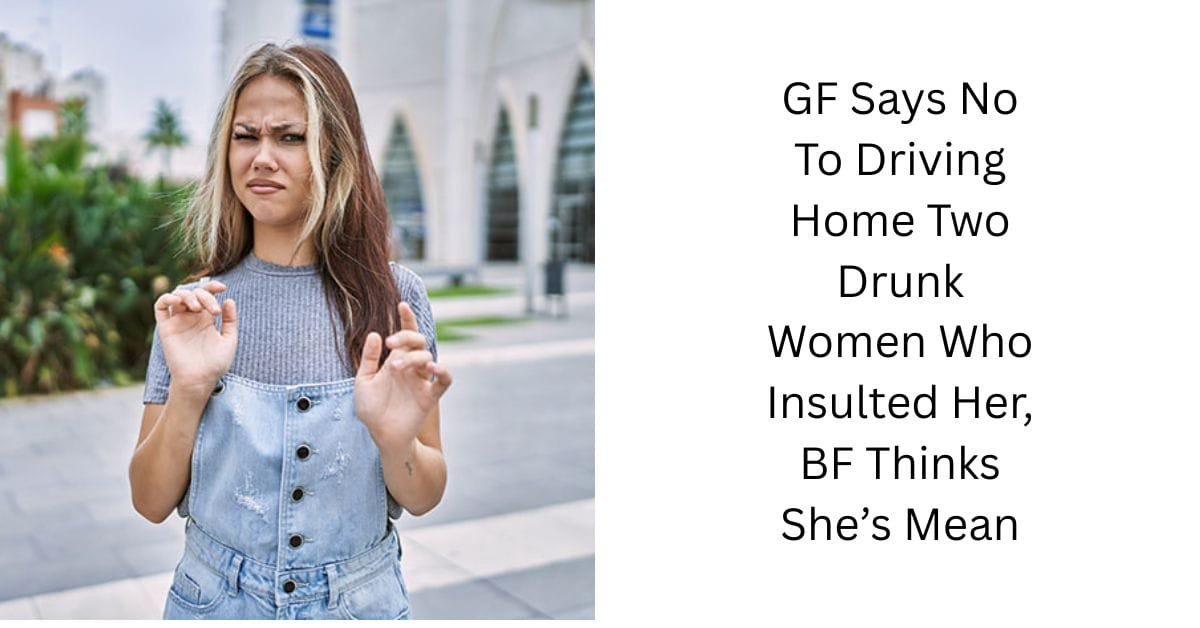
When this young woman agreed to spend the evening with her boyfriend and some of his friends, she expected the night to be relaxed and enjoyable. She had no problem being around people who were drinking, even though she personally preferred to remain sober. She understood that adults sometimes wanted to go out, have a few drinks, laugh, and enjoy themselves. However, things became uncomfortable when two women in the group began making rude comments toward her. At first, she tried to ignore them because she did not want to create unnecessary drama or ruin the evening for everyone else. She assumed their behavior might have been influenced by the alcohol and that eventually they would stop. Unfortunately, the comments continued, becoming increasingly personal and disrespectful. She felt embarrassed and uncomfortable, especially because her boyfriend was there and seemed to expect her to simply tolerate the situation. Rather than arguing with them or turning the night into a confrontation, she kept her distance and tried to stay calm. What she did not expect was that, later that night, those same women would need a ride home and that her boyfriend would assume she would be willing to drive them.
As the evening came to an end, the two women were clearly drunk and were no longer in a condition to drive themselves home safely. The boyfriend apparently believed that his girlfriend should simply take them home because she was sober and had access to a car. From his perspective, it may have seemed like a simple favor that would prevent the women from driving while intoxicated. However, from her perspective, the situation was completely different. These were not close friends who had accidentally had too much to drink. They were the same two people who had spent part of the evening insulting and disrespecting her. She did not feel comfortable getting into a car with them, especially while they were intoxicated and potentially unpredictable. When she politely refused to drive them, her boyfriend apparently became frustrated and accused her of being mean. He seemed to focus entirely on the fact that the women needed transportation while ignoring the way they had treated her earlier. She understood that drunk driving was dangerous, but she also believed that helping someone did not automatically mean she had to put herself in an uncomfortable situation, particularly after being deliberately insulted by those same people.
The disagreement quickly became more than just a question about transportation. For the girlfriend, the bigger issue was that her boyfriend seemed to expect her to help people who had shown her no basic respect. She wondered why her feelings were suddenly irrelevant simply because the women were drunk. She also questioned whether her boyfriend would have reacted the same way if the situation were reversed. If someone had spent the evening insulting him and then demanded that she drive them home, would he really expect him to forget everything that had happened simply because they needed a favor? She felt that there was a difference between refusing to help someone out of spite and establishing a reasonable boundary after being mistreated. She was not suggesting that the women should drive themselves home. She simply did not believe that she personally had to be the one responsible for getting them home. There were other possibilities, such as calling a taxi, using a rideshare service, contacting another sober person, or asking someone else to arrange transportation. Her refusal was therefore not about wanting them to be unsafe. It was about refusing to personally take responsibility for people who had treated her badly and then expecting her to rescue them when they needed help.
What bothered her even more was her boyfriend’s reaction. Instead of acknowledging that his girlfriend had been insulted and asking whether she was comfortable driving them, he apparently labeled her behavior as mean. That made her question how much support she could expect from him in situations where his friends or acquaintances crossed a line. Relationships often involve helping each other, but they also require partners to recognize when one person has been treated unfairly. She did not expect her boyfriend to start a fight with the women or embarrass them in front of everyone. She simply wanted him to understand why she did not want to spend additional time with them after their disrespectful behavior. His insistence that she should still help them made her feel as though keeping the peace with his friends mattered more to him than respecting her feelings. At the same time, she recognized that the women being drunk created a legitimate safety concern, which is why she did not want them driving themselves. But she believed the responsibility for solving that problem belonged to the group as a whole, not automatically to the one sober woman they had spent the night insulting.
Ultimately, the situation left the girlfriend wondering whether she had actually done something wrong or whether her boyfriend was being unfair by expecting her to put her own boundaries aside. Some people might argue that once alcohol is involved, safety should come first and anyone who is sober should help prevent drunk people from getting behind the wheel. Others would point out that refusing to provide a ride does not mean someone wants drunk people to drive, especially when safer alternatives are available. The heart of the conflict seems to be less about the car ride itself and more about respect, boundaries, and whether partners should stand up for each other. She was willing to accept that the women needed help, but she did not believe their need erased the way they had treated her earlier. Her boyfriend, meanwhile, appeared to see her refusal as unnecessarily harsh rather than as a reasonable response to being insulted. Now she is left wondering whether she should have put her feelings aside and driven them home anyway for the sake of safety, or whether refusing was completely justified given everything that had happened earlier that night.
Read Story…
AITA for dropping off two drunk, rude girls at the bus stop instead of driving them home? + NEW UPDATE
Originally posted by u/ThrowRa-ne9in in r/AmItheAsshole.
The original post and first update were compiled in a previous BORU by u/qwerty98765432101 found here.
ORIGINAL: AITA for dropping off two drunk, rude girls at the bus stop instead of driving them home? : AmItheAsshole (reddit.com) – 27th June 2022.
My boyfriend’s best friend’s girlfriend is always really rude to me. She wanted to hook up my boyfriend with one of her friends, so when I arrived into the picture she decided she hates my guts for ‘ruining her friend’s chance for a great relationship’. I was still trying to be nice if we had to hang out because of our boyfriends, but I preffered to avoid her, since she would always make a point to talk shit about my appearance/personality/fashion sense/work/etc.
My boyfriend and his friend went to a festival together, I was supposed to pick them up after, because they were drinking. I arrived at the parking lot at 3AM to see my boyfriend, his friend, his friend’s girlfriend and her friend – yes, the one she wanted to hook up with my boyfriend. I was surprised, but before I could ask about it they get into a car. Few minutes pass until the girlfriend’s friend asked if I’m “the b-word that stole her loooooove”, which spiralled into them going into a rant about everything that is wrong with me in their eyes, including how my boyfriend could do better. I told them that they are quite brave, considering the state they are in (completely wasted), since I’m driving them home and I can decide to just drop them off if they continue. They dared me to do so. So I did.
Pulled up to the nearest bus stop, told them to get out. They thought I was joking until they saw me turning off the engine. In the end my boyfriend got annoyed, since he wasn’t feeling well and wanted to go home, so he screamed at them to get out or he will drag them out of my car himself. His best friend tried to protest, but my boyfriend in his drunk state told him that it’s my car, so he’s not one to decide & if he has a problem then he wait for the bus with his girl and her friend or take an uber.
My boyfriend, after waking up sober and remembering what happened, called me an asshole for kicking out two drunk girls out of my car in the middle of the night. I reminded him that his friend stayed with them, but it only angered him more for some reason. I was told that the girls were drunk, so I shouldn’t take to heart what they were saying and that by dropping them off at the bus stop I’ve put them in unnecessary danger. He is going on about it for the past few hours, to the point when I don’t know if I really did the bad thing and should apologize.
Judgement: NTA
FIRST UPDATE: AITA for dropping off two drunk, rude girls at the bus stop instead of driving them home? UPDATE : ThrowRa-ne9in (reddit.com) – 1st July 2022.
AITA mods don’t let me post an update, so I’m just going to write it here. Maybe people who saw my original post will somehow find it.
Well, I have an update, but first I want to answer some of the questions that were asked A LOT. At first I wanted to respond to each and every comment, but before I realized my og post blew up, so I decided to adress everything here.
Did you know your bf went on a double date? No, it was supposed to be him & his best friend… which I have my doubts about, because the festival was ticketed & the tickets were sold out in a matter of days. I’m sure at least her boyfriend knew she was going.
Was the bus stop in the middle of nowhere? No, it was in a city center, near the festival site and there were many other festival goers waiting.
Were the buses still running? Yes, our city is hosting this festival for years now and they are always taking care of festival-goers – there are additional night buses, trams and even trains lines.
What if someone shot my bf’s bestfriend? I’m really sorry for what’s happening in the USA, but we’re living in Poland, Europe.
Now to the update, I know why my boyfriend was so adamant about me apologizing. Apparently his bestfriend’s girlfriend (& her friend) decided that I need to be „taught a lesson”. I’m not really sure what they were planning to do, but they decided to scare me somehow, as a form of revenge. My boyfriend decided it would be a great idea for me to apologize, so that they would calm down… instead of, you know, telling me.
When asked why he would withold this information from me, he said that he didn’t want drama (as if there’s not enough drama already with this psycho). He told me all of this because his bestfriend broke up with her in the end over her craziness. So my boyfriend deemed it appropriate to tell me I no longer have to apologize, lol. I contacted his bestfriend asking if he would be willing to tell what he knows about his ex & her plans to authorities, if she would ever come through with her plan to „teach me a lesson” and he agreed. My boyfriend on the other hand was furious I contacted his bestfriend,
because he doesn’t want drama. I was feeling petty, so I told him that maybe I should just go out with his bestfriend, since he seems more level-headed and caring, that’s when I learned that his bestfriend ex thought her boyfriend (my bf’s bestfriend) was attracted to me, so her outbursts of anger were justified by her insecurities. When asked why he’s so keen on victimizing her, he wasn’t able to answer and shut down completely.
Needles to say, we are taking a break. It’s hard to break up completely because we are living together and we both are on the lease. I’m pretty sure it’s not the kind of update a lot of people commenting under my previous post were hoping for, but I’m not really sure what to do.
SECOND UPDATE: I am alive, don’t worry. I finally got away! : ThrowRa-ne9in (reddit.com) – 9th December 2022.
A girl who dropped off two drunk girls at the bus stop here! I’m alive and well!
WE ARE NO LONGER TOGETHER. I know a lot of people couldn’t understand why we were on a break instead of breaking up, but I did it for my own safety. What would he do, with us still living together, if I broke up with him? He was willing to cover for people who had plans to hurt me, better safe than dead, right? I got away tho, found a nice affordable place with two other, wonderful rommates. Blocked everyone (yes, including my ex’s friend, I’m sorry but this ship has sailed and is somewhere down there with titanic) just to be sure no one will find me. Thank you for keeping me in your thoughts – a lot of people commented and reached out to me asking if I’m alright. That’s really sweet of you, I wish you all the absolute best!
Please note: this is a repost. I am NOT the original poster.
Girlfriend Joins Her Boyfriend and His Friends for a Night Out, But Two Women’s Insults Quickly Ruin the Evening
When this young woman agreed to spend an evening with her boyfriend and some of his friends, she expected nothing more than a normal night out. She knew that some people in the group would probably drink, joke around, and stay out later than usual. She was perfectly comfortable with that because she did not expect everyone to have the same habits or preferences as her. She also believed that being in a relationship meant occasionally spending time with each other’s friends, even when they were not necessarily people she would choose to socialize with on her own. She went into the evening with an open mind and had no intention of creating conflict. Unfortunately, the night eventually became uncomfortable when two women in the group began making insulting comments toward her. What started as seemingly harmless teasing gradually became more personal, and she found herself wondering why they felt so comfortable speaking to her that way.

Advertisement
At first, she decided not to react. She did not want to be the person who became upset over every little comment, especially because everyone was supposed to be having fun. She also suspected that alcohol might have been affecting the women’s behavior. Instead of confronting them immediately, she tried to laugh off some of the remarks and then simply moved away whenever the conversation became uncomfortable. In her mind, ignoring them was the easiest way to prevent the situation from becoming a bigger issue. She had no desire to argue with people she barely knew, and she certainly did not want her boyfriend’s evening with his friends to turn into a relationship drama. However, ignoring disrespect does not always make it disappear. The more she tried to stay quiet, the more comfortable the women seemed to become with making comments at her expense.
Eventually, the comments became difficult to dismiss as simple jokes. The two women repeatedly made remarks about her appearance, personality, or the way she interacted with her boyfriend. Some of their comments were delivered with laughter, which made it even harder for her to decide whether they were intentionally trying to hurt her or simply had poor judgment. She noticed that the others around them seemed uncomfortable but did not really intervene. She also felt disappointed that her boyfriend did not appear to recognize how uncomfortable she was becoming. From her perspective, she was not asking him to start an argument or defend her dramatically in front of everyone. She simply wanted him to notice what was happening and perhaps make it clear that the behavior was not appropriate.
Instead, she found herself having to manage the situation on her own. She became quieter as the night went on and stopped participating in conversations where the two women were present. She tried to focus on the people who were treating her respectfully and reminded herself that she did not have to respond to every provocation. Still, being repeatedly insulted can be exhausting, especially when it happens in front of someone whose support you expect. She began feeling less like a guest enjoying an evening with friends and more like someone who was being tolerated for the sake of the group. By that point, she had already decided that she wanted to leave as soon as reasonably possible. She did not want to spend additional time around the two women, and she certainly did not feel any obligation to become friends with them.
As the night continued, alcohol consumption increased, and the two women became noticeably intoxicated. Their behavior became louder and less controlled, and it became obvious that neither of them was in a condition to safely drive. This created an entirely different problem. Everyone understood that letting them drive themselves home would be dangerous. The girlfriend agreed with that completely. Whatever personal conflict existed between them, she did not want anyone getting behind the wheel while drunk. She believed that preventing drunk driving was important and that someone needed to find a safe way to get them home. However, agreeing that they needed help was very different from agreeing that she personally should be responsible for providing that help.
At some point, the idea of the girlfriend driving the two women home came up. Because she was sober, she seemed like the obvious choice to her boyfriend. From his perspective, the solution may have appeared simple. She had a car, she was not drinking, and the women needed a ride. There was no reason, in his mind, for the situation to become complicated. But he was looking at the problem from a practical standpoint while she was looking at it from an emotional and personal one. She had spent much of the evening being insulted by these women, and now she was being asked to spend even more time with them in a confined space while they were heavily intoxicated.
When she said she did not want to drive them home, her boyfriend was apparently surprised by her response. He expected her to understand that safety came first and that whatever had happened earlier should be put aside. She understood the safety concern, but she did not agree that she should automatically be the solution. She had not volunteered to be their designated driver, and she had certainly not agreed to take responsibility for two people who had spent the evening treating her badly. Her refusal was not an attempt to punish them. She simply did not want to put herself in that position. She also believed there were other options available that did not require her to personally take them home.
Her boyfriend, however, apparently saw the situation differently. Instead of viewing her refusal as a personal boundary, he interpreted it as an act of meanness. He questioned why she could not simply do one small favor. In his mind, driving someone home after they had been drinking was a responsible thing to do, regardless of whether she liked them. He seemed to believe that their behavior earlier in the evening should not matter because their immediate safety was more important. While she agreed with the second part, she disagreed that her refusal meant she was deliberately putting them in danger. She had no intention of allowing them to drive themselves. She simply wanted someone else to arrange their transportation.
That distinction became the center of the disagreement. The girlfriend felt that her boyfriend was presenting the situation as though she had two choices: either drive them home or allow them to drive drunk. In reality, there were several other possibilities. Someone could call a rideshare, a taxi could be arranged, another sober person could drive them, or they could stay where they were until a safe ride became available. There were ways to solve the transportation problem without forcing her to spend additional time with people who had disrespected her. She could not understand why her boyfriend seemed unwilling to consider those alternatives. To her, it felt like he had decided that her comfort was the least important part of the situation.
She also began thinking about what his reaction said about their relationship. Couples inevitably encounter situations where one partner dislikes someone the other partner considers a friend. That is normal. What matters is how the couple handles those situations. She did not expect her boyfriend to cut people out of his life simply because they had been rude to her. She did expect him to recognize when someone had crossed a line. More importantly, she wanted him to understand that she should not be pressured into helping someone who had just treated her badly. His insistence that she should do it anyway made her feel as though she was expected to absorb disrespect quietly whenever doing otherwise might inconvenience his friends.
The situation also made her question whether her boyfriend had actually noticed how the women had behaved throughout the evening. Perhaps he had been distracted by his own conversations and drinking. Perhaps he had interpreted their comments as harmless jokes. Or perhaps he had noticed but did not think they were serious enough to address. Whatever the reason, the girlfriend felt that he was minimizing her experience. She knew exactly what had been said and how those comments had made her feel. Being told afterward that she was being mean only added to her frustration because it shifted the focus away from the people who had started the problem.
She did not believe that refusing to help someone automatically made her cruel. There are situations where people have every right to establish boundaries, even when another person is asking for assistance. She felt particularly strongly about this because she had already tried to be polite. She had not insulted the women back, embarrassed them, or created a public scene. She had simply endured their behavior and eventually decided she did not want to be responsible for them. From her perspective, that was a reasonable boundary rather than an act of revenge. She could care about their safety without wanting to personally provide their transportation.
At the same time, she was honest enough with herself to recognize that her decision was influenced by how the women had treated her. If they had been kind and respectful throughout the evening, she probably would have been much more willing to help. That realization made her wonder whether her boyfriend had a point when he called her mean. Was she actually refusing because she believed it was unsafe or inconvenient, or was part of her refusal motivated by the fact that she did not like them? She knew the answer was probably somewhere in the middle. She did not want to help people who had insulted her, but she also did not want them to be put in danger.
Her boyfriend seemed to believe that once someone became too drunk to drive, personal disagreements should temporarily disappear. In his view, this was no longer about whether she liked the women. It was about getting two intoxicated people home safely. That argument was difficult for her to completely dismiss. She understood that alcohol can impair judgment and that drunk people may not behave like they normally would. She also recognized that refusing a ride could potentially complicate the situation. Still, she felt there was an important difference between helping someone in an emergency and being expected to chauffeur people who had deliberately disrespected her at a social gathering.
She also worried about what could happen during the drive. Two heavily intoxicated passengers could be unpredictable. They could become sick, argumentative, or difficult to manage. If something went wrong, she would be the person behind the wheel and potentially responsible for dealing with the consequences. She did not feel comfortable putting herself in that situation. Her boyfriend might have considered the ride a simple twenty-minute favor, but she knew that intoxicated passengers could turn a short trip into a stressful experience. Since she had never volunteered for that responsibility, she did not understand why her refusal was being treated as selfish.
As the argument continued, the girlfriend became increasingly frustrated because she felt that her boyfriend was judging her without considering the entire context. If someone only heard the final part of the story, it might sound simple: two drunk women needed a ride, and a sober woman refused to help them. But she believed the earlier events mattered. Those women had insulted her repeatedly, and her boyfriend had failed to meaningfully address it. Now, when they needed something, she was expected to forget everything and act as though they had treated her with respect all night. To her, that expectation felt unfair.
The incident also raised questions about loyalty in relationships. Loyalty does not necessarily mean blindly taking your partner’s side in every disagreement. Sometimes it means listening to their feelings and trying to understand why they reacted a certain way. She did not need her boyfriend to tell her that she was automatically right. She wanted him to acknowledge that she had been uncomfortable and that the women had behaved badly. Even if he ultimately believed she should have driven them home, he could have discussed the situation without calling her mean. The label made her feel as though her feelings were being dismissed rather than considered.
There was also the possibility that her boyfriend was caught between two competing responsibilities. On one side, he wanted to make sure his friends got home safely. On the other, he was supposed to respect his girlfriend’s boundaries. Perhaps he felt frustrated because he saw a straightforward solution and believed she was making it unnecessarily difficult. But relationships often involve situations where the most convenient solution for one person is not acceptable to the other. The challenge is finding a compromise rather than simply deciding who should give in. In this case, the girlfriend felt that the burden of compromise had automatically been placed on her.
She wondered whether he would have reacted differently if she had been the one insulted by two men instead of two women. Would he still have expected her to drive them home without hesitation? Would he have told her she was being mean if she refused? Those questions stayed in her mind because they made her realize that the situation was not only about the two women. It was also about whether her boyfriend understood her boundaries and whether he would support them when doing so was inconvenient. Sometimes a seemingly small argument reveals much bigger differences in how two people view respect and responsibility.
Despite everything, she did not want the two women to suffer because of their behavior. She was not hoping they would be stranded somewhere or forced to find their own way home while intoxicated. She simply believed someone else could arrange transportation. If a rideshare service was available, that seemed like an obvious option. If another sober person was willing to drive them, that would also solve the problem. She felt that the group had enough people to find another solution. What she objected to was the assumption that because she was sober, she was automatically obligated to take on the responsibility.
Her boyfriend’s reaction made her question whether she had been too firm. She wondered if being the bigger person sometimes means helping someone even when they do not deserve your kindness. Maybe, she thought, she could have driven them home and then simply forgotten about the insults. Maybe doing the responsible thing would have allowed her to walk away from the situation knowing she had handled herself maturely. But another part of her believed that constantly being expected to tolerate disrespect teaches people that they can treat you badly without consequences. She did not want to become someone who ignored her own boundaries just to keep everyone else happy.
The argument eventually became less about the ride and more about how each of them viewed kindness. Her boyfriend seemed to believe kindness meant helping people regardless of personal feelings. She believed kindness was valuable but should not require someone to ignore their own dignity. Neither position was completely simple. There are moments when helping someone is unquestionably the right thing to do, especially when safety is involved. But there are also moments when people have legitimate reasons to say no. The difficulty is determining where the line should be, particularly when someone’s safety and someone else’s personal boundaries collide.
For the girlfriend, the most painful part was not being asked for the ride. It was feeling that her boyfriend cared more about avoiding inconvenience for his friends than about understanding what she had experienced. She could have accepted him disagreeing with her decision. What she struggled to accept was being labeled mean without much consideration for the circumstances that led to her refusal. She wanted him to recognize that she had already spent the evening trying to be patient. By the time the women needed a ride, she had reached the point where she simply did not want any more interaction with them.
In the end, the question remained complicated. Was she wrong for refusing to drive two drunk women who had spent the evening insulting her? Or was her boyfriend wrong for expecting her to ignore their behavior simply because they needed a favor? Some people would argue that safety should always come before personal feelings and that she should have done whatever was necessary to prevent drunk driving. Others would argue that she had no obligation to provide transportation, particularly when safer alternatives were available and when the women had treated her disrespectfully. The disagreement ultimately became a question of boundaries, responsibility, and loyalty rather than a simple argument about a car ride.
What makes the situation especially difficult is that both sides can point to something reasonable in their position. The boyfriend was right that drunk people should not be allowed to drive themselves home. The girlfriend was right that she did not have to become their personal driver simply because she was sober. The real issue may have been the lack of communication and empathy between them. Instead of calling her mean, he could have asked what alternative she was comfortable with. Instead of simply refusing and walking away, she could have explained clearly that she supported getting the women home safely but did not feel comfortable driving them herself. A compromise might have prevented the disagreement from becoming so personal.
Now she is left wondering what she should have done differently. She does not regret refusing to drive the women, but she does wonder whether there was a better way to handle the situation. She also cannot stop thinking about her boyfriend’s reaction. If he can dismiss her feelings so quickly when his friends are involved, she wonders what will happen the next time someone crosses a boundary. Maybe this was simply an unfortunate disagreement caused by alcohol and an awkward social situation. Or maybe it exposed a deeper difference between them about respect, responsibility, and how partners should treat each other. For now, she is asking herself—and others—whether refusing to drive the two women made her genuinely mean, or whether she was simply standing up for herself after being treated badly.






One thought on “GF Says No To Driving Home Two Drunk Women Who Insulted Her, BF Thinks She’s Mean”
Comments are closed.