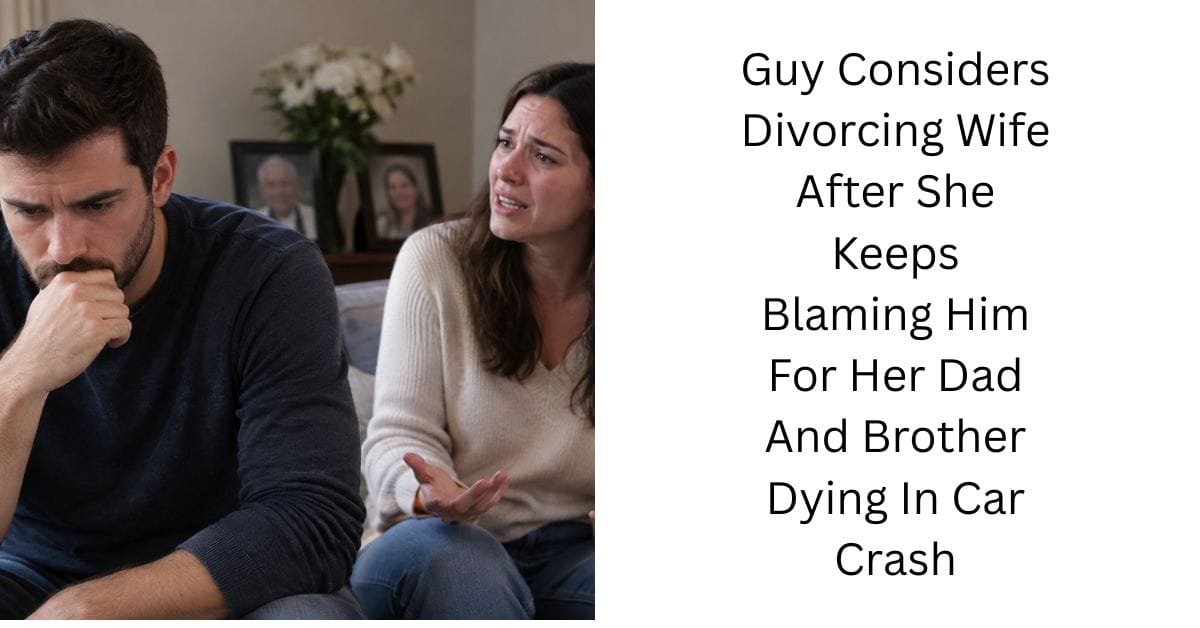
Guy Considers Divorcing Wife After She Keeps Blaming Him For Her Dad And Brother Dying In Car Crash
I never imagined that grief could eventually turn my marriage into something I barely recognize. A few years ago, my wife lost both her father and her younger brother in a terrible car accident, and ever since that day, she has struggled to cope with what happened. I understand that losing two close family members at the same time is the kind of trauma that can change someone permanently. I was devastated too, especially because I loved her family and had known both of them for years. I stayed beside my wife through the funeral, the weeks afterward, and all the difficult moments that followed. I helped with practical things when she couldn’t handle them herself, listened when she wanted to talk, and gave her space when she didn’t. For a long time, I believed we were simply going through an incredibly painful chapter together. What I didn’t realize was that she had started blaming me for the accident, even though I had nothing to do with the crash.
The first time she directly blamed me, I honestly thought she was speaking out of anger and grief. We had been discussing the accident late one night, and she suddenly said that if I had made a different decision earlier that week, her father and brother might still be alive. I reminded her that I had nothing to do with their travel plans or the accident itself. She said I was missing the point and that there were things I could have done differently that might have prevented the entire situation. I tried to understand what she meant, but her explanation didn’t make sense. Over time, I realized she had created a chain of “what if” scenarios in her mind. She blamed me for encouraging her to attend a work event on the day before the accident, for not insisting that she spend more time with her family, and even for not calling her father on a particular evening. None of those things had any connection to the crash, but she kept bringing them up as if I had somehow set the tragedy in motion.
At first, I tried to be patient because I knew she was grieving. I told myself that she didn’t really mean what she was saying and that grief could make people angry, irrational, and desperate to find someone to blame. But the accusations didn’t stop. Months became years, and eventually her comments became part of our everyday life. Whenever we argued about something unrelated, she would bring up her father and brother. If I forgot something around the house, she would say I was always careless and that her family had already paid the price for my mistakes. If I made a decision she disagreed with, she would somehow connect it to the accident. Sometimes she would simply look at me and say that she could never forgive me for what happened to her family. I would ask her what exactly she believed I had done, but she rarely gave me a clear answer. It felt like I was being punished for a tragedy I couldn’t control.
The situation eventually started destroying my mental and emotional well-being. I became afraid to disagree with her because I knew any argument could turn into another accusation. I stopped bringing up certain subjects because I didn’t want to trigger another conversation about the accident. I also felt guilty for wanting a normal marriage when she was still carrying so much grief. We tried counseling, and for a while, I thought it might help. The therapist encouraged my wife to separate her grief from her anger toward me and reminded her that blaming someone doesn’t change what happened. My wife seemed receptive during the sessions, but afterward she would sometimes tell me that the therapist didn’t understand our situation. She eventually stopped going because she said counseling was making her feel judged. I continued trying to support her, but I was reaching a point where I couldn’t keep sacrificing myself to prove that I wasn’t responsible for something I hadn’t done.
Now I am seriously considering divorce, and that decision makes me feel horrible because I know she is still grieving. I don’t want to abandon someone I promised to love through difficult times, but I also don’t know how long I can remain in a marriage where I am constantly treated like the cause of her family’s deaths. I have told her repeatedly that I am sorry for her loss, that I loved her father and brother, and that I wish more than anything that the accident had never happened. But I cannot accept responsibility for something that was completely outside my control. She recently told me that if I leave her, it will prove that I never truly cared about her family in the first place. That statement left me feeling trapped. I love my wife, but love doesn’t seem to be enough when one person believes the other deserves lifelong punishment for a tragedy. I still hope she can eventually find a way to process her grief without blaming me, but I am beginning to realize that I cannot destroy my own life simply because she refuses to let go of something I never caused.
Read Story…
“WIBTA (Would I be the a**hole) if I get a divorce because my wife won’t stop blaming me for my father- and brother-in-law’s deaths?”
The OP was in a terrible car accident with several family members.
“A couple of years ago, I was out with my father-in-law and younger brother-in-law on a guys night out when a freak accident happened. A seventeen-year-old kid lost control when his brakes went out, and he crashed right into us.”
“My brother-in-law died on the spot while my father in law fought for a couple of days in the hospital before he too passed.”
“I broke my arm and leg and almost died too but somehow I made it.”
The accident ruined the OP’s wife’s life.
“This has destroyed my wife completely. The woman I knew and loved and married isn’t here right now.”
“She was a huge daddy’s girl, she loved him, and they used to talk on the phone every single day, and everytime he’d see or talk to me, he’d always tell me to take good care of his girl.”
“She also loved her younger brother. He was 14 years younger than her, so he was like her first baby.”
“Her mood changes every other day now. Sometimes, she’s her old caring self, and other times, she can’t even look at me, and she’d scream and cuss at me all day long, and she’d blame me for everything.”
The OP wasn’t sure how much more he could take.
“It’s so hard for me, because I loved them too. I loved her dad more than my own absent father, and her brother was like a little brother to me too.”
“I still see my father-in-law in that carseat next to me with blood coming out of his mouth and with cuts all over him, and I still see my dead brother in the back. Her blaming me for it all the time makes it a million times harder for me.”
What made the situation even worse was that the OP’s wife refused any help.
“She doesn’t wanna go to couples therapy or any sorts of therapy with or without me, but I’ve been going but with her blaming me it’s basically not doing anything to help me at all.”
“I still love my wife to death, and I wanna keep my promise to my late father-in-law to take care of his little girl, but I just can’t do it anymore; it’s too painful.”
“I believe it’d be better for her to not live with who she blames for destroying her family, and I think it’d be better for me too and it might finally let me move on.”
“Should I do it or should I give her another chance? I don’t wanna put her trough even more pain, but I think this would be helpful for both of us.”
“WIBTA?”
Fellow Redditors weighed in:
- NTA: Not the A**hole
- YTA: You’re the A**hole
- ESH: Everybody Sucks Here
- NAH: No A**holes Here
Some Redditors were concerned by the fact that the OP’s wife was refusing help.
“NTA. We know she’s hurting, badly. But to blame you, and refuse to go to counseling, is completely unfair. Even without that, the way her moods are all over the place shows she needs it.”
“Ultimatums are usually a bad idea, but not always. Have you considered telling her it’s counseling or divorce?” – carmelfan
“Tell her the promise you made her dad. And tell her if SHE won’t let you help her, then you’ll be breaking that promise, and you dont want to do that.”
“Tell her HE would want her to get help.”
“If she still refuses, avoid her while home a bit. Do you have a separate bedroom or man cave? You can try to spend most of your time there. Try to keep out of her line of sight so she isn’t reminded.”
“If need be, you can do a trial separation. Go live somewhere else for a bit, but keep tabs on her.”
“No need to jump right to divorce.” – Charlie24601
“She MUST know what she is doing is wrong, borderline evil. That’s why she won’t go to therapy. I respect your commitment to her, but you may need to get a separate place for your own mental wellbeing.”
“She’s punishing you a second time when you’re already suffering by being the survivor. Sadly, I don’t see a happy marriage in your future with her.” – MeatofKings
“At this point, it’s not even an ultimatum. It’s what OP has to do. If the wife is refusing therapy, she will constantly be dealing with the resentment towards OP. It’s bad enough he is likely already dealing with his own survivor’s guilt but to be constantly blamed when it was not even his fault is something I can’t see him withstanding.”
“OP, it’s time to let your wife know that you have to think about yourself and your own mental health in this situation, and leave. If she’s refusing help, it will never get any better.” – BizarreCujoh
“She SHOULD be hating the person who CAUSED the crash that killed her dad and brother, but she’s constantly reminded that OP was the only SURVIVOR of the crash.”
“It’s so painful to OP’s wife to be reminded, but she is refusing any kind of therapy to come to terms with her loss.”
“OP is entitled to seek therapy for his own mental health. He is dealing with PTSD and anxiety issues related to the deaths of his father in-law and brother in-law.” – Feeling-Invite7953
One Redditor advised what the OP should tell his wife if she continued to refuse help.
“OP, if it were me, I would say something like this, ‘I love you, but I cannot live the rest of my life being hated and blamed for a freak accident, something that was not my fault. You treat me as if you would rather I had died in the car rather than survived.'”
“‘I’m so sorry the accident happened, but it was not my fault and you hating me is not going to bring your father and brother back. I do not want a divorce but I cannot live with your hatred any longer, so I will be moving out. If you want to continue to be married to me, you will need to get therapy. If you choose not to in the next six months, I will be filing for divorce.'”
“‘Maybe we can both be happier if you don’t have to look at me daily and be reminded of your loss. I really do love you so much and wish the accident had never happened, but neither of us has any control over that. All we can do is control how we move forward, and if you are not willing to get help, then we need to move forward separately.'” – Successful_Voice8542
Others thought it might be better for the OP and his wife to go their separate ways so they could both heal.
“Hate is the poison that kills only the hater. She should learn forgiveness, even if her husband caused it. If she does blame him, justly or unjustly, she needs therapy. And she may not be able or heal with him still in her life.” – MetaPlayer01
“You can frame it a few ways… I’d suggest something like, ‘You seem to hate me sometimes, and I seem to be a constant reminder of what happened. That’s hard for me to be around, especially as I’m grieving them as well. If we can’t go to counseling together, maybe we shouldn’t be together.'” – BodaciousVermin
“You can’t help someone who doesn’t want it. Don’t divorce her now, don’t make big decisions at a time like this, but separation for a time might be good for both of you.”
“Get a short term rental, three to six months maybe, and keep up your therapy. Being the one left behind is harder than most people think, and you need to keep talking to someone, but not her.” – Beth21286
“Tell her that you are considering divorce, and unless she’s willing to go to counseling this relationship is on its last legs. She goes to counseling or she can expect seperation to start soon.”
“You need to be firm. If she doesnt know she is going to lose you by doing this, and doesnt feel like she will (for example, empty threats to leave) she wont ever snap out of it.”
“The longer you take to impress this, the more obstinate she will be.” – Grimwohl
“This is beyond salvageable OP marriage-wise.”
“She’s unwilling to accept that it was not your fault that freak accident that occurred and had it been possible to turn back time in a time machine and she still wouldn’t have been able to change the devastating outcome because of the other driver that lost control of the vehicle and crashed into you.”
“Best to get your divorce papers in order and served to her then try start living the best you can.” – lovemyfurryfam
Grief after such a loss can be difficult for couples.
We wish them both well as they navigate these turbulent waters.
When Grief Turned My Wife Against Me
I never imagined that grief could turn my marriage into something I barely recognize anymore. A few years ago, my wife lost both her father and her younger brother in a terrible car accident, and the tragedy completely changed her. I knew there was no way anyone could simply move on from losing two close family members at once. I was devastated too because I had known her father for years and had a good relationship with her brother. I stayed beside my wife through the funeral, the family gatherings, the sleepless nights, and all the moments when she felt like she couldn’t breathe under the weight of what had happened. I never expected gratitude for being there. She was my wife, and supporting her was something I wanted to do. At the time, I thought we were facing the tragedy together. I never imagined that, eventually, she would begin treating me as though I had somehow caused it.
The accident itself was completely unrelated to me. Her father had been driving her brother somewhere when another vehicle lost control and struck their car. The investigation determined that neither of them had caused the collision. There was nothing I could have done to prevent it because I wasn’t there, and I didn’t even know they were on the road at that particular moment. For the first several months, my wife never blamed me directly. She was simply devastated. She cried constantly, barely slept, and sometimes spent hours looking through old photographs. I understood that she needed time. I never pressured her to “get over it” or expected her to return to normal quickly. I tried to make our home as peaceful as possible because I knew she was carrying something I couldn’t fully understand.
The first time she blamed me, I honestly thought I had misunderstood her. We were talking about her brother one night, and she suddenly said that if I had made a different decision earlier that week, he might still be alive. I asked her what she meant. She reminded me that I had encouraged her to attend an important work event instead of spending that evening with her family. She said that if she had been with her brother more often, she might have noticed something that could have changed what happened later. I told her that none of that made sense. The accident occurred days later, and I hadn’t even known about their travel plans. She became angry and told me I didn’t understand how many “small decisions” had led to that day.
I assumed it was simply grief talking. I didn’t argue with her because I knew she was hurting. Instead, I hugged her and told her that I wished things had been different too. I thought the conversation would end there. It didn’t. Over the following weeks, she started bringing up similar theories. Sometimes she blamed herself, sometimes she blamed other people, and sometimes she blamed me. She would say things like, “If you had told me to stay home,” or “If you hadn’t needed me that day,” as though every ordinary decision in our lives somehow contributed to the accident.
At first, I responded gently. I told her that nobody could have known what was going to happen. I reminded her that her father and brother were simply traveling when another driver caused the crash. She would sometimes agree with me, but other times she became furious. She told me that I was trying to make her feel crazy. I never wanted to do that. I was only trying to help her separate what actually happened from the endless possibilities her mind was creating.
As months passed, the accusations became more frequent. The worst part was that they didn’t stay limited to conversations about the accident. If we had an argument about household chores, she might suddenly mention her father. If I was late getting home from work, she would say that I always cared more about my schedule than her family. If I forgot to call her mother on a holiday, she would say that I had never truly valued the family she had lost.
I began walking on eggshells around her. I never knew which innocent comment would lead to another accusation. Sometimes I would come home exhausted and simply ask how her day had been, only to end up listening to an hour-long argument about something I supposedly should have done differently years earlier. I tried to remain calm because I knew that fighting back aggressively would only make things worse.
There were times when she apologized afterward. She would cry and tell me she didn’t mean to hurt me. She would say that she was angry at the world and didn’t know where to put that anger. I understood that. I really did. I told her I wasn’t angry about her grieving. I was only asking her not to make me responsible for something I hadn’t caused.
For a while, those apologies gave me hope. I believed she was becoming aware of what she was doing. I thought maybe we were finally moving toward healing. But the pattern always returned. Something would trigger her grief, she would become angry, and eventually I would become the target.
One evening, she accused me of “choosing my life over her family.” I asked her what that meant. She brought up an event that had happened shortly before the accident. Apparently, she had wanted to visit her father, but I had reminded her about an obligation we had already made. She chose to attend the obligation, and now she believed that if I had encouraged her to visit her father instead, she might have spent more time with him before he died.
I told her that nobody could have predicted the accident. She said that wasn’t the point. According to her, I should have understood how important that visit was. I reminded her that neither of us knew it would be her last opportunity to see him. She responded that I should have known.
That sentence terrified me because it meant there was no possible way for me to defend myself. If I admitted I couldn’t have known, she said I was dismissing her pain. If I agreed that I should have somehow known, I was accepting blame for something impossible to predict.
I suggested therapy again. I told her that I didn’t think she was a bad person and that I wasn’t trying to force her to forget her family. I simply thought she needed someone qualified to help her process the trauma. She initially agreed. We attended several counseling sessions together, and for the first time, I felt like there might be a path forward.
The therapist tried to help my wife understand the difference between grief, guilt, and responsibility. She explained that after a traumatic loss, people sometimes search for something they could have changed because accepting that the tragedy was outside their control can be incredibly painful. My wife listened quietly during those sessions.
Unfortunately, she didn’t continue therapy for long. After one particularly difficult session, she told me that the therapist was taking my side. I told her that wasn’t true. The therapist wasn’t taking sides; she was trying to help us understand the situation. My wife disagreed and eventually stopped going.
After that, things became worse. She seemed to believe that because therapy hadn’t “fixed” the situation, there was no reason to continue. Meanwhile, I was becoming emotionally exhausted. I started feeling like I was no longer her husband but simply the person she blamed whenever the pain became too difficult to carry.
I tried everything I could think of. I gave her space. I listened. I encouraged her to visit her mother’s family. I helped preserve memories of her father and brother. I even suggested creating a small memorial area in our home because she said she was afraid she would eventually forget their voices and faces.
But none of those things stopped the accusations.
Eventually, I reached a point where I couldn’t pretend the situation wasn’t affecting me. I started having trouble sleeping. I became anxious whenever my wife was quiet because I wondered whether another argument was coming. I stopped making plans because I didn’t want to give her another reason to accuse me of prioritizing myself.
One day, I realized I had become afraid of my own wife.
That realization was devastating. She wasn’t physically threatening me, but emotionally, I felt trapped. I felt like anything I said could be used against me. I also felt guilty for even thinking about leaving because I knew she had suffered an unimaginable loss.
I finally told her that I couldn’t continue living this way. I said that I loved her and cared about her family, but I could not accept being blamed for their deaths. I told her that if she believed I had actually caused something, she needed to explain exactly what I had done. She couldn’t.
Instead, she told me that I was supposed to understand without needing an explanation.
That answer broke something inside me. I realized there was no specific action I could correct, apologize for, or make right. She wasn’t asking me to fix a mistake. She was asking me to carry her pain with her, and somehow I had become the person she expected to punish for it.
I told her that I would support her if she wanted to return to therapy. I offered to attend with her again. I also told her that I needed her to stop accusing me of causing the accident. She said she couldn’t promise that. She told me the anger was simply part of her grief.
I asked her whether she expected me to stay in the marriage indefinitely while being blamed for something I didn’t do. She didn’t answer. Instead, she started crying and said that everyone always wanted her to stop talking about her father and brother.
I told her that wasn’t what I wanted. I wanted her to remember them. I wanted her to grieve them. I wanted her to talk about them whenever she needed to. But I couldn’t accept being turned into the villain of their deaths.
Since then, I have been seriously considering divorce. I haven’t made a final decision yet because I still love my wife and remember the person she was before this tragedy. Part of me keeps hoping that she can eventually work through the grief and recognize that I wasn’t responsible. Another part of me is exhausted and wonders how much longer I can keep sacrificing my own emotional health.
The hardest thing is that I don’t hate her. I don’t even think she’s intentionally trying to destroy our marriage. I think she’s deeply wounded and has never found a healthy place to put all of that pain. But understanding why someone hurts you doesn’t automatically mean you have to accept being hurt forever.
I still wish her father and brother were alive. I wish I could erase the accident from her life. I wish I could somehow give her the peace she had before that terrible day. But I can’t change the past, and neither can she. I have finally realized that I can love my wife and still recognize that our marriage may not be healthy anymore. If she is willing to get help and stop making me responsible for something I never caused, maybe there is still a future for us. But if she continues to believe that I deserve lifelong blame for a tragedy I couldn’t have prevented, I may eventually have no choice but to walk away—not because I stopped caring about her, but because I can’t spend the rest of my life being punished for something that was never my fault.