My Husband Is Divorcing Me After 10 Years of Marriage Because I’m Infertile
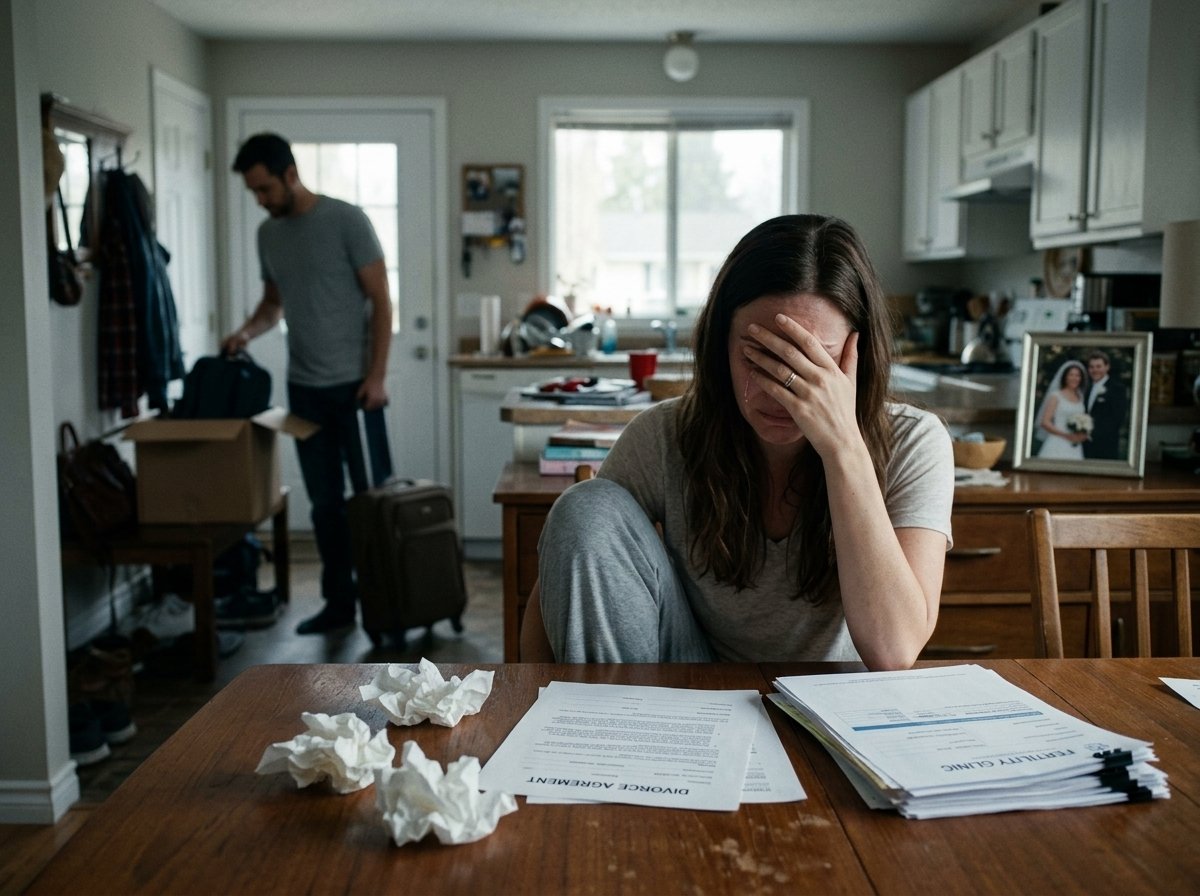
I am 32 years old, and my husband is 35. We have been married for ten years, and until recently, I genuinely believed we would spend the rest of our lives together. When we first got married, we talked about our future, the home we wanted to build, and the possibility of having children someday. Like many couples, we imagined what our family would look like and how our lives would change when we became parents. I never expected that something beyond my control would eventually become the reason my husband wanted to end our marriage. I loved him deeply, trusted him completely, and believed that our relationship was strong enough to survive life’s greatest challenges. Now, after a decade together, I am facing the heartbreaking possibility of losing the person I thought would always stand beside me.
For years, we tried to start a family, hoping that eventually we would receive the news we had been waiting for. Every month brought a mixture of hope, anxiety, and disappointment. Whenever I thought there might be a chance, I allowed myself to imagine holding our baby for the first time. Unfortunately, those hopes repeatedly turned into heartbreak. After undergoing medical examinations and consulting doctors, I learned that I was infertile. Hearing those words was devastating. It felt as though the future I had imagined for myself had suddenly become uncertain. I struggled with sadness, frustration, and feelings of inadequacy, even though I knew infertility was not something I had chosen. More than anything, I needed my husband’s understanding and reassurance that we were still a family, even if we could not have biological children together.
At first, my husband appeared supportive. He told me that we would face the situation together and that our marriage was about more than having children. Those words gave me comfort during one of the most difficult periods of my life. However, as time passed, I noticed a change in his behavior. He became quieter whenever the subject of children came up and seemed increasingly uncomfortable around friends and relatives who had babies. Family gatherings became especially difficult because people frequently asked when we planned to have children. Sometimes I answered politely, while other times I changed the subject because I did not want to explain something so personal. My husband rarely defended me when people made insensitive comments. I tried to convince myself that he was struggling with his own disappointment, but deep down, I could feel a growing distance between us.
One evening, my husband asked me to sit down because he needed to discuss something important. His serious expression immediately made me nervous. I assumed he wanted to talk about our options for starting a family, perhaps adoption or another medical possibility. Instead, he told me that he had been thinking about our future and no longer believed he could remain in the marriage. I stared at him, struggling to understand what he was saying. Then he explained that he wanted to have children of his own and could not imagine giving up that dream. He said he had spent a long time thinking about it and believed divorce was the only way for him to pursue the life he wanted. Hearing those words after ten years of marriage felt unbearable. I asked him whether our love, our memories, and everything we had built together meant so little to him. He did not give me the answer I had hoped for.
I asked him why he had married me if having biological children was something he considered essential to his future. When we first got together, neither of us knew that infertility would become part of our lives. I understood that he was entitled to feel grief over the possibility of never becoming a biological father, and I did not want to dismiss his feelings. But I could not understand why he believed ending our marriage was the answer. We had shared ten years of love, companionship, and experiences that could never be replaced. I reminded him that there were other ways to build a family, including adoption, if we both genuinely wanted to explore that option. He listened, but it became clear that he was not looking for a solution we could pursue together. He seemed convinced that our inability to have biological children meant our marriage could no longer give him the future he wanted.
Since that conversation, I have struggled with emotions I can barely explain. Losing the possibility of having biological children has already been painful enough, but now I feel as though I am losing my husband because of it. Sometimes I catch myself wondering whether I am somehow less valuable as a wife because I cannot become a mother. I know logically that infertility does not define my worth, but it is difficult to hold on to that belief when the person I love appears to see our situation as a reason to leave. I think about the promises we made when we got married and wonder whether they still mean anything to him. I also feel angry that I am being forced to question my future when I never chose this situation. I wanted us to face our struggles as partners, not have one of us walk away when life failed to follow the plan we had imagined.
I have spent considerable time thinking about whether adoption could be part of our future. I respect people who choose to adopt and understand that it can be a meaningful way to build a family. However, I also believe that adoption is a serious lifelong commitment that both partners must genuinely want. It would not be fair to a child for us to pursue adoption simply because we were desperate to save our marriage. I would want any child who joined our family to be loved, wanted, and accepted without reservation. I also do not believe I should be pressured into a major life decision to prove that I deserve to remain married. There may be other options worth discussing, depending on our circumstances and preferences, but those conversations require mutual respect. I cannot make my husband want a different future, just as he cannot demand that I solve our infertility by agreeing to something I am not comfortable with.
The thought of divorce is frightening because our lives have been intertwined for so long. We share memories, routines, friendships, and plans that once seemed permanent. I never expected to be starting over at 32, wondering where I will live or how I will rebuild my life without the person who has been my partner for a decade. Part of me still hopes that my husband will reconsider and recognize that our marriage has value beyond whether we have children. Another part of me understands that I cannot force him to stay if he no longer wants the same life. I am trying to remind myself that I deserve compassion and respect, even if our relationship ends. I also know that I need time to process everything, seek support from people I trust, and understand my legal and financial options before making important decisions. I do not want my fear of being alone to determine what happens next.
At this point, I honestly do not know what the future holds for me or my marriage. I still love my husband, and the thought of losing him after ten years together is heartbreaking. I understand that becoming a father may be deeply important to him, and I do not want to minimize the grief he may feel about our infertility. However, I also believe that marriage means supporting each other when life becomes difficult, even when circumstances change in ways neither person expected. I never chose to be infertile, and I do not believe it makes me a failure as a wife or as a person. I am struggling to understand how someone who promised to stand beside me could now be willing to end our marriage over something neither of us can simply change. Am I wrong for feeling betrayed by my husband’s decision to divorce me after ten years of marriage because I cannot have biological children, or is this a situation where we have simply reached a point where our hopes for the future are no longer compatible?
Read Stort…
UPDATE – Me [32F] with my husband[35M] of 10 years, he is divorcing me because I am infertile.
First off, I’d like to get a few things off of my chest about the messages I received about my situation. Thank you SO much to those who supported me and were kind and sympathetic to all this. I got many very kind messages of encouragement and stranger love! That being said, I got a plethora of PMs from people telling me that I deserved everything that happened to me because I refused to adopt; that I deserve a life of loneliness and that I should kill myself. That really sucked and made me want to actually die.
I don’t think I’m a bad person for not wanting to adopt. I don’t think it’s bad to prefer biological children over an adopted child. 95% of the world feels the same obviously because the vast majority people do not adopt. I think it takes a brave and very loving person to be able to take on a child that isn’t theirs – I am not one of those people, and I’m sorry if that offends you. Now onto the update…
The day after my post, I spoke to a lawyer and he agreed to take me on as a client. On Thursday my lawyer and I met up to discuss what I expected out of the divorce. I also spoke to a therapist on Friday. She told me that the best course of action at this point was to take some time to myself and to not contact my husband.
Over the past few days, I had been thinking about his leaving and the entirety of our situation and decided that even though I was furious as to how he handled it, I can understand his want to leave. If I cannot provide a child for him and that is truly what he wants, then he needed to leave. I was in a calmer state of mind by Friday, although everything was still numb. I couldn’t stop replaying in my mind him sliding the papers towards me and then telling me that he loved me but couldn’t be with me. It still isn’t real.
On Saturday afternoon, everything came crashing down again. I was trying to block everything out of my mind by binge watching Netflix when the doorbell rang. My heart tightened as I walked towards the door and opened it to my husband. He looked terrible, almost worse than I did. Without looking me in the eye, he asked if he could come in and I couldn’t even speak. I moved my body to the side of the doorway and motioned him inside. In this moment, it took me everything I had not to kiss him and to punch him all at the same time. We sat down on the couch together in silence for what seemed like 10 minutes. He finally spoke and all he said was, “infertileoldmaid, I’m so sorry.” I was silent. We sat for about 2 more minutes before I finally had the courage to ask, “Is that all you wanted to say?”
He shook his head and began to tear up, which of course caused me to tear up. He again buried his head in his hands and sighed. He told me that he’d been feeling like he was missing out on fatherhood. I told him through tears that I understood and didn’t blame him for wanting children, but he cut me off. He told me that wasn’t it. He told me that he’d been seeing a young woman at his work for the past 6 months and that he couldn’t keep lying to me any longer.
They were having both an emotional and physical relationship and she had been pressuring him to leave me for a few months. He claimed his insecurities about his lack of a family was pushing him to feel that he needed change and that she was a huge mistake.
At this point, I couldn’t take it anymore. I told him to get the fuck out of my house. He looked at me like a scared puppy and panicked told me that he wanted another chance and that he’d just broken off things with his coworker and was willing to forgo kids to be with me. I didn’t know what to do so I just started to scream, yelling at him to get out and that I was completely done. He just began to sob and started pleading for me to calm down. It was clear that he wasn’t going to leave, so I did. I grabbed my keys and ran out of the house.
I drove for 30 minutes out of town, parked on the side of an empty road and cried for an hour. Driving back into town, I looked at my phone and saw that my husband had called over 20 times and texted me things like how he was so sorry and that she was nothing… blah blah blah. I didn’t delete any of these messages because I knew how important they were for my lawyer to see. When I arrived back to my house, he was no longer there. I walked inside and all was the same, he took nothing and broke nothing, which was relieving.
I regained my composure and sense of reality and called my lawyer and left him a very long message about what had just happened. Today my lawyer got back to me and told me to come in first thing on Tuesday morning.
Husband has not tried to contact me since one last text on Sunday that read, “I love you, infertileoldmaid. I fucked up and I’m sorry for hurting you. If you ever need me, I’ll be here for you.” My mind is again in turmoil and I feel like I am dying. I have yet to tell any of my friends and family what has happened and I’m not sure that I will be able to.
tl;dr – he was cheating on me. Any talking regarding my husband will now be exclusively with my lawyer and therapist.
EDIT: I removed all information regarding anything my lawyer and I discussed.
CLARIFICATION: I am my deceased mother’s only child, but I have two non-biological sisters. Sorry for the confusion in the comments.
The Marriage I Thought Would Last Forever
I am 32 years old, and my husband is 35. We have been married for ten years, and until recently, I genuinely believed we would spend the rest of our lives together. When we first got married, we talked about our future, the home we wanted to build, and the children we hoped to have someday. We imagined celebrating birthdays, going on family vacations, and watching our children grow up. Like most newlyweds, we believed we had plenty of time to achieve everything we wanted. I never imagined that one day I would be sitting here wondering how my marriage could fall apart after a decade of love, trust, and shared experiences. I always thought that even if life became difficult, we would face our problems together. Unfortunately, I am now facing the possibility of losing my husband because I cannot give him the one thing he says he wants most: biological children.
Having children was something we discussed throughout our relationship. Neither of us expected parenthood to happen immediately, so we initially decided to enjoy our married life and allow things to happen naturally. We were busy establishing our careers, managing our finances, and building a comfortable home. Whenever the subject of children came up, we both seemed excited about the idea. My husband talked about teaching our future child how to ride a bicycle, while I imagined reading bedtime stories and creating family traditions. Those conversations became some of my favorite memories because they made our future feel real. We never discussed what would happen if we could not have biological children because neither of us thought we would face that situation. Looking back, I realize that we built many of our expectations around a future we simply assumed would happen.
After several years of marriage, we decided it was time to try seriously for a baby. At first, we were optimistic. We thought it might take a few months, and we tried not to become overly concerned when pregnancy did not happen immediately. However, as more time passed, the excitement slowly turned into anxiety. Every month seemed to bring the same disappointment, and I began wondering whether something was wrong. I tried to stay positive because I did not want our attempts to become a source of constant stress. My husband also reassured me that we should not worry too much. Still, the passing months became increasingly difficult. Whenever another opportunity ended in disappointment, I felt a little more discouraged, even though I continued hoping that the next month would bring better news.
Eventually, I decided that we needed medical advice rather than continuing to guess what might be happening. I scheduled appointments and underwent examinations to understand why I was not becoming pregnant. The process was emotionally exhausting, especially because each appointment brought the possibility of receiving news I was not prepared to hear. I tried to remain calm and remind myself that medical information would help us understand our options. My husband accompanied me to some appointments and initially seemed committed to finding answers together. I remember hoping that whatever the doctors discovered, we would be able to discuss it as partners. I wanted reassurance that our relationship was strong enough to withstand an unexpected challenge. At that point, I still believed our shared desire to have a family would bring us closer rather than create a distance between us.
Eventually, I learned that I had a fertility problem that significantly affected my ability to conceive. The exact implications and possible treatments depended on my medical circumstances, but the news was devastating. I had spent so much time imagining motherhood that hearing this felt like losing a future I had always expected to experience. I remember sitting quietly after receiving the information, trying to process everything the doctor had explained. I wondered whether I would ever hold a baby of my own or experience the milestones I had imagined for years. I also worried about how my husband would react. When I finally told him how deeply the news had affected me, I hoped he would reassure me that I was still the woman he had chosen to marry. At first, he said we would figure things out, and I held on to those words.
For a while, I focused on exploring the options available to us. I researched treatments, discussed possibilities with my doctor, and tried to understand what might realistically work in my situation. Some possibilities were emotionally and financially demanding, and none offered a guarantee. I knew that fertility treatment could be complicated, and I did not want to make decisions based entirely on fear or desperation. My husband and I occasionally discussed the subject, but our conversations gradually became shorter and more uncomfortable. I tried to bring up practical questions, while he sometimes seemed unwilling to talk about them. I assumed he was struggling with disappointment and needed time to process his feelings. I understood that the situation was difficult for him too, but I hoped we could continue supporting one another while deciding what to do next.
Over time, I noticed that my husband was becoming emotionally distant. He stopped initiating conversations about our future and seemed uncomfortable whenever someone mentioned children. When friends announced pregnancies, he congratulated them but became unusually quiet afterward. At family gatherings, relatives sometimes asked when we were planning to start a family. I found those questions painful because they reminded me of something I was already struggling to accept. I usually responded politely or changed the subject, hoping to avoid discussing private medical matters. My husband rarely explained how he felt about those interactions, so I was left guessing. I wondered whether he was disappointed in our circumstances, frustrated by the uncertainty, or beginning to question whether he wanted to remain married. I tried to approach him gently, but I could feel a growing distance that I did not know how to bridge.
One of the hardest parts of the experience was feeling alone while still being married. I would have difficult days when the reality of infertility became overwhelming, and I wanted to talk to my husband about my fears. Sometimes I needed reassurance that he still loved me and that our relationship mattered regardless of whether we had children. Instead, he often changed the subject or told me that thinking about it constantly would not help. I understood that he might have been trying to avoid painful conversations, but his responses made me feel as though my emotions were an inconvenience. I started keeping many of my feelings to myself because I did not want every discussion to become uncomfortable. Ironically, the more I tried to avoid upsetting him, the more isolated I became. I missed the feeling that we were facing a difficult situation together.
The situation became even harder when relatives began asking questions about our plans for children. Some people were simply curious, while others made comments that felt intrusive and insensitive. I occasionally heard suggestions that I should relax, try a particular treatment, or change something about my lifestyle. Although some comments may have been intended to help, they often made me feel as though people believed I was responsible for the situation. I did not want to explain my medical circumstances to everyone, so I learned to smile and change the subject. My husband also seemed affected by these conversations, especially when other couples discussed their children. However, instead of talking openly with me, he increasingly withdrew. I began to worry that the opinions and expectations of others were influencing how he viewed our marriage, even though I could not be certain what he was thinking.
One evening, my husband told me that he wanted to have a serious conversation. His expression made me nervous because he rarely initiated discussions about our relationship anymore. We sat together in the living room, and I asked what was wrong. He hesitated before explaining that he had been thinking about our future for a long time. I assumed he wanted to discuss fertility treatment, adoption, or another possible way to become parents. Instead, he told me that he was considering divorce. For a moment, I could not process what I had heard. I asked him whether he was serious, hoping he might say that he was overwhelmed and had spoken out of frustration. He did not take it back. He explained that becoming a biological father was something he could not imagine giving up, and he no longer believed our marriage would provide that future.
I asked him how he could reach such a major decision without having a more honest conversation with me. We had been together for ten years, and I could not understand why he seemed prepared to end everything instead of exploring our options together. He explained that he had been struggling with the possibility of never having biological children and that the thought had become increasingly difficult for him. He said he did not want to resent me in the future or remain in a marriage where he felt he had given up something essential. I understood that he had his own emotions and expectations, but his explanation still hurt deeply. I had never asked him to abandon his dream without discussion. I had wanted us to work out what our future could look like, even if it differed from what we had originally imagined.
Eventually, I asked him whether he still loved me. It was a question I had been afraid to ask because I was terrified of his answer. He told me that he still cared about me, but he could not ignore his desire to have biological children. I struggled to understand how both things could be true. If he still cared about me, why did he seem ready to leave without seriously exploring every alternative? I knew that love did not automatically solve every disagreement, but I had believed it would at least motivate us to search for a solution together. His answer left me feeling as though I had become associated with a future he no longer wanted. I wondered whether the years we had shared were enough to matter to him now that our plans had changed. I wanted him to recognize that I was grieving too.
After that conversation, I began struggling with feelings of inadequacy that I had previously managed to keep under control. I knew infertility was a medical issue and not a personal failure, but emotionally, it became difficult to separate my circumstances from my sense of self-worth. I wondered whether I would have been treated differently if I could have conceived. I questioned whether my husband saw me as the same person he had married or whether he now viewed me primarily through the lens of our inability to have children. Those thoughts were painful, and I recognized that they were not necessarily fair or accurate. Still, when the person you love says he wants to end your marriage because of something connected to your health, it can be difficult not to take the rejection personally. I needed to remind myself that my value as a person was not determined by my ability to become pregnant.
During one of our conversations, I brought up adoption as a possible option. I explained that I respected the commitment involved and understood that it was not a decision to make simply because we were desperate to save our marriage. I wanted us to consider whether we could genuinely imagine building a family by welcoming an adopted child into our lives. My husband listened, but he said that adoption was not what he had envisioned for himself. He wanted a biological child and was unwilling to pretend that the distinction did not matter to him. I found that difficult to hear, although I recognized that parenthood was a deeply personal decision. I also knew that adoption should never be treated as a consolation prize or a guaranteed solution to infertility. Any child we adopted would deserve to be wanted wholeheartedly by both parents, not brought into a marriage where one person felt forced into the decision.
I also considered whether there might be other medical or family-building options worth discussing with qualified professionals. Depending on the underlying fertility issue, some couples explore treatment, assisted reproductive technologies, or other approaches. However, these options can involve medical limitations, financial costs, ethical considerations, and emotional challenges. I did not want to promise my husband that a particular treatment would work when no one could guarantee the outcome. I also did not want to put myself through endless procedures solely because I feared losing him. I believed that any decision about treatment needed to be made freely and with a realistic understanding of the potential benefits and risks. When I tried to discuss these possibilities, however, it seemed that he was increasingly focused on the outcome he wanted rather than on whether we could explore a future together.
For several weeks, I replayed the history of our marriage in my mind. I wondered whether there had been warning signs I had overlooked or conversations we should have had earlier. Perhaps we had both assumed that having children would be straightforward and had never discussed what we would do if that assumption proved wrong. Maybe my husband had never fully considered how important biological parenthood would become to him. I also wondered whether I had focused so much on my own grief that I had not fully understood his. These questions helped me recognize that we might have handled some parts of our situation differently. However, I also understood that I could not take responsibility for every feeling or decision he had made. Our marriage involved two people, and its future could not depend entirely on my ability to anticipate or satisfy his expectations.
Although sadness was my strongest emotion, I also began to feel angry. I was angry that something I could not simply control had become a reason for my husband to question our entire relationship. I was angry that I had spent so much time trying to protect our marriage while he had apparently been considering leaving. Most of all, I was angry at the idea that my inability to have biological children might mean I had somehow failed as a wife. I knew my husband had the right to decide what kind of future he wanted, but I also believed that I deserved honesty and compassion. I did not expect him to ignore his desire to become a father. I wanted him to recognize that I was not responsible for deliberately taking that possibility away from him. We were both facing a painful reality, but I did not believe I deserved to carry all the blame.
Eventually, I realized I could not continue carrying all of this emotional weight alone. I spoke with someone I trusted and explained what had been happening in my marriage. At first, I felt embarrassed discussing such a personal situation, especially because I had always believed my relationship was stable. However, talking openly helped me organize my thoughts and acknowledge how deeply the situation was affecting me. I did not need someone to tell me that my husband was entirely wrong or that I should immediately end the relationship. I needed someone to listen without judging me and remind me that I still deserved kindness. The conversation also helped me recognize the importance of seeking support for my grief and uncertainty. Whatever happened to my marriage, I did not have to navigate every part of the experience by myself.
After thinking carefully, I asked my husband whether he would consider marriage counseling. I explained that counseling would not force either of us to change our minds, but it might help us understand our feelings and communicate more honestly. We had spent years building a life together, and I wanted to know whether there was still a willingness to work on our relationship. I was prepared to listen to his concerns, acknowledge any mistakes I had made, and discuss what our future might realistically look like. I did not expect a counselor to magically resolve our fertility struggles. I simply hoped that a neutral professional might help us determine whether our marriage could continue in a way that respected both of our needs. His response was hesitant, and I could not tell whether he was genuinely considering the idea or simply trying to avoid another difficult conversation.
Paragraph 20: His Reluctance to Work on the Marriage
My husband eventually told me that he was unsure whether counseling would change anything. He said he had spent considerable time thinking about divorce and did not want to give me false hope. Hearing that was devastating because I had hoped he would at least be willing to explore the possibility of repairing our relationship. I reminded him that counseling did not require us to promise that we would remain married forever. It could simply help us understand one another and make a thoughtful decision. However, I also knew that I could not force him to participate meaningfully. If he attended counseling only because he felt guilty or wanted to delay the separation, it would not accomplish what I hoped. I needed to know whether he genuinely wanted to explore our options or whether he had already decided that our marriage was over.
Another difficult part of the experience was watching other couples move through milestones that I had once imagined for myself. Friends announced pregnancies, shared ultrasound photographs, and talked about preparing their homes for babies. I was genuinely happy for them, but I also felt a private sadness that I struggled to explain. Sometimes I wondered whether my husband compared our marriage with theirs and felt that we were missing something essential. I knew that comparing our lives to other people’s lives was unlikely to help us, but it was difficult to ignore the expectations surrounding parenthood. I had to remind myself that every family had its own circumstances and challenges, many of which were invisible to outsiders. Our inability to have biological children did not mean that the ten years we had spent together were meaningless or that our marriage had never been a real family.
As the possibility of divorce became more serious, I began thinking about the practical consequences. We had shared expenses, belongings, routines, and financial responsibilities for years. The thought of separating those parts of our lives felt overwhelming, especially while I was still processing the emotional impact. I realized that I needed to understand our financial situation and learn what steps would be involved if the marriage ended. I began considering whether I should seek independent legal advice before agreeing to any arrangements. I did not want to make rushed decisions because I was frightened of losing my husband, nor did I want to turn the situation into a hostile conflict. I wanted to protect my interests while treating him fairly. Preparing for the possibility of divorce did not mean I had stopped hoping for reconciliation; it meant I was acknowledging that the outcome was no longer entirely within my control.
One of my biggest fears is the thought of starting over after ten years of marriage. I had imagined spending my thirties building a family with my husband, strengthening our relationship, and enjoying the life we had worked hard to create. Instead, I am questioning what the next chapter might look like. I worry about living alone, rebuilding my routines, and explaining the end of my marriage to people who may not understand the full story. I also worry about the possibility that infertility could affect future relationships if I ever decide to pursue one. Sometimes those thoughts make the future feel frightening and uncertain. However, I am trying to remember that being 32 does not mean my life is over or that my opportunities for happiness have disappeared. I cannot know what the future holds, but I do not want fear to convince me that I have no future beyond this marriage.
Despite everything that has happened, I still love my husband. That is perhaps the most confusing part of the entire situation. I remember the person who comforted me when I was upset, celebrated my achievements, and shared countless ordinary moments with me. I remember the laughter, the private jokes, and the plans we made together. Those memories have not disappeared simply because our marriage is struggling. I also recognize that my husband is dealing with disappointment and may be grieving the future he once imagined. I do not want to dismiss his feelings or pretend that his desire to become a biological father is unimportant. However, loving him does not mean I have to agree that my infertility makes our marriage worthless. I can acknowledge his disappointment while also recognizing the pain his decision is causing me.
Over time, I have begun to understand that two people can love each other and still want different things from life. When we got married, we believed we shared the same vision for the future. We expected to have children, and neither of us considered how deeply our relationship might be affected if that did not happen. Now, we seem to be facing a fundamental disagreement about what family means and what compromises we are willing to make. My husband believes biological parenthood is essential to his future, while I want to know whether there is a way to preserve our relationship without forcing either of us into a life we do not want. I wish love alone could resolve this conflict, but I know it cannot guarantee that our goals will remain compatible. What matters now is whether we can have an honest conversation about those differences without treating either person as a failure.
I have had to make a conscious effort to stop treating infertility as a personal failure. There are still days when I feel deeply sad about not being able to conceive, but I am trying to remember that my worth is not determined by my reproductive abilities. I am still the same person who entered this marriage with love, hopes, and the desire to build a happy life. I have qualities, interests, relationships, and goals that exist independently of whether I become a mother. I also know that I deserve to be treated with dignity, even if my marriage ends. My husband’s disappointment does not automatically mean that I have done something wrong. I can grieve what we may lose without deciding that I am somehow less deserving of love than someone who can have biological children.
At this stage, I need clarity more than anything else. I have asked my husband to tell me honestly whether he is willing to explore counseling and discuss the alternatives available to us. I am prepared to consider his feelings and listen to his concerns, but I cannot spend months waiting for him to decide whether he wants to remain married while my own life stays suspended. If he genuinely wants to work on our relationship, I want us to make that effort together. If he has made a final decision to divorce, then I need him to communicate that clearly so we can begin addressing the practical details. I do not want to threaten him, beg him, or pressure him into staying. I want a decision based on honesty rather than guilt. I also want to give myself permission to move forward if it becomes clear that we no longer share the same future.
This experience has forced me to reconsider many things I once took for granted about marriage. I believed that spending ten years together meant we had built a foundation strong enough to withstand almost any challenge. I still believe that long-term relationships deserve effort, patience, and honest communication, but I now understand that both partners must be willing to participate. I have also learned that difficult circumstances can reveal differences that were never fully discussed before. Perhaps we should have talked more openly about what we would do if biological children were not possible. Perhaps we could have sought support earlier. I cannot change those missed opportunities, but I can learn from them. Regardless of what happens, I want to approach the future with greater honesty about my needs, greater compassion for myself, and a clearer understanding that a person’s value is not defined by whether their life follows a particular plan.
I am still struggling to accept that my husband may end our ten-year marriage because I cannot have biological children. I understand that becoming a father is important to him, and I do not believe he should be forced to abandon that dream simply because I want to remain married. At the same time, I cannot help feeling hurt that something beyond my control has become the reason our relationship may end. I wanted us to face this challenge as partners, explore our options, and decide together what our future could look like. Instead, I feel as though I am being left behind while I am already grieving the possibility of motherhood. I still love him, but I am beginning to understand that love cannot make every difficult decision for us. I need to protect my emotional well-being, understand my options, and accept that I cannot control his final choice. So, am I wrong for feeling betrayed by my husband’s decision to divorce me after ten years of marriage because I am infertile, or is this a heartbreaking situation where our dreams for the future have simply become incompatible?





One thought on “My Husband Is Divorcing Me After 10 Years of Marriage Because I’m Infertile”
Comments are closed.