My Husband Questioned Our Son’s Autism Diagnosis, and Genetic Testing Changed Everything
I never imagined that a medical diagnosis could change the way my husband and I viewed our son’s future, but that is exactly what happened. Our son is five years old, and ever since he was a baby, his development has been noticeably different from that of other children his age. He reached important milestones much later than most children, and even ordinary childhood activities sometimes required more time, patience, and support than we had expected. As his parents, we spent years trying to understand his needs and find the right ways to help him. We wanted him to have every opportunity to learn, grow, and experience life as fully as possible. Although we knew that every child develops at a different pace, we could not ignore the significant delays we continued to notice. Eventually, our concerns led us to seek professional evaluations, hoping that the answers would help us understand our son’s challenges and determine what kind of support he needed.
When our son was three years old, he was diagnosed with autism. By that point, we had already noticed several developmental differences, so the diagnosis did not come entirely out of nowhere. I was willing to accept what the professionals were telling us because I wanted to focus on understanding our son rather than spending years wondering why he was developing differently. I knew that an autism diagnosis did not define his entire personality, determine his worth, or tell us everything about the person he would eventually become. I saw it as a way to understand some of his needs and find appropriate support. We enrolled him in physical therapy, speech therapy, and occupational therapy to help him develop important skills. Each therapy addressed different aspects of his development, and we hoped that consistent support would help him make progress over time. Even when improvements were slow, I tried to remain patient and remind myself that our son deserved encouragement, understanding, and every opportunity to succeed.
My husband, however, struggled to accept the autism diagnosis. He did not necessarily deny that our son had developmental difficulties, because those difficulties were obvious to both of us. Instead, he felt that autism did not fully explain what he observed in our son. Whenever we discussed the diagnosis, he would question whether the professionals had considered every possibility. At first, I found these conversations difficult because I worried that he was refusing to accept something important about our child’s needs. I wanted us to work together rather than spend our time questioning the diagnosis. However, I eventually realized that my husband was also trying to understand what was happening. He wanted an explanation that made sense to him, and he was afraid that we might overlook something that could help our son. Although we approached the situation differently, we shared the same basic concern: we wanted to understand our child and make sure he received the best possible care.
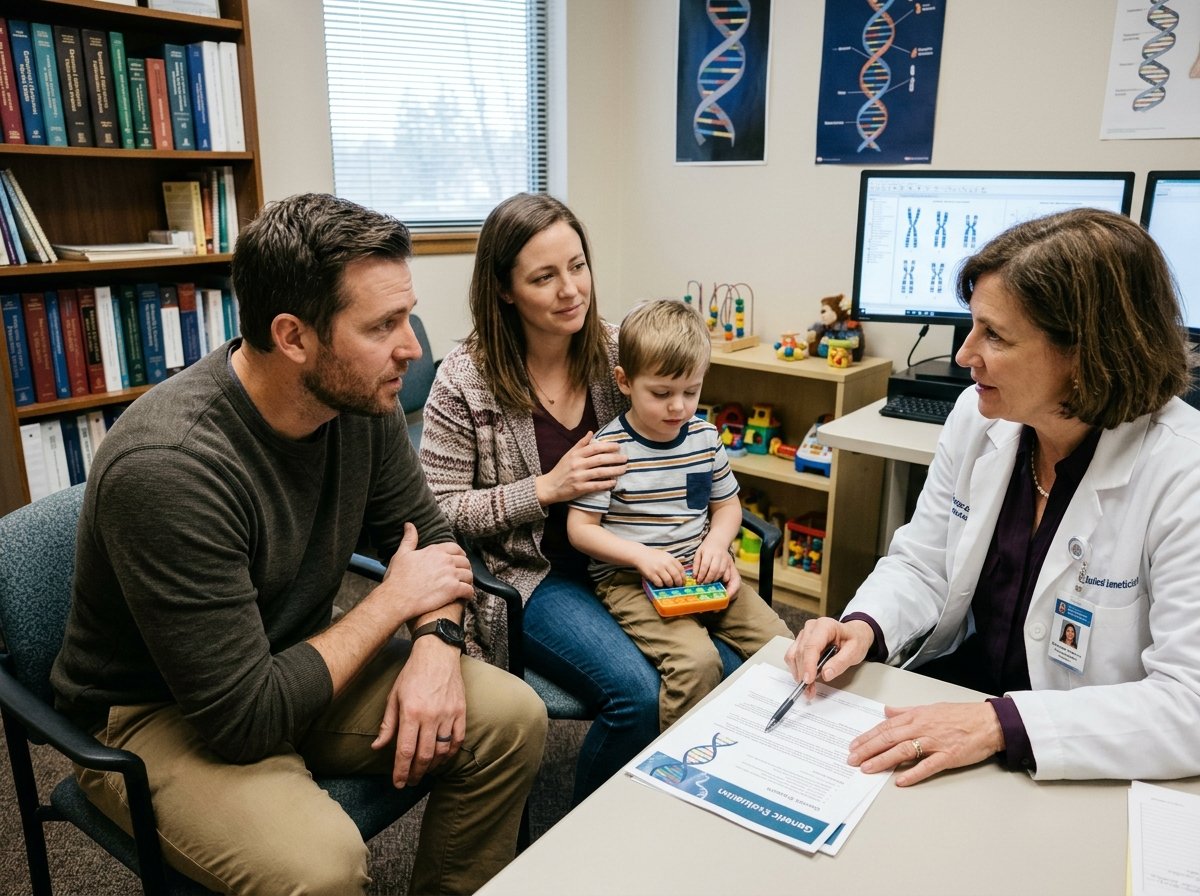
After discussing our concerns, we decided to seek another medical opinion. We began seeing a neurologist who could evaluate our son’s development and help us determine whether additional investigations might be useful. During the neurologist’s first appointment with our son, the doctor appeared to question whether autism alone explained his developmental difficulties. This immediately caught our attention because it reflected some of the questions my husband had been raising. For the first time, we felt that there might be another explanation worth investigating. We did not want to jump to conclusions or assume that the original diagnosis had necessarily been incorrect. We simply wanted a more complete understanding of our son’s condition. The neurologist recommended further investigation, including genetic testing, which could potentially reveal whether an underlying genetic condition was contributing to his developmental delays. After discussing the option, we decided that finding more information was worth pursuing, even though we had no idea what the results might reveal.
Looking back, there was one decision from the beginning of our journey that suddenly felt much more significant. When we first learned that I was pregnant with our son, my obstetrician’s clinic offered us genetic testing and carrier screening. At the time, we decided not to proceed with those tests. Money was tight, and we did not have any known reason to believe that a genetic condition ran in either side of our family. We assumed that if there were no obvious warning signs in our family history, additional screening might not be necessary. We were not trying to ignore a known risk or make an irresponsible decision. We simply made the choice that seemed reasonable to us with the information and financial circumstances we had at the time. Neither of us could have predicted how much we would eventually learn about our son’s health. Once the possibility of a genetic condition entered the conversation, I found myself thinking about that earlier decision and wondering whether our journey might have unfolded differently if we had known more during the pregnancy.
About a month ago, we finally received the results of our son’s genetic testing. I remember how nervous I felt as we prepared to learn what the tests had discovered. Part of me hoped that the results would provide a straightforward explanation for his developmental delays and help us identify more effective ways to support him. Another part of me was afraid that we might learn something unexpected. When we were told that our son had Fragile X syndrome, we were shocked. Neither my husband nor I had expected that diagnosis, and initially, we struggled to understand what it meant. We had heard of various developmental conditions, but Fragile X syndrome was not something we knew much about before that day. Suddenly, we were faced with unfamiliar medical terminology, genetic information, and questions about what the diagnosis might mean for our son’s future. I wanted clear answers immediately, but I quickly realized that understanding this condition would take time, patience, and guidance from professionals.
As we began researching Fragile X syndrome, we discovered that it is a genetic condition associated with changes in the FMR1 gene on the X chromosome. These changes can interfere with the production of a protein that plays an important role in brain development and functioning. The condition can cause intellectual disability, developmental delays, learning difficulties, and behavioral differences, although its effects vary considerably from one individual to another. We also learned that Fragile X syndrome is an important inherited cause of intellectual disability and can be associated with autism-related characteristics. Reading about these possibilities was overwhelming because we suddenly had a new framework for understanding some of the challenges our son had experienced. We also learned that the condition is often inherited through the maternal side of a family, although the inheritance pattern can be more complicated than that simple description suggests. The more information we discovered, the more questions we had about our family history, our son’s needs, and what additional testing might tell us.
The most difficult part was thinking about the uncertainty surrounding our son’s future. After reading accounts from other families and speaking with several genetic counselors, we became frightened about the possibility that he might need substantial support throughout his life. We worried about whether he would eventually be able to work, live independently, form relationships, or have a family of his own if that was what he wanted. Those questions were painful because, like most parents, we had imagined countless possibilities for our child’s future without knowing which challenges he might face. However, we also began to understand that reading other families’ experiences could not tell us exactly what our son’s life would look like. Fragile X syndrome affects people differently, and a diagnosis alone cannot determine every individual’s abilities or future opportunities. His current needs are real, and he may require considerable assistance, but we still have much to learn about his individual strengths, development, and long-term support needs. We are trying to balance our concerns with the understanding that his future is not something we can fully predict today.
My husband’s questions about the original autism diagnosis eventually led us toward genetic testing, and the results changed our understanding of our son’s developmental difficulties. I still think about how uncertain we felt before we received the diagnosis and how overwhelming everything seemed afterward. We now have an additional explanation for his challenges, but that does not mean we suddenly have every answer. We continue to rely on his doctors, therapists, and genetic counselors to help us understand his condition and plan for his needs. We also want to make sure that our son grows up knowing that he is loved for who he is, not judged by a diagnosis or limited by other people’s assumptions about what he might accomplish. There will undoubtedly be difficult days ahead, and we may need to adjust our expectations as we learn more about his abilities. For now, we are trying to focus on the child in front of us rather than allowing fear about the distant future to overshadow the progress he can make today. We cannot change the uncertainty we faced in the past, but we can continue learning, advocating for our son, and giving him the support he deserves.
Read Story…
Devastated by My Son’s Diagnosis, I Struggled to Find the Strength to Face What Came Next
My 5 year old son has always been delayed. He’s hit all of his milestones significantly later than most kids his age. He’s in physical therapy, speech therapy, and occupational therapy. He was diagnosed with autism when he was 3. I was willing to accept this diagnosis. My husband was not. He said it just didn’t seem to fit our son. So we started seeing a neurologist who, upon first meeting our son, immediately seemed to question the autism diagnosis. So, we decided to do some genetic testing.
When we found out we were pregnant with our son, we opted not to do any genetic testing or carrier screening when my OB clinic offered. We didn’t have a lot of money, and we had no reason to believe anything ran on either side of our families. About a month ago, we got our son’s genetic testing results back. He has Fragile X Syndrome.
We were shocked. And the more we looked into Fragile X, the more devastated we became. It’s an X chromosome linked disorder, meaning it (usually) comes from the mom’s side. It’s the most common genetically linked form of intellectual disability. Their body doesn’t create the proteins needed to be able to learn.
After reading stories from other families with Fragile X children and speaking to multiple genetic counselors, it’s very likely that our son will never be able to get a job, be independent, have a family of his own.
Because I am a carrier of Fragile X ( I have one normal X and one affected X), each pregnancy has about a 50% chance of receiving my affected X chromosome. Males are much more likely to be severely affected. And just based on developmental and physical similarities, we believe his 1.5 year old brother also has Fragile X. We are getting him tested next week to be sure.
Then we started reading about how females who are Fragile X carriers have a chance of going through menopause early – like in their 30s (I’m early 30s). There’s also a chance of developing Parkinsons-like symptoms (tremors, ataxia, memory loss) in my 50s.
And because we weren’t dealing with enough already, we found all of this out when I was 16 weeks pregnant…with another boy. We have been scrambling to get in somewhere to do an amniocentesis to test if this baby has Fragile X. We are considering termination if he does have it. I feel so broken and so guilty. I have cried every day and I change my mind every hour.
This baby was planned and wanted. But my husband and I don’t come from big families. When we go, there will be no one left to look out for our children who will likely not understand what’s going on. To subject a third child to a future where we can’t guarantee they’ll be looked after when my husband and I are gone feels cruel and irresponsible.
My mental health has been absolutely horrible. I feel like I’m already in a state of grieving. I no longer want to see my baby on ultrasounds.
I don’t want to feel him kicking. It just reminds me that he’s there and that I may have to say goodbye to him. I guess I’m just looking for some words of comfort from internet strangers as we face this impossible decision.
Dinner is cajun sausage and beans made in the crockpot.
Our Son’s Genetic Diagnosis Changed Everything We Thought We Knew About His Future
I never imagined that a medical diagnosis could completely change the way my husband and I understood our son’s future, but that is exactly what happened. Our son is five years old, and for most of his life, we have known that his development was different from that of other children his age. He has always needed more time to learn new skills, and many of the milestones that other children reached naturally took him much longer to achieve. As his parents, we spent years trying to understand his needs, find appropriate support, and figure out how we could help him grow. We knew something was different, but we did not know exactly why. When we finally received an explanation through genetic testing, we were shocked by what we learned. The diagnosis answered some of our questions, but it also introduced new concerns about his development, his future independence, and the kind of support he might need throughout his life.
When our son was younger, I began noticing that he was not reaching developmental milestones at the same pace as other children. Some skills that seemed relatively simple for children his age required much more time, repetition, and assistance for him. At first, I tried not to worry too much because I understood that children develop at different rates. I did not want to compare him constantly with other children or make him feel as though he was somehow falling behind. However, as time passed, the differences became more noticeable. We started seeking professional advice because we wanted to understand what was happening rather than simply waiting and hoping that everything would resolve itself. Each appointment brought more questions, and although we wanted clear answers, we gradually realized that understanding our son’s development would probably be a long process involving several specialists and different types of assessments.
Eventually, our son began receiving different forms of therapy to help him develop important skills. He started physical therapy, speech therapy, and occupational therapy, each intended to address particular areas of difficulty. These appointments became part of our family routine, and we learned to organize our schedules around his needs. Some days were encouraging because we noticed small improvements, while other days reminded us how much patience and continued support he required. I tried to celebrate every achievement, even when it seemed minor to someone who did not understand how much effort it had taken him to reach that point. My husband and I wanted our son to have every opportunity to learn and develop at his own pace. Although the therapy sessions could be exhausting, we continued attending because we believed that helping him build skills and confidence was more important than expecting him to follow the same timeline as other children.
When our son was three years old, he received an autism diagnosis. By then, we had already spent considerable time discussing his development with professionals, so the diagnosis was not entirely unexpected. I was prepared to accept it because I wanted to focus on understanding his needs and finding the right support. To me, a diagnosis was not a label that defined his entire identity. It was information that could help us understand some of his challenges and make better decisions about his care. I knew that autism affects people differently, and I did not expect one diagnosis to explain every aspect of my son’s personality or development. What mattered most was that we continued learning about him as an individual. I hoped that having a clearer understanding of his needs would help us make progress and give him the best possible opportunities as he grew older.
My husband, however, had a much harder time accepting the autism diagnosis. He did not deny that our son experienced developmental delays, because those difficulties were obvious to both of us. Instead, he felt that autism did not completely explain what he observed in our child. He would sometimes question whether the evaluation had captured the full picture or whether another condition might be contributing to the delays. Initially, I struggled with his reaction because I worried that questioning the diagnosis might distract us from the support our son needed. I wanted us to accept the professional advice we had received and move forward together. At the same time, I understood that my husband was trying to make sense of a situation that neither of us had expected. He wanted to know why our son was struggling and whether there was something important we had not yet discovered.
Our disagreements were never really about whether we loved our son or wanted the best for him. We both wanted him to thrive, but we approached the uncertainty differently. I preferred to work with the information we had and concentrate on the therapies and resources available to us. My husband wanted to investigate further because he felt there might be another explanation. Sometimes, I worried that we were becoming too focused on finding a different answer instead of appreciating the progress our son was making. Other times, I wondered whether my husband had noticed something that deserved further investigation. Parenting a child with developmental challenges can involve difficult decisions, especially when medical information is incomplete or when different conditions share similar characteristics. We were learning as we went, and neither of us had a perfect understanding of what our son was experiencing. Eventually, we agreed that seeking another medical opinion might help us move forward with greater confidence.
We began seeing a neurologist who could evaluate our son’s developmental history and help us understand whether additional testing would be useful. I hoped the appointments would give us a clearer picture of his condition, even if the final explanation turned out to be complicated. During the neurologist’s first meeting with our son, the doctor appeared to question whether autism alone explained his developmental difficulties. This immediately caught our attention because it reflected some of the concerns my husband had expressed. For the first time, we felt that there might be another possibility worth exploring. However, we did not want to assume that the original diagnosis had necessarily been wrong. Autism and other developmental or genetic conditions can overlap, and one diagnosis does not automatically rule out another. We simply wanted a thorough evaluation that considered the full range of possibilities and helped us understand what kind of support would best meet our son’s needs.
After discussing our concerns with the neurologist, we decided to pursue genetic testing. Neither of us knew what the results would reveal, and I tried not to become too attached to any particular outcome. Part of me hoped the testing would provide a straightforward explanation for our son’s delays and possibly help us identify more specific treatments or support services. Another part of me worried that we might discover something we had never considered. Genetic testing can provide important information, but it can also introduce complicated questions about inheritance, family history, and long-term development. We knew that the results might affect how we understood our son’s condition, yet we could not prepare ourselves for every possibility. We completed the necessary steps and waited for the results, hoping that the information would help us make informed decisions about his care and give us a clearer understanding of what we had been trying to figure out for years.
While we waited, I found myself thinking about the choices we had made before our son was born. When I was pregnant, my obstetrician’s clinic offered genetic testing and carrier screening. At the time, we decided not to proceed with those tests. We did not have much money, and there was no known history of a similar condition on either side of our families. We assumed that additional screening was not necessary in our circumstances, although we understood that no pregnancy came with a guarantee that a child would have no medical or developmental difficulties. We were making decisions with the information we had at the time and trying to manage our finances responsibly. Back then, I never imagined that genetic testing would eventually become such an important part of our family’s life. Looking back now, I sometimes wonder what we might have learned earlier, but I also know that we cannot judge every past decision using information we only discovered years later.
About a month ago, we finally received our son’s genetic testing results. I remember feeling nervous as we prepared to hear what the tests had found. We had spent so long trying to understand his developmental delays that receiving a definitive result felt like an important moment in our journey. I hoped the results would help us understand his needs more clearly, but I was also afraid of what the information might mean. When we learned that our son had Fragile X syndrome, I was completely shocked. My husband and I had not expected that diagnosis, and neither of us knew enough about the condition to understand all its implications immediately. We had gone into the process hoping to find answers, but the answer we received was one we had never seriously considered. Suddenly, we were faced with a genetic condition that could explain some of our son’s challenges while raising questions about his future that we were not emotionally prepared to confront.
At first, I struggled to process the diagnosis. I kept thinking about the appointments, evaluations, and therapy sessions we had attended over the years. I wondered how much of what we had observed might be connected to Fragile X syndrome and whether there were other aspects of his development that we had not fully understood. My husband also seemed overwhelmed by the information. Although he had questioned the autism diagnosis because he believed it did not explain everything, discovering a genetic condition was not the simple resolution either of us had hoped for. We still needed to understand the condition, learn what it meant for our son’s individual circumstances, and determine what support might be helpful. The test result was important, but it did not instantly answer every question. Instead, it opened a new chapter in our journey, one that required us to learn unfamiliar medical information and reconsider some of our assumptions about our son’s development.
We began researching Fragile X syndrome because we wanted to understand what the diagnosis meant. We learned that it is a genetic condition associated with changes in the FMR1 gene on the X chromosome. These changes can affect the production of fragile X messenger ribonucleoprotein, commonly called FMRP, a protein that plays an important role in brain development and functioning. When this protein is absent or significantly reduced, learning and development can be affected. Depending on the individual, Fragile X syndrome may be associated with intellectual disability, developmental delays, speech and language difficulties, behavioral differences, and other health concerns. Reading these explanations helped us understand why the genetic test mattered, but the amount of information was overwhelming. Every medical term seemed to lead to another question, and we struggled to separate what was generally true about the condition from what might apply specifically to our son.
One of the things we discovered was that Fragile X syndrome is an important inherited cause of intellectual disability. Before receiving the diagnosis, we had not realized that a genetic condition could contribute to so many different aspects of development. We had noticed our son’s delays, but we had not understood the underlying biological process that might be involved. Learning about the FMR1 gene helped us see why genetic testing had been recommended and why the neurologist wanted a more complete explanation. At the same time, we learned that people with Fragile X syndrome can have very different experiences. Some individuals need extensive daily support, while others develop greater independence and learn to manage many activities with appropriate assistance. This variation made it difficult to predict exactly what our son’s life might look like. We knew that the diagnosis was significant, but we also knew that general information about a condition could not tell us everything about one individual child.
As we continued learning, we also discovered that Fragile X syndrome can be associated with autism-related characteristics. This helped us understand why the two diagnoses were not necessarily mutually exclusive. Our son’s genetic result provided an important explanation for some of his developmental challenges, but it did not automatically mean that his earlier autism diagnosis was incorrect. Only qualified professionals familiar with his complete history could help us understand how the conditions might relate to his particular circumstances. This was important because we had initially approached the genetic testing partly because my husband questioned whether autism explained everything. Now, we understood that the answer might be more complicated than choosing one diagnosis over another. Our son could have characteristics associated with more than one condition, and his support needs would have to be considered individually. We began to focus less on which label was correct and more on understanding the full picture of his development.
Another difficult discovery was learning about the inheritance pattern of Fragile X syndrome. Because the condition involves the X chromosome and changes in the FMR1 gene, it can be passed through families, often through the maternal side. Before this experience, we had assumed that the absence of a known family history made a genetic condition unlikely enough that we did not need to pursue screening during pregnancy. We now understood that inherited genetic conditions can sometimes appear in families without anyone realizing that a relevant genetic change is present. A person can carry an FMR1 gene change without having the same symptoms or level of impairment as an affected child. We needed a genetic counselor to explain how inheritance worked in our family and whether further testing might be appropriate. Learning this was emotionally complicated because it made us reconsider our family history, but we also understood that genetic inheritance is not a matter of blame or personal failure.
I found myself returning to the decision we had made during pregnancy not to undergo genetic testing or carrier screening. I wondered whether the results might have given us useful information earlier or helped us prepare for our son’s needs before he was born. I thought about how little we knew at the time and how confident we had felt because neither side of our family had a known history of similar difficulties. It was tempting to imagine that one different decision could have prevented all the uncertainty we had experienced, but I knew that was not necessarily true. Genetic screening does not identify every possible condition, and the information available during pregnancy depends on the specific tests performed. Even when a condition is identified early, it does not remove the challenges of raising a child who needs additional support. I tried to remind myself that we had made the best decision we could with the knowledge and financial resources available to us at the time.
After the diagnosis, we spoke with several genetic counselors to learn more about Fragile X syndrome and what the results might mean for our family. These conversations were important because online research sometimes made the future seem more frightening than it needed to be. Reading about other families’ experiences gave us insight into the range of challenges that can occur, but it also exposed us to stories that were difficult to read without imagining the worst possible outcome for our own child. The counselors helped us understand the condition in a more individualized way and explained why we should not assume that every person with Fragile X syndrome follows the same developmental path. They also discussed the importance of considering our son’s current abilities, ongoing assessments, and future support needs rather than trying to predict his entire life from a genetic result. We still had many questions, but these conversations helped us approach them more carefully.
One of my biggest fears was whether our son would ever be able to live independently. I began thinking about what would happen when he grew older and we were no longer able to provide the same level of daily support. Would he be able to manage his own routines, communicate his needs, make decisions, or live safely without constant assistance? Would he be able to pursue education, training, or employment in some form? These questions were difficult because they concerned a future that was still many years away. I had previously imagined watching him grow up, become an adult, and gradually build a life of his own. Now, I was afraid that some of those milestones might be much harder for him to reach than I had expected. I had to remind myself that we were only beginning to understand his condition and that it was too early to make absolute predictions about his abilities as an adult.
I also worried about whether he would eventually be able to form close relationships and have a family of his own if that was something he wanted. As a parent, it is natural to imagine your child experiencing the ordinary joys of adulthood, including friendships, love, meaningful work, and the freedom to make personal choices. Thinking that some of those experiences might be more complicated for our son was painful. However, I gradually began to recognize that his future relationships and personal life would depend on many factors, including his individual development, preferences, opportunities, and the support available to him. A diagnosis could not tell us exactly what kind of life he would want or what he might achieve. He was still a five-year-old child with years of learning and development ahead of him. I did not want my fear about the future to make me overlook his present experiences or treat possibilities as though they were already certain outcomes.
My husband was also trying to come to terms with the diagnosis, although he sometimes expressed his emotions differently from me. At first, he had questioned the autism diagnosis because he felt there was something more to understand. Now, he was confronted with a genetic condition that carried its own uncertainties and potential challenges. I knew he was worried about our son’s future, even when he did not openly discuss every concern. We had both hoped that additional testing would give us clarity, but we had not fully understood that new information could bring both answers and more questions. We tried to support each other as we learned about Fragile X syndrome, even when we processed the news at different speeds. Some days, one of us felt more hopeful while the other struggled with worry. We began to understand that neither of us had to respond to the diagnosis in exactly the same way to remain committed to our son.
Despite our fears, we knew that our son still needed the same love, patience, and encouragement he had always needed from us. His diagnosis did not change the child we knew. He was still the little boy whose personality, preferences, interests, and daily experiences made him unique. He still deserved opportunities to learn new skills, explore the world, develop friendships, and discover what brought him happiness. We did not want every interaction with him to become focused on his developmental delays or the medical information we had recently received. It was important to remember that he was more than a diagnosis and that his life would include experiences that could not be measured through assessments or therapy reports. We wanted to continue celebrating his progress, supporting his interests, and allowing him to develop at his own pace. His condition might shape parts of his life, but it would never be the only thing that defined him.
We also began thinking more carefully about the therapies and services he was already receiving. Physical therapy, speech therapy, and occupational therapy had become familiar parts of our routine, but the genetic diagnosis gave us another reason to review his needs with his care team. We wanted to know whether any additional evaluations, educational accommodations, or specialized services might be helpful as he grew older. We understood that there was no single treatment that could simply eliminate Fragile X syndrome, but supportive interventions could help address specific developmental and functional challenges. Our goal was not to force him to meet every milestone on the same schedule as other children. Instead, we wanted to help him build the strongest possible foundation for communication, daily living, learning, and participation in activities that mattered to him. We knew that progress might take time, but we were prepared to continue advocating for appropriate support.
One thing that became clearer during this process was the importance of avoiding comparisons with other children, including other children who have Fragile X syndrome. Before receiving the diagnosis, I sometimes looked at children around our son’s age and wondered why certain skills seemed to come so much more easily to them. After learning about his condition, I found myself reading about other children with the same diagnosis and comparing their development with his. I eventually realized that this could create another source of anxiety without necessarily helping us understand our son. Every child has a different combination of strengths, challenges, interests, and support needs. Even children who share the same genetic condition may have very different abilities and experiences. I wanted to learn from other families without assuming that their stories predicted what would happen to our son. His progress needed to be understood on its own terms, with realistic goals that reflected his individual circumstances.
I also had to confront the emotions that came with realizing how much we still did not know. Before the genetic testing, I had hoped that finding an explanation would make everything feel more manageable. In some ways, it did. We finally had a specific genetic diagnosis that could help guide further evaluation and planning. However, knowing the name of a condition did not automatically tell us how our son’s abilities would develop or how much assistance he would need as an adult. I had to accept that some questions would only be answered gradually, through continued observation, professional guidance, and experience. This uncertainty was difficult because I wanted to protect my child from every possible hardship. Yet I was beginning to understand that parenting also meant learning how to live with unanswered questions while still making thoughtful decisions in the present.
I sometimes wondered whether our decision not to pursue genetic testing during pregnancy had changed the course of our family’s experience. Perhaps we would have received information earlier, asked different questions, or prepared ourselves in another way. At the same time, I knew that receiving a diagnosis before birth would not necessarily have made the situation emotionally easier or provided a complete picture of our son’s future. We might still have faced uncertainty, difficult decisions, and the same need to learn about his individual needs. I did not want to spend years punishing myself for a decision we made without knowing what we know today. Many parents make healthcare decisions based on the information, advice, circumstances, and financial limitations available to them at the time. What mattered now was how we responded to the information we had received and how we used it to support our son going forward.
The experience also changed how my husband and I approached conversations about our son’s development. Previously, our discussions sometimes centered on whether autism explained everything or whether another diagnosis might be more accurate. Now, we were learning to ask more practical questions. What skills was our son currently developing? What difficulties were affecting his daily life? Which therapies were helping him, and where might he need additional support? What could we do at home to encourage communication, learning, and independence in ways appropriate for his abilities? These questions did not remove our worries, but they gave us something constructive to focus on. Instead of trying to predict every challenge he might face decades from now, we could work with his doctors and therapists to understand his needs today. We were beginning to see that a useful diagnosis was not simply an answer to a medical mystery; it was also an opportunity to make more informed decisions about care.
We are still learning what Fragile X syndrome means for our son, and I know our understanding will continue to develop as he grows. There will probably be appointments, evaluations, and difficult conversations that we have not yet anticipated. We may need to adjust our expectations, explore new educational opportunities, or seek different forms of support as his needs change. Some days, I still feel overwhelmed when I think about the uncertainty ahead. Other days, I can focus on the child I know and the progress he is making right now. I am learning that hope does not require pretending that everything will be easy or ignoring the real challenges associated with his condition. It means recognizing those challenges while remaining open to possibilities, improvements, and experiences that we cannot yet predict. I want our family to be prepared without allowing fear to determine every decision we make.
Looking back, I can understand why my husband questioned the original autism diagnosis, even though neither of us knew what the genetic testing would reveal. His questions encouraged us to investigate further, and that investigation gave us information that we might otherwise not have discovered at that time. However, I have also learned that medical diagnoses do not always fit into simple categories, and finding one condition does not automatically invalidate another. Our son deserves a comprehensive understanding of his development rather than a debate about which label matters most. We now have a clearer reason to ask certain questions and seek appropriate guidance, but we still need to understand his individual strengths and needs. I am trying to let go of the idea that one test result will explain every difficulty or tell us exactly what his adult life will look like. Our responsibility is to keep learning and provide the support he needs as his journey unfolds.
Ultimately, genetic testing changed everything about how we understood our son’s developmental delays, but it did not change how much we love him. The diagnosis of Fragile X syndrome was frightening, and I would be lying if I said I never worried about his ability to live independently, pursue employment, build relationships, or make his own choices as he grows older. Those concerns are real, and we are still working through them. At the same time, we know that his future cannot be fully determined by a diagnosis or by the experiences of other families. We will continue working with his doctors, therapists, and genetic counselors, learning about his needs, and helping him develop the skills that can improve his quality of life. We cannot go back and change the decisions we made before he was born, and we cannot remove every uncertainty that lies ahead. What we can do is meet him where he is, celebrate his progress, advocate for his needs, and make sure he always knows that he is loved. Our son may face challenges that other children do not, but he will never have to face them without a family committed to helping him find his own path.