My University Degree Was Used Against Me When I Tried to Prove I Was Disabled
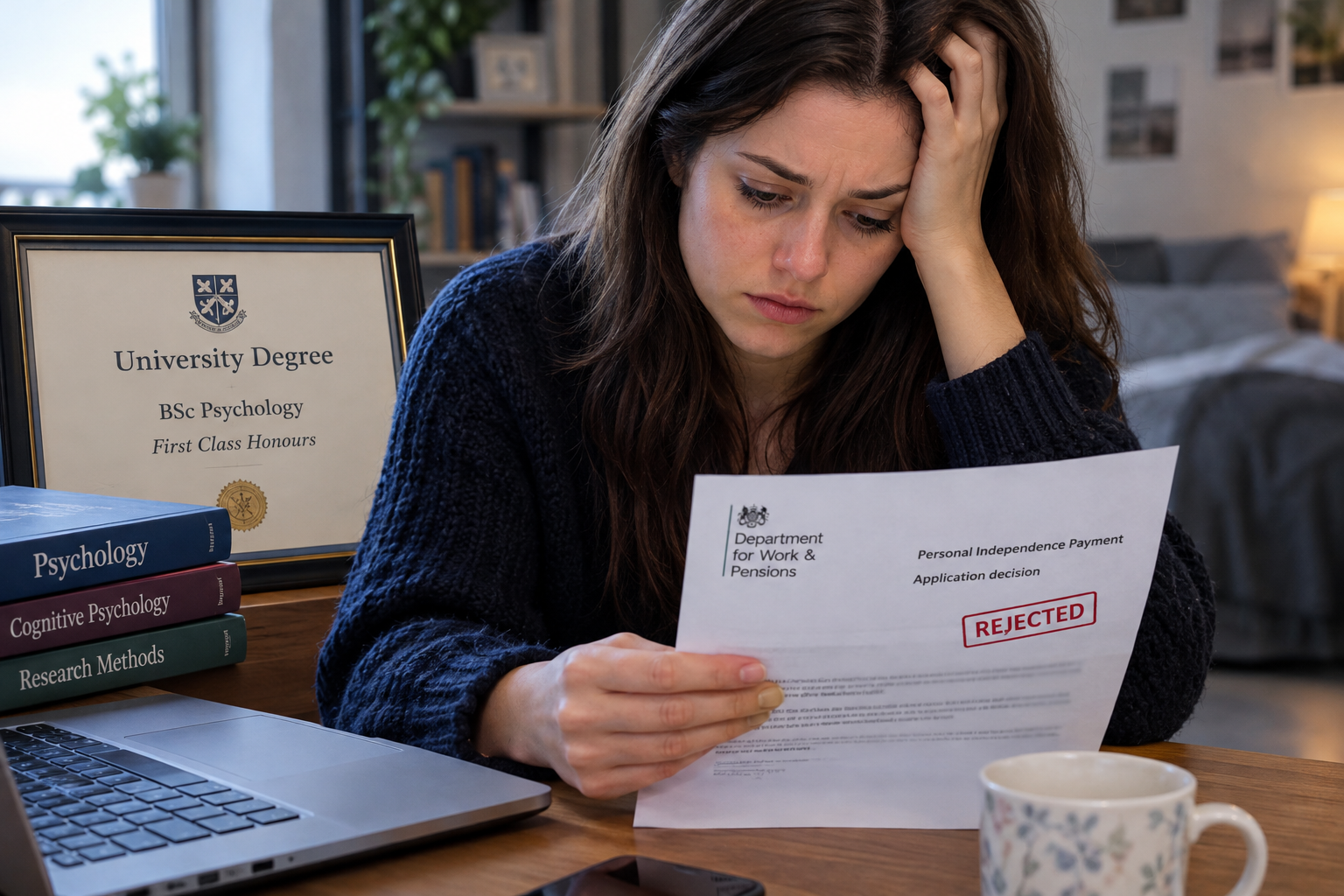
I never imagined that something I had worked so hard to achieve would eventually be used against me during one of the most difficult periods of my life. For years, I believed that earning a university degree was something I could always be proud of. It represented years of studying, countless sleepless nights, difficult exams, and the determination to keep going even when life felt overwhelming. I had worked incredibly hard to reach that point, and graduating was one of the proudest moments of my life. However, when I later tried to prove that I was disabled and needed support, my education suddenly became a reason for people to question my condition. Instead of looking at the difficulties I faced every day, they focused on the fact that I had managed to graduate. It felt as though my past achievements were being used to erase the struggles I was experiencing in the present.
The truth is that earning my degree was never as easy as it might have appeared from the outside. People saw the graduation ceremony, the certificate, and the photographs, but they did not see everything that happened behind the scenes. They did not see how much extra time I sometimes needed to complete assignments, how exhausted I became after attending classes, or how often I had to push myself beyond what felt manageable. There were days when even simple responsibilities required enormous effort, but I kept trying because I wanted to finish my education. I learned to adapt, find ways around obstacles, and hide some of my difficulties because I did not want to be treated differently. From the outside, I probably looked like someone who was coping reasonably well. In reality, I was often struggling far more than anyone realized.
For a long time, I believed that if I worked hard enough and proved myself capable, people would eventually understand me. I thought my education would demonstrate my determination and ability to overcome challenges. I never expected that the same achievement would later be interpreted as evidence that I could not possibly be disabled. When my health and daily functioning made it increasingly difficult to manage ordinary responsibilities, I reached a point where I needed formal recognition of my limitations. Asking for help was not an easy decision. I had spent years trying to manage everything independently, and admitting that I could no longer do so consistently made me feel vulnerable. Still, I understood that I could not keep pretending everything was fine. I gathered the information I had, explained my difficulties, and began the process of proving that I needed support.
During that process, I encountered an attitude that left me feeling confused and deeply frustrated. My university degree became one of the main things people seemed to focus on when considering whether my difficulties were genuine. The reasoning appeared to be that if I had been capable of completing higher education, I must also be capable of handling other demanding aspects of life. I struggled to understand how anyone could make that assumption without considering the circumstances under which I had earned my qualification. Completing a degree requires particular skills in a particular environment, often with deadlines, structured support, accommodations, and periods of intense effort. It does not automatically demonstrate that someone can consistently work full-time, manage everyday responsibilities without assistance, or function without experiencing significant limitations. Yet it seemed that my achievement spoke louder than my explanation of what I was going through.
What made the situation especially painful was that I had never claimed to be incapable of doing anything. I was not asking anyone to pretend that I had accomplished nothing or that I lacked skills. I was simply trying to explain that having certain abilities did not mean I could use them without difficulty in every situation. There is a difference between being able to complete a task occasionally and being able to perform it reliably, repeatedly, and without serious consequences for your health or well-being. I might be able to concentrate for a limited period, but that did not mean I could maintain that concentration throughout an entire working day. I might be able to complete a demanding project when I had enough time to recover afterward, but that did not mean I could manage the same workload every week. Those distinctions seemed obvious to me, yet I struggled to make others understand them.
I also began to realize how easily people misunderstand disabilities that are not immediately visible. When someone uses a wheelchair or has an obvious physical impairment, strangers may have a clearer idea that the person faces certain barriers. However, when a disability affects someone’s energy, concentration, mental processing, pain levels, or ability to manage daily tasks, those limitations can be much harder for others to recognize. A person might appear perfectly fine during a short conversation and still struggle significantly afterward. They might smile, speak confidently, and describe their education without revealing the exhaustion or difficulties behind those experiences. I had become skilled at presenting myself as capable because that was how I had learned to survive in environments where showing difficulty often led to judgment. Unfortunately, the better I became at hiding my struggles, the easier it seemed for people to dismiss them.
The entire experience began to affect my confidence in ways I had not anticipated. I started questioning whether I had explained myself poorly or whether I needed to provide even more evidence to make people take me seriously. I revisited my past and wondered whether every successful moment would be used against me. Would people point to my graduation, previous employment, or the responsibilities I had once managed and decide that my current difficulties could not be real? I felt trapped between two unfair expectations. If I tried to accomplish something despite my limitations, that achievement could be interpreted as proof that I did not need help. If I admitted that I was struggling, I worried that people would assume I was exaggerating or making excuses. It was exhausting to feel that I had to defend not only my needs but also every accomplishment that had once made me proud.
Eventually, I understood that I could not change every person’s assumptions, but I could become clearer about what I was trying to communicate. My degree described an important part of my educational history. It did not provide a complete picture of my health, my daily functioning, or the challenges I faced outside the university environment. I began focusing more carefully on explaining the practical effects of my limitations rather than simply telling people that I was struggling. I wanted them to understand what happened when I attempted ordinary tasks, how consistently I could manage them, what support I needed, and what happened when I pushed myself too far. I also reminded myself that needing assistance did not erase my intelligence, determination, or achievements. My education was something I had worked hard for, and I refused to accept that it should become a reason to feel ashamed of asking for help.
Looking back, I wish people understood that disability and achievement are not opposites. A person can earn a university degree, develop valuable skills, and accomplish meaningful goals while still living with a disability that significantly affects everyday life. Success in one area does not prove that someone has no limitations in another. My degree should have been recognized as evidence of what I had accomplished, not treated as a shortcut for deciding what I could or could not struggle with. I am still proud of the work it took to graduate, and I do not want that pride taken away from me because my circumstances have changed or because I need support. I should not have to choose between being seen as capable and being believed when I explain my difficulties. More than anything, I want people to understand that a qualification tells only one part of a person’s story. It cannot tell them everything that person has endured, what they experience privately, or what they need to live with dignity.
Read Story…
My uni degree was used as evidence that I’m not disabled
My application for Personal Independence Payment (PIP) was rejected by the Department for Work and Pensions today, and honestly, I don’t think I’ve ever felt so insulted, dismissed, and completely misunderstood by an organization that is supposed to help people who are struggling. I’ve spent months gathering information, filling out forms, explaining my difficulties, and trying to put into words how my disability affects my everyday life.
Anyone who has ever had to apply for PIP knows how exhausting the process can be.
You’re expected to explain your most personal struggles to strangers, describe the things you cannot do without help, and somehow prove that your difficulties are serious enough to deserve support. It’s already an emotionally draining experience, but receiving a rejection letter that makes you feel as though your struggles aren’t real is something else entirely.
What made the rejection particularly upsetting was the reasoning they used to support their decision. Among other things, they referred to the fact that I achieved a first-class honours degree in BSc Psychology as evidence suggesting that I wasn’t disabled enough to qualify for financial assistance.
Yes, apparently, managing to complete a university degree means that my difficulties must not be significant enough to deserve support. I genuinely sat there reading the letter several times because I couldn’t believe that my academic achievement was being used against me in this way. I worked incredibly hard for that degree, and I know exactly how much effort it took to get there. What they apparently failed to understand is that being intelligent, academically capable, or determined enough to achieve something does not magically remove the difficulties associated with being disabled.
My degree wasn’t handed to me on a silver platter. There were challenges, sacrifices, difficult days, and moments when simply keeping up with everything felt overwhelming. Achieving a first-class honours degree doesn’t mean I never struggle with everyday tasks, that I don’t need assistance, or that my disability suddenly disappears when I sit down to study. It means I achieved something academically, despite whatever challenges I was experiencing.
I thought that was something I could be proud of, but after reading the letter, I found myself questioning whether I should have even mentioned it in my application. How ridiculous is that? Something I worked so hard to accomplish had suddenly become a reason to suggest that I didn’t deserve help.
The letter didn’t just make me angry; it genuinely affected the way I saw myself. I started questioning whether I was exaggerating my difficulties, whether I was somehow being unreasonable for asking for support, and whether I had any right to feel disabled at all. I know, logically, that a university degree doesn’t determine whether someone is disabled, but when an official decision appears to dismiss your experiences, it’s difficult not to internalize some of that judgment.
I found myself replaying every question I’d answered on the application and wondering whether I should have explained things differently. Perhaps I should have described my worst days more clearly. Perhaps I should have included more examples. Perhaps I should have done something differently.
Before I knew it, I was blaming myself for a decision that had left me feeling as though my entire life had been reduced to a few paragraphs in a rejection letter.
What made the whole situation worse was the feeling that I had to prove my struggles to people who had already decided what they meant. I wasn’t asking for a reward for getting a degree, and I certainly wasn’t asking for special treatment because I had worked hard. I was applying for financial support because I believed my circumstances justified it.
I wanted my application to be considered fairly, based on how my condition affects my daily life, rather than having my academic qualifications treated as some sort of evidence that I must be perfectly capable of managing everything independently. People can be educated and disabled. People can have successful careers and still need assistance. People can accomplish extraordinary things in one area of life while finding ordinary daily activities incredibly difficult.
These things are not mutually exclusive, and I genuinely don’t understand why that seems so difficult for some people to grasp.
Eventually, the sadness turned into anger. I went from sitting on my sofa feeling worthless to becoming absolutely furious about the way the decision had made me feel. I was angry at the system, angry at the assumptions behind the letter, and angry that I had spent so much time trying to explain myself only to receive a response that seemed to use my own achievements against me.
I wanted someone to understand how humiliating it felt to have my disability questioned in this way. I wanted someone to acknowledge that a degree certificate cannot tell you everything about a person’s physical or mental capabilities, their support needs, or the difficulties they experience behind closed doors. Instead, I was left feeling as though I had to defend not only my application but also my right to describe my own life honestly.
And then, after spending far too long spiralling into self-hatred, I did something that I probably wouldn’t have predicted even a few hours earlier. I opened Etsy. Yes, Etsy. The same website where people sell handmade jewellery, personalised mugs, knitted blankets, and all sorts of charming little gifts.
Except I wasn’t looking for a birthday present or a new pair of earrings. I was looking for a witch. Specifically, a witch who offered curse services. I scrolled through listings with the seriousness of someone researching an important legal matter, reading descriptions, checking reviews, and considering which service best matched the level of rage currently consuming me. Somewhere between feeling devastated by an official letter and deciding that the situation required supernatural intervention, my brain apparently concluded that this was a perfectly reasonable next step.
I eventually found someone offering to perform a curse on my behalf and decided to pay them. I know how that sounds. I know that hiring an Etsy witch to curse a government department is probably not the most conventional way to respond to a rejected benefits application. I am also aware that there are more practical things I could be doing with my time, such as reviewing the decision, gathering additional evidence, or looking into whether I can challenge the outcome.
Those options haven’t disappeared, and I fully intend to consider them once I’ve had the opportunity to calm down and think clearly. But in that particular moment, I wasn’t interested in being the bigger person. I wasn’t interested in taking a deep breath and reminding myself that these things happen. I wanted to do something, anything, that made me feel as though I wasn’t simply sitting there helplessly accepting a decision that had hurt me.
Was the curse going to change the decision? Probably not. Do I genuinely believe that someone performing a ritual after receiving a payment on Etsy is going to cause the Department for Work and Pensions to suddenly reconsider my application? I’m not even sure what I believe about that. Part of me thinks the entire thing is ridiculous, and another part of me finds comfort in the idea that I have at least redirected some of my anger into something that made me laugh rather than cry. There is something strangely satisfying about imagining that somewhere, in a candlelit room, a stranger is performing a dramatic ritual on behalf of a furious psychology graduate who has decided that the benefits system needs a little supernatural accountability.
I also realise that some people might think I have completely overreacted. After all, it’s a rejection letter, not the end of the world. There are appeal processes, decisions can be challenged, and the practical response is to focus on those options rather than spending money on something that may have absolutely no effect. I understand that perspective, and I can appreciate that the curse probably won’t accomplish anything tangible. But I think people sometimes underestimate the emotional toll of repeatedly having to justify your needs, especially when you’re already struggling. The rejection wasn’t simply disappointing because I wasn’t awarded financial support. It hurt because the reasoning made me feel as though my achievements somehow invalidated my difficulties, as though I had accidentally proven that I was too capable to deserve help.
The part I keep coming back to is the idea that I should somehow be less accomplished in order to be believed. Would the decision have been different if I hadn’t gone to university? Would I have been considered more deserving if I had fewer qualifications, fewer achievements, or a less impressive academic record? I hate even thinking along those lines because nobody should have to feel that their success makes their disability less believable. Education should open doors, not become a weapon used to dismiss someone’s support needs. If anything, my degree taught me how important it is to look beyond superficial assumptions and consider the full circumstances of an individual. It’s incredibly frustrating to feel that the people assessing my application may have drawn conclusions from an achievement without fully appreciating the context behind it.
I’m trying to remind myself that this rejection doesn’t define me. It doesn’t erase the work I put into my degree, and it doesn’t mean my difficulties aren’t real. I can be proud of what I’ve accomplished and still acknowledge that I need help. I can be intelligent, capable in certain situations, and independent in some areas while struggling significantly in others. None of those things cancel each other out. Once the initial shock wears off, I know I need to approach the situation practically, read through the decision carefully, and consider what evidence or explanations might be needed if I decide to challenge it. I don’t want a painful experience with the system to convince me that I should be ashamed of asking for support that I genuinely believe I need.
For now, though, I have paid an Etsy witch to curse the people responsible for my rejection, and I am choosing to find that at least slightly amusing rather than spending another evening convincing myself that I am somehow the problem. Maybe the ritual will do nothing. Maybe I’ll eventually laugh about the whole thing. Maybe the only real outcome will be that a stranger on the internet has earned a few pounds from my extremely specific moment of rage. Whatever happens, I know that I need to keep moving forward, because my future matters more than the contents of one rejection letter.
So, Reddit, I have to ask: Was paying an Etsy witch to put a curse on the Department for Work and Pensions after they used my first-class psychology degree as evidence that I wasn’t disabled enough to receive PIP too much, or is this a relatively harmless way of coping with a system that has made me feel absolutely awful?
I know I should focus on challenging the decision rather than trying to summon supernatural justice, but honestly, after the day I’ve had, I don’t think I’ve ever felt so justified in being a little bit petty.
My First-Class Psychology Degree Was Used Against Me When I Applied for Disability Benefits
I never imagined that one of the achievements I was most proud of would eventually become something used against me when I needed help the most. For years, I had worked hard to build a future for myself, pushing through challenges and doing everything I could to achieve my goals. Completing my BSc Psychology degree with first-class honours was one of the proudest moments of my life. It represented years of dedication, determination, and countless hours of work. I remember feeling that all the difficulties I had experienced along the way had finally led to something meaningful. What I never expected was that this achievement would later be used as a reason to question whether I was disabled enough to deserve financial support.
My problems began when I applied for Personal Independence Payment, commonly known as PIP, through the Department for Work and Pensions in the United Kingdom. I had spent a considerable amount of time completing the application and trying to explain how my disability affected my everyday life. Anyone who has gone through the process will understand how difficult it can be to describe personal struggles in a way that fits into official forms. You are expected to explain your limitations, provide examples of the difficulties you experience, and make someone who has never met you understand what your daily life actually looks like. It can feel as though you are being asked to defend your own experiences.
I did not apply for PIP because I wanted an easy way out of life’s responsibilities. I applied because I believed I had genuine support needs and deserved to have them assessed fairly. Living with a disability can affect far more than people see from the outside. Some difficulties are obvious, while others remain hidden behind a person’s appearance, education, personality, or ability to communicate confidently. I have learned that people often make assumptions based on what they can see, without considering the effort required to maintain that appearance of normality. I hoped that the assessment process would look beyond superficial impressions and consider how my condition affected my ability to manage daily activities.
When I submitted my application, I tried to be as honest as possible. I explained the difficulties I experienced and did my best to communicate the impact they had on my life. I understood that the decision would not necessarily be straightforward, and I knew that applying did not guarantee approval. However, I believed that if I provided accurate information about my circumstances, the people responsible for assessing my application would consider it carefully. I was prepared for questions, requests for additional evidence, or even a decision I disagreed with. What I was not prepared for was feeling as though an achievement I had worked so hard for had become evidence against me.
The day the decision arrived, I was already feeling anxious. I had been waiting for an answer and repeatedly wondering whether I had explained everything clearly enough. When I finally opened the letter and began reading it, I initially tried to remain calm. I wanted to understand the reasoning behind the decision rather than immediately assume the worst. But as I continued reading, my feelings changed from nervous anticipation to disbelief, followed by anger and embarrassment. My application had been rejected, and among the reasons discussed was my academic achievement. The fact that I had earned a first-class honours degree in BSc Psychology was treated as an indication that I was not sufficiently disabled to qualify for the support I had requested.
I read that part of the letter more than once because I genuinely struggled to understand how my degree could be interpreted in that way. I had spent years working toward that qualification, often putting enormous effort into my studies. I had believed that earning a degree demonstrated determination and perseverance. Now, I was looking at a decision that appeared to treat the same achievement as a reason to question my need for assistance. It felt as though I was being punished for succeeding in an area of my life, even though that success did not mean I was free from the difficulties I had described in my application.
What seemed especially unfair was the assumption that academic ability automatically translates into the ability to manage every other part of life. University requires concentration, organisation, studying, meeting deadlines, completing assignments, and managing expectations. But the fact that someone can perform well academically does not mean they can necessarily manage every daily activity without difficulty. A person may be capable of understanding complex information while struggling with other tasks that many people take for granted. Someone can achieve excellent results in a structured academic environment and still experience substantial limitations in their everyday life. These realities are not contradictory, yet I felt that my academic record had somehow overshadowed the rest of my circumstances.
I kept thinking about the amount of work that had gone into earning my degree. There were assignments that required hours of concentration, deadlines that demanded careful planning, and periods when I had to work much harder than I wanted anyone to know. My qualification did not appear out of nowhere. It was the result of sustained effort, and I was proud of what I had achieved. But there is a difference between being able to complete a demanding task under particular circumstances and being able to carry out all the activities of daily living reliably, repeatedly, safely, and within a reasonable amount of time. I wished the people reviewing my application had understood that distinction instead of relying on my academic success to draw conclusions about my support needs.
The rejection also made me question whether being honest about my achievements had been a mistake. I wondered whether I would have been treated differently if I had never mentioned my education. Would my difficulties have seemed more believable if I had fewer qualifications? Would someone with the same disability and the same daily struggles have been viewed differently simply because they had not completed university? I hated that my mind had gone in that direction, because nobody should feel that they must hide their accomplishments to be taken seriously. Education should be something a person can celebrate without worrying that it will later be used to suggest they cannot possibly need help.
For a while, I found myself going over every detail of my application. I questioned whether I had used the right words, whether I had provided enough examples, and whether I should have described my worst days in greater detail. I wondered whether the people assessing my claim had misunderstood what I was trying to explain. Perhaps I had not communicated the full extent of my difficulties. Perhaps the information had not been considered in the way I had expected. Whatever the explanation, the result left me feeling that I had somehow failed to prove something I live with every day. It was an exhausting feeling, especially because I had already spent so much emotional energy trying to make my circumstances understandable.
The most painful part was how quickly the decision affected my confidence. I had always understood that being disabled did not mean being incapable of everything. I knew that people could have different strengths, different limitations, and different support needs. Yet reading the letter made me question my own understanding of my life. If an official decision appeared to suggest that my academic achievement was evidence against my claim, should I be reconsidering whether my difficulties were as serious as I believed? Was I exaggerating? Was I expecting too much? These thoughts were not rational conclusions, but they were difficult to push away when I was already feeling vulnerable.
I also began thinking about the people who might receive similar letters without having the confidence or emotional support to challenge them. Not everyone has the energy to question an official decision, gather additional evidence, or explain their circumstances repeatedly. Some people may simply accept the rejection because they assume the authorities must know better than they do. Others may feel ashamed for applying in the first place. I could understand how someone might read a letter like mine and begin believing that they were not deserving of help. That possibility made me even angrier, because the process of seeking support should not leave people feeling that they have to apologise for their limitations.
One of the things I found most frustrating was the feeling that I had to prove my disability by presenting the most difficult parts of my life to strangers. It is not easy to describe personal struggles in a formal application. You have to discuss things you might normally keep private, explain situations that can feel embarrassing, and provide enough detail for someone else to assess your circumstances. Then, when you receive a rejection, you may find yourself wondering whether you should have disclosed even more. It can become a cycle of explaining, waiting, worrying, and questioning yourself. Instead of feeling that you have taken a positive step toward obtaining support, you can end up feeling more exposed and less understood than before.
My frustration was not simply about the financial assistance I had hoped to receive. Of course, financial support mattered, and the rejection had practical consequences. But the emotional impact was just as significant. I had approached the process believing that my circumstances would be assessed according to the relevant criteria. Instead, I felt that one aspect of my life had been given a meaning it did not deserve. My degree was evidence that I had completed a demanding course of study. It was not a complete description of my abilities, my limitations, or the challenges I experienced outside the university environment.
I know that PIP eligibility is supposed to be assessed according to how a person’s condition affects relevant daily living and mobility activities, rather than simply whether they have a disability or possess a particular qualification. I also understand that receiving a degree does not automatically establish eligibility for benefits. My concern was that my educational achievement seemed to have been treated as evidence that I could not have significant difficulties. I wanted the assessment to consider the actual impact of my condition, the help I needed, and the circumstances I had described. A qualification can provide information about a person’s educational history, but it cannot tell an assessor everything they need to know about that person’s everyday life.
After the initial shock wore off, I started thinking about what I could do next. I knew that becoming overwhelmed by anger would not change the decision, even though I had every reason to feel upset. I needed to understand the explanation in the letter, identify which parts of the assessment I believed were inaccurate, and consider whether there was evidence that could clarify my circumstances. I began thinking about keeping a record of the difficulties I experienced, including examples of how they affected my routines and what assistance I needed. I also considered whether people who knew me well could help explain aspects of my daily life that might not have been obvious during an assessment.
At the same time, I had to remind myself that I was not responsible for every assumption someone else might make about me. It is reasonable to expect an application to be assessed fairly, and it is reasonable to question a decision when the explanation does not appear to reflect your circumstances. I did not need to prove that I was completely incapable of functioning in order to acknowledge that I experienced difficulties. Nor did I need to pretend that my degree was unimportant just because I feared it might be misunderstood. I could be proud of my academic achievements and still ask for my support needs to be taken seriously.
I eventually looked into the process for challenging a PIP decision. I learned that people who disagree with a decision can generally request a mandatory reconsideration before considering an appeal to an independent tribunal, subject to the applicable rules and deadlines. I understood that challenging the decision would require patience and careful preparation. It would not guarantee a different outcome, and I would need to focus on the reasons for the decision rather than simply express how hurtful it had been. Still, having a practical next step helped me feel a little less powerless. I could not control what had already happened, but I could decide whether to ask for the decision to be looked at again.
I also realised that I needed to separate the practical question of eligibility from the emotional judgment I had attached to the rejection. A rejected application did not mean that I was a failure. It did not mean that my disability was imaginary, that my experiences were irrelevant, or that I had somehow betrayed myself by succeeding academically. It meant that the application had been refused, and I needed to understand why and decide how to respond. That distinction sounds simple, but it was important for me to remember because the letter had made the decision feel like a verdict on my character rather than an administrative assessment.
My degree remains one of the things I am proudest of. I worked for it, earned it, and learned a great deal along the way. I do not want an upsetting experience with the benefits system to take that away from me. I want to be able to talk about my education without wondering whether someone will use it to dismiss my struggles. I want to be able to acknowledge my strengths without feeling that I must immediately list all the things I find difficult to convince people that I deserve understanding. Most importantly, I want to stop feeling as though I have to choose between being seen as capable and being believed when I explain that I need support.
I have also become more aware of how easily people confuse visible success with a lack of difficulty. When someone achieves something impressive, observers often assume that the rest of their life must be equally manageable. They see the finished degree, the job title, the completed project, or the public achievement, but they do not necessarily see the effort behind it. They may not know what support was needed, what sacrifices were made, or what happened after the achievement was completed. Success can tell us that someone accomplished something. It does not automatically tell us what it cost them or what they can manage in every other area of life.
The experience has changed how I think about disability assessments and the importance of considering people as individuals. No two people experience a condition in exactly the same way, and no single achievement can provide a complete picture of someone’s circumstances. Someone may excel at studying but struggle with personal care. Another person may manage their household but find travelling independently extremely difficult. Someone else may appear confident in public while needing substantial assistance in private. These examples are not proof that every person in those circumstances qualifies for PIP; rather, they illustrate why a person’s needs should be assessed using the relevant criteria and evidence instead of broad assumptions about what their achievements supposedly mean.
I wish I could say that receiving the rejection made me immediately determined to fight back, but my first reaction was much less inspiring. I felt hurt, embarrassed, angry, and exhausted. I wanted to shut everything away and stop thinking about the application because it was painful to revisit. There were moments when I felt that no matter how carefully I explained myself, someone would always find a reason to doubt me. I had to give myself time to process those feelings before I could approach the situation more calmly. Being determined does not mean never feeling defeated. Sometimes it means allowing yourself to feel upset and then taking the next step when you are ready.
I also had to remind myself that I was not alone in experiencing frustration with the benefits system. Many people have described the PIP process as stressful, confusing, or emotionally draining. Every application is different, and one person’s experience cannot tell us everything about the system as a whole. Nevertheless, it is easy to understand why people become discouraged when they feel that the information they provide has not been fully understood. For someone already coping with disability-related difficulties, having to repeatedly explain their circumstances can be a substantial additional burden.
The longer I reflected on the situation, the more I realised that I did not want this experience to make me ashamed of asking for help. There is a difference between accepting that a decision has been made and believing that the decision defines your worth. I can acknowledge that the department rejected my application without agreeing that my academic success tells the whole story of my life. I can accept that the process has rules and assessment criteria while still questioning whether those criteria were properly applied to my individual circumstances. I can feel angry about the reasoning without allowing that anger to convince me that I should give up.
If I decide to challenge the decision, I want to do so with clear evidence and specific examples. I want to explain what happens when I attempt relevant daily activities, whether I can manage them reliably, and what assistance or adjustments I need. I want to focus on the parts of the assessment that I believe do not accurately reflect my circumstances. Rather than relying solely on the fact that the rejection hurt me, I want to show precisely why I believe the decision should be reconsidered. I know that preparing a challenge may take time, and I may need advice from an appropriate welfare rights organisation or disability support service. Even so, I feel better knowing that the rejection does not necessarily have to be the end of the process.
There is still a part of me that struggles to understand why my first-class honours degree became such a significant issue in the decision. I cannot know exactly what weight it was given without considering the full assessment and explanation, and I do not want to assume that one sentence tells the entire story. But the fact that it was mentioned in a way that made me feel my disability was being questioned has stayed with me. It has made me think carefully about how people interpret achievements and how damaging it can be when an achievement is used to make assumptions about someone else’s limitations.
I want people to understand that disability is not a competition. There should be no expectation that someone must fail academically, abandon their ambitions, or struggle in every possible area before their difficulties can be taken seriously. A person should not have to make their life smaller to prove that they need support. We should be able to celebrate someone’s accomplishments while recognising that they may still face barriers that are not immediately visible. Achieving a degree is an important milestone, but it is not a universal measure of independence, and it should not be treated as one.
Looking back, I wish the decision had been explained in a way that helped me understand how my circumstances had been assessed against the relevant criteria. If there were areas where my evidence was insufficient, I would have preferred a clear explanation of what information was missing. If there were inconsistencies in my application, I would have wanted to understand them. Instead, the reference to my degree left me feeling as though my achievement had become a reason to doubt my need for help. That feeling was difficult to shake because it touched something personal: the fear that no matter what I accomplished, I would still have to fight to be believed about my own life.
I am trying to move forward without allowing that fear to take over. I can be proud of my education, honest about my difficulties, and realistic about the next steps I may need to take. I can seek advice, review the evidence, and challenge aspects of the decision if appropriate. I can also recognise that my emotional reaction was understandable, even if it was intense. Receiving a rejection for financial support can be difficult under any circumstances, but feeling that an achievement has been used to question your disability can make the experience particularly personal.
Ultimately, I did not earn my degree to prove that I never needed help. I earned it because I wanted to learn, develop my abilities, and build a future for myself. I should not have to feel that I must hide that accomplishment to make my difficulties believable. My education is one part of my story, not the whole story. It does not explain every challenge I face, every limitation I experience, or every kind of support I may need. I hope that if my application is reconsidered, the focus will be on those relevant details rather than assumptions based on a qualification.
For now, I am still processing what happened. I am disappointed, and I remain frustrated by the way the decision made me feel. But I am trying to remind myself that I do not have to choose between being successful and deserving compassion. I can be proud of my achievements without pretending that everything is easy. I can ask for assistance without feeling ashamed. And I can challenge a decision without treating it as proof that I have failed as a person.
I know that my experience will not necessarily be the same as everyone else’s, and I am not claiming that every rejected PIP application is unfair. I simply believe that people deserve to have their circumstances assessed carefully and individually. Qualifications, employment history, communication skills, and other achievements may provide context, but they cannot replace a proper consideration of the difficulties someone experiences under the relevant assessment criteria. No one should have to feel that their hard work has made them less deserving of being heard.
So I am left with a question that I cannot seem to shake: how are people supposed to feel confident pursuing education, developing skills, and achieving their ambitions if those very achievements can later make them feel that their disabilities are being taken less seriously? I want to believe that success and support can exist together, because they should. I want to believe that someone can recognise my accomplishments without overlooking my struggles. And I want to move forward knowing that the degree I worked so hard to earn is something I can continue to be proud of, regardless of the outcome of my benefits application.